The White House Takes On College Rape

Obama’s special task force assigned to address sexual assault on campuses has released its first report (pdf), which includes recommendations for what colleges should do:

The report calls for prevention programs that “are sustained (not brief, one-shot educational programs), comprehensive, and address the root individual, relational and societal causes of sexual assault.” Bystander intervention is listed as a “promising prevention strateg[y].” The CDC is currently researching the best sexual violence prevention practices.

The Task Force recommends that schools train officials on how to best respond to sexual assault complaints, avoiding “insensitive or judgmental comments” that make the victim feel he or she is being blamed instead of the person accused. It also recommended that colleges do away with mandatory reporting policies that may make students hesitant to report assaults in the first place. Assault survivors should have a place to turn to where they know what they say will remain confidential unless they say otherwise. “This is, by far, the problem we heard most about,” the report says.

The PSA seen above was released with the report. Bazelon wants to know why it took so long:

The administration’s recommendations are generally to the good, and Congress should make them stick by enacting them into law. And yet, I have to pause to say that I can’t believe how long it has taken to put this issue at the front of the national agenda—and how toothless the laws written to protect students remain. This is a problem the White House recommendations don’t sufficiently address.

Title IX has been on the books since 1972. The Clery Act, which requires schools to disclose campus crime statistics, passed in 1990. In 2011, the Department of Education’s Office for Civil Rights, which is responsible for enforcing Title IX, sent schools a Dear Colleague letter emphasizing their responsibilities to provide an education free from sexual harassment and violence.  And yet today the talking point from Vice President Joe Biden is, “Colleges and universities need to face the facts about sexual assault. No more turning a blind eye or pretending it doesn’t exist.” Well, yes, but shouldn’t they have stopped turning a blind eye a long time ago?

Jessica Valenti criticizes the report for its omissions:

The White House report also doesn’t provide guidelines for how schools should discipline campus rapists. According to a 2010 investigative report from the Center of Public Integrity, American colleges almost never expel those found guilty of sexual assault in campus judiciary proceedings. “The fact that schools will expel someone for cheating on a test, but not for violating another human being and their dignity shows they don’t have their values in order,” says Wanjuki.

Instead, colleges often opt for “punishments” like asking a rapist to write a letter of apology to his or her victim or forcing the assailant to write a research paper about rape. And while these abusers remain on campus – likely to rape again – their victims are often harassed, stonewalled by administrators and/or end up leaving campus for fear of running into their attacker.

Greg Lukianoff, president of the Foundation for Individual Rights in Education, is concerned that the recommendations invite colleges to disregard due process:

Perhaps most worryingly, the Task Force appears to be enthusiastic about essentially eliminating hearings altogether for students accused of assault and harassment. The Task Force is exploring a “single investigator” model, where a sole administrator would be empowered to serve as detective, judge and jury, affording the accused no chance to challenge his or her accuser’s testimony. Tellingly, the Task Force expresses only the most meager sense of the rights necessary to secure fundamentally fair hearings, noting that it believes the single investigator model would still “safeguard[] an alleged perpetrator’s right to notice and to be heard.”

Meanwhile, Charlotte Alter explores college-aged men’s fears that they could be falsely accused of rape or commit it by accident:

The changing definition of “consent” fuels a lot of this anxiety. Ben Murrie, one of the producers of a traveling campus assault education program called Sex Signals, says his program defines consent as “present, active, ongoing, freely given, and sober,” in an attempt to move away from the old “no means no” idea of consent. But to a literal-minded college student, that means anyone who willingly has sex after a couple beers could be a rape victim, and anyone who doesn’t hear “please continue with intercourse” could be a rapist.

Update from a reader, who disagrees with Bazelon:

As a former lawyer for the Education Department’s Office for Civil Rights, I don’t think Title IX is “toothless”.  Moreover, civil-libertarians have objected to the Education Department’s recent guidance on campus sexual assault and harassment, as I discuss in the commentary further below.

Not only have people successfully sued for a million dollars or more under Title IX and its sister statute, Title VI (which deals with racial harassment), as in the Zeno case, but the Education Department’s Office for Civil Rights does in fact effectively impose sanctions on schools even when it doesn’t cut off their federal funds, since it sometimes conditions the end of the investigation on a resolution agreement that contains monetary compensation for victims.

For example, Tufts recently agreed to provide “monetary compensation” for a complainant, despite denying any wrongdoing, although it balked at an Education Department demand that it also declare itself in violation of Title IX: “Tufts signed an agreement with the government earlier this month, pledging to take a long list of steps in improving their policies, as well as providing monetary compensation to the student.”

Moreover, many seemingly-innocent students have been expelled or suspended based on meager evidence, as is evidenced by the cases cited on the web site of the Foundation for Individual Rights in Education, and in former Massachusetts ACLU leader Harvey Silverglate’s Wall Street Journal op-ed in discussing the Caleb Warner case. As I noted in the commentary below,  “For examples of seemingly-innocent students expelled or suspended from school based on very weak evidence, in the aftermath of the Education Department’s “Dear Colleague” letter, see here, here, here, here, here, here, and here.”

Unfortunately, the deck is usually stacked against the accused student.  School officials have every incentive to expel students if there is any chance they are guilty at all. A state university official who doesn’t kick out the accused can be individually sued under decisions like Murrell v. School District No. 1 and Fitzgerald v. Barnstable School Committee.  That’s in addition to the fact that the university itself can be sued under Title IX.  School officials can also be sued under state sexual harassment laws that reach further than Title IX, like New Jersey’s Law Against Discrimination, which provides for individual liability on the part of school officials, as well as liability based on constructive rather than actual notice.

By contrast, a school that expels an innocent accused probably can’t be sued, even if he is probably innocent, since the accused only has a right to PROCEDURAL due process, not any SUBSTANTIVE finding of guilt or innocence.  So as long as the school goes through the motions of giving the accused a fair hearing, and follows its procedures, it can kick him out even if he is probably not guilty.

America’s Favorite New Frenchman

As popular as Piketty is here all of a sudden, he’s pretty passé in his home country:

Although Amazon.fr now puts [Capital in the 21st Century] at the top of its current best-selling books, it did not feature at all in the top 100 in 2013 and did not grab headlines when the 970-page French version came out in August last year. Across all outlets, the French version of Capital is currently in 192nd place, according to Edistat, the French book-publishers’ ranking.

The French seem almost bemused by the sudden international fame of their home-grown economist. “Thomas Piketty, une star américaine,” ran the headline of an article in La Tribune, a business newspaper.

Tyler Cowen and Veronique de Rugy explain why Capital has been such a bigger deal in America:

First, Mr. Piketty has been on the intellectual scene, and the darling of the French Socialist party and intellectuals, for some time already. An early appointment as an economic adviser to Ségolène Royale, the Socialist presidential candidate in 2007, gave him a platform to present his ideas to the news media. He also has had access to President François Hollande and many other leaders for a while, so Mr. Piketty is older news to the French political elite and journalists alike. Besides, in France, unlike in the United States, most people take for granted the notion that income inequality is growing and destructive. A book that tells people what they already believe may receive approval without generating adulation.

But as Piketty’s American editor observed recently, Capital’s huge stateside success and the ensuing publicity have “re-energized interest in France.” That’s capitalism for you.

Recent Dish on Piketty here, here, here, here, and here.

Sponsored Content Watch: “Propaganda, If You Will”

Greater Israel edition:

Zionists are having to think of new, more subtle ways to defend the occupation and dispossession of Palestinians. A new battlefield has opened up in an unlikely place: BuzzFeed, the fast-growing soft Screen Shot 2014-04-29 at 2.32.16 PMnews website that rose to prominence by disseminating videos of cute animals, but now has pretensions to serious journalism.

A group called reThink Israel has paid for eleven articles on BuzzFeed in the last two months. The content of the articles — all written in the typical BuzzFeedlisticle” style — is at first glance relatively harmless and apolitical. One is headlined “12 Neighborhoods That’ll Stop You In Your Tracks.” It features photos of trendy neighborhoods in such cities as London, Montreal and Melbourne, along with “Tel Aviv, Israel” and “Haifa, Israel.” Another article promises readers “12 Sounds From Israel You’ll Soon Be Obsessed With,” and then there is “17 reasons Jaffa is the Brooklyn of Israel.” …

The financier of reThink Israel is the American casino billionaire Sheldon Adelson.

At Yeshiva University last October, as reported by Philip Weiss for Mondoweiss, Adelson described reThink Israel as as “an NGO for hasbara” — the Hebrew word Israel uses to describe its official outreach and propaganda. He added: “We’re going to provide information, propaganda if you will. We also say that we’re cool. The beaches are cool, the clubs are cool.” Adelson wants Israel to be “cool” to distract young Americans from Israeli policy.

Update: A reader points to a somewhat related story:

On Wednesday, after the Israeli antitrust authority approved his purchase of two more news outlets, the Jewish American billionaire upped his ante in the country’s media market. Adelson already owns one of the four mainstream newspapers here, a free daily tabloid called Israel Hayom (Israel Today). He started that newspaper in 2007 and helped it grow to have the largest circulation in the country. With his latest purchases, Adelson will now also control the main religious daily, Makor Rishon, which caters to Israel’s Zionist religious right, and NRG, the news Web site of the Maariv newspaper, which has faced a multitude of financial woes in the past few years. While the antitrust authority decided that Adelson’s acquisitions are not crossing any competitive red lines, media watchdogs (and not a few political pundits) worry about Adelson’s growing influence.

Pfizer Wants To Expatriate

Jia Lynn Yang explains why the pharma giant is trying to acquire its British rival AstraZeneca:

It’s no secret that one of Pfizer’s motivations in its $100 billion bid for AstraZeneca is to save big on U.S. taxes. By purchasing a foreign company with company cash being held overseas, the pharmaceutical giant avoids getting hit by the U.S. federal corporate tax rate of 35 percent.

As part of the deal, Pfizer is also seeking to incorporate in Britain, a break from the company’s American roots — and the American corporate tax rate. But Pfizer isn’t picking just any country as a potential new home for incorporation. The British government has been tweaking its tax code in recent years to make it easier for businesses to lower their tax bills — especially for multinationals with byzantine accounting structures. And in the pantheon of companies that do this, few are more adept than tech and pharmaceutical companies. Companies exactly like Pfizer.

Peter Waldman describes how Pfizer could finagle the acquisition, which AstraZeneca has so far rebuffed, to avoid US taxes entirely:

[H. David] Rosenbloom [director of the international tax program at New York University School of Law] expects Pfizer to use a foreign subsidiary to borrow against the untaxed earnings overseas, and to use the borrowings to purchase AstraZeneca. That way the money may never technically land on U.S. shores and may never be subject to U.S. tax, and Pfizer could take a tax deduction on the interest expense, Rosenbloom says.

Barro suggests a way to counter the UK’s efforts to lure tax-averse corporations:

It’s counterintuitive, but Congress could avoid this problem by abolishing the tax on corporations’ profits and much more aggressively taxing their American shareholders – who are unlikely to flee to London along with Pfizer’s incorporation documents.

A Dropping Number Of Dropouts

And an unprecedented number of diplomas:

Screen Shot 2014-04-30 at 3.03.29 PM

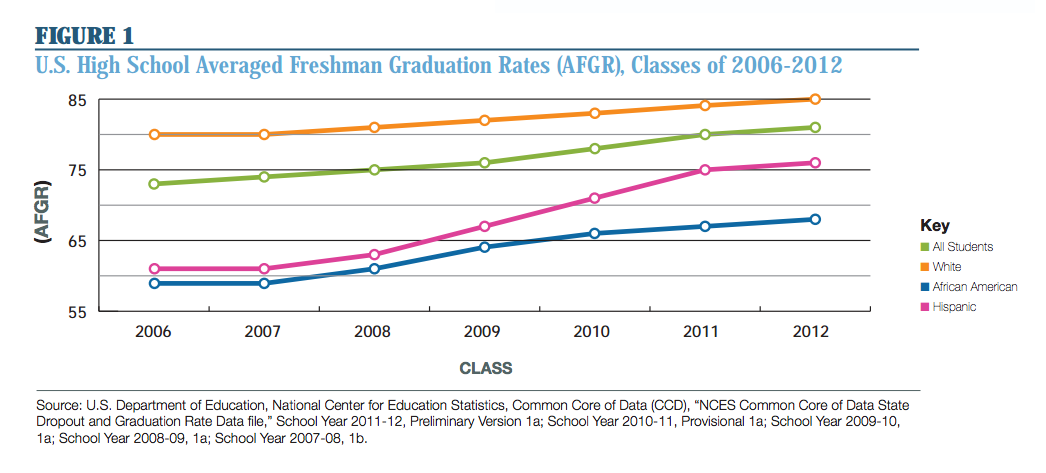
Stephanie Simon reports that the high-school graduation rate in the US has topped 80 percent for the first time in history, and that “if states can keep up their rapid pace of improvement, the rate could hit 90 percent by 2020”:

The improvement has been driven by steep gains among African-American and Hispanic students and by progress in shutting down hundreds of troubled urban schools dubbed “dropout factories.” And it’s not confined to one region of the country. Rural states such as Iowa, Vermont and Nebraska are among the best at keeping kids in school until graduation – but other top performers include Texas, Tennessee and Missouri, all of which serve large numbers of low-income students in densely populated cities. The practical result: Over the past decade, 1.7 million more students received diplomas than would have been expected if graduation rates had remained flat.

However, as the above chart makes clear, not all the news is good:

[W]hile low-income and minority students have made a lot of progress, wide gaps in achievement persist. Graduation rates increased 15 percentage points for Hispanic students and 9 points for African-American students from 2006 to 2012. But only 76 percent of Hispanic students and 68 percent of African-American students graduated in 2012, compared with 81 percent of white students, the report said. …

[In addition,] disparities are still great between special education students in different states. Students with disabilities make up about 15 percent of students nationally and have a graduation rate 20 percentage points lower than the overall rate. In Montana, 81 percent of high school students with disabilities graduated, while in Nevada, only 24 percent did.

Chris Kardish has more on the variations at the state level:

Overall graduation rates in states range from 59 percent in Nevada to 93 percent in Vermont. A number of states are graduating even low-income students above the 80-percent mark, including Texas, Nebraska, Iowa, Tennessee and Indiana. For other states, the graduation rate even among students who aren’t living in poverty stands below 80 percent. Those include Georgia, Louisiana, New Mexico, Arizona, Nevada and Oregon. Tennessee in particular has been a leader in raising graduation rates. The state boosted graduation rate 17 percent from 2003 to 2010 and reached 87 percent in 2012.

(Graph from Building A Grad Nation: Progress and Challenge in Ending The High-School Dropout Epidemic)

The View From Your Obamacare: Job Freedom

The popular thread continues:

You wrote, “When you are a long-term HIV survivor, that kind of health security and independence is, well, priceless.” Take out “long-term HIV” and replace it with “person with diabetes” or “person with a seizure disorder” or “person with a heart condition” and all of us feel that same security and independence and relief that you describe. I’ve had well-controlled diabetes for almost 30 years, which includes President Obama Visits Boston To Talk About Health Caremy entire working life. And for my entire life, I’ve known that I had to get and keep a job that offered a group insurance plan (or be married to someone who had that) in order to take care of myself and be financially stable (i.e., in the middle-class).

So that’s what I’ve done; I worked when my ex-husband was in graduate school (his school coverage didn’t cover pre-existing conditions); I put off having children until he had a job with group insurance; I worked at in the most toxic law firm environment I can imagine for 6 1/2 years because I was divorced and had to provide my own coverage; I finally left when I was hired by the federal government (admittedly, a lot of benefits came with that move, not just good health coverage).

But in the last few months, another sense of freedom has crept up on me and I realize that NEVER AGAIN will I feel trapped by my job as I have for my entire working life.

If I decide to leave the law, I can. If I want to piece together several part-time jobs that that allow me to use my other skills and would provide me with the minimum income, I can do it. It’s all up to me. I have no more excuses. It almost feels like personal responsibility and freedom and adult behavior all wrapped up together. But that doesn’t make sense, because then the Republicans would be all for it, right? I am so thrilled that Obamacare exists and I use the name proudly whenever I can. Another meep-meep for the ages!

Another also quotes me:

[The ACA’s] assurance of a stable insurance market that does not screen out someone with a pre-existing condition made me far more comfortable starting my own business. It gave me a baseline of security that simply didn’t exist before. It helped make entrepreneurialism possible.

Amen. I live in Silicon Valley.

As dynamic as this place is, I can’t tell you how many former colleagues have stayed in jobs just for the benefits. I really don’t understand why employers don’t want to get out of the healthcare business. It’s not a core competency and it’s nothing but a headache. This American Life had a story about how medical benefits became a way to lure workers during the WWI’s government-mandated frozen wages.

I’m currently in a struggling startup with no benefits. I have them through a partner, so I’m one of the lucky ones. I wonder how much innovation is being locked up by employer-based healthcare.

Another has part-time job freedom:

I am a 27-year-old freelance photographer and writer who works in the skateboard industry. I’m also a semi-professional downhill skater. It’s pretty much my dream job, and I wouldn’t have been able to chase it down without Obamacare. The ability to stay on my parents’ insurance until I was 26 gave me the freedom to move across the country and participate in a risky physical activity without fear of financial ruin. Later, when I aged out of my parents’ insurance, the lower premiums made it possible to afford insurance, without which I could not skate. (Thankfully, my sponsors pay for it.)

If the ACA hadn’t passed, I would be working a boring, stable office job instead of traveling the world pursuing my creative passion. Obama disappointed me on civil liberties and accountability for torture, but the Affordable Care Act has made a real and important difference in my life.

And this reader has freedom from jobs altogether:

I got health insurance through Covered CA. I’m 64 and Obamacare allowed me to retire a year earlier. Before Obamacare I would have been uninsurable and have to keep working to get employer-based coverage. I worked as an RN for 38 years and was wearing out fast. It’s the best thing that could have happened.

(Photo by Yoon S. Byun/The Boston Globe via Getty Images)

Dirty Dreams And Reproductive Schemes

WLA_moma_Henri_Rousseau_The_Dream

Neurologist Patrick McNamara believes our nighttime reveries are “directly related to long-term sexual strategies”:

If dreaming somehow reflects our sexual wish-fulfillment, then dream recall, dream content and dream sharing should be relatively lower in those who are satisfied with their current attachment orientation (secure, dismissive, and avoidant) and relatively higher among those who want to change their status (the preoccupied/anxious group). To test this idea, my team at Boston University recruited hundreds of volunteers until we had enough in each attachment category. We asked them about their dreams, and coders who were blind to the purpose of the study painstakingly analyzed them.

When we collated the results, we were startled by what we found.

The anxious, preoccupied group was far more likely to recall dreams than the securely attached; they took less time to enter REM sleep and had many more dreams featuring aggression against competitors. But both the anxious and the securely attached recalled more dreams than avoidant participants. That is precisely the pattern one would predict if dream sleep were directly related to long-term sexual strategies. The anxious individual is passionately interested in getting into a relationship with a romantic target, and thus recalls more especially vivid and emotional dreams filled with content concerning intimacy. The avoidant individual, conversely, suppresses the subconscious call for sexual closeness as reflected in dreams.

(Henri Rousseau’s The Dream, 1910, via Wiki Commons)

Diagnosed With Homelessness

Bryan Walsh spotlights a study on the correlation between traumatic brain injuries (TBIs) and homelessness:

Jane Topolovec-Vranic, a researcher in trauma and neurosurgery at St. Michael’s Hospital in Toronto, surveyed 111 homeless men recruited from a city shelter to see whether they had suffered a TBI sometime in their past. She found that 45% of them had experienced a traumatic brain injury at some point in their life. (Sadly, most of her subjects’ TBIs resulted from assault.)

“You could see how it would happen,” she says. “You have a concussion, and you can’t concentrate or focus. Their thinking abilities and personalities change. They can’t manage at work, and they may lose their job, and eventually lose their families. And then it’s a negative spiral” — a spiral that, for the men in Topolovec-Vranic’s study, ends up in a homeless shelter.

Charlotte Lytton adds:

The findings are important in demonstrating that homelessness can often be created by medical—as opposed to lifestyle—deviations. “Recognition that a TBI sustained in childhood or early teenage years could predispose someone to homelessness may challenge some assumptions that homelessness is a conscious choice made by these individuals, or just the result of their addictions or mental illness,” Dr. Topolovec-Vranic explains.

The Best Of The Dish Today

First up: our monthly update on the independent Dish. We’re now at 28,532 subscribers, edging toward 30,000. In the twelve months since last April 30, we have had revenue of $900K for the first time. So we hit our target four months’ late, if you’re not counting affiliate income. The merch moment is looming fast, so stay tuned for t-shirts and mugs. And we’re moving toward putting some form of video ads on the site for non-subscribers, even as we remain completely committed to an ad-free site for subscribers. So if you want to avoid seeing any ads ever, you know what to do. Subscribe!

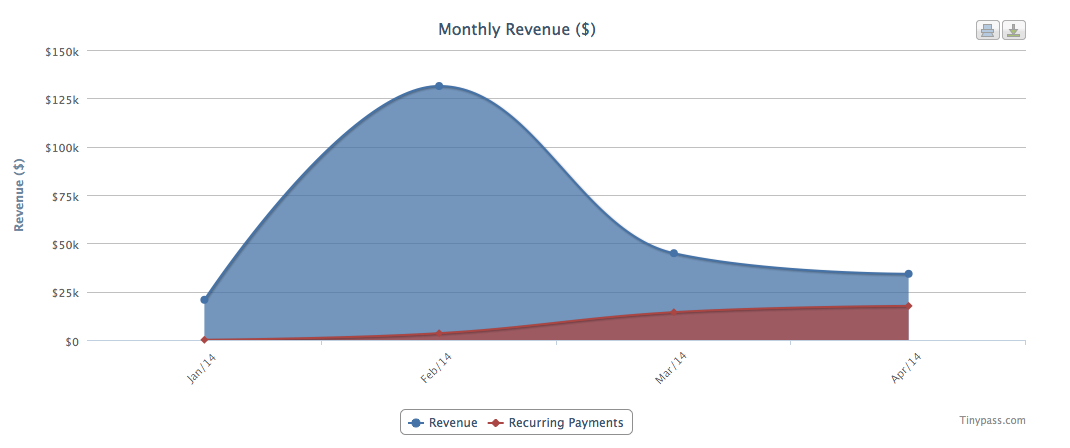
Here’s a graph of our revenue for the past three months:

Screen Shot 2014-04-30 at 2.54.24 PM

The big hump is the second wave of newly subscribed Dishheads, renewing after one year. The red line is for recurring payments, either monthly or annually, and April’s total intake was a little over $34,000. Over time, the red proportion should grow and grow. As for traffic, well over a million individual people read something on the Dish in April, our third best month in the past year. The two most popular posts in April were “The Hounding Of A Heretic” and “Jo Becker’s Troubling Travesty Of Gay History.

As you can see, our revenue remains comfortably above last year’s – but not by much. As a consequence, we simply don’t have the budget to commission, edit and nurture long-form journalism by non-staffers just yet. So the full potential of Deep Dish will have to wait a bit. But with our extra revenue, we have been able to hire two interns as staffers, Tracy and Jonah, and use their skills to deepen the regular Dish. You may have noticed that our aggregation has become much more comprehensive of late. Take a post from today on Donald Sterling. It has eleven very-gradual-changeseparate voices adding to the debate, a majority of them after the jump, both from the blogosphere and the in-tray. That follows a post with seven voices; and a personal grilling on the comparison with the Eich case. Our reader threads are also longer and deeper than in the past – again, primarily visible after the jump. Our thread on Truvada and the potential of a pill to prevent HIV-transmission was in many ways more informative than a long essay – with eight separate posts, including my views, Dave Cullen’s input, and many readers. Also, rather than let small reader comments – ones that wouldn’t necessitate a new post – fall by the wayside, we’ve been adding them as updates more and more, in order to feature as much of your input as possible. Even the window contest is getting beefed up. And don’t forget the resuscitated Book Club, which adds another layer of depth to the Dish experience – and the affiliate revenue helps pay for it.

So we’re focusing on making the Dish itself deeper until our budget grows to accommodate more commissioned pieces. But I’m still at work on one long-form essay and planning more. More podcasts are scheduled. Our goal is to do more and more to reward subscribers. But we remain committed to gradual evolution rather than big sudden leaps. It has served us well over the last fourteen years, and we see no reason to change course now.

As far as today, our most trafficked posts were Sarah Palin: Anti-Christian and John Kerry Tells The Truth … Therefore He Must Apologize (the latest here). Other popular posts included a documentary about sounding gay and a roundup of reaction to last night’s botched execution. In better news, millennials seemed to be turning against both sponsored content and male genital mutilation. Your moment of Bowie here.

Updates you might have missed: readers debated the fairness of Sterling getting fined $2.5 million dollars for his bigotry, more readers in the banking industry provided their expert take on the crackdown on porn-star accounts, and yet more readers added to the debate over Jesus’ apocalyptic views.

Thanks again for being the best readership any bloggers could ask for – and sustaining this enterprise unlike any other on the web. Thanks to you, we are truly independent, and our business model is not aiming for a future moment when we will (somehow) break even. We are breaking even. And we’re doing that without ads yet! That’s something we’re proud of. As you should be too.

So see you in the morning.

Is The Death Penalty On Its Way Out?

Death Penalty

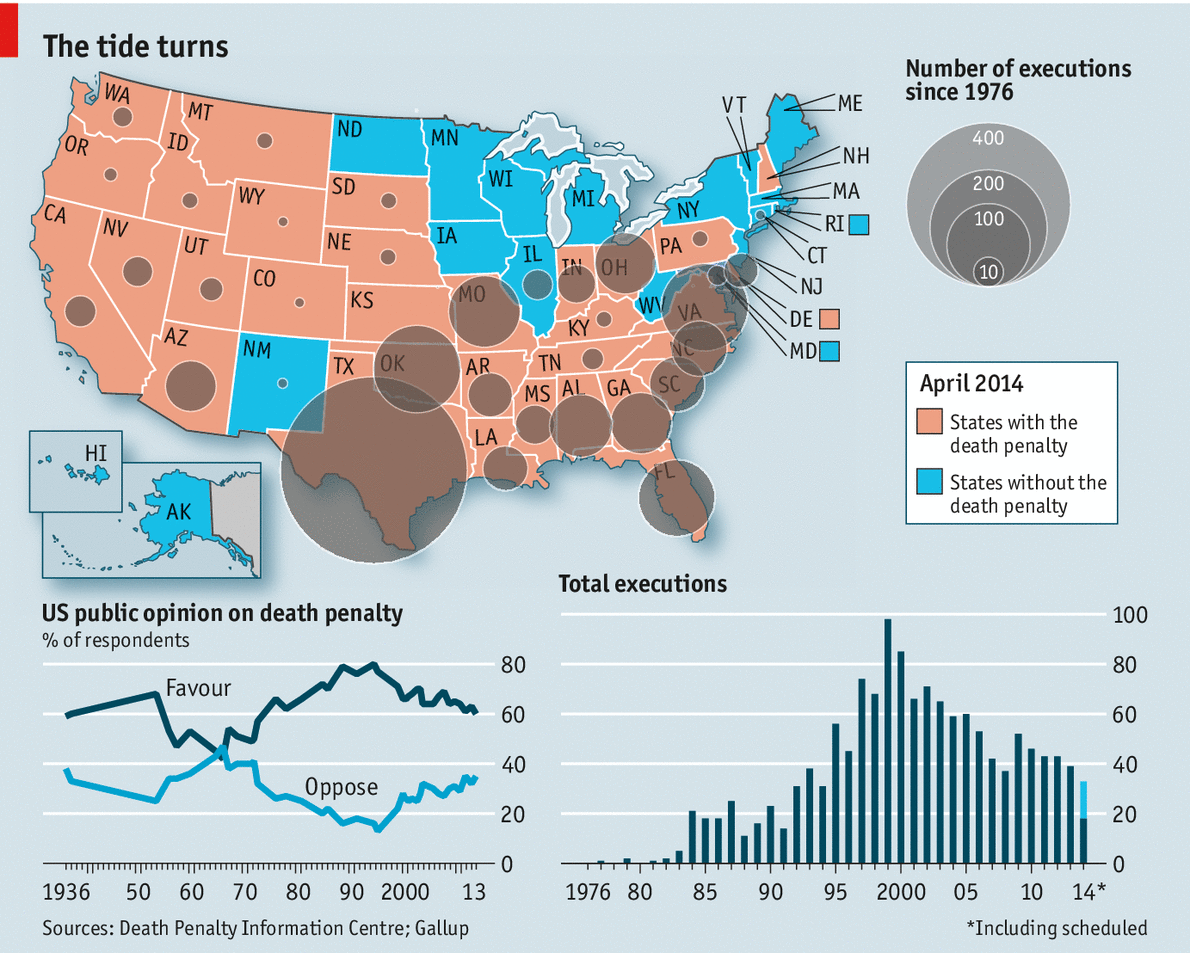
Here’s hoping. The Economist examines US capital punishment trends:

Even if all the executions scheduled for this year are carried out—which is unlikely—a total of 33 would be the lowest since 1994, and would have fallen by two-thirds from the peak of 98 in 1999 (see chart). In 2013 American juries handed out just 80 death sentences: a slight increase from the previous year, but still close to the lowest level in 40 years. As of October 1st 2013, 3,088 Americans were on death row—down from a peak in 2000 of 3,593.

Update from a reader:

The Economist‘s chart fails to note that many of the states listed as still having the death penalty have actually instituted moratoria. Those states include: California, Colorado, North Carolina, Arkansas, Oregon, Kentucky and Washington.

An accompanying piece from the magazine has more on the subject:

America is unusual among rich countries in that it still executes people. It does so because its politicians are highly responsive to voters, who mostly favour the death penalty. However, that majority is shrinking, from 80% in 1994 to 60% last year. Young Americans are less likely to support it than their elders. Non-whites, who will one day be a majority, are solidly opposed. Six states have abolished it since 2007, bringing the total to 18 out of 50. The number of executions each year has fallen from a peak of 98 in 1999 to 39 last year …

Its advocates insist that it deters murderers, thereby saving lives. If this were true, it would be a powerful argument, but there is scant evidence that it is. The murder rate is far higher in America than in the European Union, which has no death penalty. It is also higher in American states that carry out executions than in states that do not. Granted, some studies have found that, if you control for other factors that also influence crime rates, you can make the case that each execution prevents three murders, or five, or even 18. But such studies are based on thin data and questionable assumptions. There were nearly 15,000 murders in America in 2012. The chance of any individual killer being executed is thus microscopic—and distant, since the appeals process can grind on for decades.