One In 25

That’s how many prisoners on death row are likely innocent, according to a new study. Dara Lind explains:

At least 4 percent of people who receive death sentences in the United States are likely innocent, a new study finds. The paper, in the Proceedings of the National Academy of Sciences, borrows a technique from biomedical research to estimate the number of prisoners sentenced to death who are falsely convicted. The study, by Samuel R. Gross of the University of Michigan and Barbara O’Brien of Michigan State University, finds that at least 4 percent of people who get sentenced to death when they’re convicted would ultimately be exonerated if their cases were closely examined for the next 21 years.

That doesn’t just include current death row inmates: many people who initially get death sentences end up getting their sentences reduced to life in prison. And no prisoner serving a life sentence gets the same level of scrutiny as someone on death row. For this reason, the authors conclude that the rate of false convictions in life-imprisonment cases is probably much higher.

Virginia Hughes elaborates on the study:

Gross and his colleagues collected data on the 7,482 people who were sentenced to death between 1973 – the first year of modern death-penalty laws – and 2004. Of these, 117 were exonerated, or 1.6 percent. But among these, 107 were exonerated while they were still on death row, whereas only 10 were exonerated after their sentence had been reduced to life in prison. This leads to a bizarre situation. If you’re on death row and your sentence is reduced to life in prison, you’re suddenly much less likely to be exonerated than someone who stays on death row.

Steven Hsieh shakes his head:

The study refutes much lower false conviction rates cited by judges and lawyers in the past. Perhaps most notably, Supreme Court Justice Antonin Scalia suggested in 2007 that the wrongful conviction rate is “.027 percent—or, to put it another way, a success rate of 99.973 percent.”

“This would be comforting, if true. In fact, the claim is silly,” Gross writes. “Scalia’s ratio is derived by taking the number of known exonerations at the time, which were limited almost entirely to a small subset of murder and rape cases, using it as a measure of all false convictions (known and unknown), and dividing it by the number of all felony convictions for all crimes, from drug possession and burglary to car theft and income tax evasion.”

SCOTUS Allows The EPA To Do Its Job

Serwer highlights some good news for environmentalists coming out of the court yesterday:

Environmentalists scored a big win at the Supreme Court Tuesday when the high court upheld an Environmental Protection Agency rule meant to reduce interstate air pollution. Chief Justice John Roberts and Justice Anthony Kennedy sided with the high court’s Democratic appointees. …

States are obligated to meet certain emissions standards under the Clean Air Act, but sometimes pollution from neighboring states affects their ability to meet those standards. Those upwind states are supposed to adopt practices that prevent their pollution from affecting downwind states. That pollution can be nothing short of lethal, a brief filed in the case from the American Thoracic Society noted that “Air pollution measurably and substantially shortens lives.”

Rebecca Leber explains why this matters:

Simply put, the Supreme Court has effectively helped save lives.

The EPA estimated that the rule in question would prevent up to 34,000 premature deaths, 15,000 non-fatal heart attacks, 420,000 respiratory symptom cases, and 400,000 aggravated asthma cases each year, mostly in the states that bear the brunt of the cross-state pollution. With this rule and other EPA air quality regulations still on hold, national air quality has actually grown worse. According to the American Lung Association’s State of the Air report, almost 150 million people breathe unhealthy air in 2014, an increase of 16 million since 2013.

Chait looks to the battles ahead:

The Clean Air Act simply requires the cleanest feasible technology, which would require shuttering all coal-burning plants, imposing huge costs. The EPA wants to tailor its standards to curtail emissions without a blunt-force ban on coal.

Whatever plan emerges will venture onto newer legal ground. Conservatives have adopted the paradoxical strategy of denying the EPA any flexibility to craft regulations, the theory being that forcing it to issue only massively expensive (and therefore politically toxic) regulations will result in them being overridden. Conservative suits to bring about such a result are already heading toward the Supreme Court.

Yesterday’s ruling, which concerns different sections of the Clean Air Act, provides some clues to the Court’s disposition. And for those of us uncomfortable with unleashing runaway temperatures upon future generations, those clues seem encouraging.

Cutting The Tornado Body Count

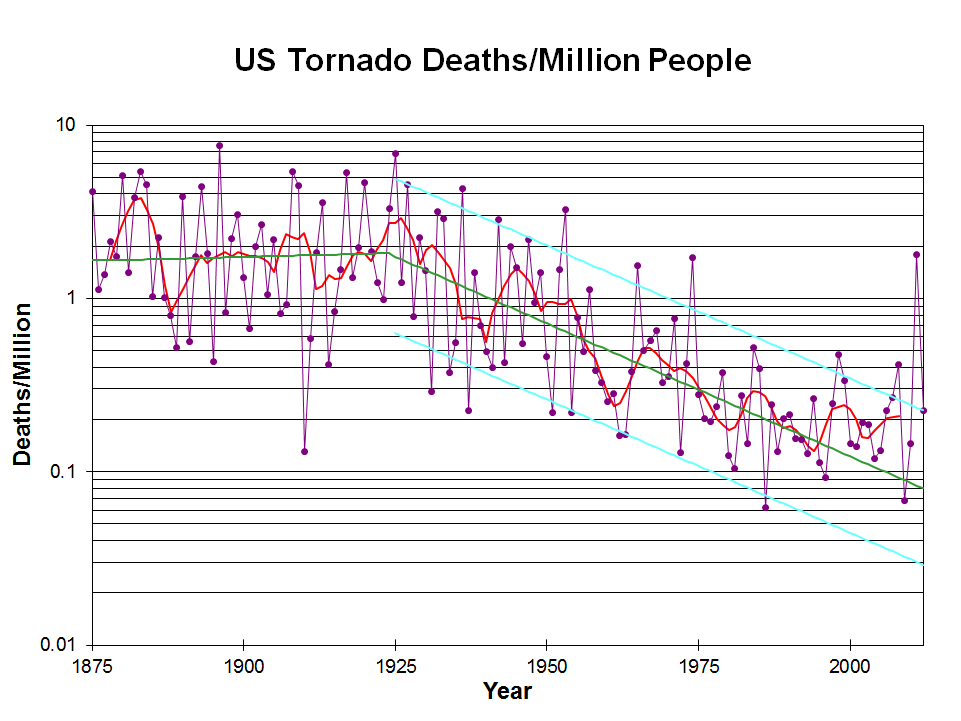
Tornado Deaths

After the recent spate of tornados, Plumer takes a close look at when twisters kill:

The chart above comes from Harold Brooks of the National Oceanic and Atmospheric Administration (NOAA). Even though more and more Americans are living in areas where twisters roam, the number of tornado deaths per capita has declined in the last century.

One reason? Better early warning systems. Back in the 1980s, forecasters could only give about five minutes warning before a tornado hit, on average. Today, that’s up to around 14 minutes, thanks to new radar systems and better forecasting. That gives people more time to seek shelter.

But improving warning times to a full hour might not lower fatalities:

[I]f people do seek shelter for an hour and the warning turns out to be false, that may make them far more skeptical of future warnings. [Economist Kevin] Simmons’ research has found that areas with more false tornado alarms have higher levels of fatalities when twisters do hit — presumably because people ignore the warnings.

Chris Mooney wonders whether climate change will mean more or bigger tornados:

[I]t would be very premature to say that scientists know precisely what will happen to tornadoes as global warming progresses. However, they have come up with some interesting new results, which point to potentially alarming changes. More generally, the upshot of this research is that tornadoes must change as a result of climate change, because the environments in which they form are changing.

And Allison Kopicki finds that people don’t plan well for tornadoes:

Despite past encounters with extreme weather and expectations for more, nearly 6 in 10 of those in the South and more than 7 in 10 in the Midwest said they had not created a disaster plan that all of their family members knew. More Southerners (44 percent) than Midwesterners (27 percent) said they had created an emergency supply kit.

Money Shot Down

Massoud Hayoun reports that JPMorgan Chase has closed “hundreds” of porn performers’ bank accounts in just over a week:

Numerous porn actors have reported that they received no clear explanation of why their accounts were closed. “Out of left field we got a notice our two personal and two business accounts were being closed,” said Joshua Lehman, the husband and former manager of ex-porn actress Teagan Presley. Lehman said that branch and telephone bankers told him it was “because of our industry,” but staff at corporate headquarters “categorically denied this” and gave no reason for their decision. … Presley agreed with her husband, adding that a customer support representative on the phone said her account posed a risk but wouldn’t specify how. “I think it’s crazy that in 2014 that you wanna give a bank money and they won’t take it. Who doesn’t want money?”

Hayoun notes that Chase of course has no compunction taking cash from porn consumers. One performer is suing the bank for closing her account. But Lux Alptraum points out:

As a private bank, Chase is, of course, within its rights to deny accounts to whomever it chooses as it sees fit.

But there is still something disturbing about a major bank choosing to deny its services to an entire industry. Should other banks decide to follow in Chase’s footsteps, thousands of legitimately employed people and legal businesses could be cut off from one of the bedrock institutions of American society – and, as our nascent legal marijuana industry has shown, a business that cannot get access to banking services is a business that cannot function as a part of legitimate society.

Andrea Garcia-Vargas adds:

Sadly, none of this is particularly surprising as this is not the first time Chase Bank has attempted to deny services to businesses dealing with sex or sexuality. Mark L. Greenberg, founder of a softcore porn studio, even filed a lawsuit against Chase after they refused to allow him to refinance a loan, allegedly because of his job. And more recently, Tiffany Gaines, the CEO of Lovability, ran into trouble with Chase when the bank refused to process her payments – all because she was selling condoms. When reached for comment by Gaines, a Chase representative told her “processing sales for adult-oriented products is a prohibited vertical.”

However, Mary O’Hara suggests the DOJ could be responsible for Chase’ move:

[N]ews is slowly surfacing that shows the US Department of Justice may be strong-arming banks into banning porn stars. It’s called Operation Choke Point, and it has nothing to do with deep-throating. Instead, it’s a targeted effort to shut down as many as 30 separate industries by making it impossible for them to access banking services. In a Wall Street Journal op-ed Thursday, American Bankers Association CEO Frank Keating wrote that the Justice Department is “telling bankers to behave like policemen and judges.”

“Operation Choke Point is asking banks to identify customers who may be breaking the law or simply doing something government officials don’t like,” Keating wrote. “Banks must then ‘choke off’ those customers’ access to financial services, shutting down their accounts.” Keating said the highly secretive operation was launched in early 2013. That’s when porn stars started to complain to the media that their bank accounts were being shut down without explanation. And while the actors are quick to blame banks like Chase and Bank of America for discrimination, those institutions may in fact have no choice.

Update from a reader:

The DOJ operation is without question behind Chase’s decision to cancel accounts belonging to folks in the porn industry. What I find interesting is that these are their personal accounts. I work for a bank and we’re doing this exact same thing – in fact, I spent no less than three hours today working on our crisis communication plan for when we cut off payday lenders, tobacco companies, etc from receiving commercial loans from the bank for which I work. We’re tiny compared to Chase, yet still disentangling ourselves from certain industries.

That said, we are not planning to quit providing personal banking services to owners or employees in these industries.

Another:

I work in the Anti Money Laundering department of a top 10 bank and I’m responsible for closing lots of accounts for unusual and illegal activities. The fastest ways to get an account closed is doing strange things with cash, sending wires to and from countries with lots of criminality, or dealing with Nigeria. In my business the likelihood of a Nigerian doing something illegal with their money is about the same as finding an honest politician. No joke.

This is the first thing I’ve heard about closing porn accounts. Not something my bank is on the lookout for. In fact, FINCEN (the guys who monitor banks for money laundering activity) just put out guidance for banks on how to bank legal pot businesses. I never thought I’d see the day that happened.

The main entities that are weighing on the banks are all from Treasury. I can only think of one time a DOJ employee made my life harder. Perhaps the most important thing to remember about Chase is they just got hit with a $2 billion fine for weak AML procedures. Biggest fine in history for AML issues. They may be overzealous to prove to their regulators that they are with the angels, because their next fine will REALLY hurt.

Yet Another Late-Night Shakeup

On the heels of Letterman’s announcement that he’s retiring next year, to be replaced by Colbert, as well as Leno’s exit, The Late Late Show‘s Craig Ferguson is also giving up his seat:

The Late Late Show formed part of Letterman’s own contract. Because the two shows were produced by the same company, one has to wonder if CBS were only holding onto Ferguson till Letterman left. But on the Monday show’s cold open, Ferguson dispelled rumors he was kicked out: “About two years ago,” he said, “I had decided after eight years … that it was probably time for me to move on and do something else.”

Eric Deggans weighs Ferguson’s contributions to the late-night genre, which he disrupted much as Letterman did:

He never had a backing band – in part, early on, it was likely a money thing. But even after CBS upgraded his studio, Ferguson avoided the bandleader sidekick and live music, instead trading banter with a skeletal robot and with two people in horse’s costume. Really.

As interviews began with guests, Ferguson would symbolically rip up his blue note cards as a way of signifying that what was coming wasn’t really planned. Sometimes, that brought a lot of empty riffing with a celebrity who just couldn’t keep up. But sometimes, you got this (warning: parts of this are a little NSFW). …

Small wonder that more traditional shows hosted by Jimmy Fallon and Seth Meyers beat The Late Late Show in ratings. And it’s also no surprise that Ferguson might get tired of re-inventing the form every night and just move on (he already has his next TV gig lined up: hosting his syndicated game show Celebrity Name Game). Beyond hoping they don’t hire yet another white male, I’m crossing my fingers that CBS succeeds Ferguson with someone just as willing to blow up conventional ideas of what a late night talk show can and should be.

David Sims admires Ferguson’s approach to comedy as well as his serious moments:

His only Emmy nomination for the show came from the 2006 eulogy he delivered for his father, who had died the previous weekend [see the above video; Part 2 here]. Even though Ferguson has always been a candid and open performer, it was still a beautiful moment, one of those rare times on television when a performer seems as personally close as a family member.

Ferguson, a recovering alcoholic, was also resolute in which targets he would pick for mockery in his opening monologue, and shied away from criticizing celebrities who had similar substance abuse problems or were obviously going through profound suffering in public. It’s a tough line for any comedian to walk, and Ferguson would probably be the first to admit he broke his own rules, but his willingness to discuss the issue also set him apart from other late night hosts.

Poniewozik refrains from speculating over who will replace him and instead suggests that CBS put something entirely different in The Late Late Show‘s time slot:

Ferguson’s audience was small but intense, but for many others, late-night only exists as a kind of cultural proxy. There should maybe be a punch-card system, in which you need to show proof of having actually watched 20 full talk-show episodes in a year before venturing a heated opinion as to who hosts one. As a colleague once told me back during the Jay/Conan disaster, “I don’t really watch Conan, but I like to know that he’s there.”

So people will debate, again, who should host CBS’s late-late show, but there’s a good argument that we don’t need the show at all–not, anyway, a show with a monologue, a house band, two interviews and a musical guest. CBS might do much better creating a program to reach some part of the vast, vast audience that does not watch talk shows, period.

Can Cops Search Your Smartphone?

The Supreme Court heard arguments yesterday in two separate cases addressing whether the Fourth Amendment’s protection against unreasonable searches and seizures extends to the contents of your cell phone. Sarah Gray sums them up:

The two cases being heard are on opposite ends of the spectrum. The first is Riley v. California. In 2009, David L. Riley had an expired car registration, and was pulled over in San Diego. Police also found two loaded guns and text messages that associated him with a gang. A further search of the phone linked him to an attempted murder. He was convicted and received 15 years in prison. Both the guns and phone were found without a warrant; a California appeals court ruled that the search was like going through a person’s wallet or address book and did not require one.

The second case is United States v. Wurie. Brima Wurie was arrested in Boston in 2007 on drug and gun charges. Officers searched his flip-phone’s call log without a warrant. A Boston federal appeals court threw out the cellphone records as evidence. Judge Norman H. Stahl wrote, “Today, many Americans store their most personal ‘papers’ and ‘effects’ in electronic format on a cellphone, carried on the person.”

Dahlia explains the court’s dilemma:

The problem for the court today is that they don’t much like the prospect of allowing the cops to search jaywalkers’ cellphones for evidence of anything bad they’ve ever engaged in. Even Justice Scalia conceded that for someone arrested simply for driving without seat belts, “it seems absurd that they should be able to search that person’s iPhone.” But at the same time, the justices also don’t want to hamstring the police who claim that if they can’t search cellphones, they will be in danger, and major crimes will go unsolved.

Serwer was unimpressed with the court’s tech savvy:

“Could you have a rule that the police are entitled to search those apps that, in fact, don’t have an air of privacy about them?” Chief Justice John Roberts asked. “What about something like Facebook or a Twitter account? There’s no real, there’s no – any privacy interest in a Facebook account is at least diminished because the point is you want these things to be public and seen widely.”

Roberts seemed confused by the difference between being able to see a public status update or a tweet and having direct access to a password-protected social media account through a mobile device – perhaps Anthony Weiner could enlighten him.

Noah Feldman hopes the justices insist on warrants for cell phone searches but fears they will settle for something less:

The court’s conservatives seemed very interested in the rule proposed by the office of the solicitor general, which is that the police should be able to search a smartphone without a warrant in order to find evidence relevant to the crime for which a person is being arrested.

On the surface, the proposed rule has some mild appeal. It certainly responds to Justice Scalia’s concern that every arrestee for any crime, no matter how small, could find his or her entire life’s data reviewed and logged into a single government archive. The trick would be figuring out how to limit a data search to information related to the cause of arrest. … As Justice Elena Kagan put it, “It sounds good as a limiting principle, but it ends up you can imagine in every case that the police could really look at everything.”

But that, as Amy Howe explains, wasn’t the only middle-ground rule proposed yesterday:

DuMont and Justice Alito, for example, suggested that a warrant should not be required as long as police are only looking at information – like a photograph – that is analogous to something that police could have searched in the pre-digital era.  But Justice Kagan objected that such a rule would actually exclude very little, noting that almost everything on a cellphone “could be reduced to a piece of paper.”  And Justice Stephen Breyer similarly noted that there is very little data on cellphones that wouldn’t have an analog from the pre-digital era, telling DuMont that the real problem is the quantity of data found on modern cellphones, which far outweighs the quantity of papers and photos that most people would carry around with them. …

And Justice Anthony Kennedy proposed yet another possible middle ground:  whether police can search an arrestee’s cellphone without a warrant would depend on whether the crime for which the individual was arrested was a serious or non-serious offense.   Having made that suggestion, though, Kennedy himself immediately expressed doubt about whether the Court’s cases would support a distinction between serious and non-serious offenses.

Orin Kerr points out that creating such a middle-ground rule is easier said than done:

[T]he Justices still have significant work to do in crafting a new rule, and not a lot of time in which to do it. If you go with a bright-line rule, the opinion pretty much writes itself; the choice of the bright line rule makes the decision easy to craft. But the middle-ground approach involves lots of different possible variables, with hard choices to be made among which variables should matter and how. That makes it tricky to craft, especially in a tight time window. To make things harder, there aren’t many examples of middle-ground answers from the lower courts. The only middle-ground approach that I recall from the lower courts was Judge Posner’s opinion in Flores-Lopez, which wasn’t necessarily a successful effort.

Brianne Gorod expects Scalia to come down, as he has in other recent cases, on the side of strong Fourth Amendment protections:

There should be little doubt about what Scalia will say about these searches. He has become a regular champion of the Fourth Amendments protections against “unreasonable searches and seizures.” In Navarette v. California, Scalia disagreed with the court’s conclusion that the police could lawfully stop a car after a woman anonymously called 911 and reported that the car had driven her off the road. Scalia wrote that such stops were not the constitutional framers’ concept of a “people secure from unreasonable searches and seizures.”

And in Maryland v. King, a case decided last term, Scalia disagreed with the court’s conclusion that the police may lawfully take a cheek swab of someone’s DNA after he or she has been arrested for a serious offense. He expressed “doubt that the proud men who wrote the charter of our liberties would have been so eager to open their mouths for royal inspection.”

For Sullum, however, this is not a tough call:

The truth is that Court’s rules for arrest-related searches have been needlessly deferential for decades. Preserving evidence and protecting officers from hidden weapons were the two original justifications for making an exception to the warrant requirement. But neither of those goals requires reading detailed information about an arrestee, whether it is stored on a cellphone or in a notebook. Barring far-fetched emergencies, there is no legitimate reason why police, having secured such evidence, cannot go to the trouble of getting a court order authorizing them to examine it. That point is especially clear in the case of cellphones and other portable electronic devices, which routinely contain just the sort of private information the Framers meant to protect when they banned unreasonable searches of people’s “papers” and “effects.”

Book Club: Apocalypse Then

A reader writes:

Beyond all the crap about resurrection, Jesus was an apocalyptic preacher who predicted the end of the world would come very soon, probably in his own lifetime. And that realization colors how I view Jesus’ most important message.

I am not a Christian. But my religious identity has nothing to do with belief (what do I know?) and everything to do with the way I live my life. The only parts of the New Testament that I admire are Jesus’ parables and his teachings. Leave your family. Give up material things and live in poverty. Don’t worry about tomorrow. Don’t show off or try to be better than others. This is radical stuff – a lifestyle I respect, but am too cowardly and weak to pursue. Therefore, I do not call myself a Christian, because I cannot live up to Jesus’ commands. And as far as I’m concerned, anyone who doesn’t live like Jesus (i.e. a vagabond) has no right to call himself a Christian.

So a big thought hit me hard: Jesus’ unique and radical teachings only make sense because he was an apocalyptic preacher. Leave your family and pay no attention to tomorrow because the world is about to end. In the context of the end of the world, it all makes sense. Of course you should abandon material things; they’re all about to be wiped away.

So now I’m left with this conundrum: Jesus’ teachings only work against a background of imminent destruction. AND, obviously, the world did not end. Does that then invalidate his teaching? Without the apocalypse at the foundation of Jesus’ ministry, aren’t we badly misinterpreting what he really meant?

We’re certainly avoiding a rather obvious point: one of Jesus’ most emphatic predictions in his lifetime was wrong. Dead wrong. Now you can try and elide this by insisting that he didn’t put a date on the end of the world, but that ignores the urgency of his warnings. Does that invalidate Jesus’ teaching, as my reader suggests? Well, the first thing to say is that Christianity spread rapidly even as its main prediction turned out to be wrong. And, as Ehrman notes, it seems that the reality of the belief in the resurrection is what galvanized and sustained this religious movement after its guru’s untimely and dishonorable death. The resurrection occluded the failed prophesy.
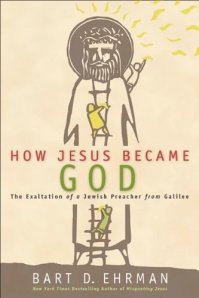
how-jesus-became-godDoes that in turn render the radicalism of Jesus’ calls for total poverty, homelessness and suffering less powerful? I’d say it makes them more powerful. They become less a last-minute preparation for the end-times than a deeper and more radical critique of worldliness in all its forms. They become less a means to an end, and more an end in themselves. And Jesus taught these things, in the Gospels, without constantly referring to them as mere end-times necessities. Power over others is to be foresaken as an eternal truth about human life; wealth is an obstacle to happiness; what matters at all times is being present to others and to God, not running around with this goal or that; forgiving makes you happier than bearing grudges; revenge only perpetuates the cycle of hatred, rather than breaking it. All of these counter-intuitive ideas are our true destiny as humans if we can only master them. They are the only sure means to internal and external peace.

Now, of course, other religious traditions speak of similar things. You can see in Buddhism, for example, the insight that possessions hurt rather than help. You can see in Taoism the wisdom of letting go, of seeking peace by striving for less. And all of these impulses – which contradict what we now understand as our evolutionary nature – transcend “the restless desire of power after power, that ceaseth only in death.” This profound insight – the early Christians believed – didn’t come from within us, but somehow from above us. And a person who walks this Bronzino-Christ-Nicewalk is indeed living as close to divinity as human beings can get.

This insight is perhaps encapsulated by the word logos, a form of divine wisdom about how to be happy and at peace through the law of love; and it is easy to see why Jesus’ life and example came to seem to his subsequent followers an incarnation of this logos, which of course is eternal. And Jesus’ decision to embrace his own torture and death with stunning equanimity and compassion represented the pinnacle of that divine achievement. How many of us could forgive those driving nails into our body? How many would stand by and say nothing when we are accused of something we never did? The Passion narrative is crafted to show how deeply Jesus walked the walk. It is by giving that we receive. It is by forgiving that we can be forgiven. Even in extremis. We will all die some day – which is our own looming apocalypse. And the only true way of grappling with that is through Christ’s logos.

Another reader:

I want to ask, (1) can a believer truly be open to evidence that Jesus, perhaps at one part of his life, said and believed things very different from what we normally attribute to him, and (2) can one – can a Christian – be open to the idea that, in these early beliefs at least, Jesus was wrong?

Take the body of assertions from Chapter 3 [in Ehrman’s book] about Jesus as an itinerant apocalyptic preacher.

I have heard such descriptions of John the Baptist and Jesus previously, but this is perhaps the first time when the sheer weight of these statements hit home. Ehrman’s evidence – supported by his criteria of independent attestation and dissimilarity – helped me to appreciate just how often the texts focus, as a whole, on judgment, on punishment, on reversals of ultimate fortune, and especially on a rhetoric of fear (and joy) in the face of an imminent end.  This vision of Jesus’ early and perhaps entire ministry seems as well founded as anything in the book.

But if you accept that we can indeed have a sense of what Jesus said and what Jesus meant by his apocalyptical proclamations – if we can get a sense of what these word meant in their historical and textual context – then how can this not have an effect on what one thinks of Jesus?

Sheep and goats; burning and wailing; shame and sinfulness; and the righteousness of new and better judgment: these are words that embody, for me, not an abiding love of humanity, but a mainly a hatred of sin. They do not promise to redeem creation, but rather revel in visions of un-creation, of joyous destruction.  These pronouncements do not so much love justice as much they enjoy imagining the punishment of injustice.  In loving God, this Jesus hates the world.

As a historical fact and a textual interpretation, this reading may be correct or incorrect.  But what if, on the whole, it seems right? What can one, as a Christian, do with these words and feelings?

We can balance them, I’d say, by other words and feelings, and see what was truly radical and new in Jesus’ teaching about how to live and die independently of the apocalyptic vision. But we cannot ignore that side completely. Jesus, Christian believe, was both fully human and fully divine. The human part was bound up in the culture and history of his time, its apocalyptic background, and its roots in Jewish scripture. The divine part escaped that. To believe in the Incarnation requires one to accept both, and to live with a Jesus we will never fully master and never totally understand.

(Read the whole Book Club thread on How Jesus Became God here. Please email any responses to bookclub@andrewsullivan.com rather than the main account, and try to keep them under 500 words.)

Update from a reader:

It seems to me a big reason Christianity spread after Jesus’ crucifixion and resurrection, and the coming of the Holy Spirit, is that his followers began to reexamine his apocalyptic predictions in light of their post-Pentecost experiences. They understood “the age to come” to have actually begun – an age defined by the upside-down Kingdom Jesus had announced in his teachings, in which the last were now first, the greatest were those who served, and Jesus – not the Caesar whose government had put him to death – was Lord. The apocalyptic signs were all around them: “I will pour out my Spirit upon all flesh, and your sons and your daughters shall prophesy, and your young men shall see visions, and your old men shall dream dreams” (Acts 2).

They had no reason to disbelieve Jesus on account of his prophecies not coming true; they were now living in the new age he had predicted would come.

Another:

Enjoying this thread. There are other interpretations of Jesus’ prophetic “mistake” about the literal end of the whole world, which does seem like a pretty big paradox for literalists. Instead, lots of the end times prophecies/symbolism make sense when interpreted as applying to the ~70CE Jewish rebellion against Roman hegemony and consequent destruction of the Temple and massive slaughter of the population of Jerusalem, followed by Nero’s persecution of the early Christians. This lines up nicely with the modern dating of the texts in the New Testament (soon after the historical events), and means we can end the idiotic game of deciding which contemporary political figures are candidates for the role of anti-Christ (though that game is too popular to end anytime soon).

Another:

Wow – great insights from the readers! “In loving God Jesus hates the world.” Strong stuff, and not to be dismissed lightly, since it has remained one pole of the dialectic that has driven Christianity from the outset. The “little apocalypse” of Jerusalem’s fall to Titus solves part of the problem, but it does not really reach the deeper issue, if Christ is speaking to mankind and not just the Jews. The response that the Pentecost renders immediate the new age is intriguing, but it cannot resolve the other great failed prophecy stated in the kerugma – the declaration of the Christian’s faith reduced to its essence: Christ has died; Christ has risen; Christ will come again.

Paul, the architect of the Church, understood Christ’s return to be imminent, like the prophecy of the apocalypse. Like the reader who suggests, correctly in my view, that Christ’s preaching of radical divestiture is made within the context of apocalypse, Paul preaches that his congregations must live their lives not in anticipation of Christ’s return, but live them in preparation for his return – tomorrow. As Christians, we can rationalize, but that path leads nowhere, I think. Best perhaps to focus on the here and now.

The $84,000 Cure, Ctd

A reader remains unsatisfied with the Sovaldi discussion:

I can appreciate the gratitude you feel towards the pharmaceutical industry whose anti-retrovirals Screen Shot 2014-04-27 at 12.53.49 PMdrugs saved your life. They saved my life too. However, the fact that the status quo has done great good does not mean that things could not be better.

Sure, research and development of drugs is expensive. But I would like to read your views on studies like this one suggesting that the pharmaceutical industry spends twice as much on marketing as it does on R&D. Also, I would like to see you grapple with the conflict between pharmaceutical companies’ responsibility to maximize shareholders’ profits, and the ethical responsibility to maximize human welfare. They are clearly often – many would argue always – in direct conflict.

Again, I appreciate the gratitude you feel towards the pharmaceutical companies. But I don’t think that gratitude requires an unconditional support of the status quo in the pharmaceutical industry. I would like to see you grapple more with the ethical conflicts and human costs involved.

My support of the drug companies’ innovation is not unconditional. In fact, it’s constantly derailed by some of the worst practices of those very drug companies. Over-aggressive and sneaky attempts to extend patents, heavy marketing of not-so-vital drugs, lobbying to ensure that the balance between the free market and the moral demands of healthcare is always tilted toward profits: I could go on. But my deeper point is a capitalist one: if the only incentive for curing people was human benevolence, I’d be dead and countless others would be suffering. A free market tries to harness human selfishness for the greater good. And maintaining that balance is what we need to do. Broad-brush condemnation of the private drug sector doesn’t help us with that balance. Another reader notes:

Here is an interesting look at the issue in Forbes. Basically, if every person suffering from Hep C in the US took this drug, Gilead would generate $227 billion in revenue. In comparison, the entire frigging drug industry in the US booked $260 billion in revenue last year. That right there is a sign that market forces have absolutely nothing to do with Gilead’s pricing. This is pure extortionary pricing. I completely understand that there are different aspects to consider for this one issue, but there is really no rational, defensible, quantitative way to justify the current price of Sovaldi … a price, by the way, that by itself will restrict access to this drug for many who need it.

But another defends Sovaldi:

I’ve been following this story on your site and around the web pretty closely, as I work for a consultancy that (in part) specializes in pharmaceutical price setting. We didn’t work on US launch pricing for Sovaldi, but the press reaction has stirred quite a bit of attention around our offices.

Our analysis shows that the price of Sovaldi should have actually been higher.

The drug sets a new standard for both efficacy and safety (and has a significantly shorter duration of treatment), and is potentially even better than the competitor drugs coming to market over the next few years. The crux of the problem is that Sovaldi is so effective and so tolerable that many more patients than expected want to initiate treatment immediately. For years, insurance payers have taken for granted that doctors “warehouse” patients who do not have HCV advanced enough to warrant treatment. Patients are streaming out of such “warehouse” queues, and that doesn’t even account for the >50 percent diagnosed population in the US.

So we see that the drug is clinically far superior to standard options that are priced at comparable or even higher levels, but as a result is having a huge impact on insurance risk pools. Is it really fair to tell a manufacturer that they shouldn’t price their breakthrough drugs at parity to inferior competitor drugs that have gone without a negative press reaction for years? The story here isn’t that manufacturers are gouging consumers for a life-saving product, but actually that our drug benefit insurance schemes are simply not equipped to give sick patients drugs that they need when a honest-to-goodness breakthrough comes out.

Another:

Thanks for defending my industry.  I admit I’m biased, and certainly my industry does some stuff that makes people unhappy.  That said, $84K to be CURED of Hep C is a bargain.  When I first saw the news I thought, well, $84K a year to stay alive is maybe a bit steep … but no, this is $84K to be CURED.  My industry doesn’t do a lot of curing.  This drug is a miracle, and those don’t come cheap.

Another looks at a different medication:

My 7-year-old daughter was diagnosed with asthma a few years ago and given a rescue inhaler. Recently the prescription ran out and we called to have it refilled. The pediatrician insisted on seeing her, then prescribed her another inhaler, a daily use corticosteroid – which costs twice as much as the original rescue inhaler.

Never having heard of this particular medication before (QVAR), I googled it and came across a Consumer Reports study noting that the drug is now 92 percent more expensive than it was in 2009, in part because of the FDA’s decision to ban CFCs – a ban which the pharmaceutical industry itself lobbied for.

I’m sorry. This absolutely qualifies as fleecing, as greed.

The NYT did a deep dive into the subject of asthma drug pricing as part of its “Paying Till It Hurts” series last October. Meanwhile, a reader raises the issue of waste:

I’m speaking as someone who worked for years in a firm that was hired by many large pharma companies to help make their internal processes both effective (i.e., defect-free, without rework) and efficient (i.e., not wasting physical, human, or financial resources).  Processes ranged from clinical trials, to marketing campaigns, to production of the active pharmaceutical ingredient.

You cannot begin to imagine the sheer amount of waste involved; it is truly, truly mind-boggling. For years, these firms resisted process improvement efforts (such as Lean and Six Sigma, popularized by Toyota and GE, respectively) in part because the FDA neither rewarded such efforts nor punished the lack of them, and in part because they did not see their activities as “processes” that could be tuned up. I remember first hearing about one firm’s method for analyzing adverse events from their products. So appalling was this description that when I got home, I checked to ensure that the meds I was taking for a chronic condition weren’t made by that company.

I agree that the cost of drugs needs to cover what it takes to bring them to market, and that not all research will result in a salable product. But consumers should not be paying for gross inefficiencies that are relatively easily fixed.

I’m not going to disagree with that. Lastly, a reader wants to clear up some confusion about the NIH:

I work in pharmaceuticals (specifically, early stage startup, not big pharma) and am very familiar with the relationship between academic-/NIH-funded research and industrial drug research and development. The NIH funds very basic research that allows us in industry to then discover and develop new drugs. There is no debate around this, and anyone in a pharma company will agree.

However, NIH funding, with rare exceptions, doesn’t even discover new drugs, let alone develop them. Typically, NIH funding will allow an academic researcher to identify a novel aspect of biology and associate it with a disease state. Pharma usually picks it up at this point by verifying the research, running chemical screens to identify potential drugs, and then modifying the potential drugs to the point where they are safe and efficacious. It is then that a drug will enter clinical trials. The entire process just to get to a clinical trial can take four to eight years and cost millions of dollars. The clinical trials are where the real money and time are spent, of course, but there is a substantial investment by a drug company prior to this that is easily overlooked.

I’m not defending drug pricing; I think we have a long way to go in terms of demonstrating value for money spent. But this is intertwined in healthcare costs itself and drug companies are responding to market pressures. I do however want to dispel the belief that the NIH funds academic research that discovers drugs, and then drug companies take it away and charge an arm and a leg. Drug companies assume the vast majority of the risk and the investment to both discover and develop new drugs.