Cool Ad Watch

Some hathetic moments, but I loved it:

Some religious fussbudgets, however, were not amused:

A Tea Party candidate challenging House Speaker John Boehner got a few chuckles, and a lot of Internet views, with a recent raunchy campaign ad about “electile dysfunction” — but the spot has cost him one of his day jobs. J.D. Winteregg, one of two candidates running against Boehner in the Republican primary for Ohio’s 8th District, got into trouble with Cedarville University, a Baptist school in Ohio where he taught as an adjunct professor. He confirmed to FoxNews.com that his contract was not renewed, on the heels of that ad. He said he was contacted by a supervisor who informed him his contract would lapse because the commercial “did not correspond with university values.”

Winteregg said it crossed his mind that the ad may draw concern from the university, but he and his team attempted to mitigate any concerns. “We actually worked really hard to put something out that I could be comfortable with as a faithful person,” he said. “I knew it might upset some people, but we did the best we could to keep it as a parody.”

Still, Winteregg said he has no regrets about the ad, saying he believes what Boehner has done in Congress is more offensive. “I’m all in with this,” he said. “You got to do this the right way. People lose elections because they are passive, and I’m going to fight for this.”

The Meaning Of The Midterms

Alec MacGillis observes how Sasha Issenberg’s new TNR cover-story complicates it:

The piece deserves to be read in its entirety, but the nut of it is Issenberg’s account of the evolving understanding of why midterms have come to differ so much from presidential-year elections. Until not so long ago, the common assumption was that midterms often favored the party not holding the White House because many swing voters who had voted for the president found themselves disillusioned and wanted to issue a rebuke… But the swing-voters dynamic has been greatly overstated—even in the historic midterm “rebuke” sweep of 2010, fewer than six percent of 2008 voters went for the opposite party in their congressional vote two years later.

Kilgore responds:

The CW about 2010 was that Barack Obama’s performance in office disappointed vast numbers of 2008 supporters who believed his talk of bipartisanship and “Red, White and Blue America” and tilted to the GOP in the midterms to rebuke him or restrain him and his “overreaching” party—a phenomenon strengthened by the advent of a new citizens movement called the Tea Party which emerged from the ranks of independents unhappy with both parties.

A “swing” of six percent of 2008 voters can hardly sustain this narrative of triumph and betrayal, can it?

No it cannot. Demography and turnout make all the difference. And the US midterms are increasingly more a survey of the white and the over-60s than of the general population. Which is why extrapolating from them too much is a fatal error, but one that Republicans seem to make every time. It’s a short term tonic for a long-term problem. And it can make the long-term problem worse.

Do I Sound Gay?

This embed is invalid


It’s a question many gay men have asked of themselves at some point. And it raises all sorts of fascinating questions about the origins of sexual orientation. Is sounding your sibilants a little excessively in the genes or from the environment? Is the gay voice a function of  learning from others and creating your own community, or is to something embedded in our nature? Why is there such a wide spectrum of gay voices – from gruff masculinity to elaborate femminess? A documentary exploring this is almost done and just launched a kickstarter campaign to finish it. You can help here.

“ClickHole”

When the cool kid cultural barometer, The Onion, takes on sponsored content, you know the tide may be turning. The Buzzfeed/Upworthy parody site isn’t up yet, but they’ve given us a flavor:

Nelson Mandela, as he lay on his death bed said, ‘My greatest regret is that I never generated buzz, and expanded my brand’s reach through a cross-promotional digital partnership with a major lifestyle brand with strong appeal among Millennials such as Pringles, or Old Navy. I have wasted my life.’

Maybe the best way to tackle something so egregious and bullshit-heavy is by parody and humor. God knows other forms of protest are like whistling in a hurricane.

Will Democrats Turn Out?

Scott Clement unpacks yesterday’s WaPo/ABC poll, which included bad numbers for Democrats. What it may mean for turnout:

While nearly seven in 10 of all registered voters say they are “absolutely certain” to vote in November, several key Democratic constituencies are much less committed to voting. Barely half of voters ages 18 to 39 are certain about voting (53 percent) and 55 percent of non-whites describe themselves as certain to cast a ballot. By contrast, more than seven in 10 whites and voters older than 40 say they will definitely cast ballots — both groups that have favored Republicans in the past two elections.

The turnout gap is smaller among self-identified partisans, with Democrats six percentage points less apt than Republicans to be certain voters (72 percent vs. 78 percent). Closing that gap, however, could be difficult, given that Democrats are more than twice as apt to rate themselves “50-50” or less likely to vote; 15 percent of Democrats say this, compared with 5 percent of Republicans.

Zeke Miller uses another poll to read likely voter tea leaves:

Facing an uphill battle to hold the Senate, the Democratic Party may be in for a wakeup call from young voters, according to a new poll conducted by Harvard’s Institute of Politics. Just 23 percent of the key Democratic-leaning demographic of 18-29 year-olds say they will definitely vote in the midterms this fall. At this point in 2010, 31 percent said they would definitely go to the polls, but only 24 percent ultimately voted. Additionally, Republican-leaning 18-29 year olds are significantly more enthusiastic about voting this fall.

Boer Deng notes that young voters, “despite casting ballots in limited numbers, can make a difference in tight races”:

Tight races abound this year, especially in the Senate, where Democrats have more seats to lose. History says that the president’s party is set for a drubbing during a midterm year. So it is worrying for Democrats that fewer of their young supporters seem to care. In fact, they are disillusioned with politics all together. The Harvard poll found that trust in political institutions has fallen to a historic low of 31 percent. Young people, no matter their political philosophy, are cynical about American democracy today: 62 percent think elected officials enter politics for a “selfish reason,” and few would run for office themselves. They can be hardly expected to canvass for votes, if that’s the case.

Sargent adds his two cents:

In short, this is more evidence the electorate is likely to tilt older, whiter, redder, and more male. Yet at the same time, Dems are more trusted than Republicans to handle the nation’s main problems (40-34), more trusted to help the middle class (52-32), more trusted on the minimum wage (49-33); and more trusted on health care (43-35). Meanwhile, women trust Dems over Republicans on their issues by 54-27. (Republicans win on guns and the deficit.)

All of this underscores what Ed Kilgore and Sasha Issenberg have been arguing: That if Dems are going to have any chance of offsetting the “midterm dropoff” among their core voters, issues alone aren’t going to do it. The sheer grunt work of contacting voters again and again and urging them out to the polls is what it will take, and it won’t be easy. The one bit of good news is that Democrats are aware of this and are planning accordingly.

Bouie warns the GOP not to get cocky:

[I]f I were a Republican strategist, I would advise my clients to ease up on the anti-Obamacare rhetoric. … As a whole, the public opposes repeal and doesn’t support the GOP’s scorched-earth approach to the law. If the GOP claims a mandate for their opposition, it risks a repeat of 2011, when it destroyed its standing with voters through a series of stunt votes and standoffs. This didn’t doom its presidential chances the following year, but it was an unnecessary obstacle.

Donald Sterling’s Personal Foul, Ctd

chalabi-sports-diversity-nba1

Mike Pesca thinks it was a bad call for NBA Commissioner Adam Silver to impose a lifetime ban on Sterling and encourage the board of governors to force a sale of the Clippers:

A swift beheading by the commissioner robs players and fans of a chance to foment justice on their own. Silver did a favor to the Clippers players who didn’t want to be put in the uncomfortable position of having to actually do anything beyond the symbolic in opposition to Sterling’s racism. …

In accepting plaudits for serving as an exacting executioner, Silver also sidesteps the fact that his office—led by David Stern with Silver as his longtime No. 2—was for years an institutional enabler. The lesson of Donald Sterling seems to extend no further than Donald Sterling, and stretches no earlier than the revelations of the past week. In fact, injustice existed longitudinally and latitudinally, with the damage done by the NBA’s inaction reaching beyond that league’s offices. If the NBA had punished Sterling a long time ago, would Major League Baseball have approved Astros owner Jim Crane, despite his company having paid a multimillion-dollar settlement for allegedly having engaged in discriminatory behavior?

Along those lines, Kareem Abdul-Jabbar criticizes the media and the public for focusing their outrage on Sterling’s racist remarks after ignoring years of much worse behavior:

He was discriminating against black and Hispanic families for years, preventing them from getting housing. It was public record. We did nothing.

Suddenly he says he doesn’t want his girlfriend posing with Magic Johnson on Instagram and we bring out the torches and rope. Shouldn’t we have all called for his resignation back then? … So, if we’re all going to be outraged, let’s be outraged that we weren’t more outraged when his racism was first evident. Let’s be outraged that private conversations between people in an intimate relationship are recorded and publicly played. Let’s be outraged that whoever did the betraying will probably get a book deal, a sitcom, trade recipes with Hoda and Kathie Lee, and soon appear on Celebrity Apprentice and Dancing with the Stars.

Many readers are flagging a similar argument on YouTube from Bomani Jones, an ESPN radio host who wrote a column eight years ago called “Sterling’s racism should be news.” One reader adds:

Think about this. Al Sharpton was prepared to mount a boycott of the NBA’s major advertisers if the league didn’t suspend Sterling as a result of the phone call. BUT, before the phone call was revealed, Sharpton was willing to stand beside Sterling while the two were honored by the NAACP. This, in spite of the fact that Sharpton knew (or certainly should have known) Sterling’s record. Does this mean that Sharpton thinks this phone call was worse that housing and employment discrimination?

Bouie elaborates on that disconnect:

When it comes to open bigotry, everyone is an anti-racist. The same Republicans who question the Civil Rights Act and oppose race conscious policy are on the front lines when it’s time to denounce the outlandish racism of the day. …

At the same time, we all but ignore the other dimension of racism—the policies and procedures that sustain our system of racial inequality. The outrage that comes when a state representative says something stupid about professional basketball players is absent when we learn that black children are punished at dramatically higher rates than their white peers, even as preschoolers. Likewise, it’s absent when we learn that banks targeted minorities—regardless of income—for the worst possible mortgage loans, destroying their wealth in the process. In turn, this blinds us to the racial implications of actions that seem colorblind. In a world where racism looks like cartoonish bigotry, it’s hard to build broad outrage for unfair voter identification laws or huge disparities in health care access.

Meanwhile, according to Adam Serwer, “There’s a more disturbing element to the controversy that has largely escaped notice”:

Sterling’s remarks show how deep, interpersonal racism can persist despite longstanding, even intimate relationships with people of color. Stiviano, Sterling’s girlfriend, is black and Hispanic. Through his charitable foundation, Sterling has given money to organizations like the NAACP,  the United Negro College Fund, and the Black Business Association. He is the owner of a basketball team made up largely of black athletes.

Yet none of these things appear to have moderated Sterling’s feelings towards black people. This is nothing new of course – even during slavery, white plantation owners sired entire families with people they owned as chattel without ever questioning the legitimacy of a system that treated blacks as property. The “black friends” defense has become a running joke precisely because it’s equally popular and unpersuasive. Sterling’s remarks are a reminder that having black associations, friends, or even lovers, doesn’t mean you can’t still hold racist views.

A reader chimes in:

So they’re banning Sterling for life and fining him $2.5 million. Listen, I think the guy is racist as hell. But are we really convicting people without a hearing, taking away their property and fining them $2.5 million for not liking black people? Isn’t that his right? It’s odious to be a jerk, and I’m appalled, but I think people have a right to hate other people. There isn’t much record of him breaking the law in his specific duties as owner of the ball team, is there?

Again, I’m troubled by this stuff. This guy makes my skin crawl. And the Mozilla guy who wants to ban my own marriage, yuck, but doesn’t he have the right to be biased too, as long as they don’t break the law? I hate that bias, and think they’re losers, but I’m uncomfortable with this witch hunt – even if they happen to be real witches.

Another

I want to disagree with the reader who questioned “convicting people without a hearing” and talks about people’s right to be biased “as long as they don’t break the law.” That’s not what is at issue here. The NBA as an association has its own rules and regulations, which Sterling’s remarks fall afoul of, and the fine and ban are entirely an internal matter to the league. Sterling has been an NBA owner for decades; the rules are written and voted on by his peers, and enforced by an employee of the league (the commissioner) who is therefore an employee of his and of his peers’; and players and coaches are routinely held to these standards of public conduct (albeit for lesser offenses). This isn’t a matter of legal or governmental punishment. It’s not even the same as the Eich case, precisely because there were actual pre-existing standards Sterling violated. The issue that Sterling was known to hold these views already is a valid one (the man discriminated in housing, after all), but the idea that this is somehow a violation of his rights is ridiculous.

And another:

As the news about Sterling’s comments unfolded, I too was initially uncomfortable with the “witch hunt.” But then I realized this has nothing to do with the NBA passing judgment on Sterling’s racism – and everything to do with the NBA protecting its own brand.

As the past thirty years have shown, the NBA doesn’t care about Sterling’s racism. What it does care about is the money his racism was potentially going to cost the league. The NBA very quickly realized that if they left Sterling in place – say, if they suspended him for a year, or even “indefinitely” – this issue was going to fester, advertisers were going to continue to abandon ship, and the team’s revenues (if not the league’s) would be in jeopardy.

So the NBA kicked Donald Sterling out of the club. In effect, through their behavior over the last thirty years, the other NBA owners essentially told Sterling, “Everything would have been fine if you would have just kept your mouth shut. But now you’re messing with our money, and if there’s one thing rich, white guys don’t like, it’s other people messing with their money.”

Another adds along those lines:

If the league didn’t act quickly, decisively, and harshly, this would have derailed a highly enjoyable playoffs but also led to more advertisers re-evaluating their relationship with the league in general. It also would have caused a players’ revolt. There were rumors that Golden State and the Clippers’ players were going to boycott the game in protest if the league didn’t handle it.

Basketball is a stars league (more so than any other team sport) and the stars were going to act (see LeBron and the Heat engaging in a solidarity protest before their game over the weekend). And if the players acted, the league was going to be in trouble. It could result in fewer sponsors and lower attendance/viewers. Energizing the players to act collectively is not something the owners want. If the star players were going to boycott games, it would be incredibly damaging (and all signs were pointing that way).

And don’t feel bad about Sterling – he is going to get paid north of $1 billion dollars when the team is sold (I’ve seen basketball guys like Bill Simmons estimate north of 1.5 billion). He’s being kicked out of a private, high-profile, exclusive club because he was going to hurt the overall brand of the NBA irreparably if he wasn’t.

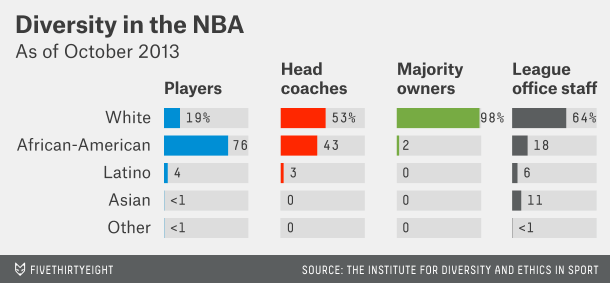
(Chart via Mona Chalabi)
Quote For The Day

“My girls and I make a lot of dark jokes together. In the upcoming season [of Louie], there’s a line from a conversation I had with my older girl. She was saying how whenever she sees a three-legged dog, it lifts her spirits, because three-legged dogs are wonderfully unaware that they have a malady. They just walk around, and they don’t give a shit. And I said, ‘You know, honey, they are lucky. But do you know the only thing luckier than a three-legged dog? A four-legged dog.’ And she really laughed. Whenever she laughs that hard at something dark? I know it’s good,” – Louis CK.

Previous Dish on some very lucky tripods here, here, and here.

John Kerry Tells The Truth … Therefore He Has To Apologize, Ctd

The above tweet is not exactly atypical of many supporters of Greater Israel. And David Harsanyi rightly bemoans its absurdly broad brush. But then, rather than responding to the substance of my post on John Kerry’s truth-telling at the Trilateral Commission, he insinuates that I am also anti-Semitic and even links to the poisonous and deranged screed that Leon Wieseltier maliciously penned about me.

Sigh. Harsanyi disputes the term ethnic cleansing to describe what happened in 1948. Maybe that term, along with the invocation of the a-word, inflames more than it enlightens. But it remains true that around 700,000 of the 1.2 million inhabitants of Palestine were either evicted from their homes or fled during the war of independence for Israel. All of them were Arab. In 1946, the Jewish share of the population of Israel was 30 percent. In 1950, it was closer to 50 percent. By the 1970s, it was over 80 percent.

Now we can debate for ever the nuances of this, who was to blame, etc. (and the Arab world definitely shares that responsibility, by its intransigent and violent stand against a Jewish state). But that’s a massive demographic shift along religious and ethnic lines. If today, 700,000 inhabitants of a country were expelled or fled to make way for a population of a different ethnicity, and if the ethnic/religious majority was changed in a matter of a few years, I don’t think we would be debating the question of ethnic cleansing. And it is that history that hangs over the ethnic engineering Israel is attempting on the West Bank. On that occupied land, Israel is settling hundreds of thousands of Jewish Israelis, in order to shift the demography some more. It is my contention that this further act of colonization is completely incompatible with any short- or long-term two-state solution; and that the Israeli refusal to stop it – even during negotiations – is the essential obstacle to any possible peace agreement. And using Occam’s razor, I cannot see any reason for it other than a longstanding commitment to build the Jewish state with a Jewish majority over the entire territory in dispute.

Harsanyi says I single out only Israel for censure. Of course that’s untrue. The very day I wrote that post, we also covered the appalling regime in Egypt. We covered the foul regime in Iran obsessively in 2009. We haven’t shied from the gruesome human toll in Syria, even as I oppose deeper intervention there as well. So to Harsanyi’s point, I favor ending aid to Egypt as well as to Israel, and I’ve written so several times. My own view is that the US should do what it can to get out of meddling in the entire Middle East. It’s a mug’s game, in which the eternal loser is the US.

Harsanyi further insinuates that I regard the Greater Israel lobby as the only force for Israel’s interests vis-a-vis America’s in American politics. Again not true. Yes, the lobby is ferocious and intransigent and disciplined and, in my view, has actively worsened Israel’s global position in the last decade. But it would not have that clout without overwhelming American identification with Israel as opposed to Palestine’s Arabs, or indeed anywhere in the Arab world.

The trouble is that that emotional support can, in my view, prevent Israel from taking necessary steps to salvage its reputation, its morality, and its survival as a Jewish state.

Max Fisher rightly points out that the apartheid metaphor could lead some to infer that a Jewish state should be abolished just as the Afrikaner state was. That’s not my view at all. My view is motivated primarily by frustration at Israeli extremism but also by a view that a Jewish state must survive and prosper as a moral cause. Because I’m so harsh on Israel’s policies right now, that might seem surprising to some. But if I weren’t committed to a Jewish state in existence as a safe harbor for the Jewish people, I wouldn’t even be writing about this much at all. My view – shared, for example, by the current Israeli ambassador to the US, Ron Dermer – is that a Jewish state permanently disenfranchising a hefty proportion of the people it controls is immoral and self-destructive and toxic to the entire enterprise and unworthy of the great civilization that the Jewish people, against hideous odds, have constructed over the centuries. And no amount of insinuation or name-calling is going to make me change my mind.

GDP Growth Stalls

Jared Bernstein reacts to the new Commerce report:

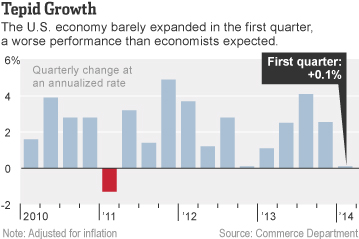
OG-AB335_GDPchr_E_20140430103641[R]eal GDP grew only 0.1% in the first quarter of the year, according to this morning’s report from the Commerce Dept.  That’s a huge deceleration from last quarter’s 2.6%, and well below analysts expectations of around 1.2%.

Remember, that 0.1% is an annualized number–the actual, quarterly percent growth of GDP was 0.03%, meaning that the real level of the value of goods and services in the US economy was essentially unchanged in the first three months of the year.  That’s unusual and alarming, if it’s correct.

However, given the jumpiness in the quarterly estimates, and this is the first of three estimates, based on preliminary data, it’s important to look at year-over-year results as well, to smooth out some noise, including recent weather effects.  By that measure, real GDP is up 2.3%, a deceleration from last quarter’s 2.6%.  In that regard, look at this quarter’s number as a stern warning, one that may or may not herald a downshift in GDP growth, but one that is hopefully not indicative of the underlying trend.

Neil Irwin digs into the data:

Business investment … contributed quite a lot to growth from 2011 to 2013, as companies increased their investments. Companies have been adding buildings, buying new equipment and acquiring new software packages strongly enough that such investment contributed 0.84 percentage points to growth in 2011, almost precisely the same as in 2012. The contribution shifted down to a third of a percentage point in 2013.

In the first quarter of 2014, however, the corporate sector was a net negative for the economy, with investment in structures, equipment and intellectual property falling at a 2.1 percent annual rate, enough to subtract a quarter of a percentage point from overall G.D.P. That was surely in part caused by the harsh winter weather, but the basic trend is real: American business, once a major driver of the expansion, no longer is.

Ben Casselman adds an important caveat:

A key note of caution: Preliminary GDP estimates are notoriously unreliable. On average, the figures get revised by half a percentage point between the first and second estimate (which we’ll get next month) and by a whopping 1.3 percentage points when the final numbers come in.

Jordan Weissmann chimes in:

Most economists seem ready to chalk up much of the slowdown to the miserable winter weather, which kept shoppers indoors, slowed construction, and otherwise turned the last few months into a cold and soggy mess. Chances are, there will be some rebound this quarter—a spring awakening, if you will.

Still, one part of the report seems like a genuine cause for concern: housing.Residential investment has now fallen for two straight quarters.

James Pethokoukis’s view:

How does the economy typically respond after a weak, but positive GDP quarter? It varies. After that weak 4Q 2012, GDP growth averaged 1.8% over the next two quarters. After 0.3% growth in 1Q 2007, growth averaged 2.9% over the next six months. A 0.2% 4Q 2002 was also followed by 2.9% growth the subsequent two quarters. Then again, weak quarters in late 1990 and 2000 were quickly followed by recessions within six months. This time around, however, odds are growth will accelerate — weather permitting.

(Chart via the WSJ)