
San Francisco, California, 12.07 pm
San Francisco, California, 12.07 pm
Chris Hayes compares the fight against fossil fuels to the abolitionist movement. He states plainly that “there is absolutely no conceivable moral comparison between the enslavement of Africans and African-Americans and the burning of carbon to power our devices.” But he sees economic parallels:
[I]n the decades before the Civil War, the economic value of slavery explodes. It becomes the central economic institution and source of wealth for a region experiencing a boom that succeeded in raising per capita income and concentrating wealth ever more tightly in the hands of the Southern planter class. During this same period, the rhetoric of the planter class evolves from an ambivalence about slavery to a full-throated, aggressive celebration of it. As slavery becomes more valuable, the slave states find ever more fulsome ways of praising, justifying and celebrating it. Slavery increasingly moves from an economic institution to a cultural one; it becomes a matter of identity, of symbolism—indeed, in the hands of the most monstrously adept apologists, a thing of beauty.
And yet, at the very same time, casting a shadow over it all is the growing power of the abolition movement in the North and the dawning awareness that any day might be slavery’s last. So that, on the eve of the war, slavery had never been more lucrative or more threatened. That also happens to be true of fossil fuel extraction today. …
[T]he parallel I want to highlight is between the opponents of slavery and the opponents of fossil fuels. Because the abolitionists were ultimately successful, it’s all too easy to lose sight of just how radical their demand was at the time: that some of the wealthiest people in the country would have to give up their wealth. That liquidation of private wealth is the only precedent for what today’s climate justice movement is rightly demanding: that trillions of dollars of fossil fuel stay in the ground. It is an audacious demand, and those making it should be clear-eyed about just what they’re asking. They should also recognize that, like the abolitionists of yore, their task may be as much instigation and disruption as it is persuasion.
He goes on to argue that avoiding “planetary disaster will mean forcing fossil fuel companies to give up at least $10 trillion in wealth.” Barro sees “reason for somewhat less despair than Mr. Hayes shows, because there are crucial political and economic differences between abolition and carbon limitations”:
In the case of slavery, slaveholders had an enormous economic interest in maintaining their property, while white abolitionists were mostly seeking moral improvement. Those who stood to gain most economically from abolition were slaves, who were excluded from the political process.
An effective carbon limitation policy should bring large economic gains to people who are not in the business of fossil fuel extraction, in the form of reduced economic disruption due to climate change. While owners of fossil fuels have a strong economic impulse to extract, the rest of us should have a strong economic impulse to limit extraction — and we should be willing to buy off the resource owners, if necessary, to enforce those limits.
Warner Todd Huston raises other objections:
[T]oday’s issue is a worldwide problem, not one centralized and isolated in the U.S. Even if we Americans stopped using fossil fuels this very minute, it wouldn’t matter even a tiny bit to the actual global warming problem as the warmists perceive it. That is because India, China, and every other nation would continue using their fossil fuels, making our purportedly heroic efforts not just pointless, but self-destructive.
Imagine if we fought the Civil War, losing 650,000 Americans in the process, thought we eliminated slavery, and then millions of slaves from other nations just flooded back into our country. It would have made the great loss a pointless exercise, for sure. This is what would happen if we destroyed ourselves over global warming while the rest of the world dallied.
In other climate change commentary, Brad Plumer chronicles the failure to meet our climate goals:
The idea that the world can stay below 2°C looks increasingly delusional. Consider: the Earth’s average temperature has already risen 0.8°C since the 19th century. And if you look at the current rapid rise in global greenhouse-gas emissions, we’re on pace to blow past the 2°C limit by mid-century — and hit 4°C or more by the end. That’s well above anything once deemed “dangerous.” Getting back on track for 2°C would, at this point, entail the sort of drastic emissions cuts usually associated with economic calamities, like the collapse of the Soviet Union or the 2008 financial crisis. And we’d have to repeat those cuts for decades.
What more warming might do:
Four degrees (or 7.2° Fahrenheit) may not sound like much. But the world was only about 4°C to 7°C cooler, on average, during the last ice age, when large parts of Europe and the United States were covered by glaciers. The IPCC concluded that changing the world’s temperature in the opposite direction could bring similarly drastic changes, such as “substantial species extinctions,” or irreversibly destabilizing Greenland’s massive ice sheet. … Here’s an analogy that Hans Joachim Schellnhuber, who helped compile some of the research for the World Bank, likes to use. “Take the human body. If your temperature rises 2°C, you have a significant fever. If it rises 4°C or 6°C you can die. It’s not a linear change. You’re pushing a complex system outside the range it’s adapted to. And all our assessments indicate that once you do that, the system’s resilience gets stretched thin.”
A timely reminder of how old the struggle for marriage equality really is in the US:
And this is how revolutions begin:
But, of course, as I noted in my 1998 anthology on the subject, the issue of gay marriage goes back much, much further in time. We even have martyrs executed for the cause. From Montaigne’s notebook as long ago as 1581:
On my return from Saint Peter’s I met a man who informed me humorously of two things: that the Portuguese made their obeisance in Passion week; and then, that on this same day the station was at San Giovanna Porta Latina, in which church a few years before certain Portuguese had entered into a strange brotherhood.
They married one another, male to male, at Mass, with the same ceremonies with which we perform our marriages, read the same marriage Gospel service, and then went to bed and lived together. The Roman wits said that because in the other conjunction, of male and female, this circumstance of marriage alone makes it legitimate, it had seemed to these sharp folk that this other action would become equally legitimate if they authorized it with ceremonies and mysteries of the Church.
Eight or nine Portuguese of this fine sect were burned.
Update from a reader:
The videos you posted remind me that I saw first-hand how the revolution was truly underway well before 2008. When I was in graduate school, my close friend and research partner invited my wife and me to her wedding at a little farm up in the Berkshires of Western Massachusetts. This would have been some time around 1996 or 1997. It was a beautiful service, conducted by a former Catholic priest using a traditional marriage liturgy that was quite familiar to me as an Episcopalian and to my formerly Catholic wife. The only thing that was unusual was that my friend and her partner were lesbians. Both families were there, along with a few close friends. It was a small, joyous affair and we celebrated them, their love, and their commitment to each other. In that way it was just like any other wedding I’ve ever attended, including my own. Virtually normal indeed.
So to whom does credit for the “revolution” belong? Not to the lawyers and political activists that Becker lionizes. Not to you, despite your early advocacy. It belongs to women (and men) like these, the courageous clergy who blessed their unions, and their families who loved and supported them and continue to do so. That would be a much more human story to tell.
The debate over Piketty’s Capital in the 21st Century continues to rage throughout the blogosphere. Weissmann thinks it will be the millennials’ liberal manifesto:
Conservatives have long had an easy framework for their economic ideas: The free market cures all. Liberals, instead of nebulously arguing that they’re fighting for the middle class, now have a touchstone that clearly argues they’re fighting against the otherwise inevitable rise of the Hiltons.
Capital will change the political conversation in a more subtle way as well, by focusing it on wealth, not income. Discussions about income can become very muddy, in part because Americans don’t like to begrudge a well-earned payday, and in part because it can be tricky to decide what should count as income. If you start adding health insurance and government transfers such as food stamps into the equation, as some do, the top 1 percent don’t dominate quite so severely.
Wealth is a different story. Americans don’t like the idea of aristocrats—there’s a reason campaigning politicians bring up family farms and steel mills, not Shelter Island vacation homes, when they run for office. Moreover, you can’t save food stamps or a health plan, and because wealth only includes what you can save, it’s a measure of who wins in the economy over the long term.
Robert M. Solow supports Piketty’s proposal for a global wealth tax:
Annual revenue of 2 percent of GDP is neither trivial nor enormous. But revenue is not the central purpose of Piketty’s proposal. Its point is that it is the difference between the growth rate and the after-tax return on capital that figures in the rich-get-richer dynamic of increasing inequality. A tax on capital with a rate structure like the one suggested would diminish the gap between the rate of return and the growth rate by perhaps 1.5 percent and would weaken that mechanism perceptibly.
This proposal makes technical sense because it is a natural antidote to the dynamics of inequality that he has uncovered. Keep in mind that the rich-get-richer process is a property of the system as it operates on already accumulated wealth. It does not work through individual incentives to innovate or even to save. Blunting it would not necessarily blunt them. Of course a lower after-tax return on capital might make the accumulation of large fortunes somewhat less attractive, though even that is not at all clear. In any case, it would be a tolerable consequence.
But McArdle doubts it would solve the real problems of the poor and middle class:
If we look at the middle three quintiles, very few of their worst problems come from the gap between their income and the incomes of some random Facebook squillionaire. … Crime is better, lifespans are longer, our material conditions have greatly improved — yes, even among the lower middle class. What hasn’t improved is the sense that you can plan for a decent life filled with love and joy and friendship, then send your children on to a life at least as secure and well-provisioned as your own.
How much of that could be fixed by Piketty’s proposal to tax away some huge fraction of national income from rich people? Some, to be sure. But writing checks to the bottom 70 percent would not fix the social breakdown among those without a college diploma — the pattern of marital breakdown showed up early, and strong, among welfare mothers.
Deploying the more standard attack from the right, Harsanyi calls Piketty a Marxist:
Like many progressives, Piketty doesn’t really believe most people deserve their wealth anyway, so confiscating it presents no real moral dilemma. He also argues that we can measure a person’s productivity and the value of a worker (namely, low-skilled laborers), while at the same time he argues that other groups of workers (namely, the kind of people he doesn’t admire) are bequeathed undeserved “arbitrary” salaries. What tangible benefit does a stockbroker or a Kulak or an explanatory journalist offer society, after all? …
The thing is, some of us still believe that capitalism fosters meritocratic values. Or I should say, we believe that free markets are the best game in town. Not that long ago, this was a nearly universal position. A lot of people used to believe that even the disruptions of capitalism — the “caprices of technology” as Piketty dismisses them— that rattle “social order” also happen to generate mobility, dynamism and growth. Today this probably qualifies as Ayn Rand-style extremism.
Douthat, meanwhile, bets that America will “tax enough, and redistribute enough, to maintain the richest nations’ social peace, and avoid violent labor-capital conflict by making even the relatively poor feel like they have too much to lose from such upheaval.” Among his evidence:
[T]axes on high incomes bottomed out in the mid-1980s (when our Gini coefficient was much lower) and have bounced around, and upward, in the two decades since; taxes on capital went down steadily from the ’80s into the 2000s, but for high incomes they’re now back where they were in the 1990s (with an Obamacare surcharge on top); our corporate tax rates were cut in the 1980s but haven’t much budged since. Meanwhile, the non-defense budget has been on a consistent upward trend (see figure 3 here) since, again, the mid-1980s, and elite-driven causes like entitlement reform and immigration reform have been repeatedly defeated by populist rebellions, left and right. And notwithstanding liberal anxieties that the Bush Republicans had found a way to push the whole political debate “off center,” the post-2000 trend toward stagnant incomes helped drive a leftward swing in public opinion, leading to the election of President Obama, an unprecedented surge of stimulus spending, a large expansion of the federal safety net, a significant increase in upper-bracket taxes, and so on.
Now it’s true that post-2010 budget cuts have counteracted some of these leftward policy shifts, and it’s also true if enacted as written Paul Ryan’s safety net cuts would send U.S. policy swinging in a direction favored by (some Republican) oligarchs. But Ryan was on the ticket that lost the last presidential election, and nobody (the Wisconsin congressman included, I would say) believes that his party is well-positioned to win future elections running on an austerity platform alone.
Earlier coverage of Piketty’s book here, here, here, and here.
David Corn, who dug up the video footage above, notes:
These days, Paul, who is stuck in a civil war within the GOP over foreign policy issues, is trying to Reaganize himself and demonstrate that he’s not outside the Republican mainstream. (His Senate office did not respond to requests for comment.) But not long ago, Reagan was a foil for Paul, who routinely pointed out that the GOP’s most revered figure actually had been a letdown. It’s no surprise that denigrating Ronald Reagan—and commending Jimmy Carter—is no longer common for Paul. Such libertarian straight talk would hardly help him become one of the successors to the last Republican president who retains heroic stature within the party Paul wants to win over.
For me, though, these clips make Paul’s candidacy more appealing, not less. What the GOP needs is an honest, stringent account of how it has ended up where it is – a party that has piled on more debt than was once thought imaginable and until recently, has done nothing much to curtail federal spending. Reagan was a great president in many ways, as Paul says explicitly in these clips.
But Reagan introduced something truly poisonous into American conservatism.
It was the notion that you can eat your cake and have it too, that tax cuts pay for themselves and that deficits don’t matter. This isn’t and wasn’t conservatism; it was a loopy utopian denial of math. And the damage it has done to this country’s fiscal standing has been deep and permanent. It is one of modern conservatism’s cardinal sins. And Paul is addressing it forthrightly – just as he is addressing the terrible, devastating consequences of neo-conservatism for America and the world in the 21st Century.
What we desperately need from the right is this kind of accounting. It’s what reformers on the left did in the 1990s – confronting the failures of their past in charting a new future. Taking on Reagan on fiscal matters may be short-term political death, as Corn suspects and maybe hopes, but it is vital if the GOP is to regain some long-term credibility on the core question of government solvency. Compared with the ideological bromides and slogans of so many others, Rand Paul is a tonic. And a courageous one at that.
The neocons don’t want you to notice, but Obama’s attempt to disarm both Syria and Iran of WMDs is actually on track. On Syria, I remember being on the AC360 show last fall, when the overwhelming consensus was that Obama had been duped, that his pivot in asking Putin to enforce the removal of WMDs from Syria was a humiliation, and that Assad would never, ever give up any WMDs. Fast forward to now:
With its latest deadline days away, Syria is close to eliminating its stockpile of chemical weapons, monitors said Tuesday, an improbable accomplishment in the midst of civil war that is likely to diminish further the possibility of international intervention.
After a slow start that prompted U.S. accusations of stalling, the government of President Bashar Assad has shipped almost 90% of its chemical weapons materials out of the country, raising hope that it can finish the job by Sunday. A United Nations plan that averted punitive U.S. airstrikes last year sets June 30 as the deadline for all of Syria’s chemical weapons materials to be destroyed. But the first and hardest task has been shipping it out of the country through the Mediterranean port of Latakia…
The shipment Tuesday means that 86.5% of its toxic weapons material has been removed, according to a statement from the Organization for the Prohibition of Chemical Weapons, the Hague-based group overseeing the destruction of the stockpile. That includes 88.7% of the 700 metric tons of the most toxic chemicals, among them mustard gas and precursor materials for the nerve agents sarin and VX.
Then we come to the much more important interim agreement with Iran. And the news is encouraging there as well:
The IAEA report last week confirms that Iran cut its stock of medium enriched uranium by three-quarters. It has completely diluted half its stock down to low enriched uranium, and it has converted half of the remaining amount into reactor fuel, all ahead of schedule. It would be extraordinarily difficult and time-consuming to reverse these processes. In short, Netanyahu’s bomb has been drained. His red line has been implemented. Even if Iran were to break the deal today, it would take it many months to make enough uranium for one bomb, and the world would see them doing it. Nor is there any indication that Iran is about to break off negotiations.
So Israel is safer today – because of Obama, not Netanyahu, who has been hoist, like so many Wile E Coyotes in the past six years, by his own canards. Now think of how Obama has operated to rid the Middle East of WMDs – a vital part of our collective security – and compare it with the “tough guys” who preceded him.
Bush and Cheney launched a ruinous, failed war that did nothing to increase our national security and failed to find and destroy any WMDs. Obama, by diplomatic maneuvering, managed to avoid getting sucked into the Syrian vortex, while successfully ridding the country of chemical weapons. Yes, there are reports of chlorine bombs being used. But they weren’t part of the agreement. Yes, the civil war remains horrifying in its human toll. But to have managed to achieve this in the midst of that civil war is a huge success. And if the successful implementation of the interim agreement with Iran continues, we could have a viable permanent agreement that reliably keeps nukes out of the hands of Tehran’s pseudo-democratic dictatorship.
At some point, this will be better understood, I suspect. But it’s worth pointing out now. If Obama leaves office with WMDs removed from the Middle East (barring, of course, Israel’s chemical, biological and nuclear weapons!), he will have done what Bush promised – at a fraction of the cost, and with no war. I don’t know about you, but that’s why I still proudly support this president. Last fall, I argued that two things would make him a liberal Reagan – the successful implementation of Obamacare, and a new era with Iran and the Middle East. And on those terms, it’s meep meep again, so far as I can see.
Update from a reader:
As a loyal but relatively new (since ~2010) Dish reader (and two-year subscriber!), I really appreciate the roadrunner image to go with your latest Meep Meep post. At last, I’m in on the joke. For the longest time, I thought it was some weird British variation of “whomp whomp” or sad trombone … which was an entirely different meaning.
Piketty’s new book is already a huge financial success:
The unlikely bestseller, clocking in at nearly 700 pages, is already serving as an interesting case study for modern book publishing. One of the hallmarks of the book’s success is that it is sold out on Amazon, even though there is a digital version available on Kindle, too. … “You can have it on your e-book reader, but that’s not the same as having the book,” said [Harvard University Press sales and marketing director Susan] Donnelly. “I’m not saying this book is a Tiffany’s bag, but nobody goes to Tiffany’s and buys something and doesn’t get that little blue bag. I think there’s still some of that about books.”
The bestseller is already poised to become the most popular book ever for Harvard University Press. Donnelly predicts it will become akin to another classic for the publisher, John Rawls’ “A Theory of Justice.”
Yglesias points out that the book’s success is itself an example of inequality:
Piketty’s best-seller status — though well-deserved — also highlights one of the drivers of contemporary economic inequality. Superstar effects.
People like to buy great books and listen to great songs and watch great movies and TV shows. But people also like to be part of the “in crowd” and “the conversation.” So when certain things reach a certain level of popularity, other people check them out precisely because everyone is talking about them. That means that being the book on economic inequality is much more lucrative than being the fourth-best book on economic inequality.
These kind of disproportionate rewards for superstars have probably always been with us. But as the number of people who could conceivably buy a book grows — because of a mix of population growth and economic progress in poor countries — the returns to being the superstar grow disproportionately fast and inequality rises.
Earlier coverage of Piketty’s book here, here, here, and here.
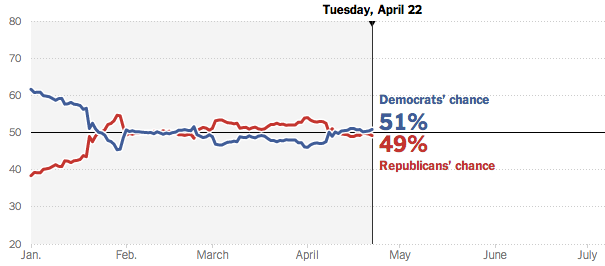
The Upshot calculates the Democrats’ current chances of holding the Senate:
Every day, our computer churns through the latest polls and reams of historical data to calculate both parties’ chances of winning control of the Senate. Although the Democrats currently have a 51 percent chance, that doesn’t mean we’re predicting the Democrats to win the Senate — the probability is essentially the same as a coin flip.
Nate Cohn looks at the role incumbency plays:
Democrats’ hopes of keeping their Senate majority this November may well hinge on the ability of three of their incumbents to hold onto their seats deep in enemy territory: the South. To take the Senate and consolidate their control of Congress, Republicans need only extend their stranglehold on Dixie to Arkansas, Louisiana and North Carolina, all of which voted for Mitt Romney in the 2012 presidential election.
Yet the hopes of these three states’ incumbent Democratic senators — Mark Pryor, Mary Landrieu and Kay Hagan — are still alive. That may be surprising in light of the region’s lurch to the right, but it shouldn’t be: Incumbency is powerful. In the South, Democratic incumbents have won 85 percent of the time since 1990, and 77 percent since 2000.
The big Republican gains in the South have come mainly in open contests without an incumbent, often after a longtime Southern Democrat retires. Republicans have won 84 percent of open races in the South since 2000 — and three of their four losses came in Virginia and Florida, states that are different from the rest of the region.
An exhaustive look at the pros and cons. Among the pros:
Kid already European enough as it is
Among the cons:
Mohel looks like he’s had about eight cups of coffee
Yeah, I know. Sullybait. A reader adds:
I think there is a third way of looking at the question of circumcision. As my grandfather likes to say, “Don’t cut it off; wear it off.”

David Leonhardt and Kevin Quealy introduce the graphic above (click to enlarge):
In 1980, the American rich and middle class and most of the poor had higher incomes than their counterparts almost anywhere in the world. But incomes for the middle class and poor in the United States have since been growing more slowly than elsewhere.
The accompanying article goes into more detail:
The findings are striking because the most commonly cited economic statistics — such as per capita gross domestic product — continue to show that the United States has maintained its lead as the world’s richest large country. But those numbers are averages, which do not capture the distribution of income. With a big share of recent income gains in this country flowing to a relatively small slice of high-earning households, most Americans are not keeping pace with their counterparts around the world.
“The idea that the median American has so much more income than the middle class in all other parts of the world is not true these days,” saidLawrence Katz, a Harvard economist who is not associated with LIS. “In 1960, we were massively richer than anyone else. In 1980, we were richer. In the 1990s, we were still richer.”
That is no longer the case, Professor Katz added.
Douthat considers what this change means for politics:
If we get back to where we were in the 1990s, with an economy that’s delivering for the 40th-through-the-60th percentiles but a welfare state that isn’t as generous as the social democracies to the 10th-through-30th, most Americans will probably be inclined to say, well, that’s just our system’s traditional “growth over fairness, opportunity over equality” trade-off working as expected, and there will be more support for efforts to keep the tax-and-transfer share of the U.S. economy close to historic norms. (Though it would help, obviously, if there were more mobility out of the 10th and 20th percentiles than we’re currently seeing.) But if the advantages of the American system are only visible from, say, the 70th or even 80th percentile up, then the case for the low-tax model will seem weaker relative to how its been received and debated in the past, and American politics will probably shift leftward on size-of-government issues (as it already has among the rising generation).
Derek Thompson, meanwhile, looks at why Canada’s middle class is becoming richer than ours:
How did we lose the lead? The authors blame three broad factors: (1) Canada’s education attainment is outpacing the U.S. and most of the world; (2) American middle-class market wages aren’t keeping up with overall economic growth; and (3) Other governments are doing more to redistribute income to poorer families in other countries, particularly in western and northern Europe. One word that doesn’t appear in the article, however, is housing. The U.S. is emerging from a catastrophic collapse of the housing market that obliterated household wealth for millions of middle-class families. Canada, however, is in the midst of a delirious housing boom and a personal debt craze that reminds some economists of the U.S. market exactly a decade ago (before you-know-what happened).
Reihan also focuses on housing:
[H]ere’s the thing: If the U.S. had done more to address the wealth destruction that followed from the housing bust, it is hard to deny that middle- and low-income households would be in a much better position. Indeed, the really scary thing is that, as Mian and Sufi have argued, it’s not clear that low- and middle-income Americans are in a less vulnerable position now than they were before the bust. And if Canada ever does see a house-price correction, as seems at least plausible, it is not clear that the contrast between Canada and the United States will look quite so favorable a few years down the road.
And finally, I’ll make a brief political point. Many conservatives believe that to win Latino voters, they need to take a particular position on immigration reform. They might instead consider paying more attention to the fact that Hispanic household wealth fell by 66 percent from 2005 to 2009, and that many Latino families, and indeed many middle-income families of all backgrounds, are still reeling from the wealth destruction of that era.
Update from a reader:
I own a small Real Estate company in Calgary, Alberta, Canada. The quotes from Derek Thompson and Reihan seem to elude that the housing situation in Canada is similar to that in the US in 2007 and that the risks for Canada are the same. This is simply not the case and shows a lack of understanding of our system here in Canada.
First off, in Canada in order to qualify for a mortgage you must have at least a 5% down payment in cash. There are also qualifying “Gross Debt Service” and Total Debt Service” ratios that ensure any mortgage payment is, on its own and in conjunction with your other monthly debt payments, below a certain percentage of your income (I think 39% and 44% respectively). Part of the problem in the US prior to the collapse was that people were financing 100% (or more) of the cost of the home.
Second, the biggest problem in the US prior to the collapse was the so-called “Adjustable Rate Mortgage”. To my understanding, this instrument kept rates very low and then unexpectedly raised the rates drastically either at a certain point or upon a default thus leaving many homeowners unable to pay and forcing foreclosure. In Canada, this simply does not exist. Mortgage rules here prohibit such practices. You can get either a “fixed rate”, “variable rate” or some combination of the two and that’s it. A fixed rate mortgage is just like it sounds, the rate never changes during the duration of the term. Variable rate mortgages rise and fall with the prevailing prime rates. While this has some risk, these risks are low because prime rates charged by the banks are derived from the rate set by the Bank of Canada (our “FED”) and typically are slow, predictable adjustments.
Thirdly, and most important, banks in Canada are largely protected from the effects of default and foreclosure because here, any person who obtains a mortgage with less than a 20% down payment (what we call a “high ratio mortgage”)is required by law to buy mortgage insurance (between 0.5% and 3.0% in most cases) . The lower the down payment, the higher the insurance premium. This insurance is typically bundled into their monthly mortgage payments. This insurance protects the banks and promotes lending as there is zero risk to them. When homeowner with a high ratio mortgage defaults, the typical foreclosure process occurs, but any shortfall of the amounts recovered are covered by the insurance.
Further, mortgage insurance is not offered outside of your principal residence so investors and speculators must have at least 20% down payment to buy a property and expensive homes (I think those over $1M) are also not covered by mortgage insurance, so again, 20% down payment would be required.
This is why Canada fared better than any G7 country during the global recession. Property values decreased here in 2007/2008 and in fact have only just recovered from that in the last year, but the difference is that here, prudent policy kept risk prone people (those who couldn’t save at least 5%) out of the market to begin with, prevented predatory lending from even occurring in the first place and protected the banks while promoting access to home ownership to the population.
Canada will continue to be able to weather housing bubbles better than the US too. Since the recession, our government has further increased this protection by limiting a mortgage refinance to a maximum of 80% of equity, capped mortgage amortization to 25 years and has put pressure on the banks not to lower mortgage rates too much.

 The Dish