The “War” In Global Warming

Last month, in an op-ed for Fox News, retired Navy Rear Admiral David Titley made a national security-based case for worrying about climate change. Eric Holthaus interviews Titley about his belief that the changing climate will be a main driving force for conflict in the 21st century:

Q. What’s the worst-case scenario, in your view?

A. … You could imagine a scenario in which both Russia and China have prolonged droughts. China decides to exert rights on foreign contracts and gets assertive in Africa. If you start getting instability in large powers with nuclear weapons, that’s not a good day.

Here’s another one: We basically do nothing on emissions. Sea level keeps rising, three to six feet by the end of the century. Then, you get a series of super-typhoons into Shanghai and millions of people die. Does the population there lose faith in Chinese government? Does China start to fissure? I’d prefer to deal with a rising, dominant China any day.

Titley thinks it’s time for conservatives to start grappling with the problem:

Where are the free-market, conservative ideas? The science is settled. Instead, we should have a legitimate policy debate between the center-right and the center-left on what to do about climate change. If you’re a conservative – half of America – why would you take yourself out of the debate? C’mon, don’t be stupid. Conservative people want to conserve things. Preserving the climate should be high on that list.

Sean McElwee thinks that environmentalists could probably garner more support on the right if they framed the issue differently:

Republican support for environmental causes is stronger than it might appear. Two Ph.D. students at the University of California Santa Barbara, Phillip Ehret and Aaron Sparks, found that a quarter of individuals self-identifying as “very conservative” or “conservative” support environmental regulations, even if they risk harming the economy. A Yale Study finds that 85 percent of Democrats and 55 percent of Republicans favor “regulating CO2 as a pollutant” and majorities from both parties favor investing in renewable energy. If Republican voters are concerned about the environment, haven’t we seen an action?

One explanation is that the framing of environmental issues is often anathema to conservatives. Matthew Feinberg and Robb Willer’s important paper on the subject, “The Moral Roots of Environmental Attitudes,” finds that liberals view environmental issues as moral concerns informed by a harm principle, while conservatives view environmental issues through the lens of purity, and particularly for religious people, stewardship.

One great challenge for environmentalists is finding a way to frame the issue in terms real conservatives intuitively grasp. To wit: If you love this land, why would you want to see it changed irreparably by our behavior? If you believe, as Christians do, that conserving the planet is our sacred duty, why would you treat the earth as disposable? Should we behave like Noah and conserve the earth – or ransack it for material ends? The trouble, of course, is that these deep conservative themes have been displaced on the right by know-nothing hatred of anything defined as “liberal”. And so you get outright mockery of concerns for the planet and too-clever-by-half attempts to deny the reality and moral challenge of climate change.

In the end, that is a crisis for conservatism, as much as environmentalism.
The Freedom To Marry And The Freedom To Dissent

I’m not much of a joiner, but I was more than glad to sign the joint statement by a wide array of supporters of marriage equality, gay and straight, declaring our commitment both to open and respectful, if robust, debate, and to ensuring that gay people have their fundamental constitutional right to marry. You can read the statement here. Money quote:

As a viewpoint, opposition to gay marriage is not a punishable offense. It can be expressed hatefully, but it can also be expressed respectfully. We strongly believe that opposition to same-sex marriage is wrong, but the consequence of holding a wrong opinion kamenypickets.jpgshould not be the loss of a job. Inflicting such consequences on others is sadly ironic in light of our movement’s hard-won victory over a social order in which LGBT people were fired, harassed, and socially marginalized for holding unorthodox opinions.

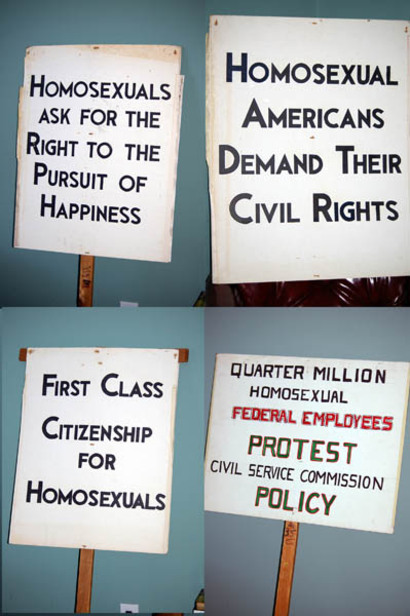
LGBT Americans can and do demand to be treated fairly. But we also recognize that absolute agreement on any issue does not exist. Franklin Kameny, one of America’s earliest and greatest gay-rights proponents, lost his job in 1957 because he was gay. Just as some now celebrate Eich’s departure as simply reflecting market demands, the government justified the firing of gay people because of “the possible embarrassment to, and loss of public confidence in . . . the Federal civil service.” Kameny devoted his life to fighting back. He was both tireless and confrontational in his advocacy of equality, but he never tried to silence or punish his adversaries.

Now that we are entering a new season in the debate that Frank Kameny helped to open, it is important to live up to the standard he set. Like him, we place our confidence in persuasion, not punishment. We believe it is the only truly secure path to equal rights.

Read the whole thing. We felt it necessary to take a joint, public stand, in the wake of the illiberal response to the Eich affair and some truly troubling sentiments in favor of shutting opponents up, demonizing rather than engaging, intimidating rather than persuading. Conor comments here; Peter Berkowitz here. The statement is also open for anyone to sign and join us in affirming these principles. Add your name here, if you want.

(Photo: Posters and placards from some of the very first public protests in defense of gay equality – from the Frank Kameny archive)

The $84,000 Cure

Earlier this month, Polly Mosendz covered the debate over Hepatitis C drug Sovaldi:

[I]nsurers cannot stand this life saving, revolutionary medication. That’s because it runs $1,000 a day and the average patient requires a 12-week treatment of Sovaldi.That’s $84,000 for one cycle. For patients with a strain that is more difficult to treat, the regiment is 24 weeks. That comes in at $168,000. It is projected to rake in between $5 billion and $9 billion in profits in the United States this year alone. There are an estimated 4 million Americans with Hepatitis C, and 15,000 are killed each year by untreated chronic infections.

Unfortunately, there is not much insurers can do about the price. A comparable drug is not yet on the market.

Dr. Frank Huyler fumes:

The low cost of manufacturing the drug means that it can be sold all over the world. Only the price varies, and that price is set by Gilead executives and protected by patent law and the FDA. At the moment, Gilead has a monopoly.

In poor countries, such as Egypt, they can’t sell many $1,000 pills. But they can sell a lot of $10 pills. So that’s how much Sovaldi costs in Egypt — and Gilead Sciences is still making a profit. Thanks to the FDA, the Egyptian version of the drug can’t be imported.

This sort of blood money is nothing new. But it is among the worst of recent examples; yet another evil act, yet another predation on mostly poor, mostly desperate people, who inevitably will ask taxpayers to save them.

“Blood money?” “Evil act?” I have to say I find that rhetoric appalling.

A miracle drug like this does not appear out of thin air. Developing these kinds of drugs can be hugely risky – so many end up as duds – and extremely expensive. If there were no real return on the few that make it to market, the economic incentives that make them possible in the first place would disappear, along with the drugs. And these drugs really do save lives – as Tim Mullaney, who has Hepatitis C, notes:

After two bouts with cancer, I can check hep C off the list of things that may kill me, thanks to virus-clearance rates of 97% in cases like mine. I’ve had no side effects. Prior therapies had much lower cure rates, and so many complications that patients refused treatment. Including me.

Surowiecki uses the outcry over Sovaldi to discuss drug pricing more generally:

Price restrictions have always been a political non-starter here, but at some point the math of the situation will be hard to resist. According to a study by the research group I.S.I., by 2018 spending on “specialty drugs” like Sovaldi could account for half of all drug spending in the U.S. Furthermore, one traditional argument against price controls is looking weaker: biotech companies claim that prices need to be high to reward risky and expensive innovation, but the fact that they’re churning out drugs and profits so consistently seems to undermine that claim. Biotech, in other words, may become the victim of its own success: the bigger the profits, the bigger the likelihood of regulation.

You might think that this prospect would encourage companies to be more cautious. But, if you assume that price controls are coming, the rational play is to squeeze out all the profits you can now.

I think there’s a trade-off here. Price controls on drugs in existence could make them far more affordable for the healthcare system as a whole. And there is a strong, moral argument for doing that. But the trade-off is that the innovation that occurs outside the NIH – and the bulk of all drug research is done by the pharmaceutical industry – would inevitably suffer. At some point a society has to navigate these two goals – innovation and access. And both matter.

Cuteness In Captivity, Ctd

Screen Shot 2014-04-22 at 2.07.38 AM

Unlike Bert Archer, Rachel Lu loves the zoo (joined by several readers below):

I’m confident [our local zoo] will linger in my kids’ memories as one of the most beloved places of their childhood. I joke to my friends that we’re “zoo junkies” because we generally visit once a week. Those animals are like old friends to my kids, and I’ve outlined many an article from the bench of the monkey house on a quiet winter afternoon. When there are no other visitors, the monkeys will sometimes come down and interact with the boys from the other side of the glass. …

When we see animals in real life, we get a perspective on the natural world that we just can’t get through television.

My kids watch TV, but at their age, understanding the reality of what lies behind the flickering images is quite difficult. (I find that older people often have this problem too.) Recognizing that fact makes me that much more grateful for the opportunity to give them a direct encounter with lions, tigers and bears.

Zoo animals have been their primary conduit for coming to understand that the world contains a diverse array of climates and ecosystems. We discuss why it is that the tiger comes outside in the winter but the giraffes not. We note how the arctic foxes exchange their white coats for grey ones as the seasons change. Even contrived, pseudo-ecosystems enable the kids to recognize how particular animals are suited to their environments. They marvel at the upper-body strength of monkeys and note with amazement that both polar bears and seals, despite their many differences, are adapted to swimming. A nature show could point this out, but they benefit far more from making the connection themselves.

A related email from the archives, responding to this post on captive orcas:

I have at times felt uncomfortable in zoos as well, for the same reason as your reader – it seems an unnatural state in which to view these animals, akin to imprisonment (and often, in a climate that is vastly different from the ones they would typically experience).  But your reader is wrong to speak of animals being “snatched from their normal lives”.  Perhaps generations ago, that was the case.  Yet the majority zoo animals alive today are born into captivity, including over 80% of mammals according to industry counts.

Of course, that doesn’t lessen the power of your slavery analogy (and in fact, it may strengthen it).  But bear in mind, too, that many zoo animals are endangered species – sometimes severely so.  The practice of keeping such animals in zoos, and breeding them in captivity, is in some cases the only thing standing between a species’ existence and extinction.

Recent Dish on breeding endangered animals in captivity is here. An animal keeper also responded to the orca thread:

The debate over zoos and aquariums is a good and healthy one to have, especially when it results in improvements in the welfare of the animals we are caring for.  But this statement by one reader just went right through me: “It just seems incredibly selfish of the human race to snatch these innocent animals from their normal lives and dump them into one we see fit to create for them, all to give families something to do on weekends.”

What were these animals “normal” lives?  I readily acknowledge that not all zoos treat animals equally, and some are incredibly abusive, which is sickening.  But not all animals in zoos were born in the wild – they were bred in a zoo, raised in a zoo, and would not be able to live in the wild even if we wanted to release them.  Others were rescued from the pet trade or taken in from the wild after their mothers were killed or they were injured by human action.  Do we simply let these animals fend for themselves? And if not zoos, where else to we put them?

I, and most animal keepers that I know, would love it if the animals we care for didn’t have to be paraded around for dog and pony shows to entertain people.  It can be stressful for the animals (no matter how well they tolerate people) and exhausting for the handlers.  We would love it if the animals we cared for could roam huge open expanses without fences or bars or cages.  We would also love it if it were still possible to see a snow leopard outside of a zoo without having to sit for weeks on end to glimpse ONE of the last remaining of the species.  We don’t live in that world, and unless a significant number of us were to die off, we never will.

While zoos may have been originally created to house unusual animals so that people other than rich trophy hunters could see them, zoos do not simply exist for that now.  If the people weren’t allowed to see the animals the zoos wouldn’t be able to help conserve the animals we have left.  The zoos wouldn’t be able to care for the animals that poachers try to kill, that cars maim, or that people try to keep as pets.  A family’s “weekend entertainment” is the bargain that zoos make so that they can help do some good in the world.

But that family’s visit DOES come with a bonus because every once in while if you’re really lucky you get to see the face of a small city-born child who comes face to face with an animal they have never seen before – even common animals like birds and turtles and frogs.  And that child realizes that there is something more than steel, concrete and rats in the world.  And if that child can appreciate the simple wonder of a turtle, that child might, just might grow up and realize that animals have just as much right to this planet as humans do, and that they are not just for entertainment.  And that is priceless.

Another reader is on the same page:

At the headquarters of Denali National Park, there is an exhibit on caribou. They do not have an easy life. Four-fifths of the calves never make it to adulthood, mostly falling to predators who rip them apart and eat them alive. The survivors are plagued by swarms of biting flies and parasites that burrow tunnels in the haunches before they are weakened by age or disease, and ripped apart by a predator.

This contrasts with responsibly-raised farm animals, who have room, board, and medical care, live much longer than their cousins in the wild. They certainly die more humanely than being eaten alive, in fact they die more humanely than most of us do hooked up to machines.

I grew up in the country and saw how wild animals lived. I suspect that most animal rights peoples’ experience with animals is limited to dog, cats, and zoos. While on a bus at Denali, we saw a fox walk by with a bloody squirrel dripping from his jaws. This was a revelation to my wife who was raised in a genteel suburb. From the oohs and aahs it caused it seemed to be a revelation to most of the passengers.

While I certainly back humane treatment of captive animals, I think at the further end, animal rights people, isolated from nature, are projecting their human selves on animals.

(Photo by Günter Hentschel)

How The Arab World Votes

Marking the presidential elections in Algeria last week and the upcoming votes in Iraq, Egypt, and Syria, Marc Lynch reflects on Arab voting:

[W]hile elections have never been sufficient for meaningful democracy, they are manifestly necessary. It is painfully ironic that the mantra “democracy is more than elections” took hold following one of the only Arab elections that actually approached the minimal standard for democracy. Those votes really were different from the dozens of earlier elections across the region, offering a tantalizing potential for the consolidation of representative, accountable government and the peaceful rotation of power. That’s now mostly gone, with even the idea of democratic legitimacy mortally wounded. Few of the current round of elections have much to do with any of that.

Instead, the current round of elections should point us back toward the pre-uprisings literature on authoritarian elections, nicely summarized by a 2009 Jennifer Gandhi and Ellen Lust review essay. Elections under authoritarianism serve many purposes, none of which involve the peaceful rotation of power, the imposition of accountability on elites, or the representation of citizen interests. Instead, as Jason Brownlee points out, they do things like offering a safety valve for regimes, serving as a form of political theater, and activating patronage networks.

The West Is Burning Up

fire-trends

John Upton flags a recent study showing that wildfires are affecting more and more of the Western US each year:

The numbers of big fires that strike annually are on the rise throughout most of the region, from the Rocky Mountains’ pine forests to the wind-whipped deserts that border Mexico. Worsening droughts are taking searing tolls, helping to nudge vast biomes into combustion. The only region spared seems to be coastal California—and, even there, in the relative respite of a Mediterranean climate, the amount of land affected by large fires continues to grow.

Researchers recently pored over satellite fire data and climate data before concluding that monster wildfires—the types of uncontrolled blazes that tear through at least 1,000 acres of forests, parched grasslands, and neighborhoods—increased at a rate of seven every year throughout the region from 1984 to 2011. That helped push the amount of area that burned in such blazes up by an average of nearly 90,000 acres every year.

Becky Oskin talks to the study’s lead author, geographer Phil Dennison of the University of Utah:

“There are a lot of different causes for fire and a lot of different things that contribute to a fire regime, and those vary tremendously across the West,” Dennison said. But because the bump in wildfires seen in the study is so widespread, Dennison thinks one main factor likely underlies the trend: climate change. “This is over too short of a period to say this is definitely climate change, but it does point in the direction of changing climate having an impact on fire,” he said.

And Ari Phillips looks at the attention this problem is getting in Washington:

In February, President Obama called for shifting the costs of fighting the biggest wildfires to the same emergency fund that handles other natural disasters such as hurricanes and earthquakes. The move is intended to allow the U.S. Forest Service to avoid using their mitigation and prevention budget to pay for the costs of massive, and extremely costly, western fires.

Thank Uncle Sam For Your iPad

Jeff Madrick praises Mariana Mazzucato’s The Entrepreneurial State: Debunking Public vs. Private Sector Myths for going “well beyond the oft-told story about how the Internet was originally developed at the US Department of Defense”:

For example, she shows in detail that, while Steve Jobs brilliantly imagined and designed attractive new commercial products, almost all the scientific research on which the iPod, iPhone, and iPad were based was done by government-backed scientists and engineers in Europe and America. The touch-screen technology, specifically, now so common to Apple products, was based on research done at government-funded labs in Europe and the US in the 1960s and 1970s. Similarly, [economist Robert] Gordon called the National Institutes of Health a useful government “backstop” to the apparently far more important work done by pharmaceutical companies. But Mazzucato cites research to show that the NIH was responsible for some 75 percent of the major original breakthroughs known as new molecular entities between 1993 and 2004.

An Ancient Political Curse

Rose Eveleth suggests that the “curse” of the Unlucky Mummy – blamed in Britain for a variety of disasters in the late 19th and early 20th century, including the sinking of the Titanic – reflected  sublimated anxieties about colonialism:

As it happens, the Unlucky Mummy arrived in England during the perfect curse-making storm. … At Pearson's_Magazine_1909_with_Unlucky_Mummythe time, Britain was occupying Egypt. It had invaded the Middle Eastern country in 1882, bombarding Alexandria for 10 and a half hours from the sea in an attack that was largely one sided – the British didn’t lose a single boat. The fires that followed destroyed much of the city and two days later the British army entered Alexandria and took on Egyptian forces in a handful of skirmishes, the most notable being the battle at Tel-el-Kebir. Because the Egyptian land was flat and open, the British decided to attack at night. After an hour of fighting, the Egyptians fled. The British military stayed in Egypt in a variety of capacities until 1922.
While the occupation of Egypt was a military success, it was met with trepidation back home.

Should a European power intervene in the goings on of a Middle Eastern country? The British said they were there to help depose a tyrannical rule, but the British people weren’t sure that was their government’s job in the first place. But while the occupation troubled many, some didn’t want to outwardly express their anxieties. So they turned to objects that represented the country in question: Egyptian artifacts. “You can’t talk about how difficult it is to occupy another country because that’s unpatriotic,” says Roger Luckhurst, a professor of literature at Birkbeck College, University of London, who details the Unlucky Mummy’s journey through myth and reality in his 2012 book, The Mummy’s Curse. “This is a narrative that lets you talk about it in another way.” The idea that objects from Egypt like the mummy board would exact revenge was a way to express anxiety without actually talking about war.

(Photo of a 1909 Pearson’s cover featuring the story of the Unlucky Mummy via Wikimedia Commons)

Ukraine’s Religious Battle Lines

Anna Nemtsova discovers that the conflict has engendered a schism of sorts within the Orthodox church:

Throughout Ukraine, where 11,000 Orthodox churches serving over 10 million believers answer to the Moscow Patriarchate, priests prayed for peace without a “fascist” and “neo-Nazi” government, as they call the new authorities in Kiev, but also without war and victims. Yet the leaders of the church hierarchy are drawing their own battle lines in a country divided not only by language and ethnicity, but by the nationalist leanings of the religious patriarchs.

In Kiev, at the height of protests that brought down Yanukovych, Orthodox priests passed through the crowd blessing the demonstrators, and on Easter Sunday there, Patriarch Filaret made a blunt political speech. He described Russia as “evil” and prayed, “Lord, help us resurrect Ukraine.”

In Moscow, Patriarch Kirill addressed an audience that included Russian President Vladimir Putin. Kirill prayed “that peace be restored in the minds and hearts of our brothers and sisters in blood and faith and that the lost ties and cooperation which we all need so much also be restored”—which would sound benign if Putin’s political technicians were not working so hard to shatter peace in Ukraine so the Kremlin can restore “lost ties and cooperation” by invading and annexing the Russian-speaking parts of the country should Putin deem it necessary.

The Best Of The Dish Today

I spent the day monitoring the latest p.r. push by the Human Rights Campaign (i.e. the Becker book on the marriage equality movement), and absorbing the debates among the earliest Christians about how exactly they came to believe that Jesus was God. The fruits of Dishness, I guess.

On the Obama front, has anyone noticed that the latest surveys from Gallup and Rasmussen show his approval rating climbing back up quite sharply?

On the ex-sherpas front, I can’t help bit think of this classic Onion piece on the douchebags who want to climb Everest or sail around the world alone.

On the HRC front, another one of them pops up on HuffPo to defend their record on marriage. Steve Fisher insists that HRC was front and center under Elizabeth Birch in the 1990s. How?

To build a movement of Americans on the side of LGBT equality, she led the creation of a slick logo built on a carefully calibrated hrcfashion.jpgmessage about equality … With the logo as a calling card, HRC built a membership base of hundreds of thousands who have been called upon to lobby, take action and help move the bar in their home states, neighborhoods and workplaces … She and her team created the Corporate Equality Index, a mammoth project that annually graded (and thus coaxed) corporations on their LGBT employment policies.

Logos!

Look: I’m not denying that these were decent initiatives and helped us all in the long run. But logos aren’t arguments. And on marriage, in the early and critical years, HRC said close to nothing and refused repeatedly to do anything. When some of us begged them to spend money on Hawaii’s marriage breakthrough, we were told to go raise the money ourselves. Pity all the donors had been told by HRC not to bother. For that matter, try and find a speech given by Birch in those years making the case for marriage equality. Try and find a clip of an HRC official on television making that case. Good luck.

As for Fisher, take a look at this NYT story from December 2004, reporting that HRC had decided even at that late date to drop marriage equality as an issue. And who in that piece is quoted backing this surrender? Steve Fisher!

Some gay rights activists, including the leadership of the Human Rights Campaign, said they believed that aggressively pursuing same-sex marriage only played into the hand of Republicans and religious conservatives, who skillfully used the issue this fall to energize their voters. Steven Fisher, the campaign’s communications director, said the group’s emphasis in coming months would be on communicating the struggles of gays in their families, workplaces, churches and synagogues … He also said the group would adopt a selective and incremental approach to winning rights rather than reaching for the gold ring of marriage right away.

You can spin but you can’t hide.

Today, we covered American oligarchy and Iraqi “democracy.” We took a look at responses – here and here – to Thomas Piketty’s new book on inequality. And we wondered what Chris Christie has been smoking lately. The Window View contest was a real, if romantic, teaser.

There’s still time to join this month’s book club – just download the e-book version of How Jesus Became God here. This reader did:

I just want to point that even before the book discussion begins, you are already doing what Ehrman specifically warns us not to do; you are treating the book as if it addresses the question of whether or not Jesus was (or is) ACTUALLY God.

Over and over and over – until I was ready to throw up my hands and scream “YES, I get the point already” – Ehrman emphasizes that he is investigating what early Christians believed about Jesus. He repeats endlessly that historians cannot make judgments about theological truth, only about historical investigation.

And as others have pointed out, the ideas in the book are not controversial among biblical scholars – except among those like the authors of the “response” book, who begin their investigation with the conclusion already determined.

I know, I know. But stay tuned for a Christian response (mine) to the book  – and then our debate.

A post update you might have missed: a reader in tiny Latta, SC gives his perspective on the firing of the town’s lesbian police chief. You can leave your unfiltered comments at our Facebook page and @sullydish.

17 more of you became subscribers today. Join them here.

And see you in the morning.