Trying To Close Up Shop

https://twitter.com/iitsgabrielaa/statuses/443401160477519873

A bipartisan effort by Congresswomen Ileana Ros-Lehtinen and Lois Capps is trying to limit photoshopping in ads like the one above. DL Cade is skeptical:

These measures are being taken because, as the bill points out in its introduction, “The dissemination of unrealistic body standards has been linked to eating disorders … [and] has a particularly destructive health effect on children and teenagers.” Noble intentions, and we still don’t know how they will set about regulating Photoshop use in ads, but all of this begs a couple of questions. First, does Congress realize how prevalent Photoshopping really is in advertisements? And second, is there anybody on Capitol Hill that is truly qualified to set rules that regulate such use?

Katy Waldman is more critical:

In a world of limited time and resources, Photoshop seems like a strange drum for the Eating Disorders Coalition to beat. Diseases like anorexia and bulimia are largely understood now to be biological in origin, although cultural conditioning can definitely trip certain wires. There’s a lot of research linking media exposure to dieting and body dissatisfaction, but only a handful of studies directly implicate ads in eating disorders (and even those caution that the offending images likely triggered pre-existing drives). Given that the specific genetic causes of eating disorders remain so mysterious, and the treatment so hit-or-miss, lobbying money might be better spent on research than on making sure the thin, beautiful women who appear in magazines are naturally thin and beautiful.

Becker On Fresh Air

To Terry Gross’ immense credit, she had Jo Becker back on her radio show to defend the ridiculous premise and framing of her book, namely that the revolution of marriage equality began in 2008 with an epiphany by Chad Griffin. Gross tries repeatedly to get Becker to withdraw her idea that the “revolution” “began” in 2008. But Becker won’t. Money quote:

GROSS: So getting back to that first paragraph in your book, if you had it to do over again, would you have written this is how a revolution starts?

BECKER: I would.

GROSS: Because?

BECKER: Because I believe that this was a revolutionary step that they took, and not to say that it hadn’t been considered, but they were the ones that took the step.

But the case that actually made the difference federally was the Windsor case, argued by Roberta Kaplan, and not the case Becker has to hype because of her sources. And challenging Prop 8 was not a revolutionary step. It was risky, sure. But taking the issue to the federal courts had been part of the strategy for the previous twenty-five years. The idea that this was first dreamed up by Chad Griffin – after all of us had been clueless and cowardly beforehand – is absurd as well as insulting. She has no clue what she’s talking about.

Becker also describes 2008 as “a really, you know, dark moment in the gay rights movement.” Seriously?

In 2008, we had higher levels of national support for marriage equality than in any previous year – and close to double the support we had when the revolution actually began; we had won in California and Massachusetts; we were on the verge of winning in Connecticut, Iowa, Vermont, New Hampshire and DC. And we had elected Obama, who was about to end the HIV Travel ban, “Don’t Ask, Don’t Tell”, and remove the federal government from supporting DOMA. A terrible campaign in California (Griffin was right about that and I was too) lost us that state in a close race in the fall election. But momentum was clearly with us. Before the Perry decision, we had also won New York, Washington, Maine, Maryland, Delaware, and Minnesota. All those victories came through the more democratic process of state legislatures. Before the Perry ruling, we also had marriage equality in 13 countries – and a wave of others followed that had nothing to do with Olson or Boies or Griffin.

The book is an attempt by a tiny few to co-opt and claim credit for a movement they had previously had nothing to do with. No one with any knowledge of the movement has defended it. And, judging from her Fresh Air interview today, Becker can’t either.

Face Of The Day

The Duke And Duchess Of Cambridge Tour Australia And New Zealand - Day 16

An Aboriginal woman performs for Catherine, Duchess of Cambridge and Prince William, Duke of Cambridge, at the National Indigenous Training Academy in Ayers Rock, Australia on April 22, 2014. The royal couple are on a three-week tour of Australia and New Zealand, the first official trip overseas with their son, Prince George of Cambridge. By Scott Barbour/Getty Images.

Rescuing Kafka From “Kafkaesque”

In a review of Reiner Stach’s Kafka: The Decisive Years and Kafka: The Years of Insight, Cynthia Ozick rails against the term:

With its echo of “grotesque,” the ubiquitous term “Kafkaesque” has long been frozen into permanence, both in the dictionary and in the most commonplace vernacular. Comparative and allusive, it has by now escaped the body of work it is meant to evoke. To say that such-and-such a circumstance is “Kafkaesque” is to admit to the denigration of an imagination that has burned a hole in what we take to be modernism – even in what we take to be the ordinary fabric and intent of language. Nothing is like “The Hunger Artist.” Nothing is like “The Metamorphosis.”

Whoever utters “Kafkaesque” has neither fathomed nor intuited nor felt the impress of Kafka’s devisings. If there is one imperative that ought to accompany any biographical or critical approach, it is that Kafka is not to be mistaken for the Kafkaesque. The Kafkaesque is what Kafka presumably “stands for” – an unearned, even a usurping, explication. And from the very start, serious criticism has been overrun by the Kafkaesque, the lock that portends the key: homoeroticism for one maven, the father-son entanglement for another, the theological uncanny for yet another. Or else it is the slippery commotion of time; or of messianism; or of Thanatos as deliverance. The Kafkaesque, finally, is reductiveness posing as revelation.’

Update from a reader:

Can I please just say: POSEUR ALERT.

Ozick’s charges could be just as fairly leveled at pretty much any eponym: Orwellian, Shakespearean, Dickensian, Hobbesian, Darwinian, Marxist – even Calvinist or Lutheran. Encapsulating someone’s life’s work in a word is not meant to be all-encompassing; it’s a shorthand to refer to the main elements that made their work revolutionary.

I think it’s a straw man to presume that the term “Kafkaesque” subsumes the work of Kafka in any way. The word refers to a quality of modern society that Kafka captured so powerfully; it does not confine Kafka only to the word Kafkaesque. It seems almost reductive of her to impute that kind of intentional misunderstanding to anyone using the word.

Sitting in a deportation hearing without access to two-way translation while other people are deliberating incomprehensibly about your future? Absolutely Kafkaesque. Being told you don’t have standing to challenge government spying because the secrecy of the program makes it impossible to prove that you were indeed spied on? How is that not Kafkaesque?

Importantly, what term does Ozick propose to replace it? If it’s important enough to warrant a word, the word is important enough to need a good synonym if it’s put out of circulation.

Sherpas On Strike

4ac10d977

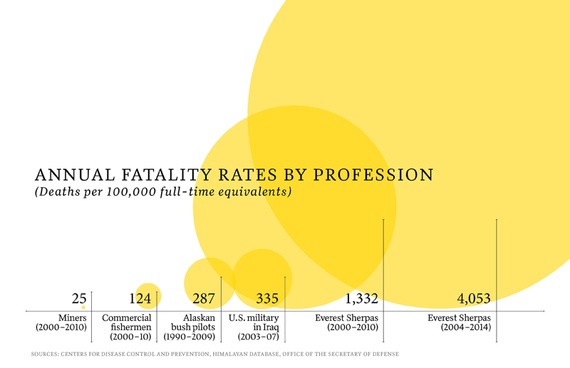
After threatening a work stoppage over unfair pay and grueling work conditions, the Nepalese mountaineers who clear the way for recreational climbers on Mount Everest have voted to leave the mountain and cancel the 2014 climbing season entirely out of respect for the 16 sherpas who died in an avalanche last Friday – the worst climbing accident in Everest’s history. Svati Kirsten Narula looks into how much more dangerous the mountain is for sherpas than for the climbers they serve:

There has always been a divide between Sherpas and Western summit-seekers, but these tensions have increased in recent years as Everest has become more accessible to unskilled-but-well-heeled climbers. The world’s tallest mountain has become much safer for the average Joe than ever before. For the people who live in its shadow, though, and must return to it again and again to earn a living, the risks haven’t declined in the same way. …

Western expedition leaders are acutely aware of this sobering reality [that being a Sherpa is more dangerous than being an American soldier during the Iraqi insurgency], and many have established funds for the families of fallen Sherpas. It’s difficult, though, to assuage the guilt of leaving the mountain with fewer people than you brought there. Melissa Arnot, the Eddie Bauer-sponsored American mountaineer who has summitted Everest five times, had a Sherpa die on an expedition of hers in 2010. Reflecting on this in 2013, she told Schaffer: “My passion created an industry that fosters people dying. It supports humans as disposable, as usable, and that is the hardest thing to come to terms with.”

Jon Krakauer, author of Into Thin Air: A Personal Account of the Mt. Everest Disasterelaborates on what makes the job so dangerous:

Sherpas aren’t provided with nearly as much bottled oxygen, because it is so expensive to buy and to stock on the upper mountain, and they tend to be much better acclimatized than Westerners. Sherpas are almost never given dexamethasone prophylactically, because they don’t have personal physicians in their villages who will prescribe the drug on request.

And perhaps most significant, sherpas do all the heavy lifting on Everest, literally and figuratively. The mostly foreign-owned guiding companies assign the most dangerous and physically demanding jobs to their sherpa staff, thereby mitigating the risk to their Western guides and members, whose backpacks seldom hold much more than a water bottle, a camera, an extra jacket, and lunch. The work sherpas are paid to do—carrying loads, installing the aluminum ladders, stringing and anchoring thousands of feet of rope—requires them to spend vastly more time on the most dangerous parts of the mountain, particularly in the Khumbu Icefall—the shattered, creaking, ever-shifting expanse of glacier that extends from just above base camp, at seventeen thousand six hundred feet, to the nineteen-thousand-five-hundred-foot elevation. The fact that members and Western guides now suck down a lot more bottled oxygen is wonderful for them, but it means the sherpas have to carry those additional oxygen bottles through the Icefall for the Westerners to use.

Although the sherpas say their decision to sit out the season is about mourning their colleagues, Bryce Covert examines the labor dispute:

Somewhere between 350 to 450 Sherpas work above Everest’s base camp during the season, which lasts two months. Despite the fact that climbers each pay a $10,000 peak fee to Nepal’s Ministry of Tourism and tens of thousands to commercial climbing guide companies, Sherpas usually get about $125 per climb for each legal load, although some take on more to earn more. They usually haul about $3,000 to $5,000 a season, although given that the average yearly salary in Nepal is about $700, many are drawn to the pay. But Western guides can make $50,000 to $100,000. …

The demands include an immediate payment of 40,000 rupees, or about $400, to the families of the victims, covering the costs of treatment for the injured, and a payment of 10 million rupees, or about $100,000, to those who won’t be able to continue working on the mountain due to their injuries. It also calls for allowing expedition teams to call off the season’s climbing and refusing to fix ropes and ladders this season, plus perks and salaries paid to the Sherpas if climbing is suspended. They have called for the creation of a relief fund through 30 percent of the royalties from issuing permits, something guides and Sherpas have called for for many years, as well as doubling their current life insurance policy payments from the current million rupees, or $10,000, to two million rupees, or $20,000.

Update from a reader:

Thanks for this curation of good reads. Here’s another gorgeous, intimate read from a young female Sherpa. It’s the point of view we too rarely see in Western media.

Over The Hill At 24, Ctd

A reader doesn’t quite buy the notion that cognitive performance peaks in one’s mid-20s:

Yeah, bite me. Gabriel Garcia Marquez was 40 when he published his most popular and most seminal work, One Hundred Years of Solitude. You hear that? One hundred years. What, are the next 76 going to be in spent in obsolescence? His characters lived a hell of a lot longer than 24, and they were lively and smart to the very end. In the real world – Newton, Dickens, Springsteen. Sure, you can say “But they’re geniuses,” but billions of regular folk get sharper and better with age.

These kinds of studies just reinforce the concept of life as a rat race – a minute-by-minute, day-by-day competition to win at the game of life instead of lose. That’s not healthy. Life is amazing, as Carl Sagan said. It’s not a battle. There are no winners and losers. What makes true happiness? I would posit an answer of living a content life, free from anxiety and worry – including the worries about studies that say you’re over the hill when you’re still young enough to be carded at restaurants.

A 27-year-old reader:

I’ve got to question the reasoning behind seeing a lag in “seeing and doing” between a 24-year-old and a 39-year-old. Can we not chalk that up to a penchant for slightly more forethought and planning as we age? No doubt there is a bit of pruning that goes on following adolescence. (I know because the Dish told me so.) Brains shrink. Synapses slow. In the context of judgment calls, I would argue the ability to plot strategy – chess vs. checkers – increases over time.

Mostly though, I know I’m on the downhill slide. Don’t rub it in.

But maybe he isn’t; another reader points to a recent article in New Scientist in which computational linguists Michael Ramscar and Harald Baayen argue that “our brains work better with age”:

Contrary to popular belief, neuronal loss does not play a significant role in age-related changes in brain structure. Rather, consistent with our findings, most of the changes that occur as healthy brains age are difficult to distinguish from those that occur as we learn. Thus, understanding the costs and benefits of learning is critical if we are to establish the facts of cognitive aging.

For example, memory experiments show that, as we age, we “encode” less contextual information, such as what we were wearing when we learned a new fact. This makes the fact harder to recall, and is seen as a sign of cognitive decline. Yet everything we know about the way our brains learn indicates that people must inevitably become insensitive to many background details as life experience grows. This is simply because detuning our attention to irrelevant information is integral to the process we call “learning”. …

We are not arguing that the functionality of our brains stays the same as we grow older, or that cognitive decline never happens, even in healthy aging. What we do know is the changes in performance seen on tests such as the PAL task are not evidence of cognitive or physiological decline in aging brains. Instead, they are evidence of continued learning and increased knowledge. This point is critical when it comes to older people’s beliefs about their cognitive abilities. People who believe their abilities can improve with work have been shown to learn far better than those who believe abilities are fixed.

The aforementioned reader adds, “I know I would rather have a 24-year-old as a fighter pilot, but a 50-year-old as an airline pilot.” He’s not the only one: a historically-minded reader notes that “in the Second World War, the Royal Air Force limited fighter combat to pilots who were younger than 26. Their estimate was that the reflexes began to slow enough to make it a fatal risk.” Update from a reader:

First of all: as a 28-year-old gamer-scientist who plays both StarCraft 1 (SC1) and StarCraft 2 (SC2) – and both since launch – I’ve been playing SC1 for just over 16 years now! – this journal article is fucking infuriating. So much bad science, so much bad gaming reporting. First of all: the base data (Ref. 1 in the PLoS article, which you can find here), only looks at a few characteristics as to what makes a “better” gamer in SC2. It turns out: being a faster neurotic (higher APM), using high tech unit / spell casters more often and wisely. The follow-up looks at how players across different ages compare to these “characteristics” and what their league level is.

Ok, here’s my scientist part: what is their control game? So far all I’ve seen is data that shows older SC2 players do worse according to their definitions of a good SC2 player compared to younger players.

As a gamer: SC1 and SC2 are different games with almost the same base. Older players who played a lot of SC1 just do NOT play SC2 the same way because we have over a decade of training to play it differently. SC1 rewards: high APM, high macro, high tech / low spell units. And if you look at the data in the cited PLoS article, it turns out the data seems to say: hey, lower skill players are all over the place (fig 3(a) in ref), but high skill players are all concentrated in the young groups (fig 3(f) in ref).

As a scientist: do other games of similar skill/age profiles show the same age-histograms? Could it be that older people have less time to play these types of games and therefore make up less of the % of leagues?

As a gamer, on pg 6 they directly mention that older gamers do better than younger players on a direct skill that was highly rewarded in SC1. As an “older” SC1/2 gamers, this fits my first point – SC1 players who transitioned to SC2 just play differently. It’s a mechanics issue where the new rules are directly fighting against 10+ years of trained playing.

Finally: we have seen over multiple reports recently that there has been a giant uptick in cognitive ability that might be directly related to lead exposure (see all the reporting by Kevin Drum at Mother Jones, but I have heard sociologists talking about this since at least 2005). You are looking at a report that compares people from ages 16-44 (those born between 1997 – 1969). So whats the baseline cognitive ability? Yes, there could be one, but there is no control.

A Latta Discrimination

A reader writes:

I know you’re not the biggest fan of pushes for laws such as ENDA, but thought I would share this with you anyway. Crystal Moore has been with the police force of sleepy Latta, South Carolina for more than 20 years, capping her career serving as the town’s police chief. She’s an out lesbian. On April 15, she was fired by the mayor, her pristine service record being marred by the SEVEN disciplinary letters he handed to her that very afternoon. After refusing to sign without having an attorney check them out, he dismissed her. These letters were the result of the police chief investigating a recent hire of the mayor’s for whom the mayor did not do his due diligence, and who was supposedly driving a city vehicle with a suspended license. Now, all of a sudden he’s not answering questions regarding the firing but was recorded in conversation with a fellow council member saying the following (audio here):

I would much rather have.. and I will say this to anybody’s face… somebody who drank and drank too much taking care of my child than I had somebody whose lifestyle is questionable around children.

Because that ain’t the damn way it’s supposed to be. You know.. you got people out there – I’m telling you buddy – I don’t agree with some of the lifestyles that I see portrayed and I don’t say anything because that is the way they want to live, but I am not going to let my child be around. I’m not going to let two women stand up there and hold hands and let my child be aware of it. And I’m not going to see them do it with two men neither. I’m not going to do it. Because that ain’t the way the world works.

Now, all these people showering down and saying “Oh it’s a different lifestyle they can have it.” Ok, fine and dandy, but I don’t have to look at it and I don’t want my child around it.

Pure bigotry. Disgusting. But the silver lining to this is the amount of outcry from within the small, rural community of all ages and races have been rallying to her cause. She was a good, competent police chief. She was well regarded in the community, and they see what Mayor Bullard did and recognize it for exactly what it is – animus. Local reports have said that in excess of 100 people filled council chambers and out into the hallways, despite the mayor’s best efforts to quash debate, even going so far as to forbid entry to the public meeting to nonresidents of the town (illegal).

I’m from this region of South Carolina, and I couldn’t be more proud of all the folks for standing up for what’s right. I’m hoping the council is able to reinstate Chief Moore. Unfortunately in SC, by law there’s no way to impeach a mayor; only the governor can remove them from office for committing crimes. I have my doubts that Gov. Haley will remove the mayor despite what may prove to be several illegal actions by the mayor.

Update from a reader:

I finally know enough about something to write in because am originally from the tiny town of Latta and personally know many of the people involved.

One aspect of the case that the previous reader left out is that prior to Ms. Moore’s firing, the town’s recreation department head, who also happens to be openly gay, abruptly resigned and took another job in a nearby town shortly after the town’s new mayor took over last December. She was also a well-respected member of the community and by all accounts had also done a fantastic job in running her department. So we have two high-profile gay citizens with exemplary records and many years on the job who are both now gone (one resigned, one terminated) within a few months of an unabashedly anti-gay mayor coming into office. On the surface, it appears to be an open and shut case of discrimination on the basis of sexual orientation.

The problem here is that quite often in small towns, it is very difficult to get to the truth in matters such as this. Although I have been very proud to see a community that is very conservative and Christian rising up to support the former police chief, the charges of anti-gay animus have somewhat overwhelmed the facts in the case – namely, the seven reprimands that the mayor drew up in short order against Ms. Moore. Very few people know exactly what has transpired in the police department, yet the protesting citizens of the town have decided that they know the real reason for the firing and are out to reconcile the situation via public pressure.

We will most likely see this play out in the courts. I do hope that that process reveals the truth in the case. In the meantime, my tiny hometown will have to serve as a flashpoint in the very complicated arena of equal rights.

A Blow To Race-Based Admissions

This morning the Supreme Court issued a 6-2 ruling (pdf) upholding a Michigan referendum banning affirmative action in college admissions, reversing a 6th Circuit decision:

Justice Kennedy penned the plurality opinion for the court, joined by Justices Alito and Chief Justice Roberts, arguing that neither the Constitution nor previous court precedent gives the courts the authority to overturn a voter-approved prohibition on race-conscious admissions policies. Justices Breyer, Scalia, and Thomas filed concurring opinions, while Sotomayor wrote the dissenting opinion. Justice Ginsburg joined in the dissent, while Justice Kagan was recused from the case and did not vote.

“It is important to note what this case is not about,” Kennedy wrote in his opinion. “It is not about the constitutionality, or the merits, of race-conscious admissions policies in higher education.” The Coalition to Defend Affirmative Action had challenged the state ban on constitutional grounds, arguing that the voter ban violated the equal protection clause of the Fourteenth Amendment.

Nora Caplan-Bricker explains the likely repercussions of the ruling:

[I]ts most immediate impact will be in the six other states that, like Michigan, have passed ballot initiatives banning affirmative action: Arizona, Florida, Nebraska, New Hampshire, Oklahoma and Washington.

Any attempt to challenge those bans is now “futile,” Robert M. O’Neil of The University of Virginia School of Law wrote in an e-mail. The ruling could also inspire other states to hold ballot initiatives—or could spur out-of state activists to look for places propose them, said Michael A. Olivas of the University of Houston Law Center.

The opening for activists could stretch beyond racial preference in admissions. Barbara A. Lee, an attorney who teaches at Rutgers’ School of Management and Labor Relations, predicted the ruling would “encourage those who oppose any form of preference (possibly even those related to social class, income, geography, etc.) to organize a grassroots movement to eradicate by ballot initiative the policies that educators have developed to broaden the scope of educational opportunity for groups traditionally excluded from access to public higher education, either by law or by poverty.”

When the Supremes took up the case last year, Bazelon called it “a case that liberals will lose, and probably deserve to lose”:

It’s about whether states may ban schools from using affirmative action. That’s what Michigan did by passing a ballot initiative in 2003 called Proposal 2. I wouldn’t have voted for it. But should the Supreme Court say that when voters decide to restrict the use of affirmative action, they have violated the Constitution? There is no way that the conservative majority of the Supreme Court will answer yes. And that is probably the correct outcome in terms of policy. To say so deviates from the usual liberal line on affirmative action, laid out today in a New York Times editorial.

And yet: The current huge fairness problem in university admissions isn’t race-based. It’s class-based. And it is at the schools of the 10 states across the country that have banned affirmative action where the most interesting socioeconomic alternatives are unfolding. The Supreme Court won’t stand in the way of those experiments. And it shouldn’t.