Saving Kurdistan

Michael Totten makes the case for ensuring that, no matter what, a free Kurdistan will remain part of America’s legacy in Iraq. Money quote:

[I]t is hard to overstate how pro-American the people of Kurdistan are. They are possibly more pro-American than Americans themselves. If Bill Clinton was America’s first "black" president, people in at least one part of the world say Bush is the first "Muslim" one: He is sometimes referred to in Kurdistan as "Hajji Bush" (meaning that he made the Muslim pilgrimage, or Hajj, to Mecca), an undeniably high honor for a Republican Christian from Texas. No, Kurdistan is not a "red state," and Kurds are not Republicans. Nor does it occur to most of them to prefer America’s conservatives over its liberals. Rather, their warm feelings of gratitude and friendship extend to all Americans and both political parties for having liberated them from the totalitarian dictatorship of Saddam Hussein…

Iraqi Kurds, though, are much more aggressively pro-American than Israelis.

They arguably take their pro-Americanism to the point of absurdity. Fake McDonald’s restaurants with names like "MaDonal" pop up in Kurdistan nearly as fast as real McDonald’s chains devour the landscapes of Western cities. Teenagers wear United States Army uniforms, T-shirts, and pants as a fashion statement—and they do so without irony. Even some of the waiters in restaurants wear button-up shirts with the words us army stitched above the breast pocket.

However, strident Kurdish pro-Americanism is older than the no-fly zones and the liberation from Iraq. As the Peshmerga’s famous guerilla leader Mullah Mustafa Barzani once told Jim Hoagland of the Washington Post, "We can become your fifty-first state and provide you with oil." That was in 1973.

Now In Paperback

"Sullivan has been more honest and open-minded than just about anybody else on the right… He has continued to think of himself as a Tcs2_5 conservative. And he has been forced to ask himself the question that many conservatives have been forced to ask themselves: If I am a conservative, and I detest many of the things this conservative administration has been doing, then what kind of conservative am I and what kind of conservatives are they? " – David Brooks, New York Times.

"This book is not a worked-out political program but an unfinished account of Mr Sullivan’s own struggle to integrate and make sense of his faith and his politics. What Mr Sullivan has to say about these subjects – indeed what he has to say about most things – is interesting, elegantly expressed and deeply thought through. The Conservative Soul is peculiar and inconclusive, but it is also intellectually challenging and thoroughly captivating," – The Economist.

A Shiite Awakening In Iraq?

Ramadialiyussefafpgetty

A reader in Iraq writes:

You state that it is unclear why the violence levels are dropping in Iraq. I tried to explain why it is happening. I didn’t intend to convince you – there is little hope of doing that since you are not able to see what I see 24 hours a day over here. I’m just giving you a heads up so you know what to look for as the story unfolds. I will reiterate a couple of points: 

What is happening has little to do with the surge.  The surge helps, but it could just as easily have lead to more violence not less.

The main driving force is the Awakening Movement that is sweeping the country.  Al-Anbar has changed so completely that it is hardly believable.  The Sunni parts of the rest of the country lag behind Al-Anbar and the Shia parts lag behind them, but I assure you the Awakening Movement is taking hold everywhere.  And after the tribes clear the bad guys out of an area, they start right in forming parties and engaging good old fashioned messy, chaotic and dirty politics.

An Arab democracy is being formed here.  Forming political parties and coalitions is the new growth industry.  It is staggering just how enthusiastically Arabs take to this sort of thing.   

I’ll leave you once again with the the quote from Sheikh Sattar.  Recall that Sattar was a small time Sheikh and one time insurgent from Al-Anbar (Anbar was by far the deadliest place to be during this war), who rid Al-Anbar of the insurgency and created the idea of the Awakening which has spread to all of Iraq:

"The Sahawa [Awakening] began because people thought the Americans were the enemy.  We rose up and let the people see the truth – let them see that the Americans are here to help us.  That was the true Awakening" – Sheikh Abdul Sattar Albu Risha, 26 May 2007.

We are winning this war.  A year from now much of today’s conventional wisdom will have been turned on its head.

From a long way away, the promised reconciliation is not occurring. But wars are opaque; they change quickly; Iraq remains a mystery to most of us. If the Shiites begin to mimic the Sunnis in Anbar, then we have a new ball-game. Here’s another nugget of news that strikes me as a big deal:

In the city of Ramadi in Anbar Province, more than 40 Shiite tribal and political leaders met with Sunni tribal leaders in a significant display of support for the Sunni alliance fighting against the insurgent group called Al Qaeda in Mesopotamia, a homegrown Sunni Arab extremist group that American intelligence agencies have concluded is foreign led.

The three-hour meeting, to which the Shiite political and tribal leaders traveled in American military helicopters, was organized by the Awakening Council, a coalition of Sunni tribes in Anbar that have begun fighting Al Qaeda in Mesopotamia for control of the province.

It was the first time that Shiite political leaders had traveled to Anbar to meet with the Sunni coalition at a gathering of sheiks.

Hmmm.

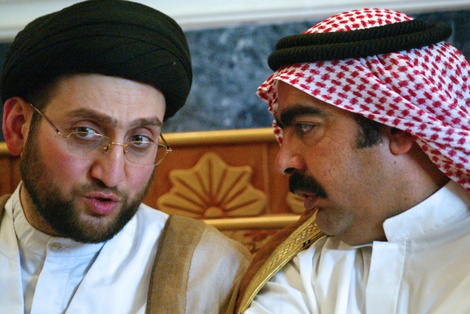
(Photo: Iraqi Shiite leader Ammar Hakim (L), a leading figure of the Supreme Islamic Iraqi Council (SIIC), meets with Iraqi Sunni Sheikh Ahmed Abu Risha, the brother of slain leader Sheikh Abdul Sattar Abu Risha, 14 October 2007 in Ramadi. The two leaders are figure heads of their community and their meeting heralds the determination to bridge the gap between the Shiite and Sunni communities in Iraq. They met under the protection of the US Army. Sheikh Abdul Sattar Abu Risha was assassinated 13 September in a car bomb attack, almost a year after he formed the Anbar Awakening Conference, a coalition of 42 Sunni tribes who along with US troops fought Al-Qaeda in Anbar. Sheikh Ahmed was elected to replace his brother. By Ali Yussef/AFP/Getty.)                   

Email Of The Day

An automated non-reader writes:

Thank you for taking our spending habits survey.

Your survey responses place you on the TIGHTWAD portion of the Tightwad-Spendthrift dimension.

Scale scores range from 4 to 26. Your score (8) was shared by 2.7% of our original sample of over 13,000 people. Again, thanks very much for participating!

My fiscal conservative credentials go up a notch.

Turning The Dancer

A reader writes:

Like you, for me she goes clockwise but you can reverse her:

Stare at her left heel, the one that "hits" the "floor". Now look at the reflection of the foot as it hits the floor. "Make" it change direction. Imagine it goes counter clockwise. Soon it will. There is some kind of "jerk" in the image…when the loop starts again or maybe it is on purpose. That’s where I can reverse it.

Now, while still concentrating on the "reflection" of her left heel, bring your focus out a bit until you see her leg swinging counter clockwise. If it is still going clockwise, look at only the reflection of her foot again. Keeping trying that until you get the leg swinging counter clockwise.

Ahhh. From right-brain to left brain. Like looking very closely for four years at Iraq. But it keeps switching back!