“Hogmeat And Hoecake”

by Dish Staff

dish_southernpork

Jennifer Jensen Wallach reviews Sam Bowers Hilliard’s recently reprinted Hog Meat and Hoecake: Food supply in the Old South, 1840–1860, admiring the author for examining “patterns in eight states of the former Confederacy to learn what Southerners ate and how effective they were at producing their own food”:

Swine, he shows, appeared on regional tables in the colonial period, and it remains today one of the most obvious markers of Southern-style cooking. “If the ‘king’ of the antebellum Southern economy was cotton, then the title of ‘queen’ must go to the pig.” And yet, Hilliard explains, the meanings assigned to different foods change over time, and although many relished the meat, antebellum Southerners were sometimes ambivalent about their dependency on pork, deeming it a coarse, indigestible food more appropriate for the beleaguered enslaved population than for the purportedly delicate white Southern belle. Despite the consternation of medical professionals such as John S. Wilson, who despaired in 1860 of the quality of fare served in the “great Hog-eating Confederacy, or the Republic of Porkdom”, nineteenth-century Southerners ate about 150 pounds of the meat annually. Because plantation owners were reluctant to set aside land for grazing cattle that could be used to grow cotton, beef was in short supply and thus rarely eaten by the enslaved population or by poor whites. Mutton served, according to Hilliard, as merely an “occasional diversion” in a pork-focused diet.

Corn was the other foundational element in the Southern diet, and the persistence of cornbread on contemporary Southern menus indicates that this pillar is still intact. Antebellum Southerners grew as much corn as they did cotton, and the grain was a staple across the class and caste spectrum. Although wheat was grown in the Southern hills and rice was cultivated in Louisiana and along the Atlantic Coast, neither grain challenged the South’s identity as “corn country”. Hilliard’s subjects rounded out their meals with garden crops such as sweet potatoes, cowpeas, turnips and watermelon, foods that are still subjected to endless variations in nouveau Southern cooking. Southerners, both enslaved and free, also hunted for venison and smaller game, including possums, raccoons and squirrels, animals yet to be rebranded as sources of “heritage” foods worthy of a place on the menus of high-end restaurants.

Update from a reader: “It has long been a Southern truism that ‘We eat every part of the pig but the oink.'”

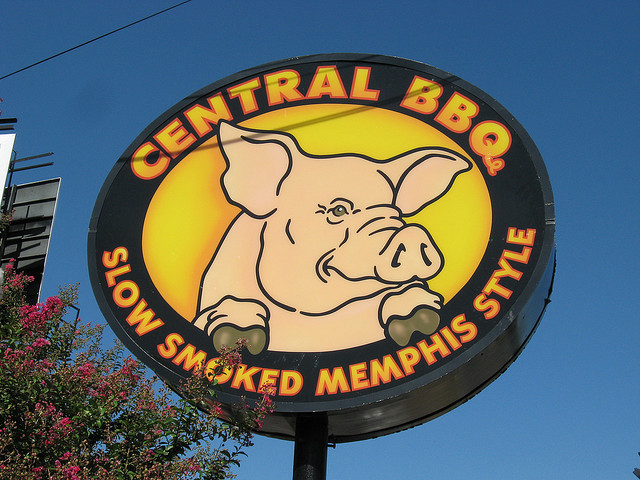
(Photo of Central BBQ Sign in Memphis via Southern Foodways Alliance)


Does “Stupid” Have A Place In Political Discourse?

by Dish Staff

About two weeks ago, Paul Krugman caused a tiff by obliquely calling Paul Ryan “stupid,” leading Laurence Kotlikoff to respond, “No one, and I mean no one, deserves to be called stupid.” (Krugman later clarified that he believes Ryan isn’t stupid, but rather a “con man.”) In a post relevant to all in the blogosphere, Noah Smith mulls over the power of the s-word:

Now, calling people “stupid” is certainly not polite. But I never cease to be amazed at how effective it is in terms of making people choke on their own rage. People really do not like being called stupid. … In the end, I think people overreact to the “stupid” insult because, as a society, we use arguments the wrong way. We tend to treat arguments like debate competitions– two people argue in front of a crowd, and whoever wins gets the love and adoration of the crowd, and whoever loses goes home defeated and shamed. I guess that’s better than seeing arguments as threats of physical violence, but I still prefer the idea of arguing as a way to learn, to bounce ideas off of other people. Proving you’re smart is a pointless endeavor (unless you’re looking for a job), and is an example of what Stanford University psychologist Carol Dweck calls a “fixed mindset.” As the band Sparks once sang, “Everybody’s stupid – that’s for sure.” What matters is going in the right direction – becoming less stupid, little by little.

Megan McArdle similarly sees “stupid” as a rhetorical crutch:

Ultimately, calling people stupid is simply a performance for the fellow travelers in your audience. It’s a way that we can all come together and agree that we don’t have to engage with some argument, because the person making it is a bovine lackwit without the basic intellectual equipment to come in out of the rain. So the first message it sends – “don’t listen to opposing arguments” – is a stupid message that is hardly going to make anyone smarter. The second message it sends is even worse: “If he’s stupid, then we, who disagree with him, are the opposite of stupid, and can rest steady in the assurance of our cognitive superiority.” Feeding your own arrogance is an expansive, satisfying feeling. It is also the feeling of you getting stupider.

Update from a reader:

When Krugman suggested that Paul Ryan was a “stupid person’s idea of what a thoughtful person sounds like,” he was not calling Paul Ryan stupid. He was, quite plainly, suggesting that those who thought that Ryan was thoughtful were the stupid ones.

Another elaborates:

I read both Krugman’s original article and his supposed clarification and I did not at all get the impression that he was calling Paul Ryan stupid. He begins with a quote by Ezra Klein, in which he describes Dick Armey as “A stupid person’s idea of what a thoughtful person sounds like”. Krugman goes on:

It’s a funny line, which applies to quite a few public figures. Representative Paul Ryan, the chairman of the House Budget Committee, is a prime current example. But maybe the joke’s on us. After all, such people often dominate policy discourse. And what policy makers don’t know, or worse, what they think they know that isn’t so, can definitely hurt you.

This is Krugman’s only reference to Ryan in the entire column, so this has got to be where his critics are accusing him of, at the very least, implying that Ryan is stupid. However, the plain reading of the passage does not bear this interpretation out. This is, after all, English grammar. Words have consequences.

Obviously, Paul Ryan is a public figure who, in Krugman’s estimation (and to follow his implied comparison), would be a substitute for Dick Armey in Klein’s quote. Krugman is in no way saying that Ryan is stupid, but rather that he is “A stupid person’s idea of what a _______ person sounds like”. In this blank you could insert the word “smart”, “serious” or any one of a number of descriptions, but I think it is quite clear that Ryan is NOT being singled out as being stupid. At least, not by Krugman is this particular column he isn’t.

With that said, Krugman DOES seem to be obliquely accusing anyone who believes that austerity cures recessions and that stimulus spending makes them worse of being wrong and, perhaps even wrong-headed. In fact, you might even take that a step further and accuse Krugman of calling pretty much anybody who believes these things stupid, but those who interpret him as specifically calling Paul Ryan “stupid” here are, I hate to say it, kind of stupid.

The Best Of The Dish Today

That’s a future prime minister up there. Won’t it be fun? Meanwhile, a reader writes:

This whole “least happy city” thing has (of course) got me riled up…

I think the key here is in the wording: satisfaction is not synonymous with happiness. It stands to reason that New Yorkers, as a species, are more dissatisfied than residents of Nashville (the adjusted “most satisfied” city). I have spent quite a bit of time in Nashville – great place, nice people – but they are satisfied with one small art museum with an ok collection, satisfied to see “Paula Deen Live” or a touring production of “The Book of Mormon” at the Tennessee Performing Arts Center, satisfied with decent but ultimately uninspired and mediocre food, satisfied with a lovely – if underfunded – library, satisfied with pretty good colleges, satisfied with four blocks of walkable urbanism downtown, etc.

New Yorkers want (and expect) MORE. New Yorkers are unsurprised that they can see Vermeers at the Frick AND the Met. New Yorkers have seen great theater, which makes them want even better theater. It’s not uncommon for a New Yorker to eat great food one week, then compare it to a better meal they had last week . New Yorkers are currently arguing about how to make the Fifth Avenue main branch of the New York Public Library even better. New Yorkers greet Columbia and NYU with a shrug (not to mention the great CUNY system). And no place on earth (except perhaps Paris) is more focused on the quality and character of the urban environment than New Yorkers – and in every borough.

Perhaps Nashville delivers satisfaction. Nashville pleases. New York teaches New Yorkers the art of dissatisfaction. New Yorkers expect an awful lot from their city, and when it delivers, it surpasses all expectation. As you well know, it doesn’t give up those moments as often as we might like, but I for one, would rather a chance at the sublime than a guarantee of comfort…

Biased and balanced. Speaking of which, an update from another reader:

All I can say to your NYC reader who seems to think Nashvilleans (and presumably all other non-New Yorkers) are satisfied with their lives because they somehow don’t KNOW to expect better is … bless his or her heart.  It’s so nice to see a New Yorker live up to the reputation of being a condescending prick.

Today, we celebrated cheap beer, back hair and loud farts in movie theaters. We lamented the murderousness of ISIS, the cynicism of Hamas, the spreading scourge of sponsored content, and the rise and rise of the Israeli right. Readers pushed back on my criticism of Israel’s latest Gaza war; and I backed Douthat’s critique of what Obama might do on illegal immigration.

The most popular post of the day was The Last And First Temptation of Israel; followed by Back Hair Is Beautiful.

Many of today’s posts were updated with your emails – read them all here.  You can always leave your unfiltered comments at our Facebook page and @sullydish. 24 more readers became subscribers today – bringing us to 29,907. Help us get to 30,000 here – and get access to all the readons and Deep Dish – for a little as $1.99 month. Gift subscriptions are available here. Dish t-shirts and polos are for sale here. One subscriber writes:

I had the wonderful yet rainy weekend in Provincetown. We were able to also take in Miss Martina’s show. I thought I saw you outside the Wired Puppy coffee shop Saturday eve but reader-hat-shadesdid not want to interrupt your private time. It is through your stories of Ptown that made me want to visit. I have been a huge fan of your blog for the past 7 years. It has made a difference in my intellectual life. I know I can always read thoroughly about a topic. I became an obsessive reader during President Obama’s elections and the Arab Spring and most recently the Israel and Gaza conflict. I have also been reading How to Live, a great book club selection. I have been a subscriber for the last two years and will continue. I still sport your original t-shirt around Wilmington, DE.

Enjoy the rest of summer in your town and thanks for the tip to come. Such a great, friendly town.

See you in the morning.

A Cure For Ebola?

Kent Brantly and Nancy Writebol, the American ebola patients now being treated in the isolation unit at Emory University Hospital, received an experimental treatment while still in Liberia that may have saved their lives. James Hamblin looks into just what this “top-secret serum” is:

[It’s] a monoclonal antibody. Administration of monoclonal antibodies is an increasingly common but time-tested approach to eradicating interlopers in the human body. In a basic monoclonal antibody paradigm, scientists infect an animal (in this case mice) with a disease, the mice mount an immune response (antibodies to fight the disease), and then the scientists harvest those antibodies and give them to infected humans. It’s an especially promising area in cancer treatment.

In this case, the proprietary blend of three monoclonal antibodies known as zMapp had never been tested in humans. It had previously been tested in eight monkeys with Ebola who survived—though all received treatment within 48 hours of being infected. A monkey treated outside of that exposure window did not survive. That means very little is known about the safety and effectiveness of this treatment—so little that outside of extreme circumstances like this, it would not be legal to use. [Sanjay] Gupta speculates that the FDA may have allowed it under the compassionate use exemption.

John Timmer has more on the treatment:

Fortunately, Mapp [Biopharmaceutical, the drug company working on zMapp,] has been publishing papers describing its progress on an Ebola treatment as it went along, so it’s possible to understand how the therapy was developed and how it operates.

Despite its fearsome behavior, Ebola is a fairly simple virus, with only seven genes. The gene that is essential for the virus to attach to human cells, called Ebola glycoprotein, has been identified previously. Antibodies that stick to this protein would be expected to block infection of new cells and target any virus circulating in the blood stream for destruction. The problem appears to be that an effective antibody response comes too late for the patients. (The virus also takes steps to tone down the immune response.) Mapp decided to do the immune system’s job for it by making antibodies that can then be injected into infected individuals to perform the same function. The challenges are making the right ones and making enough of them.

Shirley Li notes that zMapp isn’t the only experimental ebola treatment out there:

So why ZMapp, of all the experimental solutions to Ebola, of which there are many? Perhaps it comes down to Mapp’s recent successes: The NIH included Mapp in its $28 million five-year grant awarded to five companies to research Ebola further in March. A press release dated July 15, 2014 revealed that Defyrus, a private life sciences biodefense company based in Canada, had partnered with Mapp’s San Diego-based commercialization partner firm Leaf Biopharmaceutical Inc., to push the ZMapp serum’s clinical development. And just last week, the Defense Threat Reduction Agency announced it awarded a contract to Mapp to continue development of the serum.

Still, fighting Ebola means a multi-pronged attack. While Mapp’s method focuses on eradicating the disease after infection, the NIH has been working on preventing it in the first place. In the NIH’s case, it’s working to promote development of antibodies within the subject, instead of injecting them from an outside source that survived Ebola.

Steven Hoffman and Julia Belluz blame the lack of an effective ebola treatment until now on the way pharmaceutical companies prioritize their R&D:

Ebola will continue to move through Africa — this time, and again in the future — not only because of the viral reservoirs and broken health systems specific to the continent. There are much larger issues at play here. Namely, the global institutions we designed to promote health innovation, trade, and investment perpetuate its spread and prevent its resolution.

This shouldn’t be news. Most all of the money for research and development in health comes from the private sector. They naturally have a singular focus — making money — and they do that by selling patent-protected products to many people who can and are willing to pay very high monopoly prices. Not by developing medicines and vaccines for the world’s poorest people, like those suffering with Ebola. Right now, more money goes into fighting baldness and erectile dysfunction than hemorrhagic fevers like dengue or Ebola.

Follow all of our ebola coverage here. Update from a reader:

In the past I have been very critical of your coverage and thoughts on scientific matters; it’s incredibly frustrating to see published opinions littered with “rookie mistakes” from people who lack scientific training. As someone who is highly educated in these matters and has to compete for diminishing public funds, I have no tolerance for the long history of scientific inaccuracy from the media.

Having said that, your coverage of the Ebola epidemic has been pleasantly accurate and appropriate. I especially appreciate you highlighting Steven Hoffman and Julia Belluz’s article. They highlight a searing problem in our current research system; research priorities go towards profitable markets. The federal government is supposed to offset that, but thanks to the current batch of Republicans, worthwhile funding opportunities are going unfunded.

A colleague of my boss recently received a perfect score on a federal grant, but it did not get funded. There was nothing wrong with the grant scientifically, conceptually, or practically; they just ran out of money. The big problem is that funding opportunities aren’t growing while the scientific community is expanding. This has led us to the current ultra-competitive environment where there is no lack of sound ideas, projects, and causes that can directly be addressed and make real, lasting impacts on people’s lives.

But there’s no profit there, so Big Pharma researches ED, makes boner pills instead, and sleeps on beds of cash while poor people die of Ebola. “And the beat goes on…”

What’s Your Favorite Place To Read? Ctd

IMG_0238

Sending the above photo, a reader answers:

This spot (so I can get high).

Another in Boston:

My favorite place is the MBTA’s Red Line. I get on at Alewife (the end of the line) so I always get a seat, and I read all the way to Downtown Crossing.  I’ve been doing this commute for twelve years and I think I’ve read more in this fifth of my life than in the other four-fifths combined.

Another can’t pick just one:

My number one most favorite place to read is in the bathtub.  For a while, I had a water-proof protective case for my i-Pad, because I was afraid I would drop it in the tub, but then decided that it was too annoying, so now I just take my chances.  So far, so good.  A bonus is that, unlike books, which get a little waterlogged just from little drops of water on my hands even when I don’t actually drop the book in the tub,  the i-Pad is amazingly impervious to water.  My screen often looks like it is quite dirty, though, when in fact, it is just streaked with soap.

My second most favorite place to read is on the train.

I hate commuting, it sucks, but the one good thing about it is that for 70 minutes a day, 35 minutes each way (plus whatever time I am on the train waiting for it to leave) I am stuck sitting in one place, and can read uninterrupted, without guilt that I should be doing something else.  I try to sit in the quiet car, all the way in the back where no one bothers me.

Finally, I like to read in restaurants, while I am having lunch on a work day usually.  Even when I’m very busy at work, I will usually find time to grab a bite to eat, and will read while I do so.  The i-Pad also has increased my reading efficiency in this regard.  When I am reading a physical book (which I still do regularly, although not nearly as much as I read on my i-Pad) the book will flip shut if I have to let go to pick up a sandwich or cut something, so I may have to put the book down between bites, or balance a ketchup bottle on it to keep it open.  With the i-Pad, I just prop it up, and read hands free.

More reader responses here. Update from another:

I have lots of favorite places to read, but I’m also the mom to 19 month old, so life is not as flexible as it used to be. So right now, my favorite place to read is on my couch, after the boy has gone to bed, with a glass of wine on the side table and the sweet silent hiss of the baby monitor in my ear. It’s heaven when I can stay up late enough to get through a chapter.

I’m loving this thread, which is a nice break amidst all the heartbreak.

Godless Republicans Do Exist

While suggesting a few caveats to S.E. Cupp’s assertion that conservatism isn’t hostile to atheism, Allahpundit offers some reasons why she has a point:

She’s right that most conservatives welcome atheist fellow travelers. I remember telling a friend before [Hot Air] launched that I’d be writing for a righty website and him telling me that I should hide my nonbelief, but I didn’t and it’s never been a problem. The most static I catch for it is when I’ve written something extra RINO-y and a commenter grumbles that we shouldn’t expect any better from the godless. Even that’s rare; the smoking gun of RINOism that’s most often cited by my righty critics is support for gay marriage, not atheism. So yeah, certainly this is no bar to entry into the commentariat. In fact, more conservative atheists seem to be writing about their dual identities. See, e.g., Robert Tracinski in April at the Federalist making “an atheist’s case for religious liberty” or Charles Cooke back in February arguing that godlessness and conservatism aren’t incompatible after all.

I think Cupp’s right too that righty atheists on average respect religion more than their liberal counterparts do. That’s probably mainly a function of exposure:

If you’re a conservative of whatever demographic and whatever educational level and you associate mostly with other conservatives, chances are you’re going to run into and end up being friends with some devoutly religious people. I’m not so sure that’s true on the left. If you’re a highly educated, reasonably well-to-do liberal — coincidentally, the same niche that most of the left’s commentariat comes from — devoutly religious friends may be hard to come by. (Call it epistemic closure.) Just as polls on gay marriage show support for SSM rising steeply among people who have at least one acquaintance who’s come out of the closet, I suspect that knowing religious people whom you respect inevitably softens your view on the value of religion.

Update from a reader:

I find it hilarious that S.E. Cupp would say that conservatives are not hostile to atheists when she has gone on record saying that she would never vote for an atheist president ever.

Can You Grin And Bear It?

David Berry gets to the root of our dentist phobia:

Most people’s fears have less to do with the cultural history of dentistry, though, than their own personal history. Sometimes that just means they’ve seen Marathon Man [see clip above], but usually it has to do with a bad experience in their past. Occasionally that means a botched procedure of some kind—true to the fascination of fear, people supposedly terrified of dentists can and do recount these experiences at some length while explaining their current discomfort… —but shame tends to be just as powerful a progenitor of dread. Phobics are not the most fabulously reliable self-reporters, but studies have suggested that up to half of even serious phobics, and more among the merely uncomfortable, have experienced nothing more traumatic than a dentist being a weapons-grade dick about how often they floss.

This is actually kind of a double-edged sword for dentists, insomuch as the longer you go without professional care, generally, the worse things get, and attempts to correct the behaviour can often just inflame the insecurity and fear. There are ways of getting you into the chair—most dentists are happy to provide either laughing gas or anti-anxiety medication, and some even specialize in just knocking you right out even for routine cleanings—but there isn’t really a way to make you floss regularly or show up ever again (at least if you’re only a dentist: cognitive behavioural therapy has been shown to be fairly effective…).

About the only saving grace to any of this is that, on the whole, people’s fear of dentists tends to decrease while they age. Although, going back to that shame thing, children are as a group less afraid of the dentist than middle-aged adults; it’s only once you start to reach retirement age that your fears begin to lessen.

For more, check out the delightful little Dish thread “Deranged Dentist Names“. Update from a reader:

Our current dentist is Dr. Pullen. In our previous city we never made it to the dentist, but the one recommended to us by our real-estate agent was a Dr. Grinder. Prior to that I went to a dentist who shared his name with a bruising right-wing for the Chicago Blackhawks, Brian Noonan, who in the early ’90s was often seen performing free amateur dental work on members of the Detroit Red Wings.

Headline Of The Day

From the Times of Israel:

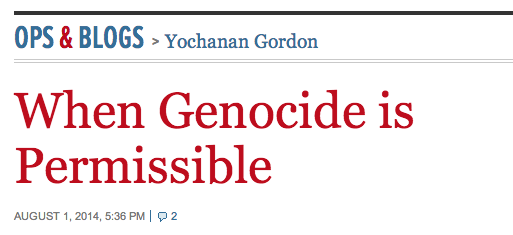
yochanan-gordon-headline

Money quote:

History is there to teach us lessons and the lesson here is that when your enemy swears to destroy you – you take him seriously. Hamas has stated forthrightly that it idealizes death as much as Israel celebrates life. What other way then is there to deal with an enemy of this nature other than obliterate them completely? …

I will conclude with a question for all the humanitarians out there. Prime Minister Benjamin Netanyahu clearly stated at the outset of this incursion that his objective is to restore a sustainable quiet for the citizens of Israel. We have already established that it is the responsibility of every government to ensure the safety and security of its people. If political leaders and military experts determine that the only way to achieve its goal of sustaining quiet is through genocide is it then permissible to achieve those responsible goals?

Update: The Times has now taken down that blog post. A reader notes:

I think it’s important to mention that the paper removed Yochanan Gordon’s reprehensible piece “for breaching … editorial guidelines.” You might also want to mention that this was a blog post, not an article in the paper itself. You would know better than I how much vetting papers do of such posts, but I suspect in this case that very little (if any) review was done in advance.

The STD We Snicker At

Jon Fortenbury resents herpes’ reputation as both shameful condition and punchline:

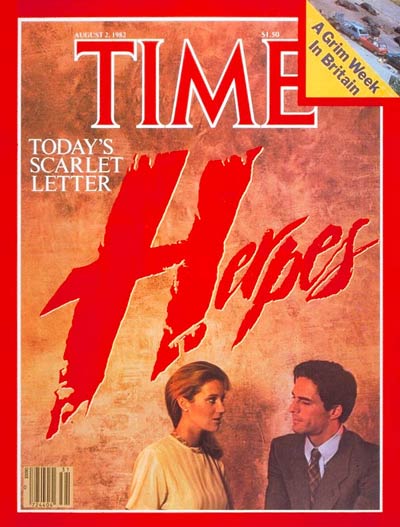
Herpes has a unique stigma among sexually transmitted diseases. HIV/AIDS is stigmatized, but few laugh at people who have it because it’s a serious illness. HPV can lead to cancer, on occasion, and women get tested TIme Herpesregularly for it, making it no joke to most. Chlamydia, syphilis, crabs, scabies, and gonorrhea are sometimes the target of jokes, but these STDS are typically curable, so people won’t have to endure the annoyance for too long. Genital herpes, though, isn’t curable, is thought of as a disease only the promiscuous and cheating-types get, and is a popular joke topic.

Despite the fact that herpes has been around since the time of the Ancient Greeks, according to Stanford University, the widespread stigma seems to be just decades old. …  [F]ilm and TV no doubt keep it alive. Leah Berkenwald pointed out in an article for Scarleteen that almost every Judd Apatow movie includes a joke about herpes. Living Sphere has a large list of films, TV shows, and books that mention genital herpes, with many of the films and TV shows poking fun at people who have it. Sometimes the jokes directly suggest people with genital herpes are whores or cheaters or they indirectly make the connection, such as the classic Hangover line, “What happens in Vegas, stays in Vegas. Except for herpes.”

Update from a reader:

As your friend Dan Savage would attest, herpes is shameful only to Americans. Justine Henin, when she was the #1 tennis player on the world, was asked why she lost a match. She very matter of factly said she had a herpes outbreak. Americans attend support groups for herpes, can you imagine an American treating herpes like the flu, something you have, not something to be ashamed of?

Another:

Reader and subscriber here. In your post about herpes, you quoted another reader who argued that “herpes” is not a shameful condition in Europe, since “Justine Henin, when she was the #1 tennis player on the world, was asked why she lost a match. She very matter of factly said she had a herpes outbreak.”

A common misconception. Americans call herpes on the lips ‘cold sores’, reserving the term ‘herpes’ only for genital herpes. Most Europeans don’t – they call the lip blisters herpes too, since they’re caused by a herpes virus. So Henin was almost certainly talking about an outbreak of cold sores, not a sexually-transmitted disease. If you type the word ‘herpes’ into European google, you will get 98% links to cold-sore treatments. I can assure you that the attitude toward genital herpes in Europe is not very different from that in America.

(Image from Time’s Aug. 2, 1982 issue)

New Dish Shirts: A Big Response From Readers, Ctd

[Update: Premium tri-blend t-shirts no longer available. 100% cotton versions here.]

Our first big screen-printing is underway and more orders for t-shirts and polos keep pouring in. If you haven’t decided on your shirt yet, full details on designs and sizing are here. Or just go here to purchase now. A hesitant customer:

I am pretty much the last person to buy a “band t-shirt” at this point, but I may actually buy one of the polos (prolly navy) with the customary alligator replaced by the dog. It’s super subtle and pretty adorable.  Most people will just think it’s a cool shirt, but those in the know will get it.

That reader soon followed up: “Caved, bought one.” Another reader:

So glad there are T-shirts and polos – thanks. It will be fun for me and other Pacific Northwest fans to recognize one another – kind of like a secret handshake. But when I go to BustedTees, they offer me 30% off my order for giving up personal information, and then I learn that I cannot apply the discount code to my Dish product because of a “stipulation of our agreement” with The Dish (a quote from the online chat in which I tried to figure this out). Grrrrr.

The Dish’s privacy policy is different than BustedTees’, and they offer a different kind of shirt than we do, so their coupon agreement isn’t compatible with our shirts. But after buying your Dish shirt, definitely look around the rest of the BustedTees’ site to check out their own shirts and offers. Some Dish faves:

BT

Update from a reader: “Surprised you didn’t give a shout-out this one, on account of the beard! Another:

The shirts do look beautiful, congratulations and hope you sell a lot because I am a big fan of your blog. I will unfortunately be abstaining because I am allergic to polyester and can only buy all natural fibers – cotton, all linen or rayon mix, etc. Can’t please everyone I guess, but you made them in America! How great!

Many readers have inquired about a 100% cotton option, so we are discussing with BustedTees a way to have that option within the next month or so. We certainly don’t want to exclude readers because of allergies. Another reader:

I just bought two T-shirts. But the checkout had no security icon. Is that site secure?

Very secure. We confirmed with Jerzy, our point-man at BT: “Our certificate is updated and we’re totally clean in terms of security.” And this verification is displayed throughout the site:

Screen Shot 2014-07-30 at 10.32.22 PM

Another:

I’m a loyal Dish subscriber and I love the shirts and will be ordering a couple for myself. If youth sizes were available you might see my kids in them as well.

We’re on it. But for you moms and dads, you can buy your shirt today. Thanks for all the feedback and keep it coming. And send us a pic of your shirt when it arrives. Though maybe not from this reader:

I just read that you’ll be at Burning Man! Brilliant! Our camp, Listen (dedicated to the proposition that really being listened to is so close to being loved that most people can’t tell the difference) is at 7:15 and Ephesus. I’ll be the one in the Dish t-shirt. Given the venue, it may be the only thing I’ll be wearing.

Update from another Burner:

I just ordered a t-shirt (the one with the howling beagle of course). And I will be wearing it at Burning Man. I read that another one of your readers is also wearing a Dish shirt at BM. I will be at a camp at 7:15 and Gold and most probably will be wearing just the Dish t-shirt and sensible footwear.

Perhaps we need to set up a Dishhead camp next year.