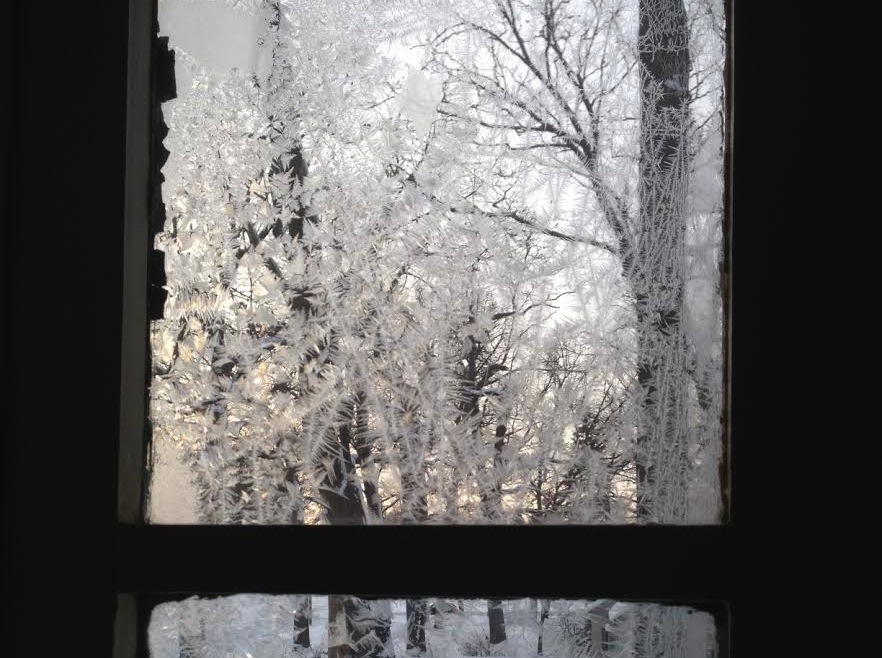
You have until noon on Tuesday to guess it. City and/or state first, then country. Please put the location in the subject heading, along with any description within the email. If no one guesses the exact location, proximity counts. Be sure to email entries to contest@andrewsullivan.com. Winner gets a free The View From Your Window book or two free gift subscriptions to the Dish. Have at it.
Kevin Hartnett points to a study from last August that demonstrated “that in some cases, flu shots can make an influenza epidemic worse, not better”:
The problem is two-fold: First, flu shots have a high failure rate (last year, nearly 4 in 10 flu vaccinations failed to confer the promised immunity); and second, once you think you’re protected, there’s a natural tendency to be a little more cavalier about germs—maybe washing your hands less, or venturing more boldly into crowded public places.
This dynamic—when safeguards like a vaccine or a condom lead people to act more recklessly—is called “moral hazard” by economists and “risk behavior” by epidemiologists, and it explains how public health interventions can have unintended negative consequences. The Northeastern study is based on a computer model that makes assumptions about vaccine effectiveness and behavior patterns, and simulates how diseases spread in a population. With the flu vaccine they find there’s a tipping point: At low-levels of vaccination, riskier health behavior outweighs the benefits of vaccination and actually fuels the spread of the disease.
Hartnett nevertheless recommends getting a flu shot this year. Sy Mukherjee also favors vaccination, noting the hazards the flu still poses:
About 200,000 people are hospitalized and anywhere from 3,000 to 49,000 people die of the flu every year in the United States, according to the Centers for Disease Control. This year’s flu season is shaping up to be particularly harsh, thanks to the return of the H1N1 flu strain, popularly known as “swine flu.” Federal health officials have reported that at least 35 states currently have “widespread influenza activity.” While national numbers on flu-related deaths aren’t available yet, the virus has killed at least 45 people in California alone so far.
This coming Monday, January 27th, will mark the fifth anniversary of the death, at age 76, of John Updike. Poetry had a special place in his life. He wrote a poem every time he took a trip, and by the time he published Collected Poems, 1953-1993, by his calculation, The New Yorker had “said yes” to his poems one hundred and thirty five times. After his death, in the March 16th issue, the magazine ran ten poems from his last, dazzling, and tremendously moving collection, Endpoint, with a sequence of poems about his diagnosis, hospitalizations, and approaching lift-off from the world he celebrated so abundantly in his more than sixty books. In the opening poem of the sequence, “Spirit of ’76,” he wrote,
Be with me, words, a little longer; you
have given me my quitclaim in the sun,
sealed shut my adolescent wounds, made light
of grownup troubles, turned to my advantage
what in most lives would be pure deficit,
and formed, of those I loved, more solid ghosts.
In Updike’s honor, we’ll post three of his poems in the coming days.
“Upon Shaving Off One’s Beard” by John Updike:
The scissors cut the long-grown hair;
The razor scrapes the remnant fuzz.
Small-jawed, weak-chinned, big-eyed, I stare
At the forgotten boy I was.
Vollmann’s cross-dressing—unlike, say, the comedian and actor Eddie Izzard’s cross-dressing, or mine—is not an expression of deep identity (it is not something he has always done, nor something he always wanted to do) but something he seems to have done on a dare; having explored the mountains of Afghanistan, the red-light districts of Phnom Penh, and the polluted croplands of Calexico, Vollmann finds a new adventure in dresses and wigs. He cannot, he writes, “know what it is like to be a woman,” but he can “perform femininity for myself.” And why not? Like me, he won’t be fired, or even stigmatized, let alone physically harmed, for cross-dressing (though every year—as he must know—many people still are); like me, Vollmann works in a field where you can embarrass yourself without much professional penalty, as long as your audience still likes the language you use. There is nothing morally wrong—though nothing morally praiseworthy—in drag per se; when a man so invested in straight male desire as Vollmann tries it on, and describes how he feels with prolix honesty, the results may be creepy or charming, or both.
What’s sad here is how much he seems to have done it alone, without even trying to figure out how other cross-dressers or trans people, or their communities or their literary precursors, might help:
sometimes he talks without listening. When Vollmann is not explaining the processes by which he made Dolores into visual art, or explaining how “The Book of Dolores” interacts with the Mexican novel, he is explaining, or mansplaining, life in general: “People often get crushed to pieces between the grindstones of conflicting realities, as did the Poles during the Nazi-Soviet Pact.” Vollman has a thing for autodidacts and big thinkers: his prose here refers to Herbert Marcuse and to Gandhi, to Thoreau, to Dostoyevsky, to photographers from Man Ray to Steven Livick, but not (unless I missed it) to anybody before him who has spent any time thinking about what it means to reject the gender in which you grew up.
Just over 98 per cent of Baby R’s crying episodes were also preceded by negative affect, but there was a single instance at 11 months where her crying immediately followed positive emotion (indicated by smiling or laughing), and then positive emotion abruptly followed the bout of crying. The mother recognised this behaviour as fake crying, and the emotional analysis appeared to confirm this. “Infant R appeared to cry deliberately to get her mother’s attention,” said [researcher Hiroko] Nakayama, “[then] she showed smile immediately after her mother came closer.”
People might have a negative impression of “fake crying” said Nakayama, but they shouldn’t…. It attracts the attention of the care-giver, and “such individual interaction contributes greatly not only to an infant’s social development but also to their emotional development. Infants who are capable of fake crying might communicate successfully with their caregivers in this way on a daily basis. Fake crying could add much to their relationships.”
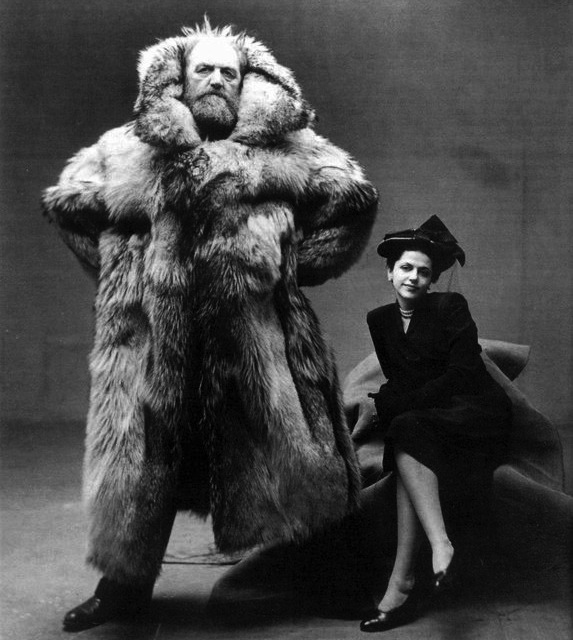
That’s what Kottke calls Peter Freuchen, standing there with his wife Dagmar in an old photo by Irving Penn:
Standing six feet seven inches, Freuchen was an arctic explorer, journalist, author, and anthropologist. He participated in several arctic journeys (including a 1000-mile dogsled trip across Greenland), starred in an Oscar-winning film, wrote more than a dozen books (novels and nonfiction, including his Famous Book of the Eskimos), had a peg leg (he lost his leg to frostbite in 1926; he amputated his gangrenous toes himself), was involved in the Danish resistance against Germany, was imprisoned and sentenced to death by the Nazis before escaping to Sweden, studied to be a doctor at university, his first wife was Inuit and his second was a Danish margarine heiress, became friends with Jean Harlow and Mae West, once escaped from a blizzard shelter by cutting his way out of it with a knife fashioned from his own feces, and, last but certainly not least, won $64,000 on The $64,000 Question.
A study suggests that brand advertising has failed to get inside the minds of computer users:
One hundred eight college students who had purchased either a Mac or PC laptop computer completed measures of the Big Five personality traits [Extraversion, Neuroticism, Openness to Experience, Agreeableness, Conscientiousness], ratings of brand characteristics of Macs and PCs, measures of implicit attitudes toward these products, and determinants of brand choices. Big Five personality traits did not differentiate between Mac and PC owners.
Students overall rated Macs higher on various product attributes (attractive style, cool, youthful, and exciting) and PCs higher on reasonable price and good for gaming. Brand owners rated their own brands higher on characteristics of reliability, good for homework, ease of use, good for Internet surfing, and good features. PC owners placed greater importance on cost as a determinant of brand choice, whereas Mac owners placed greater emphasis on style. … Mac owners showed more favorable implicit attitudes and stronger implicit self-identification with Macs than did PC owners.
If you were to describe the Israel lobby as a secretive group that enforces the policies of the Israeli government on American politicians in private gatherings, you would be called an anti-Semite. The idea that the Israel lobby is secretive and underhand plays into ancient anti-Semitic tropes. If you were to say about AIPAC that “a lobby is a night flower, it thrives in the dark and dies in the sun,” you would be regarded as an anti-Semite for the same reasons. If you were to note that an AIPAC official once responded to the idea that the lobby had been weakened by pushing a napkin across a table and said “You see this napkin? In twenty-four hours, we could have the signatures of seventy senators on this napkin,” you would be called an anti-Semite. If you were to claim that AIPAC was “the most effective general interest group … across the entire planet,” you would be suspected of anti-Semitic tendencies. (The source for these varied quotes is here.)
And if you were to say that AIPAC was so powerful it could get a left-liberal mayor of New York to give a speech so fulsome in its cravenness and excess it adds whole universes of meaning to the word “pander” and also insist that it be kept secret, even to the extent of hauling a reporter out of the hall, then all bets would be off. Why, after all, should AIPAC be in any way secretive about its completely legitimate, even civic-minded, lobbying of American public officials on behalf of the interests of a foreign government? The very idea is anti-Semitic, is it not? Why should any defender of Israel want to keep his remarks private? Even if you found nothing in the speech faintly controversial, why on earth the secrecy?
And yet here we are, with the lofty, pizza-challenged mayor of New York City, right after a landslide election, caught keeping a speech to AIPAC off his public itinerary and barring any press coverage of it. Weird, innit? What would he have to hide? Well here’s an audio of the speech that AIPAC, according to De Blasio, asked him to keep top-secret:
I’m not sure if that is the entirety of the speech, but let’s just note a few things. First up:
There is a philosophical grounding to my belief in Israel and it is my belief, it is our obligation, to defend Israel, but it is also something that is elemental to being an American because there is no greater ally on earth, and that’s something we can say proudly.
“No greater ally on earth”.
Just ponder that remark for a bit. How many troops did Israel send to fight with Americans in Iraq? None. Forty other countries did, led by the UK, Australia, and Poland. How many troops did Israel send to fight with Americans in Afghanistan? None. Fifty-nine other countries helped, also led by the UK. In both cases, this “greatest ally on earth” would have been extraordinarily counter-productive if it had been involved. That’s how useful an ally the country is in confronting our common enemies. Which allied defense minister recently publicly said of an internal security plan for the West Bank, shared confidentially among allies, that it was “not worth the paper it was written on” and that “the only thing that can ‘save us’ is for John Kerry to win a Nobel Prize and leave us in peace.” Israel’s. Which allied prime minister in recent years took the extraordinary step of lecturing the American president in front of the world press in the White House itself? Israel’s. I cannot think of any allied prime minister ever thinking about doing the same.
But this preposterous bullshit is what a left-liberal mayor felt obliged to serve up. Then this:
There is no deeper connection across boundaries than this connection we share.
Not with France, the oldest ally of the US? Not with Britain, the mother-country of the US? Not with any of the other countries whose sons have spilt blood on the same battlefields as Americans? Not with those who fought and died alongside Americans on D-Day? Then the astonishing statement that “part of my job description is to be a defender of Israel.” Really? And there I was thinking he was mayor of New York City! Would someone critical, say, of Israel’s continued settlements on the West Bank be barred as unqualified to be mayor of New York City? De Blasio is not taking any chances:
City Hall will always be open to AIPAC. When you need me to stand by you in Washington or anywhere, I will answer the call and I’ll answer it happily ’cause that’s my job.
The Nation, which indulges towards another an habitual hatred, or an habitual fondness, is in some degree a slave. It is a slave to its animosity or to its affection, either of which is sufficient to lead it astray from its duty and its interest …
A passionate attachment of one Nation for another produces a variety of evils. Sympathy for the favorite Nation, facilitating the illusion of an imaginary common interest, in cases where no real common interest exists, and infusing into one the enmities of the other, betrays the former into a participation in the quarrels and wars of the latter, without adequate inducement or justification.
It leads also to concessions to the favorite Nation of privileges denied to others, which is apt doubly to injure the Nation making the concessions; by unnecessarily parting with what ought to have been retained; and by exciting jealousy, ill-will, and a disposition to retaliate, in the parties from whom equal privileges are withheld. And it gives to ambitious, corrupted, or deluded citizens, (who devote themselves to the favorite nation,) facility to betray or sacrifice the interests of their own country, without odium, sometimes even with popularity; gilding, with the appearances of a virtuous sense of obligation, a commendable deference for public opinion, or a laudable zeal for public good, the base or foolish compliances of ambition, corruption, or infatuation.”
Pulitzer prize-winning photographer Narciso Contreras has confessed to doctoring one of the photos he took in Syria for the Associated Press:
When it comes to major Photoshop alterations, serious news organizations have a zero-tolerance policy, as AP freelance photographer Narciso Contreras recently discovered. After admitting that he had cloned out a piece of a Syrian conflict image, the news agency was forced to ‘sever ties’ with the Pulitzer Prize winner. The photo in question was taken in September of last year, and shows a Syrian opposition fighter taking cover during a firefight with government forces. In the original, a colleague’s camera can be seen in the bottom left corner of the image, a camera that Contreras decided to clone out before sending the picture in.
The AP flipped its shit; not only did the agency fire Contreras, it removed the entire library of his work from its public record. Yannick LeJacq questions whether that was the right call:
This final point about removing Contreras’s work from the visible archive of the AP’s history is particularly compelling. The AP, it seems, acted so swiftly and harshly because it has a reputation to uphold. It’s not only “the definitive source,” by its own description, but also “the world’s most trusted news organization.” And to its credit, the AP acted with commendable transparency by openly reporting on its own snafu.
But still: did it have to strike all of his work from the public record?
Roger Tooth, the Guardian’s head of photography, explains why the zero-tolerance policy matters:
Sacking someone, albeit a freelance, seems very draconian. It was a first offence after all – AP has carefully checked all Contreras’s 494 other photographs on their archive. A warning would have been more suitable, surely? Except that the major wire agencies and their clients rely on their images being totally authentic; that’s why news organisations like the Guardian spend many thousand of pounds each year on their contracts. In a news environment it’s all about a chain of trust: from the photographers through to the agencies, newspapers and websites, and then to the readers. If that chain is broken, any picture could be suspect, and that can’t be allowed to happen.
Adam Weinstein points out that other forms of manipulation, sometimes more egregious, are just fine with the AP and other news agencies:
Most news agencies have no interest in a photograph whose truth is messier, whose truth doesn’t hit a special emotional chord in our cockles. Crop it? Sure. Lighten it? Yeah, just a bit. Use this mid-action frame, and not the dozen before or after it? Yep. Add a caption to tell viewers exactly what they should get out of the image? Of course.
But good God, don’t Photoshop anything out! It’s laudable that the AP’s standard pays lip service to “truth and accuracy.” By its standards, Contreras absolutely made an unpardonable sin. But the “objective” news industry’s pretense to sinlessness is just as unpardonable.
James Estrin notes that this “type of ethical lapse happens with alarming frequency despite the clarity of the rules and the severe consequences that have befallen transgressors”:
In one of the most notorious cases, Brian Walski of The Los Angeles Timeswas fired in 2003 for combining elements of two images into one composite. Adnan Hajj, a freelance photographer working for Reuters was let go in 2006 after doctoring smoke in an image of an Israeli airstrike in Beirut. But unlike previous occurrences in which the violation was discovered by readers, bloggers or other photographers, this week’s case had a twist: Mr. Contreras — facing a moral dilemma and knowing the consequences — turned himself in.