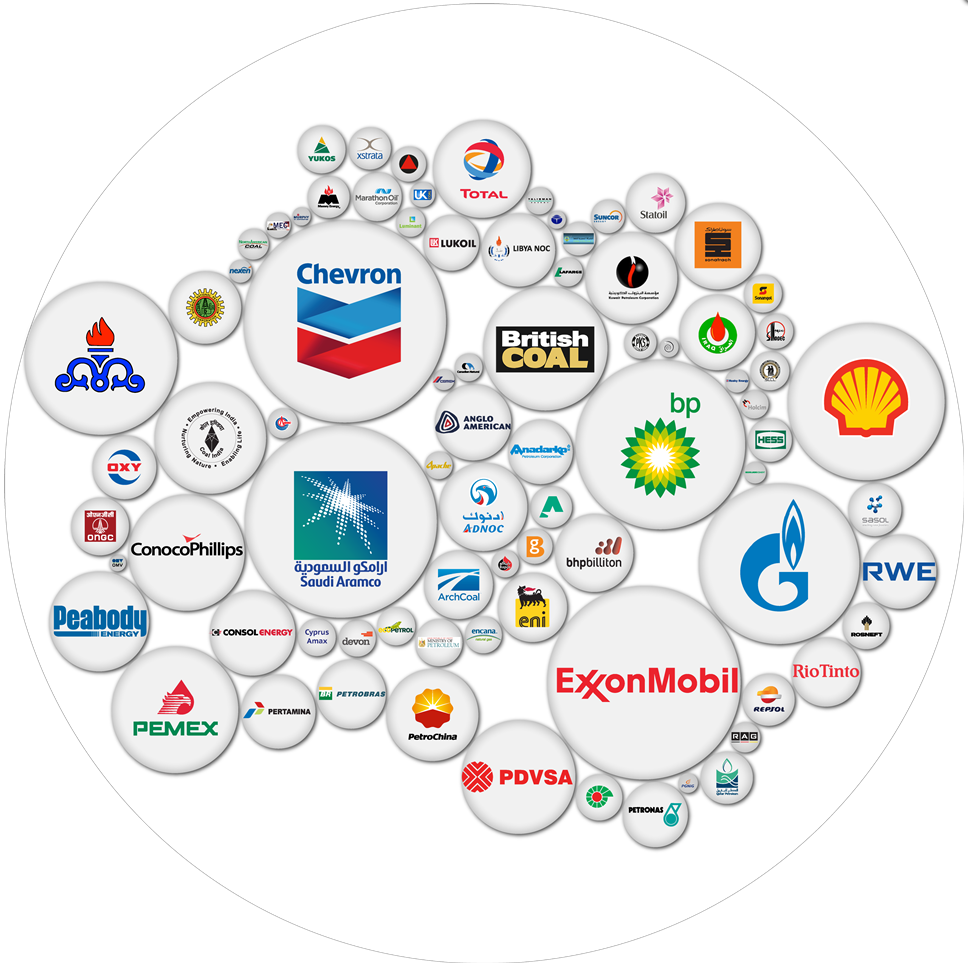
Meet the companies responsible for producing the vast majority of our fossil fuels:
A recent paper by Richard Heede, from the Climate Accountability Institute, in Colorado, shows that just 90 companies produced two-thirds of the fossil fuels burned in the industrial era. That includes 50 investor-owned companies like Chevron and Exxon, 31 state-owned companies like Mexico’s Pemex, and nine government-run entities from the ex-Soviet Union, China and other countries.
I saw the study you highlighted pop up across the Internet (including on Facebook, how meta!) a few days ago and I’m glad you brought some of the criticism to light. One that I have not seen pertains to a critical assumption. The model seems to fit the data pretty well, which is “Facebook” searches on Google. But then the authors make the assumption that searches on Google are a proxy for usage of the actual Facebook website. I’m no expert, but that seems like a strong assumption to make without knowing for sure if there is a good correlation. How many people actually access Facebook by typing it into Google instead of directly putting in the web address? Seems to me that Google searches are a better proxy for interest in news about Facebook the company. I’m no fan of Facebook and quite honestly I’d like to believe the predictions, but I’d like to know more from people who are in the field (any readers out there?) before believing the hype.
Another is on the same page:
I use Facebook daily. I haven’t googled it in years.
Another goes deeper:
To answer the question succinctly, “No” – and the reason is because of something that most people predicting its demise tend to miss: that being on Facebook is an interconnected experience; since it’s where your friends are, there are huge disincentives to leaving. Sure, I can go decide I’m going to “switch” to Google+, but if my friends aren’t there, what kind of experience am I going to have? This is not like trading in your AOL email account for Gmail, or switching Web browsers.
True, Facebook’s precursor, Myspace, did die, but keep in mind that at its peak, Myspace had 125 million users; Facebook is over one billion. That creates exponentially more interconnectedness.
Yes, some young people seem to be leaving the platform. They are the ones with the time and the inclination to make the switch, and don’t have the deep layers of friendship that an adult does, from childhood friends to college roommates to former co-workers. The real struggle for Facebook going forward is that it – and its stockholders – may have to get used to skewing older, because most of us probably aren’t going to leave.
One more:
Facebook itself has published a refutation to the study. They also show that using the same methodology as the Princeton researchers, that Princeton University is on the way out.
Reacting to the news that Bill Cosby is developing a new family sitcom for NBC, Poniewozik invokes Michael J. Fox, another former star the network recently tried to revive:
NBC’s reasons for wanting Cosby back are evident. The question will be: why does Cosby want to go back to NBC? The problem with The Michael J. Fox Show wasn’t Fox, who was and remains a gifted performer. It’s that he was in a tepid, generic show that seemed to have no idea behind it but, “Michael J. Fox, back on your TV again!” Despite a lot of talent, The Michael J. Fox Show almost seemed to go out of its way to be as unmemorable as possible, leaving it little selling point beyond the audience’s memories of Family Ties.
Likewise, Cosby was a famous name even when he brought The Cosby Show to primetime (with the same producers he’ll be working with now). But that wasn’t what made it great TV. It was that he had distinctive ideas about how to shake up the way families in general, and African American families in particular, were portrayed on TV, and he created memorable characters to express those ideas.
Willa Paskin is glad Cosby is coming back to TV, noting the decline of the black family sitcom since the ’90s:
Twenty-two years after he left television, Bill Cosby remains one of the few people who can get a black family show on a network again.
This is particularly mind-boggling given that the influence of The Cosby Show is all over television. Cliff and Clair Huxtable were exemplars of the now nearly ubiquitous TV-parenting technique that combines equal parts love and aggravation, and, when practiced at the high-level of Cliff and Clair, consists of very responsibly and reliably laughing at your children in instructive ways. No parent on any show from Modern Family to Mom does anything without Cliff and Clair hovering in the background, doing it a little better.
And Cosby’s recent stand-up material suggests that he is now positioned to be just as funny as a grandfather as he was as a dad. He seems to have been buffing the character of the slightly-doddering, cutting-in-flashes, exasperating and exasperated husband and grandpa for quite some time.
Alyssa wonders why Cosby has to star in the show himself:
He’s 76, so is he going to play a grandfather whose primary role in the show, as Cosby’s has been in the real world of late, to tell parents who are in the process of raising their own children either that they’re doing it wrong, or how to do it better? Maybe that will work. And maybe Cosby will give a huge lift to the younger African-American actors who end up in his orbit, which I think would be the most important potential outcome of Cosby’s return to television.
But why is putting Cosby at the center of a show, rather even than having him create a show that stars other actors, the best option? … Because the number of black male characters on television are so limited, and even more so black men who have families, bringing Cosby underscores a depressing self-fulfilling assumption in Hollywood: that there are only a very small number of black actors that audiences will resonate to.
Supporters of the Muslim Brotherhood chant slogans and raise four fingers, the symbol known as “Rabaa”, which means four in Arabic, remembering those killed in the crackdown on the Rabaa al-Adawiya protest camp in Cairo last year, during a demonstration in Cairo on January 24, 2014. A suicide bomber struck Cairo police headquarters on Friday, the first of three bombings in the Egyptian capital that killed five people ahead of the anniversary of the 2011 uprising. By Mahmoud Khaled/AFP/Getty Images.
Dahlia Lithwick pushes back against the scapegoating of Maureen McDonnell:
The implication that it was the former NFL cheerleader and her quest for designer shoes and gowns that brought the McDonnells down is kind of a journalistic chip shot. Cue the citations to Calista Gingrich and Sarah Palin and all the countless silly women who shop their families into political ruin. If you reside chiefly in reality TV land, such accusations fit the stereotypes perfectly. But the truth is that McDonnell was just as profligate and greedy as his wife, and the indictment proves it. So why is his own fondness for racking up exorbitant golf expenses relegated to the last disembodied paragraph of the Times piece? Is it because in the hierarchy of political greed, golfing, and private jets rank as legitimate expenses whereas couture dresses and shoes are foolish? Remember: When men are extravagant it’s manly. When women do it, it’s tacky.
A confession. I have long had an aversion to gay-themed plays, TV shows, movies, etc. I wasn’t born with it. I learned it. I learned it through what can only be called a series of cringes.
I don’t think you’re the only gay person with that cringe. I know as a lesbian, that’s been my entire experience with any sort of lesbian movie, TV show, play, etc. My girlfriends and I would sit through the L-Word, repeatedly asking ourselves why we were watching such horrible dreck, absolutely embarrassed at the portrayal of lesbians and none of seeing ourselves in any of them. We were just so thirsty to see anything that had even a passing connection to our own lives on the screen. Older lesbian movies of the ’70s, ’80s, ’90s are even worse in how incredibly amateur they look and feel. And yet, I’ve seen nearly every one of them at least part way through, cringing the entire time.
It’s almost a tradition in the gay and lesbian community, I think. I can’t quite remember the exact quote or where I heard it, but I think it was while watching Turner Movie Classic’s fascinating June series a few years ago, Screened Out: Gay Images In Film. An older lesbian was interviewed talking about conversations in her group of any hint of a lesbian in movies of the ’40s and ’50s. Same sort of cringe, but watch anyway answer. She would call her friends and say, “There’s a lesbian in this film. I mean, she’s a vampire again, but let’s go see it!” You had your minstrels, we got the vampires.
But I have to say, a vampire lesbian would have been better than any of those characters on the L-Word.
“We are pathetically starved for images of ourselves. So much so that, you know, a friend will call you up and say, ‘Oh, there’s this movie you must see -‘ this happened to me – ‘this movie, you’ve gotta see. There’s this incredible lesbian relationship in it, and there’s this great love scene, and – alright, they’re vampires! But you gotta see it, it’s great!” – Jan Oxenberg, Filmmaker, The Celluloid Closet.
Recommendations from readers on breakthrough gay cinema here. Dissents on my take here.
Since we’re on to the topic of “marijuana as a gateway drug”, I’d like to bring up an argument I almost never hear, and have no idea why: Isn’t it possible that marijuana acts as a gateway drug for some people because they buy those other drugs from the same guy? I’m sure a lot of people have gotten the Amazon-sales pitch from their pot dealer (“If you like marijuana, you might also enjoy … “). I have never been tempted, but if I wanted to try cocaine or mushrooms, etc., I would probably just ask the guy I buy pot from. My guess is that legalizing marijuana and putting it in pharmacies would limit people’s access to harder drugs for this very reason.
Another opens up about his addiction:
The main reason I would give for being “ashamed” about 20 years of smoking marijuana almost daily and eventually entering rehab is not what you might think.
It’s not that it destroyed my marriage, curtailed my career, and repeatedly saw me leave my small children at home sleeping alone while I was out replenishing my supply. Even though my habit had me do all of these things, plus steal amounts from friends, withdraw socially and thankfully only almost cause several car wrecks, by far the most embarrassing thing about being a marijuana addict has been having to tell people that my addiction was “only” marijuana.
Despite a growing acceptance in Alcoholics Anonymous of those whose substance abuse was not primarily alcohol, I would get pushback from some members when I’d tell them I only used to get drunk when I ran out of pot. I tried meetings at Narcotics Anonymous, and the junkies and meth heads literally laughed when I’d introduce myself as a drug addict and later reveal my details. Unlike the “tragedy” of other addictions, mine was received more like a story about locking my keys in the car.
I am in favor of legalization. I only hope that as marijuana’s acceptance grows, the truth becomes more well-known that while it may be less harmful than many other intoxicants, it is far from harmless, its aura of benign innocence is misleading, and its damage can be as deep as its more sinister siblings.
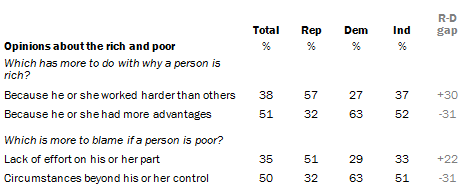
A Pew poll found that it’s popular to raise taxes on the rich to expand the safety net. Sargent takes a closer look:
The key here is that the question does not ask whether we should raise taxes on the rich to pay down the deficit, as many other polls do. Respondents are asked if we should raise taxes on the rich to expand the safety net as a way to reduce poverty, and a majority says Yes — far more than saying the best way to help the poor is by cutting taxes on the job creators. Independents agree with this by 51-36. Only Republicans favor lowering taxes on the job creators over taxing the rich to expand programs for the poor, by 59-29.
The danger for liberals to keep in mind is that voters are less persuaded that the government can do something useful to reduce inequality than they are that the government should do something useful.
People are accustomed to the idea of a mass public that’s “ideologically conservative and operationally liberal”; in other words one that hates “big government” but loves programs such as Medicare and Social Security. On inequality you could see the reverse happen, where people favor bold action to tackle inequality but are skeptical that specific programmatic ideas are workable or will be implemented correctly.
Emily Badger focuses on what the poll had to say about the causes of wealth and poverty:
The belief that people are poor more through their own lack of effort than their circumstances is widely held by large segments of the population, including 51 percent of Republicans, and 46 percent of people in the highest income group (which is not that high). If you fall into this category, then it clearly doesn’t make sense for society to try to solve a problem that it had little hand in creating.
This difference is important, although the survey question itself feels unsatisfying. I’d love to see a survey that gets much more specific about what those circumstances might be: If a child born into poverty remains poor as an adult, how much do you believe failing schools, neighborhood crime, and poor job access contributed to that outcome? I wonder if the answer would change for some people if the concept of “circumstances” weren’t quite so abstract, if it weren’t posed simply as the alternative to personal responsibility. Surely Obama is choosing his words very carefully right now.
Referring to the toll of the Syrian refugee crisis, Kori Schake argues that “the ally of America in the greatest need at the moment is Jordan”:
The United States is the largest international donor to Syrian refugee efforts. But a much larger and more diversified inflow of aid to Jordan is urgently needed and long overdue. The United Nations provisionally estimates that the cost to Jordan of hosting Syrian refugees will be $3.2 billion in 2014. The United States needn’t be the provider of that aid, but drumming it up from others is something it can and should do.
And here is where the Obama administration could perhaps make a virtue out of the catastrophe that is its Middle East policy, harnessing the newfound willingness of unlikely partners in the region to productive effect. The U.S. government should develop a strategy for raising not just that $3.2 billion but also providing political, economic, and other assistance to the government of Jordan, webbing it into regional cooperation made possible by allies worried about U.S. policies. The approach should expand from the refugees themselves to also having lines of operations for affecting Jordan’s own people and also supporting the government of Jordan.
It should increase trilateral U.S.-Israeli-Jordanian efforts on water sharing and security, folding other regional allies in to fund and share Jordan’s burdens. Jordan should also be given a starring role in Palestinian peace talks, both to reward its support for Israel but also to help in managing its domestic Palestinian population — if a peace deal is reached, Jordan will be a major beneficiary.
(Photo: An aerial view shows the Zaatari refugee camp near the Jordanian city of Mafraq, some 8 kilometers from the Jordanian-Syrian border, on July 18, 2013. The northern Jordanian Zaatari refugee camp is home to 115,000 Syrians. By Manel Ngan/AFP)


 The Dish