Who Will Replace Jesse Jackson And Al Sharpton?

No one:

[T]here are not, and never have been, any new versions of the old Jesse and Al. Not a single young preacher or politician has even started to acquire national influence by taking a page from their old playbooks. The times have changed. If the more pessimistic strains in black America can be slow to fully acknowledge progress, we can take heart from the fact that Al Sharpton will be 60 next year, and a young version of his young self is now inconceivable as a national figure.

A Family-Friendly Glass Ceiling

After moving to France with her child and confronting a brutal job market for mothers, Claire Lundberg asks how “a country that is so outwardly progressive [is] still plagued with such basic workplace inequalities”:

While France has a wonderful safety net for women, much of it is designed to promote the growth of families as a way of boosting the birthrate. Indeed, families in France receive numerous supports and subsidies the more children they have. A family with two children is eligible for an automatic monthly stipend of 125 euros, regardless of income. With three children, a family is designated a “Famille Nombreuse,” which includes a raise in the automatic stipend, a possible further subsidy of up to 500 euros a month for the mother if she chooses not to return to work, and even reduced admission for transportation, museums, and amusement parks. And, at four children, a woman becomes eligible for the “medaille de la famille,” an honorary medal from the French government.

Douthat responds:

Family-friendly socialism, [scholar Kay Hymowitz] notes, does seem to encourage more women to stay in the workforce after they have children. But it also helps explain the persistence of “the glass ceilings, as well as stubbornly large wage gaps in more progressive countries,” because working women tend to be shunted more decisively onto a mommy track than they are in the United States. And it shunts them in other ways as well: To borrow an insight Neil Gilbert, the author of one of the must-read books on this topic, the social-democratic combination of high tax rates and a large state-run caregiving apparatus creates a strong economic incentive for mothers to leave their children with professional caregivers while taking a job … as a professional caregiver. This boosts workforce participation and G.D.P. — but whether it boosts actual female welfare seems at least somewhat debatable.

Map Of The Day

Odra Noel’s “Map of Health,” on display at the Royal Society’s Summer Science Exhibition in London, illustrates the diseased tissues that most affect each part of the world:

dish_tissue_map

Robert Gonzalez calls the piece “a weirdly beautiful combination of epidemiology and microscopy”:

North America, plagued by its obesity epidemic, is depicted as adipose tissue (fat). Central and South America are represented with pulmonary tissue, reflecting the lethal impact of smoking and respiratory illness in the region. Europe and Russia, their aging populations more susceptible to neurodegenerative diseases, are depicted with brain tissue; East Asia and the Pacific are represented with pancreatic tissue, which is affected keenly by diabetes. Much of the Middle East and central Asia, where cardiovascular diseases are on the rise, are painted with microscopic representations of heart muscle. Africa, where transmittable infections like malaria and HIV pose enormous challenges to public health, is depicted with blood cells. All data was taken from statistics gathered by the World Health Organization.

More here.

Where Dictatorships Are Vulnerable

Their urban centers:

Cities are problems for authoritarian control, the traditional narrative goes, because by concentrating large masses of people, they improve communication networks, allowing anti-establishment sentiment to spread. In physical terms, dense neighborhoods are also ideal centers of resistance, easily blocked by barricades and featuring plenty of hiding places. To counter this, the wide boulevards of capitals like Washington, Paris, and Beijing have a practical as well as aesthetic purpose: allowing easy movement of police or the military in times of civil disturbance.

[Ohio State Professor Jeremy] Wallace argues that authoritarian regimes typically lavish attention on big cities over rural areas, knowing that this is where resistance is likely to take root first. But, he says, these efforts can ultimately be counterproductive as they encourage more people to move to cities. This is likely to be an issue in coming years for rapidly urbanizing China, which has typically taken the thousands of rural village protests that take place each year far less seriously than any sign of organized opposition in major cities.

The Best Of The Dish Today

BRITAIN-GAY-MARRIAGE

We published the suicide note of Kurt Cobain and readers added several last words on the shooting of Trayvon Martin. Maybe Aaron Sorkin’s Newsroom doesn’t suck quite as much the second time around, and maybe Dune is worth re-reading and Pacific Rim’s massive monsters are worth going to see. I got meep-meeped by Obama on Syria, much to my relief. And what strange beast, its hour come round at last, slouches toward Wyoming?

Turkey’s red-blue implosion hasn’t gone away – but the red hinterland is winning. And Ken Mehlman agreed to answer some of your questions.

The most read post of the day was on Richard Cohen’s exhausted career; the second most read was a link to Jon Hamm’s junk as I dreamed about him in shorts. Keep it classy, Dishheads.

See you in the morning.

When Will The GOP Remake Itself?

Cassidy wonders:

Could the party really remain in thrall to the God, guns, and anti-government brigade until Ronald Reagan returns to save us all from eternal damnation? That’s doubtful. Clearly, though, the adjustment process is going to take more time. How much more? At this stage, it is looking like at least another four years—time enough for the party to suffer a third straight crushing defeat at the Presidential level. Based on history and common sense, that will probably be enough to give the reformers the upper hand. With today’s G.O.P., though, you never can be sure.

Larison doubts that three defeats will be enough:

[I]nstead of grappling with what Bush did wrong, they have spent a lot of their time inventing a mostly fictional Obama record to run against. Making some changes on foreign policy–even superficial and rhetorical ones–seems an obvious way to address one of the party’s serious weaknesses, but there has been no movement on this except among a handful of members of Congress. The point here isn’t that foreign policy reform would be a panacea for the GOP or that it would remedy that many of the party’s electoral weaknesses, but that it is one of the more glaringly obvious opportunities for reform and a relatively easy way to break with the disasters of the Bush years. Despite that, there seems to be very little interest in it.

Kilgore explains such lack of interest, noting that the Republican coalition includes many people who don’t agree with the conventional wisdom “on how to win elections, don’t care about short-term political implications, or don’t care about anything other than expressing their opinion about the hellwards direction of the Republic and perhaps of the human race”:

Mix in another significant number of people with a large pecuniary interest in reactionary politics, and you have a movement that’s not going to turn from its current trajectory with any great speed. You can stamp your feet or call them crazy people or deplore their impact on the level of discourse all you want, but they just aren’t going away, and we might as well get used to it instead of marveling about it as though it came out of nowhere and will soon disappear.

PTSD In The US vs UK

In American veterans, rates of post-traumatic stress typically range from 10 to 17 percent, but among British veterans, the rate is closer to 4 percent. David J. Morris explains how that discrepancy has little to do with a “stiff upper lip”:

P.T.S.D. cannot be reduced to a simple matter of differing cultural attitudes. Within the field of P.T.S.D. research, there is a concept known as “the dose-response curve.” In simple terms, the more horror and death you are exposed to, the more likely you are to experience post-traumatic stress. (This is not limited to shooting combat; it encapsulates exposure to any life-threatening danger.) And Americans have been exposed to a lot more horror and death than their British counterparts.

When I asked Matt Friedman, the director of the National Center for P.T.S.D., about the differing diagnosis rates and what this might mean for American psychiatry, he seemed to grow irritated. “The Brits were down in Basra. Ain’t nothing happening down in Basra,” he said. In a letter responding to the original Lancet study that compared P.T.S.D. rates of American and British veterans, Charles Hoge and Carl Castro, P.T.S.D. researchers at the Walter Reed Army Institute of Research, made this very point, writing that “only 17% of UK service members reported discharging their weapon, compared with 77-87% of US service members; 32% of UK service members reported coming under small arms fire, compared with more than 90% of US service members.”

Morris zooms out:

The growing criticism of our current understanding of P.T.S.D. suggests that what was once ignored or treated as a failure of character—the soldier’s weakness—has now been medicalized to the exclusion of discussing its moral and spiritual dimensions. “It feels to me as if the U.S. civilian population has pathologized the veteran experience,” Elliott Woods, an Iraq veteran-turned-reporter, told me not long ago. “One well-intentioned person said to me the other day, ‘I can’t see how anyone could go to Iraq and not come back with P.T.S.D.’ ” Yet our social mechanisms for dealing with that problem are weaker than they should be.

Previous Dish on PTSD here, here, and here.

Chart Of The Day

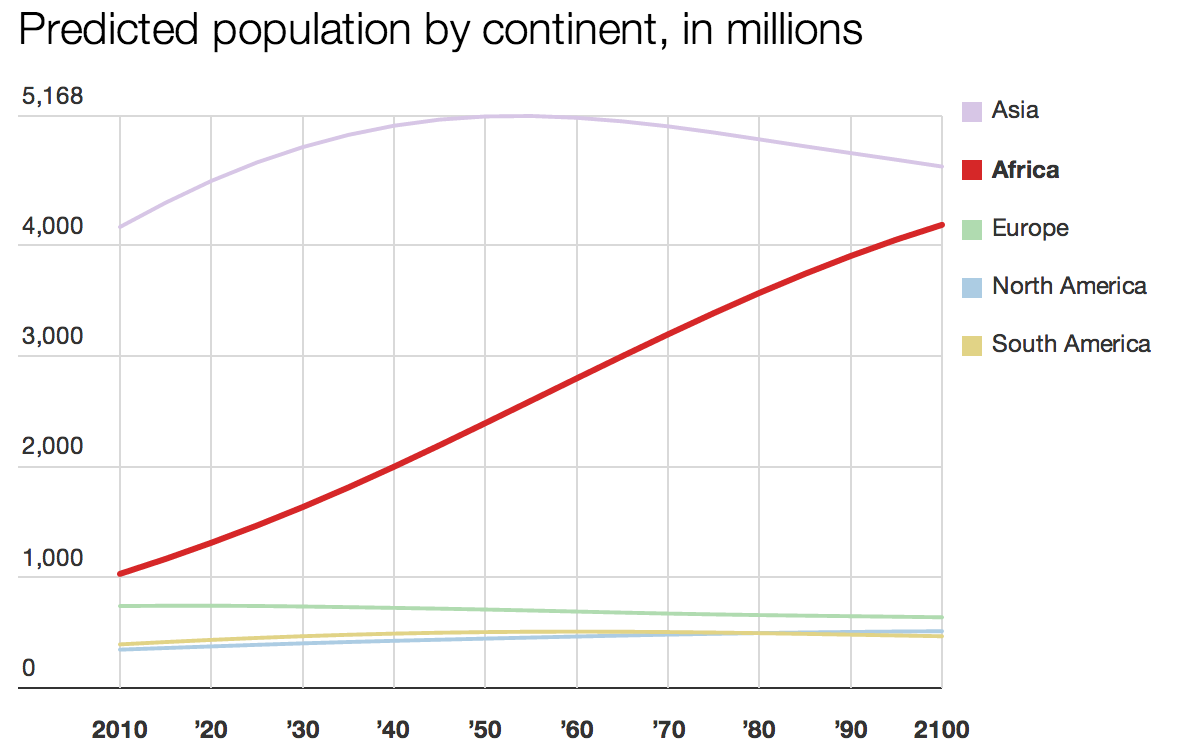
World Population

Africa’s population is projected to skyrocket:

Right now, with a couple of exceptions, Africa’s population density is relatively low; it’s a very big continent more sparsely populated than, say, Europe or East Asia. That’s changing very quickly. The continent’s overall population is expected to more than quadruple over just 90 years, an astonishingly rapid growth that will make Africa more important than ever. And it’s not just that there will four times the workforce, four times the resource burden, four times as many voters. The rapid growth itself will likely transform issues within African countries and thus their relationship with the rest of the world.

Nigeria is expected to become one of the world’s largest countries:

In just 100 years, maybe two or three generations, the population is expected to increase by a mind-boggling factor of eight. The country is already troubled by corruption, poverty and religious conflict. It’s difficult to imagine how a government that can barely serve its population right now will respond when the demand on resources, social services, schools and roads increases by a factor of eight. Still, if they pull it off – the country’s vast oil reserves could certainly help – the rapidly growing workforce could theoretically deliver an African miracle akin to, say, China’s.

Meanwhile, In Turkey …

Elif Batuman reminds us that “normalcy has not yet returned to Turkey”:

A TV personality who believes in telekinesis has been made Erdoğan’s chief adviser. Thousands of people, including doctors who treated protesters, have been detained by police. The man with the machete is now in Casablanca; as the owner of a small business, he may be entitled to government compensation for his sufferings as a terror victim.

It’s hard to get a coherent picture of what’s going on from reading the news, partly because so many editors and reporters have been intimidated into vagueness or retirement. It’s unclear what will become of all the out-of-work journalists. Some journalists tried to stage a march on Saturday, but the police blocked them before they could march anywhere. Chaos spread through Taksim. An ice-cream-parlor employee reportedly helped seven or eight civil policemen beat up a customer. I didn’t go out myself, but friends who did narrowly missed being hit on the head with gas cannisters or run over by reconnaissance vehicles. Terrifying images circulated on Twitter. One showed an art professor from Mimar Sinan University bleeding from the mouth being led into police custody.

Claire Sadar has more on the situation:

In response to the heavy-handed tactics of authorities, there has been a boom in creative passive-resistance protest in recent weeks including public standing, walking, festivals and even Ramadan Iftar dinners.  There have also been move made toward creating a solid political movement out of the diverse grievances of the protestors through the creation of community forums throughout Istanbul.

These forums are of course only baby steps toward Occupy Gezi having representatives in local or national government.  In the short term, as myself and others repeatedly predicted, Erdogan and the AKP are not going anywhere.  Indeed some, including anthropologist of Turkey Jenny White*, have begun to question whether Westerners and Turkish elites have over estimated the real impact Occupy Gezi has had and will have on Turkish politics.  I certainly don’t discount her observations and they mesh with my own impression that away from the protest centers there is little sympathy for the movement.  In this way the AKP’s base has been little effected by Gezi and the party is sure to remain a force to be reckoned with in the short term.  However, the very existence of the Gezi movement itself remains remarkable and bodes well for the political future of Turkey.

More Dish coverage of Turkey here, here and here.