When Will Marriage Equality Return To SCOTUS?

Gabriel Arana wonders:

Today’s opinion hints that the Justices have little desire to get too far ahead of public opinion. Mostly likely, the current cases making their way through the legal system will stop at the Supreme Court’s door. But given the incoherent legal patchwork the rulings leave in place, it’s only a matter of time before the Justices will have to revisit the issue. The question is when. It was 17 years between Bowers v. Hardwick, in which the Court upheld anti-sodomy laws, and Lawrence v. Texas, which reversed Bowers. Twenty years went by between the Court’s landmark abortion ruling in Roe v. Wade and Planned Parenthood v. Casey, which addressed the the constitutionality of restrictions on abortion. But with public opinion on gay rights evolving at breakneck speed, gay-rights advocates say the timetable may be shorter.

What Precedent Does Perry Set?

Ed Morrissey is bothered by the Prop 8 decision:

The voters in California amended the state constitution by referendum legally, to define a legitimate government policy regarding the recognition of marriage. The court is making the case that this is a matter for California to settle, not the federal courts, and there is a very good case to make there. However, the effect of this is to overturn an election whose legality was never in doubt just because some people didn’t like the outcome. That to me is a more dangerous outcome than a precedent-setting decision on standing.

Scott Lemieux also has misgivings:

[W]hile I’m happy the Prop 8 will be struck down standing is the worst grounds for a good outcome: it’s a pernicious argument. The courts shouldn’t be foreclosed from hearing appeals just because the current government declines to defend a law.

Kevin Drum makes a related point:

In California, it’s routine for the people to pass initiatives that neither the governor nor the legislature supports. In fact, that was the whole point of the initiative process when it was created. In cases like these, of course the governor and legislature are going to decline to defend the law in court. With today’s decision, the Supreme Court is basically gutting the people’s right to pass initiatives that elected officials don’t like and then to defend them all the way to the highest court in the land.

To me, this has neither the flavor of justice nor of democratic governance, regardless of whether I like the outcome.

Marriage Equality’s Big Day: Blog Reax

U.S. Supreme Court Issues Orders On DOMA And Prop 8 Cases

Ilya Somin unpacks the DOMA decision:

[W]hat [Kennedy] seems to be saying is that the the Congress’ pursuit of purposes beyond the normal scope of federal authority in DOMA makes the law a “discrimination… of an unusual character” and justifies imposing tougher scrutiny under the Fifth Amendment. … The idea that federal statutes are suspect if they seek to achieve purposes outside the scope of federal power is not a new one. In McCulloch v. Maryland (1819), Chief Justice John Marshall famously wrote that Congress may not “under the pretext of executing its powers, pass laws for the accomplishment of objects not intrusted to the Government.” The rule that “unusual” laws get tighter scrutiny in equal protection cases is also not new. But the DOMA decision is the first to tie these principles together.

From Jack Balkin’s legal analysis:

Windsor is a reminder of the fact that the scrutiny rules we teach our students as gospel are a relatively recent invention–less than fifty years old.   They were designed to make it easier to think about when laws are constitutionally unequal. But sometimes they don’t really assist our understanding of the issues; they just get in the way.  In fact, you actually can explain Windsor in terms of the existing structure– it’s a “rational basis with a bite” case, and that’s how the casebooks (including the one I co-author) will probably classify it. But we should be able to look behind the doctrinal superstructure, which explains little, and see the deeper principles at stake, principles that have a long history in American constitutional thought.  DOMA singled out gay people for special burdens in an important area of social life; it declared their marriages less valuable, and therefore, to that extent, it made them second class citizens.  Even if this wasn’t obvious in 1996, it is increasingly obvious today.

Jonathan Cohn focuses on plaintiff Kris Perry’s reaction:

Perry’s comments focused on the children—in the U.S., and in California, and in her very own home: “We believed from the very beginning that the importance of this case was to send a message to the children of this country that you are just as good as everybody else, no matter who you love, no matter who your parents love,” Perry said. “And today we can go back to California, and say to our own children, all four of our boys, your family is just as good as everybody’s else’s family, we love you as much as anybody else’s parents love their kids, and we are going to be equal.”

Weigel looks ahead:

So what happens politically? Republicans haven’t rushed to the microphones yet, but the House GOP lost—they paid to defend DOMA, and it was struck down. It’s within their power to try to defund the removal, and we’ll suss out soon whether there are enough House Republicans passionate about the issue to do this.

But the court’s decision not to write a new definition of marriage (to just overturn Prop 8) means that marriage rights return to the states, to be voted on in referenda, state legislatures, and in courtrooms. The polling in favor of gay marriage has stalled somewhat, after tipping into positive territory nationally. But we’re going to see a series of campaigns and scattered lawsuits from couples who now can say they deserve marriage benefits and there’s no act of Congress stopping them.

Enten expects the DOMA ruling to “be welcomed by most Americans”:

In poll after poll taken over the past few months, at least 60% of Americans have agreed that the federal government should recognize same-sex marriages in those states that allow it. This is significantly higher than the roughly 53% of Americans who believe same-sex marriage should be legalized everywhere.

Jonathan Tobin gives American culture credit for today’s decision:

How did this sea change come about? Liberals may consider it a natural evolution of thought to more progressive opinion (since as we saw with President Obama and gay marriage, reversals on such issues that end with an endorsement of the more liberal position are regarded as evolution rather than a flip-flop). But it could never have happened outside of the context of American popular culture that has normalized gays and gay marriage in films and TV to the point that they are now regarded as unexceptionable. As my colleague John Podhoretz noted on Twitter this morning after the ruling, the credit for the decision on DOMA belongs as much to the producers of the Will and Grace television show as it does to any legal scholar.

Dreher plays the victim:

Scalia has chillingly illuminated the future for marriage traditionalists: the only reason to oppose same-sex marriage is hate. In constitutional law, there is no rational basis for supporting traditional marriage. Henceforth, the Court has declared open season on religious and social conservatives and their institutions. Given the majority’s holding that hatred is the only plausible explanation for denying same-sex marriage, I see no reason why the Supreme Court will not declare same-sex marriage a constitutional right.

And the logic of the Court’s language here ought to put fear into the hearts of anyone who does not share the belief that homosexuality is morally neutral, or morally good. The Supreme Court says we are haters, full stop.

Waldman, on the other hand, tackles Scalia:

[T]his is a guy who, in a decision delivered just yesterday, helped gut the Voting Rights Act, one of the most important pieces of legislation ever passed by Congress and one that was reauthorized in 2006 by votes of 390-33 in the House and 98-0 in the Senate, yet spends two-thirds of this very dissent arguing that the Supreme Court is a bunch of black-robed tyrants when they invalidate a law passed by Congress. In other words, despite his carefully cultivated reputation as a principled “originalist,” the only principle that guides Antonin Scalia is “what he can get away with.” For him, it’s the outcome that matters. The justification comes after. Is that true of the Court’s liberals as well? Maybe. But it’s a little rich to make that charge when your own hypocrisy is on such obvious display.

Dylan Matthews notes that immigration equality is now law:

This does open the door for bi-national same-sex couples to be treated equally under the law. That means that comprehensive immigration reform probably need not include a provision specifically tailored to making sure bi-national partners of same-sex couples can get visas automatically, the same as opposite-sex partners. As Paul Smith, a partner at Jenner & Block and arguably the leading gay rights litigator in the country (he won Lawrence v. Texas, overturning state bans on gay sex), told me, “My understanding is that the elimination of DOMA would by itself mean that all bi-national married couples would have the same rights, whether same sex or not.”

Steve Benen points out another consequence, among many:

The Defense Department, for example, ended DADT, but could not apply equal benefits to gay servicemembers because of this law. Now that it’s been struck down, it’s no longer an issue.

Hagel has released a statement to that effect:

The Department of Defense welcomes the Supreme Court’s decision today on the Defense of Marriage Act.  The department will immediately begin the process of implementing the Supreme Court’s decision in consultation with the Department of Justice and other executive branch agencies.  The Department of Defense intends to make the same benefits available to all military spouses — regardless of sexual orientation — as soon as possible.  That is now the law and it is the right thing to do.

And June Thomas reflects on what the decision means to her personally:

When the Supreme Court’s decision on the constitutionality of the Defense of Marriage Act was released Wednesday morning, I was genuinely surprised and totally unprepared. I knew it was coming, but I hadn’t dared to hope that the court would do the right thing for families such as mine. Votes had gone the wrong way too many times in the past. Feelings had been hurt. What did straight Americans have against their gay and lesbian compatriots that they would go into a voting booth or stand on a legislature floor and choose to deny them basic civil rights?

As the decision was announced, I finally allowed myself to experience a feeling of belonging.

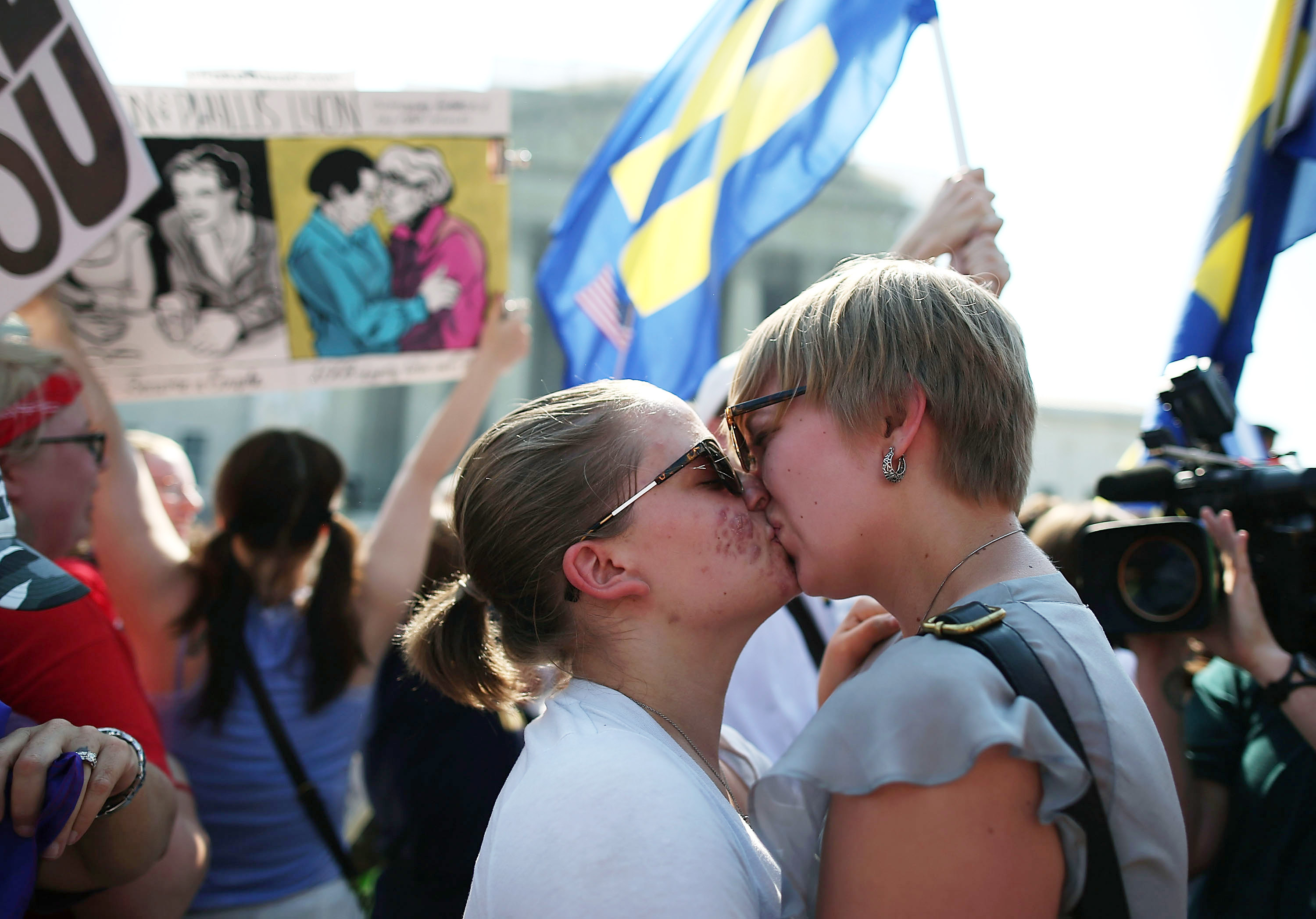
(Photo: American University students Sharon Burk (L) and Mollie Wagoner (R) kiss after hearing that the U.S. Supreme Court ruled that the Defense of Marriage Act (DOMA) is unconstitutional at the Supreme Court, June 26, 2013 in Washington, DC. By Mark Wilson/Getty Images)

From The Annals Of Chutzpah

“By overturning the Defense of Marriage Act, the Court recognized that discrimination towards any group holds us all back in our efforts to form a more perfect union. We are also encouraged that marriage equality may soon return to California. We applaud the hard work of the advocates who have fought so relentlessly for this day, and congratulate Edie Windsor on her historic victory,” – former president Bill Clinton, who signed DOMA, insisted it was constitutional at the time, double-crossed the gay activists who originally funded him, ran ads in the South bragging of passing DOMA, doubled the rate of gay discharges from the military and signed the HIV travel ban into law.

DOMA Struck Down: Tweet Reax

Live-Blogging Marriage Morning

windsor-600-thumb-580x773-269511

12.10 pm. A reader writes:

I am writing from overseas where I live with my partner of 32 years in a sort of self imposed exile. He has been unable to obtain any sort of residency visa for the USA. We have been looking forward to this day. The phone is ringing off the hook and everyone is saying “you’ll be able to marry and come home.” I think I’m going to go light a candle and thank God and all the people who have fought so long and so hard to make all this possible. Bless you.

Bless the souls of those whose courage in extremis gave me and others the strength not to falter in pursuit of their dignity as human beings and their equality as citizens. We did it in part for those we left behind. And part of the reason I am crying right now is remembering them. I want them to come to the party. I want them to see they didn’t die in vain. Another reader:

I’m surprised by how moved I am – I’m a little choked up. I know I’m going to express this awkwardly. But the decision comes across to me almost like a ray of decency. There’s so much awful stuff coming at us all the time, but here, 5 justices have done something good and human and right. It doesn’t feel like a news story, so much as something good washing over the country. It’s really nourishing.

The world is a better place than it was an hour ago. How often can you say that?

Another:

I don’t know about you, but my head explodes when I read the following from Scalia’s dissent: “We have no power under the Constitution to invalidate this democratically adopted legislation.”

You mean like you invalidated a whole section of the Voting Rights Act (just yesterday!) and tried unsuccessfully to sink the entire Affordable Care Act? I’m not a lawyer, and my lawyer friends assure me that Scalia is brilliant, if extremist, but I read that kind of head-turning inconsistency and all I see is a hack, not a brilliant legal mind. And again, I’m not a lawyer, but isn’t the entire purpose of the Supreme Court to review the constitutionality of legislation (democratically adopted or otherwise) and invalidate it when necessary? What a dipshit.

11.55 am Dueling tweets of the moment:

And I suspect Jesus’ tears were of joy – because more children of God have finally been given the dignity he offered the most despised and marginalized of his time.

11.44 am. Scalia’s dissent was worth a little wait. On gay cases, they are like operettas of dyspepsia, and this one didn’t disappoint. Money quote:

The majority says that the supporters of this Act acted with malice — with the “purpose” (ante, at 25) “to disparage and to injure” same-sex couples. It says that the motivation for DOMA was to “demean,” ibid.; to “impose inequality,” ante, at 22; to “impose . . . a stigma,” ante, at 21; to deny people “equal dignity,” ibid.; to brand gay people as “unworthy,” ante, at 23; and to “humiliat[e]” their children, ibid. (emphasis added).

I am sure these accusations are quite untrue. To be sure (as the majority points out), the legislation is called the Defense of Marriage Act.

To be sure. But defending it from whom? Kennedy explains:

The House concluded that DOMA expresses “both moral disapproval of homosexuality, and a moral conviction that heterosexuality better comports with traditional (especially Judeo-Christian) morality.” Id., at 16 (footnote deleted). The stated purpose of the law was to promote an “interest in protecting the traditional moral teachings reflected in heterosexual-only marriage laws.” Ibid.

When the Christianist GOP tells you in print that it is enacting a law to uphold moral disapproval of a class of persons, you really do get to animus. Religiously-inspired animus, but animus nonetheless. The subtler arguments – about, say, the federal need to maintain one standard for marriage recognition – were not part of that original debate. I was there. The whole thing was about “defending” marriage from those who would clearly demean it. The discrimination was explicit. At no point were the actual interests of gay citizens cited on the right. We were non-persons, because we were morally inferior and had no right to ask for that kind of equality. That’s how Scalia felt ten years ago, and he hasn’t changed. But he cannot change the legislative record or the rhetoric used at the time of the bill.

11.38 am. The president phones the couples and congratulates them.

11.35 am. Immigration equality is here. Again: after two decades of extreme anxiety, history wipes it away. You have no idea how much relief so many bi-national couples are now feeling.

11.23 am. Some have noticed how often Anthony Kennedy used the word “dignity” in his ruling. My own impression of the text is to note how Catholic it is. I mean by Catholic the sense of concern for the dignity of human beings that still resonates among the average Catholic population and, mercifully, now with the new Pope. This is the true measure of our shared faith: not a desire to use its doctrines to control or constrain the lives of others, but seeking always to advance the common good while leaving no one behind. No one.

The Church hierarchy’s Ratzingerian turn against this minority in 1986, its subsequent callous indifference to us during the plague years, its rigid clinging to 13th Century natural law rather than what or rather who was right in front of them … these were all tragic failures from the top. But not in the pews; not among lay Catholics; not among many of our families and friends. And that humane Catholicism is embedded in paragraph after paragraph of Kennedy’s text. He is talking about us, our relationships and our children as if we were human beings made in the same image of God with inalienable dignity.

It will one day – perhaps even today – seem banal. And it is. But to get to that banality required a revolution.

11.19 am. Great to see Pete Williams analyze the opinion for NBC – a long time after he was brutally outed, even when he was always out, always principled, and in a relationship that has lasted much of his lifetime. Proud of you, Pete, for thriving through all of it … until you got to do this. Amazing, innit?

11.16 am. Photo above: The amazing lawyer, Roberta Kaplan (right), and Edie Windsor, whose case gave the legal civil marriages of homosexual couples full federal equality. Windsor said, “I wanna go to Stonewall right now!”

11.11 am. In the end, it is pretty simple. Are we homosexuals lesser than heterosexuals? Are our loves inherently worth less? Are our marriages inferior to straight ones? Kennedy’s final answer:

DOMA instructs all federal officials, and indeed all persons with whom same-sex couples interact, including their own children, that their marriage is less worthy than the marriages of others… The federal statute is invalid, for no legitimate purpose overcomes the purpose and effect to disparage and to injure those whom the State, by its marriage laws, sought to protect in personhood and dignity. By seeking to displace this protection and treating those persons as living in marriages less respected than others, the federal statute is in violation of the Fifth Amendment.

11 am. I just called Aaron – just to tell him I love him. He’s in Ptown already as I wrap things up in New York. Dan had the same impulse:

Ditto. We still have the state-by-state struggle to include all of us. That fight will continue past this milestone. I just want to thank Dan for sticking up for me and Evan when we were far lonelier voices than today. I have to say that it is the most liberating feeling to hear your once near-solitary voice blend finally into a communal roar until it isn’t your voice at all any more. It’s the voice of justice.

We will all pass away (and so many dreamed of but didn’t live to see this day). Justice won’t.

10.56 am. Look how Kennedy uses Lawrence to advance his case and proves Scalia’s dissent in that case (that it paved the way for marriage equality) for him:

The differentiation [between heterosexual and homosexual couples] demeans the [homosexual] couple, whose moral and sexual choices the Constitution protects, see Lawrence, 539 U. S. 558, and whose relationship the State has sought to dignify. And it humiliates tens of thousands of children now being raised by same-sex couples. The law in question makes it even more difficult for the children to understand the integrity and closeness of their own family and its concord with other families in their community and in their daily lives.

I wondered how the welfare of children would emerge in this case – and it did, in defense of the dignity of tens of thousands of them. Didn’t expect that the words of a SCOTUS ruling would suddenly give me a huge lump in my throat. This is more emotional than I expected. But how can you anticipate a moment like this one?

10.50 am. Even having lived through all this seventeen years’ ago, and kept my eyes open as hard right and liberal Clintonites joined forces against the handful of us then fighting for this cause, I am still amazed to read the plain truth in a judicial ruling. Kennedy again:

The avowed purpose and practical effect of the law here in question are to impose a disadvantage, a separate status, and so a stigma upon all who enter into same-sex marriages made lawful by the unquestioned authority of the States. The history of DOMA’s enactment and its own text demonstrate that interference with the equal dignity of same-sex marriages, a dignity conferred by the States in the exercise of their sovereign power, was more than an incidental effect of the federal statute. It was its essence.

My italics.

10.45 am. Tweet of the minute:

10.40 am. Perry is thrown out for lack of standing:

“We have never before upheld the standing of a private party to defend the constitutionality of a state statute when state officials have chosen not to. We decline to do so for the first time here.”

10.39 am: Tweet of the minute:

10.34 am. Kennedy money quote:

Though these discrete examples establish the constitutionality of limited federal laws that regulate the meaning of marriage in order to further federal policy, DOMA has a far greater reach; for it enacts a directive applicable to over 1,000 federal statutes and the whole realm of federal regulations. And its operation is directed to a class of persons that the laws of New York, and of 11 other States, have sought to protect.

Translation: the feds may tinker with some aspects of a state’s civil marriages, but they may not remove an entire class of persons from equal protection. This is a conservative point – and DOMA was a betrayal of conservative federalism in favor of Christianist big government. I actually made that case sitting in front of the House hearings on DOMA. The Republicans were uninterested. They knew what they were about to do: gay-bait their way to re-election in 1996. And so Bill Clinton – a constitutional lawyer who signed this bill and who ordered his Justice Department to declare that it had no constitutional issues with it at all – gay-baited back. Today is as much a rebuke to the cynicism of Bill Clinton as it is to the fanaticism of the GOP.

10.27 am. What I’m now reading:

United States v. Windsor

This embed is invalid


Have at it, Dishheads.

10.23 am. Rauch and I are name-checked:

10.19 am. Kennedy both defends federalism and basic due process and equal protection principles:

New York’s actions were a proper exercise of its sovereign authority. They reflect both the community’s considered perspective on the historical roots of the institution of marriage and its evolving understanding of the meaning of equality. Pp. 13–20.
(b)
By seeking to injure the very class New York seeks to protect, DOMA violates basic due process and equal protection principles applicable to the Federal Government. The Constitution’s guarantee of equality “must at the very least mean that a bare congressional desire to harm a politically unpopular group cannot” justify disparate treatment of that group. DOMA cannot survive under these principles.

10.17. There may be a pause while I read the decision I’m actually trying to write about. Will post nuggets as I find them.

10.13 am. Tweet of the Day:

10.12 am. Some observers are noting language in the DOMA decision that seems to suggest that the Prop 8 decision will be a dismissal based on lack of standing. Not confirmed, but implied.

10.11 am. Now, through my unexpected tears, this from Anthony Kennedy:

The federal statute is invalid, for no legitimate purpose overcomes the purpose and effect to disparage and injure those whom the State, by its marriage laws, sought to protect in personhood and dignity.

10. 10 am. “DOMA singles out a class of persons deemed by a State entitled to recognition and protection to enhance their own liberty.”

10 am. Two preliminary thoughts. The first is how weird it is to be gay and married and waiting for this decision. It feels a little like waiting for your parents to acknowledge that you are their actual offspring, even though everyone has always known it. It feels both exhilarating and  humiliating at the same time. Nine people are going to decide the worth and equality of my civil marriage? Who the fuck do the they think they are? Well, they’re the Supreme Court of the United States, dumb-ass. And so the mind turns.

Then: how on earth do they still manage to keep all this so embargoed? No leaks, no gossip – it’s wonderful, and a testament to how seriously all those intimately involved in these decisions respect the need for the secrecy that enables clarity and order. But to do it in this era, when everything and everyone leaks, is a testament.

The Price Of Bacon, Ctd

A reader writes:

You’re completely correct about what will be viewed as the “barbarous and unimaginable” treatment of animals. Coming from the mind of perhaps one of the “new atheists” you’ve been pigsprofiling lately, I believe waste to be one of few true sins. It betrays a lack of appreciation, a failure to understand the interconnected nature of all things in the world, and a selfish hedonism that is driving our species (and others) towards some very unpleasant places. Furthermore, the careless waste of meat – of animals that (in the overwhelmingly vast majority of cases) we ourselves brought into being only to live horrendous lives of invisible suffering and leave a trail of environmental damage, simply for our unthinking momentary pleasure – is especially disgraceful.

I’m not vegan/vegetarian, nor do I believe it is unethical to eat meat or to raise animals specifically for consumption. But I choose to eat meat judiciously, from better sources whenever possible, and more consciously. The current system is so profoundly wrong that I’m not sure it’s possible to be an honest and compassionate human being without changing our dietary behavior or to continue living with blinders on to the issue. We can, and must, do better.

For your unafraid and more self-aware readership, I highly recommend Jonathan Safran-Foer’s Eating Animals. It gives a factual yet personal, non-judgmental, and intensely affecting account of the meat industry and human values.

Another:

The reader who wrote about his response to the PETA video reminded me of my own experience.

When I was 18, a freshman in college, I took a course in world population, which stressed the environmental costs of meat production.  One afternoon we watched a film showing cows being butchered in a factory slaughterhouse. I was so sickened that I became a vegetarian that day. It has been 38 years since I’ve eaten red meat or poultry, and I can honestly say I haven’t missed it. Based on average annual meat consumption in America, I figure I’ve spared 1050 chickens, 35 turkeys, and a dozen or so cows and pigs.

Life as a vegetarian has become much easier in the last decade. Instead of having to make my own veggie burger mix or track down tofu at the food co-op, you can buy veggie food at any grocery store, and almost every restaurant (even Burger King!) has vegetarian options. And as an added bonus, my cholesterol level is about 110.

Cruelty to animals is only one troubling facet of the meat industry. Meat production uses about 30% of the earth’s fertile land mass and accounts for about a fifth of all greenhouse gases. It takes somewhere between 430 and 2400 gallons of water to produce one pound of beef, depending on whether you use industry figures (the lower number) or PETA’s (the higher number). Earlier this month, a group of MPs  began a campaign to reduce meat consumption in Britain to prevent a global food crisis.  I don’t support PETA’s practices in general, and I’m not out to evangelize anyone – my own life partner is a happy carnivore – but I applaud you for continuing this important discussion.

Another:

I am 43 years old and lifelong carnivore. But your recent post that linked to the “humane” killing of cattle led me to stop eating red meat. This is a big deal since I eat low-carb (lots of proteins) on the regular. In the back of my mind, I have been making a deal that I won’t think about pork until I no longer miss red meat. I think this post has gotten me there.

It also led me to do a couple of things today: research where the pork and poultry at my grocery store comes from, and to send them a letter asking when they plan on being “5-step”Compliant (here is the link). This blog is making me a better citizen in so many different ways.

(Photo credit: Farm Sanctuary)

Print-At-Home Sculptures

They’ve arrived:

In his living room in San Diego right now, Cosmo Wenman has two life-sized reproductions of the British Museum’s Head of a Horse of Selene, a magnificently life-like sculpture with nostrils flared that dates to around 432 B.C. The original in Britain is made of marble, about three feet end-to-end. Wenman’s copies, created with an older digital camera and a MakerBot 3D printer, are clearly reproductions as soon as you lift them up. Created out of plastic, coated in a bronze patina, they weigh about 8 pounds each. For the last year or so, Wenman has been casing some of the world’s great sculptures for at-home replication, photographing them from every angle in plain sight inside the Getty Museum in Los Angeles, the Louvre in Paris, the Tate Britain, the British Museum and a few others.

Wenman thinks 3-D printing could change the way we learn about and experience art:

Art museums have been scanning pieces like this for archival purposes for years. What’s new is that just about anyone can now walk into a gallery—assuming that photography is allowed—and do this, too. “To me,” Wenman says, “it seems very analogous to the potential behind the Napster-like free-for-all of unauthorized reproduction and sharing and remixing of music.”

Schoolchildren, he suggests, could reproduce their own art instead of flipping the pages in a text book. Artists could use the 3D designs to create modern sculpture inspired by famous antiquities, in much the same way that musicians sample each other. Smaller local museums, in particular, might use this as a way of drawing attention to little-known collections. And, of course, any 3D printing amateur could download these files to experience art that lives thousands of miles away.