Behold, the Lyrebird:
Someone really needs to make a remix with lasers shooting from its eyes.
Behold, the Lyrebird:
Someone really needs to make a remix with lasers shooting from its eyes.
Nate Cohn reads them:
Last week’s results suggest that Republicans would be taking a big risk if they count on nonwhite turnout falling so low again. The vaunted Democratic mobilization effort did not replicate the 2012 electorate — something it could never do given the tendency for nonwhite and young voters to stay home — but it did produce a notably more Democratic electorate in states like North Carolina and Colorado than in 2010. … There is no way to be sure that the Democrats will remobilize young and nonwhite voters in 2016, even if it is the outcome most consistent with the available data on turnout and demographics. But if they do, the Republicans may need to perform still better in 2016 than they did last week.
But Larison warns that “most voters may have grown fatigued of having the Democrats in control of the White House by the time it comes to vote in 2016”:
In order to make the prospect of at least another four years of a Democratic president interesting, the party would probably need to put forward a fresh candidate with new ideas, but that is the opposite of what Clinton’s candidacy will be.
The very inevitability of Clinton’s nomination reeks of stagnation and intellectual exhaustion. So it’s possible that some other Democratic candidate might have been able to translate recent Republican success into a clear political advantage for the next election, but Clinton appears to be uniquely ill-suited to do that. That doesn’t mean that she won’t win in 2016, but it does mean that she is in a considerably worse position now than she was six months or a year ago.
Bernstein sees an improving economy as the Democrats’ best hope:
[C]umulatively, the odds are increasing that voters are finally going to believe the economy is growing. The economic picture is hardly perfect, but it’s also not unusual for perceptions to lag any improvement. For example, 20 years ago, Republicans would tell you that the recession that began in 1990 had ended well before voters went to the polls in 1992 and kicked President George H.W. Bush out of office because of the economy’s performance. But that electorate turned around and punished the Democrats in 1994 for that same long-ended recession. It took about three or four years for voters to acknowledge good times.
But what if the good times remain worse than in recent memory? Will the voters be taking it out on every president for the foreseeable future? I remain of the view that the key to winning elections is to present solid and fresh ideas for resolving clear and emergent national problems, and to find a candidate able to do that and to govern if she wins. Which means to say that Hillary Clinton needs a radical makeover in persona and policies if she is truly going to occupy the Oval Office.
“Many of us Canadians are confused by the U.S. midterm elections. Consider, right now in America, corporate profits are at record highs, the country’s adding 200,000 jobs per month, unemployment is below 6%, U.S. gross national product growth is the best of the Organization for Economic Cooperation and Development (OECD) countries. The dollar is at its strongest levels in years, the stock market is near record highs, gasoline prices are falling, there’s no inflation, interest rates are the lowest in 30 years, U.S. oil imports are declining, U.S. oil production is rapidly increasing, the deficit is rapidly declining, and the wealthy are still making astonishing amounts of money.
America is leading the world once again and respected internationally — in sharp contrast to the Bush years. Obama brought soldiers home from Iraq and killed Osama bin Laden.
So, Americans vote for the party that got you into the mess that Obama just dug you out of? This defies reason. When you are done with Obama, could you send him our way?” – a letter to the editor of the Detroit Free Press from a baffled Canadian.
(Hat tip: Addicting Info)
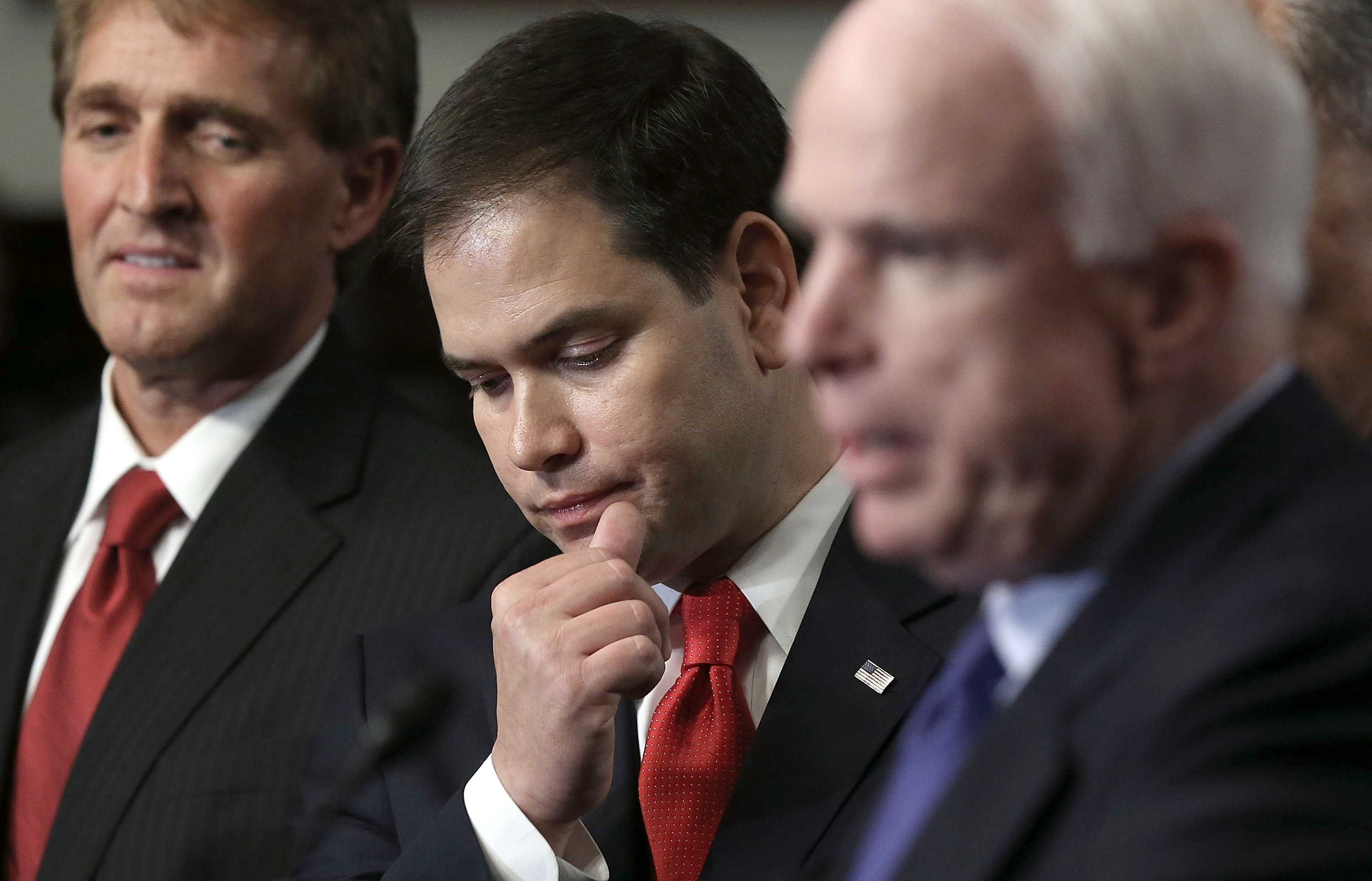
Douthat is torn between Marco Rubio and Rand Paul:
I admire Paul’s outreach to minority voters, and I was very skeptical of the immigration bill Rubio shepherded through the Senate last year. But I have agreed with practically every domestic policy stance the Florida senator has taken since, and his reform agenda seems more sensible on substance and more plausible as politics than Paul’s more stringent libertarianism.
But then on foreign policy my sympathies reverse. Paul’s ties to his father’s more paranoid worldview are problematic, but the realism and restraint he’s championing seem wiser than the G.O.P.’s frequent interventionist tilt.
Friedersdorf deems it “too risky to put another Iraq hawk in the White House, especially when they’ve given no indication of having learned anything from that historic debacle”:
Rubio would fill his White House with people who still regard the Iraq War as a good idea. Paul will tap people who believe it to have been an ill-conceived mistake. Rubio will ally with people who sing, “Bomb bomb bomb, bomb bomb Iran.” Paul represents the opposing foreign policy faction in the GOP. … Iraq is clarifying. Douthat may believe that a Rubio domestic agenda would serve America better than a Paul domestic agenda. But is the difference so great as to outweigh the risk of a Rubio war that kills 4,489 Americans, wounds tens of thousands, exposes hundreds to chemical agents, and triggers a PTSD epidemic? Is Rubio’s tax plan so good that its worth risking another $6 trillion war tab?
But, with a Jeb Bush run looking more likely, Larison is doubtful that Rubio will even run:
There isn’t room for two Texan socially conservative foreign policy hard-liners, just as there isn’t room for two Floridian pro-immigration “reform conservatives,” and so on. If both would-be candidates from any of these states run they are both bound to be much less successful. Both in each state should be able to see that they would be cannibalizing one another in the primaries, which is why many of them aren’t going to declare. That will leave us with a less interesting, but also less unwieldy field of candidates than many are expecting.
Incidentally, this is one reason why I now suspect that Rubio will end up deciding not to run for president for 2016.
(Photo: Alex Wong/Getty.)
Well, you could see this coming. Twitter announced last Thursday that it was teaming up with a left-feminist activist group to investigate gender-based harassment on the social networking site:
A group called Women, Action, and the Media, which advocates for better representation of women, is testing a new reporting process for gender-based harassment. The group developed a tool for reporting harassment and will forward confirmed reports to Twitter. “If it checks out, we’ll escalate it to Twitter right away (24 hours max, hopefully much less than that) and work to get you a speedy resolution,” says the group, which abbreviates itself as WAM. “But please note: we’re not Twitter, and we can’t make decisions for them.”
I wondered what exactly this small non-profit believes in. You can check them out here or check their agenda from the statements in the video above. Their core objective is what they call “gender justice in media.” That means that they are interested in far more than curbing online harassment. They want gender quotas for all media businesses, equal representation for women in, say, video-games, gender parity in employment in journalism and in the stories themselves. They are outraged by the following:
Less than 1 in 100 of classical pieces performed in concert in 2009-2010 were written by a female composer (and 1 in 15 was written by Beethoven!). Women make up 2% of the standard repertoire of pieces (Repertoire Report 2009-2010).
Less Beethoven – more, er, women! The crudeness of their identity politics is of a piece with their analysis. Instead of seeing the web as opening up vast vistas for all sorts of voices to be heard, they seem to believe it is rigged against female voices, or that women are not strong or capable enough of forging their own brands, voices, websites and fighting back against ideas they abhor with wit and energy and passion and freedom. Instead, WAM’s goal is to police and punish others for their alleged sexism – along the well-worn lines of contemporary and controlling left-feminism. Here’s the mindset behind the project:
“I see this as a free speech issue,” Friedman said. She said she knew some would see the work WAM does as “censorship,” but that a completely open and unmoderated platform imposes its own form of censorship. It effectively prevents women, especially queer women and women of color, from getting to speak on the service.
How exactly? Does Twitter prevent women of color from using the service? Or is it simply that WAM believes that women cannot possibly handle the rough-and-tumble of uninhibited online speech? And WAM’s intent with Twitter is not merely to highlight physical threats, abuse or stalking. They are quite upfront about casting a much wider net against those insufficiently committed to “gender justice in media”:
“We’ll be escalating [harassment reports] even if they don’t fit Twitter’s exact abuse guidelines,” Friedman said. WAM intends to “cast a wider net” and see what Twitter’s moderators address.
I can find no reason to oppose a stronger effort by Twitter to prevent individual users from stalking or harassing others – but if merely saying nasty things about someone can be seen as harassment, then where on earth does this well-intentioned censorship end? Is it designed to censor only misogyny and not racism? What about blasphemy? Are the only suspects in this brave new Twitterverse the “straight, white males” disparaged as a group in the video above? And yet, among those liberals who might worry about policing free speech in this way – let alone handing over the censorship tools to a radical activist group bent on social transformation – it’s hard to find anyone anywhere who has any qualms. Jesse Singal wonders if it’s enough to keep the trolls at bay:
There are two ways to look at this.
One is that it’s good that Twitter, in the wake of what the Verge calls “high-profile threats against game critic Anita Sarkeesian and other women” working in the gaming world, is working with an outside organization to potentially beef up its very ineffective harassment-reporting tools. The other, more cynical response is that this could be a useful way for Twitter to make it look like it’s doing something about online harassment without actually doing very much at all. After all, given Twitter’s massive resources, why should it need to outsource this job to someone else?
Marcotte is hopeful that this will help stem the tide of troll bile:
There’s reason to think that WAM!’s involvement will do some good. As anyone who has reported abuse on Twitter can tell you, pretty much anything is better than the current system. And a woman’s group might also be much better at sussing out what is and isn’t sexist harassment than the mostly-male staff at Twitter. But WAM! also has experience in this sort of thing. Last summer, the group decided to run a campaign shaming Facebook over the proliferation of pro-rape and other anti-woman hate groups that escaped censure by declaring themselves “humor” pages. Facebook responded by cracking down on this kind of content. Twitter has wisely chosen to work with WAM! directly rather than go through that sort of public shaming, and hopefully this collaboration will be mutually beneficial.
Mutually beneficial? Does she mean that WAM can get to advance their broader ideas about policing the speech of white straight males by this legitimizing alliance with Twitter?
Somehow, I suspect the culture wars online just got a little more frayed. Because Twitter has empowered leftist feminists to have a censorship field day.

Lizza takes a close look at the Dems’ presidential field. Why it might not be a cake-walk for Clinton:
The 2016 Presidential primaries will be the first fought by Democrats since the Supreme Court opened the door for individuals to spend unlimited sums of money on an election. In 2012, those new rules almost cost Romney the Republican nomination, when nuisance candidates like Newt Gingrich and Rick Santorum, who in previous years would have never survived their early losses, were propped up by rich allies. Before 2012, it would have been difficult to find interest groups that might help fund someone like O’Malley, Webb, or Sanders. Now all it takes is a billionaire who cares about gun control, climate change, war, or inequality.
“What if you decided to have a really strong antiwar person run?” one Democratic strategist told me. “Don’t you think four or five crazy rich people from the Democracy Alliance”—a network of wealthy Democratic donors—“would be funding that?”
I would imagine that the Clintons have thoroughly weeded the donor class of such wild cards by now – and the obloquy and ostracism that would greet any non-Clinton moneybags would be formidable. But I do think that the mid-terms have hurt Clinton somewhat. Why? Because they were run on classic Clinton lines: don’t really stand for anything controversial, deploy demographic-style campaigning without giving those demographics any positive thing to support, assume a get-out-the-base over a new-agenda strategy will be enough, and, er, hope for the best. The election was a classic Democratic defensive crouch – at which the Clintons are experts. And it didn’t work. It turns out you need real issues and sometimes divisive causes to win an election – and yet those are exactly the kind of themes the Clintons have always been uncomfortable with.
Matt Latimer takes another view:
No longer will she have to worry so much about gaining distance from President Obama—though that’s certainly on her agenda. No longer will she have to defend or explain her position on issues pushed by a Democratic Senate.
No longer will she have to subtly run against her husband and his scandals. Instead, she can run squarely against the circus that will preoccupy Congress and the media with every passing day. The calm voice of wearied experience. The wizened wife and mother—now grandmother—who can keep those rambunctious boys in line.
She’s probably just about the only person in Washington today who’s even happier than Mitch McConnell.
But that kinda makes my point. If all Clinton really offers is opposition to the GOP (and support for their wars) I fail to see how she’ll bring many voters to the polls. Waldman thinks the Republican Congress puts Clinton in a tricky position:
Clinton can argue that a Republican president and a Republican Congress would be a terrifying combination, and some of us might believe she’s right. But if the only alternative is four more years of bitterness and gridlock, lots of voters could chose to give the GOP the chance to do its worst. If Clinton doesn’t already have a persuasive description of how she will govern if faced with a legislature controlled by Tea Partiers and Republicans afraid of Tea Partiers, who will fight her on every single thing she wants to do, Clinton sure ought to come up with one soon.
But that would mean taking a political risk. And that is something Clinton has taught herself never to do.
(Photo: Democrats buy Clinton buttons and t-shirts following the Arkansas Democrats’ campaign rally featuring former President Bill Clinton and Sen. Mark Pryor, D-Ark., in Texarkana, Ark. on Sunday, Nov. 2, 2014. By Bill Clark/CQ Roll Call)
Let’s say you wanted to construct a narrative that perfectly fits the definition of mission creep. How could it improve on the following: at first you insist you are not going to be dragged into a new war in Iraq and Syria; then you rush military aid to avoid a humanitarian disaster; then you find that you need to make sure Kobani doesn’t fall; then you commit 1500 troops to “advise” the Iraqi “military”; and then you have the Pentagon announce “that it had received authorization from Obama to send an additional 1,500 U.S. personnel to Iraq over the coming months”, which would double the number of American boots on the ground there. But no worries. Nothing to see here:
The new troops will be placed under the same noncombat restriction as those already deployed, but they will be moved closer to the front lines. … According to a senior administration official, 630 of the new troops will be performing an advise-and-assist mission — similar to the one being conducted today — primarily in Anbar in the west of the country. The Pentagon plans to establish “two expeditionary advise and assist operations centers, in locations outside of Baghdad and Erbil,” to provide support for the Iraqis at the brigade headquarters level and above. The remaining 870 troops will be doing a more traditional training mission at locations across the country, the senior administration official said. Both missions will move U.S. troops out of Iraq’s major cities and closer to where battles are currently being waged and where a likely counteroffensive would begin.
But no combat will be allowed! What if combat comes to them? What if one of them is killed? Are we not to respond and defend ourselves? One US soldier captured by the IS and we have a huge emotional story that could guarantee even more of a commitment. This is exactly how this operation with a few advisers becomes an unstoppable war in an unwinnable desert.
And then, as if to underline the fact that he could easily be ramping up for a third Iraq war (to be continued by the Clintons or by a neocon president), Obama stressed that he would “never say never” to more troops (video above). Juan Cole wants Obama to stop bullshitting about our presence in Iraq:
If ISIL really is a dire threat to US security, as administration officials maintain, then they should go to the US public with the news that they are going to have to put thousands of US forces on the ground in Iraq. So far they are trying to spin us, and to pretend that there are just some trainers and advisers. It is far more than that; US special operations forces will be operating in Iraq brigades, likely in part to paint lasers on targets for US warplanes to bomb.
Meanwhile, the counteroffensive may have already begun: an aide to ISIS “caliph” Abu Bakr al-Baghdadi was reportedly killed in an air strike Friday night, while Baghdadi himself may also have been injured or even killed, though the Pentagon can’t confirm that. The Iraqi army is also making gains against ISIS in the strategically important northern city of Beiji:
Exclusive images obtained by Al Jazeera on Monday showed government forces pushing ahead into the rebel-controlled city, with ISIL flag covered in an Iraqi security forces slogan. Al Jazeera’s Imran Khan, reporting from Baghdad, said clashes continue and the armed rebels are fighting back. He said the oil refinery, located about 50km from the city centre, is the next big target. ISIL fighters remain in control of parts of the facility. The military advance is seen as a significant victory for the government, as Beiji and its nearby oil refinery were one of the first territories swept by ISIL in June.
The targeting of refineries like the one in Beiji is one reason why German intelligence believes the jihadist group’s oil revenues are much lower than previous estimates had calculated:
According to German English-language publication The Local, the BND (German equivalent of the CIA) estimate was obtained by several German news agencies. The BND estimate suggests that ISIS may make less than $100 million this year from oil — under $274,000 per day. Obviously, that’s still a lot, but it’s way lower than what most public estimates suggest. …
There are two big reasons the BND thinks most estimates are inflated. The first is coalition airstrikes: the United States and its allies have pounded the oil extraction rigs, which are after all right out in the open, and hit ISIS smuggling lines. As such, the BND believes that ISIS has gone from producing its highest oil production of 172,000 barrels per day to 28,000 in October. … The second reason the BND believes ISIS oil revenues are inflated has to do with ISIS governance itself.
But this is never enough. Now, the US has to fight the Iraqis’ fight for them – and somehow regain the territory lost to the IS. The goal will determine the forces. And whatever restraints this president tries to put on this will soon be busted – either by him or his successor.
This is exactly what we elected Obama to prevent, not to enable. But the war machine outlasts any president. And it has too easily coopted this one already.
One of my best friends in the Marine Corps was pretty open about his challenge. Once, during a group outing in town wearing on-base only uniforms, he pulled into the cleaners to pick up our dress uniforms for parade the next day. The only parking that wouldn’t expose us to a long walk along a busy road, and the penalties for being out of uniform, was the handicapped parking sign dead in front of the door. So, swinging the car into it, he parked exclaiming, “I’ve got a 3-inch dick … tell me that’s not a handicap!”
A gay reader attests:
A small penis can be lots of fun.
It fits in my mouth easier. Big ones can be a lot of work, after all. And big ones don’t fit well in some places. I’m sure I could accommodate a huge one if I planned on it, but not this evening. (I’d have to drag out the toys.) Some of my favorite things to do don’t involve inserting it an orifice. Or even a hand. I don’t have the patience to list them all.
I don’t have sex with a dick; I have sex with a man. He may have a extra big one or an extra small. We can find all sorts of things to do together that we can’t do when we are alone. (See your post “What Exactly Is An Unusual Sexual Fantasy?”)
Here’s a point that Dan Savage often makes in his column:
You also need to stop viewing your dick as somehow fatal to your romantic prospects. “Dr. [Justine] Schober did a study of guys who had really small penises,” [Northwestern’s Alice] Dreger continues, “small enough to be described as ‘micropenises.'” And how do men with dicks so small that doctors feel free to toss around an ego-shattering prefix like “micro” do with the ladies? “This study found that they tend to have ‘close and long-lasting relationships’ with women,” Dreger says. And Dr. Schober says: “They often attribute partner sexual satisfaction… to their need to make extra effort, including nonpenetrating techniques.” One of the microdicked men in Dr. Schober’s study had a wife and a mistress. “So much for the theory that having a small member won’t get you a woman,” says Dreger.
Every now and again, you have to remind yourself of the wonder of the First Amendment. Given the deep human urge to silence those with whom we disagree, it’s proven indispensable to protecting wild, open and robust debate against the micro-managers of the Social Justice Warriors on the left and the Jihadist-extremism monitors on the right. And if you doubt its value, just take a look over the pond, where the Tory party is proposing the most draconian crackdown on free speech since the press won its independence centuries ago.
As usual, you have the Orwellian terminology, and in this case it’s something called an “Extremism Disruption Order.” A more accurate term would be a “Government Censorship Order” – for that is exactly what this betrayal of British values truly is:
The home secretary’s manifesto plan to silence extremists by banning their access to the web and television is cast far wider than the Islamist “preachers of hate” of tabloid headlines. As David Cameron pointed out, the Conservatives now want to look at the “full spectrum of extremism” and not just the “hard end” of that spectrum that counter-terrorism policy has focused on up to now. The difference is spelled out in the detail of the policy, where it says that it is intended to catch not just those who “spread or incite hatred” on grounds of gender, race or religion but also those who undertake “harmful activities” for the “purpose of overthrowing democracy”.
Or to put it more plainly: the government has an obligation to censor dangerous ideas because they might hurt someone’s feelings:
George Osborne, the Chancellor, has made clear in a letter to constituents that the aim of the orders would be to “eliminate extremism in all its forms” and that they would be used to curtail the activities of those who “spread hate but do not break laws”.
He explained that that the new orders, which will be in the Conservative election manifesto, would extend to any activities that “justify hatred” against people on the grounds of religion, sexual orientation, gender or disability.
He also disclosed that anyone seeking to challenge such an order would have to go the High Court, appealing on a point of law rather than fact.
So this is how blasphemy laws get a comeback in a post-Christian country: all religions are now immune from any public criticism that could be regarded as “extremist”. And not just religions: also gay people, women and the disabled. And why end there? You can see the multiple, proliferating lines for government interference. If a gay man attacks Islam for being homophobic, he could be prosecuted. But ditto if a Muslim cleric denounces homosexuality. It’s win-win for government power to monitor and control public speech in all directions!
In fact, the proposed law is an invitation for an orgy of allegations of victimhood, for a million ways to define hatred, and for countless lawsuits which would be extremely hard for most people to defend against. I’m sure this blog could be liable in England under these terms – if the government decides my questioning of the Matthew Shepard myth is hateful or my insistence on the Islamic factor in contemporary Jihadist terrorism is Islamophobic. And if this blog were in the UK, I’d be constantly worried that it could be shut down:
Once served with an EDO, you will be banned from publishing on the Internet, speaking in a public forum, or appearing on TV. To say something online, including just tweeting or posting on Facebook, you will need the permission of the police. There will be a “requirement to submit to the police in advance any proposed publication on the web, social media or print.” That is, you will effectively need a licence from the state to speak, to publish, even to tweet, just as writers and poets did in the 1600s before the licensing of the press was swept away and modern, enlightened Britain was born (or so we thought).
You won’t even be able to tweet once the government has found out your views are noxious to some aggrieved group or individual. The goal, of course, is laudable – as laudable as hate crimes laws in intent: the creation of a society where impure thoughts are forbidden and thereby less likely to affect or influence others. And all this to advance what the Tories call the “British values” of tolerance, good faith and moderation.
But notice one British value that falls by the wayside. That value is freedom of speech. In our many concessions in the fight to monitor and control Islamist extremism and terror, that one should remain inviolable.
Late in the day on Friday, the White House announced that Loretta Lynch, a federal prosecutor from Brooklyn, would be Obama’s nominee to replace Eric Holder as his Attorney General. If confirmed, she would become the first black woman to hold the office:
Lynch is the U.S. attorney for the Eastern District of New York, which covers Brooklyn along with Queens, Staten Island, and parts of Long Island. She has served twice in that post—initially during the end of the Clinton administration—and was confirmed unanimously by the Senate both times. But a promotion from federal prosecutor to leading the entire Justice Department would be a big bureaucratic leap, one that according to The New York Times has not occurred in nearly 200 years.
To Sam Kleiner, her outsider status is a feature, not a bug:
This independence is particularly important for the Attorney General because she may have to prosecute cases that are deeply unpopular. Lynch prosecuted both Republican and Democratic politicians on corruption charges and her lack of experience in the administration is actually a plus; she comes to the job with an integrity and independence that is owed to her rise through the ranks of a U.S. Attorney’s office. When President George W. Bush was sworn in 2001, Lynch had hoped to stay on as the U.S. attorney in the Eastern District because, she said, ”There’s a good group of people working here: the prosecutors, judges, agents and investigators.” For her, this was more than a job; ”It’s a like a family. I’ll miss the people most of all.” Bush asked for Lynch’s resignation but her willingness to serve under a Republican president demonstrates that she is not a political operative; she has sincerely dedicated her career to the Department of Justice.
Ilya Shapiro calls Lynch a smart, sensible choice:
Like George W. Bush’s appointment of Michael Mukasey to replace the embattled Alberto Gonzalez, Lynch is likely to be a low-profile steady hand to replace the radioactive Eric Holder. At the same time, picking the first black woman AG allows the president to further his diversity agenda without spending tremendous political capital (which he doesn’t now have) – in a way that wouldn’t have been possible with Tom Perez, the controversial labor secretary who was also thought to be a contender for the job. All in all, while I’m sure I’ll disagree with some of Lynch’s enforcement decisions, this nomination means that legal analysts’ focus will largely remain on those policy issues rather than the controversial personalities and politics behind them.
But Charles Ellison talks her up as anything but low-profile:
Obama’s future deployment of her skillsets should worry adversaries who will, predictably, dismiss the black woman in charge at Justice. Is Russian President Vladimir Putin still giving you geopolitical headaches? Obama now has a Lynch for that, her elevated role in Washington giving her extra firepower in her ongoing oil-trading and money-laundering investigation of Putin ally Gennady Timchenko.
Need to keep those multi-billion-dollar, post-recession big-bank fines flowing in to federal coffers? The Big Apple’s top prosecutor has been Holder’s secret weapon in squeezing historic penalties out of banks like Citigroup ($7 billion settlement) and HSBC ($1.2 billion) over seedy mortgages and money laundering. And Wall Street gets a bat signal over Gotham while Capitol Hill gets the notice letter: It’s Lynch who is patiently hunting down just-reelected Congressman Michael Grimm (R-NY), a former FBI agent indicted on 20 counts of tax fraud, perjury and obstruction of justice.
The administration hasn’t even set a date for her confirmation hearings, and already Lynch is making waves in the fever swamps, forcing Breitbart to issue what Josh Marshall calls “the best correction since forever”. Allahpundit wonders why Obama didn’t put forward her name before the election, to try and turn out more black voters:
Democrats were desperate to get black voters and women to turn out for them on Tuesday, so here’s Obama ready to nominate the first black woman Attorney General in U.S. history and … he saves the announcement for after the election. Even odder, Lynch is a North Carolina native; some free press about that a week or two before the big vote might have helped Kay Hagan in a tight race. Not sure why O held the nomination until now, unless the White House concluded that a black woman AG would only further antagonize an electorate that was sure to be older and whiter than 2012. If that was their calculation, though, it was stupid: Nearly anyone would be considered an upgrade over Holder by righties, especially someone like Lynch with few obvious red flags on her record. It could have helped with his base (a little) and wouldn’t have hurt with a wider electorate that was already prepared to bury Democrats.
Or maybe he’s just not that cynical. Senators Ted Cruz and Mike Lee insist that Obama wait until the new Senate is seated to start her confirmation process, which they plan to turn into a hearing on Obama’s threatened executive action on immigration reform. Lincoln Mitchell, however, posits that “a confrontational Senate seeking to stop Ms. Lynch might be more politically advantageous for the President”:
The challenge for the Republican Party now is to build on a very impressive election victory in the midterm election to help bring a Republican President to the White House in 2016. Central to this effort will be to recast the party as one that can govern rather than simply obstruct President Obama. The specter of a tough confirmation battle over a cabinet position will force the Republicans into demonstrating that they are capable of the former.
Republican opposition to Ms. Lynch may or may not be based on genuine policy concerns, but given that she has already been confirmed twice by the Senate it will be very easy for the White House to portray opposition to Ms. Lynch as typical Republican recalcitrance and as evidence that the GOP is still not ready to govern in a meaningful way. Additionally, because Ms. Lynch is an African American woman, any attempt to deny her confirmation will inevitably be seen through the prism of race and gender.
 The Dish