No one suffers any more for pointing out the obvious fact that a powerful lobby defending the maximalist claims of Greater Israel exerts enormous influence in both parties – so as to effectively prevent the US, whoever is in power, from pursuing its own national interest if it might conflict with Israel’s. And in today’s mega-bucks politics, two huge donors dominate each party – Sheldon Adelson handles the Republicans, ensuring that any deviation from Likudnik politics is chilled or choked off; and Haim Saban does the equivalent for the Democrats, with his extremely close ties to the Clintons. They came together this past weekend to declare that no differences in domestic policy would ever create daylight between them when it comes to advancing what they believe is Israel’s national interest. It’s helpful to see this mindset in the light of day:
“Everyone in this room – whether you’re a Republican, a Democrat or Independent … when it comes to Israel, we’re on the same side,” Adelson said.
And so if the US and the major powers achieve a new detente with Tehran that Netanyahu opposes (and he opposes any detente), Saban and Adelson will be at one to destroy and undermine it:
Though Saban generally expressed more moderate views than Adelson on the Palestinian issue, when talk turned to Iran he said that if he were Israel’s prime minister and a nuclear deal between Iran and the West risked Israel’s existence, “I would bomb the living daylights out of those sons of bitches.” On this issue, Adelson was the more moderate, saying only that he would “take action.”
So here you have a leading American Democrat pledge to support a foreign government over his own when it comes to a critical issue of war and peace. And the pledge takes the form of a punitive and cathartic act of mass bombing authorized by no international law or body, and as a rebuke to the duly-elected president of the United States. We’re so used to this astonishing display of extremism and tribalism that it no longer manages to shock.
In the same confab, Adelson again declared that he believes that Palestinians do not really exist and that a two-state solution is anathema. And he has no attachment to democracy, per se:
“So Israel won’t be a democratic state, so what?” he asked Saban, adding that democracy, after all, is not mentioned in the Torah, and recommended that the country build a “big wall” to protect itself, saying, “I would put up a big wall around my property.”
Both men are also media players. Adelson, at least, is frank about what he regards as the point of journalism – pro-Israel propaganda:
“I don’t like journalism,” Adelson said, highlighting what he said was the media’s insistence on focusing on the empty half of the glass.
“I wish that Jeff Bezos hadn’t bought The Washington Post,” Saban said, referencing the Amazon.com founder who purchased The Post a year ago. “For $250 million — bupkis — he stole it.” Adelson countered, “Why don’t you and I go after the New York Times?” Saban said that he has “tried over and over to buy it” but that the family-owned Times is not for sale. Adelson quipped, “There is only one way to fight it: money.”
My point here is to note that one of the biggest struggles of the Obama administration is about to take place: an attempt to win a detente with Iran that polices its nuclear program and tries to coax it back to the family of nations. The struggle will be less between Tehran and Washington – although that outcome remains very much in doubt. The struggle will really come when the Israel lobby pulls out every stop to prevent any such deal – using the Congress they have so assiduously courted and the media they acquire or influence.
One crucial sign that the Obama administration really has cemented change in this country is the potential deal with Iran. Along with universal healthcare, it remains an idea that the Washington power apparatus would never have adopted save the Obama elections in 2008 and 2012. That’s why every single measure to kill healthcare reform – including now an absurd Hail Mary pass from the Supreme Court – has been deployed again and again and again. And that’s why these last two years have become as critical as any in the Obama administration’s pursuit of a durable legacy. Iran is the critical test: can the change we believe in survive its final challenges before the Establishment takes over again?
Ezra explains why the King v. Burwell case could destroy Obamacare:
Robert Laszewski warns that “the immediate impact of King would be nothing short of devastating in the 37 state individual health insurance markets––on and off the federal exchanges”:
I have been a critic of Obamacare. But I also believe the way to solve this is through the political process where change can occur in a way that provides those now covered a soft landing during the transition, not in the courts where an affirmative finding for King would instantly destabilize the insurance markets in these states leaving millions uncovered until each of the states – or the federal government – could work out a solution.
One analysis, from the Rand Corporation, suggested that overall enrollment in the “non-group” market (that is, people buying insurance on their own) would decline by 70 percent. Another analysis, using a model developed by economist Jonathan Gruber and cited in an amicus brief signed by several dozen health policy scholars, suggested that the result of eliminating tax credits in the affected states would be 6.5 million additional people without health insurance.
Margot Sanger-Katz outlines what will remain if the anti-Obamacare side wins:
The Medicaid expansions, now underway in 27 states, would stand. Young adults would still be able to get coverage through their parents’ health insurance. The law’s reforms of Medicare payment policy would stay on the books. Regulations on insurance companies limiting their profits and requiring that all products cover certain basic benefits would stay in effect. And the subsidies flowing to states that ran their own exchanges would continue. An anti-Obamacare decision in the King case wouldn’t take the health law off the books. It would just make federal spending on health care more uneven than it already is.
What will Roberts do now? He took substantial heat from conservative critics who were astonished and horrified to see the lifetime conservative betray the cause at its moment of potential judicial triumph. One possible interruption is that, scarred by this experience, Roberts would now go along with the conservative tide. The continuing unpopularity of Obamacare in opinion polls combined with the obvious weakness of President Obama after the midterm elections would provide some support for this possibility.
The other possibility is that Roberts will not deviate from his judicial restraint centrism. To strike down Obamacare now, having upheld it before, might look like opportunism or wishy-washy-ness. Given how weak the law increasingly appears, it would be a high price for Roberts to pay before the judgment of history if he now struck it down. Indeed, such a decision would vitiate his earlier restraints.
Legal experts tell me that Roberts’ past rulings indicate he’d be sympathetic to arguments that Courts should defer to executive agencies when it comes to interpreting what laws mean. If so, he’d take the government’s side and reject the lawsuit. But if we’ve learned anything in the last few years, it’s that the Court is unpredictable, particularly when it comes to Obamacare.
[R]egardless of whether the Court should have heard the case now, there can be no doubt about what it should do now that it’s hearing it. Non-partisan judges applying straightforward principles of statutory interpretation should easily conclude that the ACA not only allows, but requires, that tax credits and subsidies be available on federally facilitated exchanges. That alone should give confidence to anyone who’s worried about the fate of the Affordable Care Act. But for anyone who remains worried because they interpret the Court’s decision to hear the case as a sign of where the Justices are on the merits, there’s one more thing they should remember: it takes four votes to hear a case, but five to decide it. So it’s way too soon for ACA opponents to celebrate.
Jonathan Adler, on the other hand, buys the challengers’ arguments:
Of course the ACA’s supporters hoped tax credits would be available in all 50 states, just as they hoped the Medicaid expansion would be available in all 50 states. In both cases, they expected states to cooperate. Time and again ACA proponents said states would create their own exchanges. What no member of Congress ever said during deliberations over the ACA, however, is that there would be tax credits in federal exchanges. Despite years of looking, not a single contemporaneous statement making this simple claim has been found. That Congress did not anticipate that states might refuse to create exchanges, and did not consider whether the law adequately addressed that potentiality, does not give the IRS or the courts the authority to correct the legislature’s handiwork. Congress chose to enact what even its supporters recognized was a flawed bill, because there were not enough votes to craft an alternative and because, in their view, a flawed bill was better than no bill. Most preferred the exchange provisions embodied in the House health care reform bill, but that was not what Congress enacted.
For staffers who helped write Obamacare, though, there isn’t really a debate at all. The answer, for them, is crystal clear: they definitely meant to have subsidies available in all 50 states, regardless on who ran the marketplace.
“It was always intended that the federal fallback exchange would do everything that the statute told the states to do, which includes delivering the subsidies,” says Chris Condeluci, who worked as tax and benefits counsel for the Senate Finance Committee Republicans during the Affordable Care Act debate.
“The evidence of Congressional intent here is overwhelming,” John McDonough, who worked on the Health, Education, Labor and Pension committee during the health reform debate, wrote in an email. “There is not a scintilla of evidence that the Democratic lawmakers who designed the law intended to deny subsidies to any state, regardless of exchange status.”
Opponents of the lawsuit emphasize that absolutely no one intended for the law to function this way. There’s somedebate over whether this is actually the case, but I’m personally skeptical that the law enacts the intent of those who were voting on it. But the crucial fact in understanding this lawsuit is that, while a more liberal judge might be inclined to accept this, this is not how conservative judges tend to approach statutory interpretation. For them, the question isn’t “What did Congress want to pass?” It is “What did Congress pass?” As Justice Antonin Scalia put it: “Congress can enact foolish statutes as well as wise ones, and it is not for the courts to decide which is which and rewrite the former.”
Scott Lemieuxconcedes that the “the smart money is that the Supreme Court will vote to overturn King and throw most of the exchanges into chaos”:
Some blue states would have their own exchanges, but many others would not. Worse still, the fact that the core benefits of the ACA – the historic Medicaid expansion and the regulated exchanges – would be largely confined to blue states would make it much easier for a unified Republican Congress and White House to repeal the ACA entirely.
It’s very likely, in other words, that John Roberts is on a crusade to slowly poison the ACA to death without issuing a single high-profile ruling holding the ACA unconstitutional. First, he rewrote the Medicaid expansion in a way that denies health insurance to millions of poor people (while not even meaningfully protecting state sovereignty). And now, Roberts might be ready to join the court’s other Republicans to destroy most of the exchanges based on legal arguments that are even more dubious.
Chait imagines the political aftermath of a ruling against Obamacare’s subsidies:
NFIB v. Sebelius came out a year and a half before Obamacare was up and running. The victims of the ruling had not yet started getting coverage. Indeed, many of them still aren’t aware that their state is denying them free health care in order to spite Obamacare. States that refuse to build their own exchange, on the other hand, would be denying subsidies to millions of people who already get them. People are extremely loss-averse, and react much more viscerally to the government eliminating an existing benefit than denying a hypothetical one.
The second difference is that the exchanges service a more affluent breed of consumer. Medicaid beneficiaries are extremely poor. The very poor vote at the lowest rates, and Republican budget proposals tend to saddle them with the steepest cuts. They are, in other words, a constituency most Republicans are willing or even eager to target. The exchanges, on the other hand, reach well up into the middle class.
Sargent also games out the political implications:
“Repeal until now has been symbolic,” [the Kaiser Family Foundation’s Larry] Levitt tells me. “If SCOTUS were to disallow the subsidies, the Republican decision in response would all of a sudden have serious consequences.”
And there are other reasons this might not be so easy. If SCOTUS does this, Levitt adds, “the insurance market would collapse in these states. Congress couldn’t possibly do nothing at that point. There would be tremendous pressure from the insurance industry, and the health care industry generally, to fix this.”
Now, it’s very possible Republican members of Congress – and GOP governors – would not fix it. But at least the true consequences of their health care stance would now be nakedly apparent.
But Waldman doubts that Republicans will pay a price:
This is a country where people shake their fists at their members of Congress andsay, “Tell the government to keep its hands off my Medicare!”, where people like their state Obamacare exchange but hate Obamacare, where people approve of almost everything this law does but disapprove of the law itself. You think the public as a whole is going to understand this lawsuit and know who to blame? Don’t bet on it. They’ll only know that now they can’t get insurance anymore. “Obamacare took away my subsidy!” they’ll cry. And Republicans will laugh and laugh.
What is “invisible unemployment”? It’s discouraged workers and part-timers who want more hours. The official unemployment rate doesn’t consider them unemployed. So when we talk about the official unemployment rate—now at a lowish 5.8 percent—we’re ignoring these workers. They’re statistically invisible. Here’s a picture of invisible unemployment (in blue) vs. official unemployment (in red). Since early 2010, the number of unemployed Americans has declined by twice as fast as the number of discouraged/part-timers (42 percent vs. 21 percent).
In 2002, official unemployment swamped invisible unemployment. The official unemployment rate was an accurate description of the labor force. But the spread between invisible and official unemployment is shrinking. In the last 20 years, the six months with the smallest gaps between official and invisible unemployment were all in 2014. That means the official unemployment rate is getting worse and worse at describing the real conditions facing American workers.
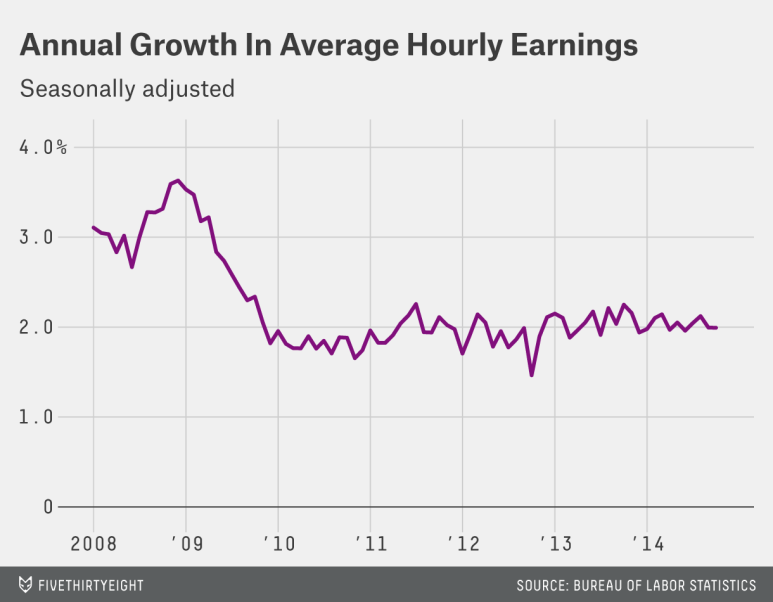
The average worker earned $24.57 an hour in October, up 2 percent from a year earlier. Even as hiring has picked up and unemployment has fallen, wages growth has remained decidedly anemic.
From an economics perspective, modest wage growth isn’t an entirely bad thing. It suggests that employers aren’t struggling to find workers to fill the available jobs, which means employment growth can continue without the economy overheating. For policymakers at the Federal Reserve, it means they can keep trying to boost the economy with low interest rates without worrying too much about inflation.
But for workers, the earnings figures mean that they aren’t seeing the economic recovery reflected in their paychecks. Until that changes, they’re unlikely to take much comfort in jobs-day headlines, no matter how positive.
Greg Ip adds that “productivity is up only 0.9% in the last year, lower than the 1.3% average recorded since the recession, itself none too impressive”:
Both weak pay and productivity might be related to the sorts of jobs growing the most; Steve Blitz of ITG reckons almost 70% of this month’s private sector job growth were in temporary work, health care and restaurants. Manufacturing and construction both rose, but by slim numbers.
But Weissmann remarks that “some, like Moody’s Analytics economist Mark Zandi, are convinced wage spikes are just around the corner”:
Even though the overall unemployment rate is still high by long-term standards, some analysts believe that the millions of the long-term jobless are essentially unhireable—meaning that employers are actually looking at a much smaller labor pool. The short-term unemployment rate is already almost back to normal, and to them, that indicates pay raises are on the way. If they are, we can only hope that the Fed doesn’t overreact and throw cold water on the economy before it ever really gets hot.
A reader points us to Massimo Pigliucci’s fascinating recap of an academic conference on denialism, or “the willful disregard of factual evidence by ideologically motivated groups or individuals.” One noteworthy takeaway:
Denialists have learned to use the vocabulary of critical thinking against their opponents. To begin with, of course, they think of themselves as “skeptics,” thus attempting to appropriate a word with a venerable philosophical pedigree and which is supposed to indicate a cautiously rational approach to a given problem. As David Hume put it, a wise person (i.e., a proper skeptic) will proportion her beliefs to the evidence. But there is nothing of the Humean attitude in people who are “skeptical” of evolution, climate change, vaccines, and so forth.
Denialists have even begun to appropriate the technical language of informal logic: when told that a majority of climate scientists agree that the planet is warming up, they are all too happy to yell “argument from authority!” When they are told that they should distrust statements coming from the oil industry and from “think tanks” in their pockets they retort “genetic fallacy!” And so on. Never mind that informal fallacies are such only against certain background information, and that it is eminently sensible and rational to trust certain authorities (at the least provisionally), as well as to be suspicious of large organizations with deep pockets and an obvious degree of self-interest.
Last Thursday, the FBI announced that it had shut down the second incarnation of the infamous black market site Silk Road and arrested its founder:
Investigators claim that Blake Benthall, 26, co-created Silk Road 2.0 in November 2013 after the man accused of founding the original Silk Road — Ross Ulbricht, known as “Dread Pirate Roberts” — was arrested and had his site shut down the month earlier. Operating under the name “Defcon,” the officials allege, Benthall owned and operated “one of the most extensive, sophisticated, and widely used criminal marketplaces on the Internet today.” The marketplace, which shielded its some 150,000 active users with Tor technology and appears to have been seized by federal authorities, was apparently generating sales of about $8 million each month, primarily in illicit drugs.
Two smaller “Darknet” sites were reportedly also seized. Chris Ingraham contends that these shutdowns actually make the drug market more dangerous, and in any case, as soon as one site goes down, another goes up:
I’ll note that there’s a strong argument to be made that the darknet economy makes the world a safer place overall. By taking drug transactions off the street and putting them online, you eliminate a significant link in the chain of violence between drug suppliers and end users. Drugs purchased online are typically less adulterated with dangerous contaminants than street drugs are, and a system of reviews rewards sellers who provide high-quality product. … Regardless of how many of these sites the FBI has seized today, it’s a near certainty that dozens more will spring up to take their place tomorrow.
In a follow-up, he adds that the FBI is returning to old-school drug war tactics that we know don’t work:
In essence, this is nothing more than a promise of an endless arms race between the FBI and Darknet administrators. It’s understandable that the FBI is going to pursue to biggest facilitators of drug sales — which are still illegal at the federal level — but it’ stills a throwback to the darkest days of the drug war, when law enforcement’s relentless focus on “supply reduction,” shutting down drug sellers and manufacturers, fueled a surge in crime and had, studies showed, no impact on overall drug use trends.
Much of the rhetoric coming out of the federal government recently, on the other hand, has been focused on the flip side of that coin: demand reduction, including drug use prevention and treatment measures. These measures largely embrace the notion that drug use is a fact of modern life, and that the best way to address it is to focus on eliminating the harms associated with it.
In an essay arguing that innovation “has been fueled and sustained by imitation,” Kat McGowan notes that “only humans ‘overimitate,’ copying an action with precision even when it’s obviously a poor technique”:
We overimitate even when told not to – it seems to be part of the way we think. In experiments conducted in 2007 by the psychologist Derek Lyons when he was a graduate student at Yale, children were shown a jar with a toy dinosaur inside.
An experimenter then demonstrated a ridiculous way to open the jar: first tapping it with a feather, then unscrewing the lid. In a video of this experiment, the psychologist emphasises how useless his actions were: ‘Josh, did I have to tap on the jar with this feather to get the dinosaur out?’ he asks. The little boy shakes his head: ‘NO!’ Then the researcher asks Josh to name the gestures that were ‘silly’ and ‘extra,’ and praises him when he answers correctly.
Clearly, Josh gets the point. So when the psychologist tells him to take the toy out however he wants, and then leaves the room, what does Josh do? He picks up the feather, taps the jar, and then unscrews the lid.
In variations of this experiment, children were explicitly forbidden to make any of the ‘silly extra’ gestures that researchers used; even so, between 75 and 94 per cent of the time, they copied the precise sequence of motions. Lyons argues that this is a perfectly rational way to behave, especially for children: puzzling out how something works through casual reasoning requires time, energy and knowledge about the world that they don’t yet have. Copying is heuristic – a smart shortcut that, outside of a psychologist’s lab, usually yields the right answer. ‘Imitation is a remarkably potent learning strategy,’ writes Lyons.
Charles Murray celebrates the contributions of stay-at-home wives:
[M]any of the important forms of social capital take more time than a person holding a full-time job can afford. Who has been the primary engine for creating America’s social capital throughout its history, making our civil society one of the sociological wonders of the world? People without full-time jobs. The overwhelming majority of those people have been wives.
Every aspect of family and community life gets an infusion of vitality and depth from wives who are not working full time. If you live in a place that you cherish because “it’s a great community,” think of the things you have in mind that make it a great community (scenery and restaurants don’t count), and then think about who bears the brunt of the load in making those things happen. If you live in a place that is not a community—it’s just a collection of unrelated people, living anonymously, without social capital—think of the reasons why it is not a community. One of the answers will be that no one has spare time for that kind of thing.
I’m not knocking the importance of stay-at-home moms for raising children. I just want us to realize that stay-at-home wives are one of the resources that have made America America. It is entirely understandable that some wives work full time, either for the fulfillment of a vocation or to make money–the same reasons men work full time. But when either partner in a marriage—and it will usually be the wife—chooses to devote full time to being a parent and neighbor instead, that choice should not just be accepted, but celebrated.
And stay-at-home husbands as well. The division of labor within marriage is important, but it doesn’t have to follow traditional gender lines. Catherine Rampell responds to Murray:
Among fathers, 16 percent say they’d ideally stay at home, if money were no object. Just 7 percent of them are actually abstaining from the labor force. Now look at mothers: 22 percent say they would ideally like to stay at home and not work, while 30 percent actually do so. …
[W]hat accounts for the divergence between stated work preferences and actual work arrangements? Let’s start with the barriers to taking part-time work: Some jobs are just not easy to divvy into part-time hours, either because of the nature of the work or the costs to the employer associated with hiring and managing more staff. Part-time jobs also tend to pay less on an hourly basis than their full-time equivalents and may not be remunerative enough to justify paying for child care. So, many parents who would ideally like to work part time instead choose full-time jobs that pay a little better. Or — more often for mothers than for fathers — they stay out of the workforce altogether, which means they can provide child care themselves.
Fathers may feel relatively reluctant to drop out of the labor force — even when that is their preference, or when they prefer a part-time job but can’t find one – for two main reasons: A) They are still more likely to be in higher-paying careers than their children’s mothers are (a trend that may change as women obtain more education, as Tankersley suggested); and B) compared with women, men may feel greater social pressure to be breadwinners rather than homemakers, part of the so-called “masculine mystique.”
Update from a reader:
Rampell’s response to Murray’s piece only gets at part of the problem with his celebration of wives. Yes, the gendering of those who chose to stay-at-home is near-sighted and problematic. But Mr. Murray is not talking about “wives” here; he’s talking about the noblesse oblige of women of a certain class who are freed from domestic labor and then in turn pursue civic pursuits. While Mrs. Murray’s social commitments are commendable (she’s no Real Housewife of Chevy Chase), where does she get the time to take on “half a dozen civic obligations” if she isn’t relying on the (most likely) underpaid work of domestic laborers who keep up her house? Not that I would want her or anyone chained to what was once called drudge work, but her free time seems to be displaced onto the back of someone that Mr. Murray is not mentioning. That someone cleans the Murray household (presumably a woman, since that is who typically performs paid domestic labor) is clearly not able to stay home and be a wife according to Mr. Murray’s definition.
Another:
I am not crazy about the “stay at home wife” terminology. It does ignore fathers who would like to stay home but do not, as well as the parents who need to work for financial reasons. However, as a “stay at home wife”, I disagree with the reader who said the civic participation occurs on the backs of hired help. Yes, that happens in some cases, but even the most cash-strapped “stay at home wives” volunteer their time in ways that benefit their community. I usually have 3-5 volunteer pursuits going at a time and I have no hired help to manage my home. We are wealthy enough to hire help but not wealthy enough for it not to be a trade off. Also, a number of women do not return to work when their kids go to college; they have a lot of time for civic pursuits.
In my experience, my volunteer civic pursuits are often treated as “cute” by men and women with careers, even if they require the same management skills as my former career did. Maybe what we need is less about celebrating “stay at homes wives” and more about respecting and valuing the contributions people make even when a paycheck is not involved.
My own equivalent of the above is when I switch off my CPAP machine in the morning. Within a few seconds, a small, three legged beagle will be headed to my face for a frenzy of licking. It’s the best way to wake up ever. Well, almost.
Readers flocked to this wonderful quote from Aleksandr Solzhenitsyn this weekend – it’s what Ben Smith would call “sharable:”
If your back isn’t broken, if your feet can walk, if both arms can bend, if both eyes can see, if both ears hear, then whom should you envy? And why?
19 more readers became subscribers this weekend. You can join them here – and get access to all the readons and Deep Dish – for a little as $1.99 month. Gift subscriptions are available here. Dish t-shirts are for sale here, including our “Know Dope” shirts, which are detailed here. A final email for the weekend:
I just listened to your amazing podcast with Christian Wiman. As a struggling Catholic, it was wonderfully life-affirming for me to listen to you, Christian, and Matthew discuss faith. You ended the podcast by thanking Chris and telling him “you make it a less lonely place for a lot of us.” That is very much how I have viewed The Dish for some time now, especially your Sunday installments. I don’t have much faith in anything transcendent, but there is still something spiritual in my heart that keeps beating. The Dish is a big reason for that (along with Pope Francis!). So thanks for making the world a less lonely place for a lot of us, especially me.


 The Dish