The Royalist Roots Of The American Presidency?

640px-George_III_(by_Allan_Ramsay)

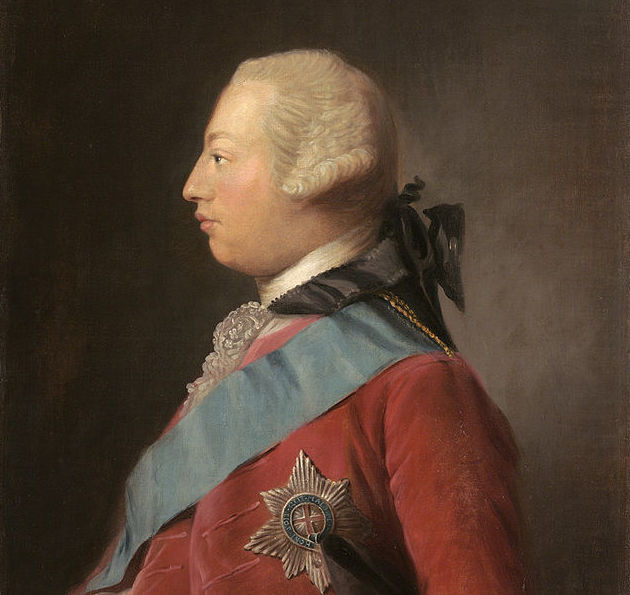
Jack N. Rakove ponders Eric Nelson’s new book The Royalist Revolution: Monarchy and the American Founding, in which the political theorist advances a contrarian take on how American colonists viewed the British monarch. Nelson argues that “[r]esistance leaders and the Continental Congress repeatedly urged George III to take their side in the struggle against Parliament’s assertion that it possessed unlimited authority to enact laws governing the colonies” – in short, a number of American leaders had become “patriot royalists.” How this sympathy impacted the presidential office they’d construct after the revolution:

[I]t is important to say “executive” rather than “royal,” because none of the authors of the U.S. Constitution—not even that purported quasi-crypto-monarchist Alexander Hamilton—seriously imagined an American king or hereditary ruler. But the same “patriot royalists” who wanted the king to nullify Parliament in 1774-76 remained advocates of a republican executive armed with independent prerogatives (such as the presidential veto) that hardly conformed to the weak models of executive leadership that Americans had once favored.

Here again, Nelson brilliantly uses 17th-century English sources largely neglected by American scholars to illuminate another critical debate. American ideas of political representation, it is often argued, rested on a belief that election by the people in constituencies mapping the real distribution of the population formed a sufficient basis of political legitimacy. Architects of the revolutionary constitutions conceived of a representative assembly as a “miniature,” “mirror,” “portrait,” or “transcript” of the larger society. If these images were accurate, the demand for active consent was adequately satisfied.

But arguments like that had also appeared during the English civil war of the 1640s, to be countered by the idea that the king also embodied the national interest. If the executive was adequately authorized to serve that function, advocates for this claim held, the theory of exclusive legislative supremacy grew weaker. A space might be cleared in which the claims for executive prerogative—for an independent capacity to recognize and pursue the public interest—would complement, or even counter, the republican orthodoxy of 1776.

Andrew O’Shaughnessy further explains Nelson’s case:

Following the repeal of the Stamp Act in 1766, colonial authorities, in Mr. Nelson’s telling, began to contemplate the idea of a more powerful and independent monarch at the helm of a re-configured imperial government. The doctor and future spy Edward Bancroft was at the forefront of this movement with a 1769 pamphlet arguing that “Though the King’s Prerogative extends, indiscriminately, to all States owing him Allegiance, yet the Legislative Power of each State, if the People have any Share therein, is necessarily confined within the State itself.” Alexander Hamilton wrote a more expansive version, “The Farmer Refuted,” in 1775, and other important proponents of this royalist ideology included John Adams and two future Supreme Court justices, James Wilson and James Iredell.

Mr. Nelson acknowledges that such ideas about prerogative were for a time overshadowed by Tom Paine ’s assault on the mythology of monarchy in “Common Sense” (1776). But they were revived in the Massachusetts Constitution of 1780 (drafted by Adams), and a broad resurgence of monarchial enthusiasm thereafter culminated in 1787 with the creation of the strong presidency in the “recognizably Royalist constitution for the new United States.” Mr. Nelson concedes that the presidency could never possess all the pomp and trappings of kingship but notes that the Constitution assigned “its rechristened chief magistrate far more power than any English monarch had wielded since William of Orange landed at Torbay in 1688.” He quotes the historian Mercy Otis Warren complaining in 1788 that the new constitution created a “Republican form of government, founded on the principles of monarchy.”

(Image: Allan Ramsey’s portrait of King George III, 1762, via Wikimedia Commons)

Books For The Boss

It turns out Bruce Springsteen has very Dish-y taste in literature. Here’s how he recently answered an interviewer’s question about the one book that made him who he is today:

One would be difficult, but the short stories of Flannery O’Connor landed hard on me. You could feel within them the unknowability of God, the intangible mysteries of life that confounded her characters, and which I find by my side every day. They contained the dark Gothicness of my childhood and yet made me feel fortunate to sit at the center of this swirling black puzzle, stars reeling overhead, the earth barely beneath us.

More of his favorites:

I like the Russians, the Chekhov short stories, Tolstoy and Dostoyevsky. I never read any of them until the past four years, and found them to be thoroughly psychologically modern. Personal favorites: “The Brothers Karamazov” and, of course, “Anna Karenina.”

Current favorites: Philip Roth, Cormac McCarthy and Richard Ford. It’s hard to beat “American Pastoral,” “I Married a Communist” and “Sabbath’s Theater.” Cormac McCarthy’s “Blood Meridian” remains a watermark in my reading. It’s the combination of Faulkner and Sergio Leone’s spaghetti westerns that gives the book its spark for me. I love the way Richard Ford writes about New Jersey. “The Sportswriter,” “Independence Day” and “The Lay of the Land” are all set on my stomping grounds and, besides being poignant and hilarious, nail the Jersey Shore perfectly.

Paul Elie offers more on Springsteen’s connection to O’Connor:

Little-known fact: In the last months of his life Walker Percy, prompted by his nephew Will, wrote what he called a “fan letter of sorts” to Springsteen – whom he called “one of the few sane guys in your field.”  He asked the Boss about “your spiritual journey,” and in particular about “your admiration for Flannery O’Connor. She was a dear friend of mine,” he told Springsteen, “though a more heroic Catholic than I.”

In a 1997 interview in DoubleTake (it figures into The Life You Save May Be Your OwnSpringsteen told the nephew what O’Connor meant to him in the voice familiar from his long on-mike introductions to songs like “The Promised Land”:

There was something in those stories of hers that I felt captured a certain part of the American character that I was interested in writing about. They were a big, big revelation … There was some dark thing – a component of spirituality – that I sensed in her stories, and that sent me off exploring on my own.

And me on mine. And you on yours – as with Whitman’s Leaves of Grass, which Springsteen likes to read on a summer’s day on the front porch.

Soothed By Sadness

Tom Jacobs flags a new study that explains why we take solace in sad songs:

The results reveal that sad music brings up “a wide range of complex and partially positive emotions, such as nostalgia, peacefulness, tenderness, transcendence, and wonder,” the researchers report. Nostalgia was the most frequently reported emotion evoked by sad music (although it came in number two among Asians, behind peacefulness).

“The average number of emotions that participants reported to have experienced in response to sad music was above three,” they write. “This suggests that a multifaceted emotional experience elicited by sad music enhances its aesthetic appeal.”

In terms of timing, “our data suggest that people choose to listen to sad music especially when experiencing emotional distress or when feeling lonely,” the researchers report. “For most of the people, the engagement with sad music in everyday life is correlated with its potential to regulate negative moods and emotions, as well as to provide consolation.” In other words, sad music is “a means for improving well-being,” they write.

An Open Mind In A Secular Age

We’ve featured the work of poet and critic Michael Robbins on the Dish before – notably, this broadside against the New Atheists, which spurred a few rounds of debate over Nietzsche and religion. In an interview about his new volume of poetry, The Second Sex, Robbins explores how his engagement with philosophy informs his poetry, and much else:

I return often to those who recognize that there are historical and cultural constraints on what it is possible for us to believe—“a background,” as [philosopher Charles] Taylor says, “to our thinking, within whose terms it is carried on, but which is often largely unformulated, and to which we can frequently, just for this reason, imagine no alternative”: Marx and Freud, despite their unsophisticated views of religion (the result of just such a background, which no one’s thinking can entirely escape), and Heidegger and Lacan. Such thinkers teach us that people like [Jerry] Coyne are not only mistaken that their beliefs are “obvious” and “rationally grounded” but literally incapable of imagining that they could be wrong about the nature of reality.

They always demand “evidence” for God’s existence, but, as Stanley Hauerwas puts it in a discussion of Thomas Aquinas, “if we could have the kind of evidence of God the evidentialist desires, then we would have evidence that the God Christians worship does not exist.” It’s not simply that the evidentialist doesn’t grasp basic theology and epistemology, but that the notion that the concept of “evidence” is itself not neutral or ahistorical could never occur to him, given the picture that holds him captive. And of course I’m not denying that the language of evidence is proper to its sphere or that my own thinking (or anyone’s) is not subject to all sorts of constraints I don’t recognize. But even if we cannot attain to a view from nowhere, we can recognize that we cannot, which allows us to avoid, to some extent at least, the epistemic arrogance that characterizes scientism. I do not know that God is the creator of heaven and earth, or that Jesus Christ is his only son, our Lord.

Face Of The Day

dish_singh

The Singh Project by British photographers Amit and Naroop depicts members of the Sikh community:

These intimate images highlight two very important symbols of the Sikh lifestyle – the beard and the turban (Dahar). The turban in particular is a representation of honor, self-respect, courage, spirituality, and piety. Sikh men (and women) wear the turban to cover their long, uncut hair (kesh), and are also seen in this series brandishing a traditional Sikh sword (kirpan).

Originating in South Asia – primarily in India, Singh was a popular middle name or surname for lords and warriors. Meaning Lion (from the Sanskrit word Simha/Sinha), it was later adopted by the Sikh religion, and today is compulsory for all baptized Sikh males. The sense of pride connected with the history of the name Singh is evident on the faces of these men.

See more images from the series here.

Fighting Stigma On Facebook

Lauren Hoffman revisits her “coming out” as an alcoholic:

It was five days after my last drink, four days after I told my parents, and three days after I started treatment. “I read a marathon training book once that said you should always tell people you were training for a race; that way, you’d have extra incentive to not abandon your goal midway through,” I wrote on Facebook. “In the spirit of that: I’m a (newly sober) alcoholic. I’m exhausted and overwhelmed but mostly profoundly relieved to not be trying to keep a giant secret anymore.” …

There’s absolutely something self-serving about that openness. I speak as honestly as I do because it’s always been a way for me to connect with others with similar struggles or to reach out to my friends and family, both of which are essential to my sanity and recovery. But I also talk about my alcoholism and bipolar disorder as frankly as I do because I see and want to contribute to a decrease in the level of stigma associated with addiction and mental illness. For as great as large-scale educational campaigns or Partnership for a Drug-Free America ads can be, I don’t think stigma can truly be broken down with sweeping gestures. Those misunderstandings and prejudices are demolished at a personal, individual level.

The Gift That Stopped Giving

Ruth Margalit recently reread The Giving Tree, Shel Silverstein’s classic children’s book, and was dismayed to find that the feel-good appeal doesn’t quite hold:

The beginning of the story is innocuous enough: a boy climbs a tree, swings from her branches, and devours her apples (I’d never noticed that the tree was a “she”). “And the tree was happy,” goes the refrain. But then time passes, and the boy forgets about her. One day, the boy, now a young man, returns, asking for money. Not having any to offer him, the tree is “happy” to give him her apples to sell. She is likewise “happy” to give him her branches, and later her trunk, until there is nothing left of her but an old stump, which the old man, or boy, proceeds to sit on.

Margalit continues:

“The Giving Tree” might be read as … a cousin to a song Silverstein wrote, called “Fuck ’Em,” in which he cheerfully exclaims, “Hey, a woman come around and handed me a line
/ About a lot of little orphan kids sufferin’ and dyin’
/ Shit, I give her a quarter, cause one of ’em might be mine.” … The dismay I felt on rereading the book soon gave way to something else. Finding that a childhood favorite wasn’t at all what I remembered carried with it a peculiar thrill, a kind of scientific proof that I’d grown up and changed. And, if I’ve changed, perhaps “The Giving Tree” has, too.

What, for example, does Silverstein mean with his injection of the flat, repetitive “happy”? He wasn’t one for happiness. In fact, the book’s illustrations seem to undermine this very conceit. “And the tree was happy,” we are told, but all we see is a sorry stump and a hunched old man staring forlornly into the distance. Is she happy? We have to ask. Is he? Or maybe the book isn’t about love or happiness at all, but a lament about the passing of time, an unsentimental view of physical decay, a withering away. Maybe it’s enough to take Silverstein’s own reading of it. “It’s about a boy and a tree,” he once said. “It has a pretty sad ending.”

What’s Your Spirit Animal?

7950378728_b0154fde04_o

Megan Garber traces how a metaphysical question became an ironic meme:

The concept of the spirit animal comes, most directly, from Native American spirituality. In that tradition, though there are variations across tribes and cultures, the spirit animal—otherwise known as a “totem animal” – generally takes the form of a single animal with which a person or a clan shares a certain set of characteristics, and therefore a kinship. The animal acts as a guide and protector for humans. In death, the humans’ spirits are absorbed into the animal.

The Internet– whose principal spirit animals include Taylor Swift, Jonathan Swift, and the KFC Double Down– has taken that metaphysical tradition and turned it into LOLs. That transformation happened gradually, and then quickly. As the Internet librarian Amanda Brennan told me, news groups and chat boards dedicated to wiccanism, paganism, and shamanism discussed sprit animals – unironically – in the 1990s. By the mid-2000s, personality quizzes offering to help people find their spirit animals began emerging. These were also earnest. The first ironic use of “spirit animal” may date back to August 2006, on one of the Shroomery.org message boards. As Brennan put it in an email,

While the thread began as an honest inquiry into animals people have formed bonds with through tripping, the user weathereporter88 claimed their spirit animal was Samuel Jackson. This one-off comment was not acknowledged by the other posters. This usage appeared online again in October 2007, when a blogger from This Recording asserted the Mad Men character Peggy Olsen was their spirit animal for being “off the hook awesome.”

So, yep: Samuel L. Jackson may have been the first of the Internet’s spirit animals. Peggy Olson may have been the second.

(Photo by Neil Girling)

A Poem For Sunday

3727970809_14383ee409_b

“Swimming in the Woods” by Robin Robertson:

Her long body in the spangled shade of the wood
was a swimmer moving through a pool:
fractal, finned by leaf and light;
the loose plates of lozenge and rhombus
wobbling coins of sunlight.
When she stopped, the water stopped,
and the sun re-made her as a tree,
banded and freckled and foxed.

Besieged by symmetries, condemned
to these patterns of love and loss,
I stare at the wet shape on the tiles
till it fades; when she came and sat next to me
after her swim and walked away
back to the trees, she left a dark butterfly.

(From Sailing the Forest: Selected Poems by Robin Robertson © 2014 by Robin Robertson. Used by permission of Farrar, Straus and Giroux. Photo by Justin Henry)