War-Torn Verse

In March we featured three selections from Eliza Griswold’s I am the Beggar of the World: Landays from Contemporary Afghanistan, a collection of folk couplets from the women of that country. In an interview about the project, Griswold reflects on how her dual perspective as a journalist and poet informed her work:

I see the world in both ways—and at the same time. The book arose from being in Kabul and knowing that so much of the meaning of daily life gets missed in the headlines. News isn’t designed to talk about daily life in its nuances, but poetry is.

With the photographer Seamus Murphy, I came across this book of landays that had been gathered by Sayd Majrouh in the ’80s, during the Soviet war in Afghanistan. These were poems told by women in refugee camps on the Pakistan side of the border. In English, the book’s title translates to Songs of Love and War, but the French title—which is closer to the Pashto title—is Songs of Love and Suicide. There is this reality for many Afghan women whereby suicide is a form of self-expression.

For many years, I would sit and Google the word “landays,” thinking nobody was ever going to send us to Afghanistan to collect poetry. But one day I came across this story of a young woman who had killed herself, and she killed herself because her family wouldn’t allow her to write poems. That’s as much as this little news squib said, and the one poem that survived her was one of these landays. The reason it survived was because they are anonymous. They’re collective, they’re oral, there is no crushing or burning. Her father had ripped up her notebooks, but he couldn’t destroy this poem.

Seamus and I set off to tell the story of this young woman, but at the same time to figure out if it was feasible to collect these poems. And what we found was that it was indeed feasible. These poems were more alive and prevalent in Afghan life than we had understood.
Beyond Hellfire And Brimstone

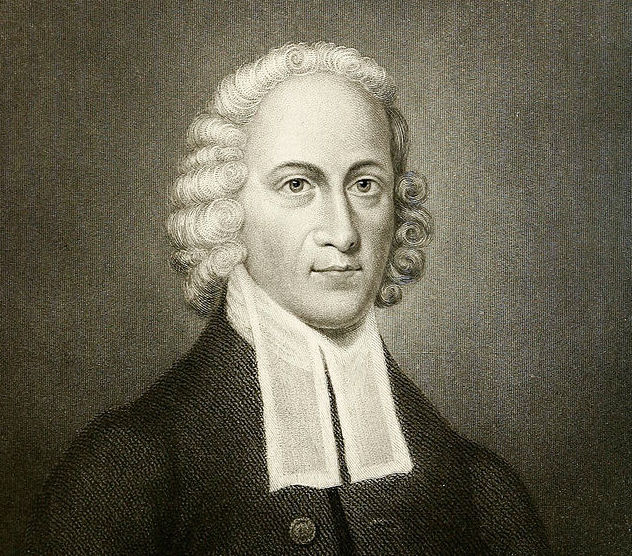
Jonathan_Edwards_engraving

Jonathan Edwards, the great 18th century American theologian and preacher, exists in the popular imagination mainly as a dour purveyor of God’s judgment, famous for his sermon “Sinners in the Hands of an Angry God.” Marilynne Robinson rises to his defense, praising his understanding of sin as “a kind of unawakened experience or perception that is blind to the glory of God and therefore to the glory that pervades being”:

For Edwards, sin was the state everyone was in, in the absence of a conversion experience, which was a kind of religious ecstasy that began with a profound awareness of guilt and a sense of utter dependency on God’s grace. Religion without conversion was almost a kind of Pharisaism, the enactment of faith and virtue without the substance of either. It was, at the same time, where the predisposition to conversion was formed. Edwards meant by his preaching and teaching to lift his hearers into the realm of spiritual light, where they would be capable of true faith, true hope, true love. They would be raised to a heightened esthetic experience, beside which the manifest natural glory of the world would seem a poor thing. Minus the theological frame, the same impulse to apprehend reality through a vision of it that is both higher and truer is present in much American poetry, from Whitman to William Carlos Williams and Wallace Stevens.

Again, for Edwards as for Emerson, this was not contempt for the world but transcendence of a kind that allowed the world and being itself to be seen in its real glory.

Given his very fixed association with hellfire preaching, it is important to remember that it was not particular transgressions that interested Edwards finally, though of course from the pulpit he deplored failures of honesty and charity. Nor was he much concerned with meritorious acts, since these were equally beside the point in the matter of personal salvation. Salvation was for him a revolution of consciousness that opened on an overwhelming sense of the beautiful, the glory of God in all its manifestations. In Edwards’s view, fallenness, the natural state of any human being, as blindness, takes no specific form as behavior and is not to be mitigated by any act of will. But the ontological nearness of humankind to God means that, through grace, perception of the purest, highest and truest kind, itself a kind of ecstasy, can be enjoyed by them, eternally and in this life.

(Image: An 1855 engraving of Edwards, via Wikimedia Commons)

Borges On God

A new collection of radio “dialogues” the late Jorges Luis Borges recorded with the poet and essayist Osvaldo Ferrari in March 1984 have been translated and published as Conversations, Volume 1. Here’s an excerpt from one of them, which details the Argentinian writer’s thoughts about God:

Osvaldo Ferrari: Many people still ask whether Borges believes in God, because at times they feel he does and at times that he doesn’t.

Jorge Luis Borges: If God means something in us that strives for good, yes. If he’s thought of as an individual being, then no, I don’t believe. I believe in an ethical proposition, perhaps not in the universe but in each one of us. And if I could I would add, like Blake, an aesthetic and an intellectual proposition but with reference to individuals again. I’m not sure it would apply to the universe. I remember Tennyson’s line: “Nature red in tooth and claw.” He wrote that because so many people talked about a gentle Nature.

Ferrari: What you have just said confirms my impression that your possible conflict about belief or disbelief in God has to do with the possibility that God may be just or unjust.

Borges: Well, I think that it’s enough to glance at the universe to note that justice certainly does not rule. I recall a line from Almafuerte: “With delicate art, I spread a caress on every reptile, I did not think justice was necessary when pain rules everywhere.” In another line, he says, “All I ask is justice / but better to ask for nothing.” Already to ask for justice is to ask for much, too much.

Ferrari: Yet, you also recognize in the world the existence of happiness—in a library, perhaps, but other kinds of happiness too.

Borges: That, yes, of course. I would say that happiness can be momentary but that it also happens frequently, it can happen, for instance, even in our dialogue.

Quote For The Day

“What about the main thing in life, all its riddles? If you want, I’ll spell it out for you right now. Do not pursue what is illusionary — property and position: all that is gained at the expense of your nerves decade after decade, and is confiscated in one fell night. Live with a steady superiority over life — don’t be afraid of misfortune, and do not yearn for happiness; it is, after all, all the same: the bitter doesn’t last forever, and the sweet never fills the cup to overflowing. It is enough if you don’t freeze in the cold and if thirst and hunger don’t claw at your insides. If your back isn’t broken, if your feet can walk, if both arms can bend, if both eyes can see, if both ears hear, then whom should you envy? And why? Our envy of others devours us most of all. Rub your eyes and purify your heart — and prize above all else in the world those who love you and who wish you well. Do not hurt them or scold them, and never part from any of them in anger; after all, you simply do not know: it may be your last act before your arrest, and that will be how you are imprinted on their memory,” – Aleksander Solzhenitsyn, The Gulag Archipelago, 1918-1956: An Experiment in Literary Investigation.

(Hat tip: John Benjamin)

Keeping The Faith Offline

8eb87783e

Emma Green ponders a new Pew study (pdf) on religion and electronic media that found “only 20 percent [of respondents] said they had ‘shared something about [their] religious faith on social networking websites/apps’ in the past week.” That’s only about half as many who claimed they did so in person:

[The] relationship between on- and offline sharing was roughly the same across Christian denominations and the religiously unaffiliated: Twice as many people talked about their religious beliefs offline vs. online. Perhaps the most interesting thing about this is that there’s hardly any variation among age groups: People younger and older than 50 were nearly equally likely to say they’d talked about their faith on social media within the last week. That’s remarkable for two reasons: In general, younger Americans are less religious than older Americans, and they’re also much heavier users of social media. Across two demographics who think about both faith and the Internet very differently, the mores of talking about God online seem to be similar.

This survey doesn’t say much what those mores are. But it does suggest that people like talking about their religious beliefs face-to-face more than they do online—or, perhaps, they’re more willing.

Cathy Lynn Grossman reminds us, however, that there’s still plenty of God-talk online:

Megachurch pastors have mega-followings online. Joel Osteen of Lakewood Church streams his Houston services online. Rick Warren of Saddleback Church has 1.8 million likes on his Facebook page. And Pope Francis has more than 4.6 million English-language followers, chiefly American, for his @Pontifex Twitter feed.

Not only do religious people find faith online; so do 50 percent of the “nones” — people who claim no denominational identity, from atheists to the vaguely spiritual. … David Silverman of American Atheists, tweeting @MrAtheistPants, has more than 29,000 followers.

Brevity: Still The Soul Of Wit

Ben Myers praises the short, apt sentence, noting that he’s “been trying to use a greater variety of sentence types in my writing, and I have particularly been labouring to achieve good short sentences”:

I have also begun to notice that many college students could improve their writing dramatically merely by setting their sights on shorter sentences. Many students have somehow got the assumption that scholarly writing requires a certain tone of voice. I don’t know where this assumption comes from. I am inclined to blame it on the rhetorical posturing of well-meaning but fundamentally inept high school English teachers – the kind of teacher who promotes “critique” and “decoding” of “texts” instead of explanation and clarity of ideas. I do not blame these teachers. I hope they will still be allowed into heaven. I know they are only doing what they’re told. At any rate, whatever the source of this malaise, the symptoms are evident in the tendency of students to obfuscate simple ideas through a complexification of syntax, a multiplication of imprecise verbs instead of the selection of the one strong verb, and a deliberate substitution of polysyllabic words whose meanings are often vague and slippery for smaller ones whose meanings are plain and solid. It is all very anti-working-class. The student’s shame of his uneducated parents and their drab suburban home is transferred to a (deeper and more scandalous) shame of plain speech. Nothing good will come of this.

So I have been encouraging students to aim for shorter sentences that say exactly what you want to say, not for longer sentences that sound the way you would like to sound. And – physician, heal thyself – I’ve been trying to do it too.

A Drone’s-Eye View Of Porn

NSFW, because porn:

Allison P. Davis raves about Drone Boning, above:

A commentary on civil-liberties issues and surveillance in modern society? No, says one of the filmmakers, the agenda of Drone Boning (poetry) was simpler: “The plan was to take beautiful landscapes and just put people fucking in them.”

Mission accomplished, sir. The groundbreaking video features straight, gay, and lesbian couples having sex alfresco on the beach, in the mountains, nestled in the mossy bed of a regal forest, amid the blossoming crops of an apple farm, and on the side of a highway against a vintage-looking royal-blue car. It’s like if a Google Maps camera caught you humping unawares amidst a Kinfolk photo shoot. Or perhaps the uncensored, unrated cut of Planet Earth. Simply stunning.

Jason Koebler agrees that the film “skews way more artsy and thought provoking than your average entrant into the genre”:

“We wanted to see the artistic value of this perspective,” John Carlucci, [filmmaker Brandon]LaGanke’s partner, said. “It’s an omniscient point of view, really. We did these shots in places where you couldn’t see much from the ground, but then you put a drone in the air and you can see what’s happening.”

So, even though the two used hired actors in mostly isolated places outside of San Francisco, there’s a certain amount of voyeurism that goes into actually watching the video. Carlucci calls it a “Where’s Waldo” sort of thing: You see these amazing, beautiful landscapes, and you quickly want to see where, exactly, people are getting it on.

A Very Small Penis Club

Alexa Tsoulis-Reay tracked down members of it:

While a precise number is open to scientific debate, it’s commonly accepted that the average size of an adult male penis is five and a quarter inches, erect. Generally speaking, measure in under about three inches erect, and you have what’s called a micropenis — the least common of the conditions falling under the banner of an “inconspicuous penis,” which includes a webbed penis, where it is difficult to decipher exactly where the scrotum ends and the penis begins; or a buried penis, where the shaft of the penis is hidden by skin and fat.

One man she interviewed, “a 51-year-old English teacher from the U.K., gave an in-depth account of his life with a micropenis”:

[Q.] Do you think about your penis size every day?

[A.] I can tell just by the way people walk and the way they look and the way they relate to other people that they have a big penis. You go into a meeting and the guys are swaggering around with their legs akimbo as if they’ve been riding a horse because they’ve got such an enormous package they can’t really walk straight and it’s just crazy. I have got to a point where I am quite amused by it and I’m fascinated by all this sex stereotyping and gender stereotyping. I’ve got strong heterosexual instincts and if I see a woman I feel strongly towards, even if I just glimpse somebody, the next thing I think is, No, don’t! You know what will happen … Well, nothing will happen, but if something did happen, you know how it will end up.  It will be that terrible scene again; it will be that thing with the regrets and the apologies. And there’s nothing worse than that.

After a while, you just accept that you can’t ever do it properly. You can try all the textbook stuff and advice column stuff about positions, but thinking about that kills things. You want it to be more natural and you just start thrusting away and it’s popping out all the time. It just doesn’t stay in because it’s just too small. That’s what it comes down to, I’m afraid.

I’m laughing, not crying, by the way. But I might cry as well.