Ask Me Anything

This embed is invalid

[Re-posted from last week with many questions added by readers, primarily about the new Dish model. But feel free to submit additional questions related to the new Pope, the Iraq War or anything else you are curious about. ]

A year has passed since I last answered questions for the Ask Anything feature, and now that we are settled into the new Dish and assembling our own video equipment, it’s a good time to revive the series. To submit a question, simply enter it into the field at the top of the Urtak poll (ignore the “YES or NO question” aspect and simply enter any open-ended question). We primed the poll with questions you can vote on right away – click “Yes” if you have a strong interest in seeing him answer the question or “No” if you don’t particularly care. We will air the videos soon.

Facts On Fracking, Ctd

[youtube: http://www.youtube.com/watch?v=phCibwj396I]

Readers revive a recent thread:

As a professional on the land side of the domestic oil and gas industry, I just want to point out one thing: Fracking is used in the production of both oil and natural gas. The conversation is usually framed as one about natural gas production alone, which is incorrect. When talking about producing our domestic oil reserves, fracking is a key component of doing so, particularly in the Rocky Mountain states and up into North Dakota, where fracking has proven to be the “key” to finally unlocking the enormous potential of the Bakken formation, which everyone has known about since the 50s, but only figured out how to tap into successfully in the last decade (with few exceptions).

Another:

Kevin Bullis claims that “some environmentalists are comparing fracking not to coal but to solar and wind power, on the assumption that we could easily abandon fossil fuels for renewables. That’s a mistake.” This may be true, but the bigger mistake is what Bullis and others like him are doing: assuming that natural gas is somehow replacing coal.  It is not.  Even if the United States is replacing some of its energy from coal with natural gas, that coal is not going to stay in the ground.  There are coal export terminals planned on the West coast.  That coal is still going to be mined and shipped overseas, where it will be burned.  So burning more natural gas is not reducing carbon in the atmosphere but is increasing carbon in the atmosphere.  The global amount of carbon in the atmosphere is what matters.

And as far as the reduction in air pollution, that is certainly a good thing.  But again, that pollution is just being exported somewhere else.  I don’t think we should be proud that we’re exporting our dirtiest energy to inflict damage on people in other countries.  Continued reliance on natural gas is only going to stall our need to transition to cleaner alternatives now.  More importantly, it deincentivizes our country from addressing the cold reality that we simply consume way too much energy for our population.  Our main concern should be addressing how to reduce our gluttonous consumption of energy, not transitioning from a really dirty carbon source to a somewhat less dirty carbon source.

And before anyone supports coal or natural gas, they should visit the blown up mountains in West Virginia or the industrialized forests and farmlands of northern and southwestern Pennsylvania.  It’s easy to be for these things that provide our energy when you don’t have to live with the localized consequences.  It’s quite another when you live at the base of a valley that’s been filled in with the rubble of a blown up mountain where your family has lived for generations.  Or to see the forested hills and valleys of Pennsylvania be transformed into industrial wastelands by the natural gas industry.  Switching to natural gas is not smart in the long run – it’s simply another short term fix for an addict.

Another:

In response to this reader’s comment, I live in Colorado, I’m in the water business, and I take issue nearly everything that was stated. I’m a die-hard liberal, but the misinformation out there on fracking just boggles the mind. No, fracking does not use “significant” amounts of water. The industry’s water needs are very small compared to other industrial and agricultural uses. The oil and gas industry has not outbid farmers for water (can the reader cite even one example?). And the water permanently “lost” as part of the fracking process is really no different than the water that is permanently “lost” (evapotranspired) when you raise corn or brew beer. The same farmers who are leasing their water to the oil and gas industry are mostly the same farmers who are reaping hundreds of thousands, if not millions, of dollars in oil and gas royalties.

I’ll agree that the land use issues are difficult. Drilling activity has intensified in recent years and it does encroach on towns and urban sprawl. That’s really what this issue is all about: NIMBY, etc.

Update from another:

I’m a long time Dish reader, first time writer, and Boulderite. The Colorado water guy who wrote in claiming that oil and gas companies don’t outbid farmers clearly hasn’t been reading the newspaper. Here’s the source, from April 2012 right after the water auction. And here’s the key part:

At the recent auction, Fort Lupton-based A & W Water Service Inc. bid successfully for 1,500 acre-feet of water, paying about $35 per acre-foot. That’s slightly higher than the market price that irrigators pay for leasing water along the Front Range. The average price paid for water at NWCD’s auctions has increased from around $22 an acre-foot in 2010 to $28 this year.

A & W also leases water from Longmont, Loveland, Greeley and other cities—and hauls it to drilling sites.

The GOP’s Looming Gay Crisis

“There is a generational difference within the conservative movement about issues involving the treatment and the rights of gays — and for many younger voters, these issues are a gateway into whether the Party is a place they want to be. If our Party is not welcoming and inclusive, young people and increasingly other voters will continue to tune us out,” – the Growth and Opportunity Project report on the problems facing the GOP.

In the latest polling, 81 percent of those under 30 favored marriage equality. I was shocked by the number, but TO GO WITH AFP STORY By Otto Bakano -- Tshouldn’t have been. What we can all forget is that this is the first generation who went through their childhood and teens knowing that civil marriage was an option for gay couples. That generation included gay kids and teens who, for the first time, could see an integrated future for themselves in their own families and society. I have no doubt this has made that generation the least fucked-up, sanest gay generation in history – seeing from the get-go a real and equal and dignified future for themsleves. And their greater self-confidence and self-esteem has been infectious. Their straight peers know them and their orientation and simply find it baffling that they would be denied what every heterosexual has always accepted as a given in their own lives.

That can only mean that, for the young generation, and all those who follow it in the future, the GOP’s aggressive stance and brutal rhetoric against marriage equality simply identifies them as bigots. Some may not be. But that is what they will be seen to be. The report does not advocate changing policy on marriage equality. But I think the premise that it can win the next generation simply by ignoring the question is untenable.

Which is to say, I would go a little further than the always insightful Tom Edsall, who wrote:

There is at least one crucial problem that the authors, all members of the establishment wing of the party, address only peripherally and with kid gloves: the extreme conservatism of the party’s primary and caucus voters — the people who actually pick nominees.

The over-60, predominantly white, Fox News watching, fundamentalist base cannot budge an inch on gays. Because it’s a religious and not a political position. And so it may soon be a truly fateful day for the GOP: drop the anti-gay policies or become the even angrier old white man party.

How amazing that marriage equality, once wielded by Ken Mehlman and Karl Rove as their key weapon in winning Ohio and the presidency in 2004, now threatens to kill the GOP as a national brand. With every year that passes, every attack on gays is now felt by growing numbers of their own family members, friends, co-workers and neighbors. There’s a multiplier effect here. And gerry-mandering has enabled the GOP to control the House without ever having to grapple with those voters.

If I were Karl Rove, I’d be praying for Anthony Kennedy to write the gay Loving vs Virginia. It would take the issue off the political table for good, and leave them a nice juicy judicial tyranny argument instead. But a mixed verdict – say one that allows for federal recognition of civil marriages in the nine states and DC that has them, and that mandates that civil unions with all the substantive benefits of civil marriage must be called marriage – would keep the issue alive, violate no federalist principles, and leave the GOP’s fundamentalist intransigence in place – as a dead weight around their necks as they try to stay afloat.

Watching ideologues confront reality is always entertaining for a real conservative. But it’s going to be excruciating for today’s Republicans.

(Photo: Getty images.)

Dissents Of The Day

A reader quotes me:

This feels like an academic debate. But it isn’t. I have blood on my hands. However many times I try to wash them, the blood will not come off.

Can you and all your fellow pundits spare us the self-flagellation about Iraq? I say this as a former Army officer who served in west Baghdad just after the civil war there cooled off. We get it. We know what a charlie-foxtrot it was. We also know we need to constructively talk about the lessons learned and strategic and policy failures. Folks like Tom Ricks and Rajiv Chandresekaran are doing that quite well right now. I would much rather have Paul Wolfowitz (see Bacevich) come to terms with Iraq than you give us your very own “hathos alert”.

Another piles on:

Let your self-importance go already! Blame the blamable, not the lemmings. You are a blog writer. You comment. You don’t wage wars. You fell for their BS. Nothing more.

Another takes issue with the visual part of the post:

Once again with the pictures of dead children. Was it absolutely necessary to post one of a child with his scalp tearing forward and a pacifier in his grandfather’s hand?  I paid up my $20 to get my regular dose of the Dish, but I cannot stand it when you post these pictures of dead children.  What is the purpose?  Sensationalism?  Trying to make the point that the war in Iraq was wrong?  You can do that with the many essays you have written, without including the broken bodies of dead children. Please. The next time you think you will … don’t.

Another doesn’t go quite that far:

I’ve emailed about this on a number of occasions and I know you have a very “if you don’t like it, stop reading my blog” attitude sometimes but, as you are a clearly a very empathetic person, I would like you to try to put yourself in the shoes of parents with young children.  As a father of two young kids, unexpectedly seeing something as horrifying as what you have posted today can be more traumatic that you realize.  And I don’t expect anyone who isn’t a parent to truly understand what I’m talking about because having children literally changes your brain.  And no, having dogs doesn’t fucking count.

Before having kids (I have a six and two year-old) I could see a photo like that and feel an appropriate amount of pain/empathy without it fucking up my brain for an extended period of time.  Not so anymore.  For example, just hearing Rachel Maddow talk about Sandy Hook again the other day almost had me in tears and made me depressed/distracted for most of the day.  Am I hyper-sensitive relative to many others about this stuff?  YES… because I have little kids.  But I’m also a big jock of a guy and can tell you that my reaction is not half as severe as what most mothers would experience if they saw what you posted today.

I very much understand why you show these pictures.  I actually applaud you for putting them out there because most Americans don’t see the horror of war, and we need to.  In fact, I’ve threatened to send pictures of dead children to my father because he can be very callous about the murders we’re committing overseas in the name of “The War on Terror.”  I’ve threatened to do this because I want him to see pictures and think about those dead kids as if they were HIS grandchildren.  But ultimately I don’t send them because I’m not an asshole who will traumatize someone just to make a point.

So, PLEASE put photos like that below Read On with a warning of graphic images.  This will at least allow your readers to choose what they are seeing and give them the opportunity to prepare themselves.  That can make a huge difference.

Another differs:

I think that the photo you posted is the most disturbing and graphic photo you’ve ever posted on your blog.  I wasn’t sure that I was really seeing what I thought I was seeing until I made the photo larger.  I imagine you will get some complaints about it.  But I’m glad you posted it.  We can’t be reminded often enough of the real consequences of any war.

I feel no satisfaction that I was 100% opposed to the war from the very beginning.  The very idea of it was devastating to me.  It made no sense to me at all, and I was appalled that the America I loved was going to start a war under circumstances that I considered unjustified.  It felt like a betrayal of the principles I strongly believed in and thought were absolutely sacrosanct.  I hated that people around the world hated us and saw us as bullies.

Shortly before the war started, I went with my husband and baby son to Spain for a vacation.  I was saddened by the hatred I felt from many people simply because I was American.  We had an encounter with an airline employee at the airport in Madrid that left me shaken for days.  Despite being an employee in a service position dealing with international travelers, she did not even attempt to hide her contempt for my little family, simply because we were American.  She took pleasure in saying “Americans are terrible people.”  I wanted to report her to her boss. I wanted to explain to her that I didn’t support the war, that a lot of Americans didn’t support the war, that I didn’t vote for Bush, that the America that would do this was not my America.  But I love my country, and I respect the office of the President, even if I didn’t respect the President, and I suffered mostly in silence.  She’d made her mind up, anyway.

I’m glad I didn’t read you then.  I don’t think I would have stuck with you.  But I don’t think you have blood on your hands.  In my America, you are always allowed to say what you feel, to give your opinion, which is all you did, even if you were wrong.

George Bush and Dick Cheney are the ones with blood on their hands.

I do not mean to exaggerate my infinitesimal influence on decisions made by others. I was trying to express as clearly as possible how sorry I am. As for the graphic photos: this is the blood on my hands. I posted it not for shock value, but as a reality check against precisely the kind of solipsism one can fall into in this kind of thing. I also see one of the defining qualities of the Dish is that we will publish photos other mainstream outlets will not, for the reasons articulated by readers.

Someone, in my view, needs to get some of the brilliant but sometimes disturbing photography of some of the world’s best photo-journalists out there. If you can’t put them on your own blog, who will ever see them? And who will see them in their minds the next time we entertain something like invading a Middle East country.

Will Readers Finally Pay For Content? Ctd

The latest attempt to crack the code on micropayments:

Len Kendall, co-founder of the new micro-payments platform [CentUp], reckons the problem isn’t so much that people don’t want to pay for things, but that they forget, it’s too much hassle, and the amounts involved are too big. CentUp, as the name suggests, deals in pennies. To give a few cents to your favorite blogger, all you do is click a little button and send the amount from a pre-charged account. … Half the money goes to charity, which provides extra incentive to pay the creators something, Kendall says. “Sometimes artists find it difficult to ask people to pay. So, we felt that if we built charity into the system, it’s easier for them to ask. They can say, ‘we’re giving half away.'”

Of course Amanda Palmer is already perfecting the art of asking. Money quote from Kendall:

“We think 2013 is really the time when people are going to start paying more for content. They are realising they don’t want to pay with their attention and advertising, and they don’t want to be behind paywalls. It’s a prime time to enable people to pay what they will.”

Previous Dish on micropayment efforts here, here and here.

Conservatives Against Capital Punishment

One reason they aren’t very visible:

Even though Legal Fellow Kelsey Hazzard says she’s personally opposed to capital punishment, it’s just not worth it for abortion rights activists to get involved. “It’s on the decline in most states, so it doesn’t have the same urgency as abortion,” she says.

Hazzard has hit on a central challenge for the conservative anti-death penalty people: Perversely, the very fact that fewer executions happen every year means that very few Americans actually have contact with people in the system. Lack of personal experience makes capital punishment a harder cause for rallying voters than, say, gay rights or pot decriminalization—especially when taking a position either way could be divisive. That’s true even with natural allies, like the younger libertarian followers of Rand Paul, who favors reforming the prison system.

The Unofficial Dedication Page

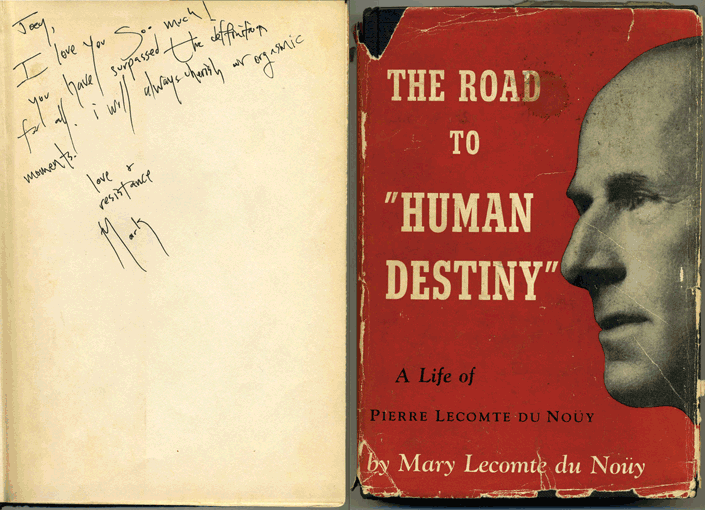
The Book Inscriptions Project began in 2002 when Shaun Raviv found the following note in The Road to ‘Human Destiny’: A Life of Pierre Lecomte Du Noüy by Mary Lecomte Du Noüy:

“Joey, I love you so much!
You have surpassed the definition
for all. I will always cherish our orgasmic
moments.
love + resistance
Mark”

For whatever reason, I happened to open the book and saw the message from Mark to Joey.
Something about that note, handwritten by an unknown to an unknown of whose whereabouts,
gender and relationship I was unaware, struck me as both tragic and powerful. …

Maybe someday this book will again find its way to Mark or Joey and I’ll get to meet them, and ask them if it worked out, if their orgasmic moments were enough to survive life’s difficulties.

Another from the archives:

Jimmy-

Like a sunburnt satellite
I circle the globe in lost
orbits, searching the most
appropriate destiny in the
dense fog of fate, but knowing
that I may touch down at
home, and we can resume our
story exactly where we left it……

All the best for the
3rd year of the techno-
millennium.

Rickey T.

January 2003

Sputnik Sweetheart by Haruki Murakami

Thanks to Danielle, who says, “I found this at a used bookstore in Kamloops, B.C.
and can’t stop wondering if they ‘resumed their story’…”

Taking In A Child

Sharon Astyk made a list of things “foster parents wish other people knew.” Among them:

We hate being told we must be saints or angels, because we’re doing something really ordinary and normal – that is, taking care of kids in need. If some children showed up dirty and hungry and needing a safe place on your doorstep, you’d care for them too – we just signed up to be the doorstep they arrive at. The idea of sainthood makes it impossible for ordinary people to do this – and the truth is the world needs more ordinary, human foster parents. This also stinks because if we’re saints and angels, we can’t ever be jerks or human or need help, and that’s bad, because sometimes this is hard.

(Hat tip: Dreher)

Proletariat To President

US President Barack Obama steps out of a

Jenni Avins examines the history of denim jeans:

Initially, jeans were proletarian western work-wear, but wealthy easterners inevitably ventured out in search of rugged cowboy authenticity. In 1928, a Vogue writer returned East from a Wyoming dude ranch with a snapshot of herself, “impossibly attired in blue jeans… and a smile that couldn’t be found on all Manhattan Island.” In June 1935, the magazine ran an article titled “Dude Dressing,” possibly one of the first fashion pieces to instruct readers in the art of DIY denim distressing: “What she does is to hurry down to the ranch store and ask for a pair of blue jeans, which she secretly floats the ensuing night in a bathtub of water—the oftener a pair of jeans is laundered, the higher its value, especially if it shrinks to the ‘high-water’ mark. Another innovation—and a most recent one, if I may judge—also goes on in the dead of night, and undoubtedly behind locked doors—an intentional rip here and there in the back of the jeans.”

(Photo: US President Barack Obama steps out of an SUV as he arrives for a visit at a friends house on February 15, 2009 in Chicago, where he is spending the weekend. By Mandel Ngan/AFP/Getty Images)

Zeitgeist By Transcription

Lightsey Darst reviews Kenneth Goldsmith’s Seven American Deaths and Disasters, which is composed entirely of transcripts of news surrounding major deaths and events like JFK, RJK, Lennon, Challenger, Columbine, 9/11 and Michael Jackson:

The transcripts elicit the same strange reactions as the events themselves — triviality struggling with meaning and voyeurism, involuntary feelings sparking amid search for a “right” feeling. Goldsmith calls this mélange “the flickering edge of cliché,” which is an apt enough term for the tumult continually evoked here, with the little distinction that this is literature and therefore a safe zone in which to watch oneself flicker.

Or so it should be, but I kept losing that sense of safety as I read.

A recent episode of “On The Media” featured Goldsmith.