The EU’s Porn Show

29_redcurtains

Today the parliament of the European Union will vote on a resolution to ban pornography, ostensibly to promote gender equality. Zack Beauchamp argues that such a ban would be counterproductive:

[There is] empirical evidence that [pornography] reduces the incidence of sexual violence. One 2007 study by Todd Kendall compared the rates of crime between U.S. states with greater and lesser access to the internet. After controlling for other crime-inducing variables (like rates of urbanization and alcoholism), Kendall found that more internet access led to lower rates of two crimes only — rape and prostitution[.]

Amanda Hess thinks the resolution, which is unlikely to pass, is patronizing:

When we find gender disparities in other sectors—from literary journalism to tech—we urge industry leaders to assess the problem and encourage women to lean in. But when it comes to porn, the impulse is to just shut the whole thing down. That’s unfortunate, because it reinforces the expectation that women can only ever be innocent bystanders to sexual material, never producers or consumers in their own right (banning all porn would mean negating the contributions of proudly feminist pornographers like Tristan Taormino, Nina Hartley, and Cindy Gallop). It glides over the experiences of female porn viewers (who have leveraged the Internet to find and distribute porn that appeals to them, even when it’s not marketed that way). It totally ignores the men who are “sexualized” in porn (if pornography discriminates against women, can we all keep watching gay porn?).

(Photo from the series The Armory by Elizabeth Moran, which “documents the ever-changing sets of the pornography company Kink.com … Devoid of people, the spaces allude to an activity, but leave the viewer to imagine the scene.)

Dollaring Yourself Up

Autumn Whitefield-Madrano connects “our tendency to overvalue fruits of our own labor,” known as the Ikea effect, to beauty routines:

It’s crossed my mind that the Ikea effect might even be part of the larger reason most women wear makeup: The more labor we pour into our “product”—that is, ourselves—the more we value we assign to it. I’m not so cynical as to believe that we think of ourselves as products that can be bought and sold; regardless, our culture certainly shapes women’s value as lying in our appearance, even if we don’t literally translate that into dollars. Put somewhat less cynically, the self-care of beauty work is part of how we physically enact our self-assigned value.

The Daily Wrap

The_Frozen_Thames_1677

Today on the Dish, Andrew contemplated sequestration’s effect on military spending, absolved Israeli forces in the death of a Gaza child, and criticized the worldwide governmental inaction on climate. Elsewhere, he disagreed with TNC on the provenance of racism, cheered Shafer’s take on advertorials while Orwell described them perfectly, solicited the next round of “Ask Andrew Anything” questions.

In political coverage, Paul Ryan selectively accounted for the cost of Obamacare as Justin Green predicted a missed opportunity and  we balanced Social Security against Medicare. Kevin Bullis highlighted the greener side of fracking and troubles in the Chinese solar market threatened American installations. Pete Wehner assigned Reagan to the RINO camp, Peter Beinart declared the Bush 2016 campaign DOA, and Rand Paul’s influence rippled outward. While Obama obscured more from the public eye, Hamas and Morsi exasperated each other, and the Guardian traced the history of some haunting images out of Syria.

In assorted coverage, The Economist audited the internet, Frank Abagnale described how modern technology would make him harder to catch, Tim De Chant saw dark clouds on the horizon for US satellites, and Evgeny Morozov explored ethical designs. Nick Holdstock weighed the merging of games and the news, Gregory Ferenstein slimmed down by standing up, and SCOTUS dissected the property rights for GMO seeds. Rachel Kolb filled in the gaps on lip-reading, monsters were nowhere to be found on ancient maps, David Leventi found beauty in dark places, and David Sessions blamed the French’s poor English on Hollywood.

Meanwhile, readers contributed their thoughts on what’s in a name, and argued against polyamory with John Corvino piling on. Garance Franke-Ruta brought Columbia back into the spotlight, women watched from outside the Conclave. Hindus in Indonesia prepared for the Day of Silence in our FOTD, a dance lesson solved racism in the MHB, the SoCal sun peeked through the clouds in the VFYW.

– D.A.

A River Of Death

SYRIA-CONFLICT

As Syria degenerates further, the Guardian pieces together “the story behind one of the most shocking images of the war” – 110 civilian corpses washing ashore along the Queiq River in Aleppo:

The concrete ledge from where the bodies were recovered is now covered by waters which, on 29 January, had receded leaving the sodden remains exposed, blood oozing from single bullet wounds to each of their shattered skulls. … “The image of my cousin was horrifying. His face was wrapped with nylon bag and with a tape to make sure he will be dead not only from the bullet but from suffocating. It is heart breaking. Killing Bashar and all of the shabiha won’t be enough revenge.” …

“Before I left the prison, they took 30 people from isolation cells and killed them.” Abdel Rezzaq said he was being held in Block 4, within earshot of the solitary confinement cells and the area where he alleges the prisoners were taken, then executed. “They handcuffed them and blindfolded them and they were torturing them till they died.” “They poured acid on them. The smell was very strong and we were suffocating from it. Then we heard gunshots. The next day they put me and some of the others in front of men with guns, but they didn’t shoot at us. They freed me later that day.”

“I heard women screaming. They were pouring alcohol on us and cursing us. Only God got us out of there, no-one gets out alive. And only god knows what happened to the rest of the people who were in there. I will fight for this cause because I want the whole world to see what is happening.”

Videos and more details here. A more graphic and haunting image after the jump:

SYRIA-CONFLICT

(Photos by JM Lopez/AFP/Getty Images)

The GOP’s Favorite Accounting Trick

On Fox News Sunday, Paul Ryan admitted that his new budget will assume Obamacare’s repeal:

Ezra Klein notes that “Ryan’s version of repeal means getting rid of all the parts that spend money to give people health insurance but keeping the tax increases and the Medicare cuts that pays for that health insurance, as without those policies, it is very, very difficult for Ryan to hit his deficit-reduction targets”:

That’s the irony of Ryan’s balanced-budget. Much of it is built on taxes and Medicare cuts that he and his party would never have proposed, and which they in fact fought bitterly, but which they’ve now assimilated into their budget because it’s almost impossible for them to hit their deficit-reduction goals otherwise.

Bernstein calls out the GOP for flipping and flopping on Obamacare’s Medicare cuts.

Shining Light On Solar

VVV at The Economist upends the conventional wisdom on the US/China green-energy trade, noting that in 2011 the US actually exported more solar, wind and smart-grid technology to China than it imported:

One important explanation for this is that while China has strengths in large-scale assembly and mass manufacturing, it lacks the innovation to come up with high-value inputs. So American ingenuity is required to supply Chinese factories with such things as polysilicon and wafers for photovoltaic cells, and the fibreglass and control systems used in wind turbines.

When Chinese solar firm Suntech flirted with bankruptcy last week, Todd Woody explored another wrinkle of the US-Chinese solar relationship:

Look up at a rooftop array in California and it’s likely the solar panels came from China. Between 2007 and 2010, for instance, China’s share of the California market jumped from 2% to 46%. If Suntech and other Chinese companies go bankrupt, warranties on their solar panels will likely become worthless, leaving solar installers like SolarCity liable for any future product failures.

Face Of The Day

INDONESIA-RELIGION-HINDU-FESTIVAL-NYEPI

Indonesia’s minority Hindu devotees parade their ‘Ogoh Ogoh’ effigies during a ceremony at Jakarta’s central National Monument on March 11, 2013 on the eve of Nyepi or Day of Silence. The effigies symbolizes evil, and after the procession are torched in a symbolic act of destroying all the negative and demonic elements in the universe and will usher in Hindu’s total Day of Silence on March 12. By Romeo Gacad/AFP/Getty Images.

Establishing Rand’s Bona Fides

Douthat thinks that “the legitimization of Rand Paul as a right-wing folk hero has implications that extend beyond the narrow hypothetical where he chose to plant his filibuster flag”:

[L]egitimizing, as Real Conservatives (TM), politicians who advocate restraint is a necessary precondition to broader policy change. Opportunism follows influence, and creates it — and right now Paul has more influence within his party than every other realist, paleoconservative and libertarian Republican of the last decade put together.

Harry J Enten points out that, were Paul to run for president and get the GOP nod, “Paul would be the most conservative Republican to win the nomination ever.” That may make it harder for his opponents to brand him as a RINO:

Rand Paul is really, really conservative. He’s the second most conservative senator, next to Mike Lee of Utah based on roll call votes. This is matched by the by the ideological ranking system based on campaign donors.

Trading Healthcare For Cash

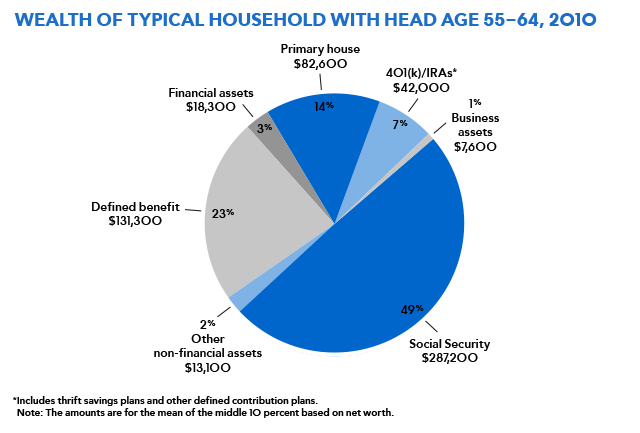
Retirement Wealth

Using the chart above, Josh Barro points outs that social security is “the most important retirement-saving vehicle” and argues that its benefits should be increased. He would be willing to cut Medicare to do so:

We are talking about the need to cut cash payments to seniors in order to finance ever more expensive health benefits for them, despite those health benefits’ dubious value. Why not give seniors less health care and more cash? With the U.S. devoting an extra six points of gross domestic product to health spending compared with our peer countries, there should be room for much deeper cuts in Medicare than what President Barack Obama has proposed. If a key purpose of those cuts was to expand Social Security, political opposition from seniors might not be as fierce.

McArdle sees a problem with this idea:

[W]hy not give people cash instead of an in-kind benefit? Well, there is a reason, with health care; in fact, there are a few of them, all of come back to the observation that health care is simply fundamentally unlike other in-kind goods that the government provides. Unlike the cost of food, or housing, or other in-kind benefits that we give to people, the value of health care varies wildly between individuals. Some people, even the majority, might be better off with cash. But the people who would be worse off would be really worse off.

Seeding Innovation

Last month SCOTUS heard oral arguments for Bowman v. Monsanto:

The question before the Court is surprisingly simple: when a farmer buys a Roundup Ready soybean seed, is it free to do what it wishes with the seeds harvested from the Roundup Ready plantings?  The farmer (Bowman) says yes – arguing that Monsanto’s rights in the seed and its progeny are “exhausted” by its sale of the first seed.  Monsanto, by contrast, argues that because it never made or sold the harvested seeds, those seeds cannot be replanted without violating the patent.

Ronald Bailey worries about the consequences were SCOTUS to rule against Monsanto:

If the Supreme Court does “eviscerate” seed patent protections, agricultural biotech companies could turn to genetic engineering solutions similar to the Technology Protection System (TPS), an approach developed in 1999 by the U.S. Department of Agriculture and the seed company Delta & Pine Land Company (now owned by Monsanto). TPS consists of an array of three genes that causes a second generation of seeds to be sterile so that farmers would gain nothing by saving them. Bowman himself suggested in 2009 to the Federal District Court that Monsanto could protect itself against people like him by deploying TPS.