In Praise Of The Defense Sequester

csbachartmon

There’s a truly hopeful piece in the NYT today that’s a further argument for the sequester. The military is slowly beginning to think through where and how to cut – in ways that can only help lower the debt and make massive land invasions of foreign countries much less feasible.

Inside the Pentagon, even some senior officers are saying that the reductions, if done smartly, could easily exceed those mandated by sequestration, as the cuts are called, and leave room for the areas where the administration believes more money will be required. These include building drones, developing offensive and defensive cyberweapons and focusing on Special Operations forces.

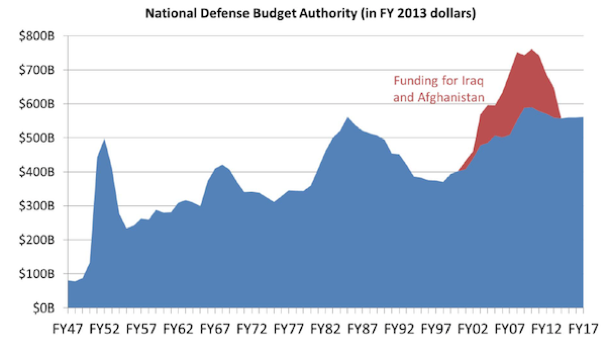
Given the way procurement and bases are spread across the states to prevent rational cutting and pruning – as would happen in any private sector company – I’m not sure the Democrats and non-neocon Republicans should ever end the defense sequester. How else are we going to cut defense spending given our corrupt, horse-trading, not-my-military-base Congress? And look at the chart above. Are we really spending more now than we did during Vietnam or the height of the Reagan defense buildup? Yes, we are.

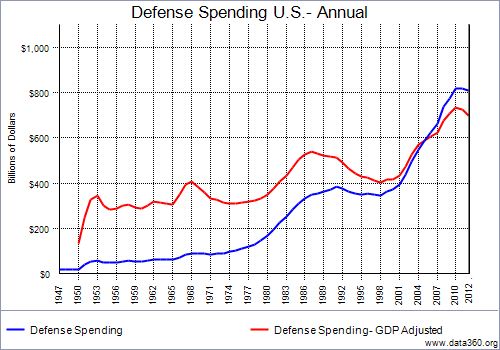
Even as a percentage of GDP? Yes, we are:
dsg539_500_350

I know we have a base-closing commission – but we all know its limits and manipulation (especially after the beginning of “House of Cards”). As the institution fights over “slices of a $530 billion budgetary pie that many experts think should be shrunk by one-fifth over the rest of this decade,” Thomas P.M. Barnett’s bet is on the army:

At roughly 560,000 men and women, the Army is bigger than it has been since 1994, when it was still crashing from its Reagan-era Cold War heights of 780,000. Later in the 1990s, the Army bottomed out at 480,000, and there’s no reason it can’t go back to that level, given that none of the fabulously high-tech wars being dreamed up by Pentagon planners calls for multiyear occupations of distant California-size countries.

(Charts via Ezra and data360)

Why Take His Name? Ctd

A reader rebuts Filipovic:

How is my father’s surname more my identity than my husband’s surname? Both, if you want to get all feminist about it, highlight the fact that females are “owned” by the males to whom they are born or wed, right? I am more than a name and I’ve had a lot of them. My birth parents saddled me with an atrocious moniker that only teenagers could have come up with and a surname that is now deemed a state secret. My parents stuck me with a vanilla Catholic saint name. My late husband offered me a new surname and my second husband gave me another. Don’t even get me started on nicknames.

And still, none of these arbitrary arrangements of letters are me. If I tried, and I have now and again, I don’t think I could put a name to me that sums me up. My names are like a history – snapshots of me at different points of my development and always a step behind as I evolve.

Another:

Jill Filipovic’s case for women keeping their surname strikes me a bit romantic.  Yes, our name is our identity, but what if you do not want to be associated with the identity?  I had three fathers growing up (a non-exsistent birth father and two abusive step-fathers) and so changing my surname to my husband’s was my first choice at creating my own identity separate from the childhood I wanted so desperately to leave behind. I loved shedding the identity of my youth (abused) for my new identity (happy adult, wife and mother).

Many more readers are sounding off on our Facebook page.

A Stand-Up Job

Gregory Ferenstein insists that we should all be walking while we work:

After piloting a walking desk – a standing desk attached to a treadmill – for a month, I’m convinced they should become the default workstation. Immediately, my daily calorie burn jumped 30.7 percent, and I lost 3 pounds and a percent of body fat in a week. I also experienced less joint pain throughout the day. …

The first day I couldn’t walk more than an hour at a time before I felt like I was losing concentration. It also takes some getting used to walking like a Tyrannosaurus rex (arms tucked-in and elbows bent at the keyboard). At first, I would work for an hour walking, and then sit for 30 minutes. The first day I walked about four hours. Now I only rest once a day. It also took a bit to develop the musculature in my upper back to support raised arms for hours on end. This is no longer a problem.

Update from a reader:

That chart is totally misleading.  By starting at 2400 calories it makes it appear like the walking desk helps you burn 300% more calories than sitting, but it actually you’d burn 33% more calories.  Not that the walking desk is a terrible idea or anything.

The Machinery Of Morality

In his new book, To Save Everything, Click Here: The Folly of Technological Solutionism, Evgeny Morozov explains how certain kinds of technology could help us become more moral beings. For instance, he’s intrigued by “a caterpillar-shaped extension cord which, if you leave devices in standby mode, it will start twitching as if the caterpillar was in pain”:

To me, it’s a nice way of alerting you, as someone who is a user of electricity, that there are many more issues involved that designers have tried to hide from you. They would rather you not think of devices in standby mode and would rather make that extension cord as invisible as possible.

And it’s this very paradigm that has brought us to a point where we think about energy – and even think that cloud computing – as being provided by some invisible infrastructure we no longer have to care about. I’m not sure how far we will be able to go with that paradigm in the future. If we will be replacing that paradigm, then I think that making technologies into these triggers for deliberation and reflection is not a bad place to start.

In a recent WSJ piece, Morozov provided other examples of ethical tech:

An Internet-jacked kettle that alerts us when the national power grid is overloaded (a prototype has been developed by U.K. engineer Chris Adams) doesn’t prevent us from boiling yet another cup of tea, but it does add an extra ethical dimension to that choice. Likewise, a grocery cart that can scan the bar codes of products we put into it, informing us of their nutritional benefits and country of origin, enhances—rather than impoverishes—our autonomy (a prototype has been developed by a group of designers at the Open University, also in the U.K.)

Charting The Unknown

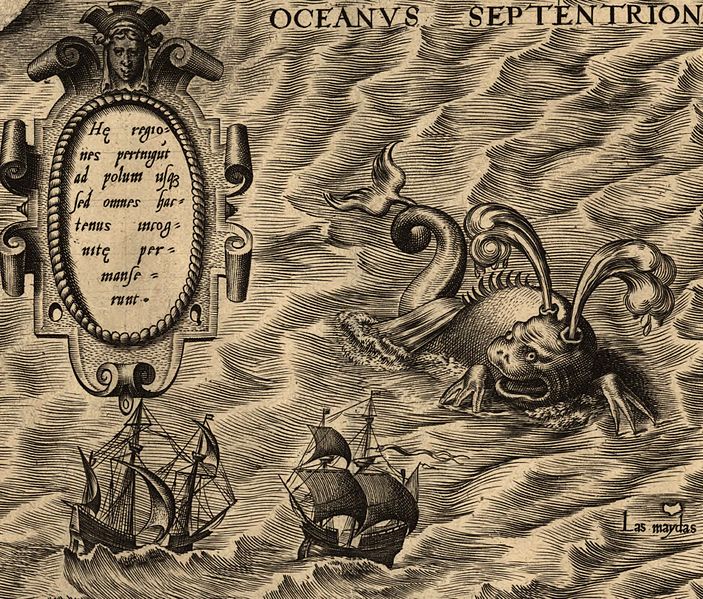
Frank Jacobs debunks the myth that “mapmakers of yore, frustrated by the world beyond their ken, marked the blank spaces on their maps with the legend Here be monsters”:

It’s a pleasing hypothesis. For to label a cartographic vacuum with the stuff of nightmares solves two problems at once. It explains why the fringes of contemporary knowledge didn’t match the outer limits of the entire world – monsters were keeping us out! And, by being equal parts fantastic and horrific, those monsters symbolise our fascination with the known unknowns just out of our reach. What keeps us out is also what draws us in.

Unfortunately, the theory suffers from an all too common trifecta: it’s neat, plausible and wrong. No map dating from the Age of Discovery (or before) is emblazoned with the slogan Here be monsters, nor with its variant: Here be dragons. At least not in English, or any other vernacular language. But there is one (if only just one) example in Latin: h[i]c sunt dracones, placed over the eastern shore of what is barely recognisable as Asia, on the so-called Lenox Globe.

(Above: Detail of the map Americae 1562 (the Americas) by Diego Gutiérrez and Hieronymus Cock (engraver) via LoC and Wikimedia)

Peak Satellite?

Tim De Chant fears the likelihood that “sometime in 2016, for the first time in over 50 years, the U.S. won’t have a polar orbiting weather satellite”:

Currently, the U.S. has 24 Earth-observing satellites in orbit. Their missions are widely varied, covering more than just weather. There are satellites that monitor tropical rainfall (key in our understanding and prediction of hurricanes), keep an eye on land-use change (important for urban development and habitat conservation), and observe the ice sheets that cover Greenland and Antarctica (an indicator of sea level rise). …

In 2007, the National Research Council issued a report on the overall status of the U.S. Earth observation system. What they found wasn’t promising.

“The extraordinary U.S. foundation of global observations is at great risk,” they wrote. Today, more than five years later, the situation hasn’t improved. Of the 15 satellite missions reviewed for that report, “I believe two of those are actually on track,” says Dennis Lettenmaier, a hydrogeologist at the University of Washington and member of the NRC committee. Budget shortfalls have jeopardized nearly every program. “Notionally, at least, there was enough money to do all those things, so it wasn’t supposed to be about there not being enough money,” he says. That changed when the economy soured. When NASA started running short on funds, it went looking for programs to cut. Satellites that were many years away from launch got the ax. “NASA basically just dropped them all,” Lettenmaier says.

The Weekend Wrap

screen-shot-2013-03-05-at-6-04-25-pm

This weekend on the Dish, we provided our usual eclectic coverage of religious, books, and cultural coverage. In matter of faith, doubt, and philosophy, Conor Williams pondered the miracles that come from love, J.L. Wall examined an exception to the decline of the religious novel, and Kerry Howley imagined a conversation between Schopenhauer and Joel Osteen. Christian Wiman ruminated on the parables of Jesus, Jerry Saltz praised Piero della Francesca’s artistic vision, and Stefany Anne Golberg visited the Shaker Heritage Society in New York. Alan Jacobs remembered Walker Percy’s Lost in the Cosmos, readers debated arguments against polygamy, Robert Zarestksy argued that Isaiah Berlin thought like a fox, and Kiley Hamlin asked why we judge each other.

In literary coverage, W.H. Auden critiqued the gluttony of reading, Amit Majmudar found that contemporary fiction fears sentimentality, and John Fram described writing a bad book for money. John Jeremiah Sullivan movingly recalled his father’s love, Jason Resnikoff traced the evolution of the word “indescribable,” and Carmel Lobello provided a Scrabble player’s dream. Claire Barliant highlighted a library of unborrowed books, Cynthia L. Haven explored how Polish-born poet Czesław Miłosz’s became a Californian, and Mark Levine mused on what former Poet Laureate Philip Levine was like in the seminar room. Mark Oppenheimer gave tips on freelancing in the digital age, Julian Baggini held that encyclopedias always were relics, and Simon Akam mourned the distinctly American transformation of a butchered pun. Read Saturday’s poem here and Sunday’s here.

In assorted news and views, Maggie Koerth-Baker compared gun violence to climate change, Marc Tracy showed where Moneyball is bankrupt, and Chip Scanlan emphasized the power of silence for journalists conducting interviews. There proved to be an app for STD diagnosis, Conner Habib critiqued Alain de Botton’s views on sex, and Rose Surnow detailed the market for paying for cuddling. Marina Galperina gazed at webcam performers who pose like they’re in a classic work of art, Niall Connolly delved into the history and enduring popularity of “voguing,” Tom Junod looked back at Dazed and Confused, and Megan Garber cast a light on moon towers.

MHBs here and here, FOTDs here and here, VFYWs here and here, and the latest window contest here.

– M.S.

(Image: Detail of Piero della Francesca’s “Virgin and Child Enthroned with Four Angels”)

“Technology Breeds Crime”

Frank Abagnale, the former conman played by Leonardo DiCaprio in Catch Me If You Can and who now works as a security consultant, explains how forgery has only gotten easier:

To forge a cheque 50 years ago, you needed a Heidelberg printed press, you had to be a skilled printer, know how to do colour separations, negatives, type-setting… those presses were 90 feet long and 18 feet high. There was a lot of work involved in creating a cheque. Today, you open a laptop.

If you are going to forge a British Airways cheque, you go to their website, capture the corporate logo and put it in the top right corner. You then put a jet taking off in the background and make a really fancy four-colour cheque in 15 minutes on your computer. You then go down to an office supply store, buy security cheque paper and put it in your colour printer.

Fifty years ago, information was hard to come by. When you created a cheque you had no way of knowing where in reality British Airways’ bank was, who was authorised to sign their cheques and you didn’t know their account number. Today you can call any corporation in the world and tell them you are getting ready to wire them money and they will tell you the bank, the wiring number, the account number. You can then ask for a copy of the annual report and on page three are the signatures of the chairman of the board, the CEO and the treasurer. It’s all on white glossy paper with black ink — scanner ready art. You then just print it onto the cheque.

Hearing With Your Eyes

Rachel Kolb, who reads lips, describes it as an “inherently tenuous mode of communication”:

Even the most skilled lipreaders in English, I have read, can discern an average of 30 percent of what is being said. I believe this figure to be true. There are people with whom I catch almost every word—people I know well, or who take care to speak at a reasonable rate, or whose faces are just easier on the eyes (for lack of a better phrase). But there are also people whom I cannot understand at all. On average, 30 percent is a reasonable number.

But 30 percent is also rather unreasonable. How does one have a meaningful conversation at 30 percent? It is like functioning at 30 percent of normal oxygen, or eating 30 percent of recommended calories—possible to subsist, but difficult to feel at your best and all but impossible to excel. Often I stick with contained discussion topics because they maximize the number of words I will understand. They make the conversation feel safe. “How are you?” “How’s school?” “Did you have a nice night?” Because I can anticipate that the other person will say “Fine, how are you?” or “Good,” I am at lower risk for communication failure.

Update from a reader:

There was a lot that I recognized in Kolb’s article.  I am deaf but lipread very well.  My husband and daughter are hearing and probably 95% of my interactions are with hearing people. My lipreading (which I call speechreading, which seems more accurate since I’m looking at much more than lips) is good enough that people frequently don’t realize that I’m deaf.

The main thing I wanted to comment on re: Kolb’s article is her seeming rejection of the Deaf community.  Why not be bi-cultural?

I have found that I need regular injections of effortless communication via sign language to be a truly effective speech reader.  Speechreading requires a level of relaxation and ease, and before I learned ASL and became part of the Deaf culture/ community, I would regularly have meltdowns where the sheer EFFORT got to me.  Where I became just too frustrated to sit back and let it all wash over me and make sense of it all.  Once I became fluent in ASL and started regularly socializing with other Deaf people, those meltdowns stopped.  Interacting with Deaf people became my recharging time, and I then was a much more effective speech reader overall.

Now I have my daily interactions (spoken, with occasional ASL) with my husband and daughter; my daughter’s (hearing) friends; my (hearing) friends and extended (hearing) community; and all of the regular everyday interactions we must have with grocery clerks and the like.  And then I also meet up with Deaf friends at regular intervals to just relax and communicate without a second thought.

I understand her fear that you must choose one community or the other, but that’s not the case.  With her background, she must know ASL.  There are plenty of interesting Deaf people out there, and she doesn’t need to limit herself to frustrating, effortful interactions.  By the same token, she doesn’t have to limit herself to the Deaf community.  You can be a part of both worlds.

What Is The Internet Worth?

The Economist explains why it’s hard to calculate:

Measuring the economic impact of all the ways the internet has changed people’s lives is devilishly difficult because so much of it has no price. It is easier to quantify the losses Wikipedia has inflicted on encyclopedia publishers than the benefits it has generated for users … This problem is an old one in economics. GDP measures monetary transactions, not welfare. Consider someone who would pay $50 for the latest Harry Potter novel but only has to pay $20. The $30 difference represents a non-monetary benefit called “consumer surplus”. The amount of internet activity that actually shows up in GDP—Google’s ad sales, for example—significantly understates its contribution to welfare by excluding the consumer surplus that accrues to Google’s users.

Some researchers tried to measure it using leisure time as an indicator:

Erik Brynjolfsson and Joo Hee Oh of the Massachusetts Institute of Technology note that between 2002 and 2011, the amount of leisure time Americans spent on the internet rose from 3 to 5.8 hours per week. The authors conclude that in so far as consumers must have valued their time on the internet more than the alternatives, this increase must reflect a growing consumer surplus from the internet, which they value at $564 billion in 2011, or $2,600 per user. Had this growth in surplus been included in GDP, it would have raised economic growth since 2002 by 0.39 percentage points on average.