Dale Carpenter marks today’s big marriage equality news:
By a 2-1 vote, with Judge Jeffrey Sutton writing the opinion, the Sixth Circuit has upheld state prohibitions on same-sex marriages in the states of Ohio, Kentucky, Michigan, and Tennessee. Given that four other circuits have come out the other way, and that same-sex marriages are proceeding in 32 states, this is the case that produces the circuit split likely to be resolved by the Supreme Court. If petitions for certiorari are filed soon, as I expect they would be, we could still be on track for argument this Term and decision by the end of June 2015.
Lyle Denniston explains that the “challengers in the cases in the four states of the Sixth Circuit now have two legal options”:
First, they can ask the full Sixth Circuit bench (the en banc court) to reconsider their cases, and if the court does that, then the panel decision released Thursday would be wiped out and the en banc court would start fresh. The loser at that level could then seek Supreme Court review.
Second, the challengers can now move directly to the Supreme Court; they do not have any legal obligation to seek further review in the Sixth Circuit Court. If they take that path, it would be up to the Justices to decide for or against review, and it would take the votes of only four of the nine Justices to agree to hear the case.
One of the key arguments in the ruling:
When the courts do not let the people resolve new social issues like this one, they perpetuate the idea that the heroes in these change events are judges and lawyers. Better in this instance, we think, to allow change through the customary political processes, in which the people, gay and straight alike, become the heroes of their own stories by meeting each other not as adversaries in a court system but as fellow citizens seeking to resolve a new social issue in a fair-minded way.
Sutton, a George W. Bush appointee, had described these concerns during oral argument last August, and they clearly guided his vote here. Predictably, Sutton also harps upon the brief portion of United States v. Windsorthat dealt with states’ rights—while largely overlooking its concern with the dignity of gay people. In Windsor, the court held that a federal gay marriage ban “degrade[s],” “demean[s],” and “disparage[s]” gay people. Yet Sutton is unconcerned that gay marriage bans might “demean” gay people; rather, he frets that overturning such a ban would be “demeaning to the democratic process.”
Say this: Sutton hit every possible argument and issue surrounding marriage equality (although he soft-pedaled his discussion of the “marriage is for men and the women they accidentally knock-up” argument). So the opinion presents a good vehicle for thorough consideration (and reversal).
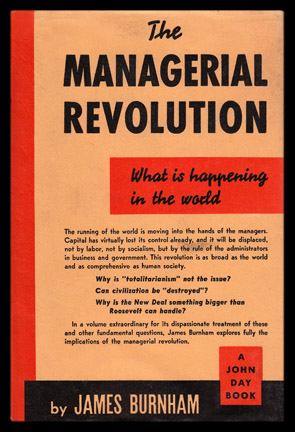
Daniel McCarthy revisits the obscure legacy of James Burnham, an ex-Marxist and philosopher who was an important figure in the postwar conservative intellectual movement (e.g. he was one of William F. Buckley’s first hires at National Review). Calling Burnham the “American Machiavelli,” McCarthy details how he “broke with Trotsky, and with socialism itself, in the 1940s, and he sought a new theory to explain what was happening in the world”:
In FDR’s era, as now, there was a paradox: America was a capitalist country, yet capitalism under the New Deal no longer resembled what it had been in the 19th century. And socialism in the Soviet Union looked nothing at all like the dictatorship of the proletariat: just “dictatorship” would be closer to the mark. (If not quite a bull’s-eye, in Burnham’s view.)
Real power in America did not rest with the great capitalists of old, just as real power in the USSR did not lie with the workers. Burnham analyzed this reality, as well as the fascist system of Nazi Germany, and devised a theory of what he called the “managerial revolution.” Economic control, thus inevitably political control, in all these states lay in the hands of a new class of professional managers in business and government alike—engineers, technocrats, and planners rather than workers or owners.
The Managerial Revolution, the 1941 book in which Burnham laid out his theory, was a bestseller and critical success. It strongly influenced George Orwell, who adapted several of its ideas for his own even more famous work, 1984. Burnham described World War II as the first in a series of conflicts between managerial powers for control over three great industrial regions of the world—North America, Europe, and East Asia. The geographic scheme and condition of perpetual war are reflected in Orwell’s novel by the ceaseless struggles between Oceania (America with its Atlantic and Pacific outposts), Eurasia (Russian-dominated Europe), and Eastasia (the Orient). The Managerial Revolution itself appears in 1984 as Emmanuel Goldstein’s forbidden book The Theory and Practice of Oligarchical Collectivism.
Despite how closely Burnham is associated with the Cold War, McCarthy asserts his continued relevance:
After all, the managerial Soviet Union is gone, and the capitalist U.S. has not only survived but thrived for decades in what is now a globalized free-market system. While the political theory of The Machiavellians doesn’t depend on The Managerial Revolution—it’s surprising, in fact, how little connected the two books are—his reputation must surely suffer for getting such a basic question wrong.
Only he didn’t get it wrong—for what is the political and economic system of China if not what Burnham described in The Managerial Revolution? Engineers, industrial planners, and managers have led China for decades, with unarguable results. Indeed, several East Asian economies, including those of American allies Taiwan, South Korea, and Japan, are managerialist. As Burnham predicted, these economies have been highly successful at controlling unemployment and raising standards of living.
The American ruling class, by contrast, has pursued a largely anti-managerial policy, ridding the country of much strategic manufacturing. Such industry—including shipbuilding and semiconductor fabrication—is now overwhelmingly based in Asia. The U.S. hybrid system, transitioning from capitalism to managerialism, outperformed the Soviet Union. Whether it can outperform the next wave of managerial revolution is very much uncertain.
The first thing that strikes me about the Alyssa Rosenberg quote is its breathtaking self-centeredness: “How much does masculine culture depend on women and femininity as a reference point?” This reminds me of the conversation that every straight guy has had with their female significant other. I call it the “You don’t have to pretend with me” talk.
Every time we straight guys talk about something we like (sports, metal music, violent video games, scotch whisky, etc.) we get the same response. “There are no guys around. You don’t have to pretend to like that stuff with me. Just be yourself!” What’s bizarre is that there is absolutely no acknowledgment that the stereotypical masculine stuff is stuff that we actually like. I like hockey fights. I like listening to Tool. I like GTA V. I like Lagavulin. Really, I do!
This is what drives me crazy about the contemporary liberal view that masculinity is nothing more than a social construct that can, with willpower, be overcome. All the things that make me a man, things that I enjoy, are apparently just externally forced cultural norms that I am too dumb and weak to transcend.
Masculinity has nothing to do with denigrating women. Period. There is no greater exemplar of modern masculinity than the character of Ron Swanson … can you imagine him denigrating women?
Many more readers chime in:
OK, straight male responding as requested! First, I will state one thing unequivocally. Masculine culture (however you want define it) is NOT under any kind of threat. This notion is as ridiculous as the idea that suddenly Sharia Law is going to take over the American judicial system.
The size, momentum, influence, and sheer predominance of straight, white, male culture makes this a frank impossibility – at least in our lifetimes. It is the de facto default; our entire society has been built around it for thousands of years. All the inroads that diversity and inclusiveness have made (particularly in the last 50 years or so) are a drop in the bucket compared to the history and established institutions that inform who we are as a society.
Second, thanks for attempting to bridge the gap between some of these disparate positions – particularly the highly polarized ones. One on my greatest frustrations in trying to discuss all of this mess is when I see people having conversations AT each other rather than WITH. As with anything, a little bit of empathy and understanding on every side helps.
On that note, Devin Faraci wrote a damn good explanation of how these gamers feel marginalized by these feminist critiques. Money quote:
Let me tell you where these kids are coming from, because I used to come from there. The first thing that’s happening is that they’re mostly males who are socially unaccepted. They’re outsiders, losers, weirdos and freaks. And most of them aren’t just male, they’re white males. What’s happening is that these men are feeling powerless in their own lives, and then along comes someone like Anita Sarkeesian telling them that as white men they are the MOST powerful group in the world. And that they should be aware of this privilege and they should be careful how they exert it.
Imagine the confusion this causes. These kids feel like the bottom of the heap, ignored and hated and mocked and here comes this woman – who is successful and admired and gets Joss Whedon to retweet her videos – telling them that they’re actually part of an invisible system keeping her down. This simply can’t compute for these guys.
I can’t read the catcalls thread without thinking of a stunning segment from This American Life about a woman undergoing a sex change. He (soon to be she) describes vividly how intensive testosterone treatment transforms the way s/he looks at women on the subway and in the street. (I may even have read this passage on these very pages a few years back, but it bears repeating I think). Here s/he describes the period following the first major injection:
The most overwhelming feeling is the incredible increase in libido and change in the way that I perceived women and the way I thought about sex. Before testosterone, I would be riding the subway, which is the traditional hotbed of lust in the city. And I would see a woman on the subway, and I would think, she’s attractive. I’d like to meet her. What’s that book she’s reading? I could talk to her. This is what I would say.
There would be a narrative. There would be this stream of language. It would be very verbal.
After testosterone, there was no narrative. There was no language whatsoever. It was just, I would see a woman who was attractive or not attractive. She might have an attractive quality, nice ankles or something, and the rest of her would be fairly unappealing to me.
But that was enough to basically just flood my mind with aggressive, pornographic images, just one after another. It was like being in a pornographic movie house in my mind. And I couldn’t turn it off. I could not turn it off. Everything I looked at, everything I touched, turned to sex. […]
I remember walking up Fifth Avenue, there was a woman walking in front of me. And she was wearing this little skirt and this little top. And I was looking at her ass. And I kept saying to myself, don’t look at it, don’t look at it. And I kept looking at it.
And I walked past her. And this voice in my head kept saying, turn around to look at her breasts. Turn around, turn around, turn around. And my feminist, female background kept saying, don’t you dare, you pig. Don’t turn around. And I fought myself for a whole block, and then I turned around and checked her out.
And before, it was cool. When I would do a poetry reading, I would get up, and I would read these poems about women on the street. And I was a butch dyke, and that was very cutting-edge, and that was very sexy and raw. And now I’m just a jerk.
Another:
I happened to read a 2010 article on Alternet today, and it reminded me very much of the issues that you and Alyssa Rosenberg were talking about a couple days ago. The author writes about his time spent as a pornography cameraman and writes in particular about the difference between straight and gay porn.
On straight porn:
What surprised me most though, was the fact that I found within myself a happy willingness to be violent, a willingness to degrade. Though my bosses may have ordered me to organize and record the scenes of degradation, I followed their orders, and not without pleasure. Something cowardly within me, an internal space, suffused with a weak kind of anger, felt satisfied when I saw a woman “take her punishment.” I clung to the sense of temporary empowerment I found through the bullying. Lust-colored aggression and the satisfaction of making “good money” guided me through scene after scene.
Of course, all participants in porno are complicit, both the bottoms and tops. Both genders willingly participate in heterosexual porn, and to some extent, both are marginalized: I was literally ordered not to film men above the waist if I could help it. And while men do make up the majority of porn’s audience, women watch heterosexual porn, too—quite a few likely doing so with major outrage or dissatisfaction. Still, though, straight porn unarguably continues to be the untrammeled domain of male fantasy.
On gay porn:
…the shame, rage, and sexual violence that I had come to associate with porn was almost completely absent. That meant something.
Gay porn, in fact, was so goddamn simple that it approached a type of Zen beauty. I mean, this was guys taking on guys, in every shape and form imaginable, for the most part in good humor and absent-minded lust. They may have stuck to roles of “tops” and “bottoms,” but in the dressing room, we all seemed equals, on the same team. Everyone laughed at me for being a straight guy shooting gay porn. Some tried to entice me to jump in front of the camera for kicks. But we all laughed about it. We all seemed like friends. The sadness and the degradation I had come to associate with my job, with videotaped sex for money, was suddenly absent.
But I’m saddened to think that the only path to the absence of hostility and anger in porn is to remove women from the equation. It doesn’t bode well, especially for a world in which men and women must continue to co-exist. In the first half of my porn-life, I lived inside of a world where it almost seemed like an entire gender was being denigrated, like that was the whole point—where very young women were choked and slapped and written-on with lipstick, simply for the crime, it seemed, of being a woman. You should have slept with me, seemed to be the unspoken message. Now see what I have to do to you.
Wow. So that was only one guy’s opinion / personal experience but in the light of recent discussions it really stood out to me.
One more reader:
I’m not sure why you’re responsible for defending straight guy culture, but Alyssa’s post is fascinating in the sense that she seems to take for granted that culture is something that is consciously shaped by its members. No one – including you – is saying that there’s nothing loathsome and regrettable about straight white guy culture. There certainly is! But all cultures have defects that don’t offer any redeeming social value and which can be safely excised, in exactly the surgical manner she wants to edit traits associated with straight guys – if only that was possible. It isn’t.
A culture describes a set of human beings. Human beings are necessarily imperfect. And so should our cultures be. What Alyssa sees as the defects of straight guy culture are – for better or worse – part of our culture. Does masculinity depend on women and femininity as a reference point? she asks. Well, yes, just as femininity depends on masculinity as a reference point. I think what she’s driving at is that too much of straight guy culture defines itself by objectifying women. Umm, sure. But that’s a snapshot of a moving target. The real question is trajectory. Cultures do not self-edit; they evolve, and straight guys have, which is why we’re shocked by the sexism in Mad Men, for example. Now clearly it’s not evolving fast enough for women like Alyssa, but they can (are!) pushing that evolution along by raising awareness about the callousness of catcalling. You can say the same thing about culture that you can about weather: If you don’t like it, wait.
And continue to make the arguments. Also, say something if you see a woman getting harassed.
It appears that Republicans will have a net gain of between 300 and 350 seats and control over 4,100 of the nation’s 7,383 legislative seats. That is their highest number of legislators since 1920. Republicans gained seats in every region of the country and in all but about a dozen legislative chambers that were up this year.
Libby Nelson recognizes the importance of these wins:
Republicans now control state government outright in at least 24 states, one more than they did before the election. They control at least 66 of 99 state legislative chambers nationwide. And they cut the number of states with total Democratic control from 14 to seven — the lowest number since the Civil War. …
Republicans made historic gains in state legislatures in 2010. They held on in many states in 2012, or made up for losses in one state with gains in another — even though Democrats won the national election. And they won even more in 2014. This isn’t an accident — it’s the result of strategic fundraising from national Republicans, beginning in 2010, aimed at engineering statehouse takeovers. Out-of-state contributions were shuffled to states where they would make a difference, particularly as congressional partisanship and gridlock made policymaking in Washington increasingly unlikely.
The 2014 legislative results will allow many more Republicans to serve as house speakers, senate leaders, and committee chairman, gaining critical experience for possible future careers in federal politics. It gives the GOP more chambers with which to advance economic and social legislation. Even if a bill goes to a Democratic governor for a veto, that’s useful to define issues and expose squishes. In many cases, however, newly Republican legislatures will be able to enact conservative reforms with the cooperation or acquiescence of such governors, who are first and foremost political animals. As for state Democrats, their ability to legislate liberal policies has just taken a nose dive. Only seven state governments are fully blue at this point.
These are, of course, just opportunities for Republicans. They could certainly squander them on pointless crusades, poorly crafted policies, or disastrous infighting.
Earlier Dish on the power of state legislatures here.
With a Republican Senate likely to give Obama problems in the realm of judicial appointments, Jonathan Ladd bets Justices Ginsburg and Breyer are having second thoughts about holding off on retirement:
[T]o find a situation as favorable for replacing Breyer and Ginsburg with liberals as 2013-14 was, we have to wait for the next time Democrats control both the Presidency and the Senate. Because presidential elections are so influenced by short term economic swings, the results in 2016 (and all future elections) are very uncertain. And with the Republicans’ new 54 seat Senate majority, party control of the Senate after 2016 is up for grabs as well. Considered together, the joint probability of Democrats controlling both the Senate and the Presidency after 2016 is only modest. The likelihood of a big fight over a Supreme Court nominee in the next decade between a president and Senate of different parties, resulting in one or more nominees being rejected and possibly a seat being vacant for an extended period of time, is reasonably high and just got higher.
Noah Feldman considers who Obama might nominate if a seat on the court opens up in the next two years:
To be confirmed by a Republican Senate, the nominee would have to be at least a credible centrist — more in the model of Sandra Day O’Connor or Kennedy then Ginsburg or Breyer.
What potential candidates fit that description? The big midterm election winners in the pool of potential justices are people like Merrick Garland, chief judge of the U.S. Court of Appeals for the District of Columbia circuit, or Sri Srinivasan, a relatively recent appointment to the D.C. Circuit. … Garland is known as a moderate, and he could plausibly replace any of the three old white men should one of them have to step down. As a judge he has managed not to incur the wrath of conservatives, and he is probably confirmable. Srinivasan has much less experience, having been appointed to the federal bench in 2013. But Srinivasan has even less partisan baggage than Garland.
Jonathan Bernstein offers a solution that he thinks would avoid a chaotic confirmation process:
Barack Obama could select an old nominee, who might be confirmed. In the event of a vacancy, a normal replacement could easily serve for decades. On the other hand, a nominee at age 75 or so would lower the stakes considerably, to the point at which obstruction would be less of a partisan imperative, even if the nominee was broadly within the liberal judicial tradition. Obama is entitled to nominate anyone he chooses. And Republicans are entitled to oppose someone they think would be terrible for the nation (and terrible for groups in their party coalition). But both sides have an obligation to find and accept reasonable compromises. If a senior appointment is the only way out, it’s hard for either side to oppose it.
Jesse Singal, regretting how he’d never challenged a “borderline-compulsive” street harasser he once knew, spoke with Hollaback’s Debjani Roy in an attempt to better prepare himself for such interventions in the future:
[A]m I overestimating the impact one disapproving conversation can have? Probably not, said Roy. [This serial harasser] Harry had probably, like many young men, been in a lot of social situations in which street harassment wasn’t looked down upon and may have been actively encouraged. “We all know about peer pressure,” said Roy. “And I think a lot of the original behavior comes out of that. Like, ‘Dude, why aren’t you hitting on her? Dude, why aren’t you trying to pick up more women? Why aren’t you yelling that at her?’” Having another guy come up and say exactly the opposite, then, can make an impact — even if it’s not guaranteed to.
Singal adds that even just commiserating with or checking on the harassed woman afterwards can be a beneficial way to get involved. He concludes:
What all this comes down to is that, in much the same way that harassing is a socially ingrained part of Harry’s life, not responding to “mild” incidents of harassment is a socially ingrained part of mine. For whatever reason, I and a lot of other otherwise “good guys” have succumbed to the notion that it’s best to just stay out of these situations rather than intervene.
A reader shares his own missed opportunity:
Many years ago when I was in my early 20s and living in Boston, I was on the T late at night and saw this middle-aged Hispanic man harassing a young black woman clearly unappreciative of his advances.
She was very overweight, and after the man sat down next to her, he started leaning in and talking to her and touching her arm while she just shrank into the wall of the car. Occasionally she would turn to glare at him, or say something so softly as to be inaudible. It was a pretty crowded train, but nobody else seemed to be paying attention to the situation and I, having never witnessed anything like it before, sort of froze. I just kept watching and told myself that if he really grabbed her or became belligerent, then I would intervene, but that never happened, and so still I did nothing. He kept harassing her, and I kept watching uncomfortably and wondering what I should do. Several minutes later when my stop came, I asked the group of people standing next to me to please keep an eye on the guy to make sure “nothing happened” and I got off the train.
I have no idea what happened to the woman, but of course something was already happening to her, and it may have gotten much worse. I could have stopped it, but I didn’t. Naturally, my regret over that night has only grown, especially after hearing my wife and female friends’ personal experiences with public harassment and assault. For all the consternation about these feminist campaigns and their tactics, the resulting discussion and increased awareness is surely a net gain. The women in my life certainly never told me about any of this stuff until I knew to ask, and I’m now quite grateful for, and influenced by, their perspectives.
As for us men? We’re long overdue to grow out of this crap, harassers and bystanders alike. I definitely wish I had sooner.
I’ve actually been in a couple of similar situations and have actually intervened. “Is this guy bothering you?” is my usual question. Both times, the answer was a demurral. But my just asking that question in public shifted the atmosphere a little bit. And I stood by, watching the dude until he moved away. I guess I could have been foolish and certainly didn’t want a physical confrontation with the dude. But it struck me how potent a simple question can be in making a woman feel a little less alone and a man a little more self-aware that others were keeping tabs.
Read our two long catcalling threads here and here.
On the whole, I found the president’s presser yesterday reassuring. First off, it upset Ron Fournier and the usual Washington establishment types, which is a good sign. Second, his very affect – calm, upbeat, confident – is classic Obama. Third, his basic stance of asking the GOP to put up or shut up now they have majorities in both Senate and House is exactly the right move. It forces some kind of constructive proposal out of them and puts the onus on them to say – at long last – what they might be for instead of whom they are against. Or, more likely, it reveals the emptiness of their opposition and lack of a constructive policy agenda.
But it seems to me that this effective strategy is immediately undermined by his continuing to threaten unilateral executive action on immigration. The threat makes sense as a way to bring the GOP to the table, but not if he fully intends to follow through before the end of the year regardless. Instead of forcing the GOP to come up with a compromise bill – which if it can, great, and if it cannot, will split the GOP in two – he’d merely recast the debate around whether he is a “lawless dictator”, etc etc. rather than whether it is humane or rational to keep millions of people in illegal limbo indefinitely. It would strengthen those dead-ender factions in the House that are looking for an excuse to impeach. It would unify the GOP on an issue where it is, in fact, deeply divided. And it would not guarantee a real or durable solution to the clusterfuck.
Yes, he’s out on a limb with his supporters on this – and they punished him for it with low turnout on Tuesday. But he punted before the election and he could punt again. And the truth is: no real progress on this can be made without legislation, and the looming demographic challenges for the GOP in 2016 without any action on the issue makes some movement on this a sane move in the next six months, especially from the point of view of the donor class and business lobby.
In other words, it makes much more sense to me for Obama to ask the GOP for a major legislative proposal before he takes any unilateral action. If they fail to do so – and it’s perfectly possible they do, given intense divisions within their ranks – then Obama’s executive action makes much more sense and can be defended much more easily, as a response to Congressional failure. But to pre-empt this with a divisive act that would polarize the country still further would make no long-term progress likely and put the blame for gridlock on his shoulders, rather than the GOP’s. And what good would that do?
What I’m saying is that he should precisely “wait” some more before acting on this. He’s waited long enough to make another six months’ delay, while he demands a bill to sign, a perfectly palatable option. If he accepts another bucketload of efforts to secure the border as part of the deal, his position remains more popular than the GOP’s with the center and the Latino population. And the real goal of all this is legislation that can guarantee citizenship, better immigration criteria and a secure border beyond any president’s executive orders or revised regulations. Unilateralism can make that less likely rather than more.
(Photo: US President Barack Obama pauses during a press conference in the East Room of the White House November 5, 2014 in Washington, DC. By Brendan Smialowski/AFP/Getty Images.)
Alabama’s Amendment 1, drafted by a lawyer who fears the non-existent problem of American courts applying Sharia law, passed on Tuesday with 72 percent of the vote. The amendment to the state constitution declares that Alabama courts “shall not apply or enforce a foreign law if doing so would violate any state law or a right guaranteed by the Constitution of this state or of the United States”. Many reports on the amendment (like the preceding link) claim that it bans the application of foreign law altogether, but Eugene Volokh disputes that:
Normal American “choice of law” principles often call for the application of foreign law in cases that involve foreign transactions, for instance in some tort cases arising from injuries in foreign countries, determining the family status of people who were married or adopted children in foreign countries, and more. American courts wouldn’t enforce foreign rules that violate Americans’ free speech rights, equal protection rights, and so on; but in the great bulk of cases in which foreign law would be applied, there would be no such constitutional problem. The Alabama amendment wouldn’t bar use of foreign law in such cases.
What it would do is less clear, Paul Horwitz explains, because the prohibition on applying foreign laws that contradict Americans’ constitutional rights is, er, “already the law in every state, including Alabama”. The redundant amendment, Horwitz argues, is a waste of time and money that will likely have unintended consequences and serves only as a gesture of hostility toward Islam:
Our state and federal constitutions prohibit discrimination against religion. An explicitly anti-Muslim law would be unconstitutional. But hostility to Muslims, or to any minority, always buys a few votes in some corners. So we now have the worst of both worlds. The law, in its past and present versions, is driven by religious hostility. But in order to avoid being struck down, the current amendment bars courts from recognizing Jewish or Christian (or, yes, Islamic) prenuptial contracts, or enforcing judgments by Southern Baptist arbitrators. At least, it would, if those judgments violated state or federal law. But our courts already forbid that. Amendment One is literally not worth the paper the law would be printed on–and printing laws costs money.
Even the state’s conservative evangelicals didn’t get behind the amendment:
Although anti-Shariah bills are often proposed and supported by conservative Christians, Amendment 1 was actually heavily criticized by many religious groups in the Cotton State — including several prominent evangelical Christians. Organizations such as Greater Birmingham Ministries publicly decried the measure, and Randy Brinson, the president of the Christian Coalition of Alabama, blasted the law as “just silliness.” Brinson argued that the bill did not actually protect “Christian values,” and passing it could potentially jeopardize foreign adoptions, marriages to people outside of the U.S., and religious liberty. “This is a tremendous waste of effort. It’s a waste of time and it costs money,” Brinson said ahead of the vote.
Beyond the phantom menace of Sharia, Mark Joseph Stern characterizes Amendment 1 as an effort “to nullify Supreme Court decisions that lean on foreign law”, particularly regarding capital punishment:
According to the amendment, any decision that uses international law could not legally be applied in Alabama courts, since citing it would involve the “application” of foreign law. A state judge couldn’t overrule the execution of a minor based on Roper, since Roper relied in part on international law. Nor could she annul the conviction of a gay person for having gay sex, since Lawrence cited foreign courts. The execution of the mentally retarded, too, would be back on the table in Alabama; in fact, much of the Supreme Court’s modern death penalty jurisprudence would now seem to be inapplicable in the state. This is not some speculative overinterpretation of a poorly worded amendment; overturning established death penalty law was a stated goal of the amendment’s chief drafter. No doubt a team of lawyers is already poring over Supreme Court rulings, searching each decision for a reference to international law. Once they’ve found one, they can alert state judges: Use this ruling, and you’ll be breaking the law.
Looking over the situations in which Alabama courts would typically come into contact with foreign law, Amanda Taub remarks on the legal uncertainties the amendment creates:
Start with disputes governed by foreign law, which are common. Consider, for instance, what might happen if a couple was married overseas, but then sought a divorce in Alabama. Or if they adopted a child overseas, but then a custody dispute came before Alabama courts. Such cases would, by necessity, require Alabama courts to consider foreign law in order to determine the validity of the marriage, adoption, or custody agreement. After Amendment One, it’s not clear whether, or how, they will be able to do so.
It’s also extremely common for contracts to be governed by foreign law, through what is called a “choice of laws” clause. Amendment One carves out an exception for “Alabama business persons and companies,” who may decide to use foreign law in Alabama Courts. But it’s not clear how that exception will be applied, because the very same clause says that “the public policy of Alabama is to prohibit anyone from requiring Alabama courts to apply and enforce foreign laws” — which appears to directly contradict the exception. That’s a potential nightmare for companies that do business in the state, who now don’t know if their choice of law clauses will be enforced, or if global contracts will now become subject to uncertain interpretation as soon as they cross Alabama state lines.
Furthermore, Faisal Kutty points out, “the consequences” of such restrictions on Sharia and foreign law “may be counterintuitive”:
In August 2012, for instance, just one month after Kansas passed Senate Bill 79, a state court found its hands tied when Elham Soleimani sought the enforcement of the mahr (dowry) provision in her Islamic marriage contract. Her husband, Faramarz Soleimani, had agreed to pay 1,354 gold coins—valued at $677,000 at the time—in the event of divorce. Faramarz agreed to this at the time of the marriage, given that it was his second marriage and Elham was 24 years his junior. The Johnson City District Court refused to enforce Elham’s claim for various reasons, the most significant being the religious nature of the contract. In its 28 August 2012 ruling, the court concluded that enforcing the agreement would “abdicate the judiciary’s role to protect such fundamental rights, a concern that was articulated in Senate Bill No. 79.” Essentially, the court took the position that enforcing the Islamic contract would violate the foreign law ban and the separation of church and state doctrine under the Establishment Clause of the First Amendment of the U.S. Constitution. Elham lost her claim to her dowry thanks to the law, which Republican State Senator Susan Wagle introduced as “a vote to protect women.” Elham would surely beg to disagree.


 The Dish