At least we have Galifianakis and his two ferns to keep us sane.
Pope Gregory And Pope Benedict?
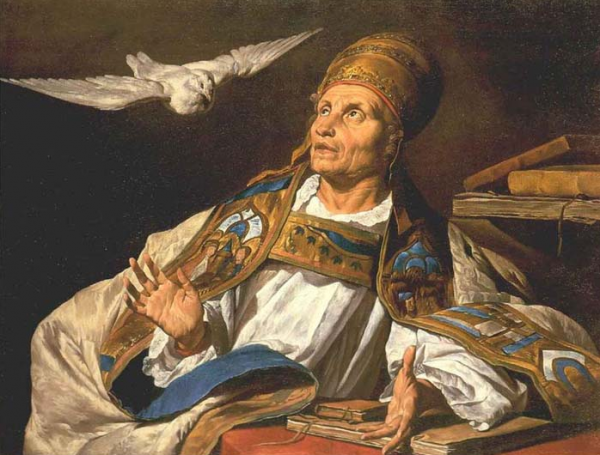
Well it sure makes for an interesting parallel:
No one could doubt that this Holy Father has meditated profoundly, and I expect repeatedly, on The Pastoral Rule of St. Gregory the Great—that sixth-century handbook for those who hold the highest spiritual authority, what Benedict and others have called the ars artium (“the art of arts”). Much of the book is a warning against the wrong reasons for grasping or holding on to power, followed by an outline of the virtues needed to exercise leadership well. In the first book of The Pastoral Rule we find this line, which I believe has quietly echoed for some weeks in the Holy Father’s thoughts: “He must be a man whose aims are not thwarted by the frailty of his body.” The office of Peter is not a spiritual thing which discounts human nature. That sacred ministry resides with a person, but that person must have the nature to exercise its rigors.
In 2008, in one of the Holy Father’s General Audiences, Benedict spoke on St. Gregory, a former monk who reluctantly assumed the papacy:
Gregory remained a simple monk in his heart and therefore was decidedly opposed to great titles. He wanted to be—and this is his expression—servus servorum Dei. Coined by him, this phrase was not just a pious formula on his lips but a true manifestation of his way of living and acting. He was intimately struck by the humility of God, who in Christ made himself our servant. He washed and washes our dirty feet. Therefore, he was convinced that a Bishop, above all, should imitate this humility of God and follow Christ in this way. His desire was to live truly as a monk, in permanent contact with the Word of God, but for love of God he knew how to make himself the servant of all in a time full of tribulation and suffering. He knew how to make himself the “servant of the servants.” Precisely because he was this, he is great and also shows us the measure of true greatness.
One line from Benedict’s comments stands out: “His desire was to live truly as a monk…” Perhaps the same, in slightly modified form, could be said for the former professor and scholar. His temperament and abilities, not unlike Rowan Williams in the Church of England, always were slightly at odds with the practical demands of his office. This profile of Williams by Paul Elie is really worth re-reading.
Heads Up
I’ll be live-blogging the SOTU tonight as usual. I’m also giving a speech tonight at Kent State at 6 pm if any of you are in the neighborhood and want to attend. It’s at Kiva, Kent Student Center.
The View From Your Window Contest: Winner #140

A reader writes:
I have never entered the VFYW contest before, so here goes nothing. The general feel of the picture is that of Italy, Spain, or Latin America. Based on the condition of the road (smooth without any obvious flaws – EU transportation subsidies, perhaps?), the more “stretched” appearance of the license plates, the presence of what appears to be a uniformed police officer in the crosswalk, and the blue shorts of a man in the crosswalk which remind me of the Italian national football team’s kit, I’m going with Italy. I suspect this is somewhere in southern Italy, based on the slightly decayed appearance of some of the buildings. And it’s clearly a congested residential neighborhood in a decently-sized city. Beyond that, it’s a shot in the dark for me. So I’m going with Naples.
Another:
The narrow cobblestone street, the somewhat decrepit 19th century building, the mixed-race crowd in very casual summer clothes, the shot through a window in a wall a meter thick (perhaps an old fortress or church?) … it must be Southwestern Europe somewhere, and based on the crowd, I’m guessing a touristed but not wealthy part of Paris. Montmartre?
Another:
The bastions in Cartagena, Colombia have deep cuts like this, large enough for a person to sit it. This looks like a view from the sea up one of the streets leading to the cathedral.
Another:
This looks like New Orleans to me. Mainly because I can’t shake the American vibe I’m getting from the streets and cars and the people. Also because its Mardi Gras season and you are a good Catholic. (I wish I was there right now with a big plate of oysters and a nasty drink from a street vendor.) Perhaps I’m reading too much into the time of year. This might be Lithuania. I’m notoriously bad at this contest.
Another:
Too hard! I’m not one to just write in with a guess without anything to back it up but that strategy does seem to work for people occasionally. And I’m still kicking myself for not going with my gut on #135 (Tehran). So there’s my guess: Rabat, Morrocco.
Another:
I have never played this game, do not have the where with all, patience or time to give these the effort that they need. But I LOVE watching it every week. I’m not really playing now. I’m responding to this one only because that is just the coolest freakin window I think I’ve ever seen ever on The Dish.
Another gets very close:
Looks like the Caribbean, with the narrow streets and painted buildings. The ethnic diversity is right, and it looks like there are also some tourists. The billowy clouds suggest the humidity of the area, and the people are dressed for warm weather as well. The cars are on the right – plus they look fairly modern and American – so I don’t think it’s Cuba or a British colony. Maybe the view is from a church window? Let’s go with the Cathedral of San Juan Bautista in Old San Juan.
Another nails it:
Just took a mental break from sorting through photos from our recent vacation to Puerto Rico and the British Virgin Islands and checked the Dish, only to see a very familiar view in this week’s contest. After all these years, finally a view I’ve enjoyed in the flesh!
This week’s window is from a small chamber in the western front of Castillo San Cristobal in San Juan, Puerto Rico. Just behind the National Park Service ranger station at that entrance, probably the second chamber from the right of the several small chambers off the little courtyard by the chapel at that gate. We’re looking directly down Calle Sol and across Bulevar del Valle. At the bottom left, the ramp from the Bulevar up to the gate ends at street level.
If you haven’t been to San Juan, I must advise you that it’s one of the very few cities I’ve ever visited that made me wish to have stayed longer. (The full list: Edinburgh, Montreal, San Juan.) Usually, when my wife and I travel, we stay a day or three in the capital or the city with the airport and then head to the countryside for the rest of our stay, and almost always we regret not leaving the burg earlier.
Another:
This picture was taken from Castillo San Cristobal in Old San Juan looking toward the intersection of Bulevar Del Valle and Calle Sol. The picture was taken from one of the small windows located just to the left of the main entrance:
My wife and I spent our 25th anniversary wandering around Old San Juan during the off season and had plenty of time to explore both forts. While this fort has the less dramatic setting of the two, it offers great views of the dense urban fabric of the old city. We chose to go to Puerto Rico because we couldn’t afford to go to Europe and our passports had expired. We ended up falling in love with the place.

Another:
This one jumped out at me as being in the Caribbean, where I travel frequently for work, but after a couple of minutes realized that I had walked past this spot the only day I ever spent in San Juan, Puerto Rico, in 2005. I had a pretty good idea of where it was on a map, somewhere near Castillo de San Cristóbal. A quick search of Google Maps led me to the intersection of Calle Sol and Calle Norzagaray (or Bulevar del Valle according to Google Maps). The view is facing west, looking down Calle Sol, from the arched window to the left of the entrance of the castle when facing the castle, indicated by the green arrow in this image:

Another:
Given the number of online photos taken from the same spot as your viewer, I’m betting you received quite a few correct responses. It was taken from a gunport in the Forte San Cristobal, one of several massive forts which guard San Juan and its harbor. Collectively, they make up the San Juan National Historic Site, managed by the National Park Service.
Perhaps the greatest thing about the VFYW contest is the utterly random knowledge you can draw upon to get the answer. When I was younger I played a video game called “Pirates!” which indirectly taught me the locations of the major cities and forts on the old Spanish Main. So when I saw this week’s view, the height and thickness of the fort’s walls told me that this was probably one of those major colonial cities, such as Cartagena, Santo Domingo or San Juan. Attached is a picture that shows your viewer’s window in the distance and the even more famous El Morro fortress in the foreground:

Another:
Since I’ve only participated in one other VFYW contest, I’m probably not going to win, but I do have a strange tidbit to contribute. The US Army used the fort during World War II (since the US had been controlling Puerto Rico for almost half a century by then), and made a number of modifications to the fort. One of the first you encounter is a “decontamination chamber,” which they built to help disinfect soldiers exposed to gas or chemical weapons. There is a big sign up describing the room and how it was used, and at the end of the narrative, it says the following: “This antechamber is also known as a gas chamber but it is not to be confused with the gas chamber used in the Second World War to exterminate racial minorities.” Right, because when I go to old Spanish forts in the Caribbean, the first thing I think of is the Holocaust.
Another shifts focus:
I’ve included one of my own photos that shows what the buildings across the street look like without a fresh coat of paint:

Another:
As I’m sure your submitter has explained, the Castillo de San Cristobal is a beautiful colonial Spanish fortress and UNESCO World Heritage site, and one of the biggest tourist draws in San Juan. Incidentally, in the area to the right is La Perla, a tragically crime-ridden slum that’s reputed to be also quite dangerous, but it is located outside of the old city walls and for that reason (and perhaps to blame for its situation) seems to be fairly isolated from the rest of the city.
Another:
I knew this right away – a blast of stale booze from a corporate retreat nearly 15 years ago. Thanks for the ugly memory. Since you guys always want the winner to have pointed out the vantage of the photo on a map like some kind of JFK assassination fetishist, here’s my attempt:

Another:
A few years ago I spent an evening wandering Old San Juan with folks from Louisiana and the West Coast. We had a feast at a family restaurant where the southerners fought over roasted fish eyes, the Left Coasters squirmed, and we all stuffed ourselves on plantain served a dozen ways. We dodged puppets on stilts ricketing up cobblestones, squeezed through an arched doorway into a salsa club with more musicians than dancers, and passed by crowds of locals watching films projected onto pastel stucco walls. For a New Orleans boy it was surreal, the same sturdy Spanish masonry as the French Quarter, but built on a hill instead of mud.
Of course hundreds of readers will also get this one so I won’t get the book, but thanks for triggering the memories.
Another:
So I just spent three days in intensive care and this contest kept me pretty busy. Thank for keeping my mind off of a difficult situation. By the way, this is my seventh entry and believe my third correct one … what’s it going to take?
A contest in which dozens of readers guess the correct location but none of them have guessed a difficult window in the past without having won already. So our intensive care reader is the winner this week. From the photo’s submitter:
Well, that was fun to see pop up on my screen. When I walked into the fort and wandered into an empty hallway, I spotted this ancient window with a view of the beautiful city of Old San Juan. They just don’t build cities like this anymore, sadly. I knew you’d appreciate the “view from a 200+ year old window” looking down Calle Sol. It occurs to me that guessers may have some difficulty with this one because Google doesn’t cover Puerto Rico very well and there is no Street View. On the other hand, there’s probably plenty of tourist pics posted on the web, and I’m sure many people have vacationed here.
Indeed several readers have:
I stood in that window just a few weeks ago!
My fiance and I spent a few days in old San Juan in late December before heading to the incredibly beautiful Puerto Rican island Vieques to celebrate our engagement. Both Castillo de San Cristobal and its sister fort Castillo San Felipe del Morro are part of a U.S. National Park Historic Site and a World Historic Site. They’re gorgeous and well worth an afternoon’s exploration, particularly to see the U.S. WWII-era modifications to the forts so that soldiers could watch for German submarines attempting to derail Caribbean cargo vessels. First-time guesser and longtime fan so I suspect I may lose to some longer track records, but perhaps a View Inside Your Window gets extra points?

Another view from a reader:

(Archive)
Special Teams Explained
A reader notices another addition to the site:
I really enjoyed reading all of the short bios of the Dish staff. (Were they always there? Never noticed them before!) I would like to bring to your attention, however, that Chas Danner’s bio is the only one that makes no mention of what he actually does for the Dish (his bio is comprised entirely background information about him.)
Also, no mention at all what “Special Teams” means.
Chas was an outgoing intern when we decided to go independent back in December. When his internship was over, he essentially refused to stop working for us and ended up volunteering as our project manager for the new site. Despite our tight one-month timeframe to get everything ready, Chris, Patrick and I were determined to maintain the same output and quality of Dish content on top of all the extra work that goes into starting a small business (such as health insurance, which we discussed last week). Chas’ experience with websites and design, as well as his ability to coordinate with developers, hosting providers and other tech peeps for hours on end, was crucial to our ability to drive the car while building it.
“Special teams,” a title that Chas picked and which I had to look up, is a football term for players that execute kickoffs, punts or other special plays. Similarly, Chas, with his variety of skills and technical knowledge, will help the Dish with things we generally have no clue about. He also has a great editorial eye and deep sense of Dishness, so he will be an asset in many areas. Basically, he rocks.
Life After Abbottabad, Ctd
Megan McCloskey sets the record straight on health insurance for bin Laden’s killer:
Like every combat veteran of the Iraq and Afghanistan wars, the former SEAL, who is identified in the story only as “the Shooter”, is automatically eligible for five years of free healthcare through the Department of Veterans Affairs. But the story doesn’t mention that.
The writer, Phil Bronstein, who heads up the Center for Investigative Reporting, stands by the story. He said the assertion that the government gave the SEAL “nothing” in terms of health care is both fair and accurate, because the SEAL didn’t know the VA benefits existed. “No one ever told him that this is available,” Bronstein said.
Seriously. That’s his excuse? Pathetic.
Dissents Of The Day
A reader writes:
I am disturbed by your interpretation of Pope Benedict’s line “subject to so many rapid changes and shaken by questions of deep relevance for the life of faith.” You make it sound like all the rapid changes in this world are toward the good, and hidebound conservatives like B16 just can’t handle them for irrational reasons. I am pretty sure Benedict was thinking of things like abortion drugs, “three-parent” technology, mechanized warfare, the hookup culture, all the horrible innovations of our time that threaten our humanity. Yes, the Church’s fight is getting harder all the time, but that’s not necessarily evidence that she’s wrong about everything. I think he means that the Church is increasingly relevant as our society continues to push at the boundaries of human dignity in the name of progress.
Another:
I’ve been a reader of your blog for a decade, and throughout all this time I’ve always been able to somehow relate to you, even when I fiercely disagreed (think Iraq war). But your reaction to Benedict’s retirement leaves me speechless. “What fascinates me is whether he can now be prosecuted for “crimes against humanity” for having enabled and concealed the rape of countless children.” … THAT is your reaction? It shows a disturbing amount of disdain that borders on hate.
Not only that you – uncharacteristically for you – assert something as fact which is extremely unlikely (the “enabled” part), you automatically pick the worst possible interpretation of Benedict’s motivation. Since you’ve proven to have the quality of self-reflection, honestly ask yourself: Would you have ever dreamed that Benedict would retire? After all, it goes entirely against your reading of him that you’ve disseminated in the past. And if your answer is “no”, could you misunderstand Benedict now, as well?
Benedict has never sugarcoated his beliefs and never shied away from any conflict. How could the extreme reactionary immovable dogmatist as who you’ve ever pictured him abdictate over “new ideas, discoveries and truths about human nature” he feels unable to cope with? It makes no sense whatsoever, and is rather a reflection of your own emotional traumas which you project on him.
What I see instead is an old man who has ever walked through life with open eyes, and who realizes that he is becoming unable to perform his duties in an acceptable way anymore. And no matter how much I may disagree with Benedict’s views, I feel that him stepping down deserves respect. Denying him this basic courtesy the way you did makes you a much pettier and smaller man than you usually are.
Look: the man was the chief figure in the church hierarchy charged with dealing with the child-rape conspiracy that spread across the whole globe. Every single case came to his desk. These were crimes of monstrous evil. Yet he insisted that the church deal with them in complete secrecy, never sent a priest to jail, even gave the mass rapist Marcial Maciel a comfortable retirement, allowed the priest who raped over 200 deaf boys to enjoy a quiet retirement, and even now will invite Cardinal Mahony to elect the new Pope. He put the prestige of the institution repeatedly before the dignity and inviolability of children. The only word for that is evil.
The Lost Promise Of Joseph Ratzinger
In an essay on Pope Benedict’s legacy in America, Michael Sean Winters highlights these words from his World Day of Peace message just six weeks ago:
It is alarming to see hotbeds of tension and conflict caused by growing instances of inequality between rich and poor, by the prevalence of a selfish and individualistic mindset which also finds expression in an unregulated financial capitalism. In addition to the varied forms of terrorism and international crime, peace is also endangered by those forms of fundamentalism and fanaticism which distort the true nature of religion, which is called to foster fellowship and reconciliation among people.
That’s an authentic Catholic message – and it’s what lies behind my own concern with fundamentalism (which is not faith – but a form of neurosis) and with the moral limits we must impose on capitalism to remind ourselves that human beings are always ends in Christianity. They are never means. Winters adds:
Imagine, for a moment, the outcry if President Barack Obama had lumped “unregulated financial capitalism” with “terrorism” and “international crime” in the same paragraph as threats to world peace! But because many of Pope Benedict’s American fans do not share his clear, unequivocal suspicion of markets, these teachings tend to be ignored …
In another mark of his distance from what Americans consider conservative orthodoxy, Benedict has earned the title of “Green Pope.” He is the first pontiff to articulate a clear theology surrounding the moral obligation to care for the environment, and to link that teaching to the Church’s traditional concern for the poor. In an environmental catastrophe, the poor are usually hit the hardest. Many make light of the Vatican becoming a “carbon neutral” state, seeing it as mere symbolism. Of course, Catholics do not ever qualify the noun “symbolism” with the adjective “mere.”
Indeed. And you can see in his handling of these matters the rudiments of what could have been a transformative, prophetic papacy, one that responded with urgency and grace to the most pressing issues of our day. For a Church that is dying in Europe and for an American religious landscape increasingly marked by the rise of agnostics and the “nones,” the ability to speak to young people about environmental catastrophe and a financial collapse that came into being just as they reached adulthood held much promise.
And yet when it came to his brutal enforcement of rigid theological orthodoxy, his callous treatment of women, his unstinting opposition to the aspirations of gay and lesbian Christians, and his weak, corrupt handling of the child rape scandal, Benedict squandered this opportunity. This is all the more tragic given Benedict’s prodigious learning and theological acumen – he could have been a messenger not just for the continued relevance of the love Jesus witnessed to on every page of the Gospels, but a sophisticated, erudite, intellectually credible messenger for that vision.
I’ve already noted the false hopes of his brilliant encyclical, Deus Caritas Est. Sadness at what might have been is given further impetus when you read his early theological works, and realize how much of his thinking was forged by the reformist and incredibly innovative work that helped spur the Second Vatican Council.
Here’s one anecdote that sticks in the mind, taken from his memoir Milestones, about the symbols he chose to mark his appointment as Archbishop of Munich and Freising:
The first of [these symbols] was the shell, which first of all is simply a sign of our pilgrimage, of our being on the road: “We have here no lasting city.” But it also reminded me of the legend according to which one day Augustine, pondering the mystery of the Trinity, saw a child at the seashore playing with a shell, trying to put the water of the ocean into a little hole. Then he heard the words: This hole can no more contain the waters of the ocean than your intellect can comprehend the mystery of God. Thus, for me the shell points to my great master, Augustine, to my own theological work, and to the greatness of the mystery that extends farther than all our knowledge.
And then there’s this, from his relatively early work, Introduction to Christianity:
[B]oth the believer and the unbeliever share, each in his own way, doubt and belief, if they do not hide from themselves and from the truth of their being. Neither can quite escape either doubt or belief; for the one, faith is present against doubt; for the other, through and in the form of doubt. It is the basic pattern of man’s destiny only to be allowed to find the finality of his existence in this unceasing rivalry between doubt and belief, temptation and certainty. Perhaps in precisely this way doubt, which saves both sides from being shut up in their own worlds, could become the avenue of communication.
These words, read from the present day, are haunting. Could there be a more wrenching image of a man “shut up in his own world” than the aging Benedict in the Vatican? Somehow, the young theologian who praised doubt as an “avenue of communication” between believer and unbeliever became the “Vicar of Orthodoxy” and “God’s Rottweiler.” My own view is that the tragic moment in Ratzinger’s career was his elevation from theologian to the enforcer of orthodoxy. His austere Augustinianism – his deep sense of the way in which God enters our lives and has entered our world regardless of our will or desires – created a beautiful, if perhaps too beautiful – theology. But with a catch, when truth became allied with ecclesiastical power:
His bleakness, while theologically a way in which the extremity of grace can be radically described, is — once in power — a recipe for authoritarianism. The same view that holds that man is hopeless and needs the mystery of God holds that man is hopeless and needs the discipline of authority. For these reasons, the elevation of Ratzinger to the prefect of the Sacred Congregation for the Doctrine of the Faith was a particularly fateful decision. The very same theology that could describe the mystery of God, His unknowability, His radical gift of grace, could be used to justify the lack of any trust in the work of the Church below, and the necessity to maintain absolute conformity to the mysterious dictates received from above. What Ratzinger’s elevation unleashed—the wild card in Ratzinger’s development—was the factor of power. His theology did not change. But its new context was to transform the purity of its intent.
Somehow, the prelate who compared the mysteries of God to the vastness of the ocean aided and abetted the forces of reaction in the Church. Somehow, the thinker who urged readers to recognize “the truth of their being” became the foe of gay and lesbian Christians who wanted to do just that. There was equally a blindness to the revolution in women’s freedom that occurred in his lifetime. You will notice that his abdication begins, “Dear Brothers …” Sisters are not among those he addresses as equals:
Ratzinger describes women, in The Ratzinger Report, as the receptacles “of motherhood, of gratitude, of contemplation, of beauty.” His challenge to women in the 1980s is to live up to the virtues of the Virgin Mary. In itself, that is hardly objectionable to a Catholic. But what is remarkable is how much is left out. No other avenue of achievement or self-fulfillment is countenanced. The implication is that there is nothing of value for the Christian view of women in the work, creativity, or independence that women in the West now partly enjoy. On the contrary, women have paid
“the highest price to the new society and its values. . . . What is the woman to do when the roles inscribed in her biology have been denied and perhaps even ridiculed? If her wonderful capacity to give love, help, solace, warmth, solidarity has been replaced by the economistic and trade union mentality of the “profession,” by this typical masculine concern?”
Is Ratzinger really saying that any form of “professional” work is destructive of the “roles inscribed in [female] biology”? And does the massive moral experience of working women, who have also struggled to lead Catholic lives, have nothing to say to this judgment? Is “solace” incompatible with a mother who devotes herself in part to a world other than the family? Is love a capacity necessarily destroyed by work? Has Ratzinger any evidence to support such claims?
Of course he didn’t. By that point – and further on – he asserted and demanded obedience. He was meticulous in his scrutiny of the church’s theologians and helped stamp out the very debate he once helped pioneer. The slightest scintilla of heresy could be detected from Rome, publicized and disciplined. Thousands of cases of child rapes – all of which he saw from 2001 onwards? Not so much. He insisted on total and utter secrecy within the church and no cooperation with civil authorities. He allowed a monster like Maciel to carry on.
Perhaps once he abdicates the papacy the full extent of Joseph Ratzinger’s transformation can be understood and, if not explained, then more fully grasped. And then, maybe, a Church that so desperately needs renewal, and a world that needs Jesus’ message of love and grace more than ever, finally can move forward and speak with credibility to the modern world. It is difficult to know how that can happen apart from coming to terms with the forces, within and without the Church, that are personified by the brilliant young German theologian who became Pope. A Pope who, in the end, gave up, when faced with the enormity of the corruption and degeneracy his papacy did so little to counter and the Western faithless he failed to engage.
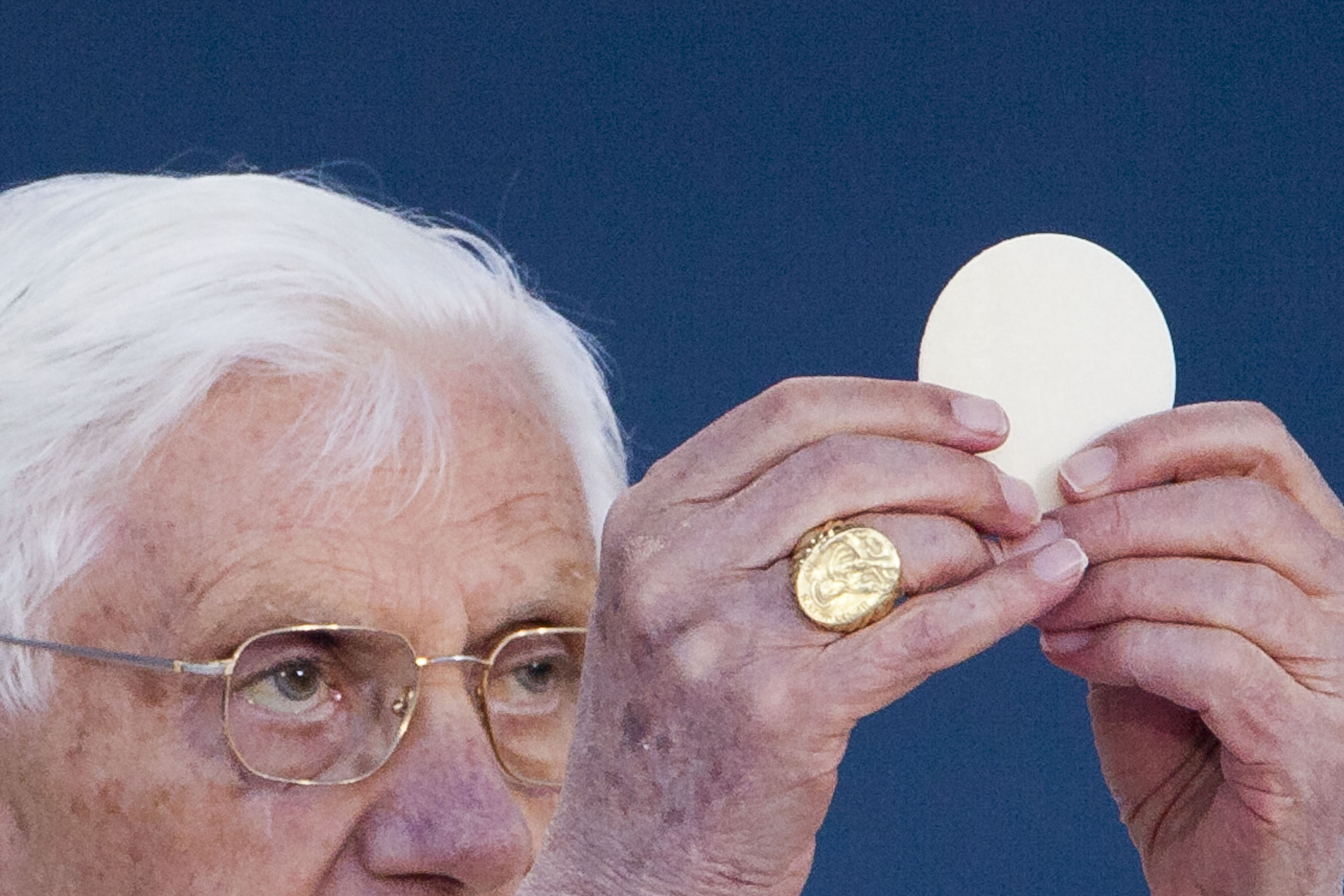
(Photo: Pope Benedict XVI leads morning mass at Domplatz square in front of the Erfurter Dom cathedral on September 24, 2011 in Erfurt, Germany. By Carsten Koall/Getty Images. My entire 1988 essay on Ratzinger is now online at The New Republic. )
The Genius Of Terry Colon

A reader writes:
Nice to see the updated cartoons! And it’s cool that Chris and Patrick have their own now, too. Who, praytell, is responsible for these, which really are an integral part of the Dish’s image?
He’s Terry Colon and has provided the Dish with our signature cartoons for many years. I love his mad-cap but meticulous style, the attention to detail, and his visual wit and concision. His homepage is here. And here’s that classic old Atlantic sketch with the mysterious red-headed women floating elegantly by.
Is Rubio The Frontrunner?
Enten is skeptical:
Rubio was … the seventh most conservative senator in the 112th Congress. His voting record puts him sandwiched between arch-conservatives Jim Inhofe and Ron Johnson. Very conservative nominees can win a party’s nomination, as did Barry Goldwater and Ronald Reagan. The issue for Rubio, though, is that these folks became nominees when the party had just recently been in the White House. When the party has been out for two terms or more, the nominees tend to be a lot more moderate – because the party wants to win and wants a centrist pick.

