Bittersweet Brokenness

[youtube http://www.youtube.com/watch?v=SVHYyrsW_Ok]

Commenting on the films of Wes Anderson, Michael Chabon reflects on the origins of the artistic impulse:

Everyone, sooner or later, gets a thorough schooling in brokenness. The question becomes: What to do with the pieces? Some people hunker down atop the local pile of ruins and make do, Bedouin tending their goats in the shade of shattered giants. Others set about breaking what remains of the world into bits ever smaller and more jagged, kicking through the rubble like kids running through piles of leaves. And some people, passing among the scattered pieces of that great overturned jigsaw puzzle, start to pick up a piece here, a piece there, with a vague yet irresistible notion that perhaps something might be done about putting the thing back together again.

Two difficulties with this latter scheme at once present themselves. First of all, we have only ever glimpsed, as if through half-closed lids, the picture on the lid of the jigsaw puzzle box. Second, no matter how diligent we have been about picking up pieces along the way, we will never have anywhere near enough of them to finish the job. The most we can hope to accomplish with our handful of salvaged bits—the bittersweet harvest of observation and experience—is to build a little world of our own.

Engineering A Bigger Crisis

Seth Baum worries that, in an attempt to geoengineer a solution to climate change, we may end up vulnerable to multiple global catastrophes happening at once:

[I]f we stop putting particles into the atmosphere, we get a very rapid temperature increase, until temperatures finally stabilize at where they would have been without the particles. This rapid temperature increase is many times faster than that of climate change alone and would be very damaging. ..

We’d be fools to impose that rapid temperature increase upon ourselves. However, if a big enough catastrophe occurred, then we could lose the capacity to continue the climate engineering. The catastrophe could be something like a major war or disease outbreak. If this causes society to stop climate engineering, then the rapid temperature increase would hit a population already very vulnerable from the initial catastrophe. The result is a double catastrophe that could be very devastating for humanity.

Return To Sender, Eventually

USPS

Sarah Kliff finds one place where the USPS excels:

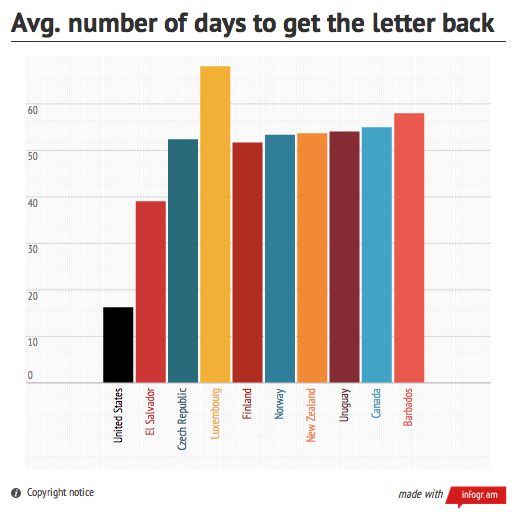
Researchers Alberto Chong, Rafael La Porta, Florencio Lopez-de-Silanes, and Andrei Shleifer sent letters to 10 fake addresses in 159 countries. The whole idea was to test government efficiency, by seeing how long it took to return the letters to the senders. All these countries, the researchers note, subscribe to an international postal convention (the Universal Postal Union, coordinated by the United Nations), which requires them to return letters they cannot deliver.

Not all are that great at it: Only 60 percent of the letters actually came back to the researchers. Among the countries that returned all 10 letters, the USPS was far and away the fastest to do so.

Spoilers Are Getting Harder To Avoid

Brian Stelter asks, “how can viewers who binged on all 13 episodes [of House Of Cards] in one sitting talk about the show without ruining the season for others who might wait weeks or months to watch it?” Joshua Gans ponders the dilemma:

This is actually the extreme manifestation of a problem that has been growing for decades. As I outlined in a paper presented last month at a BBC Workshop on the economics of broadcasting, there has always been a social component in the demand for television. It was strengthened because television was, in many ways, a non-storable good. But with time shifting and now on-demand, it can be stored. That is something many people want but the cost of that is that people watch television shows at different times. That means that it is harder to talk about those shows with your friends — which was a ‘water cooler’ benefit of watching television and coordinating viewing habits.

Astronaut Cuisine

Space Food

Amy Teitel examines it:

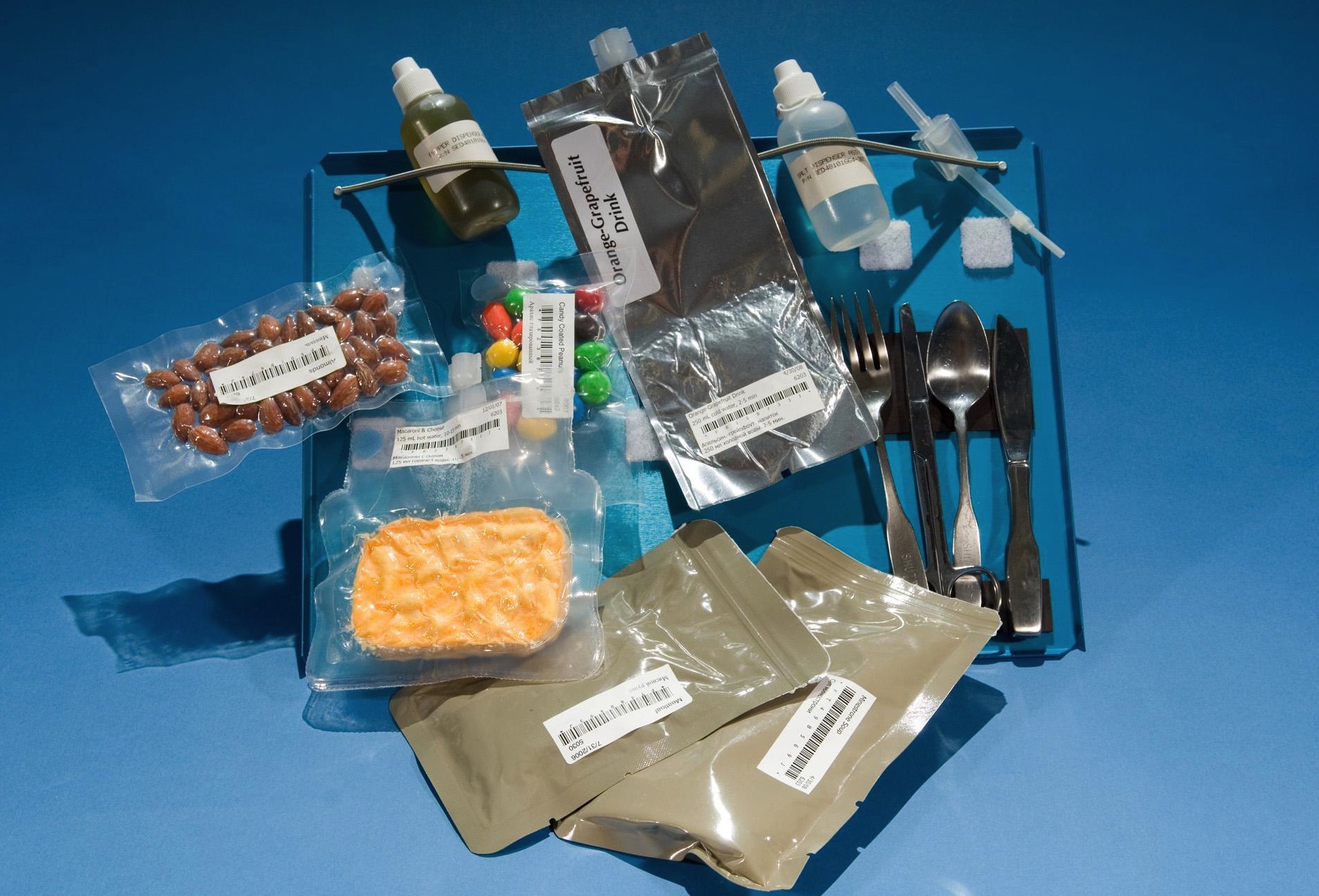
It turns out that a completely prepackaged menu is more than twice as heavy as the bioregenerative alternative, even with a significant fraction of the foods freeze-dried. The prepackaged diet was also found to have lower nutritional value; the light and heat used in sterilization does have some negative effects on the foods. But having food ready to eat does shorten the time crew have to devote to meals, freeing up more time for the things that burn calories like space walks.

(Image: Shuttle food tray from NASA.)

Will Robots Take Our Jobs?

Derek Thompson sees no reason to fixate on the question:

40 years from now, grappling with the fallout of an automated economy might be the most important economic issue of our time Today, however, worrying about robots taking over the economy feels more like an intellectual exercise. There’s no need for an artificial crisis over artificial intelligence.

Freddie’s perspective:

I’m mostly interested in these issues because they seem like a useful frame to discuss the long-term trend of less and less income going to labor, and in broader strokes, the way in which our society has become a massive machine for generating wealth for those at the top. I find the “income inequality” conversation to be frustrating on a variety of levels, in large part because it is so well worn. I’m trying to address how we think our society is supposed to function, and what happens when one of the basic planks starts to degrade. Contrary to Thompson and Yglesias, I don’t think it’s too early to think things through, even if these problems don’t start to affect us in mass in the near future. We have a habit of deciding problems are problems too late rather than too soon.

Previous Dish on the question here.

An Average Election

turnout

Waldman puts 2012’s turnout under the microscope:

Last year’s turnout was right in the middle of the 17 elections presented in this chart—better than eight, but worse than eight. It was a bit down from that of 2008, which at 61.6 percent was the highest since 1964. And it’s important to remember that there’s a huge variation in turnout among the separate states. The friendly and civic-minded people of Minnesota always have the nation’s highest turnout, and this year an admirable 75.7 percent of them came to the polls. At the other end, four states came in below 50 percent: Texas, Oklahoma, West Virginia, and Hawaii, bringing up the rear at 44 percent.

The Mail Subsidy

Yglesias asks whether “providing subsidized mail delivery to low-density areas is really a key national priority”:

Without the monopoly/universal service obligation, it’s not as if rural dwellers wouldn’t be able to get mail, it’s just that they might need to pay more in recognition of the fact that it’s inconvenient to provide delivery services to low-density areas. Nostalgia-drenched Paul Harvey Super Bowl ads aside, it’s not the case that rural Americans are unusually hard-pressed economically or are disproportionate contributors to the economy. They are, rather, the beneficiaries of numerous explicit and implicit subsidies, of which the Postal Service’s universal service obligation is one.

Mataconis is open to the idea:

There’s no economic rationale for this kind of policy. Indeed, it exists nowhere else almost nowhere else in the delivery business right now. If you want to send a package via USPS, you are generally going to pay based on where you’re sending it to. UPS prices its delivery services in much the same manner.

Previous Dish debating the USPS here and here.

The Daily Wrap

beagle

Today on the Dish, Andrew pondered how much longer America will trail her fellow democracies in delivering marriage equality and insisted that only fairness and equality will solve the Boy Scouts’ problems. He kept watch on the anti-prohibition bills in Congress, logged another day of self-sabotage for the right-wing media-industrial complex, and fired back at critics of the supposed oppressive regimes of Pret A Manger and TGI Friday’s. Elsewhere, Andrew mused on the life and legend of Shakespeare’s nastiest hero and England’s most infamous monarch, talked Catholics and conscience in today’s episode of Hitch & Sully, and explored the potential of television to blend further with independent projects found online.

In home news, he placed the Dish in the sweet spot between old and new media, updated readers on the first week of our independence, and continued to broadcast reader feedback on matters from the layout to potential merchandise.

On the political beat, Bouie disputed the openness of Silicon Valley, Brooklyn College’s chair of polisci gave his take on the BDS uproar, and Shafer brainstormed who might’ve slipped the DOJ white paper to the press. We discovered how far the government traveled to outsource torture, Nate Rawlings tallied up the bill for shipping our military gear back from Afghanistan, and Evan Osnos tracked the miscarriage of justice for China’s battered women.

While Catherine Rampell tried to pinpoint what kind of worker could take a hit from increased immigration, Michael Clemens argued that any reform hinges on making immigrants easier to hire in the first place, and Laura Entis nudged at the boundaries of the 8-hour work day. Meanwhile, Yglesias proposed a congestion charge for the metropolis, , Ambers assessed Hillary as quietly poised to pounce, and libertarians in Idaho tried to assign their state some dreary reading.

In assorted coverage, Jon Brodkin debunked the rumors of the coming universal Wifi-paradise while we learned how to send a text built to self-destruct, and wondered if e-cigs will lead to e-joints. America’s young readers discovered the fruits of curiosity as we found out what it’s like to proofread a genius. Aaron Carroll reexamined what makes healthy weight loss, Eric Zorn spotted the unique pitch of the ad-free Dish, and Reid Mitenbuler reported the life of Frederic Tudor, who kept the world chill as modernity took hold. Watched the sun set in Bigfork, Minnesota for the VFYW measured climate change on the skating rink and spun a hardcore record for the MHB.

–B.J.