Two new pieces of legislation were filed yesterday that seek to bring federal enforcement in line with public opinion on marijuana policy. Erik Altieri details the proposals. Meanwhile, legislators in Washington state are considering expunging past possession offenses “up to 40 grams”. That liberates a whole group of people to get a job again, or a mortgage or a college loan. Removing these impediments could help integrate these people back into the economy, with some impact on employment and growth.
Who Leaked The Assassination Memo?
Shafer wonders:
Washington often leaks in directions to further stoke policy fires that are already burning. (See this taxonomy of leaks compiled by Stephen Hess.) Such a Washington fire has been burning for many months, with Congress demanding that the Obama administration explain its targeted killings of U.S. citizens. Yesterday, before the Isikoff story broke, 11 senators sent the president a formal request that any and all legal opinions devised by the White House about the targeting of citizens be forwarded to the Judiciary and Intelligence Committees.
This request makes the senators, or members of their staffs, prime suspects of the leak.
Reax to the memo here. Mine is forthcoming.
The Facts On Fat
[youtube http://www.youtube.com/watch?v=9YsP7mb5R4c]
A new study forced Aaron Carroll to reconsider his understanding of obesity and weight loss:
My family loves watching “The Biggest Loser.” But I’ve found myself telling my kids again and again that what’s shown on TV isn’t the best way to lose weight. I tell them that slow and steady works better in the long-run than rapid weight loss. I also tell them that setting unrealistic weight goals can actually sabotage your efforts.
So imagine my shock to discover that what evidence exists in this new study hints towards ambitious goals being a good thing, and that quicker weight loss isn’t less likely to be kept off in the long-term.
Happy Meals, Ctd
Timothy Noah and Vaughan Bell recently debated the “emotional labor” of food service. Sarah Jaffe believes women have it worst since they’re expected not only to smile, but flirt and tease:
I spent years as a waitress—in high school, then college, then as a struggling freelance writer—in that time I received pats on the ass, scribbled phone numbers in lieu of tips, and many, many personal questions I’d have preferred not to answer. Requiring feigned intimacy on the part of the worker allows the customer to ignore normal boundaries and pretend that a smile is an invitation to cross. Like the Pret workers, one of my bosses hired secret shoppers to make sure that servers went the extra mile; we were downgraded for not thanking our customers by the names we mispronounced off their credit cards. Not only our tips—which were our livelihoods, seeing as we only made $2.13 an hour, the legal minimum for tipped restaurant workers that hasn’t changed in 22 years—but our jobs were at stake if we didn’t smile hard enough.
A reader adds:
I read this about an hour after my performance review at work.
Included in the review is an anonymous survey of my co-workers.
I scored 100% “excellent” or “good” in the category of “Courteous.”
“Well,” I said to my boss, “I’m glad to see I’m not rude to people!”
“You’d be surprised,” he said.
Now, I am a university technology analyst. I have near zero customer interaction in the regular course of business. There are times when I want to scream epithets at my co-workers for their demands, expectations, and requests. But I have this notion that “well served” is how I want people to feel when working with me, and that this is likely highly correlated with my future employment and success here. So I keep the epithets to myself.
Is this really all that much to ask at the sandwich shop?
I don’t really see why not. And, as all fans of Fawlty Towers know, you can always go to Britain if you want freedom from the oppression of being nice to customers:
Taxing Traffic Jams
Yglesias takes seriously the dilemma of traffic in America’s biggest cities and the potential rewards of solving the problem:
Naturally an underpriced valuable commodity leads to overconsumption. Traffic jams, in other words. Every once in a while Ben & Jerry’s holds a “Free Cone Day” that invariably leads to long lines. Roadways in dynamic metro areas are basically holding Free Cone Day five days a week. Charge people enough money to eliminate routine congestion and you’ll find yourself with fewer traffic jams and an enormous pool of revenue that can be used to maintain your basic infrastructure and upgrade your bus service.
The Geography Of Torture
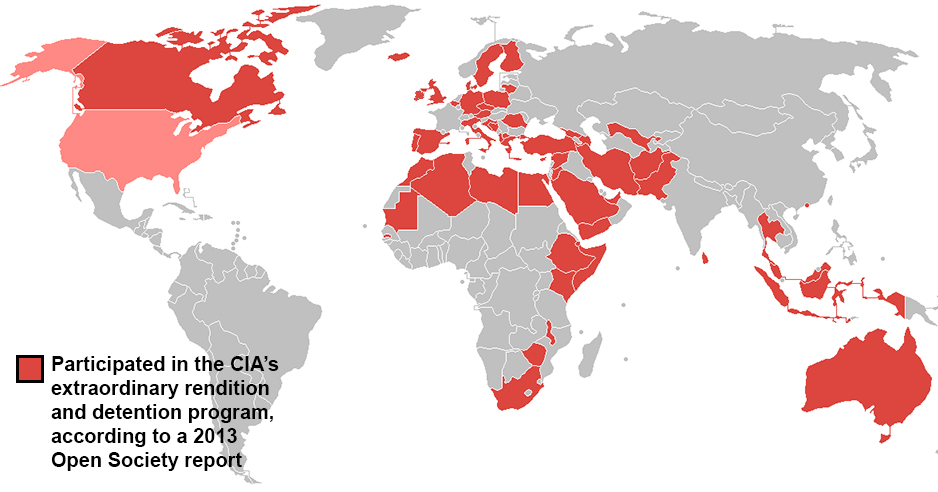
Ackerman summarizes a new report (pdf) on America’s rendition program:
A new report from the Open Society Foundation details the CIA’s effort to outsource torture since 9/11 in excruciating detail. Known as “extraordinary rendition,” the practice concerns taking detainees to and from U.S. custody without a legal process — think of it like an off-the-books extradition — and often entailed handing detainees over to countries that practiced torture. The Open Society Foundation found that 136 people went through the post-9/11 extraordinary rendition, and 54 countries were complicit in it.
Max Fisher’s map of all of participating countries is above. He is particularly disturbed by the section on Syria:
According to a 2005 article by the New Yorker’s Jane Mayer, quoted in the report, Syria was one of the “most common destinations for rendered suspects.” Government forces, according to the report, held some U.S.-provided detainees in a prison known as “The Grave” for its coffin-sized cells and subjected them to “torture involving a chair frame used to stretch the spine (the ‘German chair’) and beatings.”
Universal Free Wi-Fi?
Derek Mead gets excited about a new proposal from the Federal Communications Commission:
Internet access is an essential need on par with education access, but at what point do regulators recognize that? When will government officials acknowledge that widespread, guaranteed access is essential to fostering growth in the country? Somewhat surprisingly, that time is now, as the FCC is now calling for nationwide free wi-fi networks to be opened up to the public.
Jon Brodkin throws cold water, noting that this is “just the White Spaces proposal that’s been around for a few years”:
White Spaces takes the spectrum from empty TV channels and allows the airwaves to be used for Wi-Fi, or “Super Wi-Fi” as it’s sometimes called. Using lower frequencies than traditional Wi-Fi, White Spaces signals would be better at penetrating obstacles and thus travel farther. But the FCC isn’t going to build the network itself. The agency allocates spectrum for certain uses to spur private investment—someone else will have to find a reason to build it. … Free Wi-Fi everywhere you go? Keep dreaming, you crazy dreamers.
What’s The Answer To Unauthorized Immigration?

Michael Clemens declares that any “immigration reform proposal serious about reducing unauthorized immigration must focus on creating tools for U.S. business.” He thinks past reforms haven’t helped:
Today’s H-2A visa for seasonal agricultural work is a good example. It is so cumbersome and expensive to use that the vast majority of American farmers—who depend critically on migrant labor—refuse to use it. The program doesn’t help farmers get the labor they need, doesn’t help connect them to workers by facilitating recruitment; it exclusively puts up costly barriers for farmers to fight through in order to access legal migrant labor.
If you’re concerned about the phenomenon of unauthorized immigration or the plight of unauthorized immigrants, pay less attention to the path-to-citizenship. Keep one question foremost in your mind as you read the forthcoming details of the Senators’ and president’s proposals: What are they offering U.S. farmers to get the labor they need without going under? What are they offering U.S. parents to get the childcare they need without breaking the bank? These are the provisions that will shape unauthorized immigration for tomorrow’s America.
(Map from (pdf) the Congressional Research Service. Hat tip: Gillespie)
“The Ice King”
Reid Mitenbuler profiles Frederic Tudor, the entrepreneurial genius who brought refrigeration to the masses:
Tudor’s most ambitious plan came in 1833, when he set out to deliver ice to Calcutta, a voyage of 14,000 miles that involved crossing the equator twice. Tudor and his investors wondered if the ice would even sell. But his extraordinary profits answered that question. Until that time, residents had been importing slush from the mountains for the few weeks during the year when it was available. The prospect of a steady supply of Tudor’s clear, solid blocks prompted English residents in the city to throw parties serving claret and beer chilled with his New England ice. The India Gazette thanked him for making “this luxury accessible, by its abundance and cheapness.”
The Daily Wrap
Today on the Dish, Andrew challenged the president on his weak rhetoric on tax reform, sounded off on the DOJ white paper justifying extra-judicial killing, and took a closer look at what made ACT UP more than agitprop. He fumed at the Church’s ongoing sabotage of justice, vowed to stay diligent about the GOP’s schemes to skewer representative government, and sampled Washington’s reactions to the ACA’s new conciliation on contraception. Elsewhere, Andrew marked the passage of marriage equality in Britain’s House of Commons on contraception, spoke up in defense of America’s smiley service, despite Tim Noah’s objections, endorsed the e-cig counterculture.
Finally, Andrew, introduced readers to Patrick and Chris, the tireless stewards of the Dish, and took on readers’ praise and critique of the new, independent site before unveiling the transcript of an unreleased podcast with his old friend Christopher Hitchens.
In political coverage, Yglesias tried to steer us between overregulation and underregulation, Paul Campos warned of the oncoming higher-ed bubble, and Waldman honed in on the crucial steps toward gun control. Larison anticipated the GOP’s inadequate stand against Hagel’s confirmation while Mick Mulvaney struck a blow for fiscal sanity within the GOP. Corey Robin applauded the admin of Brooklyn College for hosting a BDS event, James Surowiecki spotted serious revenue in lifting the ban on sports gambling, and Fox News let Dick Morris back into the wild.
In assorted news and views, we wondered whether Netflix’s original series will incite a revolution in home entertainment, Andrew Leonard pointed out the company’s ever-expanding view into your personal tastes, and Ryan McGee requested smaller TV portions in general. Ann Friedman outlined her taxonomy of trolls, Maia Szalavitz spotted a drug for when you’ve had too much drugs, and Steve Benen caught the bright side of the Superbowl blackout.
Travis Waldron joined the mounting case against the football industry, Alyssa Rosenberg asked Alex Gibney what the Catholic Church’s crimes reveal about insulated institutions in general, and Michael Signorelli spotlighted St. Francis’s interaction with and toleration of Islam. We felt the breeze in Tucson, Arizona, watched a hitchhiker’s guide to heroism, and gawked as Gangham style leapt from the page in the MHB. Later, we dropped by a heavily-bearded Viking jamboree in the Face of the Day and followed the breadcrumbs to Sinzig, Germany in today’s VFYW contest (whose spinoff game you can now enjoy any time).
–B.J.

