ISIS On The Rio Grande?

Musa al-Gharbi argues that Mexico’s drug cartels are in every last respect more violent and dangerous than the Islamic State, from their body count (16,000 killed last year) to their use of child soldiers, kidnapping, torture, rape, and slavery:

Some may argue that despite the asymmetries, the cartels are less of a threat than ISIL because ISIL is unified around an ideology, which is antithetical to the prevailing international order, while the cartels are concerned primarily with money. This is not true.

A good deal of the cartels’ violence is perpetrated ritualistically as part of their religion, which is centered, quite literally, on the worship of death. The narcos build and support churches all across Mexico to perpetuate their eschatology. One of the cartels, the Knights Templar (whose name evokes religious warfare), even boasts about its leader’s death and resurrection. When cartel members are killed, they are buried in lavish mausoleums, regarded as martyrs and commemorated in popular songs glorifying their exploits in all their brutality. Many of their members view the “martyrs” as heroes who died resisting an international order that exploits Latin America and fighting the feckless governments that enable it. The cartels see their role as compensating for state failures in governance. The narco gospel, which derives from Catholicism, is swiftly making inroads in the United States and Central America.

In short, the cartels’ ideological disposition is no less pronounced than ISIL’s, if not worse.

The Swedes On Beards

Another headline I’ve always wanted to write. The winner of Sweden’s Best Beard contest is a construction worker, with a simple, lush and beautiful beard. Yes, they appear to be pandering at this point:

Screen Shot 2014-10-28 at 3.14.09 PMKristofer Larsson didn’t grow his facial hair as a fashion statement, rather he was too busy to shave while he was renovating his family home. But the carpenter from Varberg in west Sweden decided to take part in a national contest to find Sweden’s best beard, with the final held at the Victoria Theatre in Malmö over the weekend.

An audience of around 150 people voted for him to pick up the prize, after he was shortlisted by an expert jury of beard watchers.   The two runners up in the competition both had neatly clipped beards, but spectators opted for Larsson’s wild whiskers.

Wild? Now compare that with the winners of many other Western beard contests. Many readers send pictures of the finalists for a Beard Of The Week mention, and I have yet to find a single one that makes the cut. They’re way too grotesque and over-the-top to be taken seriously as beards. Twisted into pretzels, or grown to absurd lengths, or turned into sculptures, they’re unrecognizable as beards any sane man would grow or any sane woman or gay man might admire. Mr Larsson? Au contraire. The Swedes are better at everything, aren’t they?

(Photo: taken by Larsson’s boss, the wonderfully named Pontus Flatum)

Editorial Selection By Algorithm

Ravi Somaiya delves into Facebook’s impact on journalism:

The social media company is increasingly becoming to the news business what Amazon is to book publishing — a behemoth that provides access to hundreds of millions of consumers and wields enormous power. About 30 percent of adults in the United States get their news on Facebook, according to a study from the Pew Research Center. The fortunes of a news site, in short, can rise or fall depending on how it performs in Facebook’s News Feed. …

The shift raises questions about the ability of computers to curate news, a role traditionally played by editors. It also has broader implications for the way people consume information, and thus how they see the world.

Jay Rosen challenges some of Facebook’s assertions about its news feed:

It’s not us exercising judgment, it’s you. We’re not the editors, you are. If this is what Facebook is saying — and I think it’s a fair summary of [Facebook engineer Greg] Marra’s comments to the New York Times — the statement is a lie.

I say a lie, not just an untruth, because anyone who works day-to-day on the code for News Feed knows how much judgment goes into it. It simply isn’t true that an algorithmic filter can be designed to remove the designers from the equation. It’s an assertion that melts on contact. No one smart enough to work at Facebook could believe it. And I’m not sure why it’s sitting there unchallenged in a New York Times story. For that doesn’t even rise to the level of “he said, she said.” It’s just: he said, poof!

Now, if Greg Marra and his team want to make the point that in perfecting their algorithm they’re not trying to pick the day’s most important stories and feature them in the News Feed, the way an old fashioned front page or home page editor would, and so in that sense they are not really “editors” and don’t think in journalistic terms, fine, okay, that’s a defensible point. But don’t try to suggest that the power has thereby shifted to the users, and the designers are just channeling your choices. (If I’m the editor of my News Feed, where are my controls?)

Is Education The Enemy Of Religion?

A recent paper found that “that one additional year of schooling in Europe was associated with a 10 percent reduction in the propensity to attend religious services once a week or more.” But the bigger picture is more complicated:

Globally, we’ve seen a massive rise in education, without a uniform change in religious beliefs. In 1970, only about 40 percent of children worldwide enrolled in secondary education; four decades later, the rate had climbed to 73 percent. In developing nations, the increases have been substantial: In sub-Saharan Africa, enrollment rates have grown from 13 percent to 41 percent. In Pakistan, the average adult has had five years of schooling, up from a little over one year in 1960, and in Nigeria the same numbers are 7.5 years, up from 2.4. (The average American adult has 13 years.) If Mocan and Pogorelova’s results held worldwide, this massive rise in education would suggest a cratering in global religious practice.

The available evidence tells a different story.

According to the latest wave of World Values Surveys, 24 out of 42 countries have seen an increasing proportion of people who say religion is important in life. Four have seen the percentage unchanged, and 14 countries have seen it decline. In the countries where it’s declining, the starting points are radically different. The U.S. dropped from 56 percent in the 1990s to 40 percent now, whereas in Iraq, the proportion has dropped to 85 percent, down from 94 percent in the late ’90s. Overall, though, the world is becoming more godly, at least according to this measure of religious adherence.

So what makes Europe different?

[M]aybe you need to go all the way through secondary school to come out a skeptic, and most emerging markets haven’t reached that point yet. A simpler explanation might be that most children in Africa and Asia aren’t learning potentially threatening theories like evolution at school.

Boko Haram Hostages Speak Out

Former abductees tell their stories to Human Rights Watch:

Adam Taylor describes the disturbing findings:

What is life like for the women and girls held captive by Boko Haram? That’s one question Human Rights Watch (HRW) attempted to answer with a new video, in which international nongovernmental organization interviewed a number of people who had been kidnapped by Boko Haram and later released or escaped. In the video, girls detail how they were forced to convert and marry and, in some cases, were raped. In one particularly horrifying account, a young woman describes how she was forced to go on operations with the insurgents and carry their ammunition; she says she considered grabbing a gun and using it to kill herself.

HRW’s video comes as part of a wider 63-page report, “Those Terrible Weeks in their Camp,” which examines the Boko Haram kidnappings and the Nigerian government response to it. HRW reports that the extremist group has kidnapped more than 500 women and girls since 2009.

Charlotte Alter elaborates on the revelations that pertain to sexual assault:

According to the interviews in the report, Boko Haram does not consider any girls too young for marriage. After one 17-year old prisoner complained that she was not yet old enough to marry a Boko Haram commander pointed to his 5-year-old daughter and said, “If she got married last year, and is just waiting till puberty for its consummation, how can you at your age be too young to marry?”

Recent Dish on Boko Haram here.

Flavorful Highs

Jacob Sullum defends them:

Although flavored e-cigarettes and marijuana edibles are intended for adults, appeal to adults, and can be legally sold only to adults, the prohibitionists argue that they cannot be tolerated because they also appeal to minors. The same rationale has been offered for bans on flavored tobacco products and sweet malt beverages. This argument, although couched in the language of moderate and sensible regulation, should be a non-starter in a free society, because it reduces adults to the level of children.

And flavored e-cigs make quitting real cigarettes easier:

Two-thirds of the ex-smokers in the E-Cigarette Forum survey said nontobacco flavors were important in helping them quit. Survey data reported in the International Journal of Environmental Research and Public Health last December likewise indicate that flavor variety is important in quitting. That study, which involved about 4,500 vapers, found that they tended to prefer tobacco-flavored fluid initially but later switched to other flavors. Most reported using more than one flavor on a daily basis and said the variety made the experience more interesting and enjoyable.

The Best Of The Dish Today

The Dish’s favorite pet photographer has a new book out – and a puppy time-lapse to plug it:

It’s the kind of advertizing done right. I’m sorry that these end-of-the-day musings keep referring to the collapse of ethical journalism, but, hey, how can you ignore a story like this on CNN’s blatant conflict of interest in running puff pieces (with no disclosure) on the Hamad International Airport in Doha. Seriously, this is a textbook case of buying favorable coverage.

Today, you might have skipped past our latest installment of the Book Club discussion of Sam Harris’ Waking Up. It’s well worth a visit. There’s some serious, vital stuff in there. One reader was struck to the core:

To my fellow reader who wrote in describing his experience with no-self:

Oh, my friend, thank you. I’ve too have had periods of this no-self experience over the past few years.  The experience is notoriously impossible to describe, and I don’t even try.  You’ve captured it perfectly and in such concrete and simple language.  Many of the great mystics have not done as well.  I have just one friend I who knows this happens to me, and I never reveal it to anyone else.  Though I am a devoted church-goer it’s not something I would ever try and explain to anyone there.  I’ve wondered if this experience is more common than I think it is, and wondered if there could be others I could talk with about this.  I’m so glad to know you are out there.

And in response to those trying to decide whether the self exists and to locate the no-self experience in biology, divine transcendence, or some other phenomenon: Why does it matter where the experience of no-self comes from and whether the self exists or not?  I certainly don’t know.  I know the experience of “no-self” exists and that it changes who I am in the world for the better in an exponential way. I’m a church-goer, and I don’t care if there is a God or not.  That is not the most interesting question. The interesting question is how does one place oneself to make the no-self experience more likely, and when no-self does visit, what response shall I offer?

Thank you my friends at the Dish.  Politics, poetry and mysticism all in the same blog.  Bliss.

Elsewhere today, we covered the fascinating and horrifying Ebola epidemic: Christie’s still a dick; the case for an asterisk on the assurances that it won’t break out in America; and the CDC’s new, tighter guidelines for quarantining. I noticed the Pope’s impact on America’s culture war; and re-visited the enduring, exploded myths of the Matthew Shepard murder.

Plus: a remixed Ghostbuster video for Halloween week; Freddie DeBoer’s worries about micro-aggressions in the academy; and the most powerful case yet for doing absolutely nothing in Syria and Iraq.

The most popular post of the day was A Declaration of War on Francis; followed by The End of Gamer Culture?

Many of today’s posts were updated with your emails – read them all here.  You can always leave your unfiltered comments at our Facebook page and @sullydish. 22 more readers became subscribers today. You can join them here – and get access to all the readons and Deep Dish – for a little as $1.99 month. Gift subscriptions are available here. Dish t-shirts are for sale here, including the new “Know Dope” shirts, which are detailed here. One final reader for the day “surrenders” over the Book Club discussion:

Okay, okay: I finally caved, and bought Sam Harris’s book.

See you in the morning.

Liberty’s Biggest Billboard

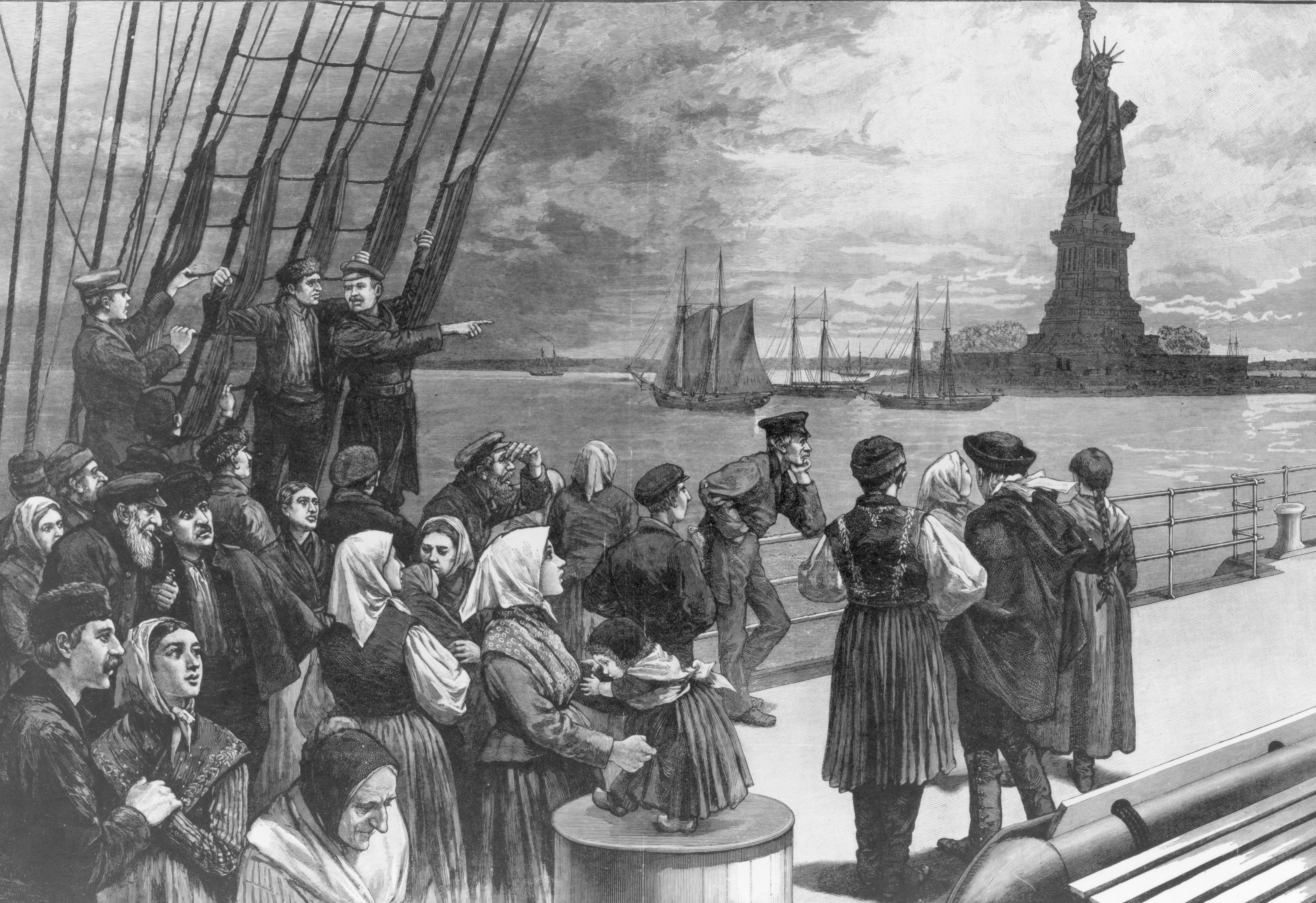
Immigrants View The Statue Of Liberty

The author of Liberty’s Torch: The Great Adventure to Build the Statue of Liberty, Elizabeth Mitchell, celebrates the statue’s 128th birthday, which is today:

[W]hat Bartholdi did back in 1871 when he first came to pitch his idea to America was make Bedloe’s Island, a former oyster bed, home to America’s core promise. If the nation were indeed founded on Life, Liberty, and the Pursuit of Happiness, let America be “pinged” on that notion every day. Passersby, not limited by demographics, would see her. The statue would be called by a title that induced a mantra: Liberty Enlightening the World, shortened down to “The Statue of Liberty.” People would be forced to say the word “Liberty” on a regular basis. Bartholdi would lose his own fame but that word, “Liberty,” would echo on, from every tour bus operator, from every child pointing out a car window, from every mind that glimpsed the iconic image on billboards or print ads.

But this Friday, as Mark Duffy notes, the statue is becoming an ad itself:

New York City’s most beloved Lady is going is to be selling bow ties on Halloween. For the record: Lady Liberty has been used to shill many, many things. India’s Jet Airways even put a bindi on her. But using her to sell bow ties is just fucking stupid. First of all, women don’t wear bow ties. And secondly, they don’t go with robes.

Nick Graham, founder of the Joe Boxer company, isn’t just going to use a representation of her: he is going to use the actual statue to help hawk his new line of bow ties. He supposedly is going to do this by hovering 60-foot [18m], 35-pound [16kg] bow ties in front of the lady via helicopter on Halloween morning.

Ugh.

(Photo: Illustration of a group of immigrants on the steerage deck of a steamship viewing the Statue of Liberty as they arrive in New York Harbor, circa 1887. By FPG/Getty Images)

An ISIS-Guided Tour Of Kobani

In a video, released last night, ISIS prisoner John Cantlie “reports” from Kobani, the northern Syrian Kurdish town that has been under siege by the militants for over a month, purporting to debunk the Western media narrative about the battle while promulgating ISIS’s own version of the story. “Perhaps what’s most odd about the video,” Adam Taylor comments, “is how much it apes the Western media it criticizes”:

The video begins with a logo “Inside ‘Ayn al Islam’ ” (a reference to what the Islamic State calls Kobane) and makes use of a number of relatively sophisticated graphics throughout. Cantlie, who may have been speaking under duress, brings to mind BBC correspondents in his presentation. The Islamic State also uses the video to give its cynical version of recent events, notably suggesting that “good old John Kerry” has been criticizing “Kurd-hating Turkish President Erdogan.” Cantlie also makes reference to the cost of American airstrikes in Kobane (“almost half a billion dollars in total”) and a U.S. airdrop that accidentally landed in the hands of the Islamic State. “The mujahideen is now being resupplied, by the hopeless U.S. Air Force, who parachuted two crates of weapons and ammunition straight into the outstretched arms of the mujahideen,” he says.

This new video is very different from previous propaganda items featuring Cantlie, which have shown him in prison garb, discussing his captivity. Jamie Dettmer wonders what’s up with that:

In the “Lend Me Your Ears” series, the British freelance photojournalist emphasizes that he is a prisoner of the Islamic State, widely known as ISIS or ISIL, and doesn’t know whether he will live or die. But in Monday night’s five-and-a-half minute clip, titled “Inside Ayn al-Islam” (the Arabic name for Kobani is Ayn al-Arab), the 43-year-old Cantlie makes no reference to his captivity, raising questions about whether he has crossed the line and is now a willing propagandist for the jihadists behind the camera.

Dan Murphy cautions us not to make too much of it, partly in order to avoid handing ISIS a propaganda victory:

Not that IS will care, but using captives as a propaganda prop – terrorized by the murder of fellow captives and the threat to their own lives – is a clear violation of the Geneva Conventions. To be sure, this crime seems minor when held up against their executions of helpless captives, enslaving of women and children for sexual and other purposes, and their stated goal of wiping out everyone on the planet who doesn’t practice their particular version of Islam. But the press needs to walk a careful line in not uncritically broadcasting the group’s propaganda, effectively rewarding them for their abuse of Cantlie.