Egg-Freezing On The Company Dime, Ctd

A few readers comment on the thread:

Actually, I would agree with McArdle (not something I usually do) about the waning energy of middle-aged parents. My wife had our two lovely daughters (now 4 and 20 months) by the age of 33. And they tire her out as it is. However, being nine years older than wife, these kids can devastate me! My wife and I are both professionals, so we have always traditionally split the household duties 50/50. But she is currently finishing her PhD thesis, which means I’ve taken on the lion’s share of the household work and raising the kids, and I can tell you that my mid-40s body/energy level is just barely up to the task. She left me in charge for a week while she was in Germany for an academic meeting; while I kept everything running well, I was also exhausted and in bed most of those night by 9PM!

Raising kids is something that is really meant for your 20s and early 30s, when your energy is less restricted. If companies really want to support working parents (because I think running a household should be split between the responsible adults), there are a raft of other family-friendly policies that could be looked at.

But another reader praises the egg-freezing policy:

So, I’m 41. I froze my eggs one week ago. I don’t have a partner, I’m still hoping to meet someone I actually want to be with, and I don’t particularly want to be a single parent, but family is hugely important to me and don’t want to regret never having children. I hadn’t really thought much about egg freezing, but then I went to my ob/gyn over the summer, and she recommended that I go see a fertility doctor and see what my options are. So I did.

I thought the doctor was going tell me it was now or never, that it was too late to freeze my eggs. But it turned out my hormone levels looked fine, and he said he thought it was a good option for me.  He also said realistically, I should start thinking about getting pregnant in the next year or two. In other words, he wasn’t advising me to put off childbearing indefinitely, but he was sympathetic to helping me create a solution in the present while I try to solve more complex issues in the coming months and years.

And then it all went down really quickly. Period, tests, shots, retrieval. Voila! 10 frozen eggs. And you know what? It feels really good. It’s possible none of those eggs will be viable when/if I eventually try to use them – there are no guarantees – but it makes me feel like I took some kind of positive action in the face of circumstances I can’t control.

So I say good for Facebook and Google. They are encouraging their employees to think about their fertility now and, quite possibly, helping them preserve their potential for children before they think about it too late, and it’s too late. I just don’t believe that freezing eggs makes a woman who has a career think any differently about her timeline for having a baby. Most women I know who are in healthy relationships, even those who are killing it professionally, end up wanting a family by their mid- to late-30s (assuming they wanted children in the first place). So egg-freezing isn’t about obsessive, type-A women putting off babies indefinitely; it’s about protecting against infertility issues, which can crop up even in one’s thirties, being honest about the challenging realities of finding a partner, and enabling women to be smarter about their relationships (rather than making a mad, desperate scramble for some man! any man! as they see their fertility window closing).

All of which makes me feel that the pushback against egg freezing is all part of the same alarmist hysteria that springs up around anything ever that has let women have say over when and how they have babies. You have too much sex! You have too little sex! You had a baby too young! You had a baby too late! You had a baby as a single mother! You had a baby with a partner but aren’t modeling a healthy relationship and/or got divorced! You didn’t have a baby at all! Witches, burn them all!

There’s no downside to women taking control of their fertility.

Kobani: A Battle In Multiples Wars

Screen Shot 2014-10-21 at 11.41.05 AM

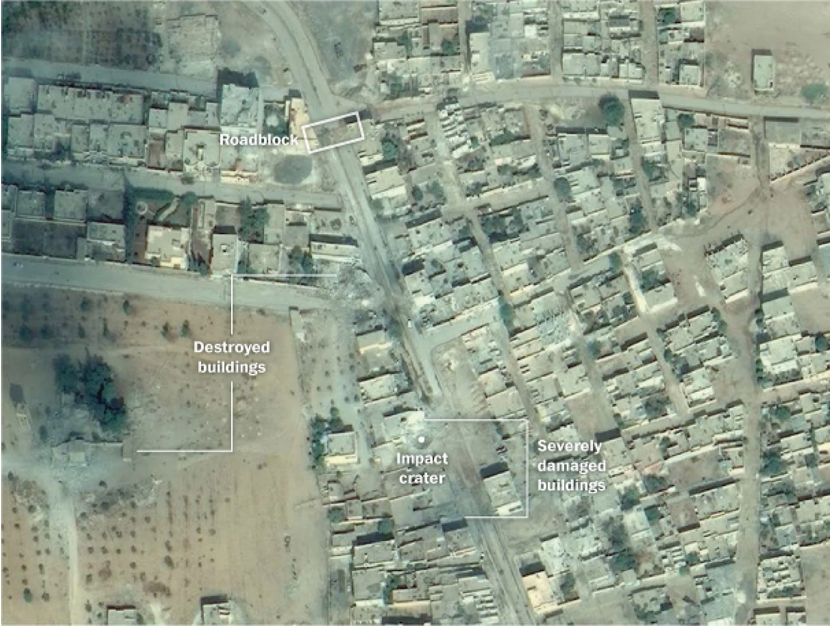
Despite recent gains by Kurdish fighters in and around Kobani, aided by the delivery of small arms and other supplies yesterday, Kiran Nazish reports that the situation in the area remains tenuous:

Firas Kharaba, the leader of a Kurdish group, has been coordinating and managing the return of many wounded fighters from Kobani into Turkey. With the help of spies that, he says, infiltrated ISIS, “we found the power hub. … After the U.S. hit that building, they [ISIS] suffered a full blow.” More than 30 top fighters and commanders were killed, he said. Recently the Islamic State has been bringing in new fighters, but many of themaccording to Firas’s sourcesare not professionally trained fighters, but mere managers, organizers, and account keepers, with little experience in the battle field.

The main concern for YPG fighters now, is their on-the-ground force. What they need even more than manpower, says Kobani government official Idris Nassan, are “weapons on the ground.”

U.S. intelligence has assisted them, says Nassan, but it is not a substitute for weaponry and ammunition. Despite this weekend’s air drop, “the coalition is not ready to send weapons on the ground,” says Tarek Doglu, a foreign affairs analyst based in Ankara. “No one wants to intervene the matters between Turkey and PKK. That is the basic complexity.”

Dettmer talks to some of the town’s few remaining doctors, who paint a harrowing picture of the humanitarian conditions:

Dr. Kurdo Abdi, gave me a first-hand account of the extraordinary demands that have been placed on the 15 doctors and nurses who remained in Kobani throughout the siege. They have struggled to provide rudimentary care for wounded fighters and civilians while dodging bombs, rockets and bullets. “The main hospital was destroyed ten days ago by rockets,” says Abdi. The ISIS militants bombed the hospital on purpose. “Since then we have been treating people in makeshift clinics in different parts of Kobani, mainly in apartments. We have very little medicines. We got a few re-supplies from some fighters and civilians who smuggled it across the border, but very little. The situation is very bad.”

ISIS’s recent retreat, he adds, has been oversold in the press:

Despite widespread media reports that the Islamic militants have left the town and are now just on the outskirts, that is not accurate. Both doctors say the jihadists have been pushed back on the West of the town but they are still inside parts of the center and that there is street fighting in the east and south.

Yusuf Sayman defends Turkey’s actions, pointing to its massive refugee relief effort, and laments that “refugees running from the war in Syria are stuck in the political war in Turkey”, between the government and Kurdish activists:

While the Turkish government wants to play the good guys by helping the refugees, the opposition — including the HDP, Turkey’s pro-Kurdish party — refuses to allow them to reap the political benefits of this goodwill gesture. Some refugees now stay in camps run by the office of Suruc’s mayor, who is from the HDP, which act as a sort of Kurdish counterpoint to the camps run by AFAD [the Turkish government’s humanitarian relief agency].

Thus, the refugees find themselves on the front line in a propaganda battle. Hazal, a 24-year-old activist from Kobani volunteering as a health worker, speaks negatively about life in the HDP camps: She says their sanitary conditions are very bad, water-borne illnesses are widespread, and there is constant YPG propaganda. People are forced to refer to each other as “heval,” or comrade — a term used by both PKK and YPG fighters. She even recalls a YPG member telling her, “If you visit your relatives staying in the AFAD camp, we will consider you a traitor.”

Intra-Kurdish politics, Hannes Cerny observes, add another dimension of complexity:

[President of Iraq’s Kurdistan Regional Government Massoud] Barzani is playing a long game, as he benefited for years from his status as the main Kurdish leader that the West could do business with. Dialogue now between the U.S. and the PYD/YPG threatens his position; the YPG could even become as indispensable in the war against IS in Syria as Barzani’s peshmerga are in Iraq. Furthermore, if the PYD holds off IS in Kobani and becomes the West’s new Syria partner in the process, it would strengthen the form of local autonomy that the PYD has been exercising in northeastern Syria over the past two years. This political model, an anarchist communalism of Kurdish confederations, poses a direct ideological challenge to the KRG.

(Image: a UN satellite photo shows details of the street fights between Islamic State militants and Kurdish fighters in Kobani. Via Rick Noack.)

What Catholics Really Believe

As we enter a year of debate and discussion about the family in Catholic teaching, it’s obvious, thanks to Pope Francis’ skillful airing of the divides, that there is no consensus on the issues of treating the divorced or single parents or homosexuals, and a majority of bishops in favor of the status quo. But it’s worth noting at the same time what American Catholics actually believe. They are increasingly one of the most socially progressive groups in American society and culture. When I am asked by many outsiders how I can remain in a church that does not welcome me or my kind, I have to respond that I have rarely experienced anything but welcome. My fellow Catholics are almost always obviously comfortable around their gay fellow-parishioners, as are, mercifully, many priests.

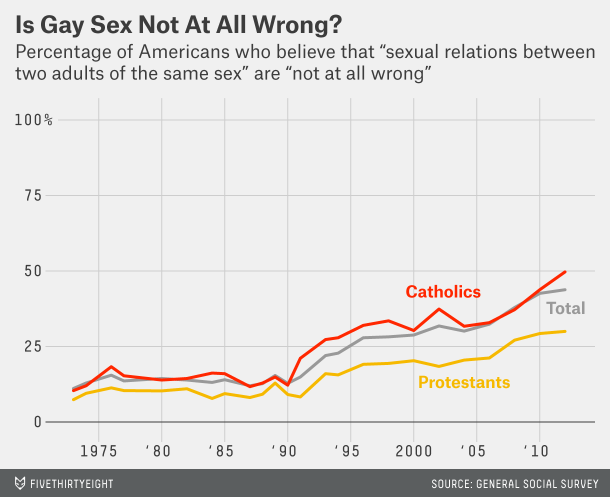
Check out this graph, for example, on the question of sodomy – yes, full-fledged sodomy – over the decades in American life:

bialik-datalab-vatican-31

If you wanted a religious vocation that was all about endorsing gay sex (not something I would ever recommend), you should rush to be a Catholic! Carl Bialik’s data-driven analysis even finds the correlation between Catholicism and social liberalism to endure across cultures and countries:

We didn’t have data broken down by religion in individual countries, so instead I examined how attitudes within countries corresponded with the percentage of their population that is Catholic. In general, the higher a share of a country’s residents are Catholic, the higher percentage of residents express tolerance toward divorce and towards gays. The effect isn’t huge, but it’s consistent.

I immediately went to read Rod Dreher to see his head exploding. In fact, he agrees:

I think most conservative Catholics intuit this, which accounts partly for their anxiety over the prospect of Rome’s waffling. They know that they are minorities within their own church, and they grieve over the possibility that the Church itself may undercut their convictions.

Rod’s point is that only this minority can really be counted upon to support the church’s work and so any liberalization in pastoral outreach to the gays or the divorced would be counter-productive. I’m not sure where he gets this idea. The liberal parishes I have attended seem brimming with volunteers and life. And notice that Francis has not argued that the doctrine should change anyway. He is pushing for the pragmatic embrace of those whom the hierarchy regards as “intrinsically disordered” or “living in sin.” He is arguing that Catholics’ general empathy for the outsider and the downtrodden – and forgiving response to sinners – should be reflected in the hierarchy as well. He is arguing for the church to be more what it is already.

As for those conservative Catholics, whose presence in the church is vital and important, one has to ask a simple question. Why are their convictions so weak that they require constant reaffirmation from Rome or the pulpit? Why is it impossible to coexist with others of a more liberal mindset – and not fight to the death over these issues as if they had the same potency and salience of other far more vital aspects of Christianity? Why can they not hang in with the church the way so many more liberal Catholics have during the papacies of John Paul II and Benedict XVI?

I think most Catholics’ response to these issues is the Pope’s: who am I to judge? And that response is essentially a Catholic one – and, in my experience, it cuts across the “conservative” and “liberal” positions to a more humane equipoise.

Peen Review, Ctd

NSFW, because Oz:

Readers point to some lesser-known shows and films with major peenage:

I love that this is a current thread! Check out Shortbus by John Cameron Mitchell (director of Hedwig and the Angry Inch) for some serious onscreen peen, and an overall excellent film about the city you love to hate: NYC.

Another adds regarding Shortbus, “How often in a non-porn, ‘art’, ‘indie’ movie do you see this much explicit sexual behavior that is clearly a legitimate part of the storytelling?” Many other readers sound off:

Given all that’s going on in the world, it seems a little weird to email you about boners on TV, but here are two notable instances that stand up – er – stand out:

Adam Scott getting a handy in HBO’s Tell Me You Love Me, and the masturbation scene in the French film Swimming Pool. I’m reluctant to link you to PornHub for clips, but of all the TV and movies I’ve seen, those are the only two times in somewhat mainstream setting that I’ve seen a boner on screen (even though Adam’s was a prosthetic and the one in Swimming Pool was just a semi in a banana hammock).

I wouldn’t include the gratuitous scene at the beginning of Antichrist because, well, awful movie.

Another:

FYI: Under The Skin, released this year and starring Scarlett Johansson, featured quite a few erect members. It was also a pretty great movie.

Another:

Outside of porn, I doubt any movie serves peen-hunting cinema fans more extravagantly than Stranger By the Lake. You’ve got soft peen, hard peen, young peen, old peen, blowjobs, cumshots, ubiquitous fucking, and even entire scenes that span minutes of dialog with peen front and center. It sounds gratuitous, but if you’re gonna make a grim, unnervingly quiet thriller about cruising, danger, and sexual obsession that has any semblance to reality, it’s gotta have plenty of peen.

And another:

I vote for the naked wrestling scene – Alan Bates and Oliver Reed – in Women in Love:

I saw the movie in Wellington, New Zealand, and when the dicks started flopping, one old lady behind whispered to her companion that it was so nice to see a real log fire.

Updates from several more readers:

The movie Angels and Insects has an erect penis at a big reveal (heh) in the film, where Mark Rylance walks in on his wife in bed with … someone she should NOT be sleeping with.  The shot of the erection makes the scene even more … gruesome (I’ll leave it at that).

Another erection:

OK, I have to weigh in, as no reader has picked up the most egregious “mainstream” example I know of: The Brown Bunny with Vincent Gallo and the usually delightful Chloe Sevigny.

Another points to more “peen on the screen”:

Offhand, I’d say the original Bear Cub (Cachorro) has bear ween during the opening credits too explicit for American theaters. But as far as the US: Robin Williams in Fisher King:

rCWHA

Go here for more SFW images of starpower peen, including Ewan McGregor and Kevin, er, Bacon. Another reader:

If the thread continues, we’d be remiss not to include Bob Hoskins’ nude scene from Mrs. Henderson Presents.

A final reader refers to the video in our previous post:

In The Crying Game, at the moment of reveal, it would have been more true to life had that penis been throbbingly erect, not hanging limply.

“Throbbingly erect” is a first for the Dish.

“Successful” Interventions Can Still Be Disastrous

Christopher Dickey puts a fresh spin on the debate over whether arming participants in foreign civil wars “works”:

Has the CIA failed repeatedly to meet its covert goals? Actually, the problem has been exactly the reverse. With the exception of the Bay of Pigs, the agency has succeeded repeatedly, sometimes spectacularly. In Afghanistan in the 1980s “the CIA arms for the mujahedin won the final and decisive battle of the Cold War, liberating Eastern Europe and destroying the USSR,” says CIA veteran Bruce Riedel, now at the Brookings Institute. “That’s victory by any measure. Of course the war had other long term consequences, but the CIA accomplished what the White House wanted, a Russian Vietnam.”

Long-term consequences indeed. What happened again and again after the agency eliminated or helped to neutralize the presumed bad guys was the spectacle of their replacements turning out to be as bad or worse. But for those tragic policy decisions one must blame every president dating back to Dwight D. Eisenhower.

It’s too tempting a tool for presidents to use – secret, unaccountable and constantly looking for new wars to fight and enemies to make. Truman saw this clearly. But by then, it was probably too late to restrain it. And no president has – least of all the current one. By the 21st Century, the CIA had fully understood that it could break the law and even commit war crimes, and all it needed to do was destroy the evidence, spy on the Senate, and lie to the public and get away with it. We await the first attempt in recent times merely to expose the facts of its brutality and incompetence. We’ve been waiting now for almost two years.

The View From Your Window Contest: Winner #227

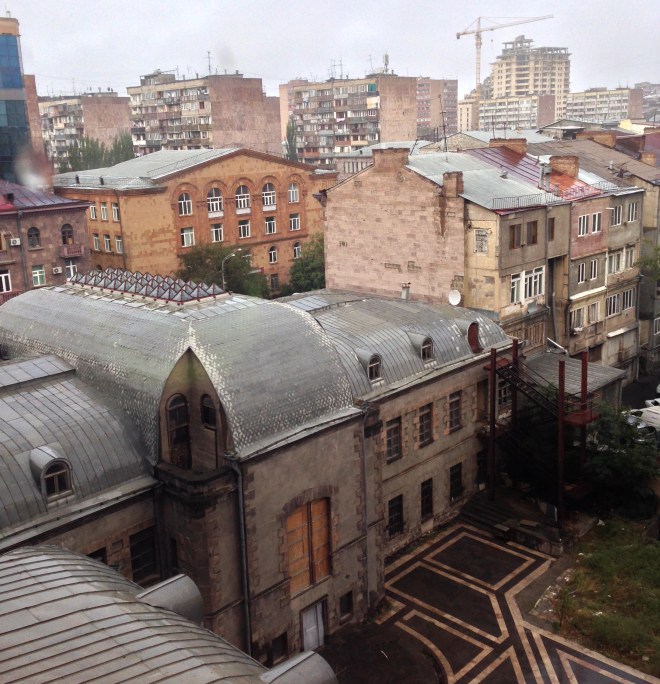
VFYWC-227

Doug Chini is pleased:

You hear that Dish team? That sharp, repeating sound? That’s the sound of a happy Chini clapping. Nicely, nicely done. No landmarks, no giveaways, no mercy. THIS is how you do a view. Don’t get me wrong, it’s not the hardest contest we’ve had (there’s almost too many clues), but it’s still a classic example of what this little slice of Internet insanity is all about.

A less-pleased contestant:

Damn. That roof seems like France, but not the rest. Trees seem Italian. Apartments, less European. Who knows? Throwing a stab with Cagliari, Sardinia.

Another describes the scene in greater detail:

European-style architecture from the era of the Industrial Revolution, but a level of run-down shabbiness that you wouldn’t find in western Europe, which says eastern Europe, Russia or former Soviet Republic, or maybe Shanghai. A crane currently building a new high rise maybe argues for the latter.

I’m guessing that one of those cars in the lower right is of former Soviet bloc make, so I’m going to take a random guess of Kiev. I can find quite a few apartment blocks of the appropriate vintage (although nothing that looks in quite such disrepair), but I’ve got nothing to narrow it down to the building under renovation with the Mansard roof and the spiky sky light.

And just as I was about to give up, I noticed the flag on the building across the street. It looks like it’s red, blue and red horizontal stripes. Laos? Doesn’t seem likely to have a city this dense. Nope, I’ll stick to Kiev. Whatever it is, at least it’s an interesting photo.

Another zooms in on the car:

OK, I give up. Based on the metal roofs, snow fences, tall buildings and the Lada in the corner of the picture, I think we’re in Moscow. Since I can’t find the buildings or window, I’ll just send in a Lada joke:

A man buys a Lada but after only one day of ownership returns it to the garage.image1

‘The car’s no good.’ says the man.
‘What’s wrong?’ asks the car dealer.
‘Do you see that steep hill over there?’ says the man, pointing. ‘Well it will only get up to 75 up there’.
‘That’s not bad really sir, especially for a Lada. I can’t see a problem with that’.
‘Trouble is,’ said the man, ‘I live at 95’.

Almost every guess this week landed in the former Soviet Union, including cities like Kaliningrad and Tbilisi. This reader returns to the most important clue:

So many clues, but unlike past challenges, this one is just out of reach.  Let’s start with the hint of a red and blue flag at the door of the building in the middle of the photo.  I wasn’t able to get a definitive hit, but the colors are typically Slavic.  (Of course,  it’s hard not to immediately conclude that we’re in Eastern Europe anyway, based on the architecture and apparent lack of recent prosperity.)  Then there’s the indecipherable script on the van to the left.  Even after zooming in I can’t tell if it’s a Latin or Cyrillic script which would have helped enormously.

So my guess is the Northern/Central Balkans.  The consistent  use of metal roofs instead of clay tile pushes us away from the southern Balkan nations, and the shallow slope of the roofs keep us from going too far north and east into snowier climates.  So my guess is Serbia, Romania or Moldova, but I can’t seem to get any more specific than that.  I’ll stick with Serbia based on the Slavic suggestion of the flag.

Identifying that flag led to the bulk of this week’s correct guesses:

You’d think a building with a curvy gambrel roof (or flagmodified mansard?) with pyramid skylights would be easy to find. Maybe, but I sure can’t. Clues were few and far between this week. The vista looked rather post-Soviet: run-down but lots of satellite dishes. Grates on the roof edges suggested someplace snowy. All that added up to any city between Harbin, China and Krakow, Poland. The single real clue I could divine was a flag on the building across the street. It looked red-blue-red to me, which is the flag of Laos, which seemed improbable. But maybe it was red-blue-orange, like the flag of Armenia.

From all the pictures I looked at, it sure did look like Yerevan, Armenia. But I still can’t find that dang building anywhere, and it’s not for lack of trying.

Dish readers have been to Yerevan, naturally:

The moment I saw this week’s VFYW contest picture I knew it was Yerevan, Armenia. I recently had the opportunity to visit that country, and as soon as I scrolled down and saw the photo I had a strong sense of deja vu. What gives it away is the mix of Eurasian, Imperial Russian and Soviet architecture. And the pink/dark stone used for many of the older buildings, which is practically uniquely Armenian (although used to a lesser extent in Azerbaijan and Georgia).

A former winner, who nearly gets the right building, elaborates on why Yerevan is known as “The Pink City”:

Pretty tough; or should I say pretty tuff? You know, there is only one city in the world whose buildings are mainly made of pink tuff [a light, porous rock formed by consolidation of volcanic ash]. This week’s picture was taken in Yerevan, Armenia, from the northwest side of this building on Teryan Street:

14th-Floor-Hotel

There is a hotel housed in the building, the 14th Floor Hotel, but – as its name clearly implies – it is located on the 14th floor, while the contest picture was taken from about the sixth floor, so I am assuming that someone hosted in the hotel sneaked into some other place in the building to shoot the photo.

A contest veteran nails the correct building – another hotel:

Thank God for the half-obscured flag of Armenia by the door of the tan building!  Armenia has the only national flag with that pattern of colors, so we have to be in Yerevan. From there it was a matter of matching the right configuration of Soviet-era housing blocks on Google Earth and finding a photo nearby showing any of the buildings in the foreground of the view.  A photo from Amiryan Street clearly shows the tan building with the obscured flag.  That building is the Yeghishe Charents School No. 67, named for the noted Armenian poet and political prisoner under Stalin:

VFYW Yerevan

Details about the rest of the area in the shot, a block away from Yerevan’s Republic Square, were frustratingly few, but there’s enough to go on to deduce that the photo was taken from the Paris Hotel at 4/6 Amiryan Street.

Another former winner adds:

Before focusing on Yerevan, the search began in Vanadzor, Armenia because the Vanadzor State Pedagogical Institute’s building looks similar to the Yeghishe Charents Basic School No. 67 in the center of the contest photo.  (No word yet on whether Armenia will be altering its naming system for elementary schools in light of the basic American meme.)  The detour was nonetheless useful.  The resemblance between the buildings indicated that the window was likely in Armenia.  As for Teryan and Charents, they were Armenian poets of some renowned.

One reader’s struggle after IDing the flag:

“This should be easy!” I thought to myself.

Wikipedia.

“Only one city of real size … Yerevan.”

Google Map.

“Bingo … all sorts of Soviet era apartment buildings. OK … quite a few. No. An amazing amount of them.”

Hours pass.

“Oh crap, I’m going to have to go block by block.”

Hours pass.

“Maybe it isn’t Yerevan. But … the flag … an embassy? That new republic of something or other …”

I was just about to go take some ibuprofen and give it another shot in the morning. But then I saw a row of buildings that looked very solid. I went through hundreds of assumptions, and none of them panned out. Eventually, brute force won out.

Another notes:

The very small image of a flag, which is barely visible, was the only clue to quickly identify the country as Armenia. This is a very poor country with wide-spread poverty which the view from the window under-scores.  Quite a contrast with Providence, Rhode Island!

The absence of Google street view for Yerevan makes identifying the precise window or address very challenging.  This montage summarizes my search process:
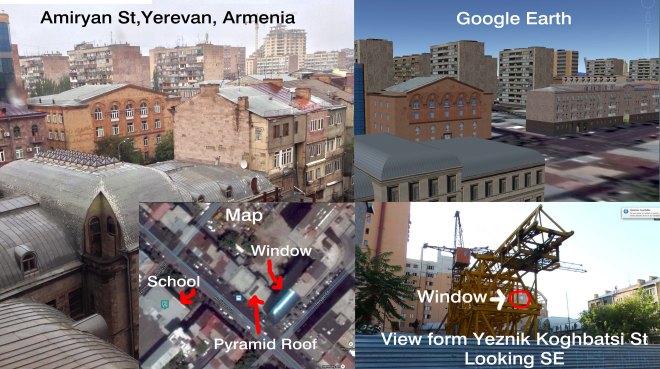
Montage

An incredibly detailed walkthrough:

My first impression of the scene was the juxtaposition of 20th Century shabbiness with some Second Empire / fin de siècle architecture.  I was immediately inclined to think we were looking at a former Soviet or Warsaw Pact city.  But the French feel of the old building in the foreground and the rising terrain in the background left me unable to rule out immediately a Parisian suburb or provincial cité.

image004The essential clue proved to be the flag on the building in the middle distance – a detail visible only when I enlarged it. (At first I thought the blue stripe appeared between two red ones, which led me astray for a while.)  When I recognized that the bottom stripe was orange, I knew we were in Armenia.  And presumably Yerevan, because I cannot even name another city in Armenia. But the degree of difficulty in pinpointing the window was raised significantly by the fact that Google does not provide Street View for Yerevan.  But at least some Armenians have created a less comprehensive version that allows a few street-level views.
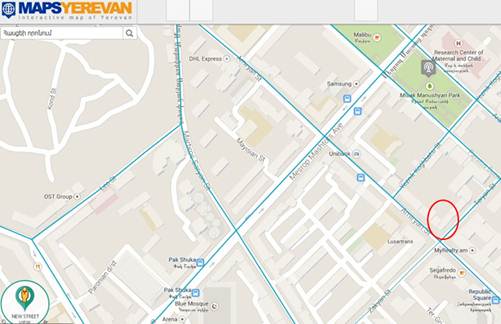
image012

And thus we match the window’s western view …
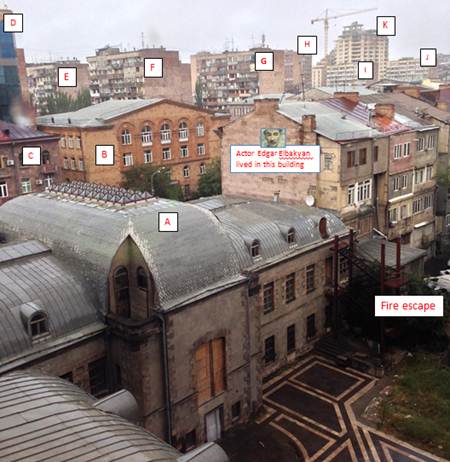
image017

… to landmarks in Yerevan:

image007

Incidentally, a southern view from an upper floor of the same building ought to show Mt. Ararat:

image019

The building in the middle distance (labeled “B”) is the Yeghishe Charents School No. 67.  Here are some other views of it:
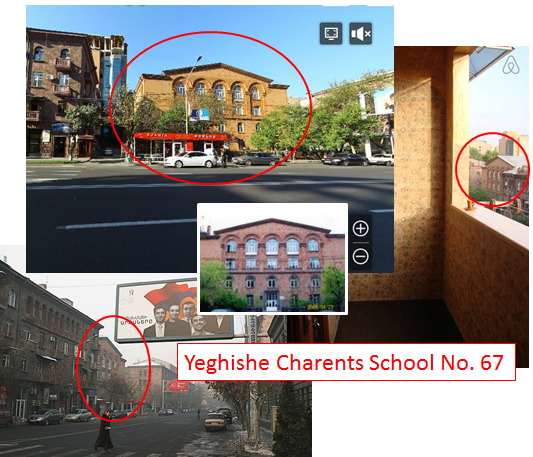
image008

So our photographer was looking generally west from this building or set of buildings at the corner of Amiryan and Teryan Streets:
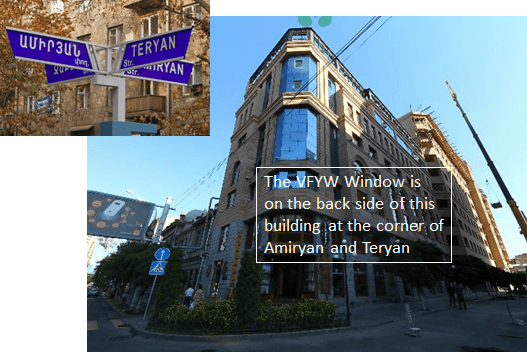
image010

Unfortunately, because “Maps of Yerevan” has fewer still images than Google Street View, one cannot adjust slightly to see around an obstacle to find the window.  And the only street view of the northwest side of the VFYW building is this – in which the photographer’s window, overlooking the fire escape of our fin de siècle building, is obscured:

image009

And so I must resort to the most inexact of tools: a Google Earth model image:

 image013

Since the scale is distorted, I find that this is as exact as I can get.  Perhaps this is the view from Deloitte’s Yerevan office on the 3rd floor of 4/6 Amiryan, but it just as likely might be the view from the Regional Studies Center on the 4th floor.

By the way, Yerevan will forever be etched into my mind as the target city for attack in the first computer simulation I ever played (on a Radio Shack TRS-80):  B-1 Nuclear Bomber.

Only one reader nailed the right floor of the building this week, for the win:

image

Seems to be looking WSW from 4/6 Teryan St, I’m going to say the 7th floor, let’s say room 715 for kicks. Though I can’t seem to find any additional information or pictures of the building and there’s no street view.

BTW, the street numbering system seems completely arbitrary. Only clue was was the Armenian (yes that’s red, blue, ORANGE, not red, blue, red) flag on the Yeghishe Charents Basic School No. 67 and the shiny roof on the building in the view.

Congrats! From the reader who submitted the photo:

Wow!  This is great! The photo was taken from my 7th floor hotel room at the Paris Hotel in Yerevan.  I was there from Oct. 3-7.

See everyone again on Saturday.

(Archive: Text|Gallery)
Epistemic Closure Watch

Media Polarization

Pew looks at how conservatives and liberals consume their news:

When it comes to getting news about politics and government, liberals and conservatives inhabit different worlds. There is little overlap in the news sources they turn to and trust. And whether discussing politics online or with friends, they are more likely than others to interact with like-minded individuals, according to a new Pew Research Center study.

John Avlon is distressed:

A few decades ago, politicians sent talking points to talk radio hosts. Today, talk radio hosts and online echo-chamber pundits send talking points to politicians. They keep their readers and listeners addicted to anger. The durable wisdom of the late, great Sen. Daniel Patrick Moynihan—“everyone is entitled to their own opinion, but not their own facts”—gets discarded when people come to political debates armed with their own facts.

Justin Elis’ take is more nuanced:

On their face, these findings might seem to lend support to the idea that we’re becoming a country of smaller and smaller filter bubbles, personalized universes of news and people that fit our own interests. But the connection between how Americans get news and their political polarization is not black and white.

Pew found that on Facebook, the majority of people only see political posts they agree with some of the time. That’s also reflected in the real world, as Pew found people on all ends of the political spectrum tend to get a mix of dissent and agreement on politics in their every day life. 58 percent of consistent liberals and 45 percent of consistent conservatives say they often get agreement and disagreement in their conversations on politics. For people with mixed political views — Pew’s middle ideological category — that jumps up to 76 percent.

Christopher Ingraham makes note of the least trusted outlets:

Overall, four of the top five least-trusted news outlets have a strong conservative lean: Limbaugh, Fox News, Glenn Beck and Sean Hannity. MSNBC rounds out the list. The most trusted news outlets, on the other hand, tend to be major TV networks: CNN, NBC News, ABC News, CBS News, with Fox at No. 5.

The Pew Study notes that “liberals, overall, trust a much larger mix of news outlets than others do. Of the 36 different outlets considered, 28 are more trusted than distrusted by consistent liberals.” By contrast, among conservatives “there are 24 sources that draw more distrust than trust.”

On the topic of distrust, Kilgore highlights a telling detail:

BuzzFeed has the dubious distinction of being more distrusted than trusted among every single ideological category. Pretty impressive for a relatively “young” site, eh?

Congrats, sponsored content. Update from a reader:

As a grad student who has studied polarization, the Pew study isn’t all that surprising (although it is very useful in confirming what many have long assumed.)  I think it may be time, however, to challenge a long-standing assertion of polarization studies.  As Bill Bishop has argued in The Big Sort, Americans seem to be increasingly segregating themselves along partisan/ideological lines.  Not only are our neighbors more likely than before to share our political views, but we also are probably consuming the same kinds of political news and cultural products.  This extends to Facebook as well.  Some people argue this creates an “echo chamber” that merely reinforces our political beliefs.  In other words, the more Fox News we listen to, the more conservative we become.

But I wonder if there isn’t an opposite effect going on as well.  The proliferation of media outlets also makes it easier for us to bump into dissenting views.  Unlike the 1950s-1980s, when there was one monopolistic media establishment that kept the heated rhetoric toned down, now there are many outlets, giving us all greater opportunity to encounter viewpoints that we find abhorrent and that we can’t believe others harbor.  Facebook didn’t so much create an echo chamber as expose us to the private opinions of people we previously assumed were “sane” in their opinions.  Consuming partisan news isn’t so much about finding the truth as it is like running for cover in a crazy world.

Another reader:

So according to that graph you posted, Liberals “are more likely to defriend someone on a social networking site because of politics”. Boy has this been true in my own experience (I’m about as far right politically as it’s possible to be). I have had significant disagreements with old and new friends alike on Facebook and Twitter over the past few years, and I have never once defriended anyone, and my conservative friends (at least the ones I’m closest to) have not done so either. But I most certainly have been told off and immediately defriended by some left-leaning friends over one relatively simple disagreement or the other.

Anecdotal yes, but I think it’s probably true in general that there is little room for disagreement allowed, and certainly less tolerance, for differing opinions on the left than on the right. Your graph and the source would seem to validate this as well. I assume that this comes from the self-righteousness and extreme confidence that modern progressives have that they are sole arbiters of truth and justice, with sole claim to the mantle of righteousness, much like they have (many times accurately) portrayed the right to be from days past. To me this point is beyond dispute: there is MUCH less tolerance for differing opinions and beliefs on the left than there is on the right today. The left is simply blind to the deep strains of religious bigotry of many in their ranks, if nothing else.

And another:

I think it’s probably worth noting that liberals are more likely to defriend conservatives over politics, but the chances are good that they weren’t very close friends in the first place (although you can find many laments over the end of long-term friendships on the left, often precipitated by relatively mild pushback and a stream of abuse in response). I’m from the Deep South originally, and of course everyone back there “knows” that Obama is a Muslim socialist, because between Fox and talk radio and right-wing churches and the NRA, that’s what all self-described respectable, well-informed people hear (plus, Democrats are the party of black people, who are widely seen as lazy, violent, and ignorant). I effectively defriended almost everyone there many years ago when I left; social media allowed for at-arms-length reconnections without my having to pretend that I had any interest in the ideology or institutions it was such a relief to leave.

FWIW, I just hide the crazies, and have been defriended a couple of times by conservatives (one a relative to whom I used to be close) even though I’m rarely aggressively political except in political fora or among like-minded acquaintances. The truth is that a) I don’t always want to know what people are thinking about important issues, and b) I do think less of political conservatives, because I consider it a mean, regressive, often self-serving inclination in practice. That’s why I left an area in which it is so unquestioned … and a state that uncoincidentally ranks at or near the bottom of every quality-of-life measure.

Book Club: Does The Self Exist?

harris-waking-up-SD-img

In our discussion of Sam Harris’ Waking Up, I want to try a different tack than in previous Book Club discussions. I want to throw this over to you as quickly as possible, rather than write a review of the entire book as an introduction. And with Sam’s dense but deep little tome, there’s one question I’m eager to ask Dish readers about: were you convinced by his argument that there is no real self as we usually understand it?

Sam makes the case with a dozen little perspective shifts. He cites the fact that the right side of the brain often has no idea what the left side is doing, and vice-versa and asks: how can there be a coherent “I” if that is true? Or he challenges us with Derek Parfit’s thought experiments about the inherently unstable entity called a self “that is carried along from one moment to the next.” Or he notes how much of our lives are lived without our active consciousness at all, where even the task of sipping a cup of coffee is undergirded by

motor neurons, muscle fibers, neurotransmitters I can’t feel or see. And how do I initiate this behavior? I haven’t a clue. In what sense, then do I initiate it? That is difficult to say.

Much of this argument is entirely by a process of elimination. He merely chips away at a stable notion of the self – even in its most intuitive form – and challenges us to ask what remains:

However one looks for it, this self is nowhere to be found. It cannot be seen amid the particulars of experience, and it cannot be seen when experience itself is viewed as a totality. However its absence can be found – and when it is, the feeling of being a self disappears. This is an empirical claim.

The key argument, it seems to me, is that we are not identical to our thoughts. Our existence is rooted elsewhere – in fact, in the banishment of thought. It reminded me of the account given by Pope Francis of his experience before he signed the document that would make him Pope:

Before I accepted I asked if I could spend a few minutes in the room next to the one with the balcony overlooking the square. My head was completely empty and I was seized by a great anxiety. To make it go away and relax I closed my eyes and made every thought disappear, even the thought of refusing to accept the position, as the liturgical procedure allows.

I closed my eyes and I no longer had any anxiety or emotion. At a certain point I was filled with a great light. It lasted a moment, but to me it seemed very long. Then the light faded, I got up suddenly and walked into the room where the cardinals were waiting and the table on which was the act of acceptance. I signed it …

For Sam, this is evidence merely that meditation works, that stilling unending thoughts enables a person to live mindfully rather than to experience life as one goddamned distraction after another. He sees this as proof of the absence of a self and a way to live with clarity and calm as we are beset by feelings and passions, good and bad.

But the Pope suggests another way of seeing this: not as proof of the absence of self so much as the simplicity and calm of being oneself with God. It is a mysterious way of being, this communion with God. And maybe, experientially, it is indistinguishable from Sam’s meditative clarity and occasional epiphanies. But in it, for a Christian like me, the self does not disappear. It is merely overwhelmed by divine love and thereby fully becomes itself. In fact, this is the core mystery of our faith: communion with something greater and other than us, and a communion marked by love. In fact, something even more miraculous than that: a divine love that actually loves you uniquely.

I can read much of Sam’s book, in other words, and yet reach a very different conclusion about what’s really going on. Or am I only projecting what I want to believe onto the experience itself? Feel free to tell me. Not that it usually requires a request.

More relevant: Did Harris persuade you on the question of the self? Where was his argument’s weakest – or strongest – link for you? Email your thoughts to bookclub@andrewsullivan.com

The First Gentleman Of Fashion

Tanya Basu considers the legacy of Oscar de la Renta, who died yesterday at the age of 82:

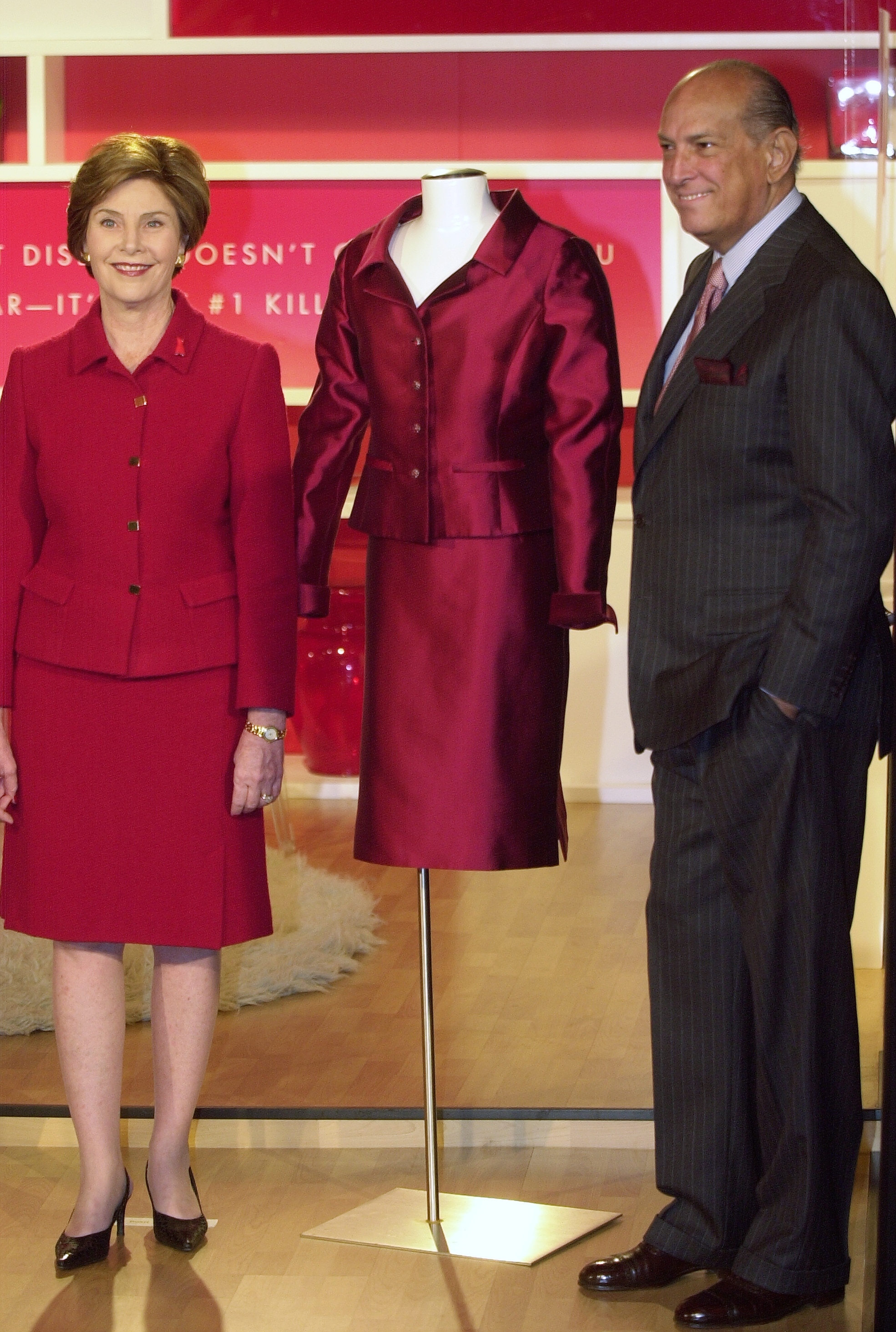
Before de la Renta’s entrance, American fashion was ruled by copycats: Runway looks from Paris and London were adjusted for American tastes, which strayed towards the practical and First Lady Laura Bush joins Oscar de la Renta during fall 20avoided the cutting-edge risks that defined the European scene. De la Renta changed that—he focused on the American woman, her needs, her cultural outlook, her sense of practicality but desire to be beautiful. De la Renta combined these sensibilities into what became his unmistakable brand of strong lines, very little skin-show, sumptuous fabrics, vibrant single hues, ornate details like lace and bows and pearls that evoked a purity that was at once sultry and innocent, and, most importantly, a tag bearing his calligraphic name, scrolled in smooth strokes both delightfully unexpected and surprisingly expected, just like his line. …

Indeed, de la Renta’s revolutionary designs were, ironically, steadfast in their dedication to classic form and structure, stridently maintaining a fairy-tale quality that gave the women he dressed an ethereal quality. He favored ruffles, billowing tiered gowns that evoked a concoction of Renaissance grandeur with graphic Warholian splashes of color. Unlike some of his peers, de la Renta avoided making political statements or overt experimentation (“Fashion is non-political and non-partisan,” de la Renta said in that same Clinton video while discussing how he dressed then-First Lady Hillary Clinton for a Vogue shoot).

Amanda Wills put together a gallery of first ladies in de la Renta gowns. One very reluctant late addition:

First lady Michelle Obama had a frosty relationship with de la Renta, snubbing his designs for years after he publicly criticized her choice of clothing for a meeting with Queen Elizabeth II in 2009 and at a state dinner with Chinese officials two years later. This month, she appeared in the designer’s clothing for the first time, wearing a de la Renta dress at a White House cocktail party.

Zooming back out, Robin Givhan has more on the appeal of his designs:

With French lace and delicate embroidery, he helped women subdue their insecurities. And with his eye for a gentle flounce and a keen understanding of line and silhouette, he helped them build a powerfully stylish wardrobe that never denied their femininity nor apologized for it. He helped them look like their most romantic vision of themselves. …

Today, there are designers in New York who are more adept at capturing the sexuality of the modern era. There are those who are able to speak to the esoteric, the experimental and the avant-garde. But de la Renta represented a kind of old-school fashion with its emphasis on propriety, elegance and good taste.

Lauren Indvik adds:

De la Renta’s couture training always showed. Whatever the fashion of the moment, his garments were always constructed, shaping the female body into something more perfect and swan-like than its natural shape allowed. “I don’t really know how to do casual clothes,” he told WWD in 2005.

(Photo from Getty)

The Trouble With Religion, Ctd

A reader writes:

As a professor of religion, I cannot resist responding to Reza Aslan‘s latest effort to put foolishness in the mouth of “every scholar of religion.” According to him, the “principle fallacy” of “New Atheists” and many other “critics of religion” is that “they believe that people derive their values, their morals, from their religion. That, as every scholar of religion in the world will tell you, is false.” It takes only one scholar of religion to refute that claim, and I am happy to be that scholar.

The first problem with Aslan’s view is that it treats “morals” and “religion” as if they exist in two separate boxes. The second problem is that it assumes that “morals” can impact “religion” but “religion” cannot impact “morals.”

It is of course the case, as Aslan argues, that people “bring their values to their religion.” That fact helps to explain why they can read the same texts (the Bible, the Quran) and find in them such divergent plans of action. But it is not the case (as Aslan also argues) that “people don’t derive their values from their religion.”

Aslan is quite good at telling interviewers on CNN or FOX that they are oversimplifying things. But here his own oversimplifying is epic.

Religion, culture, values, and morality all grow up together, intertwined, and there is no simple way to disentangle them, either in an individual life or in the history of a civilization. The reason we try to disentangle them is to defend one while throwing the other under the bus. Like the New Atheists, we want to indict “religion” for clitoridectomies or suicide bombings or homophobia, so we pretend that “religion” is separate and at fault. Or, like Aslan, we want to protect “religion” from Hitchens’ claim that it “poisons everything,” so we pretend that it is “culture” or “morality” that does the dirty work.

Unfortunately, it’s a lot more complicated than that. Is religion really as inert as Aslan implies? Religious beliefs, institutions, practices, and leaders shape us, both culturally and morally. A nun tells you to take care of the “least of these,” and you listen. A pastor tells you to “hate fags,” and you do. Yes, we hear these sermons in bodies and minds shaped by moral norms and cultural forms, but those are shaped in turn by religion, which is shaped itself by morality and culture. And round and round it goes, as just about every scholar of religion in the world will tell you.

Another notes a “striking juxtaposition” of two Dish posts:

In “The Trouble With Religion“, Reza Aslan tells us, “People don’t derive their values from their religion – they bring their values to their religion.” But in “Hasidic No More” (the immediately preceding post – was that deliberate?), we are told about the Satmar Hasidim, ultra-orthodox Jews who live lives that are strictly regimented: isolated from the secular world, segregated by sex, told what to wear and how not to cut their hair, commanded to say a particular prayer after their morning shits.

Another piles on:

Aslan is generally a pretty thoughtful guy, but this is just silly. First off, he talks as if all adherents of a religion come to it voluntarily as adults, already possessing set ideas about how life works. Children who are raised in a religion most definitely do not. Depending on their parents’ devoutness and how immersive the religion is, they derive their values from that religion.

He also elides the existence of religious authority. While adult adherents do come to a religion with their own values, no religion simply accepts and adopts those values. Religions have doctrines. Insofar as they are text-based, they have canonical lists of religious texts. They have authoritative interpretations of those texts.

Of course, there’s tremendous variation in how strict religions, sects, denominations, etc., are. Some tolerate a good deal more heterodoxy than others. And some build authority from the bottom up, rather than deriving it from the top. But none are completely without authority. To one degree or another, all religious communities are disciplined communities.

Aslan has more of a point in Western societies where ethnic identity has largely been divorced from religion and states no longer dictate religion, so a person can shop for the religion they want, and change at will. That’s very much the American experience nowadays, but it’s hardly universal.

Lastly, he ignores the fact that often what adult converts want – what they come to a religion for – is transformation. Their whole purpose is to lose their values and adopt the religion’s.