The GOP’s Likely Gains

Most of the midterm models expect Republicans to pick up 52 seats:
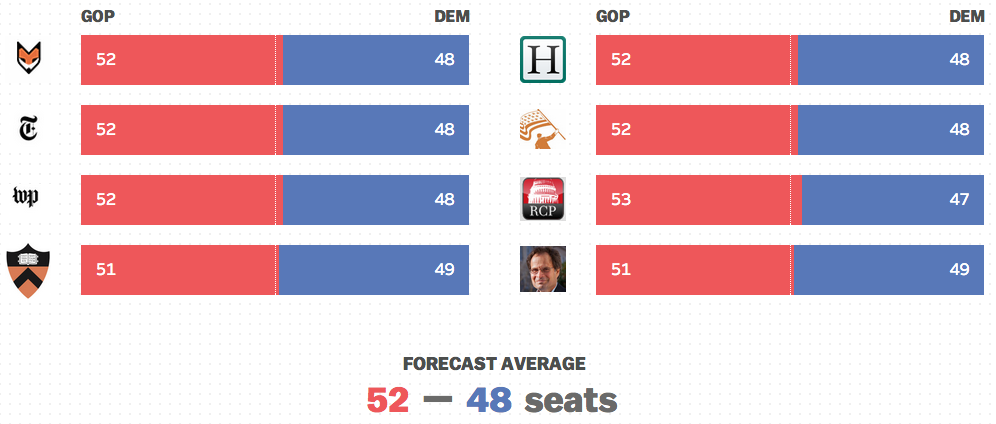
Senate Forecasts

Chris Cillizza notes that the Republicans’ chances of taking the Senate have improved. But Jonathan Bernstein focuses instead on the diminishing likelihood of a Republican blowout:

Granted, pickups in Iowa and Colorado would be a nice way to put Republicans over the top. But at least so far, they haven’t managed to add potential targets such as Minnesota, Michigan or Virginia to the list of closely contested states, and they remain unlikely to win New Hampshire or North Carolina. The result is that prediction models are converging at 52 Republican seats, not 54 or more.

I’m not playing that down. No matter what the opportunities, I doubt there has been a single point during this election cycle when Republican strategists would not have been satisfied with winning seven seats to reach 52. And just as Democratic hopes to hold a majority are still realistic, so are Republican dreams of an even larger landslide. Still, what’s happening is consistent with Republicans taking advantage of expected opportunities.


Greg Sargent maintains that “Democrats do still have paths to retaining control. But they are increasingly narrow”:

Put it this way: Republicans are favored to take the Senate. If they do, it wouldn’t be at all surprising. On the other hand, if Democrats somehow hold on, that outcome wouldn’t be all that shocking, either. But a lot has to go right for Democrats for that to happen.

Charlie Cook is keeping tabs on the Kansas and Georgia races:

The prospects remain very tough for Democrats to hold onto their majority in the Senate, but there is a new scenario emerging—albeit still unlikely—that is turning the majority math a bit on its head.

As I have said previously, Republicans need a net gain of six seats to take the majority. The question has generally been whether Republicans just need to knock off six Democratic seats to get to 51, or if they will need to gross seven seats in order to net six. Now there appears to be a real question as to whether Republicans may need to gross eight seats in order to net six, covering for the potential loss of not just Sen. Pat Roberts in Kansas but an open seat in Georgia as well.

The Grave Risks Of A Travel Ban, Ctd

With Marco Rubio preparing a bill to ban nationals of Liberia, Guinea and Sierra Leone from entering the US, and with vulnerable Dem candidates hopping on the Ebolanoia bandwagon, our political class appears to be warming more and more to an Ebola travel ban. (Ron Paul, at least, has called out such proposals as bad, politically motivated policy). So the point bears repeating that a travel ban is not as commonsensical as its supporters make it out to be. Julia Belluz and Steven Hoffman look back at past epidemics in which travel bans proved unhelpful, including the AIDS crisis:

After HIV/AIDS was discovered in 1984, governments around the world imposed entry, stay and residence restrictions on people with the disease. As one 2008 study notes: “Sixty-six of the 186 countries in the world for which data are available currently have some form of restriction in place.” In the US, the ban — instituted by President Ronald Reagan in 1987 — was only lifted when Obama came into office. But HIV/AIDS managed to spread anyway, reaching pandemic proportions by the 1990s. This 1989 review of HIV/AIDS travel restrictions found they were “ineffective, impractical, costly, harmful, and may be discriminatory.” Prevention of HIV worked better than travel restriction, the authors concluded.

And swine flu:

After the arrival of H1N1 swine flu in 2009, some countries imposed travel restrictions on flights going to and coming from Mexico, resulting in a 40 percent decrease in overall travel volume. A study looking at this event found it “only led to an average delay in the arrival of the infection in other countries (i.e. the first imported case) of less than three days.” So again, reduced travel delayed (by three days!) but didn’t stop disease spread. The authors wrote: “No containment was achieved by such restrictions and the virus was able to reach pandemic proportions in a short time.”

Another common argument against travel bans is that they would seriously harm relief efforts. Jonathan Cohn elaborates on this:

Experts, along with non-profits like Doctors Without Borders, say that they’d have a much harder time getting volunteers into the countries if those volunteers knew they could not easily return. Even with an explicit exception for aid workers, they say, the extra burden and uncertainty of having to get special clearance would dampen enthusiasm. Meanwhile, a U.S. travel ban would almost certainly cause other highly developed countries to follow, dramatically reducing the demand for flights and other transportation options to West Africa. Agencies already struggling to get supplies into the area would struggle even more.

Lots of people wonder, couldn’t the U.S. government just arrange other transportationmaybe a modern-day version of the 1948 Berlin airlift? I’ve put that question to a number of officials and experts and the answer I keep hearing is “no.” In the real world, they say, making these arrangements would be difficult and solutions would be inadequate. It’s not as if assistance is this highly organized campaign, with all the necessary aid workers and their supplies lined up at Dover Air Force base, just waiting for C-17s to take them across the Atlantic. The flow of people and wares into West Africa is a constantly changing, unpredictable blob that’s heavily dependent on freely available commercial transportation. Replacing that would take resources and time, the latter of which the region really doesn’t have.

A Burning Desire

OLYMPUS DIGITAL CAMERA

Mary Pauline Lowry confesses to pyromania:

The constraints of attentive parents kept my pyromania to a minimum for the next few years. I’d light a few matches while my mom was in the shower, or feed scraps of paper to the gas burner on the stove if she stepped out to the grocery store. I told no one about my urge to light things — not even my big sister, whom I usually told everything. My mom would sometimes let me light candles on the dinner table. She would watch me closely and joke about the incident with the advent wheel. I’d feel a twinge of guilt — she wouldn’t have laughed if she knew it wasn’t just a one-time incident, how I yearned for more ambitious conflagrations.

In sixth grade, I was deemed old enough to make the short walk home from school with my best friend and then stay at home unsupervised for an hour or so. This brief window of freedom became a time for me to explore my pyromania more fully. I did most of my fire-lighting in the bathroom, operating under the theory that bathroom tile wasn’t flammable. The first time I lit a match and sprayed the tiny flame with Aqua Net, the ensuing fireball was so big and breathtaking that I felt satisfied — and only a little afraid.

I wondered if these urges would ever be appeased. But even as I hoped I would outgrow my love of fire, I took bigger and bigger risks.

(Photo by Flickr user herval)

Pregnant With Depression, Ctd

David Bornstein argues that postpartum depression has been misunderstood:

Postpartum depressions are often assumed to be associated with hormonal changes in women. In fact, only a small fraction of them are hormonally based, said Cindy-Lee Dennis, a professor at the University of Toronto and a senior scientist at Women’s College Research Institute, who holds a Canada Research Chair in Perinatal Community Health. The misconception is itself a major obstacle, she adds. Postpartum depression is often not an isolated form of depression; nor is it typical. “We now consider depression to be a chronic condition,” Dennis says. “It reoccurs in approximately 30 to 50 percent of individuals. And a significant proportion of postpartum depression starts during the pregnancy but is not detected or treated to remission. We need to identify symptoms as early as possible, ideally long before birth.”

Regarding treatments, the following passage from Bornstein brings in a recent thread on telemedicine:

The third model grows out of Cindy-Lee Dennis’s research in Canada, and is important because it illustrates the potential of treating women through interventions over the phone. It thus reduces one of the biggest barriers low-income or rural women face in accessing treatment: transportation to and from treatment and scheduling appointments.

In one clinical trial, 700 women in the first two weeks after giving birth, who had been identified as being at a high risk of postpartum depression, were given telephone-based peer support from other mothers — volunteers from the community who had previously experienced and recovered from self-reported postpartum depression (and received four hours of training).

“We created a support network for the mothers early in the postpartum period,” Dennis explains. “It cut the risk of depression by 50 percent.” On average, each mother received just eight contacts — calls or messages, and the calls averaged 14 minutes. Over 80 percent of the mothers said they would recommend this support to a friend.

Previous Dish on depression and pregnancy here and here.

Creepy Ad Watch

The above ad for BLAH Airlines – Virgin America’s parody of airline travel – is just a glimpse into the nearly 6-hour commercial tracing a flight from Newark to San Francisco. Jessica Plautz calls the full film “more than boring – it’s nearly Dalí-style surrealism”:

It starts out boring, as you would expect on any flight with nothing but the safety manual to entertain you. Shots go back and forth between the back of the seat and our protagonist, a gaping dummy with a bowl cut. A fasten-your-seatbelts announcement 12 minutes in is so familiar it’s uncanny. At 3 hours and 19 minutes, a dummy appears outside the window, Nightmare at 20,000 Feet style. And then it gets even more Twilight Zone. There are weird small talk conversations throughout that must have been a treat to write and produce.

Full video after the jump:

Home Sweet Moon?

Saskia Vermeylen considers what it might take to own a lunar homestead:

If you just simply occupy a place and no one else can access or use it, aren’t you the de facto owner? Lawyers call this corporate possession (corpus possidendi) and it represents another reason why title deeds cannot be a legal proof of lunar ownership – no one is physically there. In order to possess something, both mind and body need to be involved. Intention alone is not sufficient; possession also requires a physical act.

The difficulty of physically establishing an act of possession on the moon should protect it from private development, but it seems technology is once again outsmarting the law. Back in the late 1990s commercial firm SpaceDev intended to land robotic prospectors on an asteroid to conduct experiments and claim it as private property. The project eventually ran out of funds and was shelved, but advocates of such “telepossession” point to cases of salvage companies claiming undersea wrecks as property after exploring them with robots. …

I get the uncomfortable feeling of a déjà vu. Was it not Locke’s property theory that justified possession over nature and vacant land and eventually led to the colonization of the Americas?

The Best Of The Dish Today

A new twist on the metaphor of what it sometimes feels like to blog every day:

Meanwhile, a reality check on whether Muslim apostates can really live free lives across the world. It’s in the form of the hashtag #AnApostatesExperience. I found it a sobering reminder of the trouble with Islam today. You may too. A sampler:

https://twitter.com/KiranOpal/status/521790206199201792

https://twitter.com/Mookers/status/521790308154372096

https://twitter.com/schwanncells/status/521758972630798337

For some unaccountable reason, these victims of brutal intolerance want to get Reza Aslan’s attention. Maybe Ben Affleck could chime in about the racism of these people as well.

Today, we reported tentative good news from the ongoing victims of Islamist terror and unspeakable brutality in Kobani against ISIS and in Nigeria against Boko Haram. And some other tentatively good news about Ebola in the US. Plus: gains in the fight for legal cannabis in DC and now in Mexico. And more good news: inflation is clearly whipped – not that any of those predicting a second Weimar a few years ago will ever apologize or recant.

Now for the bad news: I found my stomach lurching when hearing of a debate within the Obama administration on whether to ban torture and abuse anywhere under US control in the world. Yes: a debate. Presidents come and go. The CIA endures – and does whatever the fuck it wants. Always in secret and with total impunity.

Many of today’s posts were updated with your emails – read them all here.  You can always leave your unfiltered comments at our Facebook page and @sullydish. 22 more readers became subscribers today. You can join them here – and get access to all the readons and Deep Dish – for a little as $1.99 month. Gift subscriptions are available here. Dish t-shirts are for sale here, including the new “Know Dope” shirts, which are detailed here. A final email for the day:

Every day your readers email you about the content of your posts, but today I just want to thank you and the Dish team for your consistency. I started reading the blog back in 2006, recommended to me by a political science teacher at a haughty East Coast university. Since then I’ve studied and taught at six universities in five countries. No matter where I went or what I was going through, your posts and words comforted and challenged me. Whether I am in the arcane confines of a British university master’s program or freelancing articles in a dusty desert suburb of Los Angeles, your blog acts as a tether to a constantly changing conversation. I just sent away my passport in preparation for another move and felt the urge to write these words. Thanks again.

See you in the morning.

The Limits Of Meritocracy

Screen Shot 2014-10-20 at 12.30.56 PM

Matt O’Brien discusses a new paper showing how even “poor kids who do everything right don’t do much better than rich kids who do everything wrong”:

You can see that in the above chart, based on a new paper from Richard Reeves and Isabel Sawhill, presented at the Federal Reserve Bank of Boston’s annual conference, which is underway. Specifically, rich high school dropouts remain in the top about as much as poor college grads stay stuck in the bottom — 14 versus 16 percent, respectively. Not only that, but these low-income strivers are just as likely to end up in the bottom as these wealthy ne’er-do-wells. Some meritocracy.

What’s going on?

Well, it’s all about glass floors and glass ceilings. Rich kids who can go work for the family business — and, in Canada at least, 70 percent of the sons of the top 1 percent do just that — or inherit the family estate don’t need a high school diploma to get ahead. It’s an extreme example of what economists call “opportunity hoarding.” That includes everything from legacy college admissions to unpaid internships that let affluent parents rig the game a little more in their children’s favor.

Noting the abundance of other studies that point to this same class disparity, Freddie stresses that the notion of America as a pure meritocracy has been thoroughly debunked, even if many people still believe in it:

The question of how much control the average individual has over his or her own economic outcomes is not a theoretical or ideological question. What to do about the odds, that’s philosophical and political. But the power of chance and received advantage — those things can be measured, and have to be. And what we are finding, more and more, is that the outcomes of individuals are buffeted constantly by the forces of economic inequality. Education has been proffered as a tool to counteract these forces, but that claim, too, cannot withstand scrutiny. Redistributive efforts are required to address these differences in opportunity. In the meantime, it falls on us to chip away, bit by bit, on the lie of American meritocracy.

Email Of The Day

A reader writes:

I choose to believe that Obama will not adopt Bush administration interpretation of torture treaty obligations, will not adopt a West African travel ban, and will not go deep into Syrian quagmire.

Maybe “hope” is a better word.

I’m hoping too. And doing what little I can to help make it so.

Marriage Makes All Relationships More Stable

Ronald Bailey digs through recent research:

In a September study in the Journal of Marriage and Family, [Stanford sociologist Michael Rosenfeld] uses time series data from the How Couples Meet and Stay Together survey (HCMST) to probe the longevity and breakup rates of America’s marriages. The HCMST, which began in 2009, is a nationally representative survey of 3,009 couples, of which 471 are same-sex. Rosenfeld’s paper reports the breakup rate of the couples surveyed annually through 2012.

What he discovered:

Not too surprisingly, there are big differences in relationship stability between married and unmarried heterosexual couples. The annual breakup rate among married different-sex couples was 1.5 percent. The relationships of unmarried different-sex couples dissolved at annual rate of 21.7 percent.

Married same-sex couples broke up at a rate of 2.6 percent per year, while 12.8 percent of unmarried same-sex couples went their separate ways annually. Interestingly, Rosenfeld notes that “lesbian couples have a significantly higher rate of break-up compared to heterosexual couples, while gay male couples have a break-up rate that is not distinguishable from the break-up rate of heterosexual couples.” It is also noteworthy that unmarried same-sex couples broke up at about half the rate of unmarried different-sex couples. It is likely that part of the reason for this disparity is that unmarried same-sex couples had already been together almost twice as long their different-sex counterparts at beginning of the survey.

Rosenfeld also found that “marriage is not just associated with stability but causes it.”