Republicans Get A Cash Infusion

Nate Silver analyzes the latest Senate fundraising totals:

Among the most hopeful signs for Democrats this year have been the strong fundraising totals for their Senate candidates. Through June 30, the Democratic incumbent Mark Udall of Colorado had raised $7.9 million in individual contributions to $3.2 million for his Republican opponent, Cory Gardner. In Iowa through the same date, Democrat Bruce Braley had raised almost three times as much ($5.6 million) as his opponent, Republican Joni Ernst ($2.1 million).

But the latest numbers show Republican fundraising catching up with, and sometimes surpassing, Democratic totals in Iowa, Colorado and other key states. … FiveThirtyEight’s Senate forecast model uses fundraising totals as one of the “fundamentals” factors it analyzes along with the polls. The fundamentals receive little weight in the model at this stage of the race, but they nevertheless help to explain some of the polling movement we’ve seen in certain states.

At this point, should the Democrats pull off an upset, Charlie Cook will largely credit their ground game:

There is no question that while the 2004 Bush-Cheney reelection campaign had the most sophisticated voter-identification and get-out-the-vote presidential campaign operation in history, the GOP’s state-of-the-art capabilities atrophied over the next eight years, with the Obama-Biden campaign outgunning the Republicans greatly in both 2008 and 2012. Earlier this year, Senate Democrats announced a $60 million voter-ID and GOTV program (labeled the Bannock Street Project) with the goal of paying 4,000 workers to use techniques employed by DSCC Chairman Bennet in his 2010 race in Colorado—techniques that were greatly expanded by the Obama campaign in 2012. While some Republicans have scoffed at Democrats’ ability to mount such an effort, they concede that the Democratic ground game was superior two years ago and that, in midterm elections, if Democrats can crank up turnout among young, female, and minority voters—with young, single women a prime target—their chances of success increase.

Short of some “black swan” event that changes the dynamics, the result of this election may come down to whether Democrats can replicate their past successes in midterm elections—in many cases in non-swing states, with candidates who, for all their fine qualities, are not inspirational, aspirational, or charismatic.

Why Do Invasive Species Take Over?

1189715136_31bc46ad06_b

Carl Zimmer considers the question:

[Last] week in the New York Times, I write about new research on why invasive species thrive. Some scientists argue that native ecosystems have to be weakened for aliens to take hold. Some favor the idea that alien species gain an advantage by leaving their parasites and predators behind.

But a pair of ecologists, Jason Fridley and Dov Sax, argue that something else may be going on. It may simply be that the invasive species are superior. …

Fridley and Sax have drawn on some remarks by Darwin to develop what they call the Evolutionary Imbalance Hypothesis. They argue that species in different parts of the world have adapted to similar physical conditions. East Asia is a lot like Connecticut, for example, in terms of its climate. The species in both places have evolved, as natural selection improved their ability to survive, grow, and reproduce. It’s conceivable that a species in one place might get better at all that than a species somewhere else. It would be, in other words, superior. That doesn’t mean that this species would be some kind of Platonic ideal, or that it was a kind of Aryan paragon. It simply produced more offspring under identical conditions than another species.

The possible implications of this research:

One of the things that make ecosystems worth saving is the services they provide us with. If a superior species swoops in, it may do a better job at some of those services than native ones. An alien plant might draw more carbon dioxide out of the atmosphere and store it away in the soil, for example. Maybe we’ll be better off with an invaded ecosystem? I may not be fond of the barberry infiltrating the New England forests, but maybe our decisions about managing the wilderness have to be based on more than aesthetics.

(Photo by Katie Ashdown)

A Sandwich Shop With A Noncompete Clause

This story has been making the rounds:

Noncompete agreements are typically reserved for managers or employees who could clearly exploit a business’s inside information by jumping to a competitor. But at Jimmy John’s, the agreement apparently applies to low-wage sandwich makers and delivery drivers, too.

By signing the covenant, the worker agrees not to work at one of the sandwich chain’s competitors for a period of two years following employment at Jimmy John’s. But the company’s definition of a “competitor” goes far beyond the Subways and Potbellys of the world. It encompasses any business that’s near a Jimmy John’s location and that derives a mere 10 percent of its revenue from sandwiches.

Neil Irwin comments:

What’s striking about some of these labor practices is the absence of reciprocity.

When a top executive agrees to a noncompete clause in a contract, it is typically the product of a negotiation in which there is some symmetry: The executive isn’t allowed to quit for a competitor, but he or she is guaranteed to be paid for the length of the contract even if fired.

Jimmy John’s appears to have demanded the same loyalty as the price of having a low-paid job hourly job making sandwiches, from which the worker could be fired at any time for any reason.

However, Clare O’Connor reports that Jimmy John’s noncompete clause is probably unenforceable:

“There’s never a guarantee, but I can’t see any court in the world upholding this,” said Sherrie Voyles, a partner at Chicago firm Jacobs, Burns, Orlove & Hernandez. “Every state law is different on this issue, but the general idea is that it’d only be upheld if it’s reasonable. The test would be, is there a near-permanent customer base? No. Customers at Jimmy John’s are probably also customers at Subway.”

Voyles said she can’t imagine any Jimmy John’s outlet actually enforcing this non-compete clause (indeed, there’s no evidence any have tried), but can’t see any reason it’d hold up in court.

Drum is puzzled:

[W]hat’s the point? I’ve not heard of a single case of Jimmy John’s actually taking someone to court over this, and it seems vanishingly unlikely that they would. That seems to leave a couple of options. First, it’s just boilerplate language they don’t really care about but left in just in case. The second is that they find it useful as a coercive threat. Sure, they’ll never bother going to court, but maybe their workers don’t know that—which means they’re less likely to move across the street to take a higher-paying job. In other words, it’s a handy tool for keeping workers scared and wages low.

Matt O’Brien’s sees the noncompete clause as the kind of thing that happens “when workers have zero bargaining power”:

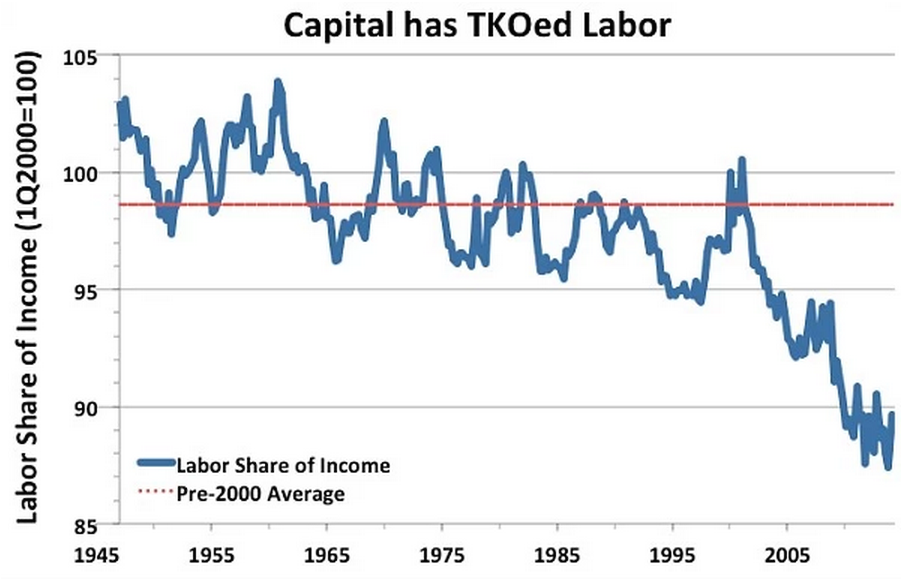
Now, economists used to think that the balance of power between labor and capital was pretty fixed. In other words, workers would always get a certain share of their company’s earnings, and owners would get the rest. For most of the postwar period, this certainly seemed to be the case: the split between labor and capital stayed roughly the same throughout, although it did start to slowly shift in management’s favor during the 1970s. Despite that, labor’s share of income was still close to its longer-term average in the late 1990s.

But, as you can see below, labor’s share plummeted at the turn of the century. What changed? Well, for one, globalization really got going. China joined the World Trade Organization in 2001, and the cost of its increased trade with the U.S. was an estimated 2 to 2.4 million jobs here, mostly in manufacturing. All this offshoring, of course, let U.S. multinationals pay their shareholders more at the expense of U.S. workers. And then the financial crisis all but finished labor off. That’s because the government did enough to save the economy, but not the unemployed, so companies could squeeze their workers even more while booking record earnings. Not only that, but, for reasons that aren’t entirely clear, the middle-class jobs we lost during the Great Recession have just been replaced by low-paying ones during the not-so-great recovery. That’s kept labor from catching up at all the past few years.

Capital And Labor

So the crisis has let Corporate America gobble up an even bigger slice of the income pie for itself, while the rest of America is stuck hoping for some wage crumbs.

Caffeine In The Genetic Code

OLYMPUS DIGITAL CAMERA

Andrew Giambrone flags new research on why you might be craving that cup of coffee this morning:

By analyzing DNA as well as data on 120,000 adults of European and African-American heritage, the researchers identified eight genetic variants that predispose individuals to seek out and drink caffeine. “Our results show that people are naturally consuming the amount of coffee that allows them to maintain their optimal level of caffeine” to get that good caffeine feeling without becoming jittery, Cornelis told me. “If we need more, we’re reaching for it.”

Six of the genetic variants examined in the study were newly discovered by the researchers. According to Cornelis, individuals whose DNA expressed all the variants tended to drink around half a cup of coffee more than those without them. Additionally, the new genes can explain about 1.3 percent of all coffee-drinking behavior, or about the same amount that genes can explain other habits, like smoking and alcohol consumption. While those effects may seem small, Cornelis said the study sheds light on why individuals’ bodies and brains react differently to caffeineand how some people feel anxious after a single cup of coffee, whereas others can down a Starbucks Venti and feel just fine.

(Photo by Flickr user Alan)

Spoken Like A True Leader

Authors David Mark and Chuck McCutcheon highlight examples of speech patterns among politicians:

Take “my good friend”—politician-speak for somebody he or she often can’t stand. “My good friend” is most commonly used on the House or Senate floors when addressing a colleague. Usually it’s a thinly veiled way of showing contempt for the other lawmaker while adhering to congressional rules of decorum. When Democratic Rep. Gene Green of Texas first arrived on Capitol Hill in the early 1990s, he recalled, “The joke we had was, when someone calls you their good friend, look behind you. I try not to say it unless people really are my good friends.’”

A linguistic cousin of “my good friend” is another term favored by an older generation of House members:

“minimum high regard.” Former Rep. Martin Frost of Texas, who held several Democratic leadership positions during his tenure from 1979 to 2005, turned us on to this time-honored knock against political foes. Frost recalled “one House member saying to another during floor debate: ‘I hold the gentleman in minimum high regard.’” Frost helpfully translated the phrase for us: “It means, ‘You are an idiot.’”

There’s also “counterproductive,” which, as Brookings Institution President Strobe Talbott told National Public Radio, is “a word we use here in Washington to mean ‘stupid.’” And lawmakers have found they can get away with almost anything if they preface it with, “With all due respect.” That’s just what Maryland Democratic Rep. Chris Van Hollen did in a December 2013 MSNBC interview chiding Kentucky Sen. Rand Paul that Congress would be doing a “disservice” to workers by extending unemployment benefits. “With all due respect to Sen. Rand Paul, that is a ridiculous argument,” said Van Hollen.

Mark and McCutcheon’s new book, Dog Whistles, Walk-Backs, and Washington Handshakes: Decoding the Jargon, Slang, and Bluster of American Political Speech, is available here.

The Best Of The Dish Today

First up, the burning issue on everyone’s minds. Not Ebolisis – a strange pandemic in which the deaths of a handful of Westerners has caused an entire nation to brown its whites:

pt3zpm8eavkixwtkvyh5

No, I mean the relative absence of wing-wangs on TV and the big screen. (All links in this post are NSFW, BTW.) Despite Trey Parker’s fascination with the remarkably few swinging dicks on Game of Thrones, there’s still an obvious double-standard for men and women. Boobs have long been everywhere, as the charming Seth McFarlane once reminded us at the Oscars; vaginas much less so – but still common in indie movies; bare butts are now ubiquitous. But even Lena Dunham only shows a somewhat comically deflated dick on the bathroom floor after her parents have an accident during shower sex. And in the most famous dick-shot in movie-history – although readers are more than welcome to correct me – it’s pretty dark and vague down there. 

But the pendulum seems to be swinging the other way, as this rather amusing chit-chat at TNR suggests. There’s a whole thread at Deadspin, it appears, called Athlete Dong, edited by a self-style “Dongbudsman” who features the unmissable, usually in spandex. (Yes, that was an hour down the drain this afternoon.) Then there was the great Jon Hamm package followed by the more recent jogging display by The Leftovers‘ Justin Theroux – and now some question whether Ben Affleck’s dick is in Gone Girl or not. And don’t forget the penis pioneering of Jason Segel. The Starz network is apparently in the lead, but

Showtime has also had their fair share of penises on display. One fellow in particular that comes to mind is Jody (Zach McGowan) on Shameless. Not only did we get a look, they even gave us a long close up. It was, shall we say, memorable. Overkill? Heck no! It was situational and it drove the plot, which is more than I can say for countless shots of female full-frontal nudity or breast shots.

The TNR writers have various points to make about this – is it feminism finally FTW? are dicks finally being treated as objectively as boobs? etc – but one factor seems obvious to me. The dick pic is what’s new. And the dick pic has begin to change the next generation’s views about views of wandering willies.

The Dish has long celebrated the wonderful, compassionate tumblr CritiqueMyDickPic (see here and here), as well as an art exhibit of such pics, and a YouTube called “Janet Looks At 89 Dicks“. And now the great Instagram account @thatlookslikeadick makes its Dish debut:

Screen Shot 2014-10-16 at 7.42.38 PM

But the existence of all these is not (just) a function of my own curiosity, but primarily a small sign of the legion of penises marching around social media these days. Sexting has broken the taboo – for men as well as for women. Except, of course, most dick pics sent on Tinder or Grindr or whatever’r are erect, while almost all movie/TV shots are extremely flaccid, even moments after orgasm. That’s where we have yet to venture on TV. Where have you gone, Lena Dunham? A nation turns its lonely eyes to you.

Earlier on the Dish today, we covered the pretty unforgivable lapses in treating Ebola cases in the US (and some truly foul electioneering by the GOP); we hailed a possible breakthrough in nuclear fusion and took issue with some whiny lefties over it; I had some real due process concerns about the new sexual consent law in California and Harvard (Conor FTW); and I noted a somewhat pathetic effort by the American bishops to re-translate Monday’s Relatio from Rome on welcoming gay people into the church in order … well, for us to feel less welcome. Plus: the latest liberal interventionist proposal for mission creep in the Syrian-Turkish-Kurdish Clusterfuck that Obama so foolishly got us into.

The most popular post of the day was Yes, This Is A Pastoral Revolution; followed by Codifying Consent, Ctd. And the most popular t-shirts publicizing the Election Day vote to legalize pot in Alaska, DC, and Oregon are here:

know-dope-shirts

Buy the standard “Know Dope” t-shirt (seen on the left) here. Buy the DC one (on the right) here. That same design but with “Alaska” on it available here. And all you Oregonians out there, get your version here. Each version is just $20. All purchases help us keep this blog on the road. And don’t forget to email us a pic – with or without a dick – after your shirt arrives.

See you in the morning.

The Fusion Of Journalism And Advertising, Ctd

There isn’t even a fig-leaf any more. The reporter and the copy-writer are exactly the same person over at the Mail Online:

Mail Online runs journalists’ bylines on the [native advertising] pieces, a move designed not only for transparency but also for commitment to sponsor content being held to a high standard …

A recent example of this is a monthlong campaign kicked off last week for T-Mobile. Mail Online pitched the carrier with a content program that’s part of a larger ad package for T-Mobile’s new home-networking technologies … That’s where Mail Online’s U.S. technology and science editor Mark Prigg comes into the picture. In the first of five sponsored offerings, he was enlisted to create the first piece of the program, a detailed examination of the “10 surprising hacks to improve your home’s technology for FREE.” The piece is wrapped Screen-Shot-2014-10-15-at-3.02.44-PMby a T-Mobile advertising “skin,” and carries “Sponsored by T-Mobile” in blue. Unlike other publishers, Mail Online does not file its native ad stories in a sponsored section — this piece is in its science and tech vertical.

Prigg is also the “journalist” who reviews T-Mobile products for the paper. And what’s fascinating to me is how so many editors have not struggled with this obvious conflict, but regarded all criticism as absurd: “It’s amazing the debate continues to go on when advertorials have been around forever,” says Mail Online North America CEO Jo Steinberg.

Arianna Huffington has also proudly announced that HuffPo staffers will now be directly embedded in an ad agency to create the native ads that will run on HuffPo. There is not even a scintilla of concern about the journalistic ethics of that. As for whether the surrender of journalism to advertising is actually selling anything – well:

There’s more evidence that the impact of sponsored content, a hot trend in advertising, is hard to measure. According to a new report from the Content Marketing Institute, only 23% of business-to-consumer marketers polled said they were successful at tracking the return on investment of their content marketing program. That figure rose to 43% for marketers who said they had a written content marketing strategy.

And the beat goes on …

The Battle For Benghazi Heats Up

LIBYA-UNREST-BENGHAZI

Yesterday, two Egyptian officials claimed that Cairo was taking on an active role in the Libyan civil war, and that Egyptian warplanes had carried out airstrikes against Islamist militias in Benghazi:

The two officials, who have firsthand knowledge of the operation, said the use of the aircraft was part of an Egyptian-led campaign against the militiamen that will eventually involve Libyan ground troops recently trained by Egyptian forces. The operation, they said, was requested by the internationally recognized Libyan administration based in the eastern city of Tobruk. That elected administration was thrown out of the capital, Tripoli, by rival militias allied with Islamic political factions. “This is a battle for Egypt not Libya,” one of the senior officials said. “Egypt was the first country in the region to warn against terrorism and it is also the first to fight it.”

Egypt officially denied the claim. Mohamed Eljarh puts the news in context, noting that fresh fighting broke out in Benghazi just yesterday:

The clashes started a few hours after a televised statement by ex-general Khalifa Haftar in which he vowed to capture the city from a coalition of Islamist groups called The Benghazi Shura Revolutionaries Council, which is dominated by the extremist group Ansar al-Sharia. Both sides are deploying artillery and other heavy weapons in the fighting. …

The city of Benghazi, Libya’s second largest, has endured a two-year assassination campaign targeting army and police personnel as well as judges, journalists, and civilian activists. Many Libyans blame the attacks on extremist Islamist groups. The Libyan authorities have been unable to establish control in the city and its people have become correspondingly disillusioned with government institutions. Last May, General Haftar decided to seize the initiative by deploying units of the National Army in a military offensive against the militias in the city. His efforts have met with widespread support across the country.

Alaa al-Ameri predicts that Egypt’s intervention will backfire:

Egypt’s intervention in Benghazi allows Libya’s Islamists, who had hijacked Libyans’ hard-won chance at democracy at every turn, to point to the House of Representatives’ allegiance with Sisi as proof that the Islamists are the true defenders of the Libyan revolution. Their patrons in the region, most notably Qatar, can now support them more readily than when Libya’s troubles appeared to be purely internal, thereby adding more fuel to the fire and threatening a much wider regional spillover. Although Qatar has made a public show of easing back on its regional sponsorship of Islamists, it seems unlikely that it will completely abandon its allies in Libya, whom it has supported with weapons and money since the beginning of the uprising against Muammar Qaddafi’s regime in early 2011.

Frederic Wehrey notes that Libya currently has no single, legitimate governing authority:

There are now two governments in Libya. One is in the eastern city of Tobruk, backed by the rump of the elected parliament, the House of Representatives (HOR). The other, based in the capital, Tripoli, has taken de facto control over ministries, relying on a handful of former members of the HOR’s predecessor, the General National Congress (GNC), to provide a veneer of legitimacy. Each is associated with a coalition of militia forces: those supporting the rump parliament have dubbed themselves Operation Dignity; those opposing it go by Operation Dawn. And each is flush with cash, heavy weaponry, and support from outside powers — Egypt and the United Arab Emirates (UAE) have backed Dignity, while Qatar, Sudan, and Turkey are purported to be backing Dawn. Contrary to some commentary, both sides have used force against civilians and elected institutions, and both show little sign of compromise.

Mary Fitzgerald explores the complexities of the divided country and how the fighting has affected ordinary Libyans:

The militias’ fighting this summer left Tripoli scarred: The international airport is a burned-out shell, and scores of homes lie ruined in the worst-hit neighborhoods. But elsewhere in the capital, life goes on — families flock to the beach or busy cafes, and traffic snarls in the usual gridlock. There is little overt militia presence, apart from outside certain ministries and the area around the destroyed airport.

The Dawn camp knows it needs to get the people on its side. Its effort is hindered, however, by lingering memories of the killing of more than 40 demonstrators by Misratan militiamen last year. “All these militias are as bad as the other, no matter who they claim to represent,” says one shop owner who shuttered his business for weeks in July and August. “Most Libyans want to see the end of all of them.”

(Photo: A vehicle drives in a deserted road as smoke billows during clashes between soldiers and Islamists who control Benghazi, the country’s second biggest city, on October 15, 2014. By STR/AFP/Getty Images)

Inching Closer To An Agreement?

Iranian officials are reportedly considering a compromise offer by the US that would resolve one of the main sticking points in the slow-going negotiations over Iran’s nuclear program:

At issue is Iran’s uranium enrichment program, which can make both reactor fuel and the fissile core of nuclear arms. Tehran insists the program is only for future energy needs. Iran is refusing U.S. demands that it cut the number of working enriching centrifuges from nearly 10,000 to only a few thousand. That dispute has been the main stumbling block to progress since the talks began early this year.

Ahead of a Nov. 24 deadline to seal a deal, diplomats told the AP last m nth that U.S. had begun floating alternates to reducing centrifuges that would eliminate the disagreement but still accomplish the goal of increasing the time Iran would need to make a nuclear weapon. Among them was an offer to tolerate more centrifuges if Tehran agreed to reduce its stockpile of low-enriched uranium, which can fuel reactors but is also easily turned into weapons-grade material. Back then, Iran was non-committal. But the two diplomats said Thursday it recently began discussions with Moscow on possibly shipping some of its low-enriched stockpile to Russia for future use as an energy source.

Suggesting some other potential compromises, Reza Marashi hopes that both the Obama and Rouhani administrations can overcome the domestic political challenges that stand in the way of an otherwise feasible and necessary deal:

The reality facing both sides will not change:

There are spoilers in the U.S. and Iran who will try to torpedo a deal, no matter the details. Precisely because it is impossible to satisfy ideologues, they only way to defeat them is to have a deal in hand that both sides believe is a win-win outcome. That will force the ideologues to publicly flesh out the details of their alternative — and the only alternative to a comprehensive deal is war. That is Obama and Rouhani’s trump card, and as November 24 approaches, they must play to win the game.

Matthew McInnis suspects the Iranians are under more pressure now than before:

Perhaps the eagerness we are seeing from some in Tehran reflects a regime realizing it must reach an agreement even if the deal may be a more painful pill to swallow than expected. The recent substantial drop in oil prices may have convinced Rouhani and the senior leadership that their critical domestic economic reforms are in potential serious jeopardy and that sanctions relief must happen soon. That is not to mention the conflict with ISIS is also bleeding valuable resources. Fears of the Israelis starting a covert campaign against their nuclear facilities may have spooked the military.

But Drezner is less optimistic:

Complaining that domestic politics is getting in the way of a nuclear deal is a little like complaining that enriched uranium is getting in the way of a nuclear deal — they are both intrinsic to the negotiations. … It’s also not obvious to me, by the way, that either President Obama or President Hassan Rouhani will be able to make the hard sell on a compromise to their respective legislatures. It’s not like Obama’s national security street-cred is riding terribly high at the moment, and Rouhani has his own hardliners to massage.

So the political scientist in me thinks that a nuclear deal would be good for the United States in the short and long runs. But that same political scientist in me is also increasingly skeptical about arguments that leadership will somehow be able to override hardliners in both countries to get to that deal.