The Syrian-Turkish-Kurdish Clusterfuck, Ctd

Senate Armed Services Chairman Carl Levin has come out in favor of establishing a buffer zone along the Turkish-Syrian border, along with a no-fly zone, to protect civilians against both ISIS and the Assad regime:

“We should seek to establish a delineated buffer zone along the Turkish border in order to protect civilians, a zone which would be secured by Turkish boots on the ground, if Turkey is willing, protected by a coalition no-fly zone,” Levin said Wednesday morning at the United States Institute of Peace. “Both things will be necessary, for Turkey to consider Turkish boots on the ground inside Syria along that border, there must be a no-fly zone to protect that buffer zone… and we should seek to do that.”

This is not the first time Levin has called for a no-fly zone in Syria. In March of 2013, Levin endorsed the idea of a no-fly zone and airstrikes against the Assad regime. But that was before the Obama administration made a deal with Assad promising no airstrikes against his forces in exchange for Syria turning over its chemical weapons stockpiles.

Levin’s proposal would fulfill some of Turkey’s conditions for participating in the fight against ISIS in Syria. However, Kate Brannen points out, it would also be an expensive, risky undertaking that could draw us much deeper into the Syrian civil war than we’d like to get (which, in turn, would sort of fulfill Turkey’s other main condition):

Creating a no-fly zone along the Syrian-Turkish border that could serve as a refuge for civilians fleeing the Islamic State and a training ground for members of the Syrian opposition would most likely mean taking out Syrian air defense systems and possibly taking on its air force. That could result in significant numbers of Syrian military fatalities — and potentially American ones.

That type of fight would also run the risk of setting back the fight against the Islamic State, as the United States and its coalition members would essentially be fighting a war on two fronts. The Syrian military has not interfered with U.S. airstrikes against terrorist targets in eastern and northern Syria, but that could change if U.S. airplanes also start bombing Syrian targets.

As for Ankara’s surprising behavior of late, Totten stresses that it shouldn’t be surprising at all:

When [Turkish President Recep Tayyip Erdogan] looks at the map he sees dominoes. Kurdish independence in Iraq could lead to Kurdish independence in Syria which could lead to Kurdish independence in Iran which could lead to Kurdish independence in Turkey. Every time a new independent Kurdish entity pops up in the Middle East, the liklihood that Turkey will lose an enormous swath of its territory increases. His analysis is correct. So he’ll bomb the Kurds but not the Islamic State. He’d be against Kurdish independence in Syria even if the PKK didn’t exist.

Turkish animosity against Kurds is hardly a secret, so I’m not sure why so many in Washington can’t understand this guy. Maybe it’s because he lets girls go to school and doesn’t stone anybody to death.

Derek Davison seconds that:

The fact that Turkey would apparently rather let Daesh slaughter and enslave the Kurdish defenders of Kobani than do anything that might benefit long-term Kurdish political aims may be immoral, unconscionable, even indefensible on a humanitarian level, and it’s fine to condemn Turkey on those grounds, but as a pure calculation of national interest, what Turkey is doing shouldn’t surprise anybody. It’s not as though America hasn’t greatly wronged the Kurds in the past, when it was in US interests to do so. It’s also worth noting that the UK and Germany have also opted out of direct military involvement in Syria, but nobody seems to be talking about expelling them from NATO or moving American military hardware to other countries in Europe.

It may be that Turkey will still come around to America’s position on Daesh, or at least closer to it; recent Kurdish protests aside, Ankara’s Syria policy has been consistently unpopular within Turkey, and PKK threats to break-off peace talks with the government over its inaction in Kobani may yet force Erdogan’s hand. But if Erdogan is swayed, it will be because of domestic politics, not American pressure or threats.

The Grave Risks Of A Travel Ban, Ctd

quarantine1

New survey data from YouGov show that the public is pretty enthusiastic about quarantines and travel bans as means to prevent an Ebola outbreak:

Those following news about the virus are especially likely to want to take action.  82% of those who have been following news stories about Ebola very closely would quarantine travelers from countries with Ebola outbreaks; two in three would completely exclude travelers from those countries.

We covered the debate over a travel ban earlier this week. Rebecca Leber outlines how a potential quarantine policy would be enforced:

Authorities generally prefer to make recommendations and rely on people to follow them in good faith. “In the U.S. we tend to try to do a softer approach, not be too coercive, and not scare people so as to drive the epidemic underground,” says Lawrence Gostin, a Georgetown University professor and Director of the World Health Organization Collaborating Center on Public Health Law and Human Rights.  The exceptions are situations in which people are ignoring recommendations. And that’s already happened at least twice in the Ebola saga. …

In Dallas, Texas, four people who were inside the apartment when Duncan became ill are also under quarantine. But local authorities have handled it in a way that highlights the potential danger of the approach. Duncan’s partner and her family were trapped in a contaminated apartment for days, amid soiled bedsheets and clothes, before they finally could move to a clean apartment. Gostin told me this may be unconstitutional. “That’s unacceptable to subject people who are quarantined to that kind of risk to their health,” he said.

Douthat resists the suggestion – one that is gaining traction on the far right – that the Obama administration is avoiding such measures for ideological reasons:

Sure, maybe the Obama White House isn’t wild about the potential implications for immigration politics of giving ground on a quarantine or travel ban … but the potential implications of a hundred Ebola cases spread across five cities are so, so much worse that the political-ideological incentive cuts, if anything, in favor of overreacting. And what’s true of crisis politics around a specific issue like immigration is true of crisis politics writ large: Because there is nothing, nothing that would wreck Obama’s legacy and his party’s immediate fortunes alike more than a real Ebola outbreak in the United States, I have to believe that people in the White House have what they consider sound, non-ideological reasons for why a travel ban isn’t a no-brainer[.]

To J.D. Tuccille, a fear-based response to Ebola is scarier than the disease itself:

To be honest, it could all be a lot worse. In the frenzy of panic over potential bioterrorism post-9/11, many states adopted part or all of the Model State Emergency Health Powers Act, written by Lawrence O. Gostin, a professor of law and public health at universities including Georgetown and Johns Hopkins. Gostin argued that “Although security and liberty sometimes are harmonious, more often than not they collide.” He added, “The central inquiry, then, is not whether government should have the power to act… Rather, the proper inquiry is under what circumstances power can be exercised.”

The resulting legislation, the American Civil Liberties Union noted at the time, “doesn’t adequately protect citizens against the misuse of the tremendous powers that it would grant in an emergency.” Nobody has yet proposed dusting off that fear-fueled legislation. But with the whiff of cold sweat in the air, it’s all the more reason to fear panic more than a virus.

What The Hell Is Happening In Houston?

News dropped on Tuesday that pastors’ sermons had been subpoenaed in the ongoing legal maneuvering over the city of Houston’s equal rights ordinance (HERO), which includes prohibitions against discriminating on the basis of sexual orientation and gender identity:

Opponents of the equal rights ordinance are hoping to force a repeal referendum when they get their day in court in January, claiming City Attorney David Feldman wrongly determined they had not gathered enough valid signatures to qualify for the ballot. City attorneys issued subpoenas last month during the case’s discovery phase, seeking, among other communications, “all speeches, presentations, or sermons related to HERO, the Petition, Mayor Annise Parker, homosexuality, or gender identity prepared by, delivered by, revised by, or approved by you or in your possession.”

To add to the story, Mayor Annise Parker is openly lesbian – creating an irresistible opportunity for the usual suspects. Fox News hack Todd Starnes declares that, if pastors are arrested for refusing to obey the subpoenas, then “Christians across America should be willing to descend en masse upon Houston and join these brave men of God behind bars.” Dreher is having his usual cow. The issue is a little more complicated, though:

When the city rejected the petition on the ground that the signatures were invalid, some opponents of HERO—not the pastors themselves—challenged the city’s decision in court. The city issued the subpoenas in connection with that litigation.

The theory, as I understand it, is that because these pastors helped organize the petition drive and hosted meetings, the pastors’ statements about the petition are important. I guess the idea is that the pastors may have said something that induced phony signatures … So when the city says it would like to know what the pastors may have said about the petition drive itself, that’s not a completely untenable position, given the freewheeling rules of American pretrial litigation.

Still, the subpoena is disturbing to me – and way too broad, as Eugene Volokh notes. But the story falls a little flat because, well, the mayor herself claims she first heard about the subpoenas yesterday and agrees with the critics. Katie Zavadski investigated and found out the following:

The subpoenas were sent by outside attorneys working for the city pro bono. They were looking into what instructions pastors gave out to those collecting signatures for a referendum on the non-discrimination law. (What exactly the pastors said, and what the collectors knew about the rules, is one of the key issues in pending litigation around whether opponents of the law gathered enough signatures for a referendum.)

“There’s no question, the wording was overly broad. But I also think there was some deliberate misinterpretation on the other side,” Parker said at a press conference Wednesday. “The goal is to find out if there were specific instructions given on how the petitions should be accurately filled out. It’s not about, ‘What did you preach on last Sunday?'”

Katie also notes that the mayor’s office confirmed via email “that the city will narrow the scope of inquiry into the pastors’ communications to more directly target HERO petitions.” Which is a relief.

Update from a helpful reader:

I’m an attorney who does civil litigation, so subpoenas like this are very familiar to me. One important point is that the City has no ability to enforce these subpoenas itself. Any party in civil litigation can issue a subpoena on its own and without court permission. If the people who receive the subpoena think it is too broad, they can object, and the party who issued it then has to convince the judge in the litigation that the subpoena is appropriate.

Also, the typical process for dealing with an issue like this is that the person (or their attorney) who receives a subpoena would call the attorney who issued it, express their concern, and the two sides would try to reach a mutually agreeable compromise. Such “meet and confer” sessions are routine in civil litigation, and would be required before the issuing party could ask the judge to enforce the subpoena.

Thus, there are very reasonable safeguards in place against abuse.

The American Bishops Try To Re-Write The Relatio

The hierarchs largely appointed by John Paul II and Benedict XVI have amended the English translation in ways that are unfaithful to the original Italian – and all as a way to tone down any outreach to gay people. So the section titled “Welcoming Homosexuals” has been changed to “Providing For Homosexuals.” So we are to infer that the Catholic bishops in America really don’t want to welcome gay people. It’s critical to note that “in nearly all cases, the first version followed the official Italian version in verbatim; the second provides a different tone altogether.” And so:

The first version asked if the church was capable of “welcoming these people, guaranteeing to them a fraternal space in our communities.” The new version asks if the church is “capable of providing for these people, guaranteeing … them … a place of fellowship in our communities.” The first version said homosexual unions can often constitute a “precious support in the life of the partners.” The new one says gay unions often constitute “valuable support in the life of these persons.”

All of which goes to show that the reactionaries are going to fight this papacy down to petty issues such as translations. This Synod is just the beginning of the struggle; and that struggle’s success will lie in the wiles and, above all, longevity of Francis.

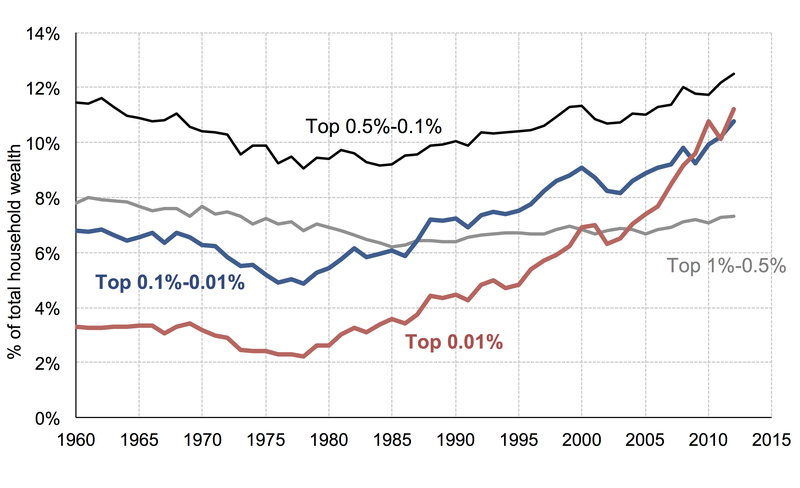
Chart Of The Day

Wealth one percent

Yglesias eyes the wealthiest Americans:

The basic punchline is that wealth — accumulated asset ownership — is very, very concentrated and has been growing more concentrated for a generation. Back in 1980, 0.01 percent of the population owned three percent of national wealth. Today that top 0.01 percent, about 32,000 people, owns about 11 percent of national wealth. That’s a staggering increase from an already high base.

The Ebola Election?

Cillizza calls the outbreak in the US the “October surprise” of the midterms. How the epidemic fits into the pre-existing election narrative:

The country is as anxious and uncertain as it’s been in a very long time.  Much of that anxiety had been laid at the feet of a deeply uncertain economic situation (the broad indicators improving without much to show for it closer to the ground) and the turbulence abroad (the Islamic State, Russia, the Middle East, etc.) coupled with a broader sense that the institutions that we once relied on (government, church, the justice system) are no longer reliable.

That sense of drift — caught between the old way of doing things and a not-yet-realized new way of doing things – is palpable in polling (huge majorities who say the country is headed in the wrong direction, a desire to get rid of everyone in Congress in one fell swoop) and in conversations I’ve had both with political professionals and average people. Ebola — with its sky-high mortality rate and lack of a vaccine – dovetails perfectly with those existing fears and anxieties.

Still, Waldman really wishes candidates would refrain from campaigning on it:

Here’s what I’d like to hear a candidate say when asked about this: “I don’t have an Ebola policy, because I’m running to be a legislator. It’s the job of legislators to do things like set budgets, but when there’s an actual outbreak of an infectious disease somewhere in the world, we should step back and let the people who actually know what they’re doing handle things. In this case, that’s the Centers for Disease Control. This is why we have a CDC in the first place, because if we were relying on politicians to keep us safe from infectious diseases, we’d really be screwed.”

You can call that an abdication of responsibility, but it isn’t. Even if Congress has an important role to play in setting policy priorities for agencies like the CDC, once there’s a potential crisis occuring, the idea that a bunch of yahoos like Pat Roberts should be determining the details of our response is absurd.

Nia-Malika Henderson observes that the public is weirdly confident in the government’s ability to handle an Ebola outbreak:

On the one hand, a new Washington Post/ABC News poll shows they are deeply dissatisfied with the effectiveness of the political system — a.k.a. all the people and processes that are in place to address things like health emergencies. The dissatisfaction is bipartisan, with 66 percent of Democrats and 80 percent of Republicans agreeing. But when it comes to Ebola, people are somehow confident that the federal government, which is (of course) part of that very same political system they deeply mistrust, has the ability to effectively respond to an outbreak. Again, that confidence is largely bipartisan, with 54 percent of Republicans and 76 percent of Democrats expressing confidence.

That’s still a significant gap, though. Looking at the same poll, Brendan Nyhan reflects on how partisanship drives the way people answer these questions:

This finding represents a striking reversal from the partisan divide found in a question about a potential avian influenza outbreak in 2006, when a Republican, George W. Bush, was president. An ABC/Post poll taken at the time found that 72 percent of Republicans were confident in an effective federal response compared with only 52 percent of Democrats. The partisan divide also appears to have grown as Republican disapproval of President Obama has deepened. …

These findings illustrate how people use simple partisan heuristics to make judgments about future government performance. Few people know about how the federal government responds to disease epidemics, but most people have views about President Obama and the job he is doing in office. That’s why Democrats are more confident in government’s capacity for an effective response than they were in 2006, for example, not because they approve of how the Centers for Disease Control and Prevention is being managed.

Beating New Life Into Occupy Central

Just as Hong Kong’s protest movement seemed to be losing steam, a video of a protester being assaulted by police in the pre-dawn hours of Wednesday morning has re-energized the movement:

In footage by local television station TVB, the protester, later identified as Civic Party member Ken Tsang, is escorted by six officers to a dark corner and pushed to the ground, his hands bound in a plastic tie. The government later confirmed there were seven officers involved in the assault, all of whom have now been suspended. In the video, police then punch and kick Tsang while others stand watch, which the reporter narrating the scene has said lasted for about four minutes. …

The video quickly went viral on Facebook, Hong Kong’s social network of choice, with web users launching a so-called “human-flesh search,” using social media to identify those involved in the beating. An Oct. 5 page on Facebook originally used to identify anti-occupy protesters was quickly repurposed to identify abusive police. Some netizens have even condemned police officers as “black cops,” slang meaning they have forfeited their role as public servants, working instead for undefined “dark” forces.

Suzanne Sataline was present for the police raid where the video was allegedly taken:

Around two o’clock, a cry arose from the crowd. “Police!” people shouted. The trill of whistles pierced the air. The protesters raced from the tunnel, donning safety goggles and masks. After 10 minutes, a sea of bobbing blue lights drew closer from the road’s western end. Word raced through the crowd. More police were coming from the east. And a cluster of white lights emerged from the walkway along Victoria Harbour. None had helmets — a good sign, I thought. That meant no tear gas. Hundreds of officers, with round riot shields, began pushing the crowd backwards, toward the tunnel. Another contingent pushed protesters in the other direction. Suddenly, the officers coming from the shore amassed a few feet from a group of us in Tamar Park, a small patch of lawn and trees atop the highway tunnel. The officers addressed the crowd over a bullhorn.

“They say we are here illegally,” said Lock Cheung, a freelance videographer. “Police say if they don’t leave, they will use spray.” The crowd hissed. “Gangsters!” Cheung urged us to be careful. The police, he said, “don’t follow any rules anymore.”

In Ben Leung’s opinion, the incident will likely push many fence-sitters onto the demonstrators’ side:

For the neutrals, this episode could well be the tipping point. Yes, the protests themselves had lost momentum over the past 10 days or so. Yes, people are generally fed up or simply bored of the protests and the disruptions caused. But after such a brutal beating—which we know happens all the time behind closed doors at police stations or in panda cars but just never in public—it’s become harder for many to just sit on the fence. Indeed, more people are back out on the streets Wednesday night outside the main police HQ in the Admiralty District, and angrier than ever.

In response to the news, the government quickly revived an offer to hold talks with the protesters:

Chief Executive Leung Chun-ying said the government is ready to meet with student leaders as soon as next week, but urged them to be pragmatic, reiterating that Beijing will not change its mind on election restrictions. That raised doubts that the proposed meeting can overcome the vast differences between the two sides. Alex Chow of the Hong Kong Federation of Students welcomed Leung’s offer but criticized the government for setting preconditions. Many other demonstrators gathered in the main protest zone echoed his view. “I paid attention to what (Leung) said but I couldn’t find anything constructive. He didn’t say anything new and I don’t think it is going to break this deadlock,” said Tong Wing-ho, 26.

Lily Kuo didn’t hear anything too encouraging in Leung’s presser either:

Leung did float one topic that could potentially entice protesters: changing the make-up of the mostly Beijing-appointed nominating committee. “In the second round of consultation, we can still listen to everyone’s views,” he said. “There is still room to discuss issues including the exact formation of the nomination committee.” The students have insisted that changes to the committee won’t be enough, and have publicly insisted on civic nomination. Although unlikely, the possibility that the committee could be reconfigured, potentially allowing non-Beijing approved candidates to make it onto the ballot, might be enough to tempt some of the protest leaders to make the most of their considerable political leverage—and cut a deal.

Why Do Democrats Suck Up To Big Coal?

It doesn’t get them the support of the coal industry:

Mary Landrieu of Louisiana and Mark Pryor of Arkansas are the only Senate Democrats running for re-election who have voted with the coal industry more than half the time since 2008. Yet with the red-state lawmakers’ campaigns down in the polls and their political lives on the line, the industry is spending tens of thousands of dollars more than it has donated to Landrieu and Pryor to bolster the prospects of their GOP rivals.

Dave Roberts is unsurprised by these findings:

Coal executives understand one of the basic truths of the partisan age: Most of what you need to know about a politician can be derived from the (D) or (R) after their name. As the parties become stronger and more parliamentary, a reliable vote matters more than an individual candidate’s opinions or character (or even committee rank).

After all, polarization is happening on both sides. As conservative Dem senators lose in red states, Senate Democrats are becoming more unified. For Big Coal and the kind of people who feel cultural solidarity with it — the guys “rolling coal” — the choice between a coal-friendly Dem or one step closer to a Republican majority is easy. They’d be crazy not to go for the latter.