Peen Review

A reader points to the above NSFW scene in reference to me claiming that Harvey Keitel had “the most famous dick-shot in movie-history”:

I beg to differ! Surely the big reveal of Jaye Davidson‘s, um, davidson in The Crying Game takes the title?

Another doesn’t agree:

Certainly it must be Mark Wahlberg in Boogie Nights.

NSFW and after the jump, because Dirk Diggler’s dong:

Another vote for The Crying Game:

The Piano? Are you kidding me? Dissertations have been written about The Crying Game, and it’s spawned many parodies, including this scene from Ace Ventura: Pet Detective and this one from Naked Gun 33 1/3.  You did know, didn’t you?

Dish editor Chris earns his paycheck for the day:

Don’t forget the split-second schlong at the very end of Fight Club (which was only available on YouTube within the German version):

A reader comments:

I’m just guessing, but it seems pretty cut-and-dry clear to me that you don’t see erect penises on TV or in movies for the same reason you don’t see spread-open vaginas: both indicate sexual intent. Unlike a flaccid penis or bare breasts that fall into the category of nudity, an erection crosses that line, since an erection only serves one purpose. The same can be said of an open vagina. At that point you are only one degree away from porn.

So, unless you’re watching porn, it’s highly unlikely you will ever see either of those things on the big, or little, screen. And to be perfectly honest, I really prefer it that way. When I watch porn, I want to see aroused genitalia and explicit sex. But when I watch TV or movies for actual entertainment, I don’t need or want to witness an actor’s erection or wet vagina to understand sex is about to occur. I’m not that voyeuristic.

Another adds:

This is the kind of movie talk I never get to engage in at TCM.  Thanks?

Quite welcome.

The “Ebola Czar” Arrives

This morning, Obama appointed political operative Ron Klain as his point-person (er, “czar”) to oversee the multi-agency response to Ebola:

Klain, who served as chief of staff to Vice President Biden and former Vice President Al Gore, helped to oversee the 2009 stimulus bill. He will now be tasked with coordinating both the domestic public health response and the international humanitarian and military efforts to stop the virus in West Africa. Klain will work out of the White House’s West Wing. … Republican lawmakers had been calling on the White House to appoint the so-called “czar” for weeks to lead the Administration’s response. The White House had been cool on the subject until Thursday, when Obama told reporters he was considering making such an appointment.

The right is already making hay out of the fact that Klain is not a doctor, has no public health experience, and has an extensive background in Democratic party politics. Ezra, on the other hand, calls him a great choice for the job:

The Ebola response involves various arms of the Department of Health and Human Services (particularly, though not solely, the Centers for Disease Control and Prevention), the Pentagon, the State Department, the National Security Council, the World Bank, the World Health Organization, President Obama’s office, private stakeholders, and many, many more. The “czar” position requires someone who knows how these different agencies and institutions work, who’s got the stature to corral their efforts, who knows who to call when something unusual is needed, who can keep the policy straight. …

Actual government experience is badly underrated in Washington. Politicians run for office promising that they know how to run businesses, not Senate offices. “Bureaucrat” is often lobbed as an insult. But in processes like this one, government experience really matters.

Mataconis is not so sure:

[W]hile Klain certainly has experience in government, to the extent of being Chief of Staff to two Vice-Presidents counts as experience, I’m not sure that he’s the best choice for this position. The fact that his experience is purely political, and heavily so on one side of the political aisle, suggests strongly that the White House was more concerned with picking someone that they were comfortable with than the were with picking someone who would be the right fit for the job, such as, say, a retired General or Admiral or a former Cabinet Secretary of high prominence. At the least, someone with experience at running a multi-agency effort such as this would seem like a better choice. Perhaps Klain will turn out to be just what’s needed for the job, but on first glance this isn’t a very impressive appointment.

Jonathan Cohn weighs in:

Why not pick somebody whose resume includes a stint at the Department of Health and Human Services, Department of Homeland Security, or maybe the Federal Emergency Management Agency? This is not the first time the federal government has confronted a biological menace. An official who’d lived through and worked intensely on responses to SARS, Avian flu, or even HIV might bring critical and beneficial experience to the table. …

Still, the Administration doesn’t lack for expertise on disease and potential outbreaks. The Centers for Disease Control has made some mistakes, but nobody I know questions the expertise of Tom Frieden, CDC’s director, or Anthony Fauci, who is in charge of the National Institute of Allergy and Infectious Diseases. Fauci, in particular, has been working on these sorts of issues since the 1980s, when he was a key player in the government response to AIDS. (If there’s a need for more medical knowledge, perhaps the Senate could act on Obama’s nominee for Surgeon General?)

The Grave Risks Of A Travel Ban, Ctd

Yesterday, House Republicans dragged CDC Director Thomas Frieden and other health officials onto the floor for a little grilling and grandstanding about why we haven’t instituted an Ebola travel ban yet:

“None of us can understand how a nurse who treated an Ebola-infected patient, and who herself had developed a fever, was permitted to board a commercial airline and fly across the country,” said Rep. Fred Upton (R-Mich.), the House Energy and Commerce Committee Chairman. “It’s no wonder the public’s confidence is shaken.”

Upton joined other lawmakers, including Rep. Tim Murphy (R-Pa.) and House Speaker John Boehner, who want the Administration to consider travel restrictions between the U.S. and West African countries, where the outbreak has killed more than 4,500 people. “It needs to be solved in Africa but until it is, we should not be allowing these folks in, period,” Upton said at the hearing. … Frieden countered that the Administration can better track people from the most vulnerable countries in West Africa without restrictions on travel.

Dr. Steven Beutler, an infectious disease specialist, favors quarantining everyone who travels to the US from an Ebola-afflicted country:

This obviously will result in considerable inconvenience and some expense, and in this respect I realize that it sounds draconian. But the fact is, it will prevent most importation of the disease.

If the quarantine could be established prior to travel, then virtually no cases would be imported from West Africa. Ultimately, it will diminish the total number of people being quarantined and being tracked, since there will be fewer contacts and less transmission. …

Note that I am not advocating travel bans. It is hard to disagree with Dr. Anthony Fauci, the National Institutes of Health director of infectious diseases, and CDC Director Thomas Frieden when they point out the necessity of engaging the outbreak at its source, and being able to provide material support to the affected regions.

John Cassidy sees politics pushing the administration toward a “tougher” response:

The President’s problem is that he appears to be reacting to events rather than dictating them. Initially, his Administration resisted calls to screen visitors from West Africa; the day Duncan died, it announced a system of screening. Until yesterday, the White House insisted that the C.D.C. had established proper protocols and systems for hospitals dealing with Ebola victims. Now it is beefing up federal oversight and promising to fly in SWAT teams.

Will that be enough? In terms of fighting the disease and protecting health workers, we can only hope so. For political reasons, however, Obama will almost certainly have to do more—a point conceded by one of his former spokesmen, Jay Carney, who on Thursday advised the White House to reconsider its opposition to banning flights from West Africa.

Morrissey backs Obama’s decision to focus on containing the outbreak at its African source, partly because he doesn’t trust the CDC to prevent things from getting out of hand once more cases arrive in the US:

In its own way, the CDC’s fumbles over the last few weeks proves the wisdom of Obama’s warning here. Just like terrorism, it is better to fight Ebola on its own ground rather than ours, because once it gets here, it’s almost impossible to contain effectively — or at least at the moment. That is one reason that support for a travel ban from Ebola-impacted countries has become a nearly consensus position outside of the White House. People understand that the first and best defense is to keep the bug from getting to the US at all.

Yuval Levin, who supports a travel ban and expects the administration to impose one eventually, nonetheless argues that we aren’t thinking about the threat correctly:

The very nature of the debate we are now having, including the debate over the travel ban, is evidence of the fact that we probably have not yet learned not to underestimate this outbreak. We are still thinking about it in terms of a crisis in Guinea, Liberia, and Sierra Leone that could reach our shores by the various means that connect us to them.

But the real danger, to us and to others, is probably far greater than that. Our greatest worry should not be that the disease could get to the United States from those West African nations but that it will get to Nigeria’s larger population centers or to, say, India or other places with massive population density and weak public-health systems, and from there will become an epidemic throughout the third world. The scale that this outbreak is now likely to reach in West Africa will make it rather difficult to prevent that, raising the risk of a far more colossal human catastrophe than the nightmare we are already witnessing and of a greater threat to the U.S. population.

That has not yet happened, and so it is likely preventable, but what the world is doing at this point in West Africa is probably not sufficient to prevent it.

Update from a reader, who comments on the original tweet we posted:

I was hoping for you to lay down some sanity regarding the whole “You can give but not get Ebola on a bus” thing, but you posted the tweet without comment, and since I’ve seen the point ridiculed elsewhere already, I’d like to point out what seems like the obvious message behind saying something like that:

If you don’t have Ebola, go ahead and ride the fucking bus. But if you think you might have Ebola, just to be goddamn sure, don’t ride the fucking bus.

Is that such a crazy interpretation? I mean, can you imagine what people would say if Frieden had said something like: “Yeah, if you have Ebola, go ahead and take the bus, who cares, right?” What do people want from the director of the CDC besides a reassurance that if you’re healthy and at low risk you should go about your daily lives, but if you’re sick you should take more precautions than may be necessary?

I haven’t been following the details closely enough to have an opinion on whether the rest of the administration’s Ebola response has been a giant cock-up or not (although it seems like maybe yes), but it seems like people are being lazy in making fun of Frieden’s comment without doing even a little bit of thinking.

Obama And Torture: The Record Gets Worse

US-POLITICS-OBAMA-INTELLIGENCE

We are still, of course, waiting for the Senate Intelligence Committee Report to be released to the public. It’s been forever since it was finished, and forever since the CIA managed to respond, and the endless process goes on and on – even after John Brennan’s attempt to spy on the very committee supposed to oversee his out-of-control agency, and then lie about it. The very fact that Brennan is still in his job – after displaying utter contempt for the Constitution and the American people – tells you all you really need to know about where Obama really stands on this question. He stands for protecting the CIA – and Denis McDonough, his chief-of-staff, has become the CIA’s indispensable ally in enabling not only its immunity from any prosecution for war crimes, but from even basic democratic accountability.

So it does not, alas, surprise me to find this anecdote in Leon Panetta’s memoir:

The extent of the Obama’s fury over the [Senate Committee’s] study was revealed in a memoir by former CIA Director Leon Panetta that was released this month. The president, he wrote, was livid that the CIA agreed in 2009 to give the committee access to millions of the agency’s highly classified documents. “The president wants to know who the f— authorized this release to the committees,” Panetta recalled then-White House Chief of Staff Rahm Emanuel shouting at him. “I have a president with his hair on fire and I want to know what the fuck you did to fuck this up so bad!”

We don’t have merely passive indifference to the CIA’s record on torture, we have active opposition to the entire inquiry from the very beginning of Obama’s term in office. If you want to know why we are still waiting for the report almost two years since it was finished, and if you want to know why the White House refused to provide mountains of internal documents that would have added to the report’s factual inquiries, just absorb the anecdote above. And if you want to know why the White House did nothing to discipline the CIA after it hacked into the Senate Committee’s own computers, ditto. It’s impossible not to conclude that Obama wants as little of this material made public as possible. His pledge for the most transparent administration in history ends, it seems, at Langley.

The question is: why? The answer, I’d wager, is pretty simple and deeply depressing. From the very beginning, Obama was told (and apparently believed) that if he attempted to investigate or cooperate in any inquiry into the CIA’s war crimes, he would “lose the agency,” as they say in Washington. It’s a curious phrase when you come to think about it: “lose the agency”. In what other branch of abu_ghraib_thumbgovernment would cooperating with a Congressional investigation into alleged misconduct risk “losing the agency”? There’s an implicit sense here that the CIA can and will retaliate against presidents who dare to hold it to account. And that kind of conventional wisdom is what led Emanuel and now McDonough to protect the CIA at nearly any cost.
The current battle – in which McDonough is apparently indistinguishable from John Brennan – is over the extent of the redactions in the report. They’re already voluminous, but the CIA is now asking for unprecedented concessions in order to make the report as hard to understand as possible and to render critical narratives impossible to follow. So, for example, they are objecting to the use of pseudonyms to identify individuals who crop up often in the report, alleging that they somehow risk agents’ lives.

But the pseudonyms in the report are not the pseudonyms that agents use to protect their actual identities; they are merely completely fictional names in order to clarify an individual’s role over time in the torture program. Without them it could become close to impossible to make sense of the torture narrative. In the past, moreover, all sorts of reports that have emerged from government inquiries – from the Church Committee to Iran-Contra – have used real names for some individuals, and pseudonyms for others, in laying out their conclusions. But not this time, apparently. And even from the CIA’s perspective, this battle makes little sense. If all identifying pseudonyms are turned into black spaces, it can lead to the impression that the agency as a whole was responsible for various war crimes, as opposed to pseudonymous individuals within it. Removing pseudonyms actually paints the entire CIA with a much broader and darker brush than it deserves – for there were many in the CIA appalled and shocked by the amateurish brutality of the program, and many who were integral to ending it.

Then there is an attempt to redact parts of the report that include the history of intelligence before the torture program was put into effect. The CIA wants this removed as irrelevant, but in the context of the report, it can be highly relevant. If, for example, it can be shown that a certain piece of intelligence was already known in the CIA before the torture program, and a torturer subsequently claimed it was discovered in a torture session, then it is highly relevant for that history to be known. For it proves that torture was not necessary and that many of the claims for its success were without key context and therefore deeply misleading.

Yesterday’s McClatchy story leads with the notion that the report does not follow the trail of responsibility up to Bush, Cheney, Tenet, Rumsfeld et al, and is thereby somehow toothless.

But the committee was an investigation specifically into the CIA’s records on the program, to get a full accounting of what happened within that agency. It was not tasked with the essentially political job of holding the White House responsible. And it may be, in fact, that even some of the most powerful individuals in the Bush administration were actually unaware of what was really going on, or that they were merely repeating what the CIA was telling them, and the CIA was lying to cover its ass. That does not minimize the political responsibility of president Bush and others for presiding over such a grotesque torture program; but it’s essential context for understanding what actually happened.

That’s what this Committee report is really about. It is not about assigning responsibility for torture. It is merely the legislative branch’s completely legitimate inquiry into how on earth a democratic society could have sunk so low so fast in the war on Jihadist terrorism. It is the beginning of that process of truth and accountability, not its end. But even that minimal task of fact-finding has been stymied, obstructed and foiled by the CIA from the very beginning. And in that process, the president has been one of the CIA’s strongest defenders and enablers.

In no way does that mean that Obama bears the responsibility for this hideous stain on this country’s integrity and values. It does mean, however, that we have a government agency that is effectively beyond any democratic accountability – even when it commits war crimes. Something is rotten in this national security state. And it is our duty to expose it – and do what we can to make it better.

(Photo: Director of the Central Intelligence Agency John Brennan (L) talks with the Director of National Intelligence James Clapper before President Barack Obama spoke about the National Security Agency and intelligence agencies surveillance techniques at the US Department of Justice in Washington, DC, on January 17, 2014. By Jim Watson/AFP/Getty Images.)

How We Feel About Islam

islamA

A new YouGov survey sheds some light on Americans’ attitudes toward the religion:

Most Americans (59%) have an unfavorable opinion of Islam, while only 18% say that they have a favorable view of the religion. Republicans (74%) have the most unfavorable view of Islam, while under-30s (32%) have the highest favorable attitudes towards Islam.

Perceptions vary greatly as to how many Muslims sympathize with ISIS and Al Qaeda. 19% of Americans believe that most Muslims sympathize with the two extremist groups, while at the opposite end of the spectrum 31% believe that less than 10% of Muslims support ISIS and Al-Qaeda. 27% say that between 10% and 50% of Muslims around the world back the two groups. Democrats are much less likely to say that significant numbers of Muslims support the two groups, with 43% of Democrats estimating that the percentage of Muslims that support ISIS and Al-Qaeda is under 10%, something only 20% of Republicans agree with.

Looking back at how Americans’ views of Jews evolved over time from hostile to welcoming, Jon Fasman predicts that feelings toward Muslims will follow a similar path:

As with much social change, finding a single, directly attributable cause for the decline in American anti-Semitism is more or less impossible. Many nebulous things happened at once. Jews grew more “American” and less “foreign”, not least because, as the 20th century wore on, an ever-greater share of them were American-born.

… America will inevitably reach the same accommodation with Islam that it has reached with Judaism. It will take time, of course—most American Muslims are foreign-born, so are in roughly the same xenophobia-provoking demographic position as American Jews were three generations ago. But already there are encouraging signs: Muslims appear to be far better integrated in America than in Europe, as measured by their share of non-Muslim friends and by the intermarriage rate. Their worldviews more closely resemble those of non-Muslim Americans than they do Muslims outside the United States.

A reader sounds off at length:

I’m a 30-year-old atheist who deconverted from Islam on my 15th birthday. Some friends and I (all of us secular liberals from various religious backgrounds who grew up in the Persian Gulf region, then moved to the West) have been having a great online debate about the very matters you have been covering in your Islam thread. I have found a lot of the discussion online quite invigorating, notwithstanding what I have to say here.

I think there is a huge overlap in the beliefs and opinions of Bill Maher, Reza Aslan, Sam Harris, and yourself. The primary difference lies in the strategies employed and the goals of the discussion. Maher/Harris, ultimately, want to advance atheism, and that’s what sets them apart from the others. I also want to advance atheism, at least in theory, but I am also a realist and it is my realism that makes me part ways with them and, frankly, you, on this matter.

Yes, open dialogue and discussion is a principle that must be protected and advanced … except when doing so actually hinders the cause in the long-run. There are a lot of things we just. don’t. talk. about. For instance: I have met Muslims throughout my life who, in their effort to explain some of the injustices Palestinians face, are obsessed with talking about which companies have Jewish CEOs or the proportion of Jews on the board of directors of Whatever, Inc. To those people I say: I don’t know if you are right or wrong, and frankly I don’t care. It doesn’t advance the cause of Palestinian human rights to point these things out. All it does is elicit strong emotional reactions from Jewish people, and further alienates them from the fucking cause you are fighting for.

I am one of those liberals who complains within my circle of Arab/Muslim friends and family that our community needs to confront the extremism that is spreading like a cancer in our region’s politics and culture. Yet I also recognize, because I have my legs glued to the ground, that the millions of Muslims who could be fighting extremism will defend their identities and their religion first, if it is under attack. This is basic human nature, like it or not. When Bill Maher (whom I adore, BTW) condemns Islam as a religion, whatever the nuances of his argument, he is perceived as attacking the identities of literally millions of potential allies in the liberal project. These millions, instead of focusing on the scourge of extremism, expend valuable airtime and resources in defending their faith, which as Azlan rightly noted, is an integral part of their identity.

The vast majority of Muslims are like the vast majority of all human beings: they just want to eat, fuck, sleep, and work. Non-Muslim people need to STFU about Islam so that normal, everyday Muslims can begin the fight against extremism in earnest. It’s the only strategy that makes any sense and the only one that has any chance of working. Muslim extremists don’t have to answer to white liberals, but they do need to answer to people who identify as Muslim.

The reforms that took place within Christianity were not easy, but the ones that are necessary within Islam have at least one greater hurdle to overcome. The transformation of Christianity did not have to contend with accusations that reformists were trying to “Islamize” or “Easternize” Christianity; reformist Christians, to my knowledge, weren’t accused of following the “corrupt example” of a powerful, foreign, dominant culture (and one that has meddled in the affairs of the region, to its detriment). In contrast, today, any effort to reform Islam will naturally be viewed as bowing down to a dominant, powerful western culture. Considering the fact that humans will do anything to distinguish themselves from external cultural forces, you can’t possibly think of a more powerful obstacle to reform than living in the shadow of a powerful liberal-Christian culture that has already embraced those reforms.

The good news is that enough Muslims live in liberal societies. Muslims who do not live in those societies, for the most part, do view their liberal counterparts as their brethren. If we give the Muslims in our part of the world the fucking space to speak for liberal values, for reforming Islamic institutions, for advancing the good parts of the religion while downplaying or reinterpreting the ugly parts, these views will be transmitted to their counterparts in the Middle East. In order for that to happen on a bigger scale, those liberal Muslims must be given the psychological space to do so, and it is my view that when westerners from Christian or Jewish backgrounds attack even small aspects of Islam on national TV, they are lessening that psychological space. I know it sounds somewhat irrational, but issues of identity and religion rarely are.

In my non-expert opinion, Islam is probably more violent than all the other major faiths. But insofar as you want to live in a more peaceful, stable world, who the fuck cares? Non-Muslims: STFU; Muslims: SPEAK.

Marriage Equality Update

A reader provides it:

Not even two years ago, I worked to help the town of Bisbee, Arizona set up municipal-level domestic partnerships – essentially a package of trusts and contracts that would grant couples all the rights they could grant each other under existing law. There were press conferences by the Attorney General and angry editorials.

This morning a federal judge struck down an amendment to Arizona’s constitution denying same-sex couples the right to marry. It’s not even really news at this point.

Inching Closer To An Agreement? Ctd

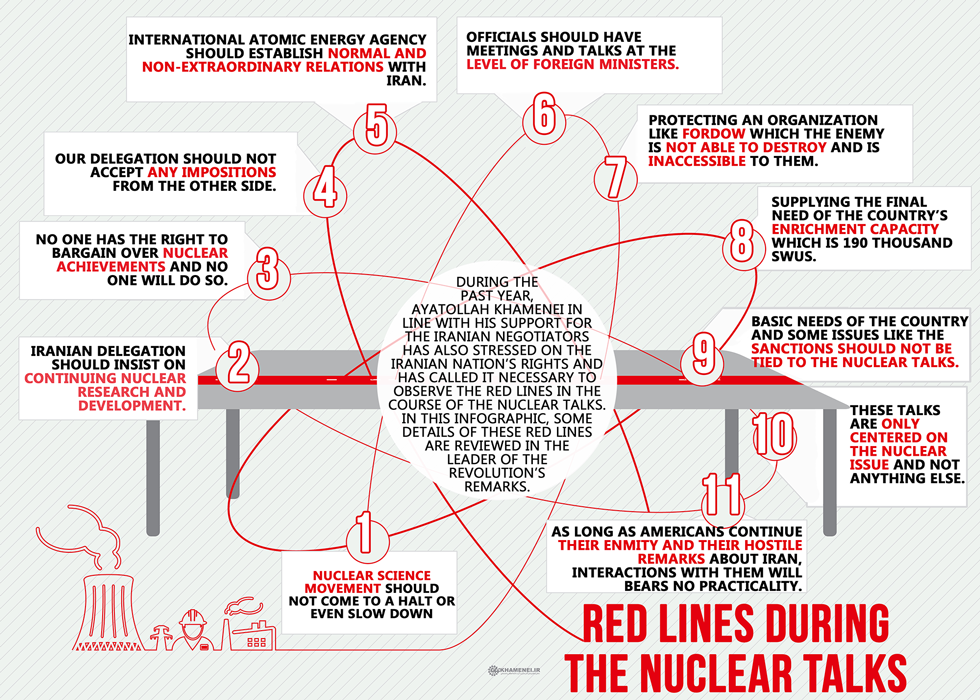
KhameneiRedLines

Suzanne Maloney provides “an anatomy of Iran’s eleventh-hour nuclear negotiating strategy.” She admits that, by “sticking to its guns, Tehran has gone from supplicant to sought-after in the talks, with Washington and its allies scrambling to devise formulas that might meet the supreme leader’s imperious mandates”:

Still, it seems unlikely to me that Washington will acquiesce to Iran’s obstinacy on enrichment. The Obama administration has already extended major concessions to Tehran in devising a formula that Tehran could claim acknowledged its nuclear rights and in backing away from previous American insistence on a suspension or end to all enrichment on Iranian soil. Any deal that fails to redress the breakout timeline would gainsay a decade of efforts to deter Iran from nuclear weapons capability, as well as the strong preferences of America’s regional allies.

And more importantly, I think the presumption that the Obama administration is so desperate for a foreign policy victory, so feeble in its assertion of American interests and the security of our allies, or so eager for Iranian cooperation on other regional challenges that it will accept a hollow deal represents a profound misinterpretation of this administration’s foreign policy and the capabilities of the United States.

For that reason, I believe that Tehran’s four-point hedging strategy is a dangerous bluff, and one that will ultimately fail. I suspect that will not prove the end of diplomacy with Iran, but neither will it facilitate the end of Iran’s self-imposed forfeiture of its rightful place in the world.

Gareth Porter maintains that the “key to understanding Iran’s policy toward nuclear weapons lies in a historical episode during its eight-year war with Iraq”:

The story, told in full for the first time here, explains why Iran never retaliated against Iraq’s chemical weapons attacks on Iranian troops and civilians, which killed 20,000 Iranians and severely injured 100,000 more. And it strongly suggests that the Iranian leadership’s aversion to developing chemical and nuclear weapons is deep-rooted and sincere.

A few Iranian sources have previously pointed to a fatwa by the Islamic Republic’s first supreme leader, Ayatollah Ruhollah Khomeini, prohibiting chemical weapons as the explanation for why Iran did not deploy these weapons during the war with Iraq. But no details have ever been made public on when and how Khomeini issued such a fatwa, so it has been ignored for decades.

Now, however, the wartime chief of the Iranian ministry responsible for military procurement has provided an eyewitness account of Khomeini’s ban not only on chemical weapons, but on nuclear weapons as well. In an interview with me in Tehran in late September, Mohsen Rafighdoost, who served as minister of the Islamic Revolutionary Guard Corps (IRGC) throughout the eight-year war, revealed that he had proposed to Khomeini that Iran begin working on both nuclear and chemical weapons — but was told in two separate meetings that weapons of mass destruction are forbidden by Islam.

Yesterday, Drezner worried that Iranian and American legislatures won’t agree to a deal. Larison adds his two cents:

Since the Senate GOP is opposed to a final agreement with Iran that doesn’t include their impossible conditions, the prospect of their takeover could adversely affect the final stage of the negotiations this year. If the Iranians see that Republicans are poised to win control, they might be more likely to stall or walk away from the talks all together. In the worst case, there might be no deal because the Iranian side assumes that the U.S. won’t be willing to fulfill the rest of its side of the bargain, or there could be a deal reached that is then blown up a few months later as it becomes clear that there will be no action on sanctions relief from Congress.

“2016’s Premier Novelty Act”

Phil Mattingly covers Carson’s budding presidential campaign:

[S]upporters launched the National Draft Ben Carson for President Committee. It raised more than $7 million in less than a year of existence. It has deployed staff members to Iowa and South Carolina and purchased tables at Republican events throughout the country. The group, according to Federal Election Commission filings, is gathering reams of supporter, fundraising and digital data that could be purchased and utilized by Carson’s campaign should he decide to give the green light. It’s a little like Ready for Hillary, the outside group pushing for the former secretary of State to jump into the 2016 race.

Except the Carson group actually outraised Ready for Hillary last quarter.

Francis Wilkinson remarks that Carson’s candidacy “promises to be a (traditional) marriage of Michele Bachmann’s personal loopiness and Herman Cain’s professional ignorance of public policy”:

In his book, Carson called the Affordable Care Act “the biggest governmental program in the history of the United States.” (So much for Social Security, Medicare, the Pentagon.) And if he can’t be bothered to learn much about government, he has an all-purpose rationale: “I would choose common sense over knowledge in almost every circumstance,” he wrote. It’s just too much to ask for both.

Carson, who is poised to be 2016’s premier novelty act, is already following the script from Cain’s 2012 Republican presidential run. He is a successful black man who tells conservative white audiences that there are no meaningful structural impediments to success: There are only character failings. That should be enough to keep him on the stage, at least until the Iowa caucuses.

Update from a reader:

Loopiness?  Professional Ignorance?  Premier Novelty Act? REALLY? I’d expect better from the Dish. For many of your readers, who may not even know who Ben Carson is, how about being fair, rather than simply trashing him? His resume is second to none:

  • Raised by a single mom in Inner City Detroit.
  • Director of Pediactric NeuroSurgery at Johns Hopkins Hospital at age of 33.
  • In 2001, CNN and Time magazine named Ben Carson as one of the nation’s 20 foremost physicians and scientists.
  • In 2001, the Library of Congress selected him as one of 89 “Living Legends.”
  • In 2006, he received the Spingarn Medal, the highest honor bestowed by the NAACP.
  • In February 2008, President Bush awarded Carson the Ford’s Theater Lincoln Medal and the Presidential Medal of Freedom, the U.S. highest civilian honors.
  • In 2009, actor Cuba Gooding, Jr. portrayed Carson in the TNN television production Gifted Hands.
  • Because of his unflagging dedication to children and his many medical breakthroughs, Carson has received more than 50 honorary doctorate degrees and is a member of the Alpha Honor Medical Society, the Horatio Alger Society of Distinguished Americans and sits on the boards of numerous business and education boards.

Find me 10 Americans alive today that are more admired, successful and accomplished. Yet you lead with Novelty Act, Loopy and Professional Ignorance.

Carson is clearly an incredible physician and humanitarian. But politician? On the Dish alone, we’ve seen Carson call Obamacare “the worst thing since slavery“, champion creationism, and compare homosexuality to bestiality and pedophilia.

When Does Spanking Become Child Abuse? Ctd

The popular thread continues with a new angle – sexual shame:

I can only remember one time I was spanked. It’s an early memory of running away and cowering in the corner while my very sweet and kind father came towards me. I was so scared. The spanking wasn’t terrible but that image will stick with me forever. That and the humiliation. I still can’t reconcile it with my father’s otherwise extraordinarily loving personality. And I have no memory of why I was punished. Clearly the “lesson” didn’t stick. But that image always will.

As an absolute aside, has anyone noticed that hitting someone’s buttocks is an oddly sexual place to hit someone? Could it, even unintentionally, be a form of sexual abuse? Certainly that element adds to the humiliation of being spanked.

Another can relate to that humiliation:

My parents never paddled me with an implement, or whooped me with a switch, or a belt.

My father spanked me, bare-bottom, bare-handed over his knee until I was about six. For some reason, the recent discussion about child abuse and corporal punishment treats spanking as a lesser act, like a kindly “slap on the butt”. I couldn’t disagree more.

My earliest emotional memories are the terror and shame I felt as my dad tore down my pants and spanked my bare bottom. The anger and rage he expressed terrified me. I didn’t understand. It didn’t teach me anything, except to fear my father, who surely had loving thoughts of his son. It took ten years before I could get to know my dad, and I wonder often how it might have been different. And he wasn’t otherwise a frightening figure. He was a bookish lawyer from a good family.

There’s a sexual element to corporal punishment that is difficult to confront. Society nearly admits as much when witnesses are required for female students to be spanked. Maybe small children haven’t formed sexual identities yet, but I am certain the sexual shame of bare beatings is felt, even if it can’t quite be articulated.

Update from a reader:

Without delving into the question of whether spanking across the buttocks constitutes sexual abuse, intentional or otherwise, there is a practical reason for striking someone there. The sciatic nerve runs over the gluteus muscles in the buttocks, meaning that a blow delivered to that spot can deliver a fair amount of pain without causing lasting damage.

The Basics On Basic Bitches

If you’re not familiar with the cultural meme yet, College Humor has you covered:

Noreen Malone looks closer:

It seems to me that while what it pretends to criticize is unoriginality of thought and action, most of what basic actually seeks to dismiss is consumption patterns — what you watch, what you drink, what you wear, and what you buy — without dismissing consumption itself. The basic girl’s sin isn’t liking to shop, it’s cluelessly lusting after the wrong brands, the ones that announce themselves loudly and have shareholders they need to satisfy. (The right brands are much more expensive and subtle and, usually, privately owned.)

The basic girl is also someone who isn’t into androgyny.

She likes being a woman, or at least she buys the products that are so inherently female-skewing they don’t even NEED to be explicitly marketed to women, like low-calorie margaritas invented by Bravo heroines. She delights in all the things that men dismiss as unserious or that don’t often even register for them as existing — celebrity gossip, patterned disposable cocktail napkins that mean something sentimental. She expresses traditionally feminine desires, like wanting to get married or to have kids. She doesn’t have a poker face when it comes to those things, and doesn’t see the point in trying to develop one. She likes what she likes and she doesn’t care if it doesn’t make her outwardly special.

The word basic has become an increasingly expansive stand-in for “woman who fails to surprise us,” as seen in this Vice tournament of basic bitches that includes Gwyneth Paltrow and Mother Teresa and Shirley Temple and both Michelle Williamses, among others. And so the woman who calls another woman basic ends up implicitly endorsing two things she probably wouldn’t sign up for if they were spelled out for her: a male hierarchy of culture, and the belief that the self is an essentially surface-level formation.