
A cameraman collapses after being hit with pepper spray by police during clashes between pro-democracy supporters and police in the Mongkok district of Hong Kong on October 17, 2014. By Alex Ogle/AFP/Getty Images
A cameraman collapses after being hit with pepper spray by police during clashes between pro-democracy supporters and police in the Mongkok district of Hong Kong on October 17, 2014. By Alex Ogle/AFP/Getty Images
Jordan Pearson flags a first-of-its-kind “addiction”:
San Diego doctors recently identified the first case of “internet addiction” involving Google Glass in a 31 year-old Navy serviceman who checked himself into rehab for alcohol abuse. His symptoms included involuntary temple tapping and seeing his dreams through Glass’ tiny gray box. He used Glass 18 hours a day for work, only taking it off to sleep and bathe. Why? Because it made him very, very good at his job.
According to a paper published yesterday in Addictive Behaviours, the patient used Glass to quickly take photos of convoy trucks and tag them with identifying numbers and equipment lists (his exact job title is not specified), boosting his workplace productivity. He became so dependent on his newfound abilities at work that an addiction began to form, according to the doctors. But, really, what was he addicted to? The internet? Google Glass itself? No—he was hooked on work, and Glass merely made it possible.
Jesse Singal can relate:
This is consistent with “game transfer phenomena,” or GTP, a weird cognitive quirk that I’ve written about for the Boston Globe here and here. It’s when you’re playing a game that involves some repetitive sensory elements — images or sounds or button combinations — and aspects of them start to seep into the real world and/or your dreams after you turn the game off.
It’s happened to me in the past, and when it has, it’s always been worst around bedtime — I remember trying to sleep after playing a first-person shooter game and, upon closing my eyes, feeling the sensation of traveling through the game’s hallways and seeing slight hallucinations of walls racing past. Another time, during the height of my GTA III–playing days, I was wandering around near my parents’ house and wanted to look behind me, and I could feel the part of my brain responsible for getting me to press the middle mouse button — that is, the command to look behind you in the game — go off. (No, these are not stories I will be telling on first dates anytime soon.)
The controversy over violent, misogynistic trolling in the gamer community returned to the spotlight this week when death threats compelled feminist critic Anita Sarkeesian – no stranger to such threats – to cancel a public appearance:
Sarkeesian, who is currently in the middle of a lengthy project dissecting sexist tropes in video games, was forced to cancel an upcoming speech at Utah State University, after an anonymous letter threatened a mass shooting should her speech proceed. Sarkeesian canceled after officials were unable to make sure there would be no concealed weapons at her speech. Utah law allows for concealed carry with a permit. Though the threat on Sarkeesian’s speech was almost certainly the work of a disaffected, unaffiliated troll, it plays into a larger trend involving the critic — she does pretty much anything, and angry threats, often from self-described “gamers,” follow.
But there is always the risk that drawing too much attention to these anonymous misogynists and their distant violent threats could actually empower them, when otherwise they might simply molder in their basements. And changing one’s behavior in the face of such terrorism is giving the troll a win of sorts, in the same way we saw with the Mohammed cartoons and ISIS beheading tapes on a much grander scale. But ignoring such threats is never an easy call of course, and Sarkeesian deserves the utmost sympathy. Alyssa Rosenberg insists that such threats be taken seriously:
To some observers, threats made online are ephemeral, abstract even in their fantastical, violent detail. And yet, a threat to carry out a school shooting does not actually have to result in an auditorium full of bodies to achieve what the letter-writer intended, to make it impossible for Sarkeesian to move forward with her talk. And a threat does not have to meet the legal threshold of a crime — in some states, evidence that the person issuing the threat has an actual intent and clear plans to carry it out – to levy extremely high social costs.
Sarkeesian has had to leave her home because someone who threatened her claimed to have her address and that of her parents. Brianna Wu, who co-founded the video gaming company Giant Spacekat, also moved to avoid threats made in response not even to sustained criticism of video games, but to jokes she made about the Gamergate campaign. “Depression Quest” developer Zoe Quinn went into hiding after a vengeful ex-boyfriend published a long account of her alleged infidelities that seemed to imply she chose her partners for professional advancement.
And also:
Take the case of Gamasutra blogger Leigh Alexander, who was targeted after she questioned the changing nature of “gamer identity” and claimed that “gamers are over.” In apparent response to her piece, a subreddit arose imploring gamers to flood the Intel Corporation with complaints about her, resulting in Intel ads being pulled from Gamasutra’s site. And while Intel issued a boilerplate statement against gender discrimination, the ads remained down and #Gamergate claimed victory. “They targeted me specifically,” Alexander told Vulture. “They were offended by the assertions in my article and by my progressive/feminist work in general. And they continue to harass me and others on a regular basis.”
More broadly, Sarkeesian’s critics – including those who don’t threaten her with rape or murder on a regular basis – accuse her of being part of a culture of corruption in videogame journalism. Yet, as we’ve seen, these critics’ targets are primarily women, and the “criticism” too frequently crosses a line into trolling or outright threats, so it’s often difficult to separate the good critics from the bad. Jim Edwards is amazed that there is any controversy here in the first place:
Gamers who have rallied around the hashtag #GamerGate insist that the death threats are trivial. It’s only Twitter, they say. Grow up and ignore it the way the rest of us do. More importantly, they add, the death threats are not the TRUE issue at the heart of GamerGate. Rather, it’s the video game industry’s cozy relationship with video game journalists and the conflict of interests they indulge in. Sometimes, the writers sleep with the game coders, apparently. “Video game journalism [is] in need of urgent reform,” writer Milo Yiannopoulos insists. …
But look at the priorities here. On the one hand, a handful of women have said, “Some of these games are frankly not great, guys!” and been threatened with death for having that opinion. And on the other hand, a huge chunk of the gaming community is now fiercely arguing that the death threats aren’t important. Rather, the technicalities of video game reviewing are the priority. It’s completely insane. It’s insane that you even have to say out loud that sending death threats to people who disagree with your opinion of video games is wrong. Yet here we are: Apparently, it needs to be said.
Jesse Singal views Gamergate as a form of backlash against the maturing of videogames as a creative industry:
We are never going back to a time when there aren’t developers making games about nuanced, mature themes, some of which may be of little interest to some stereotypical “traditional” white male gamers. That’s why Kyle Wagner’s comparison of hardcore Gamergaters to tea partiers is so accurate: Like members of the tea party, some Gamergaters are seeing big, real changes and wrongly predicting that said changes will bring them personal hardship or persecution. Hence the outrage, and hence the “deep sense of entitlement coming out of a section of the male gaming community,” as Sarkeesian described it to me.
It’s easy for a male observer of all this to wax hopeful about the “silver lining” of the vibrant, endlessly fascinating indie game scene, of course — I’m not the one who has been driven from my home because of harassment, and I’ve never known the feeling of having to cancel an event because of the threat of a mass shooting. But at some point this paroxysm of misogynistic, revanchist rage will die down. When it does, fascinating, quirky indie games will still be there, and the creative forces behind them will only be growing in power and visibility.
Adam Chandler narrates the latest diplomatic twist in the Mideast turducken:
On Thursday, things got a little stranger. The State Department announced that it had held direct talks with the Kurdish Democratic Union Party (P.Y.D.), a Syrian Kurdish group that is linked to the P.K.K. In other words, American diplomats met with the Syrian affiliate of a group that Turkey had just bombed and that the United States has listed as a terrorist organization since 1997. …
During Thursday’s press conference, [State Dept. spokesperson Jen] Psaki offered that the United States is “certainly aware of the connection” between the P.K.K. and the P.Y.D., but tempered word of the meeting by saying that it “does not represent coordination — it represents one conversation.” Nevertheless, the news comes as the United States appears to be in the market for new ground forces in Syria. As Hannah Allam reports, the U.S. announced it plans to scrap its affiliation with the Free Syrian Army to recruit and train its own moderate force to do battle in Syria.
And the quicksand deepens. Alia Malek observes that the PKK is gaining a following among Iraqi Kurds as well, making the Kurdistan Regional Government nervous:
In the past, the PKK did not count many Iraqi Kurds among its members, nor was the separatist group a critical player in Kurdistan’s internal affairs. But since ISIL fighters swept through northern Iraq this summer, that has changed. Increasingly, Iraqi Kurds are embracing the PKK fighters as heroes, lauding them for recapturing the northern Iraqi town of Makhmour and its surrounding villages and for rescuing thousands of members of the Yazidi ethnic group who were trapped in nearby Sinjar. …
The PKK’s newfound popularity in Iraq’s semiautonomous region of Kurdistan has been watched warily by the government here. Not only could the group’s rise upset internal politics; it could also destabilize the region’s relations with other nations. The Kurdistan regional government, or KRG, has long maintained good relations with Turkey, which has for 30 years been locked in a violent struggle with the PKK.
Matthias Christensen criticizes the haphazard way in which weapons have poured over Turkey’s border to various Syrian rebel groups since the start of the conflict. He urges NATO to step in and start directing traffic:
Turkey’s laissez-faire policy on weapons flows has failed miserably. Studies show that there are currently around 1,500 different opposition groups in Syria – and that number relates directly to the way weapons are distributed. A policy guided by strategy and implemented with the help of other NATO members would beget a coherent Syrian opposition – an absolutely central component to bringing the war to an end. This streamlining of supplies would be a top-down process, but it would be effective, since Syrian fighters are quite naturally drawn to groups that can supply them with weapons, training, food and a basic living standard. Military coherence, in other words, will result in a politically legitimate opposition movement.
And in coalition news, as it is, Lake and Rogin report that the Turkish government has agreed to let the US launch drones, but not manned planes, from its key airbase at Incirlik:
“They are letting us do a ton of signals work,” a U.S. official working the issue said, using military jargon for the interception of hostile communications. “They have not objected to just about anything on the surveillance side. The fights have been about manned aircraft coming in and out.” … One U.S. intelligence official told The Daily Beast that overall Turkey has been willing to allow the United States to fly drones out of Incirlik but has not allowed the United States to fly manned aircraft. Instead, those missions have been flown from other locations and from aircraft carriers stationed in the region.
Dara Lind parses a new report from Human Rights Watch on the plight of Hondurans who came to the US illegally to escape gang violence, got deported, and are now in grave danger back in their home country:
The Hondurans interviewed in the report fled Honduras because their lives had explicitly been threatened — mostly by gangs. One man had been shot in the back repeatedly by a gang initiate, and had to spend two months in the hospital and relearn how to walk. Even though he’d initially been targeted at random — the initiate was told to kill the next person he saw — he found out after he recovered that the initiate was now obligated to track him down and finish the job. Another man had sent his wife and son to the US after gang members tried to kidnap his son, then left on his own once he heard they were safe. And at least two of the 25 deportees had fled the country after they watched their mothers killed by gang members — knowing that witnesses of gang murders aren’t allowed to live.
Now that they’ve been returned to Honduras, their only priority is to make sure the gang members looking for them don’t know they’re back in the country. And because gangs are so powerful, and the government provides no protection, that means making sure no one knows they’re back in the country. Deported Hondurans hiding from gang violence can’t work, stay in their homes, or even see their children.
Caitlin Dickson focuses on what the report has to say about our asylum process – none of it good:
The report explains that there are two stages asylum-seekers must go through when apprehended at the border. First, a CBP agent must flag them for a “reasonable fear” assessment. In the second stage, an asylum officer from U.S. Citizenship and Immigration Services (USCIS) will meet with them to determine whether they have a credible fear of returning home and whether they have a good chance of being granted asylum in immigration court. According to 2011 and 2012 CBP deportation data obtained by HRW, at least 80 percent of Hondurans detained at the border are placed in expedited removal proceedings while only 1.9 percent are flagged for credible fear assessments.
Comparatively, during those same years CBP flagged 21 percent of migrants from other countries for credible fear interviews. These statistics, plus the anecdotal evidence collected through more recent interviews, lead HRW to argue that “the U.S. is violating its international human rights obligations to examine asylum claims before returning [asylum seekers] to places where their lives or freedom would be threatened.”

Florida, Massachusetts, 12.49 pm
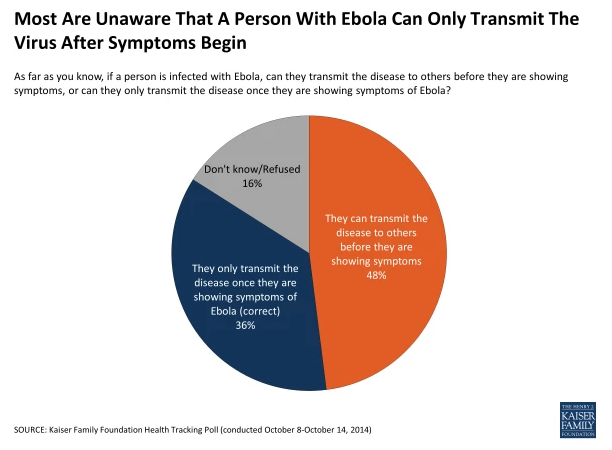
Aaron Blake flags a new Kaiser Family Foundation poll showing that most Americans don’t know – or don’t believe – that Ebola can only be transmitted by patients who already have symptoms:
In addition, 25 percent of Americans wrongly think that Ebola can be transmitted through the air, and 37 percent think it can be transmitted by shaking hands with someone who isn’t symptomatic. Both of those are wrong, per the CDC. Could some of these folks be aware of the science and the CDC’s assurances and just not believe them? Sure. There are certainly some doubters out there, even in the scientific community, who think the CDC’s blanket assurances might be premature. But even if those doubters are correct that you can’t quite rule out transmission from a person who isn’t showing symptoms, the lack of a negative doesn’t necessarily prove a positive. In other words, there is still no data to support the belief of 48 percent of Americans, even if you think what they believe can’t be completely ruled out.
The area of northeastern Ohio where Ebola patient Amber Vinson had visited her mother just days before being diagnosed is displaying what officials are calling an “abundance of caution” and others might call an overreaction:
Two Cleveland-area school districts shut down entirely on Thursday, citing one teacher who had unspecified contact with an infected patient and another who was on a different flight “but perhaps the same aircraft” as Vinson — a step that public health officials deemed unnecessary. Ohio health officials also issued new guidelines on Thursday that go well beyond what the Centers for Disease Control and Prevention has recommended: The state says that even those who’ve exchanged a simple handshake with an infected individual should be quarantined for 21 days if they’re not wearing protective gear, even though the disease is not airborne and cannot be transmitted through casual contact. Ohio officials also recommend that those who have been “within a three-foot radius” of an infected individual for a prolonged time should monitor themselves — warnings that could further stoke fears of the disease’s contagion.
America: land of the free and home of the completely terrified at all times. The outbreak, such as it is, has become a bonanza for suppliers of the doomsday community:
In the past week, preppers-turned-entrepreneurs Fabian Illanes and Roman Zrazhevskiy say they have seen sales of gas masks and their harrowing-sounding NBC (Nuclear Biological Chemical) kits skyrocket. “Tripled is probably an understatement,” Illanes says. Their company, Ready to Go Survival, sells prepacked survival, or “bug out,” bags and kits. As fears of Ebola grow, they’ve been filling $1,000 orders of gas masks for whole families.
Illanes, who recently moved to Texas from New York, says he imagines a time when Manhattan might shut down all access into and out of the city. “If I’m in a car with my family and each of us has gloves, masks, and bodysuits, and there’s a regular family in a car next to us—who do you think the people controlling borders are going to feel more comfortable letting through?” he asks. In response to the calls they’ve been receiving, they’re putting together a “pandemic kit” that will provide quick full-body protection and will go on sale late next week.
And then there’s the Halloween industry:
https://twitter.com/perlberg/status/518224465587499008
The latest in hysteria-deflating perspective comes from Philip Bump, who offers a brilliant illustration of just how unlikely it is that you or I will come into contact with the roughly 0.000001 percent of Americans who currently have the virus, and from Max Fisher, who points out that we are more likely to be killed by our own furniture:
Threat to Americans: According to a report by the Consumer Product Safety Commission, just under 30 Americans are killed every year by “tip-over,” which is when “televisions, furniture, and appliances” fall onto their owners. The report also found that over 40,000 Americans receive “emergency department-treated injuries” from tip-over every year.
Worst-case scenario: This is America. We can always find ways to make a bigger, heavier, deadlier TV.
How freaked out should you be: Council on Foreign Relations scholar Micah Zenko found that tip-over kills about as many Americans per year as terrorism does, and injures many more. In theory, then, you should be just as freaked out by tip-over as you are by terrorism. Based on the fatality rate, you should be much more freaked out about tip-over than you are about Ebola.
Then maybe this lady is just trying to protect herself from the chair:
It was inevitable, but the tenor of some of the comments coming from the more traditionalist cardinals at the synod in Rome is getting sharper. Below is Cardinal Pell laying into the outreach to the currently excluded and marginalized:
You’ll notice the phrase “going out of business.” Also the distinction between the “good people” in the pews and presumably the “bad people” who are trying to emphasize mercy as well as truth. The first, I think, is a troubling argument. It treats the church as a business seeking customers, and thereby opposes a weakening of the brand. It compares this brand with others and argues that the more traditionalist churches have a better record of retaining members than more reformist ones. I find this argument disturbing whether it comes from those saying that a more inclusive and welcoming church would be good for business or those who believe a Benedict-style small and purist church is what’s necessary to keep the pews full. All that should matter for the church is whether what it is teaching is true, regardless of how many “customers” it attracts. But there is another worry here: the fact that many of the biggest donors to the Benedict XVI church may well withhold their money if Francis’ impact endures. The power of right-wing money in the church is not a conspiracy theory. We saw how powerful it was in sustaining the cult of the Legion of Christ and the child-rape epidemic.
The second “good people” argument Pell uses is simply in conflict with so much that Jesus says in the Gospels, in Jesus’s radical refusal to endorse the conventionally virtuous and devout as opposed to the marginalized, weak and fallen. Jesus specifically repudiates that kind of division – saying that the first shall be last and the last first, that those whom we regard as self-evidently “good people” may in fact be something rather different. This is not some minor theme in Jesus’ ministry; it is fundamental to it. And it is what Francis is clearly trying to recover in the church’s outreach to those whom Jesus met where they were, in their lives as they were living them, among collaborators, sex-workers, and women in ways then profoundly opposed by the religious authorities.
And the Relatio does not endorse non-procreative sex; it does not endorse communion for the divorced or re-married. Instead, it simply insists on what seems to me to be undeniable:
that, for example, cruel and technical exclusion for survivors of divorce should be supplemented or replaced with much more mercy and understanding; and that committed, loving relationships that fall short of the church’s marital ideal are not therefore without any positive or redeeming aspects, and should be engaged rather than simply stigmatized.
On the homosexual question, what the Relatio does is actually live up to church teaching on not treating gay people as if we are “intrinsically disordered” moral lepers or somehow outside the church we have always been central to. The positive language about the way in which gay couples sacrifice for each other, take faithful care of children, or fulfill all the moral requirements of marriage apart from procreative sexual acts seems to me to be a recognition of the simple truth. Moreover, no heterosexual Catholic in a marriage with few children or none is ipso facto deemed anathema in the way an openly gay couple is. And when the church can fire gay teachers for sins heterosexuals commit with total impunity, or demand that faithful choir members in their senior years get a civil divorce and separate after decades of cohabitation if they are to continue in communion with the church, it is being both callous and unfair.
This is not about truth versus mercy; it is about the way the two interact:
The demands do not vanish. God does ask hard things of all of us. But in this field hospital that is the Church in the modern world, the image that the synod document brings to mind is that of Simon of Cyrene. Simon could not free the Lord from his cross. He could simply walk with him and help him carry it. The synod fathers seem to be asking how the Church can do the same.
The doctrine does not change, nor the call to repentance. But the Lord does rebuff those who would “tie up heavy burdens [hard to carry] and lay them on people’s shoulders, but they will not lift a finger to move them” (Mt 23:4). Our challenge is to help families in their struggles to carry their crosses.
The document that will emerge at the end of this week – probably Saturday night but maybe later – will doubtless soften some of the language in the first draft, and add much more positive language about the point of life-long monogamous always-procreative matrimony. Like many other reformist Catholics, I understand that this is a dialogue and a conversation, and that these themes deserve space and emphasis, and may have been minimized too much in the first draft. But equally, if the core themes of welcoming the currently ostracized, of mercy as the critical Christian ally of truth, and of new language to minimize unnecessary cruelty are explicitly revoked, it will be sign that this astonishing papacy is under siege from the establishment.
And then it gets really interesting, doesn’t it?
[Update: via Rod, here’s a rather convincing, traditionalist account of how Francis really is the motor behind this Synod – and how he has, in many ways, already achieved a profound re-orientation. Must-read.]

[Re-posted from earlier this week]
So we figured as we put out our first round of Dish merch that, every now and again, we might offer a special message t-shirt, if the moment was right. And with less than a month to go before seismic votes on legal cannabis in Oregon, Alaska and my home-town of DC, why not create a t-shirt for legalization for Dishheads – especially those of you who enjoy our daily 4.20 pm Mental Health Breaks and those who choose to subscribe at $4.20 a month (for some reason). Legal cannabis has been a cause here since 2000, and, along with marriage equality and the Obama candidacy, has been easily the most successful. But we’re not there yet – so try these on for size.
Buy the standard “Know Dope” t-shirt here. Buy the DC one here. All you Oregonians out there, get your version here. Alaskans, yours is here. All of the shirts are just $20. And all of them help us keep this blog able to pay its way as well. So if you just want to help us out, and take a stand for personal freedom and drug sanity, you know what to do.
A big thanks to the t-shirt’s designer, Dave Stenken (aka BiggStankDogg), whose other work you can peruse at TeePublic or his Facebook page. And another thanks to our BustedTees guy, Jerzy Shustin, for helping us launch our latest merch (our regular Dish t-shirts are still always available here). If you end up getting a “Know Dope” tee, email us a pic at dish@andrewsullivan.com.
 The Dish