The Running Of The Indies

Danny Vinik examines the ideology of Larry Pressler, a former Republican campaigning as an independent in the South Dakota Senate race:

At first blush, it may seem like Pressler is living up to his independent candidacy. And technically that is true: On some issues, he supports the GOP. On others, he’s closer to the Democrats. But this is only the case because the Republican Party has swung so far to the right. With the exception of supporting same-sex marriage and a pathway to citizenship, Pressler’s Democratic positionsslightly more revenue in return for significant spending cuts, a moderate increase in the minimum wage, and reforming Obamacarearen’t very Democratic. In fact, Pressler’s platform is mostly a mix of centrist and Republican positions. In years past, that would make him a Republican, not an Independent.

Francis Barry entertains the prospect of a Senate with three or four independents:

King, Orman and Pressler have all said they are open to caucusing with either party. If neither party wins outright control of the Senate, King – along with Orman and Pressler, if they win – would become the Capitol equivalents of LeBron James: highly prized free agents. (Sanders, by contrast, would sooner denounce maple syrup than join forces with Republicans.)

The independents would have enormous leverage to extract financial benefits for their states and political benefits for themselves. While King and Orman might prefer aligning with the Democrats, and Pressler would lean toward the Republicans, all would be able to play the parties against each other. Constantly.

Perhaps, but the independent candidates will have to win first. Enten takes a closer look at the Kansas race, which may be moving back towards the GOP:

In Kansas, Republican Sen. Pat Roberts faces a strong challenge from [Independent Greg] Orman. Orman, though, may have peaked too soon. Roberts recorded his first lead in two polls released last week, and a newPublic Policy Polling (PPP) survey puts Orman only up 3 percentage points. That’s down from a 10 percentage-point lead in PPP’s two prior polls. FiveThirtyEight still gives Orman a 58 percent chance of winning, but the race appears to be trending back toward the fundamentals (i.e. Kansas is a red state), and the GOP has a large advertisement advantage heading into the final few weeks of the campaign.

Tom Jensen of PPP identifies a major reason Republicans might still pull off a win in Kansas:

There’s still one big data point in Kansas pointing to the possibility of Roberts ultimately coming back to win this race. By a 52/35 margin, voters in the state would rather Republicans had control of the Senate than Democrats. And among those who are undecided there’s a 48/25 preference for a GOP controlled Senate. If voters make up their minds based on the national picture in the closing stretch it could mean voting for Roberts even if they don’t really care for him personally.

A Massacre In Mexico

Mexican Federal Forces Takes Over Security In Iguala and Tixla

Nick Miroff reports on the aftermath of a horrifying mass disappearance in Iguala, where “43 student teachers appear to have been rounded up after a day of protests, then marched into the hills and apparently massacred by local police and gang members, who prosecutors say control the city and its officials.” The discovery of at least 28 bodies, “so butchered and burned that Mexican authorities say it could take two months for DNA testing to determine if they’re the missing students”, has sparked protests throughout the country:

Iguala — in one of Mexico’s poorest and most troubled states, Guerrero — is the place where the country’s radical protest traditions have collided tragically with a new reality of gangster-run local governments. It’s not to say that local police wouldn’t have roughed up protesters, or possibly worse, in the past. But in Iguala, where prosecutors say police act under the orders of the gangsters, there was no restraint. Where crime bosses rule — the local capo goes by the nickname “El Chucky” — there was apparently no patience for pesky protesters and other such democratic nuisances. What has been so shocking to Mexicans is that the traffickers would treat them just as any other criminal rivals. One grisly image circulating social media shows a dead student whose face has been removed.

Claudia Romero stresses that this was not an isolated incident:

[T]he state of Guerrero is only one of several Mexican states where organized crime is fighting a turf war. The government of Iguala, moreover, is not Mexico’s only bureaucracy paralyzed by corruption. Police brutality is nothing unique to this case, either. Murders, disappearances, torture—these are weapons law enforcement across Mexico has turned on peaceful protesters. Ayotzinapa calls to mind other similar cases, including; Aguas Blancas, Acteal, and Tlataya, where corrupt police in league with the mafia have effectively criminalized social protests.

“It’s not always clear,” Kathy Gilsinan adds, “whether the local government is working for the drug cartels, or the other way around”:

InSight Crime’s David Gagne suggested on Thursday that Guerreros Unidos was likely “acting as ‘muscle’ for corrupt local officials,” since the cartel itself had little incentive to target the students. “Oftentimes criminal groups can take actions that authorities cannot,” InSight Crime’s co-director Steven Dudley told me. As to who exactly is working for whom in Mexico’s criminal-political nexus, Dudley said, “The short answer is, we don’t know. And the longer answer is, it changes all the time.”

Leon Krauze blames President Enrique Peña Nieto for failing to address Mexico’s serious corruption problem:

In lockstep with his party’s long held tradition, Peña Nieto has mostly turned a blind eye to numerous allegations of corruption at both the municipal and the state level. In the months before the kidnapping of the Ayotzinapa students, Jose Luis Abarca, the allegedly corrupt mayor of Iguala, had numerous and serious complaints filed against him. Federal authorities merely stood by. Now, the man is on the run, along with his chief of police. I’d be surprised if they’re heard from again and amazed if they’re ever prosecuted and sent to jail.

The US, Carimah Townes argues, doesn’t have clean hands here either:

Though Mexico is well-known for government corruption and systemic violence, the U.S. cannot be absolved of its involvement. The U.S. has contributed billions in financial aid to Mexico’s military under the Merida Initiative, with very little oversight. Indeed, due to concern over the U.S.-Mexico partnership and little knowledge of how the money is actually spent, Amnesty International stated, “In August [2012], despite the failure of Mexican authorities to meet human rights conditions set by the US Congress as part of the Merida initiative, the US State Department recommended that Congress release the 15% of funds subject to the conditions.” The Washington Office on Latin America, also attributes the overall militarization of Mexico’s public security to a U.S.-backed remodel, under which law enforcement officials are military-trained.

(Photo: Abandoned clothing is seen near clandestine graves in the outskirts of Iguala on October 13, 2014 in Iguala, Mexico. Mexican authorities found four more graves containing human remains near Iguala where 43 students went missing after a confrontation with local police that left 6 dead last September 26. By Miguel Tovar/LatinContent/Getty Images)

At A Loss

Sarah Varney flags research on slimmed-down daters:

Holly Fee, a sociologist at Bowling Green State University, has conducted some of the only research on dating attitudes toward the formerly obese. In 2012, Fee published her findings in the journal Sociological Inquiry. She found that potential suitors said they would hesitate to form a romantic relationship with someone who used to be heavy. “The big dragging factor in why they had this hesitation in forming this romantic relationship was that they believed these formerly obese individuals would regain their weight,” Fee said.

The prevailing belief is that people who have never been obese can control their weight, and those who’ve been heavy have less will power, said David Sarwer, a psychology professor and the director of clinical services at the Center for Weight and Eating Disorders at the Perelman School Medicine at the University of Pennsylvania. He said the physicians and the general public tend to think that obesity is “a moral failing, and that they can’t push away from the table.”

Heather Havrilesky, an advice columnist, recently addressed a reader who had rejected her friend’s advances when he was obese, but after losing 125 pounds, the tables were turned. Here’s the reader:

I asked (via text) if he still felt the same way as he did last year, and he said, “Nah not really. Kinda gave up on you.” I was furious. What had changed his mind? Was there another girl that had caught his eye? I went to the bar with a couple of female friends, but after a few drinks could not get him off of my mind. I called him and asked if he wanted to smoke, went to his apartment, and after sitting on the couch together just hanging out, he made a move. We had hours of amazing sex.

I was certain we were going to take the relationship to the next level. The man who had embodied so many of the qualities I was looking for now pretty much had ALL of them. The next few days went the same way. I would get off work, he would text me telling (never asking, TELLING) me to come over after work, and I would end up spending the night. I expected to see him more, but after a few days the texts stopped. Several days passed and I didn’t see or text with him. Had I scared him away? We communicated practically every day for years until that point, so I was pretty shocked by his silence. I got onto Instagram and saw a dozen or so photos of him at a few different outings with a girl who is pretty much the younger, dumber version of me. Same body type, same hair, on the body of a 19-year-old cocktail waitress.

After almost a week, we finally spoke again, and I asked him if they were serious, to which he replied, “Of course not.” But after a conversation of vague, ambiguous answers, I finally blurted out everything that I was feeling. I wanted him, and I felt like he was punishing me for not being interested in him before. He started laughing, then called me shallow. Saying that he could never date me because he “would have to get on a scale every morning” to determine if he was worthy of me. That his personality had not changed, and that a small change in physical appearance shouldn’t take my interest level from 0 to 100.

He then went into lawyer mode, showing me Facebook posts from his heavy days and now; the same clever Facebook status that had gotten 30 likes when he was overweight got over 100 now that he was thin. He then became upset, near tears even, and told me that the saddest part of losing weight was that people finally complimented him on qualities he’d always had. Then he kissed my forehead and told me that my first instincts on dating him were the right ones. I’m absolutely smitten, and want to prove to him that my intentions are genuine. But are they? Should I be punished for not wanting the ugly duckling, then falling for the beautiful swan? And is he really upset, or just using my feelings for him against me?

Havrilesky’s advice is here. And go here for a previous Dish thread on dealing with the aftermath of serious weight loss.

Is North Korea Getting Any Better?

After more than a month out of public view, the country’s state media report that the young dictator has reappeared:

Last seen on Sept. 3, Kim [Jong Un]’s lack of public appearances marked his longest span of time away from the public, and while Tuesday’s Korean Central News Agency report may put to rest rumors that Kim had been deposed, he is now walking with a cane. Kim has been dogged by persistent rumors about his ill-health, including reports of gout, diabetes, and an ankle injury. The report contains no mention of Kim’s alleged health problems.

But Mark Stone finds “nothing to prove beyond doubt that the images were taken on Monday.” Zooming out, Andrei Lankov claims that the country, while still “a brutal place,” is a little less of a hellhole than it used to be:

To understand North Korea today, one needs to admit that its economy, while grim, is nowhere near breakdown. In fact, from a nadir in the late 1990s — when state-run industries collapsed and a famine killed an estimated 600,000 people — the economy has grown slowly but steadily. … The world barely noticed a remarkable achievement last year: For the first time in nearly three decades, North Korean farmers managed to produce enough food to meet the population’s basic survival needs. In spite of a drought this spring, preliminary reports indicate that this year’s harvest is likely to be good, too.

Lankov also marshals evidence that North Korea’s gulags are housing fewer prisoners:

This has much to do with the regime’s abandonment of the so-called family responsibility principle. Previously, all immediate family members of a convicted political criminal (so long as they shared his or, far less frequently, her household registration) were deemed to be political criminals as well, and thus were also dispatched to the gulag.

After the death of Kim Il Sung in 1994, his son and successor Kim Jong Il ordered that this approach be applied selectively. A few years later, the authorities were instructed to punish relatives only in cases of especially hideous crimes — such as writing anti-government graffiti. By North Korean standards, this represented a substantial improvement.

Tweeting Faith

Screen Shot 2014-10-07 at 11.03.02 PM

Kimberly Winston flags a of study of 92 million American Twitter users of varying religious backgrounds, noting that “atheists – among the smallest populations in the US – are the most prolific” tweeters. Other findings:

  • Of the five specifically religious groups studied, Muslims are the most active on Twitter based on the average number of tweets, and Muslims and Jews have the most friends and followers compared with other religions. …
  • While Pope Francis may have a lot of Twitter followers – 4.54 million – other faith-related celebrities popular among those studied include the Dalai Lama, Rick Warren, Tim Tebow and Richard Dawkins. But the bigger the religious celebrity, the more likely he or she was to have a high number of followers outside his or her own faith group.
  • The study also found that while self-identified religious Twitter users talk about topics specific to the faith they adhere to (Christians talk about Jesus, atheists talk about science), all the studied faith groups had similar concerns. A tag cloud of the most commonly tweeted words across all the studied groups were “love,” “life,” “work” and “happy.”

(Image: A ‘friend cloud’ showing the top 15 Twitter accounts followed by each group of religious users studied. Via U.S. Religious Landscape on Twitter)

The Grave Risks Of A Travel Ban

The debate over whether to impose a travel ban on Ebola-afflicted countries strikes Rod Dreher as a culture-war battle in the making:

I learned over the weekend that to raise the question of whether or not we should refuse Ebola Virustravelers from Ebola-infected countries is to identify oneself as a right-wing nut, and possibly even a racist. Apparently — according to some liberal readers of this blog — Limbaugh and the usual suspects are working Ebola fears into political talking points. It is therefore required of all decent and right-thinking people to take the opposite position. So I’ve learned.

This is crazy, and dangerous. I haven’t checked, but I have no doubt that talk-radio loudmouths are making political hay about this stuff; it’s what they do. They are, in fact, the enemy of clear thinking — but so are those whose thinking is dictated by a compulsion to take the other side of whatever Limbaugh says.

McArdle fails to see why the notion of a travel ban is so controversial:

Ivory Coast cut off all travel from the affected areas in August, and if you look at maps of the outbreak, this actually seems to be controlling it pretty well within their borders. Even if all it did was buy the government time to prepare, that might help them lower their fatality rate.

You can still argue, of course, that such bans are inhumane and costly. But at least from the evidence we have, closing the borders does seem possible, so we should probably stop insisting that it isn’t. And we should stop acting as if this has any relevance to U.S. immigration policy, which takes place in a much different context, and over a different timeframe, from African travel in the time of an epidemic.

But Julia Belluz and Steven Hoffman reiterate that there are sound, practical reasons to oppose a travel ban:

There are three reasons why it’s a crazy idea.

The first is that it just won’t work. In CDC Director Tom Freiden’s words, “Even when governments restrict travel and trade, people in affected countries still find a way to move and it is even harder to track them systematically.” In other words, determined people will find a way to cross borders anyway, but unlike at airports, we can’t track their movements.

The second is that it would actually make stopping the outbreak in West Africa more difficult. Dr. Anthony Fauci, director of the National Institute of Allergy and Infectious Diseases, said, “To completely seal off and don’t let planes in or out of the West African countries involved, then you could paradoxically make things much worse in the sense that you can’t get supplies in, you can’t get help in, you can’t get the kinds of things in there that we need to contain the epidemic.” …

The third reason closing borders is nuts is that it will devastate the economies of West Africa and further destroy the limited health systems there.

Aaron Blake examines how the public feels about it:

A new poll from the Washington Post and ABC News shows 67 percent of people say they would support restricting entry to the United States from countries struggling with Ebola. Another 91 percent would like to see stricter screening procedures at U.S. airports in response to the disease’s spread. …

Concern about Ebola, at this point, is real but not pervasive. About two-thirds (65 percent) say they are concerned about an Ebola outbreak in the United States. But while people are broadly concerned about an outbreak, they are not necessarily worried about that potential outbreak directly affecting them. Just 43 percent of people are worried about themselves or someone in their family becoming infected – including 20 percent who are “very worried.”

(Photo of the Ebola virus via Getty)

Codifying Consent, Ctd

Amanda Taub defends California’s new “Yes Means Yes” law, arguing that it “emerged as a response to a status quo that has proved to be an all-too-powerful tool for sexual predators, because it enables them to claim to see consent in everything except continuous, unequivocal rejection”:

This week, a Detroit man murdered a 27-year-old mother of three named Mary Spears after she rejected him in a bar. Right now, a woman is in critical condition in a New York City hospital because a man slashed her throat on the street after she declined to go on a date with him. In April, a Connecticut teenager was murdered by her 16-year-old classmate after she turned down his invitation to prom. Stories like these (and there are others) should remind us that women have a lot of reasons to fear the consequences of saying “no.” That’s all the more reason why silence shouldn’t be presumed to be consent.

That argument in particular changed Ezra Klein’s mind. He now supports the law, even though it’s unlikely to be enforced very often:

If the Yes Means Yes law is taken even remotely seriously it will settle like a cold winter on college campuses, throwing everyday sexual practice into doubt and creating a haze of fear and confusion over what counts as consent. This is the case against it, and also the case for it. Because for one in five women to report an attempted or completed sexual assault means that everyday sexual practices on college campuses need to be upended, and men need to feel a cold spike of fear when they begin a sexual encounter.

The Yes Means Yes law could also be called the You Better Be Pretty Damn Sure law. You Better Be Pretty Damn Sure she said yes. You Better Be Pretty Damn Sure she meant to say yes, and wasn’t consenting because she was scared, or high, or too tired of fighting. If you’re one half of a loving, committed relationship, then you probably can Be Pretty Damn Sure. If you’re not, then you better fucking ask.

Robby Soave and others fire back:

First of all: who is to say that “Yes Means Yes” will actually decrease instances of sexual assault? The law’s main function is to push colleges to investigate and adjudicate sexual assault based on a narrower set of standards and without recognition of established due process rights. Given the track record of campus rape trials, there is little reason to think colleges will excel here. I predict more lawsuits—from both accusers and the accused—and similar levels of sexual assault. The heavy hand of government does not automatically and instantly change culture in the manner that central planners envision. …

Klein’s do something at all costs approach is also an indictment of the modern left’s warped priorities and callous disregard for due process. Safeguarding the rights of the accused was once a cardinal virtue of civil liberalism. But for many so-called progressives, paranoia about sexual violence trumps all other considerations. They have much in common with the tough-on-crime conservatives of past decades, in that respect.

Freddie also goes after Ezra – and the elite media in general – for not addressing the law’s risks:

We know that the police state targets the poor. We know that false convictions are far more likely to happen to black and Hispanic men. We know those things. Doing away with the presumption of innocence will not mostly hurt privileged white frat boys. It will hurt poor people and black people the way that our judicial system always does. So if you, like Klein, want to be breezy and loose in your talk about the consequences of a law that many or most admit is badly flawed, fine. But let’s count those costs like adults.

And Judith Shulevitz stands up for the rights of accused rapists:

What’s happening at universities represents an often necessary effort to recategorize once-acceptable behaviors as unacceptable. But the government, via Title IX, is effectively acting on the notion popularized in the 1970s and ’80s by Andrea Dworkin and Catharine MacKinnon that male domination is so pervasive that women need special protection from the rigors of the law. Men, as a class, have more power than women, but American law rests on the principle that individuals have rights even when accused of doing bad things. And American liberalism has long rejected the notion that those rights may be curtailed even for a noble cause.

“We need to take into account our obligations to due process not because we are soft on rapists and other exploiters of women,” says [Harvard professor Janet] Halley, but because “the danger of holding an innocent person responsible is real.”

Meanwhile, Shikha Dalmia’s reaction to the law last week provoked this rant from Erin Gloria Ryan, under the headline “Consent Laws Are Ruining Sex, Says Writer Who Probably Has Awful Sex”:

First, the assumption that sex is a horny guy trying to convince a tired woman to lie there while he pumps away at her sex hole while she wonders to herself if this is what she really wanted is an assessment of heterosexual intercourse so grim that I feel a great deal of pity for the person whose life experiences have led to those conclusions.

That, McArdle points out, is not an argument; it’s just sex shaming:

When guys do this to them, left feminists easily recognize it for what it is: reactionary, misogynist bile spewed by angry people who couldn’t think of an actual argument. So why does Erin Gloria Ryan feel free to deploy it against a woman with whom she disagrees? Why didn’t her colleagues at Jezebel take her aside and say, “Hey, that’s not how we roll. We’re against sex shaming, remember?”

This is not the first time I’ve run into this idea that all’s fair as long as you restrict it to conservatives. Although the exact post seems to be lost to the mists of Internet time, I’ll never forget when a woman at a major feminist site accused me of holding the political opinions I do because — wait for it — I was trying to catch a man. Or the liberal men too numerous to count, or at least bother counting up over the years, who have hailed me with every misogynist slur you could imagine, and a few I’m sure you couldn’t.

Dalmia herself hits back at her detractors:

[I]n a WonketteJezebel gynocracy, discrediting someone’s (imagined) sex life = discrediting their argument.

When Limbaugh called Sandra Fluke, the Georgetown law student who wanted taxpayer funded contraceptive coverage, a “slut,” the whole feminist establishment rose in unison to condemn him—and rightly so. Ultimately, he was forced to do the decent thing and issue an apology. “I did not mean a personal attack,” he said. “My choice of words was not the best, I sincerely apologize to Ms. Fluke for the insulting word choices.” The question now is, can Gray and Ryan manage to rise to Limbaugh’s level? I’m waiting, sisters!


Chart Of The Day

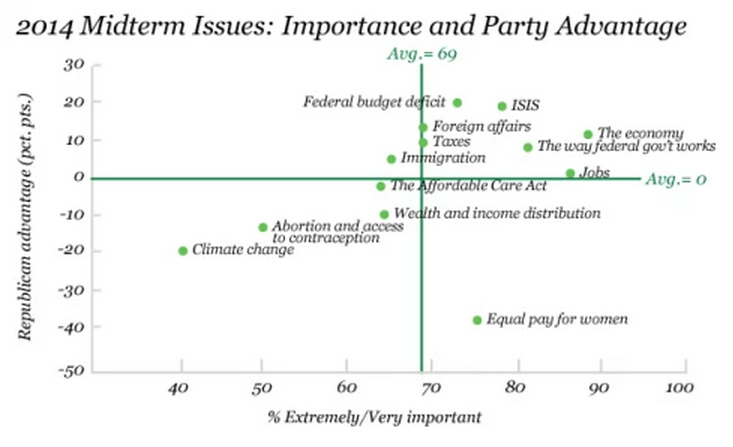
Gallup asked “registered voters to rate the importance of 13 issues to their vote for Congress, and then to indicate which party would do a better job on each issue.” Republicans came out ahead:

Midterm Issues

Aaron Blake captions:

The GOP has an advantage on eight of the nine most important issues tested by Gallup, while Democrats lead on the four least-important. Among the issues the GOP leads on: the economy, the Islamic State (ISIS), the budget deficit, foreign affairs and even immigration.

Democrats, meanwhile, have finally gained an advantage on the Affordable Care Act — a.k.a. Obamacare — only to see it wane in importance as an issue. The lone big issue on which Democrats have an advantage (and a big one, at that) is equal pay for women.