WWD: What are your views of native advertising? Do you run them on your site?
David Remnick, editor The New Yorker: We run all kinds of ads, as long as they are clearly marked as advertising when there’s ever a question. I think advertising is advertising. If it’s 100 percent clear what it is, then, with certain exceptions, I can live with that.
What I object to is tricking the reader and blurring the lines so that unsuspecting readers, thinking that they are getting something that is assigned and edited by the editorial side, are getting something quite different. They are getting an advertisement.
WWD: Time Inc. has editors that will work on editorial and advertising content. Is that a no-no in your book?
David Remnick: Call Time Inc. That’s not what I got into journalism to do. I got in journalism for any number of reasons, not least because it’s so much fun. Journalism should be in the business of putting pressure on power, finding out the truth, of shining a light on injustice, of, when appropriate, being amusing and entertaining — it’s a complicated and varied beast, journalism.
Alex Rogers flags the fear-mongering ad seen above, which tries to make political hay out of the Ebola crisis by blaming the lack of preparedness on budget cuts supported by Republicans:
Erica Payne, the producer of the ad and president of the Agenda Project Action Fund, blamed the Ebola crisis wholly on the Republican Party. “I think any Republican who attempts to chalk this ad up to politics is a Republican who is too afraid to examine the results of his of her actions and the very real consequences that they have,” she said. “They have developed a governing philosophy that is so fanatically anti-investment that they literally have at their doorstop death. There is no exaggeration in this.
Dr. Francis Collins, director of the NIH, tells Sam Stein that Ebola research has been hampered by stagnant funding over the past decade:
“NIH has been working on Ebola vaccines since 2001. It’s not like we suddenly woke up and thought, ‘Oh my gosh, we should have something ready here,'” Collins told The Huffington Post on Friday. “Frankly, if we had not gone through our 10-year slide in research support, we probably would have had a vaccine in time for this that would’ve gone through clinical trials and would have been ready.” …
Money, or rather the lack of it, is a big part of the problem. NIH’s purchasing power is down 23 percent from what it was a decade ago, and its budget has remained almost static. In fiscal year 2004, the agency’s budget was $28.03 billion. In FY 2013, it was $29.31 billion — barely a change, even before adjusting for inflation. The situation is even more pronounced at the National Institute of Allergy and Infectious Diseases, a subdivision of NIH, where the budget has fallen from $4.30 billion in FY 2004 to $4.25 billion in FY 2013.
But Nick Gillespie doesn’t buy that the NIH and other government health agencies are hurting for money:
According to its budget documents, the NIH got about $23 billion in fiscal 2002 (George W. Bush’s first budget year), a figure that rose to $30.2 billion in 2009 (his last budget year) before peaking at $31 billion in 2010. It dipped a bit from then and came to $30.1 billion in 2014, which is about the same amount the NIH requested in President Obama’s 2015 budget plan.
You can argue that the United States needs to be constantly and massively increasing its spending on everything and that every time spending doesn’t go up in a lockstep fashion (and faster than inflation, as it did throughout the Bush years) that you’re killing people. You can also argue that the topline budget figures for various agencies don’t matter, but then you’re really talking about the ways in which bureaucracies, especially in the budget sector, misallocate resources. The one thing you really can’t do is say that the federal government, which is not actually controlled by the Republicans (just saying), has been slashing its spending on anything.
There are some conservatives who have convinced themselves that the federal government is to blame for the spread of Ebola to the United States. A few conspiratorial types insist that Washington is indifferent to the spread of this deadly bug to America, despite the fact that this claim defies Hanlon’s razor and there is no evidence to support it. There is, however, sufficient evidence to suggest the federal agencies responsible for preventing a public health crisis – from medical care, to transportation, to oversight – are simply too unwieldy and prone to human error to take the necessary precautions which might have prevented Ebola’s spread across the Atlantic. That is a debatable point, but it is apparently so dangerous to the left that they are mounting a counteroffensive.
“I have stood by Israel through thick and thin, through the good years and the bad. I have sat down with Ministers and senior Israeli politicians and urged peaceful negotiations and a proportionate response to prevarication, and I thought that they were listening. But I realise now, in truth, looking back over the past 20 years, that Israel has been slowly drifting away from world public opinion. The annexation of the 950 acres of the West Bank just a few months ago has outraged me more than anything else in my political life, mainly because it makes me look a fool, and that is something that I resent.
Turning to the substantive motion, to be a friend of Israel is not to be an enemy of Palestine. I want them to find a way through, and I am delighted by yesterday’s reconstruction package for Gaza, but with a country that is fractured with internal rivalries, that shows such naked hostility to its neighbour, that attacks Israel by firing thousands of rockets indiscriminately, that risks the lives of its citizens through its strategic placing of weapons and that uses the little building material that it is allowed to bring in to build tunnels, rather than homes, I am not yet convinced that it is fit to be a state and should be recognised only when there is a peace agreement. Under normal circumstances, I would oppose the motion tonight; but such is my anger over Israel’s behaviour in recent months that I will not oppose the motion. I have to say to the Government of Israel that if they are losing people like me, they will be losing a lot of people,” – Richard Ottaway, conservative MP, Westminster.
The non-binding vote in the Commons to recognize a Palestinian state was overwhelming – 274 – 12. I hope it leads to more and more countries taking this position – because all other avenues to prevent or stall the grotesque and relentless attempt to annex all the land once inhabited by Palestinians – and to treat an entire people as anathema – have failed. There is no dialogue with the Israeli government on all these issues; there is simply a monologue from the Israelis to the rest of us. I feel exactly as the Tory MP feels: this has gone on long enough. If enough European parliaments take this position, maybe even the US Congress will budge from its current position that Israel can never be criticized. But I doubt it.
Turkey launched airstrikes yesterday – not against ISIS, but against Kurdish insurgents in southeast Turkey:
Turkish news reports said the strikes had been aimed at fighters of the Kurdistan Worker’s Party, known as the P.K.K., and were in retaliation for the shelling of a Turkish military base. Such airstrikes were once common, as Turkey fought a Kurdish insurgency in a conflict that claimed almost 40,000 lives over nearly three decades. But hostilities essentially ceased two years ago when the peace process began, and both the Turkish newspaper Daily Sabah and an online statement from the P.K.K. said the airstrikes on Monday were the first since then. The Turkish military also released a statement, but it did not mention airstrikes specifically, only an exchange of fire with “terrorists.”
Authorities in Iraqi Kurdistan are now pressing Ankara to let their fellow Kurds cross the border to help defend the Syrian town of Kobani, which remains under siege from ISIS:
Speaking on a visit to RFE/RL in Prague on October 13, Falah Mustafa, the foreign minister of the Kurdish regional government (KRG), said Ankara should heed calls from the international community to help the city, which has been under siege for almost four weeks.
“It’s a moral responsibility for all of us to move in order to help the besieged [city of] Kobani,” Mustafa said. “We hope that there would be an understanding by Turkey to the calls from the international community and to the needs of these people who have proven to be bravely fighting the terrorists throughout this period, from the day they have been besieged.” He said Ankara should establish a corridor between its border checkpoint of Mursitpinar and Kobani, whose northern edge is less than a kilometer from the Turkish frontier.
Today and yesterday, ISIS positions in Kobani and elsewhere in Syria came under heavy attack from US planes:
Centcom said the 21 strikes in and around Kobani destroyed two of the group’s staging locations and damaged another, destroyed one an ISIS-held building and damaged two others, damaged three ISIS-held compounds, destroyed one ISIS truck, and destroyed one ISIS armed vehicle and another ISIS vehicle. The US military also struck an additional seven ISIS staging areas, two ISIS mortar positions, three ISIS occupied buildings, and an ISIS artillery storage facility. Centcom said early indications were that these strikes were “successful.” Separately, the US military conducted an additional strike on an ISIS-held oil refinery near Dayr az Zawr. Centcom said this strike was also successful.
But the jihadists are apparently making gains in Iraq:
“The militants, they now control 80% of Anbar province,” said Faleh al-Issawi, a local politician from Anbar, detailing weeks of miserable performance on behalf of the Iraqi military. Government forces, he says, are constantly on the back foot, rarely launching offensives to regain territory. Outgunned and beleaguered, he says, Iraqi army units in Anbar are beginning to collapse. “We are renewing our call for American or International troops to come to Anbar province and begin ground operations,” he said, expressing a policy desire completely at odds with that of the central government.
Meanwhile, the Obama administration is claiming that Turkey has agreed to allow US warplanes carry out strikes from its bases, but Turkish officials won’t confirm that:
[National Security Advisor Susan] Rice said Ankara had joined Saudi Arabia in agreeing to allow its bases for training moderate Syrian opposition forces and had agreed that “facilities inside Turkey can be used by the coalition forces, American and otherwise, to engage in activities inside of Iraq and Syria.” Incirlik Air Base, located about 50 kilometers inland from the Mediterranean Sea in southern Turkey, is home to the U.S. Air Force’s 39th Air Base Wing and about 1,500 American military personnel and is key to protecting NATO’s southern flank.
On Monday, Turkish Foreign Minister Mevlut Cavusoglu denied there was such an agreement on bases, according to state-run Anadolu Agency. “There is no decision at the moment concerning Incirlik or any other issue,” the agency quoted Cavusoglu as saying[.]
Meanwhile, Jamie Dettmer is dismayed at the anti-Western rhetoric Turkish President Erdogan whipped out in a speech yesterday:
About T.E. Lawrence—who is still viewed as a hero in the West and by many Arabs—the Turkish President showed nothing but disdain, then used Lawrence as a vehicle to heap opprobrium on others. Erdoğan dismissed the British officer as “an English spy disguised as an Arab.” And he told the university audience—the speech was televised—that Westerners are “making Sykes-Picot agreements hiding behind freedom of press, a war of independence or jihad.”
Erdoğan argued there are modern-day Lawrences in Turkey right now “disguised as journalists, religious men, writers and terrorists.” And the remark was especially ominous on the day five foreign journalists—three of them German—were hauled before a court for a preliminary hearing in the southeastern Turkey of Diyarbakır, following their arrests at the weekend by anti-terrorist police.
Erdogan appears to believe he can squeeze the PKK and its affiliate in Syria, while negotiating a settlement with Turkey’s Kurdish community. If so, he would be underestimating how quickly a massacre in Kobani could push events beyond his control. Erdogan is a formidable politician and never to be underestimated, yet I suspect he is making a big mistake for Turkey.
That’s because only one of the two very risky paths for Erdogan has a chance of a positive outcome. The Turkish leader has a real prospect of building a long-term alliance with the Kurds and creating a stable buffer against the chaos of the Middle East, partly because he has already done a lot to repair relations with Kurds in Iraq and Turkey in recent years. Islamic State, however, can offer nothing but instability and fear.
Michael Crowley returns to our other big problem in Syria – Assad, with whom Erdogan and the Syrian rebels would like us to go to war as well:
Obama may find it increasingly difficult to battle ISIS without coming into conflict with Assad’s forces. “Sooner or later the linkage is going to be forced,” said Paul Salem, vice president of the Middle East Institute. Salem wonders how Obama would react if American-trained rebels come under aerial bombardment by Assad’s air force: Would U.S. forces pounding ISIS targets elsewhere in the country refuse to intervene? (That would hardly inspire goodwill among the rebels.) How should the U.S. respond [if] Assad’s forces move to claim territory cleared by ISIS after coalition attacks? And will Obama tolerate Assad’s infamously brutal attacks on civilian populations now that U.S. fighter-bombers are mere minutes away from the scene of such crimes?
It is unreasonable to expect anti-regime forces to do Washington’s bidding against other enemies of the regime when their overriding concern is to fight regime forces. However, that isn’t an argument for doing what the rebels want. It draws our attention back to why the war has been misguided and unlikely to succeed from the start, especially once it expanded into Syria. If both Turkey and the “moderate” opposition refuse to cooperate unless the U.S. attacks the Syrian government, that tells us that the war against ISIS cannot be fought effectively at an acceptable cost. That should be a clear warning to the administration to stop now before it gets in any deeper. Warring against both sides in the same civil war not only appears absurd, but it greatly increases the chances of costly failure.
Max Fisher, on the other hand, asserts that an alliance with Assad is the only logical outcome of Obama’s Syria policy:
Obama doesn’t want to build up the rebels enough to defeat ISIS, he doesn’t want to invade and occupy Syria (rightly), and he doesn’t trust Turkey enough to sponsor a Turkish invasion. With those options off the table, only Assad is left as someone who is able to re-conquer ISIS-held territory and occupy it for many years, which is what it would take to end the ISIS threat. So it looks increasingly likely that Obama will come to view Assad as his only real option if he wants to defeat ISIS.
Maybe I missed it, but how have you not posted on gay marriages happening in North Carolina? I guess it’s a sign of how radically things have shifted that Jesse Helms’ state is now performing gay marriages and the Dish doesn’t even post on it : )
The Getty caption for the above photo reads:
Lynda Johnson, center, cries as she watches her daughter Kandyce Johnson, left, marry Jana Downs outside the Mecklenburg County and Courts Office building on Monday, Oct. 13, 2014 in Charlotte, N.C. Monday was the first day that gay couples could marry in Mecklenburg County after a judge’s ruling. By Jeff Siner/Charlotte Observer/MCT via Getty Images.
Another reader reflects at length:
I had never had a strong opinion one way or another on the issue of marriage equality until I moved to NorthCarolina.
I grew up in Michigan and had a vague sense that a constitutional marriage amendment was wrong, and when it came up for a vote in 2004 I voted against it. My primary reason was the sense than a friend of mine who happened to be gay deserved to marry anyone she wanted just as much as I did. At the time, however, I couldn’t understand how anyone could find civil unions to be an unreasonable compromise. While opposed to enshrining discrimination into a constitution I still couldn’t appreciate the significance, let alone the necessity, of marriage equality.
As time went by this vague sense of wrongness became more and more fixed. As more of my friends felt comfortable being who they were and sharing their committed relationships publicly I began to see how wrong asking them to settle for a civil union would be. They responded to their loves exactly as I responded to mine. The benefits I received from marriage at that time had nothing to do with procreation. I started to see through the flimsy arguments made in favor of the status quo.
When Thom Tillis and others came to power in NorthCarolina and started making noises about adding an amendment to our state’s constitution in 2012, I finally began to understand I needed to use my voice. For the first time I had something to say about marriage equality and felt like it was time to say something to people who often vehemently disagreed with me.
I don’t share any of this because I feel like I’ve done anything. I share this because of what you and so many other people did. By sharing your voice on the Dish every day, by posting so many supporting and dissenting opinions, you challenged my level of empathy. You challenged me to see the United States of America as being capable of more than it was and at the same time not quite as perfect as I wanted it to be. I didn’t like what I found at first. In the end you taught me a lot about this issue but really you taught me a lot about myself. We’ve never met. We probably never will. But I owe you and the Dish a great deal.
Today [Friday], my state’s horrific decision to enshrine discrimination into its constitution was struck down. For the first day ever I lived in a state where all people who love each other can benefit equally from joining in marriage.
It doesn’t affect me, directly. But at the same time, it does. The days where you can personally see a nation becoming a “more perfect union” are rare throughout your life. But this day is one of those times. I wish you could be here. Those of us who spoke out and tried to change minds in 2012 came up short. But every day seeing men and women be who they are, seeing them fight through centuries of prejudice and bigotry to say this time things will be different … it’s hard to describe what I feel today watching people enjoy this opportunity they never should have been denied.
They are, naturally, having a collective breakdown. Here’s a taste:
John Smeaton, co-founder of Voice of the Family, a coalition of 15 international pro-famiy groups, said it is “one of the worst official documents drafted in Church history.” “Thankfully the report is a preliminary report for discussion, rather than a definitive proposal,” he said in a press release. “It is essential that the voices of those lay faithful who sincerely live out Catholic teaching are also taken into account. Catholic families are clinging to Christ’s teaching on marriage and chastity by their finger-tips.” … At the Vatican press conference this morning, Michael Voris of ChurchMilitant.TV challenged the authors on this section. “Are the Synod fathers proposing that ‘gifts and qualities’ flow from the sexual orientation of homosexuality?” he asked. “Is the Synod proposing that there is something innate in the homosexual orientation that transcends and uplifts the Catholic Church, the Christian community, and if so, what would those particular gifts be?”
I hope to respond intellectually to the synod report. Tears right now are streaming from my face, and it is not about objections to welcoming gay people. There is something more profoundly at stake for me. Is this me? In the corner?
Cardinal Raymond Burke, demoted rather abruptly by Francis, is apoplectic:
He strongly criticized yesterday’s Relatio … which the Catholic lay group Voice of the Family had called a “betrayal,” saying it proposes views that “faithful shepherds … cannot accept,” and betrays an approach that is “not of the Church.” … The relatio, he said, proposes views that many Synod fathers “cannot accept,” and that they “as faithful shepherds of the flock cannot accept.” … “Clearly, the response to the document in the discussion which immediately followed its presentation manifested that a great number of the Synod Fathers found it objectionable,” Burke told Olsen.
“The document lacks a solid foundation in the Sacred Scriptures and the Magisterium. In a matter on which the Church has a very rich and clear teaching, it gives the impression of inventing a totally new, what one Synod Father called ‘revolutionary’, teaching on marriage and the family. It invokes repeatedly and in a confused manner principles which are not defined, for example, the law of graduality.”
To get a flavor of how Burke would respond to a family welcoming their son and his partner for Christmas, check this out:
We are to “value their sexual orientation”? Again, what exactly does that mean? Am I to value what my own catechism calls an intrinsic disorder? How do I do that? Do I value their orientation by saying, “I think it’s wonderful that you desire to have anal intercourse with another man?” Would that be honest or true to natural law and the divine revelation? Just how do I do this without “compromising Catholic doctrine on the family and matrimony”?
Celibate lesbian Catholic Eve Tushnet helps explain why valuing gay people cannot be reduced to anal sex (the priest above sees all gay people as sodomites and lesbians as non-existent):
For many of us our sexual orientation does flow out into expressions of love. For example, I agree with Wesley Hill that for some gay people it’s precisely our orientation which makes us unusually attuned to same-sex friendship. That may be especially true in our particular cultural moment, in which homosexuality is quite public and friendship relentlessly shunted into the private and even the trivial sphere. And I obviously don’t mean that gay people have “better” or deeper friendships than the rest of you people! Nonetheless I think the language of gay people having “gifts to offer” may help gay Catholics explore how our sexuality can be expressed, rather than repressed: how it can be channeled into friendship, artistic creation, teaching, etc.
Some reactionaries are simply in denial. George Weigel uses the occasion to attack the New York Times, which is as good a sign as any that he is still reeling. Then he makes the utilitarian point that rigidly orthodox churches survive and more open ones fail in the modern world:
Christian communities that maintain a clear sense of their doctrinal and moral boundaries survive and even flourish, while Christian communities whose doctrinal and moral boundaries become porous wither and eventually die. Why have the Catholic leaders who have gotten the most press at this synod, including Cardinal Walter Kasper of Germany, failed to grasp that? Why do they want to emulate the pattern charted by the dying communities of liberal Protestantism?
But this is not an argument against the mercy espoused by the first week of this Synod. It’s a very tired argument from the 1980s. One wonders why Weigel thinks the church in Ireland has all but collapsed in a generation? Too chill and welcoming to outsiders – or a clerical elite that believed it could get away with raping children because its boundaries were not porous at all? Last but by no means least, here’s Rod Dreher:
I suppose anything could happen, but it seems to me that the fix is in. This is a pastoral synod, not a doctrinal one. But the change in pastoral practices it mandates will be a de facto change in doctrine, because that’s exactly how it will be received by the Catholic public. Recall these 2013 remarks by Ross Douthat, commenting on Pope Francis’s “who am I to judge?” remarks:
“But still, such a tonal difference … on a fraught, high-profile topic is surely newsworthy, even if the news media inevitably offered misinterpretations of its significance as well.
And it’s especially newsworthy since a latitudinarian statement on this topic is of a piece with the tone of Francis’s pontificate as a whole. Popes do not change doctrine, but they do choose what to emphasize and what to downplay, which issues to elevate and which to set aside, where to pass judgment and where to talk about forgiveness, and so forth. And we’ve seen enough of this pontificate to sense where Francis’s focus lies: He wants to be seen primarily as a pope of social justice and spiritual renewal, and he doesn’t have much patience for issues that might get in the way of that approach to Christian witness.”
You can also teach falsehood by failing to teach the whole truth.
In an excerpt from his forthcoming book, Winning Marriage, Marc Solomon recaps a private conversation Obama had during his Senate run:
In the course of this conversation, [Kevin Thompson] happened to mention Stonewall. “Well, what’s Stonewall?” Obama asked.
“You’ve never heard of it?” Thompson asked in surprise. This was a sophisticated Columbia- and Harvard-educated scholar and political organizer, running for national office. And yet he had never heard of the event that many consider the birth of the modern gay rights movement: the riots that took place at the Stonewall Inn in Greenwich Village in 1969, when the LGBT community fought back against police intimidation and arrest and demanded legal equality. Thompson gave Obama a primer, glad that they could have an honest back-and-forth.
Soloman sees this as evidence that Obama “began his political journey sympathetic to gay rights, but not deeply informed about them”:
They were not one of his core political priorities. Today, just over a decade later, he has done more for gay rights than any other US president. In particular, the president has been a key part of landmark achievements on the freedom to marry, from the gutting of the Defense of Marriage Act to winning marriage in state houses and courtrooms. It is now easy to envision the completion of this civil rights battle before Obama leaves office. A confluence of good timing, a strategic and determined advocacy movement, and a president who saw with increasing clarity that the values inherent in our cause were fully in sync with his deepest values, enabled this journey. These historic successes, on his watch and with his help, meant that LGBT rights, and marriage equality specifically, would be at the center of the legacy he’d leave behind.
John Cassidy explains the significance of Tirole’s work:
Taking tools of game theory and information economics developed in the postwar decades, he and his colleagues helped to change the way governments and economists think about an old subject that is becoming ever more important to our networked economy: the regulation of companies with monopoly power.
From Amazon’s battle with book publishers to Cablevision’s attempted takeover of Time Warner Cable and the European Commission’s investigation of Google, the issue of how to deal with companies that operate in markets where competition is restricted or absent has become front-page news around the world. Tirole and his colleagues, particularly the late Jean-Jacques Laffont, didn’t establish a set of hard-and-fast rules for governments to follow in individual cases. But they did create a unifying intellectual framework that regulators, aggrieved parties, and the companies themselves can draw on in thinking through the relevant issues.
Tyler Cowen calls it “an excellent and well-deserved pick”:
Overall I think of Tirole as in the tradition of French theorists starting with Cournot in 1838 (!) and Jules Dupuit in the 1840s, economics coming from a perspective with lots of math and maybe even some engineering. I don’t know anything specific about his politics, but to my eye he reads very much like a French technocrat in terms of approach and orientation.
Justin Wolfers details how the “conclusions of Mr. Tirole’s style of analysis defy easy political characterization”:
In some cases they may call for a more vigorous regulatory response from government policy makers than is currently the norm, while in others, they call for greater restraint. In each case, the recommended policy depends on the details of the particular market, and in particular on what information is available; what contracts can be written; and how competitors, suppliers and customers are likely to respond.
In turn, this shows just how much Mr. Tirole’s work is a sophisticated mash-up of the three recent Nobel-winning themes that have revolutionized microeconomic theory. His research extends and applies the tools of game theory, which is used to analyze strategic interactions between firms and their competitors, suppliers, customers and regulators. It takes seriously the problem of imperfect information, analyzing how these interactions are shaped by what each of these players knows about the others. And he has been a pioneer within contract theory, assessing the consequences of the difficulty of writing contracts that fully specify the consequences of commercial transactions. This prize represents a vote of confidence in the direction of modern microeconomic theory.
Matt Yglesias highlights Tirole’s work on competition:
… I think many people will be most interested in his 2002 paper “Platform Competition in Two-Sided Markets,” co-authored with Jean-Charles Rochet. Among other things, the paper offers a powerful explanation of why so many leading internet companies — most prominently Google and Facebook — don’t charge for their products. In the most simplified thinking about business, a company has suppliers and then it has customers. But a platform market is two-sided. Apple sells iPhones to customers, but it also collects 30 percent of the gross sale price of apps in the app store. …
[W]hile it costs a lot of money to run Facebook it costs very little money to serve one more Facebook customer. The same is true for Google. Indexing the web is expensive. Paying engineers to work on the search algorithm is expensive. But serving one additional customer costs basically nothing.
Jordan Weissmann praises Tirole for his prescience:
Even in papers published decades ago, the subjects of his work feel ripped from today’s headlines—he was writing about the threat of too-big-to-fail banks and the hazards of bailouts all the way back in 1996. Want to talk about how to prevent another financial crisis, deal with Comcast, or think about the meaning of a monopoly in the era of free Internet services such as Google and Facebook? Triole’s your man, and has been for a long time. Yet he’s not a name you’re likely to see all the time in the New York Times or Wall Street Journal.
“Many of his papers show ‘it’s complicated,’ rather than presenting easily summarizable, intuitive solutions which make for good blog posts,” economist Tyler Cowen wrote in a summary of Tirole’s work. “That is one reason why his ideas do not show up so often in blogs and the popular press, but they nonetheless have been extremely influential in the economics profession.”
And David Spencer, who notes that he “do[es] not intend to criticise directly the award of this year’s prize to Jean Tirole,” uses the award as a starting point for a broader argument:
Academic economics is still stuck in an intellectual and ideological rut. Despite the global financial crisis – the worst in a lifetime – academic economists are more likely to win awards and the respect of their peers by producing abstruse models than by tackling and resolving real-world problems. The economics Nobel awards advances in economic analysis – meaning the development of formal models and the application of particular mathematical and statistical techniques. In essence, solving puzzles within economics matters more than dealing with grand societal challenges.
Thomas Piketty, who has done more than anyone else in the last year to bring academic economics to the public attention, had no real prospect of winning the prize, given his concern with the real-world issue of inequality. The non-award of the prize to Tony Atkinson – pioneer of inequality and poverty studies – can also be explained in the same way. But it should be a cause of concern, not least for members of the public tuning in to learn who has won the economics Nobel, that acute economic and social issues are not high on the agenda of academic economics.
The trash can says “Please Don’t Litter”, so we are in the Anglophone world. The cars drive on the right, so we are most likely in North America. There is gleaming new construction in a super-clean neighborhood, with ample surface parking attached, adjacent to a more established neighborhood that is urban, but not super-dense. Also, slightly hilly. Assuming the photo was taken recently, we are reasonably far south, because everything is very, very green. So … probably the US, in a well-established mid-sized city that has seen some significant growth lately.
That type of new architecture (blocky with lots of glass and slick materials) is, unfortunately, really ubiquitous these days. I’ve seen buildings like that in Seattle, Portland, San Diego, Charlotte, Atlanta, Boston … a couple of weeks ago I passed through Tyson’s Corner, VA, for the first time in a long time, and seems like that is the entire town now. And seriously, that (apparently purely decorative) canal with the fountains in it should make this easy to find, right? Indianapolis (where we were for a gimme window a few weeks back) has one like it, but that’s not it.
I hate giving up on this, but I honestly have no idea. Just so I have something to put in the subject line, I’m going to say Atlanta, since it always seems like they’ve erected some new glass and steel monstrosity every time I go back there.
Another aims for a blue-glass city of the North:
Vancouver, British Columbia, Canada
Or waaay south?
My first reaction to the picture was Auckland, New Zealand. Just a wild guess, but saw a House Hunters International recently of a couple trying to buy a condo in Auckland and this looks similar to one of their views.
Another reader e-mails it in:
I’m resolving to enter this contest every week, even when I don’t think I have a good idea of where the photo was taken. Too often I’ve said, “hey that looks like xxxx, but it’s probably not, so I won’t enter.” Then it turns out to be xxxx. That said, my entry this week is probably wrong. But something about this photo looks like eastern Canada to me, and the English on the trash can rules out Montreal. So I’m guessing Ottawa.
Only a fraction of contestants guessed incorrectly this week. The first of a few hundred correct guessers needed only 14 minutes from when the photo was posted:
Providence, Rhode Island, United States of America
A former resident elaborates:
This photo is undoubtedly of downtown Providence! I have long enjoyed reading the submissions and marveling at those who could identify the far flung places featured in VFYW so seeing my almost home state was a treat.
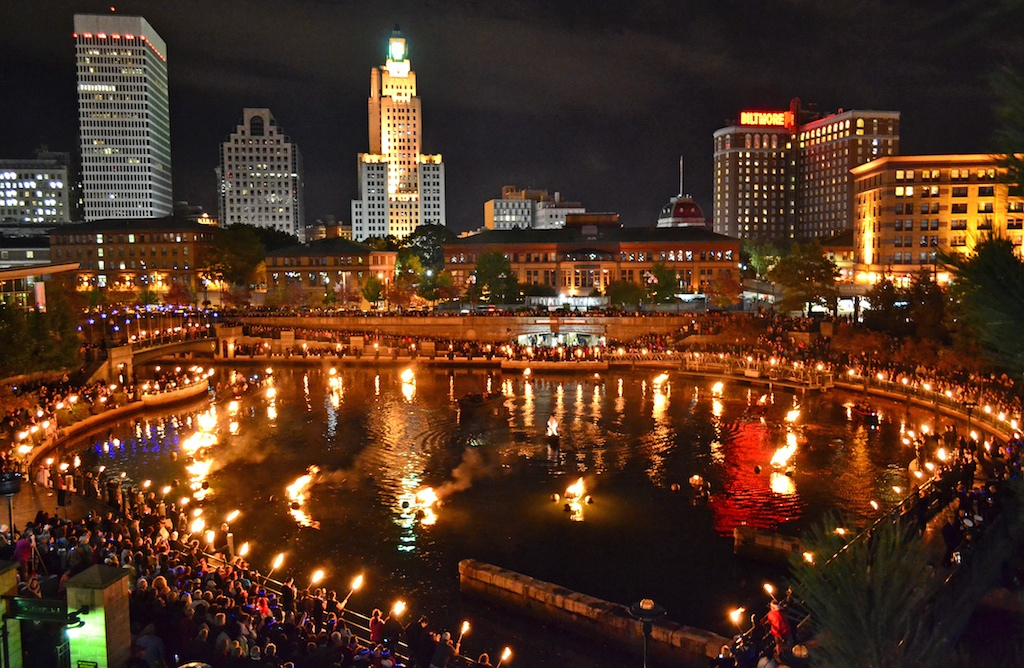
This was taken from the north side of the balcony about halfway up the GTECH building at 10 Memorial Boulevard in downtown Providence. You can see the church I grew up attending far to the right and the river with WaterFire baskets installed below. The red triangular building is home to Cafe Nuovo, which is a great (although I haven’t been in years, my parents go) restaurant.
I grew up in a small town outside Providence, but my parents are professors at Rhode Island College in North Providence, so I spent a lot of time in the city. Buddy Cianci was responsible for a lot of the downtown development that took place in Providence when I was growing up and it’s hilarious to me that he’s running for mayor AGAIN. People love him. I’m not up on all the politics as much anymore (I live in DC now so we have plenty to keep up with here) but I know enough to admit that the downtown area is much more pleasant than it used to be. RI still struggles economically and a half-dozen WaterFire festivals each summer won’t fix that, but it’s a beautiful city with an incredible food scene and a lot of great art in general.
Wondering what a WaterFire basket could be? Dishheads have you covered:
I’m a master’s student studying water quality and sustainability, and I immediately recognized the floating bonfire pits of WaterFire in Providence. In the 1990s, the city daylighted the previously covered Woonasquatucket River and installed the bonfire pits in the river as a civic art project. During WaterFire nights, the city lights fires on the river and it becomes a center for activity in the city. It has been a huge success story for Providence and a model for other cities to rebuild and reinvigorate their downtowns.
Another gives you a look:
The balcony overlooks the circular basin that marks one end of the Fire Water celebrations, where the city builds bonfires in metal baskets set in the middle of the Woonasquatucket and Providence Rivers. Fire Water is the centerpiece of the renaissance of downtown Providence that occurred during the tenure of Buddy Cianci, Providence’s notorious once and future mayor. All of the tall office buildings in the picture were built during that renaissance, in which Cianci spearheaded the redevelopment of the downtown riverscape, which had been covered over for much of the twentieth century. It is extraordinary how much the city has changed as result of the public and private investment in the downtown. It is an amazing spectacle, truly carnivalesque, as well as a brilliant way of bringing tourists and suburban residents back into the city.
More on Cianci in a bit. A former winner notes:
It is probably not a coincidence that this view appeared on the day that “Full Light” takes place and it’s the event’s 20th anniversary. I suspect someone will submit an entry that includes this Saturday’s spectacle.
Total coincidence! And sadly no, it seems no Dish readers were there that night. But another reader is friends with the artist who created WaterFire, Barnaby Evans. Another passed along this video:
A more expert take:
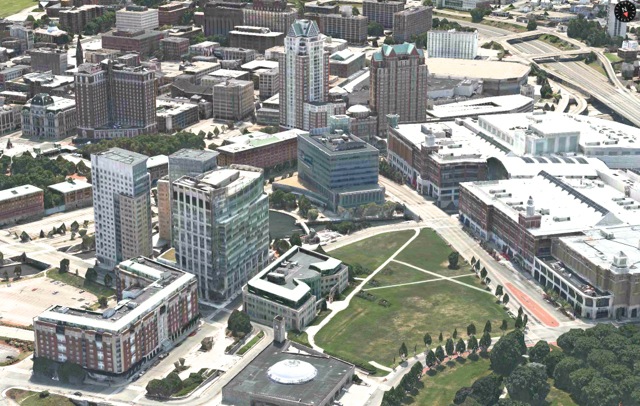
I’m an architect, and at first glance all I saw were those relatively new banal buildings found in countless north American cities. But in the hilly background were some brick and clapboard buildings that reminded me of coastal New England towns such as New London. Of course if you combine coastal New England with a spanking new Riverfront you immediately come up with Providence, Rhode Island, which in 1994 uncovered its long-buried river by removing what was euphemistically termed the “world’s widest bridge.” An aerial view of downtown immediately shows the distinctive basin and amphitheater and that’s all that you need as the balcony of 10 Memorial Boulevard is pretty evident in photos.
Another had more trouble:
I became convinced that the view was looking out over a canal with fountains in it, and started searching based on that idea. There’s a Wikipedia page documenting US canals, which counts over 18,000 of them, although I got the impression most of those are for agricultural use.
As far as the right window, the following entry is probably the closest the contest has ever gotten to accidental modern art:
That entrant adds, “I tried to say “Woonasquatucket” to my wife and she chortled “is that an invitation?” Meanwhile, this reader reminds us about the soul of wit:
What really clued me in on this one was the bush. It’s centered in the frame, very nearly the subject of the photo. It seems to regard the viewer quizzically, “Why are you looking at me?” or rather, and more introspectively and shockingly self-aware, “Why can I see you looking at me?” And its the bearing of the bush, the very regal, upright, staid look on what I can only refer to as its ‘countenance,’ that bespeaks a soul bestirred, a corporal glove filled with a heavenly hand, the capital-D Divine, and when I thought “capitol” and “divine” I realized I was looking at Providence.
Incidentally, I was born in Rhode Island, in the town of S. Kingston, and have long loved the Blossom Dearie tune “Rhode Island Is Famous for You”:
With lyrics like:
Pencils come from Pennsylvania
Vests from Vest Virginia
And tents from Tent-esee
They know mink / where they grow mink / in Wy-o-mink
A camp chair / from New Hampshair / that’s for me.
Minnows come from Minnesota
Coats come from Dakota
But why should you be blue?
‘Cause you / you come from Rhode Island
And little old Rhode Island / is famous for you.
The following reader, as well as most of the numerous Dishheads who went to school in Providence, just needed the steeple to the far right of the image:
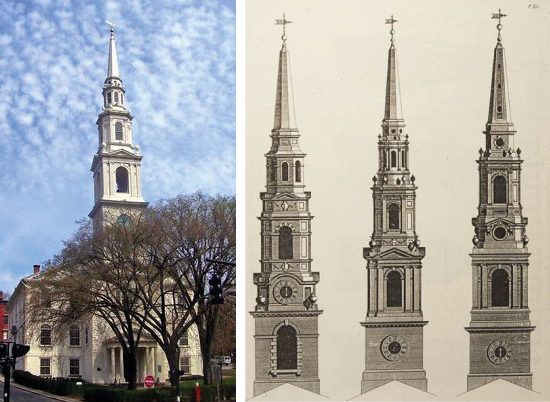
I took the steeple as the most useful clue. Searches for “New England steeple” and “Connecticut steeple” were fruitless, but “Rhode Island steeple” brought me this among the first images (left-most)
This is the steeple of the First Baptist Church in America, built in Providence in 1774-75. But there might be other U.S. steeples that are nearly identical; it is very close to a model in James Gibbs’s classic Book of Architecture from 1728.
More on the church:
The white steeple all the way on the right edge of the picture is First Baptist, as in Roger Williams’s FIRST Baptist parish in America, which, unlike their Southern component’s image nowadays, was a huge mover for religious freedom in colonial (Puritan) New England, and, not incidentally, was the great and wonderful late Rev. Mr. Gomes’s denomination (though his accents and tastes seemed those of a High Anglican).
Another notes:
While the church was started in the 1630s by Roger Williams, the meeting house was completed in 1775. At that time the steeple was erected in three and half days and has ” survived time and hurricanes since then.” Quite amazing don’t you think!
And we learn that Brown’s grad ceremonies happen in that church:
In the far right of the frame is the steeple of the austerely beautiful First Baptist Church in America (located, appropriately enough, on the corner of Steeple St.), where I graduated from Brown University, and which celebrated its 375th anniversary last year. On that occasion, congregant David Coon composed the following:
Who are the members of the First Baptist Church in America?
We are not Southern Baptists.
We are not Jerry Falwell Baptists.
We are not Westboro Baptist Church Baptists.
Nor are we an ethical debating society.
We are followers of Jesus Christ, as study and prayer and teaching and worship lead each of us to an individual belief in what that means.
We are Roger Williams Baptists.
We are “soul liberty” Baptists.
We are “separation of church and state” Baptists.
We are a “shelter for persons distressed of conscience,” a place where everyone has the right to approach God in her or his own way.
Here, we take the Bible seriously, not literally.
Here, we worship a God who provides “minimum protection, maximum support.”
Here, we expect acceptance, not judgment – humility not hubris – laughter not gloom.
Here we listen thoughtfully rather than speak loudly.
Here, we sing – we sing praises, we sing thanks, we sing prayers, we sing because we love to sing.
Here, we honor, we truly honor, the differences of opinion among those who are reverently seeking their own way to God.
We are the First Baptist Church in America and we reserve the right to accept everyone.
Another notes that First Baptist “seems to take pride its punny sign out front (“This church is prayer conditioned”)”. Another reader has more:
Interestingly, the Providence Plantation, founded by Roger Williams in 1626, is described as “the first place in modern history where religious liberty and the separation of church and state were acknowledged.” Williams founded this church two years later. It would be interesting to hear how Williams might evaluate his own legacy in the US today, 388 years later.
He adds:
Another week where I am feeling the fleeting satisfaction from correctly discovering the view location, followed by the lingering sadness that comes from knowing that hundreds of others (many who actually LIVE in Providence, or went to Brown University, or have some other clearly unfair advantage), are at this very moment getting this week’s view correct also, and that my response will likely be put into the “correct answer collage”. I have no doubt that some reader in posession of too much leisure time as well as the building blueprints and intergalactic coordinates of the boxwood will edge me out. Oh well. At least last week’s contest was won by someone who wrote impressively about naturalized, cultivated Norway spruce trees and temperate forests transitioning to aired steppes. That guy DESERVES the book.
And you deserve a collage:
A reader reaches a important milestone:
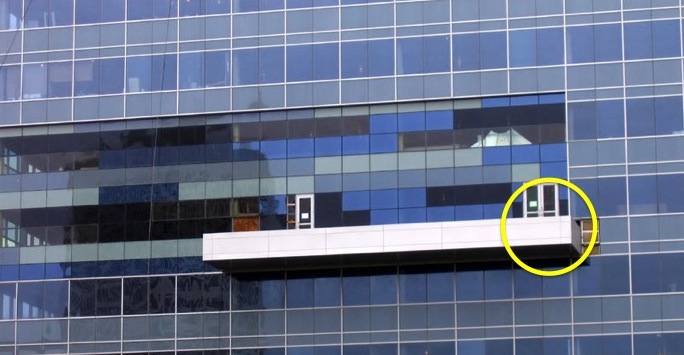
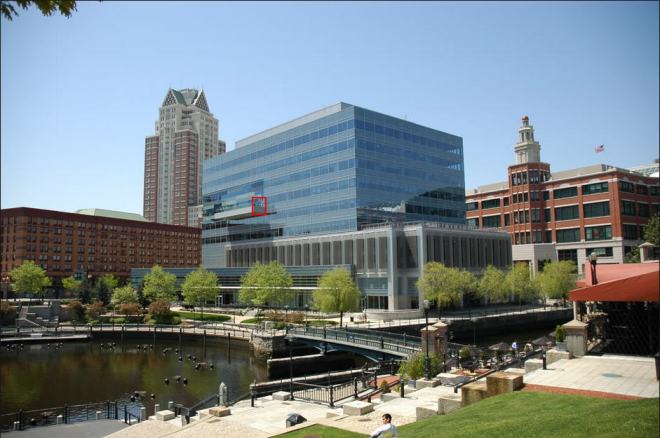
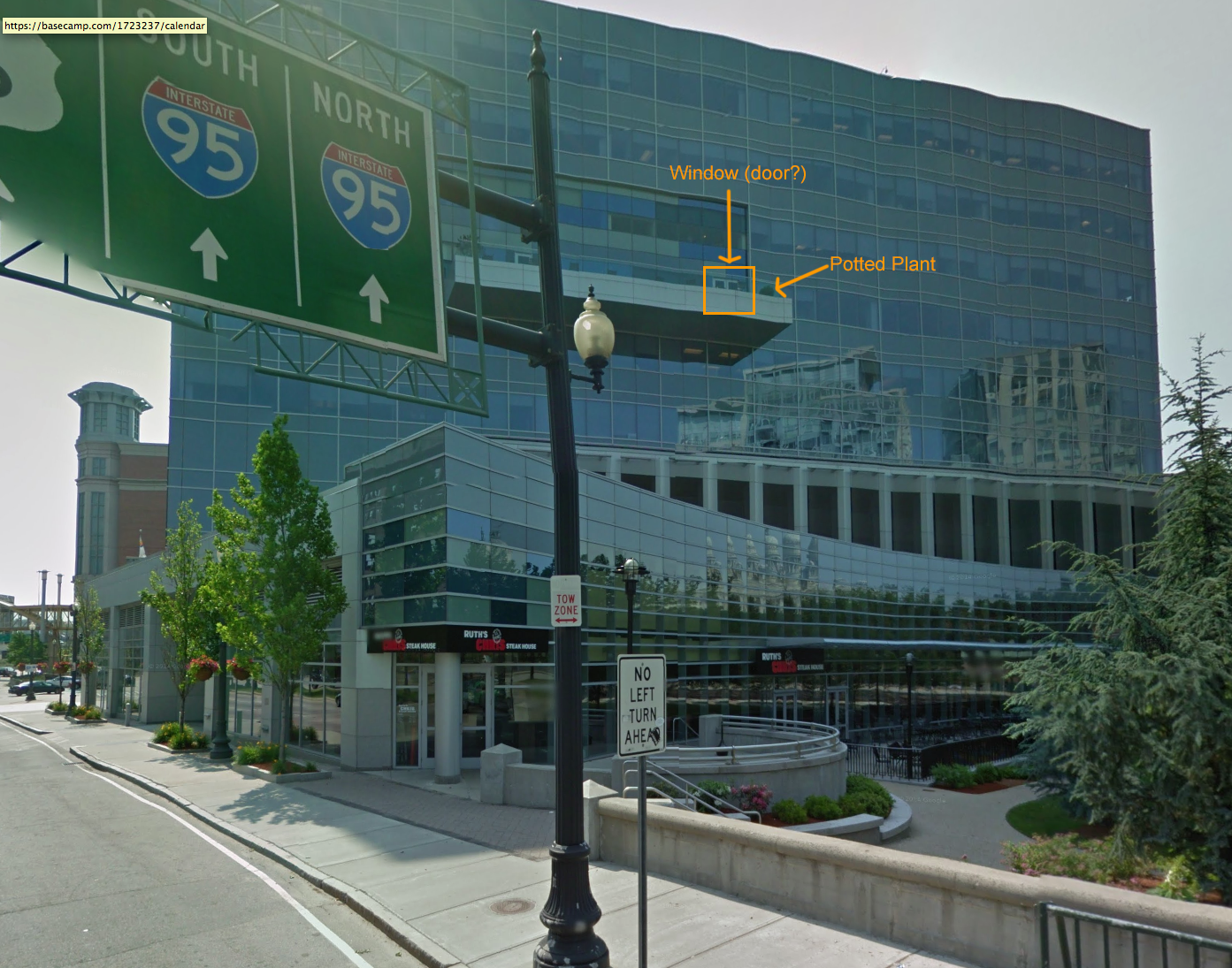
Man, that art history degree FINALLY paid off (well, enough to know where this photo was taken, the student loans are still a monthly burden. Mind you, I started paying them off in 1993.) I immediately recognized the steeple of the First Baptist Church in America in Providence, Rhode Island. It looks like the view is from the GTECH Corporation building. It’s that window off the corner of the balcony jutting out riiiiiight … THERE:
The architecture critics really came out of the woodwork this week:
Collectively, this photo is taken from and of several pieces of Modernist architectural banality that have stymied the civic momentum represented by the work done in Providence during the 1990s to revive downtown through traditional urban planning and architectural. These buildings, with the GTech building being the worst offender, represent the resurgence of the “avant garde” as they bravely resisted the civic pride that was being rediscovered, via PoMo blandness, Vancouver-ish soporifics, and good ol’ Dallas-Ft. Worth office park cheap’n’boring respectively. Fortunately, Providence still retains a great deal of its historic fabric from the late 1700s through the 1930s, so ugly junk like this is mostly the exception, not the rule.
Another:
The buildings look part of the mixed use redevelopment trend, but it also seems this is a tourist district. It’s nice enough, and almost certainly better than the old industrial complex that was probably there 50 years ago. But the architecture leaves me a little cold and I wish they had riffed a little more off the brick that dominates most New England downtowns. I’m not alone in the critique – found these quotes from an article about the design before the building went up:
“The structure has no place in Providence,” said Gregory Mallane. “It really belongs in an industrial park.”
“This building is completely out of place” in Providence, said Charles Pinning, a Providence property owner. “This building would be appropriate . . . in a city that has either obliterated its history or doesn’t have any.”
Another critic takes us to city planning school:
The Gtech building sabotaged what had been a really interesting experiment in architecture and urban design Providence had going for 20 years. A new take on urban renewal that would eventually emerge as a critique of the bomb-and-rebuild modern method of urban renewal that had marred cities from coast to coast. In the 1980s the federal, state, and city governments cooperated to bury the massive train yards between the State House and downtown, and to move and expose the two rivers that join to form the Providence River. In doing so, 80 acres of formerly industrial land right next to downtown were opened up for development.
It got interesting when regulations were drawn up to ensure that development here would feel complementary to the existing downtown. Above-ground parking was prohibited, and buildings had to built out to their lot lines, to create a consistent street wall and an urban rather than suburban feel. Further, a commission was appointed to enforce these regulations and to approve the design of individual buildings. This type of committee is certainly a potential nightmare for developers, but there was plenty of development and for a good while the commission worked surprisingly well. From 1988 to 2002 eight large buildings were built, among them a 30 story hotel tower and a 1.4 million square-foot shopping mall.
Initially the designs were postmodern but as years passed, shaped by the Commission, the designs became less postmodern and more unabashedly neo-historic, using traditional elements without irony or distance. Most architects and critics where lukewarm at best towards these buildings, but the public and vistors tended to love them. It was an intriguing experiment- what might an urban district built entirely anew at the turn of the 20th and 21st centuries look like without the reigning prohibition on designing in historic styles? At the intersection of Francis Street and Memorial Boulevard the experiment had achieved some real intensity, with the proximity of three buildings patterned and decorated to sharpen, rather than dull, the sense of scale of large buildings close together.
Then in 2004 the empty lot at the fourth corner of this intersection was filled by the Gtech building, a clunk of offices wrapped in a glass curtain wall that would have looked dated in 1965.
It somehow manages to feel insubstantial and leaden at the same time. The truncated corner tower is flat-topped because no one could come up with a satisfying modern minimal spire that didn’t look cheesy. It’s as graceful an amputation. The designers of this building either didn’t know how to or weren’t interested in respecting the very strong, albeit newly-created, context of this very prominent intersection, not to mention the downtown beyond. The building is twelve stories tall but thanks to its lack of lack of surface detail feels like half that. Whereas the surrounding buildings are romantic and exuberant, playing up the urban drama of congestion and vertical space with details that allow the eye to measure height to 30 stories, the Gtech building refutes all that with an obstinate blankness. It is as wrong for its site as if dragged in from a suburb of Atlanta or San Diego. (Both cities I like, by the way.)
Once Gtech went up the floodgates were opened and the rest of the capitol center filled up with modern somewhat minimalist buildings, which are visible in the window view. None are as bad as Gtech.
And back to the political angle of this week’s contest:
The scene is timely at the moment as we are in the midst of a pretty amazing Mayoral election that features Vincent A. “Buddy” Cianci trying to return to the office he has had to leave twice previously due to felony convictions. He was leading in the one publicly released polled and it will be amazing if Providence voters return him to office.
Many readers covered Cianci:
“Buddy” was mayor of Providence from 1974 to 1984. He was forced to leave office after pleading no contest to an assault. He had allegedly taken a burning log from a fireplace and beaten a man whom he believed was having an affair with his wife. His wife’s name is Nancy Ann, which makes her full name Nancy Ann Cianci (say it out loud).
In 1990, he ran for mayor again. His slogan was that “Providence needs to be made love to again.” After he won, his particular form of romantic devotion was to have the dreadfully polluted Woonasquatucket River (one of the two branches of the Providence River) converted into “Riverwalk,” a series of paved bridges that is billed as “the widest bridge in the world” (on the theory that all the bridges that cross the river are part of a single bridge). He was sent to federal prison in 2002. He has served his time and will be on the ballot as a candidate for mayor in a few weeks.
So much more:
Since this is Providence, public corruption is never far away. WaterFire opened during Vincent “Buddy” Cianci’s second stint as mayor. And here’s a 1997 photo of Cianci in front of the redeveloped WaterPlace Park before he was arrested during Operation Plunder Dome, convicted of racketeering charges, and spent over five years in federal prison. (According to the Solicitor General, “the government presented evidence at trial that [Cianci] and his co-defendants awarded (or caused to be awarded) municipal jobs, city contracts, tax abatements, and building-code variances in return for cash (including contributions to Cianci’s campaign fund) and other items of value.”)
Not that a prison term should ever stop someone from a life in Rhode Island politics. Cianci is running for mayor again and, according to a recent poll, maintains a slip lead over his closest competitor.
Another provides some art history connected to Cianci:
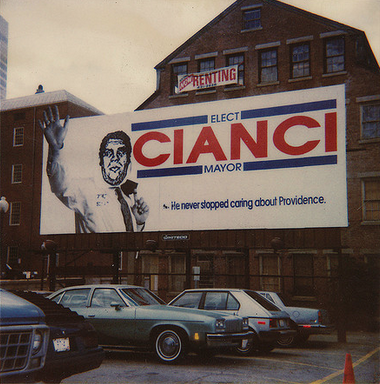
I believe the viewer is looking in the direction of one of Shepard Fairey’s alleged first acts of political art; he was a RISD student in the ’90s. Then candidate Buddy Cianci’s face was super-imposed over a billboard advertising the Providence Zoo’s naked mole rat exhibition.
Actually, as this reader explains, Cianci was the original inspiration for Fairey’s “Obey” images:
An interesting bit of trivia: Behind the red triangular building, on the corner of N Main and Steeple streets, was where Shepard Fairey began Obey Giant (or more specifically, it’s earlier incarnation of “Andre the Giant has a Posse”), which predates his famous HOPE posters for Obama. It was 1990, and convicted felon Buddy Cianci, was running for Mayor for a second time after being released from prison. He had a large campaign billboard at the foot of College Hill facing RISD, where Shep and I were both students. As part of a class assignment, Shep wheat-pasted Andre the Giant’s head over that of Cianci’s, scrawling the soon to be famous words “Andre the Giant Has a Posse” over Buddy’s reelection message.
Someone made a short film telling the story as well. Speaking of stories:
I got into a fight with my girlfriend in that little amphitheater on the left, so thanks for re-opening those wounds. At first I wasn’t sure which floor the balcony was on, so I called GTech and asked the security guy. It’s the 5th floor. (He was very confused so I told him I was planning an elaborate proposal for my girlfriend. Haha, he has no idea we already broke up.)
And a few readers have actually been to the GTech balcony in question, but only one has puked there:
Good lord do I remember this view. Late afternoon cocktail party that went on a bit too long. I found refuge and comfort on that balcony. Don’t want to mention the company’s name, if anyone there is reading this they’ll know who I am. I assure you the box fern in the pic is a replacement.
And finally, this week’s winner is a veteran of more than 20 contests:
Time to give the novice players a chance, huh? I imagine Chini got it before his coffee got cold. This week’s window actually looks to be a glass door, leading to the balcony on the 7th floor of the Gtech headquarters. The balcony overlooks picturesque Waterplace Park in Providence, Rhode Island:
I found the location by doing a Google images search for condo “random balconies”. The main building the view shows up about halfway down the first screen. Interestingly, putting “random balconies” in quotes was the key. Without the quotes, the building doesn’t show up at all. Makes me a little proud of my “Google Fu”.
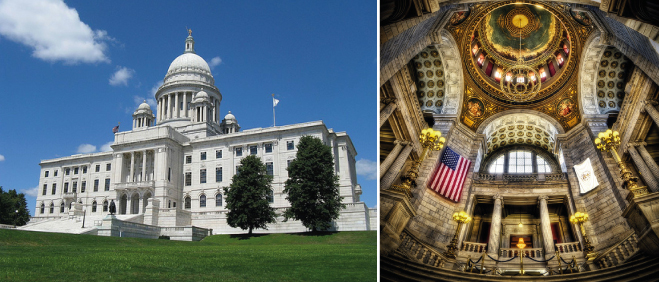
Not pictured is the gorgeous Rhode Island State House, just out of view to the left. In my opinion one of the most beautiful capitol buildings in the country, both inside and out:
Beautiful, and likely corrupt, it seems. As it turns out, this week’s view originated on a field trip:
As a regular incorrect guesser of the contest, I feel a bit bemused to have the photo chosen for the contest! We took URI’s full-time MBA students to visit GTECH’s North American HQ, located at 10 Memorial Blvd in Providence. I took this photo from the northeast corner of 7th floor of the building, which overlooks the Providence River. GTECH uses this balcony to host special events, and this window is the first window of that balcony. If anyone has attended a Waterfire event, they’ll know this spot.
Too bad I can’t enter a guess in the contest, because I’d nail it this week!
Instead we’ll see you for next week’s (more difficult) contest.





 The Dish