Patient Two

Health Care Worker In Dallas Tests Positive For Ebola Virus

On Sunday, the CDC announced a second case of ebola in Texas:

The Centers for Disease Control and Prevention say that a hospital worker who cared for Thomas Eric Duncan, the Liberian patient who died of Ebola last Wednesday, has tested positive for the Ebola virus. This is the first case of Ebola being transmitted in the United States. Officials blame a “breach of protocol” during treatment of Duncan—and although all healthcare workers who came into contact with Duncan were wearing protective clothing, Dr. Thomas Frieden, the CDC director responsible for overseeing agency action against the Ebola crisis, said additional cases are possible because of the breach.

Abby Haglage and Kent Sepkowitz comment on how the nurse managed to contract the virus:

The Dallas nurse, who officials confirmed was wearing gear, was allegedly treating Duncan on his second visit to the ER where he was hospitalized and diagnosed, before eventually dying. This detail is extremely important. Though much remains unclear about Ebola and transmission, we do know that any virus is much more contagious when high amounts of virus are concentrated in the sick person’s blood. It is likely therefore that Duncan was much more contagious farther into his illness, making transmission increasingly likely. …

This may have played into Duncan’s case, which has left officials in Texas such as Health Resources chief clinical officer Dan Vargas, scratching their heads. “We’re very concerned,” Vargas told the press. “[Though we’re] confident that the precautions that we have in place are protecting our health care workers.” In other words, the protocol works but many people’s ability to follow it exactly—really exactly—may pose a substantial challenge.

Jonathan Cohn thinks about how better safety protocols could mitigate the risk to health workers:

Ideally, every facility with Ebola patients would adopt the kinds of practices that groups like Doctors Without Borders have developed and honed over the years. They have thorough checklists, for example, and follow them meticulously. They also use a buddy system or, in some cases, have trained professionals who focus on the disposal of infected material and make sure caregivers take off protective gear properly. Frequently they are “WatSan” specialists, meaning they deal with water and sanitation.

The CDC seems to be moving in that direction already: Frieden said on Sunday that “we are recommending there be a full-time individual who is responsible only for the oversight, supervision and monitoring of effective infection control while an Ebola patient is cared for.” But simply “recommending” hospitals take these steps may not be enough. CDC, or some other arm of the federal government, may need to dispatch these infection control officers and pay for their services.

“A more drastic, but possibly necessary, step would be moving all Ebola patients to hospitals that specialize in these sorts of infectious diseases,” Cohn adds. Sarah Kliff voxplains what sets these hospitals apart:

Emory, the University of Nebraska, and the National Institutes of Health have all received and successfully discharged Ebola patients. These three hospitals are among just four in the nation with specialized biocontamination units. These are units that have existed for years, with the sole purpose of handling patients with deadly, infectious dieases like SARS or Ebola.

While biocontamination units look similar to a standard hospital room, they usually have specialized air circulation systems to remove disease particles from the facility. And, perhaps more importantly, they’re staffed by doctors who have spent years training, preparing and thinking about how to stop dangerous infections from spreading.

(Photo: On October 12, 2014 in Dallas, Texas a man dressed in protective hazmat clothing walks towards an apartment where a second person diagnosed with the Ebola virus resides. By Mike Stone/Getty Images)

Yes, This Is A Pastoral Revolution, Ctd

Synod On the Themes of Family Is Held At Vatican

Yesterday’s big news was the release of a remarkable document detailing the deliberations so far of the Synod on the Family, a gathering of Roman Catholic bishops called by Pope Francis to grapple with issues such as homosexuality and divorce and remarriage among church members. My take (that it’s a truly BFD that I didn’t even begin to expect) is below. John Thavis, a veteran Vatican observer, understands the significance:

In pastoral terms, the document published today by the Synod of Bishops represents an earthquake, the “big one” that hit after months of smaller tremors … While defending the traditional teachings that reject divorce and gay marriage, the synod said the modern church must focus more on the “positive elements” in such relationships, rather than their shortcomings, and open a patient and merciful dialogue with the people involved. The ultimate aim, it said, is to use these “seeds” of goodness to bring people more fully into the church.

Barbie Latza Nadeau has more on what it said about marriage and divorce:

On the discussion of whether or not cohabitating and remarried couples could be considered valid Catholics—obviously a controversial topic among the prelates—they seem at least to agree that there are positive aspects of these relationships that until now the Church has openly condemned. “A new sensitivity in today’s pastoral consists in grasping the positive reality of civil weddings and, having pointed out our differences, of cohabitation,” they write. “It is necessary that in the ecclesial proposal, while clearly presenting the ideal, we also indicate the constructive elements in those situations that do not yet or no longer correspond to that ideal.”

The bishops also suggest they need to challenge themselves to try divorce prevention by working harder to prepare couples during the engagement stage, focusing more on the challenges that lie ahead for them and less on the strictly doctrinal regulations of taking the sacrament of marriage. In other words, they agree they need to provide better advice on what marriage is in real life rather than what it is on paper. And they suggest the dioceses even provide a sort of follow-up care for newly married couples after the honeymoon, which, they conclude, is best done by other married couples with experience that celibate clerics don’t have.

That proposal to have, you know, actual married couples help other married couples is so blindingly obvious one wonders why it has until now been restricted to celibate priests – about the last people on earth with any deep understanding of what it practically takes to keep a marriage alive and healthy through its countless challenges. Burroway applauds the new tone the bishops used to talk about gay people:

This is the first time in the Church’s history that its leadership appears willing to look at our relationships in anything approaching a positive light. The document acknowledges that we have “gifts and talents” without having to, er, “balance” that that recognition This picture taken 21 March 2007 shows awith our living in sin. And it recognizes that there are same-sex relationships which rise “to the point of sacrifice” and “constitutes a precious support in the life of the partners.”

It’s impossible to overstate the importance of the word “sacrifice” in Catholic doctrine. It signifies an essential opening to all that is good and holy, whether it’s Christ’s sacrifice on the Cross or the daily sacrifices that we make as we go about our lives. Sacrifice is central to the Catholic understanding. Non-Catholics see it most visibly in the Lenten sacrifices and fasting, but Catholics see sacrifices, big and small, as a daily expression of their faith. Gay people living in same-sex relationships have been hitherto looked upon as selfish and narcissistic, unwilling to sacrifice their sexuality for their faith. And so for the Bishops to acknowledge that gays and lesbians are also living sacrificial lives is to suggest that something good and valuable is happening. That word’s appearance alone in this context is, I think, the most earth-shattering aspect of this statement.

The idea of gay couples offer anything “precious” in their relationships has never appeared in an official church document before. And the phrase “intrinsically disordered,” so reflexively deployed in the past, is nowhere to be found.

I’m with Jim on the profundity of the breakthrough. B.C. at the Economist offers a similar take:

While the Vatican will almost certainly try to assuage conservative alarm by saying that nothing in the Catholic world-view has fundamentally shifted, the change of tone is startling. Under Pope Benedict XVI, the official view of homosexuality hardened considerably—with a new stress on the idea that gay orientation, let alone practice, was “fundamentally disordered” and incompatible with the priesthood. This hardening coincided with ever-more damaging revelations about priestly child abuse, cover-ups and the existence of a “gay Mafia” in the internal politics of the Vatican.

Up to now, not many prominent Catholics have publicly considered the possibility that there might be any spiritual merit in same-sex unions. One of the few was Father Mychal Judge, the chaplain to the firefighters of New York who was one of the victims of 9/11. “Is there so much love in the world that we can afford to discriminate against this kind?” he used to say. Perhaps he is smiling in heaven.

He was a Franciscan, after all. Tom Roberts asserts that one of the document’s biggest impacts is that it “takes the weapons out of the hands of the hierarchical culture warriors”:

What practically results from this document? Perhaps bishops will not be so quick to turn away from their schools the children of gay parents or to fire gays and lesbians involved in ministry because they are living openly with or married to a partner. Perhaps they will consider the “concrete circumstances,” as the document suggests, of people divorced and remarried and welcome them to the communion table. 

A key term in Francis’s papacy from the start has been “mercy.” Application of the law and of doctrine, he preaches, must be tempered by mercy. In an earlier meditation, he said he wished the church to be “the place of God’s mercy and love, where everyone can feel themselves welcomed, loved, forgiven and encouraged to live according to the good life of the Gospel.” That is not a recipe for cheap grace. The good life of the Gospel places some extraordinary demands on the believer.

The approach is clearly disorienting, however, to those who believe that the church must be a place where teaching and practice are absolute and immutable, where the dividing line must be clear between those who are in and those who are out.

It’s a depth charge against the neurosis of fundamentalism. Grant Gallicho compares this document to past ones by the church:

Of course it notes that gay unions are not “on the same footing” as traditional marriage. But even asking those kinds of questions constitutes a dramatic shift. Seeing them in a synod document was unthinkable under past popes. Just a decade ago, the Congregation for the Doctrine of the Faith instructed Catholics to oppose gay civil unions because, in part, it would lead to allowing them to adopt, which would “do violence” to children. You won’t find that tone in this document–with respect to gay people or anyone else. Francis sings in another key. It’s a tune he seems to want the whole church to learn.

Note the comparison to the “violence” done to children in gay relationships with this:

The Church pays special attention to the children who live with couples of the same sex, emphasizing that the needs and rights of the little ones must always be given priority.

Rebecca Leber likewise emphasizes the difference Francis has made:

To understand this reaction, consider how far the Papacy has come on LGBT issues in what is, by Church standards, a short span of time. John Paul II said in 2005 that the “family is often threatened by legislation whichat times directlychallenges its natural structure, which is and must necessarily be that of a union between a man and a woman founded on marriage.” His successor, Pope Benedict XVI, took many occasions to condemn gay marriage publicly. On World Peace Day and Christmas, Benedict equated gay marriage to an attack on the “essence of the human creature” and presenting a “serious harm to justice and peace.” He even called gay couples “intrinsically disordered.” But Francis? In September of last year he famously said, “If a person is gay and seeks God and has good will, who am I to judge?”

John Allen draws a parallel between the Synod and Vatican II’s approach to ecumenical efforts, which sought to “find a theological logic for the widespread popular desire to break down the walls between the various Christian churches”:

Vatican II did so by elaborating a new theology of the church: While the fullness of the church, according to Catholic doctrine, may exist only in Catholicism, there are nevertheless precious elements of it to be found outside that deserve honor and respect.

With that, the world changed. Before Vatican II, many Catholics hesitated to even enter a Protestant church; afterwards, such taboos were gone. While ecumenism hasn’t yet achieved full reunion, it’s still among the most stunningly successful Christian movements of the late 20th century.

Without overdramatizing things, something similar may be going at the 2014 Synod of Bishops on the family vis-à-vis people living in what the church considers “irregular” situations – cohabitating couples, gays and lesbians, people who divorce and remarry outside the church, and so on.

Alexander Stille discusses the notion of gradualism, one aspect of yesterday’s document that’s been much-debated:

One idea that has emerged at the synod is that of “graduality”; that certain behaviors, although contrary to doctrine, can nonetheless lead people on the right path. Pope Benedict XVI, a doctrinal traditionalist, acknowledged that it was right for a prostitute with AIDS to use condoms. While this did not constitute a change in the Church’s stance against birth control (or prostitution), it was a recognition that taking care not to transmit a deadly disease to others is a moral act that points a person in the right direction. In opening the synod, Cardinal Erdo invoked the idea of graduality in speaking about the birth-control encyclical “Humanae Vitae.” In a briefing session for journalists, Cardinal Vincent Nichols, of Great Britain, said that graduality “permits people, all of us, to take one step at a time in our search for holiness in our lives.”

The draft report refers directly to gradualness as a key to welcoming those whose lives are imperfect but who wish to be welcomed in the Church.

Elizabeth Tenety elaborates:

Is graduality just moral relativism in disguise—or a more realistic approach to modern sex and spirituality?

“It’s trying to present a positive, welcoming, fully alive view of human sexuality,” explained William Mattison, an associate professor of moral theology at the Catholic University of America.

“When we speak of gradualism, it’s not because we’re lightening up the rules but it’s that we’re all struggling to get there,” Mattison added. “The danger would always be that people perceive that you sacrifice the ideal, but that need not be the case.”

So take the example of an engaged couple who is living together before marriage, as 37 percent of Catholics have, or currently are. Are they “living in sin”? Or are they on their first step towards embracing the fullness of the Catholic vision for marriage? Will a priest welcome them to be honest about their situation and get married in his church, perhaps with some special classes or a request that they go to confession? Or will he turn them away for not being serious about what the Sacrament of Holy Matrimony entails?

Elizabeth Dias, however, ratchets down expectations for what the document portends:

First, here’s what the document actually is:

The relatio is a mid-Synod snapshot of 200+ Catholic leaders’ conversations that happened in the Synod hall last week. It is a starting point for conversations as the Synod fathers start small group discussions this week. It is a working text that identifies where bishops need to “deepen or clarify our understanding,” as Cardinal Luis Antonia Tagle put it in Monday’s press briefing. That means that the topic of gays and Catholic life came up in the Synod conversations so far and that it is a topic for continued reflection.

Second, here’s what the document is not:

The relatio is not a proscriptive text. It is not a decree. It is not doctrine, and certainly not a doctrinal shift. It is also not final. “These are not decisions that have been made nor simply points of view,” the document concludes. “The reflections put forward, the fruit of the Synodal dialogue that took place in great freedom and a spirit of reciprocal listening, are intended to raise questions and indicate perspectives that will have to be matured and made clearer by the reflection of the local Churches in the year that separates us from the Ordinary General Assembly of the Synod of bishops planned for October 2015.”

Emma Green adds:

Although there won’t be any specific doctrinal changes made until the synod gathers again in Rome next fall, the report hints at doctrinal changes to come, particularly in terms of simplifying the process for annulment of marriages. But even in the near future, the most important changes might be more subtle, pastoral shifts: The Church wants to be a more welcoming place for people whose relationships don’t fit into the template of man and wife, till death do they part.

All the caveats are well taken. But the words along have already transformed the church. That is Francis’ gift to us: a language of mercy, not judgment. It is the language of Jesus.

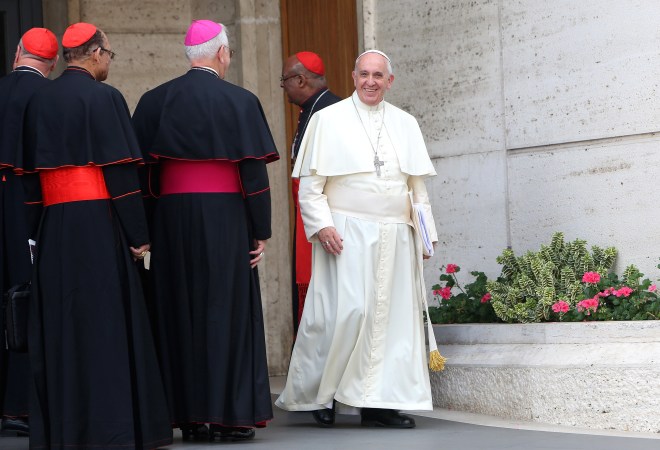
(Photo: Pope Francis leaves the Synod Hall in Vatican City at the end of a session of the Synod on the themes of family on October 13, 2014. By Franco Origlia/Getty Images)

Yes, This Is A Pastoral Revolution

This picture taken 21 March 2007 shows a

Well: we can now see the seeds of growth being planted by Pope Francis. Plenty of analyses have already been written insisting that nothing much has changed in the first week of the Synod on Family Life; that established doctrine – even on matters such as the re-married being allowed back to the Lord’s table at Mass – remains unaltered; that this is window dressing, and not the window itself. The only way to answer this critique is to watch the Synod – see this extraordinary moment from last week – and read its first Relatio and to find oneself – certainly as a gay Catholic – in a certain amount of shock. The drama certainly continues; a huge plurality of the bishops appointed by John Paul II and Benedict XVI will be pushing back hard against what Francis has already done; in fact, they already were, which may have been why Francis appointed six new over-seers of the Relatio at the last minute.

The result – though this will never be admitted or conceded – is a thorough repudiation of the last two papacies. They were both dedicated to upholding a very traditional and uncompromising view of family life and marriage, describing those outside of that model as problems to be guarded against, and even talking of some human beings as “intrinsically disordered” because of their seeming inability to live up to the uncompromising standards the church upheld. This created a fortress church, of the holy, in which those who fell short often felt excluded, even demonized, by the language and rhetoric coming from Rome.

Now compare that with the way Francis talks about family life in the very opening part of the Relatio:

Evening falls on our assembly. It is the hour at which one willingly returns home to meet at the same table, in the depth of affection, of the good that has been done and received, of the encounters which warm the heart and make it grow, good wine which hastens the unending feast in the days of man. It is also the weightiest hour for one who finds himself face to face with his own loneliness, in the bitter twilight of shattered dreams and broken plans; how many people trudge through the day in the blind alley of resignation, of abandonment, even resentment: in how many homes the wine of joy has been less plentiful, and therefore, also the zest — the very wisdom — for life.

This is looking outside the church to the family dinner – with wine of course! But it also sees not some pristine vision, but also the crooked reality of so many – the countless who dine alone, or whose exhaustion after work strains family life still further, or whose career has crashed, or whose job has just been lost, or the grown children unemployed who live in the basement. The single mother; the abused wife; the frustrated father; the traumatized children. This seems to me where Jesus is – not among the perfect, but among the wounded; and not in austere and brutal judgment, but beside them, listening, caring, loving.

This is where the church should really start:

It is necessary to accept people in their concrete being, to know how to support their search, to encourage the wish for God and the will to feel fully part of the Church, also on the part of those who have experienced failure or find themselves in the most diverse situations. This requires that the doctrine of the faith, the basic content of which should be made increasingly better known, be proposed alongside with mercy.

The abstract certitudes of the Bavarian theologian cede to the pragmatic pastor from Buenos Aires. And what we are seeing here is similar to what we saw at the Second Vatican Council. Just as that Council for the first time recognized that other faiths can have insight into the divine, so this Synod is also recognizing the goods and positive aspects in families and relationships outside the pristine model.

Following the expansive gaze of Christ, whose light illuminates every man, the Church turns respectfully to those who participate in her life in an incomplete and imperfect way, appreciating the positive values they contain rather than their limitations and shortcomings … Imitating Jesus’ merciful gaze, the Church must accompany her most fragile sons and daughters, marked by wounded and lost love, with attention and care, restoring trust and hope to them like the light of a beacon in a port, or a torch carried among the people to light the way for those who are lost or find themselves in the midst of the storm. 

Which is when we stumble across the nub of all of it:

The truth is incarnated in human fragility not to condemn it, but to cure it.

So let me address one of the more controversial and revolutionary aspects of this document, and one which obviously affects me deeply: the section the document actually titles:

Welcoming homosexual persons

Yes, you read that right. Instead of being seen as intrinsically disordered human beings naturally driven toward evil – and thereby a contaminating influence to be purged when we become visible (see the recent acts of cruelty and rigidity toward gay parishioners around the country), the church is now dedicated to welcoming gay people. You can write a long disquisition on how this changes no doctrine, but it seems to me you are missing something more profound – a total re-orientation of the church toward its gay sons and daughters. I have managed to find churches that do indeed welcome gay people; but even they rarely publicly declare that they welcome us with open arms – as we are, “her most fragile sons and daughters, marked by wounded and lost love.”

Here is the key section:

     50.        Homosexuals have gifts and qualities to offer to the Christian community: are we capable of welcoming these people, guaranteeing to them a fraternal space in our communities? Often they wish to encounter a Church that offers them a welcoming home. Are our communities capable of providing that, accepting and valuing their sexual orientation, without compromising Catholic doctrine on the family and matrimony?

     51.        The question of homosexuality leads to a serious reflection on how to elaborate realistic paths of affective growth and human and evangelical maturity integrating the sexual dimension: it appears therefore as an important educative challenge. The Church furthermore affirms that unions between people of the same sex cannot be considered on the same footing as matrimony between man and woman. Nor is it acceptable that pressure be brought to bear on pastors or that international bodies make financial aid dependent on the introduction of regulations inspired by gender ideology.

     52.        Without denying the moral problems connected to homosexual unions it has to be noted that there are cases in which mutual aid to the point of sacrifice constitutes a precious support in the life of the partners. Furthermore, the Church pays special attention to the children who live with couples of the same sex, emphasizing that the needs and rights of the little ones must always be given priority.

I never thought I would live to read these words in a Vatican document. Gone are the cruel and wounding words of Benedict XVI to stigmatize us; instead we have the authentic witness of someone following Christ who came to minister to the broken and the hurt, the Synod On the Themes of Family Is Held At Vaticanfragile and the strong, the people who had long been excluded from the feast – but now invited to join it as brothers and sisters – “a fraternal space” in the church. Notice too that the church is now emphasizing a pastoral “accepting and valuing” of homosexual orientation, yes, “valuing” the divine gift of our nature and our loves. Yes, the doctrine does not change. The sacrament of matrimony is intrinsically heterosexual – a position, by the way, I have long held as well. But it is possible to affirm the unique and wondrous thing of heterosexual, life-giving union without thereby assuming that gay people are somehow intrinsically driven to evil, as Benedict insisted. It is not either/or. It has always been both/and.

And look too at the positive aspects of a gay relationship: “mutual aid to the point of sacrifice.” Instead of defining us as living in sexual sin, the church is suddenly seeing all aspects of our relationships – the care for one another, the sacrifices of daily life, the mutual responsibilities for children, the love of our families, the dignity of our work, and all that makes up a commitment to one another. We are actually being seen as fully human, instead of uniquely crippled humans directed always and everywhere toward sin. And, yes, there is concern for our children as well – and their need for care and love and support.

Of course I cannot write these words without something breaking inside of me. It is like a long, dark night suddenly seeing a crack of daylight. Or rather it is like the final breaking of bread within me, a sacrament of love being released within, of a faith made more whole, of a home finally found.

Know hope. Know joy.

(Photos: A grey-beam coming through a stained-glass window, on every spring and autumn equinox, at the Strasbourg cathedral, eastern France. By Frederick Florin/AFP/Getty; Pope Francis leaves the Synod Hall at the end of a session of the Synod on the themes of family on October 13, 2014 in Vatican City, Vatican.By Franco Origlia/Getty Images.)

The Most Defensive Campaign Of The Midterms

It belongs to Alison Grimes, the Democrats’ Senate candidate in Kentucky. She has repeatedly refused to disclose whether or not she voted for Obama. Mitch McConnell is taking full advantage of the situation:

Ed Morrissey rolls his eyes in her direction:

Alison Grimes isn’t running for the position of Private Citizen. She’s running for the US Senate in a cycle where Barack Obama’s agenda is very much on the table — just as Obama himself insisted earlier this month. She wants Kentucky voters to replace McConnell with her, but won’t say whether she’ll vote for Obama’s agenda, instead offering wishy-washy language about independence while taking no stands on Obama policies like ObamaCare and coal restrictions. Now she wants to pretend that, even though Grimes served as a delegate to both of the Democratic National Conventions, in 2008 and 2012, that nominated Obama for President, her support of Obama in the election is somehow a mystery — and that it’s none of the business of Kentucky voters because of the principle of the secret ballot. 

Sam Youngman weighs in:

The problem with Grimes’s answer is that she had no problem telling Austin Ryan, who interviewed Grimes as part of a documentary for KET and the University of Kentucky, that she voted for Hillary Clinton in Kentucky’s 2008 Democratic primary.

Ultimately, who Grimes voted for in the last two presidential elections isn’t going to be what decides this race. What has hurt Grimes throughout is who won the presidency and how Kentucky views him. The president’s approval ratings hover around 30 percent in Kentucky, and McConnell has all but physically sewn Obama to Grimes.

Drum compares Grimes’ failed political dodge to those of Iowa Senate candidate Joni Ernst and Colorado Senate candidate Cory Gardner:

The difference is that Grimes was clumsy over her handling of a process issue: her support for a president of her own party. Reporters feel free to go after that. Ernst, by contrast, was crafty over her handling of policy issues: in this case, environmental policy and health care policy. Likewise, Gardner is being crafty about his handling of abortion and contraceptive policy. That sort of craftiness generally invites little censure because political reporters don’t want to be seen taking sides on an issue of policy—or even rendering judgment about whether a candidate’s policy positions have changed.

Jason Zengerle calls “Grimes’s refusal to say who she voted for is emblematic of her entire campaign, which, for the last 15 months, has been waged in a defensive crouchevading and obfuscating at every turn.”:

Grimes’s candidacy is showing just how absurdand ultimately self-defeating the modern political campaign has become. So preoccupied with not making mistakes, and demonizing the opponent, the modern political campaign often forgets what would seemingly be its most important task: to make an affirmative case for its candidate. If Grimes and Terri Lynn Landthe Republican candidate for Senate in Michigan who’s run a similarly bunkered raceboth go down to defeat, perhaps it’ll serve as something of a wake-up call to strategists on both sides of the aisle.

Intelligent Design

Oliver Morton pens a touching tribute to modern science, inspired by a visit to a biotech company that mass-produces designer proteins “that recognise and help the body regulate various sorts of target, notably cancers”:

If cells could choose their environment, these pampered tanks would be top of their list. Tens of thousands of hours of meticulous engineering design, years of research by acute minds, billions of dollars in capital expenditure, all devoted to letting one biological process unfold with less hindrance than has ever been possible before. The ability to design environments that so suit their inhabitants may be second only to the ability to design those inhabitants themselves when it comes to the human revolutionising of biology.

And the relation of this fierce focus to diversity is not an either/or. These antibodies are designed for a purpose. I have friends whose cancers have responded to treatments of which these antibodies are a part. Those friends have lives as unique as all human lives, as unique as any sport of creation and far more precious. And mass-produced molecules, copied in numbers that dwarf those of the stars in the sky, have intervened in the machinery that supports that life and helped to prolong it.

Books On Bikes

OLYMPUS DIGITAL CAMERA

Adele Peters flags a cool educational experiment:

While some elementary schools no longer have recess, and people like New Jersey Governor Chris Christie argue that school days should be even longer, a few schools are already moving in a different direction. Some are testing out standing desks, and realizing that a little bit of activity can actually improve attention spans. Others, like Ward Elementary in Winston-Salem, North Carolina, are starting to fill classrooms with exercise bikes, so students can work out while they learn.

The Read and Ride program at Ward began five years ago. One classroom is equipped with enough exercise bikes for a full class of students, and teachers bring students throughout the day to use them. As they ride, they read. The combination burns calories, but it turns out that it also helps students learn better. As the elementary school analyzed testing data at the end of school year, they found that students who had spent the most time in the program achieved an 83% proficiency in reading, while those who spent the least time in the program had failing scores–only 41% proficiency.

(Photo via Read and Ride)

How The Literary Make A Living

While pondering the eternal question of how full-time artists can fund their work, Alan Jacobs looks back to a 1945 essay by the poet and critic R.P. Blackmur, “The Economy of the American Writer”:

From our vantage point, perhaps the most interesting point here is Blackmur’s uncertainty about the most likely source of support for artists: will they find their place in the world of the university, or in the world of the non-profit foundation? Well, we know how it turned out: while foundations do still support artists of various kinds, universities have turned out to be the chief patrons of American artists — especially writers.

Blackmur sees that even at his moment support for writers and artists is drifting towards the university; he’s just not altogether happy about that. He’s not happy because he has seen that “the universities are themselves increasingly becoming social and technical service stations — are increasingly attracted into the orbit of the market system.” A prophetic word if there ever was one.

The universities have in the intervening seventy years become generous patrons of the arts; but what is virtually impossible for us to see, because we can’t re-run history, is the extent to which the arts have been limited and confined by being absorbed into an institution that has utterly lost its independence from “the market system” — that has simply and fully become what the Marxist critic Louis Althusser called an “ideological state apparatus,” an institution that does not overtly belong to the massive nation-state but exists largely to support and when possible fulfill the nation-state’s purposes.

On a related note, author Jess Row recently spoke out against the idea of writing for exposure rather than pay:

My feeling is that if we’re talking about a large publicly traded media company, then the contributors ought to be paid something, even if it’s very little. The question of journalism being degraded so that it’s basically being treated as something that you just do for exposure or visibility or self-branding—perhaps it’s not a conspiracy per se, but it is by all accounts a corporate strategy.

I have a lot of problems with the idea that we should be paid less for book reviews that appear online than those that appear in print. I understand that because of the internet the question of how any of these properties make money is very much up in the air, but somebody’s making money, and some people are making a great deal of money, and the people who aren’t making any money are the people who care the most about what they’re doing—the writers and the contributors and the journalists, the people on the ground. I think that’s an unacceptable position, and I think that’s an unacceptable model. It’s a good business model, but an unacceptable artistic or cultural model.

Is Amazon A Monopoly? Ctd

Many readers join the debate:

I can’t figure out whether Yglesias was being naïve when he says that “suffice it to say that ‘low and often non-existent profits’ and ‘monopoly’ are not really concepts that go together.” That’s exactly what monopolies do. They have enough capital to take a loss for long enough to wipe out the competition, then they take of advantage of being a monopoly.

Another elaborates by making a key distinction:

Amazon is not a retail monopoly.  However, it is quickly becoming a wholesale monopsony (a market form in which there is only one buyer for goods) with respect to books, e-books, and likely other product categories.

By driving down prices and operating at a loss for decades, Amazon is driving out all other potential buyers and resellers of these goods. This may sound good on the surface for consumers (low prices, yay!), but the concern is if Amazon becomes the only viable buyer (and therefore the only viable reseller), there will be no one left to step up as an alternative when Bezos decides he is ready to turn a profit and jacks up prices. Not to mention what happens to the suppliers (publishers and authors) when Amazon (as the sole buyer) drives prices down to unsustainable levels, which in turn will result in less choice for consumers. Many have written on this subject, including the NYT.

Another has a favorable view of the mega-company:

Amazon, as a monopsony, is not something the government should be stomping on, as long as it continues to provide good value to consumers. Amazon is losing money in these efforts and that can’t go on forever. Other businesses may struggle, but that’s generally to the benefit of consumers. Tough for business owners, sure, but business ain’t beanbag.

As far as beating up Hachette goes, Amazon is fighting to be able to discount e-books. Hachette wants to keep prices high, and keep paying authors an absurdly low royalty for e-books. Amazon certainly has its flaws (treatment of warehouse employees among them), but in the book market – which I know about as a publisher, author, and reader – Amazon has been a massive force for good. There are thousands of authors now making good money from Amazon who would never have had a chance under the old publishing system.

But another isn’t a fan:

The issue with Amazon (and Walmart) is not that they are monopolies.  Depending on the market in question, these two may or may not possess majority marketshare (in small towns, WalMart and Amazon may be your only choices for many things).  On the other hand, neither of them are (per the law) predatory monopolies – companies that drive competitors out of business and then raise prices once the competition is extinguished and collect monopoly rents.  Instead, Amazon and Walmart keep prices low and generally provide good service, which largely immunizes them from much antitrust scrutiny in the US. The behavior that gets companies in trouble with antitrust authorities in this country is any form of price-fixing or other scheme to charge customers more than they would be charged in a competitive marketplace.  Complaints that WalMart harms consumers by “reducing choice” (not carrying a wider range of products that might be carried were the retail market less concentrated) have been generally laughed out of court by federal judges.

Instead, the issue with both companies is that they are ruthless monopsonies that viciously exploit their vendors and their workforce.  Both companies demand (and get) price concessions from manufacturers that are arguably responsible for lots of outsourcing and such; both companies are also well-known for mistreating their employees.  US antitrust law, which focuses on harm to consumers (in their capacity as consumers) is not well-situated to focus on predatory monopsony behavior (after all, it was Apple and the publishers who were prosecuted for anti-trust behavior in the recent Amazon fight, even though they were aligning themselves against the 800lb gorilla in the retail book market).  US antitrust law doesn’t generally give a rip about mom-and-pop stores being run out of business.  (European authorities are more able to deal with predatory monospony behavior; whether this is good or bad policy is an interesting question).  And labor relations are, with a few exceptions, outside the scope of anti-trust law – unless business cartels attempt to fix wages in the absence of collective bargaining, anti-trust law simply doesn’t apply.

Another, more neutral observer details the company’s vast services:

I’ve been following the discussion about Amazon as a monopoly and it seems that some people miss the power of Amazon as a company that wants to be your only source for everything. The company is not only your first place to look for anything you may like to purchase from electronics, to house items, to even clothing. Amazon seems to have a hand on every slice of the consumer experience. With Amazon you have prime to get anything in two days without worrying about shipping, but in addition you get a service “prime instant video” that is a competitor of Netflix, Hulu, and regular TV. You also can get your Amazon phone (competing against Apple, Samsung, Google) and your Kindle fire (Nexus, Samsung and iPad tablet rival). Your Kindle also serves as your ebook reader (vs B&N Nook, now a Samsung tablet). On top of that Amazon has also its own app store (vs Google play and iTunes), and now I understand you can also have your music stored in the cloud by Amazon.

But Amazon is also your source for all the back-end computing cloud needs. You can have your files on AmazonCloud Drive, but if you are a company wanting a solution for your IT needs you can use Amazon Web Services and have everything you need from basic website setup to sophisticated data mining applications. AWS even has scientific clients as you can run sophisticated modeling software to do advanced drug search and any other complex data processing and searches. In fact Amazon is looking for academic clients for their AWS system.

If you need to search for anything you want to buy, you don’t even need Google to do the search. Unlike Facebook, Amazon doesn’t nag me to their website every day to waste my time with the latest viral news or inane discussions. They have never asked for anything too personal but they have everything they need to know about my personal interests if they just look at my purchases and regular browsing habits in their website.

They seem to have a knack to pick businesses and services that are going to be necessary as long as humans want to be consumers, and in principle you can have pretty much every need covered in their ecosystem.

(Full disclose: the Dish gets about 3 percent of its annual revenue from Amazon’s affiliate program, detailed here.)

Following In The Footsteps To Freedom

dish_JeanineMichnaBales

Photographer Jeanine Michna-Bales retraced the steps of fleeing slaves along the Underground Railroad for her project Through Darkness to Light:

Finding that there were few visual records of the secret stations along the escape route, she herself traced the steps taken by many of the 100,000 slaves between the Southern plantations of Louisiana to the border of Canada, where slavery was prohibited. Along the way, she creates an archive of historical sites both famous and obscure, discovered through academic inquiry at historical societies and oral histories passed down through generations. …

Michna-Bales shoots after dark, capturing the ambiguous nature of the shadowed land, which becomes shrouded both in terror and in hope. After examining each station during the day, she sometimes had to score the spot with a plastic bag lest she lose her way in the dark. Some safe houses had not been well documented; after reading accounts, she would work from a general area, searching and asking around for old houses. Many homeowners confirmed her hunches and led her other buildings along the railroad. Once, police showed up after her presence had been called in by neighbors, only to offer her more insight into the history of the railroad.

See more of her work here.