“A comment article on 13 August about the European Court of Human Rights said that the supply of heroin and gay porn to prisoners was now a ‘right’. We are happy to clarify that this was not meant to be taken seriously and is not the case,” – the Daily Mail.
The Best Of The Dish Today
Ted Cruz, some supporters are arguing, is dead-set on a presidential campaign for 2016 and determined to make foreign policy his focus. It does not appear, it would seem, that this comes from a long mulling over the state of the world today, but instead as a response to the current very Republican-friendly re-animation of the post 9/11 hysteria about Jihadist terror that Josh has now noted. And his position is not neoconservative. He has no illusions about the ability of developing countries, especially in the Middle East, to find a way forward to democratic stability with American help. And so he would be as skeptical as I am that Obama’s new war in Iraq will somehow prod the sects there to overcome their differences and construct a functioning broad-based government. Instead he just wants to bomb the crap out of places from the air – or engage in massive military efforts to quell enemies – and then run away. Or, in his words:
“If and when military action is called for, it should be A) with a clearly defined military objective, B) executed with overwhelming force, and C) when we’re done we should get the heck out. I don’t think it’s the job of our military to engage in nation-building. It is the job of our military to protect America and to hunt down and kill those who would threaten to murder Americans. It is not the job of our military to occupy countries across the globe and try to turn them into democratic utopias.”
Well, I’m with him on that last p0int. But I’m not sure that the “rubble makes no trouble” paradigm really works in practice. If you’re dealing with Islamist terror, brutal bombing raids, which would inevitably involve civilian casualties, could very well provoke more resistance, more anti-Americanism and more terrorism. Even an occupation designed to quell an insurgency, as in Iraq from 2004 – 2010, failed to do that. And such a policy would be very hard to sell to allies – as even the current containment policy toward ISIS suggests. Then there’s his softer belligerence: much tougher sanctions against Russia and Iran. As if sanctions against the one government policy supported by the Iranian people – a peaceful nuclear program – would somehow resolve the problem. Or as if Obama hasn’t done both those things already.
But I expect Cruz to run, and I would not be surprised if he won. In the current mood – with the right returning to outright panic over Islamism, despite no terror attacks from any of the putative deadliest foes – the atavistic strain is tumescent. The GOP base wants revenge and bombs and bombast – preferably against Muslims. And the symbol of all this will be Greater Israel – the state that bombs its enemies with ruthless abandon, and with no apology. Just as Obama has adopted the Likudnik policy of “mowing the lawn” in the Middle East, Cruz will take that even further. The world will be our Gaza!
Today, I wondered whether the administration cared any more about whether a terror threat was imminent or non-existent before going to war against it; I tried to makes sense of the president’s apparent conviction that the Shi’a, Sunnis and Kurds will at some point decide they love Iraq more than they hate each other; I outed John Oliver as a journalist; and Jake Weisberg penned a tart review of Rick Perlstein’s history of the right. Man, I miss Jake’s writing.
The most popular post of the day remained this Chart Of The Day on how successive recoveries have benefited the rich more and more; followed by this reflection on how envy kills mid-life friendships.
Many of today’s posts were updated with your emails – read them all here. You can always leave your unfiltered comments at our Facebook page and @sullydish. 24 more readers became subscribers today. You can join them here – and get access to all the readons and Deep Dish – for a little as $1.99 month. Gift subscriptions are available here. Dish t-shirts and polos are for sale here. A new subscriber writes:
Just wanted to let you know, I’ve been wanting to subscribe to The Dish for what seems like ages now, but promised myself I wouldn’t until I found a job (internships notwithstanding). Well, I finally found one! So, after getting my first paycheck and a credit card, it seemed about time to ante up. There was only one last hurdle: being told I was “part of the smartest, most diverse and open-minded community on the web,” without throwing up. You might as well put up a sign, “You must be this pretentious to enter.”
But subscribing to The Dish is a big deal to me. I’ve wanted to do it for so long. Because of the deal I made myself, it’s come to signify that I’m actually going somewhere in my life, that I finally have some income I can dispose of. So I was thrilled for this to be the first purchase made on my new card.
We’re all as thrilled as our slightly nauseated reader.
See you in the morning.
Dunham, Reviewed
Reviews are in for Lena Dunham’s new essay collection. Helen Lewis focuses on Dunham herself, and her advantaged upbringing:
Dunham’s first appearance in print came in 1998, when a Vogue story on New York tweens quoted her thoughts about big-name fashion designers—“I really like Jil Sander, but it’s so expensive”— and her attempts to re-create them on a $5-a-week allowance. She was 11.
Within five years, she was already on her second appearance in the New York Times, after a reporter was despatched to a vegan dinner party she gave for her private-school friends. “A crunchy menu for a youthful crowd”, records the headline. The 16-year-old Lena found that “meat was easy to give up, cheese, almost impossible.” But: “One year into a totally vegan diet, she has become a soy connoisseur.”
Not exactly the kind of up-bringing I had. I was munching on liver and bacon and mash and gravy at that point – and loving it. Lewis does eventually get to the book itself:
This book is emphatically not a feminist polemic. There is one chapter where she imagines the memoir she’ll write at 80, in which she will name the names of all the creepy male directors who have propositioned her, and one letter (in a collection of “emails I would send if I were one ounce crazier/angrier/braver”) that smacks of real, rather than posturing anger, at having her feminism derided. But everywhere else, perhaps from a desire to separate art from activism, the focus is relentlessly inward. (Her sister, Grace, is arranging for representatives of Planned Parenthood to campaign at events on Lena’s book tour; the book does not mention abortion.)
She writes in the book: “When I am playing a character, I am never allowed to explicitly state the takeaway message of the scenes I’m performing—after all, part of the dramatic conflict is that the person I’m portraying doesn’t really know it yet.” The same applies to most of the book: Her whole life is a performance art piece where she plays a noxious brat with great skill, and poses herself, either eerily like one of her mother’s dolls, or sexually, like her father’s nudes. And as the carapace of fame around her has expanded, she has shrunk within it, leaving only gnomic statements about granola and blowjobs. Reading this book, you realize that Lena Dunham has been playing “Lena Dunham” for a long time. She is not real.
Michiko Kakutani, for her part, refuses to conflate Dunham with her “Girls” protagonist:
In fact, the differences between Ms. Dunham and Hannah help fuel this book. A young woman in search of a comic road map to love and sex and work and “having it all” would hardly benefit from consulting the self-sabotaging Hannah (or, for that matter, Marnie, Jessa or Shoshanna) for advice. But the author of this memoir — that’s another matter. Ms. Dunham doesn’t presume to be “the voice of my generation” or even “a voice of a generation,” as Hannah does in the show. Instead, by simply telling her own story in all its specificity and sometimes embarrassing detail, she has written a book that’s as acute and heartfelt as it is funny.
Jessica Kasmer-Jacobs agrees that Dunham isn’t Hannah, but not about the quality of the book:
What surprised me most about Ms. Dunham’s memoir is that one of the funniest voices of my generation has written a book that isn’t very funny. …
One suspects that Ms. Dunham did not quite know what she wanted this book to be. It reads like a memoir, divided by sections titled “Love and Sex,” “Body,” “Friendship,” “Work” and “Big Picture,” but it is packaged like a self-help book, something of a nostalgic tribute to Helen Gurley Brown’s “Having It All” (1982), the Cosmopolitan editor’s “passionate program” for “women who won’t settle for less than the best.” Ms. Dunham harbors a respect for Gurley Brown, she reports, despite what she calls the latter’s “demented theories” on attracting men, family planning and crash dieting, “which jibe not even a little bit with my distinctly feminist upbringing.” Herself “a girl with a keen interest in having it all,” Ms. Dunham says she feels obliged to pitch in with “hopeful dispatches from the frontlines of that struggle.”
Laura Miller shares her views:
“Not That Kind of Girl” is a book in which stories peter out. The advice theme wanders off and gets lost in the long grass. There is a strong chapter on Dunham’s relationship to her younger sister, followed by a pointless and predictable list of things she likes about New York. Some passages are general when they need to be specific and others are close-ups when they need to pan out to take in a bigger picture.
Contrary to what some critics might assert, self-absorption per se isn’t a deal-breaker in a writer. It has worked for everyone from Saint Augustine to Anne Sexton. But it requires a particular form of discipline, an ability to distinguish signal from noise that Dunham has yet to achieve on her own. I’m not sure I want her to, at least not yet, because while she lacks Allen’s precision, she exceeds him in courage and vulnerability by miles. The most fascinating bits of “Not That Kind of Girl” are the handful that describe Dunham’s approach to her work, the revolutionary, liberating way she has used her own naked body (not to mention her naked psyche) as “simply a tool to tell the story.” What she doesmatters more to her than anything she can merely be, which is millennia of traditional femininity turned on its head, granny panties showing, right there.
The Enduring Appeal Of Bullshit

Brendan Nyhan considers why absurd claims spread so quickly on the Internet:
[T]ake the bizarre but instructive example of the woman who claimed to have had an implant to add a third breast – clearly an example of an implausible story that was too good to check. Initial reports circulated widely on social networks, totaling over 188,000 shares according to Emergent’s data. The story was quickly discredited after it was reported that a three-breast prosthesis had been previously found in the woman’s luggage, but the articles reporting that it was false never attracted even one-third as many shares as the initial false reports.
That hoax may seem silly, but it’s instructive about the problem with rumors – they’re often much more interesting than the truth. The challenge for fact-checkers, it seems, is to make the facts as fun to share as the myths they seek to replace.
(Screenshot from the New York Post)
Not Minding The Gap
Alice Robb discourages excessive gender-gap-awareness:
The “bike gap” is the latest in a small spate of “gender gaps” that don’t seem worth our concern. At New York’s “The Cut,” Ann Friedman says women don’t feel “at home in the world of weed.” It’s not entirely clear that Tracie Egan Morrissey, writing for Jezebel, is joking when she urges women to “close the gender gap on being potheads.” She cites research suggesting that nearly twice as many men smoke weed (or at least admit to it). The only possible explanation, according to Morrissey, is sexism. “When it comes to cultural representations, it’s generally accepted that the world of weed is a guy thing,” she writes. …
“No one bemoans the gender gap in female dominated activities,” points out journalist Jessica Grose in an email. “Where are the men in knitting or flower arranging?” Or, for that matter, where are the men in Soul Cycle? Marcotte admits that indoor cycling is dominated by women; she estimates that women make up “80 to 100 percent” of most spin classes. Yet she sees no problem.
Friedman dissents:
Closing a gender gap for the sake of closing the gap is going about it all backwards. Usually gaps are symptomatic of other problems. It is important to interrogate why a gap exists, and address that problem. I don’t think you can argue that women are naturally less interested in cycling or video games or weed than men are—our choices are shaped by the culture and society we live in. That society is pretty sexist!
Instead of looking at the world with all its many group differences and appreciating that, one kind of liberal sees it all as a problem to be fixed. Let me just reiterate my own view: vive la différence! Amanda Marcotte agrees with Friedman:
I don’t think the fact that men smoke more pot than women is a problem, in and of itself, that needs fixing. But the fact that men don’t feel guilty about firing up a joint and playing Call of Duty while women think they should be spending that time on “worthwhile” activities perhaps bears a little more interrogation.
Michael Barone inserts evolutionary theory into the debate:
There are salient differences between men and women, on average, as the natural result of the evolutionary process, and those differences are reflected in different behavior and different career choices, again on average. We want a society where people can make the choices they want, but we fool ourselves if we think that in such a society men’s and women’s choices would be statistically indistinguishable.
Ya think?
Is Baseball A Religion?
As October nears, George Will answers the question this way:
Part of the beauty of baseball, and sport generally, is that it doesn’t mean a damn thing. It’s valued for itself. Now, it can be the pursuit of excellence.
It is competition tamed and made civil by rules. It is aggression channeled in a wholesome direction. These are all virtues. They tiptoe up to the point and stop well short of giving baseball meaning. It’s a game. It’s a very pretty, demanding, and dangerous game.
I do think that baseball satisfies a longing in people, particularly urban people. There is a vestigial tribal impulse in all of us. For instance, when you get on the L and the cars begin to fill up with people wearing their Cub blue and you’re all going to the same place for the same reason, for about three hours a little community exists. It disperses after three hours, but it will come back tomorrow.
Daniel Patrick Moynihan talked about what he called the “liberal expectancy.” He said that with the coming of modernity the two drivers of history, religion and ethnicity, would lose their saliency. Sport caters to this and entertains this desire for group identification. But there’s nothing transcendent about baseball.
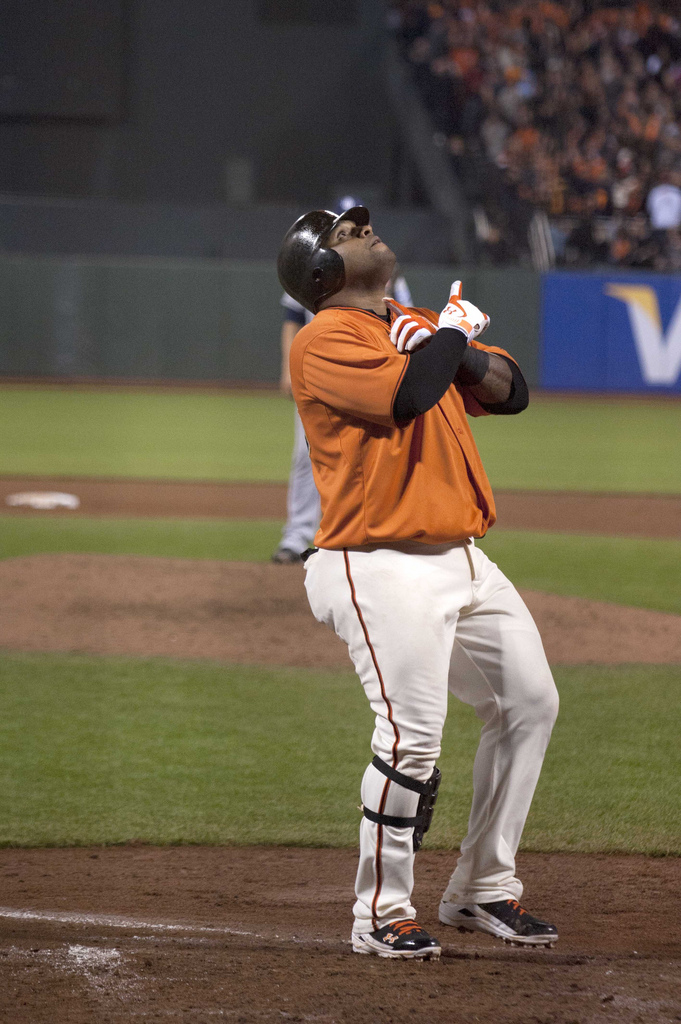
Update from a reader:
George Freaking Will and baseball? Seriously? Any post about Will and baseball should be accompanied by this SNL skit.
(Photo from 2012 Giants-Padres game by Joel Henner)
Poor Choices
Linda Tirado, author of Hand To Mouth, explains why the poor often make terrible decisions:
I smoke. It’s expensive. It’s also the best option. You see, I am always, always exhausted. It’s a stimulant. When I am too tired to walk one more step, I can smoke and go for another hour. When I am enraged and beaten down and incapable of accomplishing one more thing, I can smoke and I feel a little better, just for a minute. It is the only relaxation I am allowed. It is not a good decision, but it is the only one that I have access to. It is the only thing I have found that keeps me from collapsing or exploding.
I make a lot of poor financial decisions. None of them matter, in the long term. I will never not be poor, so what does it matter if I don’t pay a thing and a half this week instead of just one thing?
Dreher, who was initially sympathetic to Tirado, had second thoughts after a reader dug up a 2013 hit piece on her. In an interview with Danielle Kurtzleben, Tirado defends herself against such attacks:
DK: You were accused of being a hoax after that “Poverty Thoughts” essay came out. Is that flaring up again now, with your book coming out? What’s your response to all that?
LT: I’m a published author at this point, and The Nation did a very, very good job of reporting on that. But most of the criticism I’ve seen centers around my decision-making processes. What I see a lot of is people talking about like things I have to explain — like why did you do this or why did you do that? A lot of people are confused about how I couldn’t, for instance, feed myself when I could pay my electric bill.
The Guardian also caught up with Tirado:
[Q.] Were you expecting what happened after your essay was published?
[A.] Oh, God, no! I was just on a message board. I was just talking to my friends the same way I’d done for many years. Then I went to bed, and then I went to work. It took me about two weeks to realise I was awake because I was pretty sure I was having a really fucked-up dream. There is no processing what happens when the internet looks at you and says: it’s your turn. It was insane: people were outside my house, they were calling my elderly relatives, I got 20,000 emails in a week. I still have no idea why it was this piece at this moment; it’s nothing me and my friends haven’t been saying for years. I don’t understand why it was controversial. Period.
Meanwhile, Andrea Louise Campbell, author of Trapped In The Safety Net: One Family’s Struggle, shares another harrowing story of poverty:
In February 2012 my sister-in-law Marcella was in a car accident on her way to nursing school, where she was working towards a career which she hoped would catapult her and my brother Dave into middle-class security. Instead, the accident plunged them into the world of American poverty programs. Marcella is now a quadriplegic, paralyzed from the chest down. She needs round-the-clock personal care and assistance.
The only source – public or private – for a lifetime of such coverage is Medicaid. But because Medicaid is the government health insurance for the poor, she and my brother must be poor in order to qualify. (Medicare does not cover long-term supports and services, and private long-term care insurance is time-limited and useless to a 32-year-old who needs decades of care). Thus, Marcella and Dave embarked on a hellish journey to lower their income and shed their modest assets to meet the state limits for Medicaid coverage.
To meet the income requirement, my brother reduced his work hours to make just 133 percent of the poverty level (around $2,000 per month for their family). Anything he earns above that amount simply goes to Medicaid as their “share of cost” – a 100-percent tax.
Face Of The Day

A man takes a picture with his mobile phone of a pro-democracy protest on Nathan Road, a major route through the heart of the Kowloon district of Hong Kong, on September 29, 2014. Police fired tear gas as tens of thousands of pro-democracy demonstrators brought parts of central Hong Kong to a standstill on September 28, in a dramatic escalation of protests that have gripped the semi-autonomous Chinese city for days. By Alex Ogle/AFP/Getty Images.
Take It As Unread
Mallory Ortberg kicks off a Toast thread by coming clean about the books and TV shows she’s only pretended to know:
I will get the ball rolling: I have never seen The Wire. I have seen the pilot for Friday Night Lights three times and the pilot for The West Wing four; I have never seen any other episode for either show. I have never gotten more than three chapters into Lucky Jim because it wasn’t funny and also I hated it. At least two separate friends have lent me their cherished copies of Mary McCarthy’s The Group and I have returned their copies to both of them unopened. I have never read Octavia Butler and I’ve gone for so long without admitting it, I don’t know how I’ll get on after confessing. …
I have read two Chelsea Handler autobiographies. This is not germane to the topic, but I felt the need to confess. I read the first half and the last chapter of The Brothers Karamazov but skipped most of the important stuff. I do not know if I have ever read Camille Paglia. I have a vague idea of who she is — in my mind she is a little bit connected with Fran Leibowitz? — and I know a lot of my friends get mad about her. That’s pretty much it.
I have never read Infinite Jest. I have done my best to give the impression that I have in conversation without ever actually making outright claims, but I have not read even a single word of David Foster Wallace’s fiction. I have never read A Tree Grows In Brooklyn, and I do not believe that I ever shall.
The View From Your Window

Washington, DC, 2.52 pm
 The Dish