The View From Your Window Contest: Winner #224

VFYWC_224

A reader is aghast:

YOU PEOPLE ARE MONSTERS.

Another wonders, “Are you sure you didn’t mix up the daily VFYW and contest photo?” Another gave up in about 20 minutes:

Clearly you decided to put up an easy one this week.  What with the Ents in the distance, I know I won’t be the only one to pin this down to the Fangorn Forest in Middle Earth.  I think I see the mist of the river Earwash ahead, putting us at or close to the site where Gandalf the White met the hunters. Heck, it’s as good a guess as any other.  A tree in the middle of the forest?????

Another goes for a “shot in the dark”:

Looks like deciduous trees, the coastal range, and a fog bank. That sounds like Walnut Creek, CA to me.

Or South America?

Ariau Towes, an eco-lodge outside Manaus, Brazil:

brazil

Another looks for clues:

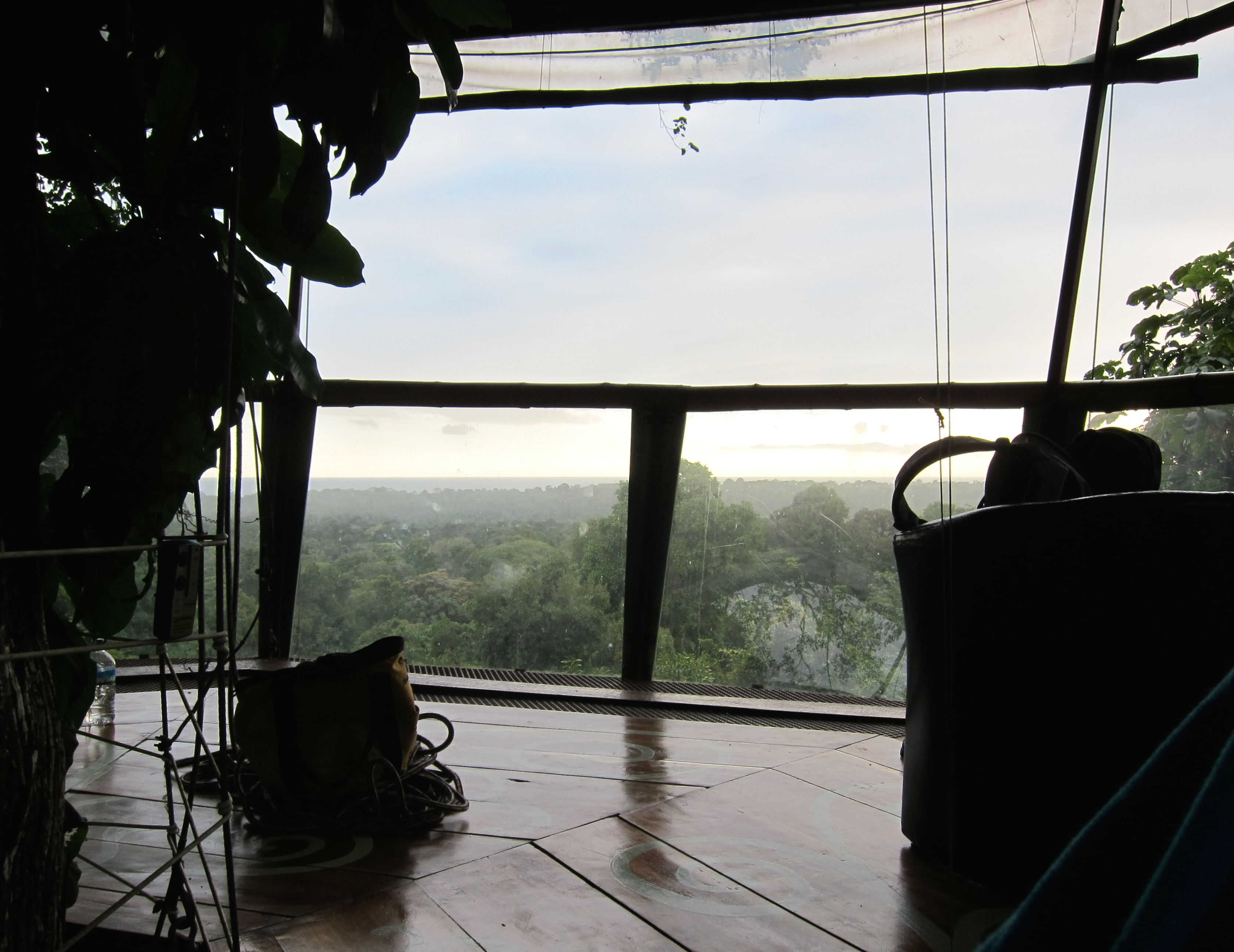
There are a bunch of deciduous trees. That’s less than helpful. We seem to be on a mountain. I see nothing outside to help me other than that. Given that the paucity of detail outside, I chose to focus on what was inside. There’s more to work with but … yeah, not a lot. It looks like some recording equipment (headphones, cabling, something that might possibly be a sound meter), a water bottle, and a floor with interesting swirly markings. I’m sure someone will recognize the logo on the water bottle instantly, but I got nothin. Same with the floor.

Based on the trees and recording equipment, my husband guesses Tennessee. I don’t think you’d stay in North America four weeks in a row, but I don’t have a better alternative. So, we’re going with a recording studio in Tennessee. On a mountain.

It’s not recording equipment. Another reader figures out the key characteristic of this week’s view:

[I]t’s a treetop hotel, built around a tree. No doubt about it. You would think that would narrow it down – I mean, how many of those can there be? Lots, it turns out, but none that I can find with classy inlaid wooden floors. Our best guess is Dad’s: somewhere on the coast of Peru.

Which brings me to another point: this is superficially mind-bogglingly difficult. There are no landscape clues, except the unbroken vista of trees, which does little more than prove that we’re not in downtown Manhattan or Beijing. All clues have to come from the “window” itself and surrounding items.  Despite this, because you posted the contest, it follows that it must be solvable in a reasonable amount of time by a reasonably-intelligent Dish reader. Therefore, I propose the View Anthropic Principle: no matter how hard a “view” is, the fact that it is posted at all means that it is solvable with the information on hand. 

Maybe so. Just not necessarily by us, this time!

Most of this week’s guesses correctly got on the treehouse track:

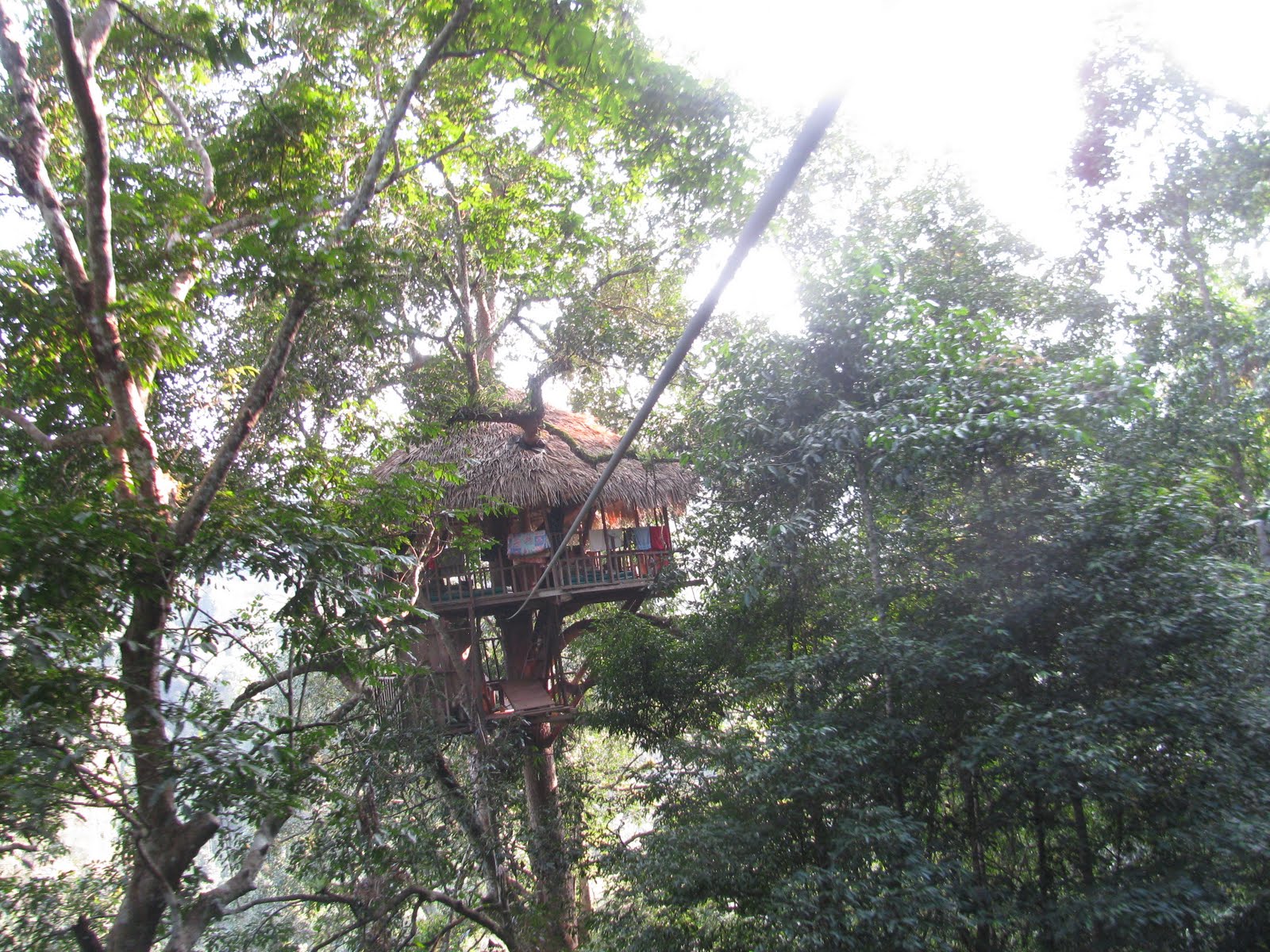
This treehouse doesn’t look like the one I stayed in, but the view reminds me of some of the views while we we ziplining around in the Bokeo Reserve for three days is Laos almost four years ago.  It was one of the only times I’ve seen a jungle view that just went on and on the way it looks like this view does. I can tell this is definitely a view from a tree house so its worth a shot, right?

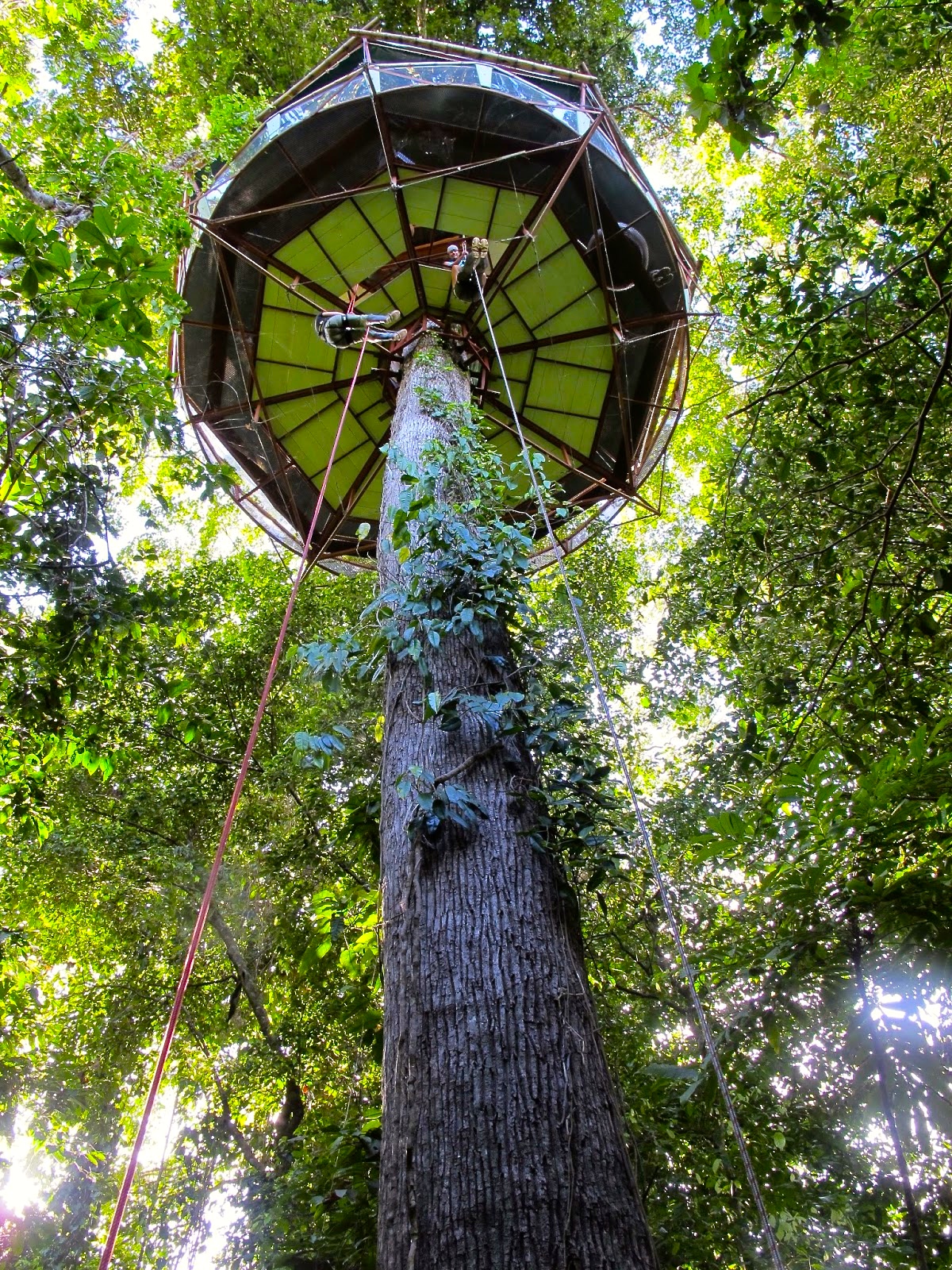
Here’s a view of what one of the tree houses looked like as you were sailing towards it on the zipline:
IMG_4861

Another reader is thinking Africa:

I just spent my Monday morning at work googling “African treehouse.”  I looked at lots of images, but nothing fit, so I’m guessing Botswana, mostly because it’s fun to say.

Another suggested “Youvegoddabephukingkiddingme, Thailand”. But this guess gets pretty close:

Although the foreground view is a little more cluttered than I remember it, I am fairly sure this is taken from the platform of the Canopy Tower, Soberania Park, near Gamboa, Republic of Panama. That appears to be a Cecropia tree on the right (often sloths feed there), and the view is, I think, towards the North West, overlooking Soberania Park from what used to be a U.S. military-intelligence messaging center, that has been converted into a nature observatory / hotel.

A reader nails the right country:

Wow! I can only guess about where this is, but I really want to go. We’re in an octagonal (maybe hexagonal) observation platform-like structure that appears to be built around a tree overlooking a rain forest. Apart from the forest itself, there are no telling geographic features, and apart from the structure we are in, no architectural clues. So, we need to know something about the building we are in, rather than what we are looking out at.

The structure seems well-built and well-maintained.  That, the bag on the floor to the left, the pile of rope (zip lining?) and the bottled water suggest “tourist destination”. That doesn’t narrow it down a great deal, but I’m going to go with Costa Rica. And since satellite views seem a lost cause here, I looked for treehouses in Costa Rica and found the Finca Bellavista community, which seems like the sort of place (some) Dishheads might find themselves on vacation. Plus they have a couple of structures that, while not being a dead-on match for the one here, share an awful lot of features. So even if we aren’t in Finca Bellavista, I bet we are someplace close by.

Another pinpoints the location:

Ok, so I was a bit glib last week. I promise I’ll rein in disparaging comments about the difficulty of the contest because, damn, this one is pure evil. Trees. All we can see are trees. And floorboards. But wait, we’re IN a tree. And those floorboards are pretty unique with their painted viney patterns. Just fire up the Google machine. Somebody else has stayed in this treehouse and put a picture of it on the internet. An hour of searches along the lines of “jungle treehouse resort” later, and then, there it is. These guys stayed there. One click later and I’m on the web page of Nature Observatorio, located in Manzanillo, Costa Rica.  Not too shabby for a picture of some trees.

Not shabby at all. Here’s how all the entries broke down:

This embed is invalid

Image searching was by far the most popular method for the dozens of correct guessers this week:

At first glance this appeared to be one of those impossible views that only the champ and one or two others would solve. When I realized it was a treehouse however, I at least had some VFYW-Treehouse-2search terms. After a few searches I was amazed at the sheer number of awesome treehouses that are out there. My fourth try on Google Images I used the terms “treehouse rainforest ocean” and found [the composite image to the right]. That led to this website that offers neat “glamping” places. Glamping is “glamorous camping” apparently (something I didn’t know – thanks VFYWC!).

The VFYW is the upper level of a two level treehouse in the Gandoca-Manzanillo Rain Forest of Costa Rica. You can stay there for $320.00 a night, and “all meals are hosted in the tree house and hoisted up by staff. Guests are supplied with harnesses, helmets, and gloves.”
Here’s a wonderfully specific entry:

The picture is taken from the Nature Observatorio (aka Amazing Treehouse), located in the Gandoca-Manzanillo wildlife refuge in Costa Rica (which is called the Refugio Nacional Gandoca-Manzanillo, 36, Costa Rica by Google Maps):

image1_1

The closest town is Manzanillo, which is not visible, but would be on the right side, or northeast, out of frame of the picture roughly 3km to the city center. It is taken from a hammock on the first floor (observation level) of the treehouse, facing the Caribbean Sea to its (approximate) north. The deck is 79 feet (or 25 meters) above ground, and is reachable by rope or rope elevator. There aren’t exact GPS coordinates for the Observatorio — even the owner doesn’t have them — and the only ones I found were actually for the road and beach roughly 2 km to the north.

Visible on the left of the picture (west) is the “host” tree, which is amazingly supporting the treehouse without a single screw or nail driven into it. I hope your readers will research and watch the available interviews with the owner, Peter Garcar, and read up on the location itself. His efforts and passion are truly inspiring, and the treehouse is a wonder of both engineering and natural education. I only wish I could visit and climb to appreciate its views and all it offers. To whomever made the trip and took the picture, I am envious beyond description!!!!!

This reader only needed the floor:

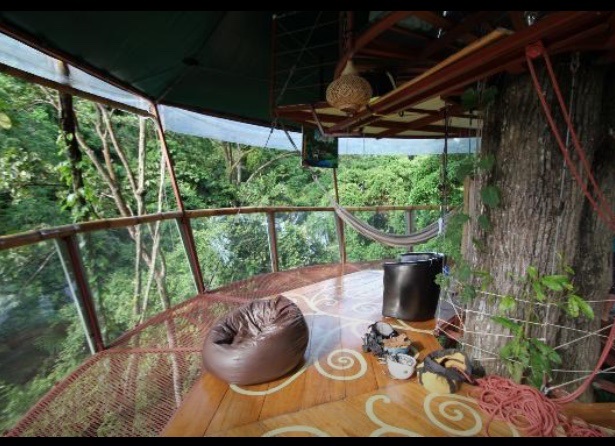
Okay, I was searching in Australia before, but then an image search on Google for rainforest treehouses found me the distinctive floor of this treehouse in The Gandoca-Manzanillo wildlife refuge in Manzanillo, Costa Rica. Here is the floor:

780-15-tree-house-costa-rica

Another key clue:

It was an Instafind, and shows up in first couple pages of Google image search for  “treehouse winch remote”.

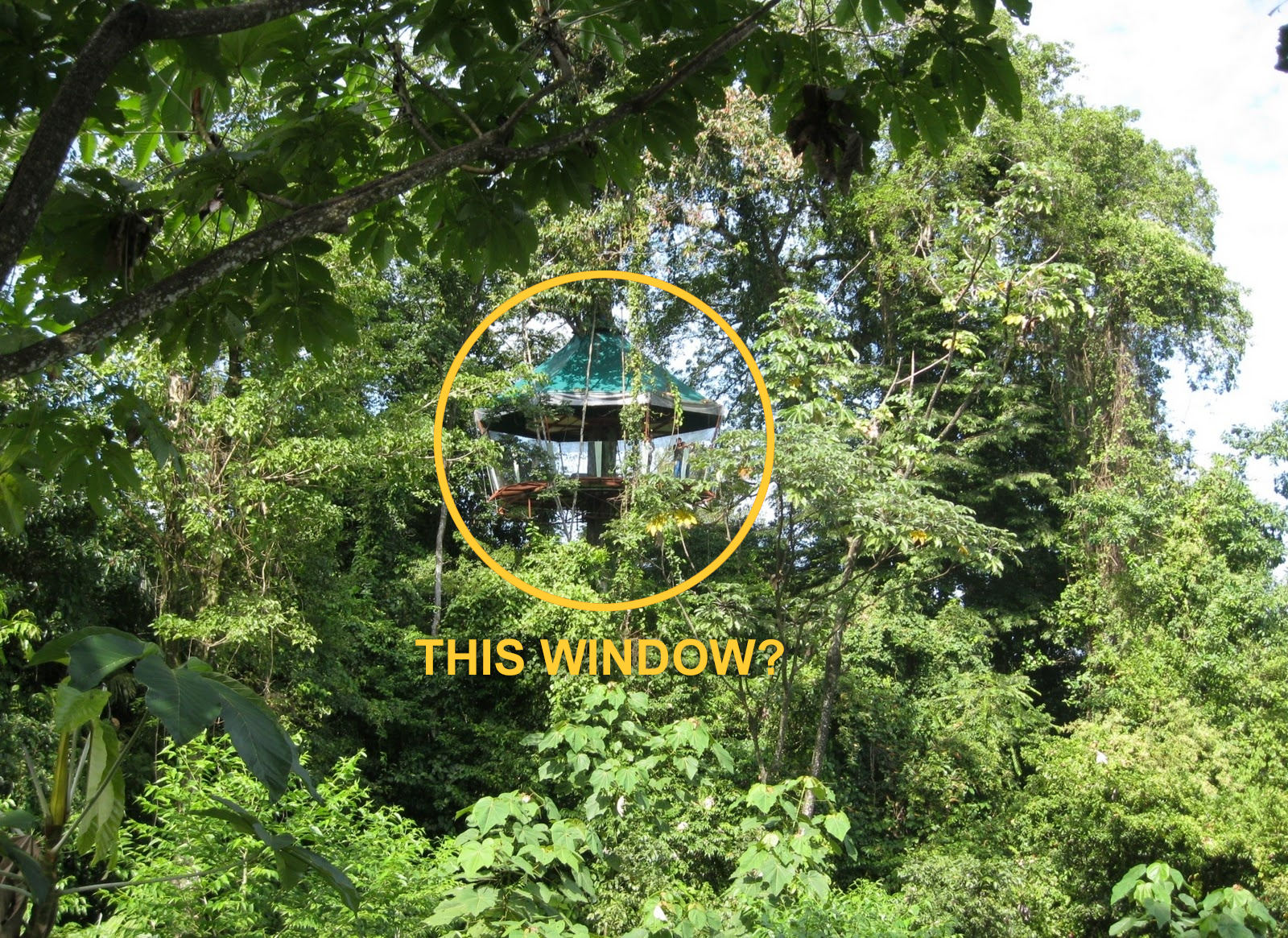
A regular player takes a shot at circling this week’s “window”:
4C882427-6BB5-4782-923B-B04B0766D872

A breakdown of the exact view:

I consider the window to be the space between the exterior vertical supports that, along with the major floor beams, create the octagonal framing of the structure. The contest photograph looks across the two sets of floor boards that are lifted to provide rope access to the tree house. These were identified by comparing the vine tendril pattern in the contest photograph with those next to people about to descend or just arrive through the open floor boards:

vfyw_Costa_collage_9-27-2014 copy

Photographs taken from beneath the tree house show which floor boards are opened. The contest window is that adjacent to the more westerly of the two openings.

A previous winner makes a connection:

A few weeks ago, we were in Manzanillo, Mexico and now we are high up in the trees of the Gandoca-Manzanillo National Wildlife Refuge south of Manzanillo, Costa Rica.

Probably the best entry we got this week:

“Haven’t they broken the rules?” asked my wife when I showed up at her elbow, having found the window this past Saturday in minutes and wanting to proclaim my triumph.  She’d noted the absence of any distinguishing features in the landscape and it seemed wrong to her that I’d had to depend solely upon objects within the room to pinpoint the location.

“Rules?  In a knife fight?  No rules!” I might have said, evoking Ted Cassidy’s assertion to Paul Newman’s Butch Cassidy just prior to his being kicked in the crotch.  I knew that, apart from the one rule that requires at least part of the window frame to appear in the photo (to prove that it really is a view from a window), then nearly anything else is fair.  And this week there was really nothing in view but a vast verdure framed by a distant sea.  Great view but lacking in specificity.

So inside, then. We see climbing ropes and a winch controller, bamboo rails, a loopy painted design all over a wooden floor, a framework of cable and wire that surrounds a hole in that floor, a hole which itself appears to center on a TREE TRUNK. So we’re high up in a tree house gazing out over a jungle view.  

The design on the floor proved to be the most valuable clue, because it appeared around 150 images deep in a simple google image search using the terms “tropical” and “treehouse.”  It’s called Nature Observatorio and it’s in the Gandoca-Manzanillo Refuge in Costa Rica, suspended 25 meters up a tree in primary rainforest.  The photo was taken looking north from the lower of its two floors.  We’re told by the proprietors that guests fall asleep lulled by the exotic chatter of parrots (along with the Caribbean breezes), that they awaken in the morning to the roar of howler monkeys.

Observatorio group

Wonderfully, its Airbnb listing says that, along with internet and breakfast, its amenities include “elevator in building,” which unavoidably raises a string of philosophical questions: what parts of an elevator can be stripped away and have it remain an elevator?  If it lacks walls and floor, but consists rather of a harness, ropes, and a winch? If it dangles BELOW the building, suspended from it, is it indeed IN the building?   

IMG_8744

I’m picking at nits there, but the Observatorio comes equipped with mosquito netting, so that’s ok. Honestly, I’m ready to sign up. It look’s wonderful!

It’s hard to resist the charming enthusiasm of this happy guest, as he shows us around:

Chini felt challenged:

Well one thing’s for certain, we’re, uh, hell and gone from the Arctic. And we’re like totally in a tree-house. Now all we need to do is find the right one. Easy, no? No. Turns out, tree-houses are the new orange, and that made this hunt one of the wilder ones. India, Thailand, Brazil, Borneo, you name it, they all got in on the act. By the time I landed in the right spot, I knew more about tree-house construction than I’ll ever need to know. But that’s the VFYW contest for you; the obscure begetting the even more obscure.

This week’s view comes from the best damn hotel room any contest viewer’s ever stayed at, i.e. the Nature Observatorio in Manzanillo, Costa Rica. The picture was taken on the lowest, main platform of a multi-platform, non invasive tree house/observatory/hotel room built in 2012 and looks east-north-east on a heading of 62 degrees towards the Gulf of Mexico in the distance:

VFYW Manzanillo Bird's Eye Far Marked - Copy

This reader has traveled in the area:

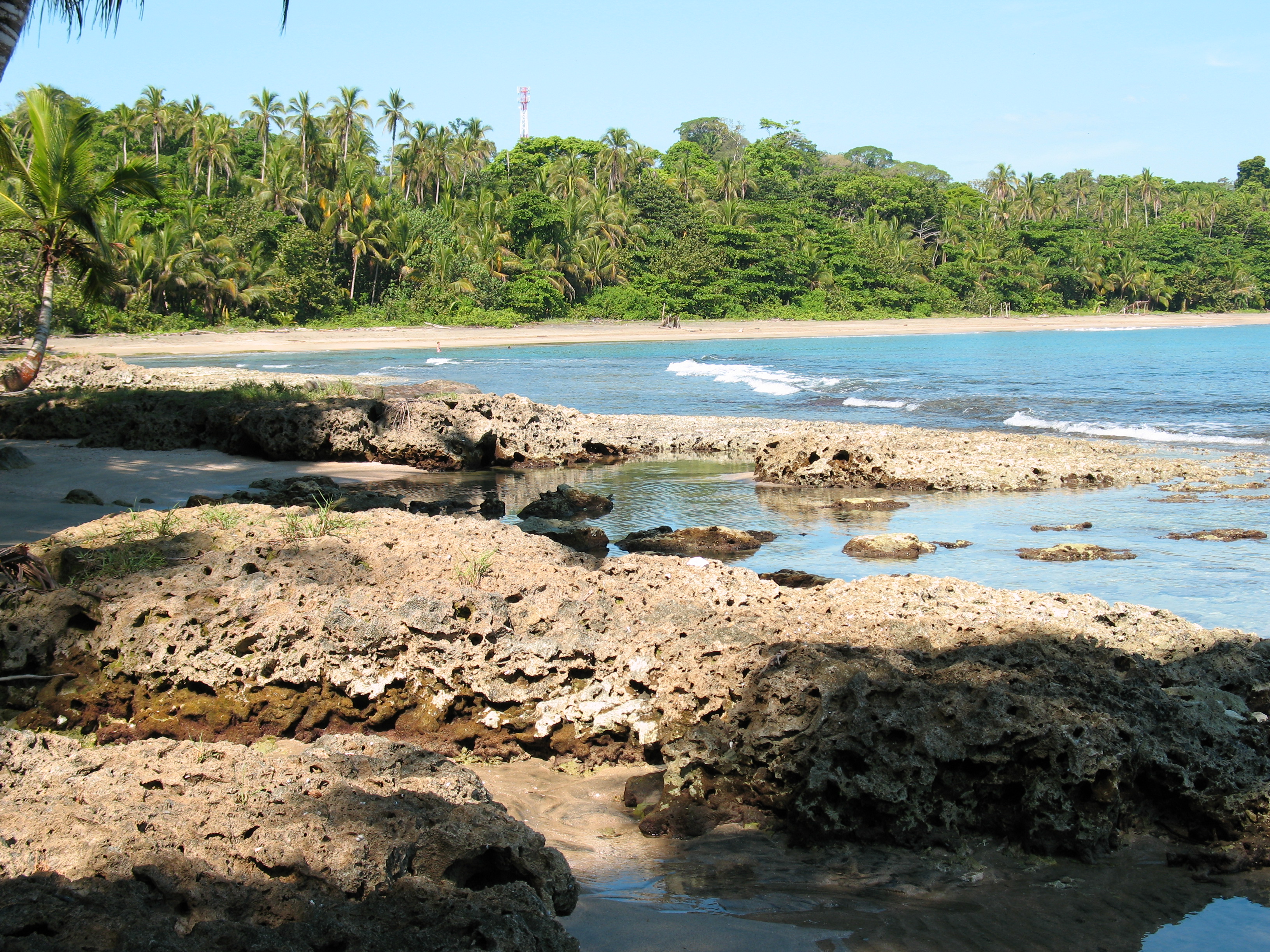
We spent a month in Costa Rica and thought the Atlantic coast was much better than the Pacific side.  Less touristic and a bit more raw country, with much friendlier Ticos – it’s got that rasta-Caribbean vibe.  Manzanillo is perfectly ramshackle and laid-back, with some great small beaches, waterfalls, and mellow roads for bike riding.  And there is still plenty of tourist infrastructure.  We ate most lunches at a great French bakery / deli (Bread and Chocolate Cafe) and stayed in a couple of mid-range places on the beaches (Banana Azul and Cabinas Yemanya).  A week looking for turtles and sloths, building sand castles with the kids, or swimming in the turquoise ocean was too short – we wish we had stayed on the Atlantic side the whole month.  I’ve included a picture from the tidepools and beach near Punta Cocles, about five miles toward Puerto Viejo from the Tree House.  A great place to reread Paul Theroux’s Mosquito Coast (a favorite book of mine – made into a decent but not quite as good movie too).
IMG_0104

Our winner this week describes himself as a “long-time correct guesser, long-time suffering loser”:

An interesting clue this week.  My initial thought was that it was impossible: a nondescript view of a forest with not much else.  Seeing as how it was a beautiful day, I was thisclose to abandoning my search this week for more productive endeavors.  Before I did, I lightened the picture to bring out some of the features in the foreground.  This is what I got:

image1

A tree trunk to the left, a climbing rope, swirly designs on the floor, a backpack on a chair and what looks like the ocean on the horizon.  Typing those elements into the google machine, I had to scroll through about a page of results until I spied this:

image4

Large tree trunk, swirly floor, climbing rope, similar chair.  I found the answer before my morning cup of coffee had gotten cold.

This week’s contest view actually came from the Dish’s own Chas Danner. He writes:

My wife and I took a belated honeymoon to Costa Rica over the winter, and our stay at the Observatorio was absolutely one of the highlights of our trip. It was an unforgettable night alone in the canopy of a lush primary rainforest.

IMG_2947

And yes, you do wake up to the howler monkeys, a pack of which rolled by like a thunderstorm around 5:30am. Our only regret was that we didn’t spend more than one night. Also, Peter, the Czech engineer who dreamed up and built the treehouse, was a delightful guide and host as well as one of the coolest people I’ve ever met in any country. Here he is holding the rope as I ascended in my tree climbing harness:

IMG_2941

Is The HIV Divide Now Over?

What are your options today as a gay man with a sex life in America? You live in a community where a deadly virus has killed hundreds of thousands and is still resilient in the gay male world as a whole. It has no external or visible symptoms most of the time. Many people have no idea they have it. But the virus can be permanently suppressed to a point where it cannot be measured in your bloodstream and to a point where an HIV-positive man cannot transmit the virus to another person. And someone who is HIV-negative can also have access to a daily pill that, if taken conscientiously, all but wipes out the chance of getting infected.

Here are your options: the blue pill or the red pill. Take the one-pill-a-day Truvada (below right) and never get HIV; take the often one-pill anti-retroviral pill (like atripla, below left), and truvadayou will never give someone HIV. To make doubly sure, you can always use a condom. Except almost every man who ever had sex hates condoms – and, unlike a pill you take every day, wearing a condom means making a decision in the middle of sexual desire and passion when your rational self is at its weakest.

For me, this seems obvious – partly because I have been through the HIV mill for my entire adult life. I was dumped by an HIV-positive man when I was HIV-negative; I was dumped by countless HIV-negative men because I was positive; I have had an undetectable viral load for nearly two decades; and I am open about my HIV status – even to the point of risking deportation; I’ve been publicly shamed by HIV-negative gay men for seeking sex only with other HIV-positive men. I have navigated relationships with men on both sides of the divide – and yet the divide remained. These trials-by-fire are mercifully not always the norm any more – but that means that the young generation has fewer psychological resources or experiences with HIV to grapple with the whole issue of getting infected, or avoiding infection, or navigating sex with the issue of HIV menacingly in the way. Which may be partly why the younger generation remains the one most at risk. The trauma of the distant past still echoes in the collective psyche; this is still a disease people feel ashamed of; it is still a disease which other gay men will stigmatize and ostracize you for; it is still a disease that your friends and family regard as terrifying – even though it is no more rationally terrifying at this point than diabetes. It still compels you into denial; or fear; or blame; or ostracism.

imagesAnd so our psyches are lagging behind the science – and behind the epidemic. And one of the most powerful aspects of that traumatized psyche is the division between HIV-positive men and HIV-negative ones. It’s been there from the very beginning – this segregation of fear. But surely, at this point, there is no reason to continue the segregation. What matters is not whether you are HIV-positive or HIV-negative. What matters is whether you know your status and are on one medication or the other. Once that is true, sex can cross the bridge once more. The pills can erase the stigma and the divide – if we really want them to.

There’s a terrific new piece in Poz magazine that explores much of this territory. It weighs some of the risks of the Truvada revolution, but it also illuminates the liberation of it as well, the amazing promise that the viral Jim Crow can be dismantled at last:

Out of the dozens (nearly all of them gay men) who shared their stories about being on PrEP for this article, many described life-altering sexual and personal renaissances as, for the first time ever, they discovered what it was like to have sex without fear.

“PrEP makes me feel good about being gay,” says Evan (some of those interviewed preferred to use their first names only), a 22-year-old full-time sex worker living in Washington, DC. “Growing up gay is still really hard. The first things that we learn about our sexuality are that some people aren’t going to like us, and that we are probably going to get HIV. Taking PrEP has allowed me to step into my sexuality and feel empowered.” PrEP, he adds, “has led me to accept all gay men as a potential friend, sex partner or life partner regardless of their HIV status.”

Another man, dogged by the threat of HIV his whole life, expresses how he feels about taking Truvada this way: “I felt free, finally. For the first time since I was a kid, I know my sexuality is not going to be the cause of my death.”

The discourse around this new breakthrough has long been about risks and expense and compliance and how to make sure men don’t get too promiscuous again. And all that has its place. But we fail to understand this moment if we do not understand the liberation that comes with ridding gay sex of the terror and stink of death, the liberation that comes with leaving a world where another man – before he can be anything to you – has to be put in a “positive” or “negative” box. Or to put it another way:

If life is worth living
it’s got to be run
as a means of giving
not as a race to be won
Many roads will run through many lives
but somehow we’ll arrive
Many roads will run through many lives
but somewhere we’ll survive

Sex is about intimacy; it is about love; it is about relief. And for the first time since the early 1980s, we have a chance to rid it of fear. Why are we not rushing to embrace this? What is still preventing us from becoming collectively a force for love and friendship that is no longer limned with terror?

Will The Hawks Come Around On Rand?

Ryan Lizza’s lengthy profile of Rand Paul is making the rounds. McCain, of all people, had kind words for Paul:

John McCain, one of Paul’s longtime critics, told me in August, “I see him evolving with experience, with travel, with Senators Discuss Balanced Budget Amendmenthearings on the Foreign Relations Committee. I see him having a better grasp of many of the challenges we face than when he first got here. That doesn’t mean he is now a John McCain, but it certainly does mean that he has a greater appreciation and has been articulating that.” He compared him with Ron Paul. “His father is a person who really believes that the United States should not be engaged in foreign events and foreign countries. I think that Rand Paul is seeing a very unsettled world, one in significant turmoil, and I see him understanding and articulating what in my view is a realistic view of the United States and the importance of its leadership and role in the world.” …

McCain told me that, if Rand Paul is the Republican nominee for President in 2016, he will support him. “I’ve seen him grow and I’ve seen him mature and I’ve seen him become more centrist. I know that if he were President or a nominee I could influence him, particularly some of his views and positions on national security. He trusts me particularly on the military side of things, so I could easily work with him. It wouldn’t be a problem.”

Allahpundit is shocked:

Remember, a little more than a year ago, McCain was telling reporters that he didn’t know who he’d support if the 2016 election came down to Paul and his old friend Hillary Clinton.

If memory serves, he later tried to play that off as a joke. But there’s nothing jokey about it; it would make all kinds of sense for Maverick, whose political brand these days is more about interventionism than Republicanism, to endorse a true blue hawk like Hillary than the “wacko bird” libertarian Paul. As recently as this past summer, former McCain right-hand-man Mark Salter said flat out that GOP hawks would have no choice but to back Hillary if forced to choose between her and Paul. And now here’s Maverick himself, in a splashy piece for the New Yorker, giving Rand the interventionist seal of approval. What happened?

Regardless, Aaron Blake expects the hawkishness of the GOP base to do Paul in:

A lot can happen over the next 18 months, but the renewed focus on foreign policy — and more specifically, the Islamic State — has reminded the Republican Party where its true views on international affairs lie. And it is decidedly not with non-interventionists like Paul (R-Ky.). A new poll from CNN/Opinion Research is the best we’ve seen to date bearing out this point. …About seven in 10 (69 percent) [of Republicans] say they are hawks, while just one-quarter (25 percent) side with the doves. That’s nearly three-to-one.

 picks out other important quotes from Lizza’s piece. At the top of his list:

1.  “Ron was always content to tell the truth as best he understood it, and he saw that as the point of his politics. Rand is the guy who is committed to winning.” — Paul family strategist Jesse Benton

This gets to the core of the difference between Rand and Ron Paul. It’s not — as Lizza correctly notes in his piece — fundamentally about their policy views on which there is considerable overlap. “They don’t really have differences,” Carol Paul, wife of Ron and mother of Rand, told Ryan. “They might have fractional differences about how to do things, but the press always want to make it into some kind of story that isn’t there.”  The real difference between the two men is stylistic and focus-oriented. Many Republican strategists admit that if Ron Paul had simply refused to go down the rabbit hole of his foreign policy views (over and over again) during nationally televised debates, he might well have won a primary or caucus in 2012.  Rand Paul, by contrast, understands the need to pivot off of topics where his views are not entirely aligned with the people he is trying to woo.

But Emma Roller notes that Ron Paul remains a liability:

Rand Paul has all the political savvy that his father lacked. He built his own political career on his father’s name recognition—and the ardent band of libertarian fanboys who came with it. “I had some notoriety, but not much. My dad had a lot,” he told Lizza.

Making matters worse for his son, Ron Paul refuses to stop espousing those “crackpot theories,” as former John McCain chief of staff Mark Salter has called them. In July, Ron Paul cast doubton the idea that pro-Russian rebels shot down Malaysia Airlines Flight 17, writing that “Western politicians and media joined together to gain the maximum propaganda value from the disaster.” And on Monday, he drew parallels between Scotland’s secession vote and Americans who have called for secession.

“Americans who embrace secession are acting in a grand American tradition,” he wrote. “It is no coincidence that the transformation of America from a limited republic to a monolithic welfare-warfare state coincided with the discrediting of secession as an appropriate response to excessive government.”

And David A. Graham considers the awkward position Rand is in:

Voters are willing to grant candidates room for youthful indiscretion, and they’re certainly willing to forgive them the sins of their fathers. But by refusing to take his reversals head-on, Paul is passing up a chance to explain why he’s changed or how he differs from his father, and get credit for it. It puts him in a weird state of suspension, both pilloried by some critics for taking fringe stands and accused by others of abandoning his principles for craven reasons. As Ryan Beckwith notes, this could also create a dilemma for those crafting attack messages against Paul, though it seems more likely that the different raps cater to different segments of the populace. In the meantime, Ditzler’s question lingers uncomfortably. “If he’s changed, why can’t he just say that he’s changed?”

(Photo: by Win McNamee/Getty Images)

“I’m Here So I Can Sleep At Night”

For those just tuning in, Fisher does a good job summarizing why Hong Kongers have taken to the streets:

Today, the territory’s chief executive Leung Chun-ying asked Occupy Central to disband the demonstrators, casting the disorder as a threat to public safety, but the protest leaders are demanding a face-to-face meeting with Leung and threatening to occupy government buildings if the demand is not met. Christopher Beam takes the pulse of the protest movement going into this week:

The conventional wisdom after the Sunday night clashes was that the movement had lost momentum. But my conversations with protestors on Monday suggested the opposite. Many of the people I spoke with didn’t come out until after the police cracked down. Henry Wong, 19, a student at Chinese University of Hong Kong, decided to join after seeing a live broadcast of students fighting with police. “I’m here so I can sleep at night,” he told me. Michelle Chan, 18, also said she was galvanized by the use of force: “Police don’t have to be that cruel.” Tony Wong, 24, said he was skipping work to come to the protest. I asked if his boss would be upset. “I can get another job,” he said. “I can’t get another Hong Kong.”

Ishaan Tharoor looks ahead:

The protests appear to be growing. Wednesday and Thursday mark a national holiday in China, and many expect what takes place on those days to define the current unrest. If the sit-ins and demonstrations continue with the intensity they’ve already shown, there’s a chance that local security forces could crack down more violently than they have so far, including perhaps using rubber bullets. That sort of violent response could be a disaster for Hong Kong’s government, which would face mounting pressure from the territory’s voluble civil society and media.

Julian Snelder fears the worst:

Twenty five years ago, we saw what happened when a threatened Beijing is backed into an existential confrontation. Today, China is a country with a triumphal sense of infallibility. It is so resolute and confident of its sovereign power that it can deliberately taunt large neighbors like Vietnam and India as a matter of routine. Hong Kong is a mere flyspeck by comparison, and a domestic concern at that. Of course, this is not June 1989, and Hong Kong is not the capital. But the protesters need to realize what they’re dealing with here: a state that will use lethal force if it deems it necessary. Then there’ll be real tears.

Update from a reader on the ground:

Julian Snelder says, “But the protesters need to realize what they’re dealing with here: a state that will use lethal force if it deems it necessary. Then there’ll be real tears.” I’m in Hong Kong. I’ve been at the demos. My students are out there every day. Barring small children, there is not one person who is not vividly aware of this possibility. Julian Snelder, whoever he is, is a patronising git. What gives him the right to assume that courageous people are stupid instead?

Adam Taylor explains why the umbrella has become a symbol of the protests:

Umbrella RevolutionProtesters used whatever they could get their hands on for protection: Some images even show people using plastic wrapping to cover themselves. The use of the umbrellas as protection was striking, however, and media outlets picked up on it, dubbing it the “Umbrella Revolution.”…

Some protesters painted messages on top of their umbrellas, and artists began incorporating umbrellas into logos designed for Occupy Central. “I was inspired by seeing people defend themselves with domestic props,” Hong Kong artist Kacey Wong told the BBC. “The contrast was so marked. On the one side there was police brutality and on the other side there were these poor umbrellas.”  According to the Associated Press, umbrellas are now being donated to replace those destroyed by the police.

Historian Jeffrey Wasserstrom feels that it’s “important to make space in our minds for partial victories”:

It’ll be very hard for the Communist Party to say “Okay, there will be open and free elections.” That’s unlikely to happen.

On the other hand, the protestors are calling, quite specifically, for the current chief executive of the territory to step down. That’s very thinkable: he would become a scapegoat for larger problems, but it would defuse some of the anger over the protests. And if even the person who replaced him had similar policy views, it would be a sign to that official that there would be a value in being more responsive to the people.

(Image from FP’s round up of viral Hong Kong graphics)

The Case For Microwave Dinners, Ctd

Sarah Kliff interviews Sarah Bowen, one of the researchers behind the home-cooking study we covered earlier this month:

SK: Was there anything in doing this research that surprised you?

SB: How much people were cooking. We hear all of the time that Americans have stopped cooking. A lot of the families in our study were cooking every night, especially the poorest families. They couldn’t afford to eat fast food and a lot didn’t have cars. People were cooking a lot and that surprised me a little, because of how much we hear that the opposite is true.

At the same time, they felt they weren’t cooking well enough. They felt like they didn’t have enough money and weren’t able to cook the right way or the way they should be.

Linda Tirado offers some more perspective in an interview we cited earlier:

[W]hen you’re wealthy you can go buy things when they’re in bulk. Because it’s the question of startup capital, really: if you can spend your money up front in the right places wisely, then you’ll save money in the long term. But if you’re constantly struggling just to kind of patch it up and make ends meet, you’re taking whatever the most convenient option is, which is inherently going to be more expensive.

For more reactions to the study, see this “Room For Debate”.

How Do You Enforce An Abortion Ban?

That has always been the question hovering around abortion politics – and the pro-life forces have often danced around it. My general sense is that doctors would be penalized in some way, while adoption policies would be greatly expanded – because many pro-lifers are against the best defense against abortion there is, contraception. But executing the mother? At first I thought this was a joke of some sort – or had some context I was missing:

And for some reason, this is the treatment Williamson has in mind:

I have always found Williamson – even when I’ve disagreed with him – a stimulating writer. And maybe this sentiment is simply a function of Twitter wars getting out of hand. But it seems to me, as a leading writer for National Review, he needs to articulate how his favored abortion scheme would work with the hanging of sinful women. How would they be found guilty of using Plan B, for example? What kind of police state would be required? And as for hanging, why not stoning? Williamson is, indeed, as he puts it, old-fashioned.

What Are Ted Cruz’s Chances?

Yesterday, I wrote, “I expect Cruz to run, and I would not be surprised if he won.” Jonathan Bernstein, on the other hand, gives him the “longest odds” of any “viable candidate”:

Not just because he’s an irresponsible demagogue, or because he’s made enemies in the Senate. And not just because he’s almost certainly a weaker general election candidate given that he’s by far the one most likely to be perceived by voters as an ideological extremist. The biggest reason Cruz’s nomination bid would be unlikely to succeed is that Republican party actors mostly identify him with the October 2013 government shutdown, which, apart from a small number of radicals, is perceived as a hugely damaging unforced error. Remember, not only were Republicans widely blamed for the shutdown, it also had the side effect of distracting the press from the disastrous first weeks of the Obamacare exchange rollout. Even party actors who are itching to nominate a real conservative after suffering through Mitt Romney and John McCain (and in many cases having decided that George W. Bush was no conservative after all) are unlikely to choose a candidate whose strategic judgment has proved to be suicidal for the movement.

But Michael Tracey isn’t writing off Cruz. One reason:

I would implore all readers to watch a full Ted Cruz speech if he or she has not already. The man is simply a performative marvel. He manages to strike some sort of preternatural balance between fiery Southern Baptist sermon and stand-up comedy routine, invariably bringing crowds to their feet. In the era of the tweet-sized soundbite, Ted Cruz’s mastery of the one-liner and the pun are not trivial; they are integral to his success.

Another factor:

In the post-Citizens United landscape, traditional donor class support is becoming less and less important. Multi-billionaire casino magnate Sheldon Adelson was able to bankroll Newt Gingrich’s 2012 presidential bid as nothing more than a personal vanity project. Gingrich went onto win the South Carolina primary. That unpredictable dynamic will only have been heightened by 2016. Ted Cruz may be disliked by elements of the GOP elite, but he doesn’t have to rely on their support to prevail, as likely would have been the case in years past.

Instead, Cruz can lean on what I’ll term the “para-establishment”—a constellation of advocacy groups, media entities, individual mega-donors, and others who have long ago thrown their lot in with Cruz.

Allahpundit imagines how the primaries might shake out:

Cruz isn’t really running against the entire field, at least in the early states. He’s running against Paul. If he can finish ahead of Rand in Iowa and New Hampshire, the thinking goes, conservatives who prefer Rand will abandon him as a lost cause and line up behind Cruz for South Carolina. If Cruz can get to that point, he’ll take his chances against the centrist champion, no matter who it is. If it’s Jeb, Cruz will add an anti-dynastic note to his broader “return to Reagan” message. If it’s Romney, he gets to pound Mitt for having blown his and the GOP’s chance of regaining the White House once before. And if it’s Christie, he’ll count on the right’s disdain for the big guy plus Christie’s personal abrasiveness to alienate voters. All of which makes me wonder if the donor class won’t decide to skip those three and back Rubio instead.

Treating The Anti-Vaccine Moment With Kindness

Amanda Schaffer contemplates Eula Biss’s new book about vaccination:

Biss sympathizes with parents who fear vaccines, and she understands the cultural roots of their hesitation, which include an insistence on bodily independence; an obsession with physical purity, free from chemicals; and even a kind of pre-industrial nostalgia that casts vaccines as newfangled and SWITZERLAND-HEALTH-EBOLA-WAFRICAunnatural. She focusses on the historical antecedents to today’s shots, complicating the view that immunization is modern and therefore scary. In the eighteenth century, farmers observed that those who were exposed to cowpox tended not to develop smallpox later on. The physician Edward Jenner tested this connection by transferring fluid from a milkmaid’s pustule to the skin of a young boy, who then developed immunity to smallpox. Historical figures, including Cotton Mather, Mary Wortley Montagu, and Voltaire, championed the practice of variolation, in which individuals were infected with a mild form of smallpox to protect them from a more severe version of the disease.

If variolation had been more widely practiced in France, Voltaire wrote, “twenty thousand persons whom the smallpox swept away at Paris in 1723 would have been alive at this time.” Biss acknowledges that these practices were far less safe than the highly regulated shots administered in pediatricians’ offices today. Yet she seems to take comfort in the idea that “vaccination is a precursor to modern medicine, not the product of it.” But even if shots against some childhood diseases, like measles, mumps, rubella, and polio, have not changed substantially in recent decades, the leading edge of vaccine development—against pandemic flu, cancer, or Ebola, for instance—benefits enormously from advances in genetics and immunology.

Despite some misgivings, Schaffer sees an advantage to the book’s tone:

Biss’s gracious rhetoric and her insistence that she feels “uncomfortable with both sides” of the rancorous fight may frustrate readers looking for a pro-vaccine polemic. Yet her approach might actually be more likely to sway fearful parents, offering them an alternative set of images and associations to use in thinking about immunization.

Mark Oppenheimer has mixed feelings about the book:

Biss comes not to rail against the vaccine skeptics, but to understand them. She is pro-vaccine, but she’s not an op-ed writer: she’s a high-style essayist, elliptical like Joan Didion, aphoristic like Susan Sontag, familiar like Anne Fadiman. Biss comes down on the side of science and reason, but in such an MFA-ish fashion that maybe some of the educated white women who are, alas, the main constituency for anti-vaccine nonsense, will be persuaded that they can trust Biss. Because she either has no animus toward those parents who withhold vaccines from their children, or because she hides that animus so very wellshe’s a grandmaster of judgment-withholdingthis may be the perfect book to hand to that mother or father of a newborn who is on the fence.

But if Biss has scored a minor success, we still have to bemoan that she succeeded where public science education failed. Vaccinating children should not be up for debate, so to read an elegant, incisive book that takes the debate seriously is bound to be an ambivalent experience. This is a book fair to both sides of a debate that, among people who know the evidence, does not exist. That there’s a market for it makes it a curiosity, a time-capsuled bit of evidence for a hysterical fad that surely must pass.

(Photo: A statue representing a child receiving a injection of vaccine is seen at the World Health Organization (WHO) headquarters on September 5, 2014 in Geneva. By Fabrice Coffrini/AFP/Getty Images)

A History Of Neglected Teeth

Olga Khazan considers why the ACA and most Medicaid plans don’t cover dental care:

The partition between dentistry and the rest of medicine dates back to the dental profession’s roots as an offshoot of hairdressing.

Until the 1800s, barbers served as rudimentary dentists, pulling painful teeth and lancing abscesses after they finished trimming whiskers. In earlier centuries, people would see barbers for occasional bloodletting (thought to be therapeutic at the time)—hence the red-and-white striped pole. If there was a flesh wound, the barber could also play surgeon in a pinch. He, after all, was the one with the sharp knives.

“In the early days of medicine, surgery and medicine were two distinctly different professions,” says Burton Edelstein, a professor of dental medicine and health policy at Columbia University and founder of the Children’s Dental Health Project. “This is before anaesthesia, so surgery was rough. It was not regarded as sophisticated.” …

This minimization of dentistry persisted when Congress was crafting the public health insurance programs in the 1960s. During the original 1965 formulation of Medicaid, the dental market wasn’t very robust and policymakers didn’t value it as highly as other forms of medical care, Edelstein says. In 1960, only 2.3 percent of Americans had some kind of dental insurance.

“Both Easy And Difficult To Look At”

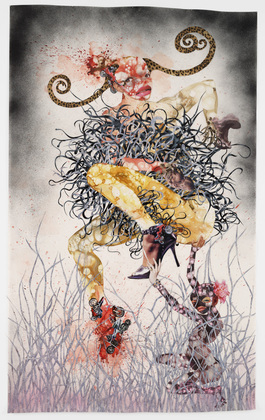
Teju Cole also describes the work of artist Wangechi Mutu as “seductive in their patterning, grotesque in their themes”:

[Mutu] calls herself “an irresponsible anthropologist and irrational scientist.” Charged with historical misuses of science, her images Mutu_Hundred_Lavish_Months_of_Bushwhack_2004underscore the way female bodies can act as measuring devices of any society’s health. Her women respond to their environments with both intelligence and agony. Some are skinless, the rush of veins and colours alarmingly visible. Many are powerful, muscular, lithe, in heels, half-cyborg at times, often erotic, sometimes dangerous. Some are influenced by real women: Sarah Baartman (the so-called Hottentot Venus who was shown in European fairgrounds), Josephine Baker, Eartha Kitt, Grace Jones and Tina Turner. It’s an all-star line-up of black women who had fiercely ambiguous relationships with the racial and gender tropes imposed on them.

Mutu’s work is sensual, delighting in the materiality of its media (paper, paint, mica, wool, Mylar). Seen in a gallery, the organic forms, hybrid anatomies, wild hair, machine-like forearms, delirious patterns and compound eyes coalesce in a way that no digital reproduction can quite match. And what is true of the pictures is doubly true of the sculptures and installations, which also make use of smell and sound: dripping bottles, fermenting wine, rotting milk.