The Case For Slow And Steady

Olga Khazan explains why being in a hurry can be so counterproductive:

Do you park in the first spot you see, even if it means a longer, grocery-laden walk back from the store later? When unloading the dishwasher, do you quickly shove all the Tupperware into a random cabinet, thereby getting the dishes-doing process over with faster—but also setting yourself up for a mini-avalanche of containers and lids?

In a recent study published in Psychological Science, Pennsylvania State psychologists coined a new term for this phenomenon: Precrastination, or “the tendency to complete, or at least begin, tasks as soon as possible, even at the expense of extra physical effort.” … Why do we do this? Holding a goal in our minds taxes our working memory, the authors write, and just doing something—anything—allows us to dump that memory faster. Last year my colleague Julie Beck explained how this works with unpleasant experiences: We’ll want to get it over with faster in order to lessen our feelings of dread.

A Gloomy Take On Global Democracy

John Gray finds a sobering message in Francis Fukuyama’s latest book, Political Order and Political Decay, about what it takes to make democracy work:

One of the merits of this ambitious and wide-ranging book is that it recognises the daunting difficulties of creating an effective state – democracy’s most essential precondition. ‘Before a state can be constrained by either law or democracy’, Fukuyama writes, ‘it needs to exist. This means, in the first instance, the establishment of a centralized executive and a bureaucracy.’ Much of the book is a catalogue of the vicissitudes of state-building, and Fukuyama recounts in impressive detail the disparate results in countries such as Prussia, Italy and the United States. Part of the book is given over to examining semi-failed states, with an instructive chapter devoted to Nigeria. Here Fukuyama’s analysis is incisive: ‘Lack of democracy is not the core of the country’s problems.’ What Nigeria lacks is ‘a strong, modern, and capable state … The Nigerian state is weak not only in technical capacity and its ability to enforce laws impersonally and transparently. It is also weak in a moral sense: it has a deficit of legitimacy.’

In some ways Political Order and Political Decay may be Fukuyama’s most impressive work to date. The upshot of his argument is that functioning democracy is impossible wherever an effective modern state is lacking. Since fractured and failed states are embedded in many parts of the world, the unavoidable implication is that hundreds of millions or billions of people will live without democracy for the foreseeable future. It’s a conclusion that anyone who thinks realistically is bound to accept. It’s also a view that runs counter to nearly all currents of prevailing opinion. Perhaps it’s not surprising that Fukuyama – who is not known for challenging ruling orthodoxies – makes little of this aspect of his analysis. At the same time, it is a conclusion that is hard to square with his continuing talk of ‘the globalization of democracy’.

A Warm Welcome For Narendra Modi

US-INDIA-DIPLOMACY-MODI

The prime minister of India, who was once denied entry to the United States for apparently turning a blind eye to deadly anti-Muslim riots during his tenure as chief minister of Gujarat, will be meeting with President Obama at the White House tonight. Somini Sengupta considers the significance of Modi’s visit:

Mr. Modi is visiting at a time when India and the United States are each seeking big things from the other. Theirs was supposed to be what Mr. Obama once called the defining “partnership” of the 21st century. The relationship has withered since then, though, and both Washington and Delhi are trying urgently now to repair it, showering each other with the diplomatic equivalent of Champagne and roses during Mr. Modi’s five-day visit to America.

He has met with two mayors and three governors, and more than two dozen members of Congress attended his event at [Madison Square] Garden. He is scheduled to meet on Monday with 11 chief executives from companies like Boeing, Google and Goldman Sachs, and then to speak at the Council on Foreign Relations. An intimate dinner is planned with Mr. Obama on Monday (though Mr. Modi’s aides have let it be known that he is fasting for a Hindu festival called Navratri), as well as lunch on Tuesday at the State Department and tea with Speaker John A. Boehner. His itinerary also includes a meeting with Hillary Rodham Clinton.

Raghav Bahl argues that “Modi’s rapid transformation from persona non grata to esteemed White House guest signals a momentous shift, not only in India’s prospects but also in its relationship with the United States”:

Despite India’s long-time policy of non-alignment, Washington has fitfully pursued a closer strategic partnership with Delhi over the past decade. China’s runaway rise and the scourge of large-scale Islamic terrorism have pushed the United States and India into unprecedented strategic cooperation, erasing years of political differences, mistrust, and miscommunication. An economically robust India could muster the confidence and gravitas to become the assertive strategic ally the U.S. has always hoped for. When CNN’s Fareed Zakaria asked Modi, in his first post-election interview, whether such a relationship was possible, the prime minister responded firmly: “I have a one-word answer: Yes.”

Adam Lerner believes that Modi “could turn out to be a tremendous boon to Washington, so long as the relationship doesn’t turn sour”:

Should India emerge from the inflation and slowed growth of the past few years and become an Asian dynamo, its success will inherently promote the oft-stated American goal of a vibrant, growing and democratic continent. In the long run, the biggest threat to unfriendly regimes in the region is not the U.S. military—it is a democratic, secular and growing India, embodying fully the ideals that framed the country’s independence in 1947. Modi provides a fresh start for Indians after the last administration’s corruption and indecision. So long as he avoids the sort of counterproductive Hindu nationalism that many fear is in his bones, there is reason to be optimistic that Modi could help fulfill this promise.

However, Rebecca Leber notes that the US and India may find themselves butting heads on climate change:

When President Barack Obama said “nobody gets a pass” on fighting climate change in a speech last week, he might as well have been speaking directly to India. India’s willingness to reduce greenhouse gases is a major wild card in negotiations for a global climate treaty next year. It’s difficult to imagine a meaningful agreement that doesn’t include some kind of commitment from what is, after all, the country with the second largest population in the world. But Indian officials haven’t been very enthusiastic about the prospect. Just a day after Obama spoke, India’s environment minister Prakash Javadekar told the New York Times“What cuts? That’s for more developed countries.”

Addressing those differences will be a major topic of discussion on Monday, when Obama and newly elected Indian Prime Minister Narendra Modi hold their first-ever meeting in Washington. It’s easy to see why India’s emissions are so important. India is already the world’s fourth-biggest polluter — after China, and the U.S., and European Union combined.

Meanwhile, William J. Antholis puts Modi’s visit to the US in the context of his four-month “diplomatic whirlwind”:

First, he invited leaders from neighboring Pakistan, Sri Lanka and Bangladesh to his inauguration – amidst tense relations with all three.  He then set off to a summit with Japan’s Shinzo Abe and hosted a state visit by Australia’s Prime Minister Tony Abbott. Mr. Modi seemed intentionally to be setting the stage for his two most important summits – welcoming China’s Xi Jinping to India last week, and then travelling to the United States this week to attend the UN General Assembly meetings and then meet with President Obama.

Across the country – north, south, east and west – his election has uncorked an intoxicating optimism. His summer of summitry has been popular because trade and economics have been his core message. In my own recent trip across India in early September — traversing six cities in 12 days – I met with government officials, BJP and Congress Party members, business leaders, journalists, policy analysts, academics and students. Even Mr. Modi’s opponents concede that the nation’s mood is changed, and many are willing to help seize the moment to advance India’s future, at home and abroad.

In contrast, Hartosh Singh Bal isn’t so taken by Modi:

In India, there is already evidence that his political honeymoon is over. One of the few polling agencies to monitor voter sentiment in the country continuously, Cvoter, has aggregated the answer over time to the question: “Which party can best manage/handle problems facing our country today?” Since Modi was sworn in as India’s prime minister in late May, the levels of trust in his ruling Bhartiya Janta Party (BJP) have declined rapidly to where they were a month before the elections, and the BJP—after a national victory that ensured one-party parliamentary rule in India for the first time since 1984—has lost a series of important local elections. The party appears to have misread the votes it got in May as support for its far-right nationalistic tendencies, rather than its economic priorities.

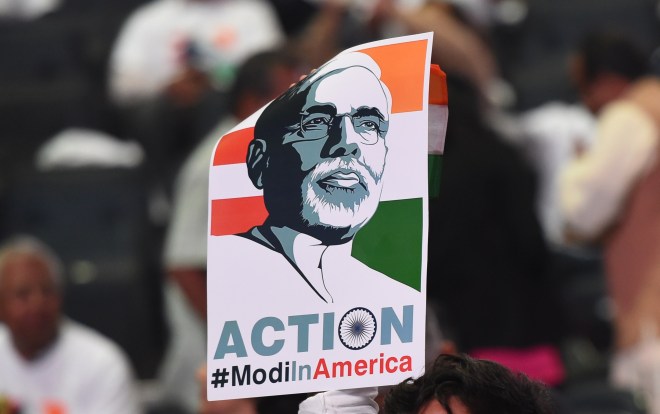
(Photo: A crowd of US-based supporters await the arrival of Prime Minister Narendra Modi of India for a community reception September 28, 2014 at Madison Square Garden in New York. By Don Emmert/AFP/Getty Images)

Poseur Alert

“Actually, there was one time I had graduate students participate with the inmates in a joint reading of Michel Foucault’s Discipline and Punish. I got permission from the prison administration to have fifteen students come, and the prisoners prepared punch and cookies for our meeting, and we just sat down together and talked Foucault. We had also read Goffman’s Asylums and one other book in that vein, and the interesting thing was that in discussing each of those books, the Foucault in particular, the inmates were very upset about the construction of subjectivity, the way in which institutions create a subjectivity,” – Michael Hardt.

Why Chinese Cops Are More Dangerous Now

In the wake of March’s Kunming train station terrorist attack, in which 33 people died, the Chinese government decided to provide guns to the country’s previously unarmed patrol officers. William Wan warns that “the flood of newly armed police — combined with poor training and the government’s take-no-prisoners attitude – could become as fearful a problem as the terrorism it is intended to combat”:

China’s removal of a ban on police guns came in response to a gruesome attack on a train station several hundred miles from here, but it has given the police almost blanket authority to shoot whenever they see fit. … In the latest police-related violence, at least 40 people died [two Sundays ago] in China’s restive Xinjiang region, according to state-run news media, which attributed the incident to terrorists and identified the deceased as “rioters” shot by police or killed in explosions. By contrast, the sleepy village of Luokan is about as remote and unlikely a place for terrorism as can be found. Yet when police fatally shot a man recently in the middle of a busy market here, they declared him a terrorist as well and abruptly closed the case.

Wan and Xu Jing observe that many newly armed officers express “a surprising aversion” to their guns:

“I’ve never liked guns,” said one nine-year veteran. Until this year, guns were forbidden to most police – except for SWAT units and teams on special missions. “Even in past special operations, when we were ordered to have guns, I let co-workers take them instead. You have to worry about it misfiring, about it getting stolen or someone dying improperly.”

A retired officer from Hangzhou City suggested there’re tricky issues of pride at play. In the past, police were praised for daring to confront criminals without firearms, he said. And whenever bad guys got away or a situation spiraled out of control, police could always fall back on the excuse that they were unarmed, unlike police in many countries. “Now that they have guns, they’re in a tighter spot,” said the retired officer. “If you shoot, the public may question whether it was necessary. If you don’t, they may say, ‘You can’t even control criminals with the power of  a gun?'”

Quote For The Day II

This embed is invalid


“Well, I think there’s going to be a generational challenge. I don’t think that this is something that’s going to happen overnight. They have now created an environment in which young men are more concerned whether they’re Shiite or Sunni, rather than whether they are getting a good education or whether they are able to, you know, have a good job. Many of them are poor. Many of them are illiterate and are therefore more subject to these kinds of ideological appeals. And, you know, the beginning of the solution for the entire Middle East is going to be a transformation in how these countries teach their youth. What our military operations can do is to just check and roll back these networks as they appear and make sure that the time and space is provided for a new way of doing things to begin to take root. But it’s going to take some time … But in the meantime, it’s not just buy them time, it’s also making sure that Americans are protected, that our allies are protected …

With the allies, with their ground troops, and if we do our job right and the Iraqis fight, then over time our role can slow down and taper off. And their role, reasserts itself. But all that depends, Steve. And nobody’s clearer than I am about this. That the Iraqis have to be willing to fight. And they have to be willing to fight in a nonsectarian way. Shiite, Sunni and Kurd alongside each other against this cancer in their midst,” – president Obama, Sixty Minutes.

Well, if anything can calm me down, it’s this no-drama president carefully explaining what his strategy is. It’s not about transforming the Middle East, or unseating Assad, or directly intervening to try and achieve in the future what we couldn’t achieve in the past. It appears to be about minimally containing the threat of Jihadist networks so as to create some space for “a new way of doing things to begin to take root”. This is, as Krauthammer put it, containment-plus.

But the same worries persist. What if it becomes impossible to roll back a network like ISIS? What if air bombing campaigns – with civilian casualties – actually galvanize ISIS and empower it with a new global identity with which to draw recruits? What if the broken Iraqi state can never be put back together as a multi-sectarian democracy? What if a “new way of doing things” is actually decades in the future? Are we really going to be bombing for decades? And in how many countries does that formula apply?

The key thing for the president is that the Iraqis fight in a non-sectarian way.

But we already constructed a multi-sectarian government, we already trained a massive Iraqi army, we already ousted a Shiite prime minister – and there are precious few signs of such non-sectarian fighting, least of all in a region now convulsed in either a cold or hot Shi’a-Sunni war. A couple weeks ago, the Iraqi parliament could not overcome sectarian divisions to fill the interior and defense ministries even as an insurgency was nearing Baghdad! If they cannot get there in a real emergency, what chance if the Americans are busy saving their collective asses?

I can see what the president would like to happen. But even he implies it won’t happen for a long, long time. Which means we will be bombing for exactly that long time. And there are unintended consequences to all such wars which he doesn’t even seem to contemplate. Those are my worries – an indefinite military commitment, with no way to achieve the underlying changes that would end such a commitment, with the real possibility of blowback.

The Natural Gas Hype

Natural Gas

Rebecca Leber deflates it:

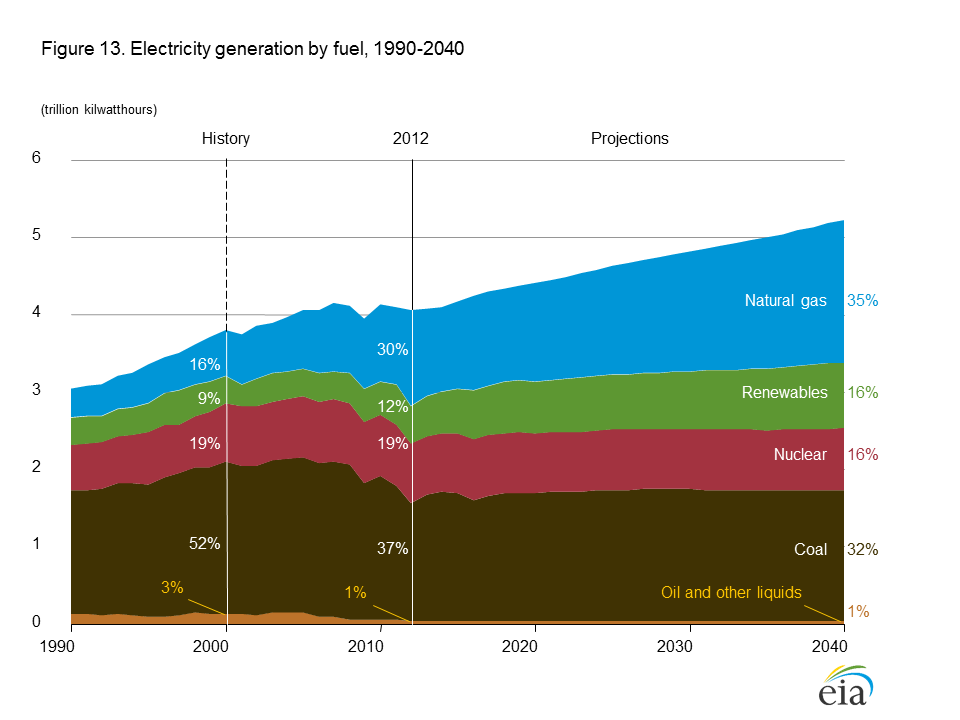
If you thought of natural gas as a useful “bridge fuel” to help America transition from dirty to clean energy, a new study published in Environmental Research Letters has some disappointing news: Natural gas won’t cure our greenhouse-gas affliction. Rather, the study finds, abundant and cheap gas would cause people to consume more electricity, and since gas competes directly with renewables, it will delay the transition to clean power. The result: natural gas does not noticeably lower emissions.

Brooks Miner adds that “natural gas does have a dark side: It is composed primarily of methane, which has a much stronger climate-warming effect than carbon dioxide.”

Quote For The Day

“Some would say, it is not fair or it is unjust to deny same-sex partners the civil “right” to marry. In reality, it is not unjust at all because marriage and same-sex unions are essentially different realities. Justice actually requires society to maintain its long standing definition of marriage. To uphold God’s intent for marriage, in which sexual relations have their proper and exclusive place, is not to offend the dignity of homosexual persons. Of course, a central issue with many same-sex partners are the social benefits that are received through marriage … In trying to think of an analogous situation that could cause a pastor to deny Communion, one might think of an involved Catholic parishioner who was then ordained as a Protestant minister. They would likely be acting according to their sense of conscience and they would probably be a very good person, but they would have broken their communion with the Catholic Church in a very fundamental way,” – Bishop Michael Warfel of Montana, explaining why he stripped an elderly gay couple of their communion after they got a civil marriage license.

My italics. One wonders how a Protestant minister would be able to attend mass regularly at a local Catholic church as well. The hierarchs had better find a better analogy than that – and I wonder if they actually can. Heterosexuals can privately commit sodomy all the time within a public marriage and never arouse any suspicion of scandal; devout gays who simply want to protect themselves in civil marriage – and who are in their sixties and seventies – have no such lee-way.

Which is to say that the church is no longer penalizing heterosexual parishioners for sin; they are uniquely penalizing homosexual parishioners for love. How much longer can this specific discrimination and persecution of a minority be sustained without wider and wider revolt? How many of the next generation will find it possible to belong to a church which singles out a small minority for persecution in this way?

Why Did America Turn Right?

Jacob Weisberg pans Rick Perlstein’s The Invisible Bridge: The Fall of Nixon and the Rise of Reagan, the latest installment of his history of how conservatism came to dominate American politics in the second half of the twentieth century:

As a political history, The Invisible Bridge suffers from more serious deficiencies: a lack of interest in character, and a failure to engage seriously with ideas. Both Nixon and Reagan appear here as flat figures, for whom the author musters no human sympathy and about whom he offers no fresh understanding. At various points Perlstein calls Reagan a “divider” and accuses him of telling lies. Every politician surely divides and misleads to some extent, but these loaded terms fit his subject badly. They jar because they’re in conflict with Reagan’s fogginess, his lack of cynicism, and with what he accomplished politically, which was to unify divided strands in his party, win over an entire class of Democratic voters, and achieve more bipartisan consensus in Congress than any politician has in the 34 years since he was first elected. The lack of any apparent inner life, about which Edmund Morris expressed his frustration in his Reagan biography, Dutch, makes the fortieth President a confounding biographical subject. But unlike Morris, Perlstein doesn’t wonder about what made Reagan tick. He doesn’t find him an enigmatic figure at all.

The second, more serious problem is the author’s tendency to pathologize conservative views rather than reckon with them.

Perlstein builds his Nixon-Reagan bridge not out of Reagan’s policies, domestic or international, but out of the nostalgia-clouded vision of American life he embodied. He believes Reagan triumphed not because he proposed reining in government but because he told Americans they were fundamentally good and decent and didn’t have to face up to their collective misdeeds. Perlstein writes almost as if Reagan had won the general election in 1976, instead of losing the nomination to Ford. The seeds of Reagan’s appeal may have been planted during his losing campaign. But there was a lot more of the 1970s ahead—four more years of energy shocks and disco infernos—before Reagan triumphed by challenging an incumbent President who told Americans that they weren’t perfect and that they would have to accept limits. Reagan’s broad vision of renewed national possibility made for a powerful contrast with Jimmy Carter, to be sure, but he won in 1980 running on a nationalistic, anti-government platform that was more popular than his opponent’s.

In an interview, Perlstein does his best to explain his understanding of Reagan – which is as the son of an alcoholic father:

Once you wrap your mind around the adult children of alcoholics trying to negotiate the chaos of their lives, they form their characters around that. That’s a very strong foundation for understanding. Most people who cover up their inner wounds with this hard shell of fantasy, once that shell faces adult reality, it cracks, and the result is often trauma and neurosis. I call Reagan an “athlete of the imagination.” He worked out in that mental gymnasium ten times harder than us mortals, right? His shell ended up going all the way down.

He was able to use that set of resources and skills he brought in order to do some pretty powerful things, in order to manage and negotiate and the political and social situations around him in a strikingly effective way, and lead quite effectively. I think previous biographers thought they could crack the shell open and get at the real Reagan. I think this is the real Reagan. There are people like that.

I’m haunted and struck by a story that Ron Reagan tells in his wonderful memoir, My Father at 100. He said that, when his dad was toward the end and wracked by dementia and Alzheimers, he’d wake up in the middle of the night with a start and say “the guys need me, the guys need me.” As Ron points out, it wasn’t that the guys needed him on the set of a Warner Brothers film, or the White House situation room, it was the guys in the locker room needed him on the football film. It really just kind of shows that, at the deepest levels of his being, this projection of himself as a hero on the field of battle went all the way down, for good or ill.

Recent Dish on the book here.