The Friend Of Our Friend Is Our Enemy

The “moderate” Syrian rebels aren’t happy about us bombing their extremist allies:

Thousands of civilians and rebels across Syria protested allied airstrikes against extremist militants that continued on Saturday, underscoring the challenge the U.S.-led campaign faces in dealing with complex ties among rival rebel factions.

Jacob Siegel remarks that “America is competing with al Qaeda for the support of those rebel groups. And so far the momentum is on Qaeda’s side”:

The alliance between America and rebel forces has been strained by the U.S. refusal to directly attack the Assad regime. In some ways, the U.S. and its chosen proxies are fighting different wars, despite sharing a common enemy in ISIS.

The rebels consider the Assad regime, which has slaughtered tens of thousands of Syrians over years of brutal attacks, their primary enemy, while the U.S. has condemned Assad but focused its attacks only on ISIS and al Qaeda.

That tension led to a symbolic break last week when Harakat Hazm, one of the few vetted rebel groups to receive American weapons and training, called the U.S.-led airstrikes “an attack on national sovereignty” that would only strengthen the Assad regime.

Larison saw this coming:

Supporters of expanding the war against ISIS into Syria seem to assume that “moderate” rebels will pursue Washington’s goals, but that isn’t going to happen. Like any proxy group, the “moderate” opposition was always going to pursue its own agenda, and there was never going to be much that the U.S. could do about this, especially when it was so intent on trying to “shape” events. These opposition protests confirm what opponents of arming Syrian rebels have taken for granted from the start: providing arms to rebels isn’t going to gain the U.S. the influence or control that Syria hawks want, and the belief that the U.S. can build up a “moderate” alternative to both the regime and jihadists has always been a fantasy.

Is John Oliver A Journalist?

I have to agree with Asawin Suebsaeng: of course he is.

On some critical public issues – take the scourge of “native advertising” – he has done more to bring the question to light than any other media source (I try but the Dish doesn’t have the mega-reach of a “comedy” show on HBO). That story was almost quintessentially journalism: it took on established interests – the whoring media industry – and called them out on it. It shamed the New York Times for their “re-purposed bovine waste”. That it did so with humor and wit and jokes is neither here nor there. Great journalism should be entertaining. It doesn’t all have to be vegetables. Was Mark Twain merely a humorist? Is Michael Lewis not our finest contemporary non-fiction writer?

Jon Stewart comes close – but the one frustrating aspect of his show is his meek interviewing. It’s as if once he has to enter a more conventional interactive piece of journalism, he panics and turns it into light comedic banter. Or he recoils when he needs to put the boot in – and apologizes for being too mean. Colbert pulls it all off through irony – he plays a fake journalist, but nonetheless exposes real truths and real phonies. But Oliver has taken all this a step further. His extra eight minutes give him a chance for relatively long-form investigative journalism – such as the wonderful bit on the Miss America pageant and its bullshit claim that it grants fellowships to far more women than it does. Yes, it’s funny; yes, it ended with a live comedy skit with Oliver as a losing pageant contestant. But its methods – tracking down massive amounts of documents to prove that Miss America is full of it – were classically journalistic.

And Oliver has a position each time: sponsored content is a massive scam betraying every ethical principle of journalism; the Miss America pageant is an utterly preposterous dinosaur engaged in comedic attempts to cover up its fathomless sexism. It’s opinion journalism at its entertaining best. The closest to it is arguably Real Time with Bill Maher – a comedy show that contains a serious broadcast about current events and ideas.

My own view is that Americans seem unlikely to tune into a weekly, lively show about the week’s events or news – of the kind you get in Britain. They want to be entertained – especially if the show is about the news. But what the brilliance of Maher and Oliver suggests is that there might be room for shows not unlike theirs’ but with less of an escape clause to claim it’s all jokes, never mind, move on … Why not a show that does what Oliver does but a few inches closer to opinionated and witty journalism? A show in which the punchlines are not always jokes but also key arguments to shift the public debate? I suspect Oliver and Maher and Colbert and Stewart have opened a door. Who will go through it?

The Question Of Scotland Isn’t Settled

Scotland Decides - The Result Of the Scottish Referendum On Independence Is Announced

Peter Geoghegan keeps tabs on the situation:

Concerns about Westminster’s ability to deliver on its devolution promises is one of the factors behind the huge surge of people joining pro-independence parties in the wake of the referendum defeat. In one week, more than 35,000 people have joined the SNP, making the nationalists the third-largest party in the United Kingdom. Demand to join the SNP has been so great that the party’s website crashed over the weekend. An emergency hotline has been set up and a dedicated team assigned to cope with the numbers seeking to join. The Scottish Green Party has seen its numbers more than triple too.

Many of these new recruits are people who delivered fliers and tried to convince friends, neighbors, and colleagues to vote yes in the largest grassroots campaign Scotland has ever seen.

In a more recent dispatch, Geoghegan continues:

Far from defeat destroying Scotland’s independence movement (as many thought it would) the disappointment of losing has quickly given way to renewed political engagement, says Michael Rosie, a sociologist at the University of Edinburgh. At the same time, the major pro-UK forces—Conservatives, Labour, and the Liberal Democrats—have quickly descended into in-fighting about what powers should be offered to Scotland’s devolved parliament at Holyrood in Edinburgh.

“The side that lost is acting like the side that won by being energized, and the side that won is acting like the side that lost by falling into bits,” says Dr. Rosie.

(Photo: A discarded Yes sticker lies on cobble stones along the Royal Mile after the people of Scotland voted no to independence on September 19, 2014 in Edinburgh, Scotland. By Christopher Furlong/Getty Images)

The “Unbreakable Bond” Between Israel And America

This cliché, amplified by president Obama, placing the state of Israel in a unique place in all our history with respect to US foreign policy, is something that would have horrified George Washington – or indeed any realist on foreign policy. It effectively means that no pressure can or will ever be brought to bear on an ally, even if its interests diverge considerably from ours. A permanent, unbreakable alliance is not an “alliance”; it is a fusion. That must mean that Israel can, at the very least, constrain America’s entire Middle East policy – as it consistently does – and no elected American president can really push back. And this connection is reinforced year after year by the huge financial lobbying machine recently detailed by Connie Bruck in the New Yorker. But a journalist, it seems to me, should at least attempt to fight against this reflexive support somewhat – or to disclose why he or she has a particular bias for another country which is at the center of public debate, when writing about it.

Can there be any stronger conflict of interest when writing about another country’s war than the fact that your own son is fighting for that foreign country? But that is the case with David Brooks. He divulged it recently in a Hebrew language interview in Ha’aretz. No, he’s not a reporter, like the NYT’s Ethan Bronner, assigned to cover Israel fairly even as his son was fighting for the Jewish state. (Bronner was assigned to a domestic beat until his son had finished his service to a foreign country.) And Brooks is a very decent man who is one of the best columnists in America. But still. Here’s what Brooks said about it:

“‘It’s worrying,'” says Brooks, ‘But every Israeli parent understands this is what the circumstances require. Beyond that, I think children need to take risks after they leave university, and that they need to do something difficult, that involves going beyond their personal limits. Serving in the IDF embodies all of these elements. I couldn’t advise others to do it without acknowledging it’s true for my own family.'”

Why not serve in the US army? Because “every Israeli parent understands this is what the circumstances require.”

The Senate Swings Toward The GOP

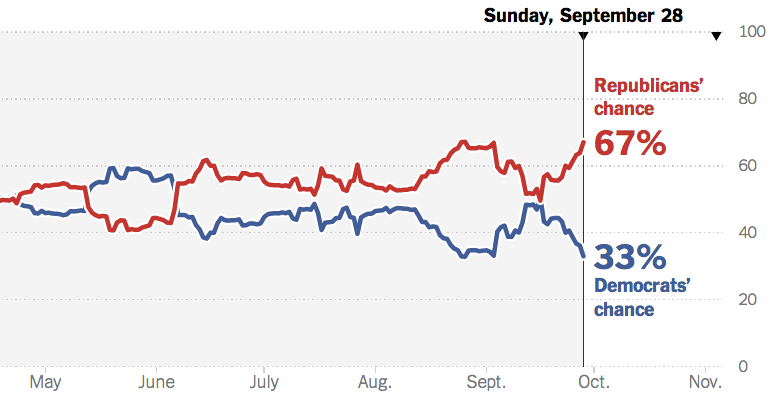
At least that’s what the NYT’s forecast shows:

NYT Forecast

Nate Cohn analyzed the state of affairs on Friday:

Four consecutive surveys have shown Cory Gardner, the Republican candidate in Colorado, in the lead. Two nonpartisan polls — the only two of the last three weeks — showed Dan Sullivan, the Republican candidate in Alaska, also in the lead. The Republicans have not held a consistent lead in Iowa, but the Democrats haven’t led any of the last three polls there, either. As a result, Leo now makes Republicans slight favorites in these states — and that’s the main reason the fight for Senate control has drifted toward the Republicans.

Silver asks, “So what conditions would merit outright panic from Democrats?”:

They should keep a close eye on North Carolina and Kansas. These states have been moving toward Democrats in our forecast, helping them offset Republican gains elsewhere.

But these are also races in which the Democrat is doing better than the “fundamentals” of the states might suggest. The Democratic incumbent in North Carolina, Kay Hagan, is pretty clearly ahead in the polls today (including in a CNN survey that was released on Sunday). However, two other states with vulnerable Democratic incumbents, Colorado and Alaska, have shifted toward Republicans. Perhaps if the Republican challenger Thom Tillis can equalize the ad spending in the Tar Heel State, the polls will show a more even race there as well.

And the Kansas race is still in its formative stages.

Molly Ball profiles Greg Orman, the independent running in Kansas:

Control of the Senate could hinge on this unlikely contest between an insistently nonpartisan, Ivy League-educated former consultant and a Republican incumbent who’s spent 33 years in Washington. If elected, Orman says he would caucus with whichever party has the majority. But if there are 50 Republicans and 49 Democrats, he would play tiebreaker: Joining the GOP would give them 51 votes; joining Democrats would give them 50 votes plus the vice president. In that case, Orman says, he would ask both parties to commit to issues like immigration and tax reform, and join the one that agreed. “We’re going to work with the party that’s willing to solve our country’s problems,” Orman said in an interview.

Almost every ballot has an independent or third-party candidate who blames the two major parties for America’s problems. Most of them are flakes or gadflies who go unnoticed. But Orman has money, he’s run a smart campaign, and he seems to be in the right place at the right time. A weak Republican incumbent, a Democrat willing to get out of the way, and a state whose Republican majority has been badly split by years of toxic intraparty battles—all these factors have made Kansas uniquely receptive to Orman’s message.

Andrew Prokop watches as the various forecasts come into agreement:

In early September, there was an evident split among the six main Senate forecasts. Those that used only polls of individual races — HuffPost Pollster, Daily Kos, and Princeton Election Consortium — showed a small Democratic advantage. But those that also incorporated factors called “fundamentals” —FiveThirtyEight, the Upshot, and the Washington Post — gave the GOP a lead. (These “fundamentals” can include both state-level factors like candidate fundraising and how the state voted in the 2012 presidential race, as well as national factors like the generic ballot.)

Now, though, that split is gone — two of the polls-only models also give the GOP a lead …

The CIA’s War-Without-End

When Glenn Greenwald and Andy McCarthy agree on something, it’s perhaps worth taking notice. Both are now on record with severe doubts about whether the Khorasan terror-group in Syria – the one we were just informed had been bombed – actually exists. Glenn wants to argue that it was a pretext to justify bombing Syria on more defensible grounds than fighting ISIS, which officials have noted does not pose a threat to the US, while we were told that Khorasan did. McCarthy wants to argue that it’s simply a new name given to an al Qaeda off-shoot, cynically designed to hide the fact that al Qaeda is alive and well and on the offense in the Middle East. Both have ideological biases – Glenn believing that much of the war on terror is based on fantasy, McCarthy believing that we need to return to torture and aggressive war to fight a new totalitarianism the “left” is too weak to name and shame. I don’t share either assumption, but I do worry about wars against “a more direct and imminent threat” that turns out, after the fact, not to be imminent, wars which find new enemies and dire plots every day, and in which the public simply has to trust the CIA and the Pentagon and the president as to the truth of it all, while we are encouraged to “go shopping.”

And the narrative about Khorasan turns out to have been a classic bait-and-switch. In the beginning of the new war, this group was named as planning imminent threats against the US with innovative explosive devices designed to bring down airplanes. Glenn has an exhaustive account of how the US media – from the NYT to NBC – simply repeated this argument from the administration (with scary graphics and scarier rhetoric). One example from CIA-sourced Eli Lake:

American analysts had pieced together detailed information on a pending attack from an outfit that informally called itself ‘the Khorasan Group’ to use hard-to-detect explosives on American and European airliners.

So at that point, this new and lethal al Qaeda branch had a “pending” threat to US aviation.

It was only after the attack had taken place that the story evolved a little. Last week we noted a Foreign Policy story that concluded that the group was no more capable of launching an attack on the US than ISIS – which is to say, none at all. Then this classic AP account:

Senior U.S. officials offered a more nuanced picture Thursday of the threat they believe is posed by an al-Qaida cell in Syria targeted in military strikes this week, even as they defended the decision to attack the militants. James Comey, the FBI director, and Rear Adm. John Kirby, the Pentagon spokesman, each acknowledged that the U.S. did not have precise intelligence about where or when the cell, known as the Khorasan Group, would attempt to strike a Western target. . . .

Kirby, briefing reporters at the Pentagon, said, “I don’t know that we can pin that down to a day or month or week or six months … We can have this debate about whether it was valid to hit them or not, or whether it was too soon or too late…We hit them. And I don’t think we need to throw up a dossier here to prove that these are bad dudes.”

The same could be said for ISIS. They pose no threat to the US, according to all the intelligence sources as well as the president. But hey, who needs “to throw up a dossier here to prove that these are bad dudes”? Yeah, that’s how far we’ve come. Remember the “dodgy dossier” that the Blair government fabricated to justify the war in Iraq? It tells you something that our protectors don’t even feel the need to fake such a dossier any more. The standard for new wars is now merely the existence of “bad dudes” which the media can be relied upon to amplify into scary monsters. The strikes take place; we do not know if they were successful; and we subsequently find the “threat” was not imminent at all.

My point is simply that a) we have no idea if these multiple, metastasizing wars are actually justified by national security; and b) even when the CIA and White House say they’re not a threat to the US, we bomb them anyway. So we’re at a point when actual debate about what the threats really are to us has no real relationship to new wars. Those wars are pre-emptive now as a matter of course. The only justification is that they are “bad guys.”

Remember when we used to debate pre-emptive war? Now it’s simply routine – and that very debate has evaporated. Obama is running several undeclared, pre-emptive wars against threats the public has no way of judging, and the CIA has an institutional interest in hyping.

At this point, we simply have to trust our rulers on all this. But how can we at this point? The key officials who are supposed to command our trust – James Clapper and John Brennan – are proven, public, bald-faced liars, contemptuous of the Congress and the public. Brennan’s most recent attempt to claim he was not lying earlier this year when he claimed that CIA officials would never look into the Senate Committee’s computers merely underlines how utterly slippery he is. He should have been fired a very long time ago. That he remains in place and that Clapper can lie to the Congress and suffer no sanction tells you all you need to know about who really calls the shots on national security. Clapper told a clear lie to the Congress and has suffered no consequences.

And our role? To cheer each war and to wait until they come back to haunt us still further. Which, given the experience of the last few months, will merely empower the CIA and the Pentagon even more. Maybe you still believe that Obama can keep a lid on the worst of this. But even if you did, can you not see that the extraordinarily permissive standards for new pre-emptive wars all over the world is a standing invitation for a Clinton or a Cruz or a Rubio to do whatever the CIA tells them? The standards under which we are now operating are light years from anything we once considered rational. Has the world really changed so much – or have we?

The World Agrees On CEO Pay

dish_pay

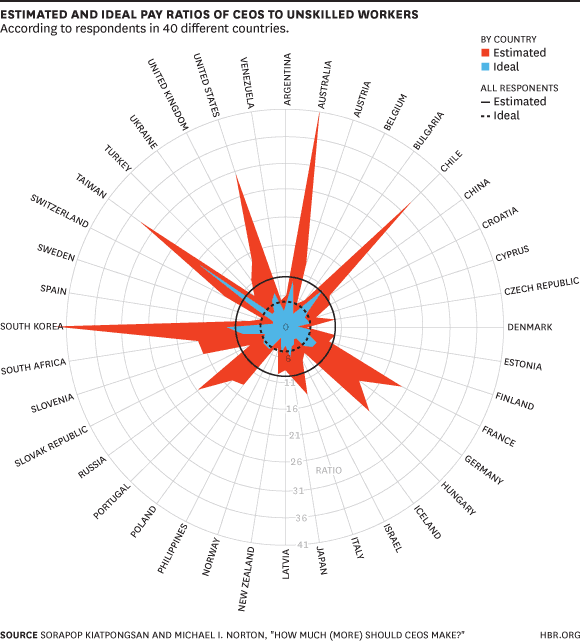
A new study investigated “what size gaps people desire” when it comes to CEO and unskilled worker pay ratios:

It turns out that most people, regardless of nationality or set of beliefs, share similar sentiments about how much CEOs should be paid — and, for the most part, these estimates are markedly lower than the amounts company leaders actually earn. Using data from the International Social Survey Programme (ISSP) from December 2012, in which respondents were asked to both “estimate how much a chairman of a national company (CEO), a cabinet minister in a national government, and an unskilled factory worker actually earn” and how much each person should earn, the researchers calculated the median ratios for the full sample and for 40 countries separately.

For the countries combined, the ideal pay ratio for CEOs to unskilled workers was 4.6 to 1; the estimated ratio was about double, at 10 to 1. But there were some differences country to country. People in Denmark, for example, estimated the ratio to be 3.7 to 1, with an ideal ratio being 2 to 1. In South Korea, the estimated gap was much larger at 41.7 to 1. The ideal gap in Taiwan was particularly high, at 20 to 1.

A quick rundown of the actual numbers on executive pay in the US:

In the 1960s, the typical corporate chieftain in the U.S. earned 20 times as much as the average employee. Today, depending on whose estimate you choose, he makes anywhere from 272 to 354 times as much. According to the AFL-CIO, the average CEO takes home more than $12 million, while the average worker makes about $34,000.

Two Centuries Before Windsor

Carol Faulkner marvels at the story Rachel Hope Cleves tells in Charity and Sylvia: A Same-Sex Marriage in Early America, a “dual biography of two women who lived together in Weybridge, Vermont, for forty-four years”:

Cleves traces the backgrounds and marriage of Charity Bryant and Sylvia Drake in remarkable detail, piecing together town histories, family papers, their poems, and what remains of their correspondence (unsurprisingly, much was destroyed). When the couple met in 1807, Charity was 29, seven years older than Sylvia. Charity had several previous relationships with other women, but she and Sylvia quickly became inseparable. They moved in together, on property rented from a widowed female landlord, and supported themselves as tailors.

At first, and for their relatives’ sake, Sylvia was Charity’s “assistant.” Soon, the two women became equal partners, jointly running their business, and owning their house and personal property. In public records, Charity’s name often appeared above Sylvia’s, establishing her civic identity as the husband of the relationship, a household order that their neighbors understood. The couple shared a bed, a fact that would have been clear to early visitors to their one-room house, but they later built additions, establishing some privacy and upholding the community’s reticence about their sex lives.

In an earlier review, Laura Miller described Charity and Sylvia as that rare academic book “capable of bringing tears to a reader’s eyes,” noting these details about the historical context for their life together:

Charity Bryant was born to a well-regarded Massachusetts family in 1777. A running theme of “Charity and Sylvia” is the remarkable generational divide between those Americans who came of age before the Revolutionary War, in a world dominated by tradition, and the generation raised after it. Many of the latter — known as the “rising generation” by their elders — had been orphaned or beggared by the war or by disease. Furthermore, Cleves writes, “the war for independence had not only broken the political bonds of empire, creating a new nation, it had torn the social fabric of the colonial world, birthing a new American culture.”

If it was possible to jettison England and her king, why not other authorities, as well? For while in colonial America, “no more than 2 or 3 percent of women remained unmarried for life,” after the Revolution, “an increasing number of women, like Charity, began to choose singlehood in order to preserve their autonomy.”

Last month, Maria Popova excerpted the following passage from the book, about how the two women’s marriage somehow found a measure of acceptance in their town:

Like queer people in many times and places, Charity and Sylvia preserved their reputations by persuading their community to treat the matter of their sexuality as an open secret. Although it is commonly assumed that the “closet” is an opaque space, meaning that people who are in the closet keep others in total ignorance about their sexuality, often the closet is really an open secret. The ignorance that defines the closet is as likely to be a carefully constructed edifice as it is to be a total absence of knowledge. The closet depends on people strategically choosing to remain ignorant of inconvenient facts…

The open closet is an especially critical strategy in small towns, where every person serves a role, and which would cease to function if all moral transgressors were ostracized. Small communities can maintain the fiction of ignorance in order to preserve social arrangements that work for the general benefit. Queer history has often focused on the modern city as the most potent site of gay liberation, since its anonymity and living arrangements for single people permitted same-sex-desiring men and women to form innovative communities. More recognition needs to be given to the distinctive opportunities that rural towns allowed for the expression of same-sex sexuality.

The Huge Protests In Hong Kong

The FT relays the latest:

The Chinese government faces its biggest challenge since Tiananmen, as tens of thousands of people on Monday joined the huge democracy protests in Hong Kong. Peaceful protesters poured into Admiralty – the scene of Sunday’s tense stand-off – on Monday after the Hong Kong government withdrew platoons of riot police whose use of tear gas generated sympathy for the demonstrators.

The BBC is live-blogging. Rachel Lu describes yesterday’s events:

Tens of thousands of protesters, calling for “true democracy” – that is, no Beijing-led nomination process in the planned 2017 election for the city’s chief executive, its top government official – confronted the police in the heart of Hong Kong. The smell of tear gas hung in the air near Prada and Gucci shops in glitzy Central area. Police in full riot gear marched on thoroughfares normally congested with traffic in the Admiralty district, where the government is headquartered. By midnight, hundreds of protesters blocked the main roads in Causeway Bay and Mongkok, two bustling shopping areas favored by locals and tourists alike.

A Hong Kong resident sounds off over at Fallows’ place:

When the police decided to retake the street, they sprayed chemicals in our faces, pointed rifles at us, smashed our limbs with batons. While they were throwing tear gas with reckless abandon, our side threw not one rock, not one bottle, not one egg, nothing. None from our side brandished a firearm, a knife, a club, anything at all. I have neither seen nor heard any reports of protesters looting, burning cars, destroying property, or intentionally injuring police.

Young women felt safe enough to doze off during the lulls. In what other city would tens of thousands of ‘rioters’ act with such restraint?

The government warned against the chaos Occupy Central would cause. It’s all too clear to me which side is supplying the chaos and which side is conducting itself with dignity. These demonstrations may have been sparked by anger, but they’re sustained by compassion and love.

Max Fisher identifies the primary purpose of the protests:

That public opinion split among Hong Kong residents is what makes this week really important. The protesters were hoping to galvanize public opinion against Beijing’s plan for the 2017 election, and against China’s more gradual erosion of Hong Kong’s freedoms. But Beijing (and Hong Kong’s pro-Beijing chief executive) seemed to hope that, by unleashing this highly unusual crackdown, they could nudge Hong Kong’s ever-conservative mainstream against the protesters and in favor of the status quo.

In other words, both the pro-democracy protesters and Beijing are hoping to force Hong Kong’s public to choose whether or not to accept, at a fundamental level, China’s growing control over Hong Kong politics. If the public tacitly accepts Beijing’s terms for the 2017 election, it will likely be taken as a green light for more limits on Hong Kong’s democracy and autonomy, however subtle those limits end up being. But if Hong Kong residents join the protesters en masse, they will be rejecting not just the 2017 election terms, but the basic terms of Hong Kong’s relationship with the central Chinese government.

Bruce Einhorn doubts China will cave:

[T]he Chinese government has very publicly intervened in the Hong Kong fight, first with its controversial white paper asserting locals had a “confused or lopsided” understanding of Hong Kong’s autonomy, later with its decree that any candidates running for chief executive in 2017 must first win majority approval by a pro-Beijing nomination committee of 1,200 people. That makes it virtually impossible for Chinese President Xi Jinping’s government to make any concessions.

Zoher Abdoolcarim adds that “Hong Kong is pushing for democracy precisely when China is becoming more authoritarian at home and exercising a sterner diplomatic approach abroad”:

Beijing is cracking down hard on dissent at home. The latest example: the life sentence handed to moderate Uighur academic Ilham Tohti allegedly for advocating “separatism” for Xinjiang. China has also become more assertive, even aggressive, over its maritime disputes with its Asian neighbors, essentially refusing to negotiate and imposing its own boundaries. Thus, Hong Kong — which, with its 7 million people, is just a tiny corner of China — can expect no quarter from Beijing over its fight for democracy.

Gordon Chang dreads the Chinese government’s response:

For many, it is impossible to believe Chinese troops would march on the city, but at this moment almost anything can happen, especially as the protests are taking on an anti-China taint. Students now say they will not salute the Chinese flag if it is raised in schools on Monday, and protesters on Sunday chanted anti-Beijing slogans.

If the disturbances continue into the early part of this week and the Hong Kong police are unable to restore order, Xi Jinping may feel he has no choice but to strike hard. As Chan Kin-man, the Occupy Central co-founder, said as he urged protesters to go home late Sunday evening, “It is a matter of life and death.”

An Atheist And An Absurdist

Michael W. Nicholson claims that the atheists he most wants to engage are those “who wrestle seriously with the implications of their affirmation that the Deus Absconditus is finally the Deus Absentia.” He puts Albert Camus at the top of that list:

Beginning with his essay “The Myth of Sisyphus,” Camus focused his literary investigations on the question of how to overcome nihilism in an absurd world in which, he believed somewhat paradoxically, 640px-Albert_Camus,_gagnant_de_prix_Nobel,_portrait_en_buste,_posé_au_bureau,_faisant_face_à_gauche,_cigarette_de_tabagismereason and logic pointed to a cosmos with no meaning for man: “The absurd is born of this confrontation between the human need [for happiness and reason] and the unreasonable silence of the world.”

Camus’s starting-point was the assumption that humanity’s own rational, scientific enterprise had revealed that the heart of existence was a closed material universe that itself was utterly indifferent to the deepest human longings. In such a universe, “suddenly divested of illusions and lights, man feels an alien, a stranger.” While Camus was not the first to examine the existential question of modern man’s sense of alienation, his works—The Stranger, The Plague, The Rebel, The Fall, The Myth of Sisyphus—were the eloquent high-water mark of the postwar existential sensibility (though Camus rejected the “Existentialist” label).

It is easy to like Camus. Algerian born, member of the French resistance, thoughtful and kind, but an inveterate womanizer. He was the Bogart of atheist existentialism; larger than life, romantic, complex, a “code hero”. No writer since has taken so seriously and expressed so well the implications of the modernist acceptance of a closed universe and the denial of transcendent meaning. Camus’s attempt to assert human value beyond the absurdity of a world without God is imaginative and appealing, but turns out to be only a loop with no exit. Camus, who believed in decency, courage, and compassion, can only assert these traditional values; he can give no foundational reasons for preferring them over selfishness, depravity, and evil.

It’s worth revisiting William Faulkner’s famous obituary for Camus, which touches on these themes. An excerpt:

Despite himself, as all artists are, he spent that life searching himself and demanding of himself answers which only God could know; when he became the Nobel laureate of his year, I wired him ‘On salue l’âme qui constamment se cherche et se demande’; why did he not quit then, if he did not want to believe in God? At the very instant he struck the tree [in the car accident that killed him], he was still searching and demanding of himself; I do not believe that in that bright instant he found them. I do no believe they are to be found. I believe they are only to be searched for, constantly, always by some fragile member of the human absurdity. Of which there are never many, but always somewhere at least one, and one will always be enough.

People will say he was too young; he did not have time to finish. But it is not How long, it is not How much; it is, simply What. When the door shut for him, he had already written on this side of it that which every artist who also carries through life with him that one same foreknowledge and hatred of death, is hoping to do: I was here. He was doing that, and perhaps in that bright second he even knew he had succeeded. What more could he want?

Related Dish on “favorite heretics” here.

(Portrait of Camus from New York World-Telegram and Sun Photograph Collection, 1957, via Wikimedia Commons)