The Seriousness Hierarchy

In a defense of pieces about cultural appropriation, Linda Holmes muses on “little stories”:

Think about the way the rigor with which writers are understood to think about things conventionally expands as the distance (both literal and figurative) between the reader and the subject increases. Writing about international affairs is sometimes treated as more “serious” and higher in status than writing about national politics, which is more serious than writing about local politics. Foreign movies are more serious than Hollywood movies; inaccessible books are more serious than popular and accessible books. While it’s certainly not the only metric that affects all these status decisions, we do very often wind up assigning ascending levels of importance alongside ascending levels of remoteness.

You can see echoes of this in lots of places: go in for medical treatment, and the status of the doctor who may see you only briefly will often be more credited for the success of your care than nurses who actually touch you, who swab your skin and move your limbs and wrap and clip and stick things around you and to you, on top of the expertise they’re bringing. What feels close feels easier and simpler: I could take somebody’s blood pressure, I guess.

It’s sometimes the same in writing. When you write about appearance and beauty, it might seem like pure frivolity, and sometimes it is. But when you are touching on people’s bodies, on their hair and skin and shape, you are actually treading on something that’s powerful because of its intimacy. Writing about books or TV shows can be the same way: people are attached. It’s personal. It’s not a pass to take your eye off the ball. In a lot of ways, it’s the opposite.

The Iranian President Goes West

https://twitter.com/SaeedKD/status/514798826537091072

Haleh Esfandiari mulls the mixed signals Rouhani sent this week while in New York:

In an interview with NBC’s Ann Curry, President Rouhani questioned U.S. motives in moving against ISIS; he called the U.S.-led coalition “ridiculous” and pooh-poohed the effectiveness of an air campaign. President Rouhani asserted that the U.S. is bringing together the very countries that had funded, supported and armed ISIS militants in the first place. He did not specifically endorse Syrian President Bashar al-Assad, but both he and Mr. Zarif have said that ISIS could not be defeated without the Syrian government’s cooperation, and both have described Mr. Assad’s opponents as terrorists. As to prospects for better Iranian-U.S. relations, Mr. Rouhani suggested that this might occur not on his watch but under his successor or his successor’s successor.

Yet in a breakfast with journalists in New York on Tuesday, President Rouhani seemed to adopt a different tone. He said that airstrikes against ISIS targets in Syria lacked “legal standing,“ but he did not press the point. (The Syrian government said that the U.S. had informed it of the intended airstrikes, making its official position more moderate than Iran’s.) President Rouhani also predicted that Iran-U.S. relations would change dramatically if a nuclear agreement is reached, and that things “will not go back to the past” even if an agreement is not reached.

Speaking to the United Nations General Assembly yesterday, Rouhani said that a nuclear deal would “open the way for broader international collaboration” on ISIS. But Tom Rogan is pessimistic about Iran joining the fight against ISIS:

Some suggest that Iran could be enlisted in the fight against the Islamic State. Practically and in the short term, they’re right. But the underlying reality renders this idea absurd. Iran’s leaders have no interest in cooling the sectarian conflict that fuels the group’s jihad. Rather, Iran’s security forces seek to expand Ayatollah Khamenei’s power, a cause completely at odds with Sunni empowerment, let alone a functional Iraq.

Laura Rozen reports on the nuclear negotiations:

Limited progress has been made in narrowing differences towards reaching a final Iran nuclear accord, but significant gaps remain, a western diplomat said here Friday. Reaching a final deal by the November 24 deadline is “doable, but difficult,” he said. “On the core issues, we remain pretty far apart,” the western diplomat at the talks, speaking not for attribution to discuss the sensitive negotiations, told a small group of journalists Sept. 26 after eight days of talks here between Iran and six world powers. “On enrichment, we are not there yet,” the western diplomat. “There are significant gaps, but we are still expecting significant moves from the Iranian side,” he said. The diplomat’s comments came amid conflicting signals about whether Iran and the six world powers had begun to slightly narrow differences on the key issue of the size of Iran’s enrichment capacity in a final nuclear accord.

Bloomberg View’s editors remain hopeful:

Obviously the gap in expectations is vast. But it’s a mistake to focus so intently on the centrifuge numbers, turning them into destructive measures of victory or defeat, when “breakout” depends not only on producing fuel for a bomb, but also on assembling and testing the delivery mechanisms and warheads, as an excellent new paper from the Washington-based Arms Control Association explains. To prevent Iran from developing a clandestine program that could put together the whole package, the U.S. and its allies mainly need an intrusive inspection program.

A potential phased agreement that would satisfy both sides could, for example, give Iran some of the centrifuges it wants but require that it stockpile uranium in powder, rather than gas, form so as to expand the breakout period. Other creative solutions have been floated, too. Where the P5+1 should not compromise is in requiring on-demand access to Iranian facilities, including military ones, to conduct inspections.

Paul Richter’s dispatch doesn’t inspire confidence:

While officials insisted that the discussions have yielded some new ideas, there is less agreement now than there was in July on some issues, such as how Iran will limit output from the heavy-water nuclear facility at Arak. The two sides disagree not only on sticky political issues, but also on matters of basic nuclear physics, said one participant in the negotiations.

Alireza Nader argues that Iran’s leaders badly need a deal:

Iran’s unemployment rate keeps rising, despite reports of reduced inflation and greater investor confidence. Many Iranians are anxious for Rouhani to produce results, but will they blame the United States if Rouhani walks away from the negotiations? Despite his campaign promises to reduce repression, the human-rights situation in Iran is as bad as it was under Rouhani’s predecessor, Mahmoud Ahmadinejad. The Washington Post’s correspondent in Iran, Jason Rezaian, has disappeared and is reported to be undergoing “interrogation,” though it is unclear why. The Rouhani government has demonstrated its inability to prevent increased government repression. Of course, Rouhani does not deserve all the blame, though he is the one who promised change. A failure in nuclear negotiations will not resolve Iran’s political division and could make the economy even worse than before.

At best, many Iranians could lose any sense of hope they felt when Rouhani was elected. And, as Iranian history has shown over and over again, the Iranian people tend to see civil disobedience, street protests and even violent insurrection as possible alternatives to fruitless participation in electoral politics.

Also, during his visit, Rouhani ducked questions about human rights abuses in Iran, including the arrest of several young people who appeared in an online tribute to Pharrell’s “Happy.” Ronald Bailey elaborates:

[Fareed] Zakaria asked Rouhani about the prosecution of six Iranian youths who put together a YouTube dance video to the tune of Pharrell William’s song “Happy” as part a fad sweeping the globe. The seven youths were initially sentenced to six months in prison and 91 lashes for their offense, but those punishments have been suspended on condition that they commit no more offenses in the next three years. Oddly, at the time of the arrest Rouhani’s twitter account noted, “Happiness is our people’s right. We shouldn’t be too hard on behaviors caused by joy.” Rouhani responded to Zakaria that Iran has an independent judiciary, and if what the youths did was legally not allowed in Iran, then they broke the law. “What happened, happened,” said Rouhani.

The Constraints On Unlimited Vacation

Cary Cooper praises Virgin’s new vacation policy:

Richard Branson has introduced a radical new policy for Virgin employees, offering his personal staff unlimited holiday rather than a fixed number of days in a given year. … The policy, or indeed non-policy, is a modern solution to a modern problem – our jobs are infringing on our personal lives more than ever and the nine-to-five life is becoming a thing of the past. We talk constantly of how our devices bring work into our homes but few meaningful solutions are forthcoming. If staff are expected to be flexible with their time, why should they expect any less in return?

It is good to see an employer signalling to his employees that he values them so highly he is prepared to offer them such a generous benefit. Branson says he has taken his inspiration from online video subscription service Netflix but other than these two companies, such a policy is relatively unheard of.

Others are more skeptical. Anne Perkins notes a tension in this plan:

According to Branson, [when to take vacation days] would be simply a matter of personal judgment. The only constraint would be if the employee entertained the faintest doubt that he or she was “up to date on every project and that their absence will not in any way damage the business”. Or, as he put it with that legendary twinkle, their careers.

That should be enough to keep most workers chained to their desks for ever. If the first condition for taking time off is deciding you wouldn’t be missed, it sounds scarily like an invitation to the boss to make it permanent.

Simon Kelner spots a double-standard:

It’s all right for Branson. It’s his business, and he can slip off to Necker Island any time he wants. He’s got a squadron of underlings to take up the slack, and in any case no one is going to question his right to take a break. For his employees, however, it’s a slightly more complicated and nuanced equation. In theory, it’s modern working practice, redolent of a new-age dot-com business, but in reality it leaves too much within the realms of uncertainty, placing an added burden on the individual worker.

Choice means anxiety. How much holiday is too much? Eight weeks? Ten weeks? Twelve? There are no guidelines, other than what we imagine our colleagues will think of us if we’re consistently absent from our workstations.

Leonid Bershidsky puts the policy in international perspective:

Although this policy sounds attractive, it is also quintessentially American. The U.S. is the world’s only advanced economy that doesn’t guarantee people a paid vacation. Netflix workers may well end up taking none if they want to keep their jobs. Disappearing for a month would definitely undermine an employee’s ability to be effective.

Under employer rules that envisage a certain amount of time off each year, many people don’t use it all. The average U.S. employee only uses 51 percent of allotted vacation time. Asked why, most people say nobody else can do their work or they’re afraid of getting behind. But 17 percent admit they’re fearful of not meeting goals or getting fired, and another 13 percent say they want to outperform colleagues.

Face Of The Day

IRAQ-CONFLICT-SHIITE-VOLUNTEERS-JIHADISTS

About 500 Shiite volunteers from Tal Afar attend a combat training session at a military camp in the Shiite shrine city of Karbala in central Iraq to join the fight against jihadists of the Islamic State (IS) group, which led a sweeping offensive in June that overran much of the country’s Sunni Arab heartland. The militant organisation has taken control of important cities including Mosul, Saddam Hussein’s hometown Tikrit and Tal Afar in northern Iraq, as well as Fallujah and part of Ramadi in the west. By Mohammed Sawaf/AFP/Getty Images.

Precarious Peddling

Rachel Williamson contextualizes a “brawl” in Cairo between police and black-market vendors:

[Nasr] Eissa and his competitors are archetypical of Egypt’s black market economy: opportunistic entrepreneurs who’ll sell you a flag during a national celebration and be back to hocking Batman t-shirts the next day. They’re regular targets of police and bureaucratic shakedowns for bribes, and represent a small fraction of an underground economy. It includes non-taxpaying companies, allegedly up to $360 billion of unregistered real estate assets, and provides up to 40 percent of the country’s GDP, according to research from the Peruvian think tank Institute of Liberty and Democracy (ILD).

These entrepreneurs are also the targets of a brand new government initiative seeking to formalize the informal economy. It’s an idea that’s been tried before in Egypt, but this time, the directives are coming from the very top.

Williamson provides the cases for and against this informal economy:

The sheer size of the informal sector — a genuine parallel economy — creates a structural risk. Diwany says the usual tools for managing an economy are unusable when a sizable chunk of the country’s assets and production are hidden in the black market. For example, last year Youm7 newspaper discovered that unregulated “backdoor” cheese factories were adding formaldehyde to their products to extend shelf lives. …

But not everyone agrees that the existence of the informal economy is bad for Egypt, nor that Sisi’s government can heal decades of distrust in state institutions. Angus Blair, founder of the think tank Signet Institute, points out that the sheer size of the informal sector is what got Egypt through the tough economic times of the last three years. He says it provides a huge amount of liquidity, and that Egypt’s real GDP might not be growing at the 2.3 percent it is now (as projected by the International Monetary Fund) if all that extra, unaccounted-for cash wasn’t floating around.

Where Social Entrepreneurs Fall Short

Charles Kenny doubts that their brand of business ventures can accomplish much on their own:

The problems with the social enterprise approach start with the challenge of being small. Aspire is currently working in Mexico, where grasshoppers regularly appear on restaurant menus. At the moment, the insects cost six times more per kilogram than beef or chicken. The enterprise hopes that by significantly scaling production – factory-farming the insects – they can dramatically reduce that price.

That’s a significant hurdle. Small startups rarely go global. Not, at least, without governmental buy-in. … Fixing the infrastructure problems and low-quality health and education services takes more, better government – even if the services are contracted out. For all the valuable work they do, social entrepreneurs can’t replace the state’s role, and they can’t function nearly as effectively where governments are poor, incompetent, or corrupt.

Paternity Pays, Ctd

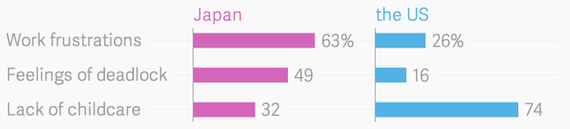
Dish alum Gwynn Guilford argues that Japan especially needs paid paternity leave:

Women in Japan are already paid only 73 percent of what men make for the equivalent jobs; the fact that this gap grows during childbearing years suggests what some call a “motherhood pay penalty.” The work women can find after having a child is often part-time, and usually less well paid, so they have less incentive to go back to work. It’s telling that the better educated a woman is, the more likely she is to stay out of the workforce.

Reasons Female College Grads Leave the Workforce

3fbf24898

Oddly enough, men don’t have it so great either. In return for job security, companies expect their male employees to work grueling hours that end in booze-drenched after-hours bonding sessions, week after week for their entire career. Until very recently, to test their commitment companies would deliberately transfer male workers away from their families. This peer pressure is also part of why Japanese men seldom take vacation days.

Gwynn has some hopes for reform but isn’t too optimistic:

To the government’s credit, in 2011 it launched the Ikumen Project (the word is a slangy play on ikemen, which means a “good-looking man,” and iku (育), which means “to raise”), an online community that 2011 encourages fathers to take a more active role in child-rearing.

Another cultural milestone occurred in Aug. 2014, when Masako Mori, the minister then in charge of the declining birthrate and gender equality, declared that she would promote men who take “paternity leave,” by which she probably meant parental leave. Abe now says he wants the number of men taking leave to rise from 1.9 percent to 13 percent by 2020.

However, it’s not clear that this is much more than rhetoric. The salary gap between men and women means it still usually makes more economic sense for fathers to keep working, especially given that they’re likely to get only half their wages during parental leave. So what the Japanese government ought to do is fix this disparity in how men’s and women’s time is valued. Instead, it’s considering making it worse, by extending maternity leave to three years. That would further entrench the traditional divide between men’s and women’s work, worsening Japan’s labor-supply problems and keeping GDP growth anemic at best.

Meanwhile, turning to the maternity front, Michelle Nijhuis reports on the slow road toward better breast pumps:

In the U.S., as Jill Lepore observed in the magazine in 2009, pumps have become a substitute for adequate maternal leave. Today, they provoke a sort of impotent consumer hatred—even high-end breast pumps are noisy, bulky, and awkward to use, and pumping is sometimes painful, often boring, and never dignified. Not surprisingly, many women who attempt to pump at work wean their infants before the six-month mark recommended by pediatricians. Research and investment into postpartum maternal health, including lactation and pumping, lags behind even other aspects of women’s health—perhaps in part because postpartum health lacks its own specialty, and is instead awkwardly partitioned into obstetrics, pediatrics, and general family medicine.

Nijhuis details a “hackathon” that stepped up to the plate. Elsewhere, on the subject of “the maternal-leave problem,” Darlena Cunha explains how women can end up fired for pregnancy, even at companies where that shouldn’t be the case:

A big challenge for women who want to take their claims to court is that discrimination can be very hard to prove, Colorado attorney Brian Stutheit says. In many states, videotaping inappropriate workplace behavior for evidence goes against privacy laws. And unless there’s a paper trail clearly indicating harassment or discrimination, the evidence is considered circumstantial. In Stutheit’s experience, eyewitnesses are hard to come by because they also work for the company and don’t want to jeopardize their own employment. …

Stutheit calls it the “halo effect”: After a complaint, the employee who filed is treated like an angel for six months or so, then fired for something unrelated. “Employers consider them troublemakers,” he said.

All recent Dish coverage of parental leave here.

The Other Coalition America Is Forming

ISIL’s rejection of Al Qaeda’s senior leadership weakened the latter group’s grasp on foreign fighter flows and donor cash. By striking both ISIL and Al Qaeda’s official arm in Syria, Jabhat al-Nusra, the United States may be encouraging ISIL and Al Qaeda to return to coordinating rather than competing against each other. There are already hints of this happening elsewhere.

Last week, Al Qaeda in the Arabian Peninsula and Al Qaeda in the Islamic Maghreb, two Al Qaeda affiliates losing manpower and momentum to the hot new kid on the block — ISIL — called for unity among jihadi groups in the fight against America. If Nusra and ISIL, rather than eroding each other’s support and competing for resources, join forces to combine ISIL’s resources and skill at insurgency in Iraq and Syria with Al Qaeda’s international terrorism knowhow, the danger to the United States and its interest around the world could multiply rapidly. In other words, the United States could win some tactical victories by hitting both groups hard in Syria, but might be committing a massive strategic blunder by uniting a jihadi landscape it desperately sought to fracture over the past decade.

Eli Lake heard a version of this argument earlier in the week.

An Actual War On Women, Ctd

The victims of ISIS are often raped, as we’ve detailed. But take issue with much of the reporting on these rapes:

Press reports and punditry about sexual violence in Iraq and Syria continually employ the phrases “weapon of war” and “tool of terror.” Without a doubt, some wartime rape is a weapon of war: Some commanders use rape or the threat of rape strategically to punish enemy communities, induce compliance, or demoralize opponents. But the “weapon of war” narrative is disastrously incomplete.

Research suggests that rape has multiple causes, and is more closely associated with fighting forces’ internal practices (like forced recruitment, training practices, or the strength of the military hierarchy) than with strategic imperatives, ethnic hatred, or other “conventional wisdom” causes. In short, to assume that wartime rape is always “rape as a weapon of war” is to ignore the majority of cases.

Moreover, to the extent that wartime rape is a weapon of war, policymakers who invoke the “weapon of war” narrative may actually strengthen belligerents’ strategic positions. Commentary about the Islamic State’s sexual “brutality” ­– exemplified in a recent policy recommendation aimed at “shaming” the organization – risks reinforcing the Islamic State’s intimidating reputation (which is already well-known on the ground and in the refugee camps). Reputations and rumors matter in conflict; recent research in Lebanon has suggested that fear of rape has become an important reason for refugees to leave Syria. Playing into combatants’ rhetorical strategies could result in increased refugee flows, contribute to efforts to diminish women’s involvement in public life, or even increase the incidence of wartime rape.