Game Of Thrones meets the Wild West:
After watching it, David Haglund can’t help but imagine a “Tarantino-directed spinoff movie based on characters created by George R.R. Martin.”
Game Of Thrones meets the Wild West:
After watching it, David Haglund can’t help but imagine a “Tarantino-directed spinoff movie based on characters created by George R.R. Martin.”
Reviewing Richard Evans’ Altered Pasts: Counterfactuals in History, Cass Sunstein argues that what-if scenarios aren’t, as E. P. Thompson put it, “unhistorical shit,” but rather an integral part of the historical enterprise:
Here is another way to make the point. Social scientists test hypotheses. They might hypothesize, for example, that if people have to pay a small tax for plastic bags at convenience stores, they will use fewer plastic bags. To test hypotheses, social scientists usually like to conduct randomized controlled trials, allowing them to isolate the effects of the tax. Such trials create parallel worlds and hence alternative histories—one with the tax and one without it.
Historians cannot conduct randomized controlled trials, because history is run only once. Yet they nonetheless develop hypotheses, and they attempt to evaluate them by reference to the evidence. Evans is himself engaged in this enterprise. There is no difference between hypothesis-testing and counterfactual inferences. Any claim of causation, resulting from such tests, requires a statement that without the cause, the effect would not have occurred.
Evans appreciates the entertainment value of the most imaginative counterfactual narratives, but he doesn’t want them to be taken seriously, or to be seen as what historians do. With Thompson and Oakeshott (and countless others), he thinks that historians should explain what did happen, not what didn’t happen. The problem is that, to offer an explanation of what happened, historians have to identify causes, and whenever they identify causes they immediately conjure up a counterfactual history, a parallel world. Sure, there is a lot of distance between science fiction novelists and the world’s great historians, but along an important dimension they are playing the same game.
A reader writes:
Regarding the uses of Tocqueville to explain why the Middle East isn’t ready for democracy:
If we really want to know what Tocqueville thought about Islam and the Middle East, just skip the flattering portrait he gives us in
“Democracy in America” and read his enormous body of work on France’s 1830 colonization of Algeria — a colonization that didn’t come to an end until 1962. Surprise: Tocqueville the liberal was an early and vocal supporter of the invasion, conquest, and subjugation of Algeria. In fact, he was such a fan that he made two trips there himself to determine whether he and his brother ought to buy land and become settlers. He also read the Qur’an, considered taking Arabic lessons, and positioned himself in the Chamber of Deputies as an expert on the “Algeria Question”. The man was committed.
So what can Tocqueville tell us about how modern Middle Eastern politics got so messed up? Stop me when this starts sounding familiar.
He sets out with the best of intentions, to civilize the barbarous Arabs and introduce solid French virtues like liberty and fraternity. But that doesn’t last long. When the native population turns out to not appreciate France’s virtuous conquest, a full-scale counter-insurgency is launched. And when other politicians begin to question the French army’s tactics, Tocqueville pulls a full Cheney: “I have often heard men in France whom I respect, but with whom I do not agree, find it wrong that we burn harvests, that we empty silos, and finally that we seize unarmed men, women, and children. These, in my view, are unfortunate necessities, but ones to which any people that wants to wage war on the Arabs is obligated to submit.” (1846)
Likewise, some of his colleagues began to complain that French liberals were being hypocritical, demanding equality at home but promoting despotism abroad. In words that might as well have been spoken by Netanyahu, Tocqueville reminds us:
“There is neither utility in allowing, nor a duty to allow, our Muslim subjects exaggerated ideas of their own importance, nor to persuade them that we are obligated to treat them under all circumstances precisely as though they were our fellow citizens and our equals. They know that we have a dominant position in Africa; they expect us to keep it. To abandon it today would be to astonish and confuse them, and to fill them with erroneous or dangerous notions.” (1847)
And contra Mitchell’s argument about the roots of “Islamic fundamentalism”, Tocqueville never once believed that the problem in the Middle East was too much tribal or religious linkages. Rather, his claim was the exact opposite, that the roots of Algerian violence can be found in the destruction of native institutions, habits, and social connections — and, moreover, that this is entirely Europe’s fault. French rule, he writes, has made “Muslim society much more miserable, more disordered, more ignorant, and more barbarous than it had been before knowing us.” (1847) Such was his faith in the importance of empire for France, however, that even admitting this failure could not undermine his ultimate support for the Algerian conquest.
I could go on. Others have at length. My point is just that if we really want to get into the business of shaping our Middle Eastern policy according to the theories of a man dead more than a hundred and fifty years, we should be serious about looking at what he actually said and wrote on the topic. And when we do, we may find that we bear far more direct responsibility than Mitchell or you, Andrew, seem to allow.
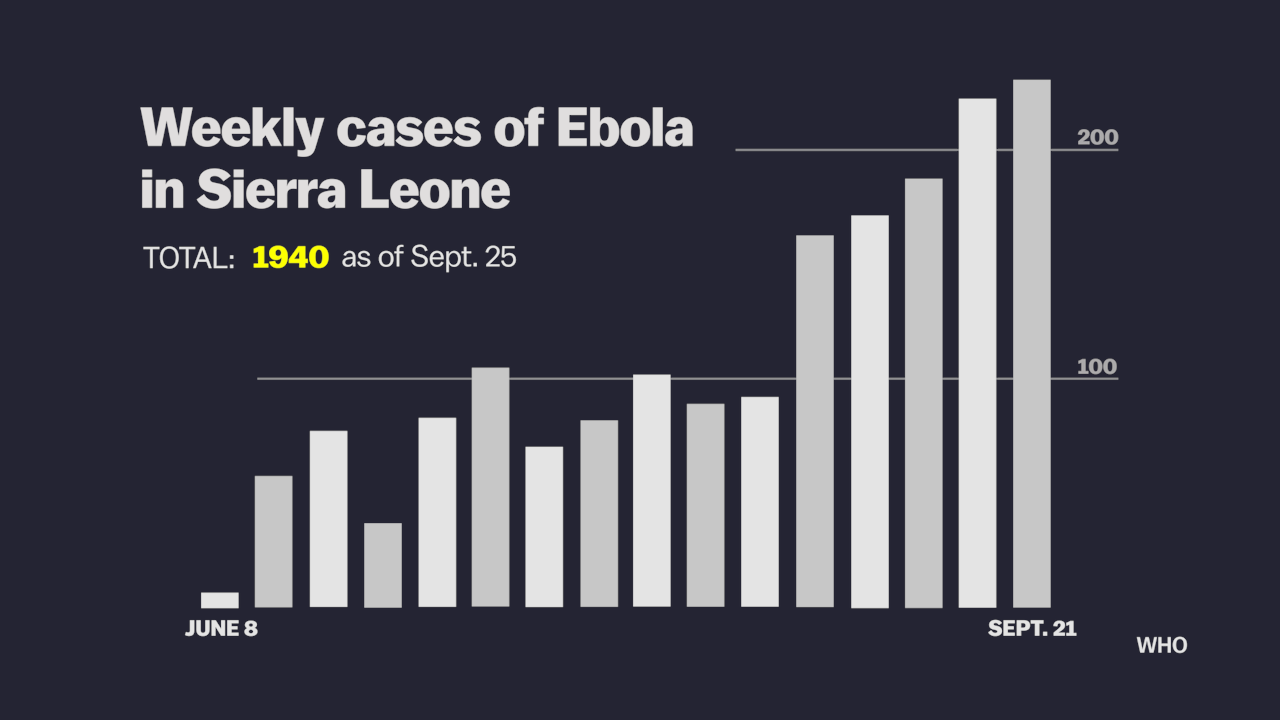
Julia Belluz explains that Sierra Leone is “imposing mandatory lockdowns on its citizens.” She provides the above chart showing the extent of the devastation:
The districts where Ebola is believed to be moving fast — Port Loko, Bombali, Moyamba — are now isolated. People won’t be able to leave their homes or go to school or work. During these periods, government and public-health officials will go door to door, educating people about Ebola and trying to identify patients who should be brought to containment facilities. Officials in Sierra Leone are worried that many Ebola victims are either going underground or simply unable to access care. And the death toll continues to surge — with nearly 600 estimated Ebola deaths in Sierra Leone this year.
Adam Taylor sees “numerous signs that pregnant women in Liberia, Sierra Leone and Guinea could be dying due to Ebola without ever getting the disease”:
Maternity hospitals are fearful of taking women in due to the risk of catching Ebola from a sick patient. That fear is understandable. Hundreds of health-care workers have been infected with Ebola recently, and many were infected by the patients they treat.
Bruce Aylward, assistant director-general for polio and emergencies at the World Health Organization, said that at first, most health workers who died were people working in “poorly run Ebola treatment centers.” However, as the disease spread, it began to affect the broader health community. “Now, if you look at [health-care workers infected with Ebola], they’re somebody who is delivering a baby in a clinic that had nothing to do with Ebola,” Aylward explained. The shift has affected both local and foreign doctors: Rick Sacra, one of the American doctors who contracted Ebola, was treating pregnant women in Liberia when he became infected (he has since made a full recovery).
Worse still, the fear of Ebola infection at medical facilities cuts both ways. Many pregnant women who need treatment are too scared to head to a health center, fearing a visit to a medical facility will actually increase their chance of catching Ebola. In countries where maternal mortality rates are so high than almost one out of every hundred women die, such a lack of treatment can have a deadly impact.
We featured one of those women here.
Well, this is unnerving:
Russian President Vladimir Putin and members of the Russian security council are reportedly considering a plan that would give the Kremlin the ability to cut off the Russian Internet from the rest of the world’s connection in the event of a national emergency. The plan, which officials say is necessary to protect Russian cybersecurity, has raised fears about tighter Kremlin censorship, though questions remain as to whether a national “kill switch” is even possible.
Reports first surfaced Friday in the Russian business newspaper Vedomosti, with sources saying, “Russian Internet service providers will be required to install equipment that would make it possible to shut off Russia’s access to the global Internet, in the event of an emergency.” The broadly defined “emergency” reportedly includes “military actions” or “serious protest actions,” possibly of the kind that came in the wake of Putin’s return to the presidency in 2012. The security council will also discuss a plan that gives Russia control of the country code top level domains (ccTLDs), the websites ending in “.Ru,” “.рф,” and to a lesser extent “.Su.”
Ilya Khrennikov and Henry Meyer contextualize the move:
Russia last month banned anonymous access to the Internet in public spaces and expanded the regulation of media to the blogosphere, requiring those with at least 3,000 daily readers to register their real names and contact information. In February the authorities had passed a law allowing them to close webpages without a court decision if material is deemed “extremist.”
Russian opposition leader Alexey Navalny, who used to criticize Putin and reveal corruption among his inner circle, was the first victim of that law when his blog on LiveJournal.com was shut in March. Recent legislation requires Internet companies to store Russian users’ information on servers in the country, similar to Chinese regulations.
Emily Parker adds:
According to Freedom House, from January 2012 to February 2013, the number of websites flagged for containing extremist material and blocked by the Ministry of Justice increased by around 60 percent. In 2012, Russia enacted a law allowing for the blocking of certain websites without judicial oversight. The law supposedly protects children and controls other harmful content but has been widely viewed as an attempt to clamp down on free speech. According to one study, in the year that followed, more than 83,000 websites were put on an Internet blacklist, and the vast majority was blocked “without a valid reason.”
In other Putin punditry, Benjamin Bidder worries that Putin’s successor will be even worse:
The fear is that someone could seize control of the Kremlin who thinks and acts more radically than Putin. The president created the preconditions of such a possibility with his own failed policies. If the Kremlin insiders want to find a successor, they will have to recruit him from the immediate circle of the current president. But Putin has reinforced hard-liners and pushed out the liberals.
The revolution scenario is no less disheartening. Power could be seized by forces from the extreme right and left. The boundaries between both are vague in Russia, as the name of such groups as the “National Bolsheviks” suggests.
Motyl disagrees:
In the final analysis, Bidder’s assessment amounts to an unwitting justification of dictatorial rule, repeating the self-serving claim that all dictators make: après moi, le déluge. In fact, world experience and both Russian and Soviet history suggest that Russia is likely to experience a better future if and when Putin finally goes. Getting rid of him, as quickly as possible, is a bet worth making—both by Russia and the West.
Mark Thompson remarks that strikes on ISIS’s oil refineries amount to America “going to war against oil, not for it”:
The fact that the U.S. and its allies attacked a financial hub of the Islamic State in Iraq and Greater Syria (ISIS) on Tuesday–the first day of strikes in Syria—and spent Wednesday and Thursday bombing its oil-production facilities, highlights ISIS’s predicament. Unlike a smaller terrorist organization—al-Qaeda, for example—ISIS now occupies, and purports to govern, a wide swath of desert straddling the Syrian-Iraqi border. It needs the estimated $2 million a day it’s grossing by smuggling oil because many, if not most, of its 30,000 fighters are in it for the cash, not the ideology. But the refineries represent only a small slice of ISIS’s oil revenues. It makes most of its money from crude oil, and the U.S. has refrained so far from attacking oil fields in the region. If the money eventually dries up, Pentagon officials believe, many ISIS fighters will head back home. The terrorists control about 60% of Syria’s total oil production, according to a Syrian opposition estimate.
But Jamie Dettmer calls cutting off ISIS’s oil wealth “a monumental task”:
Hitting a dozen rudimentary refineries isn’t going to undercut the group, according to analysts. They say the oil refined by ISIS inside Syria is for the militants’ own immediate transport needs and not for sale to dealers in Turkey, Jordan, and Iran. Revenue is generated from the sale of crude oil, according to Luay al-Khatteeb, an energy expert at the Brookings Doha Center.
To deprive ISIS of its oil revenue would require the U.S. and its allies to bomb nearly a dozen oilfields and hundreds of wells the group has seized in both Syria and Iraq—an operation that would require a huge commitment from the coalition’s air forces and if conducted would cause an environmental hazard. And the government in Baghdad has tied the Pentagon’s hands when it comes to oilfields seized by ISIS in Iraq; it has asked the U.S. not to bomb them, hoping to recapture them intact.
Even more than bombing, a key component in stopping ISIS from profiting from oil will be blocking militants from getting their oil to market by locking up the border with Turkey and Jordan and pressing Kurds to stop dealers in semi-autonomous Kurdistan from trading. The Turks have shown little enthusiasm for halting the trafficking in the past, although in recent weeks they have interdicted some tankers carrying illicit oil.
Michael Lewis highly recommends the latest episode of This American Life:
I don’t want to spoil the revelations of “This American Life”: It’s far better to hear the actual sounds on the radio, as so much of the meaning of the piece is in the tones of the voices — and, especially, in the breathtaking wussiness of the people at the Fed charged with regulating Goldman Sachs. But once you have listened to it — as when you were faced with the newly unignorable truth of what actually happened to that NFL running back’s fiancee in that elevator — consider the following:
1. You sort of knew that the regulators were more or less controlled by the banks. Now you know.
2. The only reason you know is that one woman, Carmen Segarra, has been brave enough to fight the system. She has paid a great price to inform us all of the obvious. She has lost her job, undermined her career, and will no doubt also endure a lifetime of lawsuits and slander.
So what are you going to do about it? At this moment the Fed is probably telling itself that, like the financial crisis, this, too, will blow over. It shouldn’t.
Dan Froomkin eyes defense contractors:
Now, with U.S. forces literally blowing through tens of millions of dollars of munitions a day, the industry is not just counting on vast spending to replenish inventory, but hoping for a new era of reliance on supremely expensive military hardware.
“To the extent we can shift away from relying on troops and rely more heavily on equipment — that could present an opportunity,” Jack Ablin, chief investment officer at BMO Private Bank, whose $66 billion portfolio includes Northrop Grumman Corp. and Boeing Co. shares, told Bloomberg.
Defense contractor stocks have far exceeded the performance of the broader market. A Bloomberg index of four of the largest Pentagon contractors rose 19 percent this year, compared to 2.2 percent for the S&P 500.
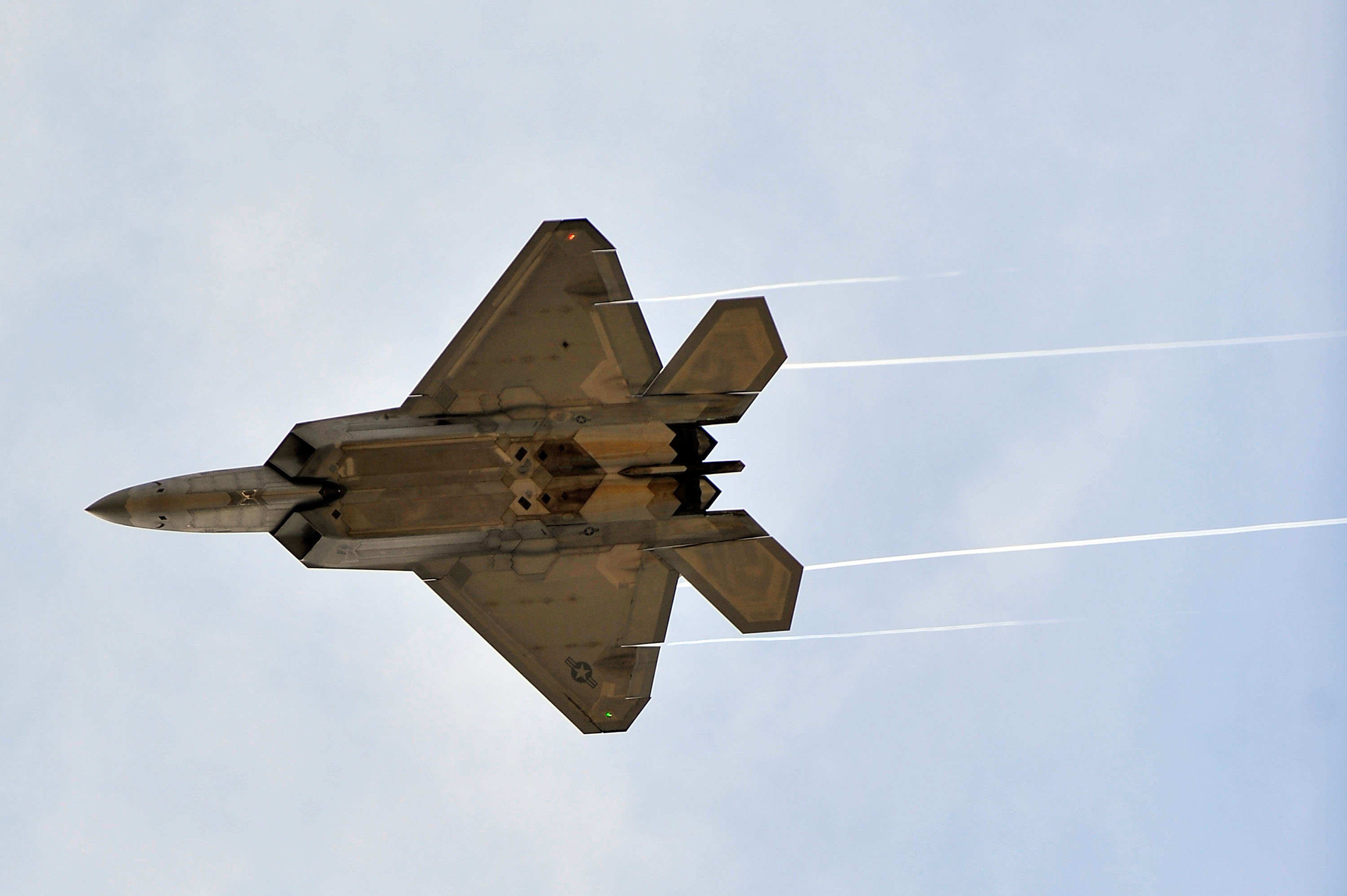
The pricey F-22 made its combat debut this week:
[T]he F-22 is extremely expensive to operate and difficult to maintain. In 2013 the Raptor cost the Air Force about $68,000 per hour to operate once maintenance and other factors are added in, according to documents provided by the Center for Defense Information.
Daniel Altman wonders “whether the arms industry put its thumb on the scale”:
Even a short involvement in Syria will be exceedingly profitable; the first round of air strikes this week reportedly cost $79 million, more than India’s mission to Mars. To “train and equip appropriately vetted elements of the Syrian opposition,” as the amendment voted on by the House states, could cost much more, perhaps as much as $500 million.
So the arms industry had a lot on the line in Roll Call Vote 507. In the end, it passed easily. But those who voted for the amendment may have been much more beholden to the industry than those who did not. On average, the “Yea” voters had received more than $36,000 in contributions from the defense sector during the last campaign cycle, according to the Center for Responsive Politics. The “Nay” voters had taken only about $22,000.
Relatedly, Tom Z. Collina questions the utility of our vast nuclear arsenal:
As the New York Times reported on Sept. 22, the United States plans to spend about $355 billion on nuclear weapons over the next 10 years, and up to $1 trillion over 30 years. As they say in Washington, that’s real money. Yet these weapons play essentially no role in responding to today’s highest-priority threats. U.S. nuclear weapons did not keep Russia from taking Crimea. They did not stop the Islamic State from rampaging through Iraq and Syria. And Ebola? Yeah, right.
A quarter-century after the Cold War, spending this much money on nuclear weapons is simply not justified. But even if it was, the harsh reality is that the country does not have the cash to pay the tab.
(Photo: An F-22 Raptor. By Jason Smith/Getty Images)
Rosa Brooks parodies Obama’s speech to the UN:
PRESIDENT OBAMA: My fellow Americans, the Middle East today is frighteningly full of threatiness.
What, you ask, is threatiness? As my good friend Mr. Stephen Colbert will surely understand, threatiness is to threat as truthiness is to truth. By this, I mean that sometimes we cannot articulate why something is a threat, or offer evidence, but we still think it just feels, you know, threaty. We know it in our gut. And let me be clear: when there is enough threatiness floating around, America must take action.
Nicely done. It’s amazing that no one has yet identified any threat to the US to justify a return to war in Iraq, let alone Syria. Fisher finds Brooks’ coinage useful:
There are two ways to interpret the threatiness of the Obama administration’s case for Syria strikes. The sympathetic interpretation is that there is in fact a good case for intervening against ISIS to curb the danger it poses, but that this danger is difficult to sell politically, because it is too indirect, abstract, and/or complex for a prime time speech. For example, the administration may believe that ISIS is destabilizing an already unstable region in a way that, if left unchecked, really would lead to non-exaggerated threats to the US, not unlike what happened when the Taliban took over Afghanistan. And so, for the sake of political expedience, Obama is using the more palatable language of threatiness, even though that language is at least partly bullshit. That’s the sympathetic interpretation.
The unsympathetic interpretation is that the Obama administration felt pressured into strikes that it now has to justify, or it has no strategy and is trying to cover that up, or it earnestly believes its overstated language.
Take your pick. But none of the interpretations really add up, at least in my mind.
Matthew Continetti is tired of the Clintons’ “passive-aggressive, push-pull tactic of complaining about and condemning supposedly harsh media coverage even as she and her husband and their minions use access and connections to advance their preferred narratives, bullying reporters and outlets who do not conform, and responding to press inquiries with snark and insults and flip and mendacious retorts”:
What is more I am tired of the mainstream media’s complicity in the manipulation and goaltending, the manner in which reporters for establishment outlets accept the Clintons’ absurd regulations and spin, for reasons that are baffling and mysterious to me: whether it is out of ideological or partisan bias, or journalistic self-interest, or the calculation that one day bills will have to be paid, the scribbling will have to end, and jobs in the White House or at SKDKnickerbocker will have to be obtained. …
It will be the unabashedly ideological media that provides the best coverage of the corporatist “centrist” stalking her way back to power. And not just the conservative media: There is plenty of sublimated progressive grumbling at, and critical reporting of, the Hillary juggernaut. Alex Seitz-Wald of MSNBC wrote a fair-minded piece, “The agony and the ecstasy of the Clintons at CGI,” that was a much clearer analysis of the event than any in the major papers. Seitz-Wald went so far as to mention the “elitism problem” and “Wall Street problem” that dog the Clintons, whose idea of combating income inequality is to talk about it while vacationing in a multimillion dollar mansion in the Hamptons, then rub their chins at lavish uplit plenary sessions with Hollywood celebrities and foreign leaders and the head of Goldman Sachs.
My own view is that Clinton is a very establishment, corporate candidate in a very populist, restless era. Maybe the public mood will want some reassurance at the top in a troubled time – the restoration of a royal family to the throne. Or maybe the reverse. I just don’t see anyone out there capable of marshaling that kind of populist campaign against Clinton or against the GOP establishment either. You need exceptional talent to pull off what Obama pulled off in 2008. Cruz is too scary; Paul, alas, does not seem very presidential; Warren has no intuitive way to connect to white working class populism; Rubio looks like a high school debating kid, with a Reagan handbook.
I remember what Hitch once said: the Clintons are always the last people to leave a meeting. Their will to power is unstoppable. But that doesn’t mean others cannot protest as the bandwagon grinds relentlessly forward.
Earlier Dish on the Clinton’s press operation here.
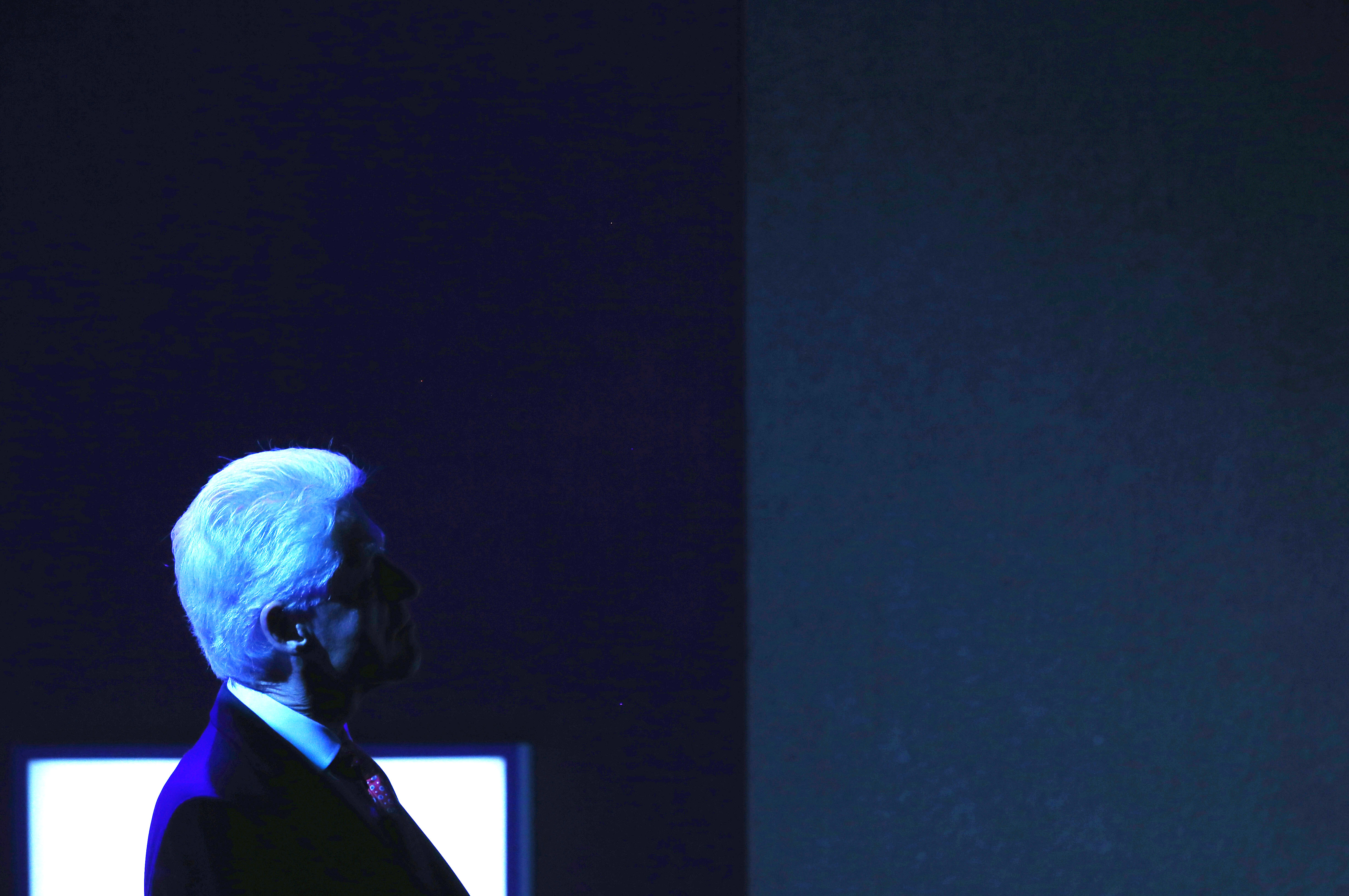
(Photo: Former U.S. President Bill Clinton watches a video at the opening plenary session of the Clinton Global Initiative (CGI), on September 22, 2014 in New York City. By John Moore/Getty Images)

 The Dish