Museum Of Modern Snapchat?

Zachary Fine worries that “even art – that precious category of aesthetics coveted for its ability to draw our eye and focus – finds itself potentially imperiled by the company’s growing orbit”:

The renowned Los Angeles County Museum of Contemporary Art (LACMA) justScreen Shot 2014-09-04 at 3.58.12 PM joined the app as a user, and almost immediately gathered a following with its witty snaps. Now careening along after their forward-thinking competitor, the Blanton Museum of Art in Austin, the Georgia Museum of Art, and the Museum of Contemporary Art Chicago have followed suit.

While it remains to be seen what kind of future this bodes for habits of viewing inside museums and beyond, the prospects seem grim. Unfortunately, Snapchat rewards those very practices of rapid looking and reading that have so impaired our attention spans and hermeneutic dexterity in the Internet age. It not only convinces us that we have become good at seeing quickly, but that such practices are sufficient for the thoughtful interpretation of challenging and information-dense images. If users are determined to keep Snapchat in their lives, let them routinely resort to the under-employed screenshot—assuming fingers can scramble in time.

(Image from LACMA’s Snapchat channel via Hrag Vartanian)

A Rand vs Hillary Match-Up

Linker sincerely hopes it happens:

[T]he only scenario that promises to deliver a genuine contest and spark a serious, important debate is one that involves an electoral smackdown between Clinton and Rand Paul. That is the presidential match-up America needs.

Let me be clear: I am not a libertarian. It’s very unlikely I will cast a vote for Paul or any other Republican in 2016. I anticipate supporting Clinton in the general election.

But I nonetheless believe that American democracy would benefit from a contest that forces the establishment candidate (Clinton) to defend herself and her positions against a challenger who presents a genuine alternative — and one that confounds at least some of the pieties that have gripped the GOP through the last several election cycles.

The Best Of The Dish Today

photo-11

I’ve been enjoying the to-and-fro on Slate about the “end of gay culture” between June Thomas and a young, out lesbian living in Tennessee, Vanessa Vitiello Urquhart. I’ve always had mixed feelings on this issue, but tend to be more on Vanessa’s side of the argument (yes, I know, while living in uber-gay Ptown all summer).

The truth is: I’ve never really felt totally comfortable identifying with a whole lot of what’s called gay culture, which led one wag to note once that I love gay sex and can’t stand gay men. That’s not true, but it isn’t entirely untrue either.  So, for example, I have a bit of a visceral reaction when watching this other Slate video about why the “gay community” loves Joan Rivers. Check it out:

This embed is invalid


I know many gay men do; I know there is a diva worship in many parts of gay culture; I don’t begrudge it an iota; but I really don’t share it, and when it’s presented with the words: “Today we pause to honor a single figure of particular importance to the gay community—the late, great Joan Rivers;” or “Joan was always one of our favorites;” I tend to have this response: Why you say “our”, homo? But then my first reaction upon seeing Mommy Dearest was to be horrified by child abuse – rather than titillated by the camp of it all.

I’ve learned gay culture over the years the way I once learned algebra. I kinda get it, but most of the time, I’m faking it.

I’m not the only one – and I guess one reason I’m happy that we are so much more integrated than in the past is that we increasingly cannot be lumped together as one BLT glob of stereotypes and clichés, or forced into some lockstep lefty orthodoxy if we don’t happen to share it. I have no issue with anyone being gay however they want. But the point of the gay rights movement is not to help people be gayer, but to help them be themselves. Vanessa is walking that walk in the South, where it matters. Best of luck to her.

Today, I coughed up some guilty indifference to Scottish independence – and realized I predicted this fifteen years ago. I worried about the rush to a new war in Iraq (as did Greenwald), and noted new Republican outreach to gays and to women. We aired the question of why women stay with men who abuse them; and announced the new Book Club selection – Sam Harris’ just published “Waking Up: A Guide to Spirituality Without Religion“. Buy it here and join the discussion! Oh, and we “grazed some dicks”. If you need more elaboration of that, click here. Oh, and a Dish day would not be complete without a whack at an unreconstructed neocon. Enjoy!

The most popular post of the day remained Are We Being Baited?, followed by The Scots and the English: Some Guilty Thoughts.

Many of today’s posts were updated with your emails – read them all here.  You can always leave your unfiltered comments at our Facebook page and @sullydish. 24 more readers became subscribers today. You can join them here – and get access to all the readons and Deep Dish – for a little as $1.99 month. Gift subscriptions are available here. Dish t-shirts and polos are for sale here. A reader writes:

I am glad you are back with us! You remarked that traffic was high while you were gone, but in my case that was simply out of a sort of loyalty to you. In truth, if you had not come back, I would no longer subscribe! The blog began to slowly become a kind of melange – tasty, yet lacking the essential ingredient that gives it a focus: you!

So I do not think the blog would thrive without you (and I hope you are not thinking it should become some kind of institution, or that you would just become some sort of detached figurehead). As a Buddhist, I say, embrace impermanence! And while long may you live and flourish! May you live a hundred years or more! When you are gone, I hope you let the blog be gone too. It quite frankly IS you, regardless of how your team writes and works under your guidance (and they do so brilliantly).

I loved the way you were so reticent about Burning Man, by the way, with only those two lovely stories to give us a clue. Bacon and ukeleles. In the dust and under the stars. Probably would take a poet to write about all that.

My reader is too kind.

See you in the morning.

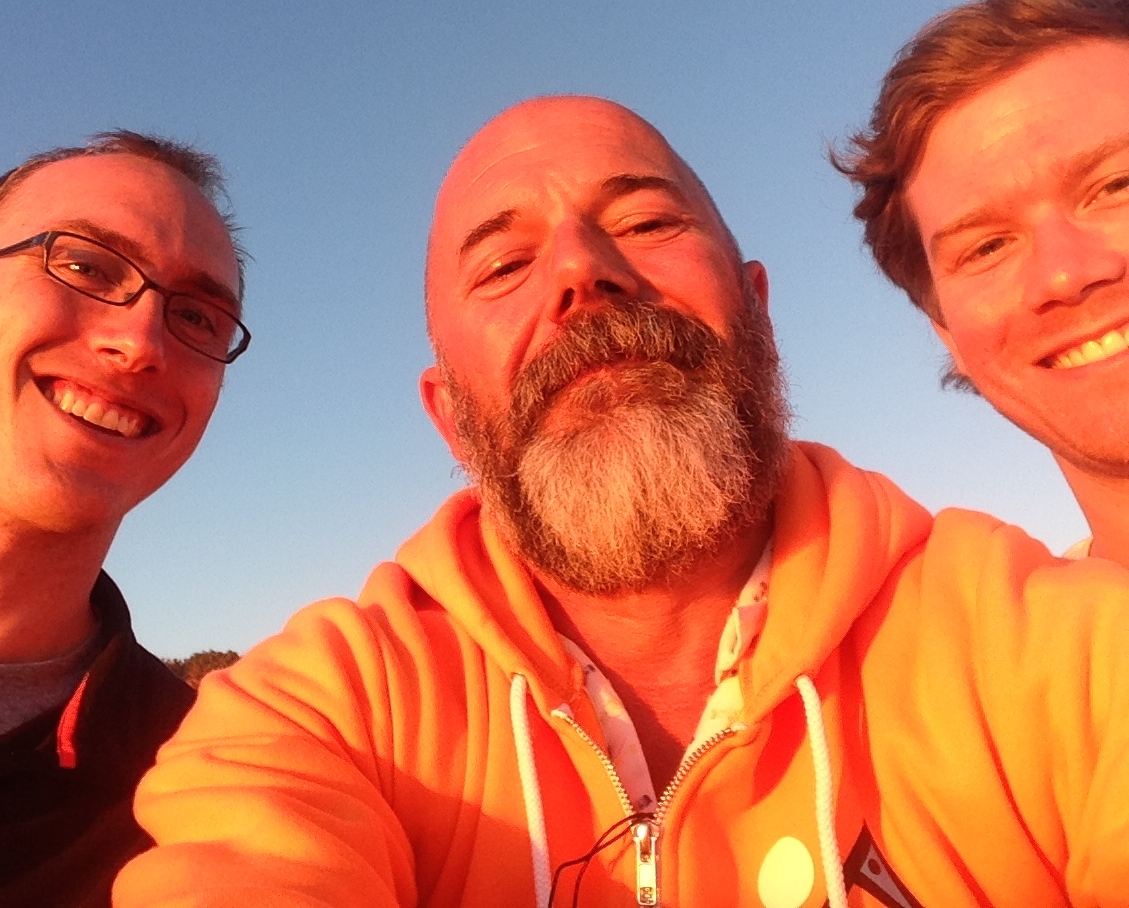
(Photo: me, and Chris and Patrick in the evening Cape Cod sun this past weekend.)

The Symbolic Sea

In an interview, Brett Fletcher Lauer shares how he came to title “Seaside Suicide,” one of the poems in his debut collection, A Hotel in Belgium:

“Seaside Suicide” takes its title from an unrecorded song by the teenage Kurt Cobain, as reported in the documentary Kurt & Courtney. And I liked the phrase, partly for its sonic appeal, but also because the phrase combines a sense of tranquility and tragedy. There might also be a moment of minor hubris in my pretending to retrieve the phrase from being an obscure footnote on Nirvana messages boards—that the lost song was the equivalent of a lost or burnt manuscript, or really, more like a crumpled up post-it note.

Of course, I’m also allowing myself that pathetic fallacy and identification with the poetic image of the sea. The sea and the idea of the sea never fail to draw me in with a sense of meditative awe, any bodies of water really, which accounts for many of the narrators in the book being placed at the edge of the sea. And I think before I talk too much about suicide as an idea, or metaphor, it would be irresponsible to not acknowledge the seriousness of people struggling with suicidal thoughts and to note a resource for assistance.

Obviously, suicide is the ultimate, determined, and irretrievable action to feeling captive to the earth, or feeling, or disorder. I do appreciate your phrase “spiritual suicide,” which I think helps differentiate between a purely Romantic notion of killing oneself as in The Sorrows of Young Werther, another big influence, and what I see as a more existential crisis or a death on the inside.

Is The Border Crisis Over?

Screen Shot 2014-09-09 at 2.21.53 PM

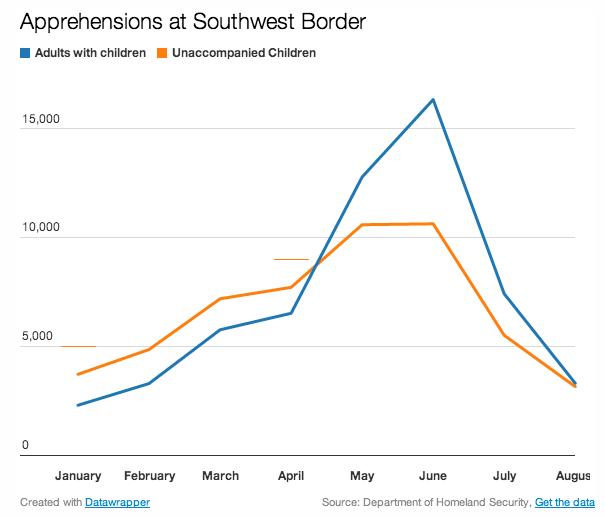
The influx of migrant children into the US has plunged in the past two months, “from more than 10,600 apprehended in June to just over 3,000 in August”:

One major culprit is the hot summer weather, which could discourage migrants from making the journey from Central America to the United States. But at the same time, the Obama administration has engaged in an aggressive public-relations offensive in Latin America to warn parents against sending their children here. And immigration courts nationwide have expedited processing cases of the migrants recently caught at the border, putting those hearings ahead of others in line. “The system is, by and large, working,” said Kevin Appleby, the director of migration policy for the U.S. Conference of Catholic Bishops. “If anything, they need to ensure that the children are receiving the appropriate due process and we’re not violating our own law or international law.”

But Danny Vinik isn’t celebrating:

The ultimate answer is that we just don’t know why so many unaccompanied minors came across the border this year or why it is falling now. One reason may be that the administration ran multiple ad campaigns to deter parents from sending their kids north, explaining that the journey is dangerous and the kids wouldn’t be allowed to stay. The Mexican government also stepped up enforcement on its side of the border. And the weather may be having an effect as well. It’s still tough to tell the exact reasons. Given that, it would be foolish to make sweeping policy changes, like House Republicans voted to do before the August recess.

That’s not to say this situation does not require action. The thousands of kids who came across the border still need housing and food. The immigration courts are still backlogged. This crisis isn’t over. But it’s a different one than policymakers originally imagined. It’s not about border security or stopping the flow of unaccompanied minors. It’s about fairly handling the ones who are already here. That’s a very different problem.

(Chart via Vinik)

Wars, Dumb Wars, And Permanent War

IRAQ-UNREST-VOLUNTEERS

The great and wonderful thing about being a neoconservative is not just that you never have to come to terms with your mistakes – because you are never, ever wrong – but you can also write the same column again and again across decades and Washington will still find you a deep and meaningful thinker. You know the two-step by now: plug in any foreign crisis, call it the 1930s, campaign for war, and pick up your welfare check from a think tank.

Here’s Bob Kagan, as noted by Peter Beinart, on the rise of ISIS among the Sunnis in Iraq after the war Kagan championed and has never apologized for:

The Obama Administration’s current policy invites Islamist adventurism abroad and repression at home. At the beginning of this bloody century, we all should have learned that appeasement, even when disguised as engagement, doesn’t work.

Actually, those sentences were slightly adapted from a column Kagan wrote in 1998, when he and Bill Kristol were itching for a fight with China (which was as good as they could get at the time, before al Qaeda came along). They didn’t get their Cold War then, but after 9/11, they sure hit the jackpot. Their conclusion from those futile, costly catastrophes? Let’s have another one – to deal with the fateful consequences of the first.

But really: Chamberlain again? 1931? Are they that lazy? Yes they are! But how does someone in 2014 actually write the following?

Until recent events, at least, a majority of Americans (and of the American political and intellectual classes) seem to have come close to concluding not only that war is horrible but also that it is ineffective in our modern, globalized world.

Gee, Bob, why on earth would any American conclude that war is ineffective these days? Maybe it’s because we tried it for a decade in Iraq and made things far worse than they were in the first place. Maybe it’s because the longest ever American war in Afghanistan seems destined for the exact same conclusion. Maybe because we’ve seen its horrors in the memories of so many whom we have lost and the faces of so many more trying to overcome the trauma – physical and emotional – of the horror in Iraq he and I urged upon the country so eagerly.

Beinart sketches the extraordinary number of wars, air-strikes, drone-strikes and the like that have already gone on under this administration:

Near the end of his first year in office, President Obama sent 30,000 additional troops to Afghanistan. That same year, he began an expansion of America’s drone program that would lead him to authorize eight times as many strikes (so far) as George W. Bush did. In 2011, the Obama administration helped militarily depose Muammar al-Qaddafi. Over the last month, it has launched 130 airstrikes in Iraq, with more almost certainly to come, perhaps in Syria as well.

If this is appeasement, what would the alternative look like? A full-scale military confrontation with Russia? Another occupation of Iraq? A war with Iran? Kagan doesn’t say, of course, his silence on this as damning as his silence on Iraq and Afghanistan. To take his absurd analogy at face value, it would require re-invading Germany once again in 1920 – just two years after the First World War.

This is not an argument; it’s a feeling. And the feeling is fear directed outward with violence and aggression. It comes perilously close to seeing perpetual war almost as an end in itself, an instrument to maintain and expand global hegemony, even after it has bitten us again and again in the ass. It sees only good motives – not unintended consequences. And you see in it a constant rhetorical drumbeat that anything other than permanent war is somehow weakness, rather than strength.

We can do better. We can learn from our mistakes – rather than simply ignoring them. We can defend ourselves without invading other countries with land armies, without occupying places we do not understand and cannot control, and without creating new enemies every time we launch a drone strike or threaten another war. This is not appeasement. It is prudent self-defense, moral self-defense, American self-defense – and a foreign policy insulated from fear and panic and hysteria and self-doubt. The fight for this is not over. In some ways, especially as we face the prospect of a future president Clinton or another Republican schooled in neocon cant, it may just be beginning.

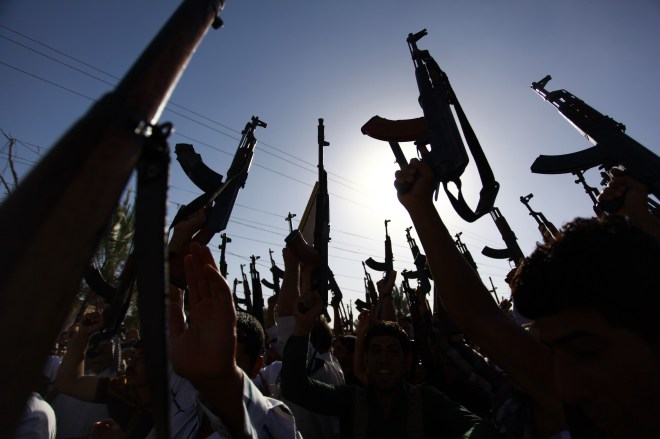
(Photo: Iraqi Shiite tribesmen brandish their weapons as they gather to show their willingness to join Iraqi security forces in the fight against Jihadist militants who have taken over several northern Iraqi cities, on June 17 2014, in the southern Shiite Muslim shrine city of Najaf. By Haidar Hamdani/AFP/Getty Images)

How Secret Should Abortions Be?

A reader writes:

I read Jessica Valenti’s article about how women should not be pressured to talk about their abortions because those personal stories shouldn’t be necessary to make people “understand how basic and necessary abortion rights really are.” I immediately thought of Harvey Milk giving his address at Gay Freedom Day over 45 years ago, shortly before his assassination. He implored his gay brothers and sisters:

You must come out. Come out… to your parents… I know that it is hard and will hurt them but think about how they will hurt you in the voting booth! Come out to your relatives… come out to your friends… if indeed they are your friends. Come out to your neighbors… to your fellow workers… to the people who work where you eat and shop…

Where would the gay rights movement be in America if not for the indomitable courage his brothers and sisters showed in telling the world that they are gay? Would Bowers v. Hardwick still be law?

Yes, women getting abortions must tell the world their stories. That is how people realize that their family members, their relatives, their friends, their neighbors, and their co-workers would be hurt by legislating away their rights. That is how you turn an impersonal story into a personal one. The pro-life segment knows this and uses it to their advantage repeatedly by, for example, parading people who admit they were conceived from a rape and are glad their parents didn’t abort them. If those who think abortion should be legal don’t tell their personal stories, they are making it that much harder for others with no skin in the game to support them.

Face Of The Day

-

An environmental activist faces a riot policeman in the Sivens forest as clearing has started in preparation of the Sivens dam construction, on September 9, 2014 near Gaillac, in the Tarn region of France. Although the construction of the dam would help supply water to nearby farms, it would remove a 13-hectares-long reservoir of biodiversity. Proponents of the dam – including the Departmental Federation of Syndicated Farmers (FDSEA) – deemed necessary to secure water supplies for farmers. Opponents – backed by French Europe Ecologie Les Verts (EELV) – are moved by the disappearance of a wetland sheltering 94 protected species and therefore denounce the projected irrigated agricultural model. By Remy Gabalda/AFP/Getty Images.

Was The Ebola Epidemic Preventable?

Laurie Garrett argues as much, blaming the international community for not acting on the crisis early enough:

Shortly after the World Health Organization (WHO) officially declared an outbreak of the same strain of Ebola that first appeared in Zaire in 1976, outside humanitarian responders appeared on the scene to assist Guinea; they were the organizations that dominated the treatment and prevention efforts throughout the spring and into the summer, as Ebola spread to Liberia and Sierra Leone. During that time the outbreaks were largely rural, confined to easily isolated communities, and could have been stopped with inexpensive, low-technology approaches.

But the world largely ignored the unfolding epidemic, even as the sole major international responder, Doctors Without Borders (also known by its French acronym, MSF), pleaded for help and warned repeatedly that the virus was spreading out of control. The WHO was all but AWOL, its miniscule epidemic-response department slashed to smithereens by three years of budget cuts, monitoring the epidemic’s relentless growth but taking little real action. Even as the leading physicians in charge of Liberia and Sierra Leone’s Ebola responses succumbed to the virus, global action remained elusive.

Julia Belluz flags a new study that assesses the virus’s chances of making its way to America:

In a Sept. 2 article in the journal PLoS Currents: Oubtreaks, they published their findings. “Results indicate that the short-term (3 and 6 weeks) probability of international spread outside the African region is small, but not negligible,” they wrote. Ghana, the United Kingdom, Gambia, the Ivory Coast, and Belgium were the countries most at-risk of importing at least one case by Sept. 22, the date they chose as the projected cut-off for their model. Out of the 16 countries analyzed, the US ranked 13th (toward the last) for risk of importing Ebola by that time. The risk for the US was as high as 18 percent and as low as one percent.

And as Ronald Bailey notes, the same study calculates that any US outbreak would only infect about 10 people. Meanwhile, Joshua Hunt takes a look at another promising Ebola treatment, made by the pharmaceutical company Toyama Chemical:

The Fujifilm subsidiary’s small yellow tablets are marked アビガン, which is a Japanese rendering of the brand name Avigan. They inhibit the replication of viral genes within an infected cell, while also mitigating their ability to spread from one cell to another—a two-pronged approach to fighting influenza that Fujfilm says is unique. The drug was approved in March by Japan’s health ministry as a treatment for both novel and reëmerging forms of influenza, but researchers have theorized that it could be an effective emergency treatment for Ebola. …

Avigan offers new hope because, since it received regulatory approval for sale in Japan in the spring, it has been manufactured on a much larger scale than the experimental drugs being developed specifically for Ebola. Supplies of ZMapp, which was created by the San Diego-based Mapp Biopharmaceutical, have already been exhausted, and its results have been mixed. Two American doctors treated with ZMapp recovered, but a Liberian doctor who also received it died. Fujifilm’s Avigan stockpile would be sufficient to treat twenty thousand people—the exact number of infections that the World Health Organization has estimated might occur before the current outbreak is brought under control.