McWhorter has met “more than a few who seem honestly to think that when Obama, who generally speaks in a vanilla standard way, uses some black inflection or slang with black audiences, he is being fake”:
Wrong. Obama is doing something most black Americans do: using a special repertoire that has a function, to connote warmth and connection. Linguists call it Black English. If Obama is phony in switching into it to strike a certain note, then millions of black people are spending their entire lives being linguistically inauthentic. Doubtful. And — we must be under no impression that Black English is simply the things generally thought of as slang (or, with less scientific justification, errors) such as ain’t and good old aks for ask. Black English is a whole spice rack beyond this.
Take “folks,” for example, which Obama used in his mentioning that, “We tortured some folks.” To many, it sounded like he was trivializing the gravest of issues. But black speakers (and many whites as well) tend to substitute “folks” for “people” to indicate a sense of affection for, or identification with, the people in question. Black academic types (such as Obama) are especially given to saying “black folks” as a way of indicating that they do not feel superior to ordinary black people despite their own success. Obama’s extension of it to discussing the war on terror was unsurprising.
Another three-day ceasefire went into effect in Gaza at midnight last night and appears to be holding for now, as negotiations resume in Cairo:
A senior Israeli government official had said on Sunday Israeli negotiators, who had left Cairo on Friday hours before a previous three-day ceasefire expired, would return to Egypt to resume the talks only if the new truce held. Hamas is demanding an end to Israeli and Egyptian blockades of the Gaza Strip and the opening of a seaport in the enclave – a project Israel says should be dealt with only in any future talks on a permanent peace deal with the Palestinians.
Ed Morrissey likes former Shin Bet chief Yaakov Perry’s proposal to turn the Gaza ceasefire negotiations into regional talks on a permanent peace deal:
Israel has to find a way to push Hamas aside without opening up a vacuum that will allow a worse alternative to take its place. Voila: the Arab League. The neighboring Arab nations hate Hamas too, and would love to see it expelled or at least marginalized in the region. A comprehensive regional peace plan would lock Iran out of Palestinian politics entirely and allow for a greater focus on the threat coming from Tehran rather than the constant irritation of Palestinian uprisings. They’ll never get the “right of return,” but the Arabs could gain some other concessions, especially on the West Bank wall and some of the settlements in exchange for purging Hamas from Gaza and getting the Palestinian Authority to take over its governance.
At least, that’ll be the theory.
And even if the talks can’t pull off the improbable, at least the effort will be a little more productive than listening to Hamas demand that Israel commit national suicide by reopening the border crossings under Hamas leadership.
Gershon Baskin thinks this might actually work, if the Arab states and Israel play their parts:
If King Abdallah of Saudi Arabia would issue an invitation to Netanyahu, Abbas, President El-Sisi of Egypt, and King Abdullah of Jordan to come immediately to Riyadh with Gaza on the table, it could very easily lead to the acceptance of the Arab Peace Initiative. The current war is a dead end; we need a brave initiative and a courageous Arab leader (and Israeli one) to get beyond the current lose-lose scenario in progress.
There is more Israel can do to move things in the right direction, without giving an inch to Hamas. Netanyahu’s government should reach out to the Palestinian population in Gaza with messages that move from the current language of threats to the language of promise and hope. Israel needs to articulate to Gazans what a peaceful Gaza could look like with an airport, economic development, and jobs. Gazans desperately want to hear concrete plans for how their basic needs for a normal life could be met, and Israeli officials should be the ones to tell them.
But Omar Robert Hamilton considers the trope that Hamas can’t be negotiated with preposterous:
Of course, a central tenet of Israeli spin is to always refer to “Hamas” and not to “Palestinians” (Americans are sympathetic to Palestinians, but not to Hamas), to hit the word “terrorist” as often as possible and to stress that Hamas is “committed to the destruction of Israel.” It is never mentioned that in their 2006 election manifesto, Hamas dropped their call for the destruction of Israel and simply reaffirmed their right to armed resistance. Hamas is a political player that, like all others, is primarily interested in the acquisition of power and influence – they are very far removed from the theocratic death cult that Israel strains to see in its dark mirror. In 2006, as Hamas was engaging in the democratic process, it announced it would stop using suicide bombers. There has not been a bomb since. Israel claimed that the (still-incomplete) Wall was to thank. Again and again, Hamas have tried to play by the rules of the game as they are set by Israel, America and the International Community. Democracy is embraced and brings with it a siege. Israel’s existence is recognized but this goes unmentioned. Military resistance is halted and the siege deepens. Truces are agreed to and Israel violates them.
Whichever way this tentative new peace effort goes, Judis observes that the US isn’t leading it. That’s because, he asserts, it’s no longer in our interests to do so:
The pressure from surrounding Arab states to resolve the conflict has eased, particularly in the wake of the failure of the Arab Spring. Lebanon, Syria, and Iraq are preoccupied with their own internal problems. Egypt’s el-Sisi is more sympathetic to Netanyahu than to Hamas’s Khalid Mishal. The Saudis are still committed to their own initiative for resolving the conflict, but like el-Sisi, have no affection for Hamas. And the threat of terrorism in the region—typified by Islamic State in Iraq and Syria—is no longer so clearly tied to the continuation of the Israeli-Palestinian conflict. So while the surrounding Arab states are always under public pressure to end Israeli attacks against Palestinians, Arab leaders have not displayed the same urgency.
The pressure that existed in 1975 or even 2005 doesn’t exist. As a result, Obama and Kerry do not feel the same urgency to act.
By 1970, Ianni calculated, there were 42 fourth-generation members of the Lupollo-Salemi-Alcamo-Tucci family – of which only four were involved in the family’s crime businesses. The rest were firmly planted in the American upper middle class. A handful of the younger members of that generation were in private schools or in college. One was married to a judge’s son, another to a dentist. One was completing a master’s degree in psychology; another was a member of the English department at a liberal-arts college. There were several lawyers, a physician, and a stockbroker. …
The moral of the Godfather movies was that the Corleone family, conceived in crime, could never escape it. “Just when I thought I was out,” Michael Corleone says, “they pull me back in.” The moral of A Family Business was the opposite: that for the Lupollos and the Tuccis and the Salemis and the Alcamos – and, by extension, many other families just like them – crime was the means by which a group of immigrants could transcend their humble origins. It was, as the sociologist James O’Kane put it, the “crooked ladder” of social mobility.
When researcher Luca Maria Aiello and colleagues at the University of Turin began to map out aNobii.com, an Italian social network similar to Goodreads, they created a user account for an automated crawler. They watched as the bot, named lajello, built social cred simply by “visiting” pages of other members, prompting the team to investigate the question, “Can an individual with no trust gain popularity and influence?”
The results surprised them. Every time lajello began its round of visits, it triggered a burst of comments on its public wall. When it finished its round, people quickly stopped sending messages but resumed at the same intensity when the bot started visiting again. By December 2011, lajello’s profile had become one of the most popular on the entire social network. It had received more than 66,000 visits as well as 2435 messages from more than 1200 different people. In terms of the number of different message received, a well-known writer was the most popular on this network but lajello was second.
“Our experiment gives strong support to the thesis that popularity can be gained just with continuous “social probing”,” conclude Aiello and co. “We have shown that a very simple spambot can attract great interest even without emulating any aspects of typical human behaviour.”
The researchers then tested whether the bot had any influence over real people:
[T]hey started using the bot to send recommendations to users on who else to connect to. The spam bot could either make a recommendation chosen at random or one that was carefully selected by a recommendation engine. It then made its recommendations to users that had already linked to lajello and to other users chosen at random. Again, the results were eye-opening. “Among the 361 users who created at least one social connection in the 36 hours after the recommendation, 52 per cent followed suggestion given by the bot,” they say. …
It is not hard to see the significance of this work. Social bots are a fact of life on almost every social network and many have become so sophisticated they are hard to distinguish from humans. If the simplest of bots created by Aiello and co can have this kind of impact, it is anybody’s guess how more advanced bots could influence everything from movie reviews and Wikipedia entries to stock prices and presidential elections.
“Can family leave policies be too generous?” asked Claire Cain Miller in The New York Times yesterday. Cue the eye-rolling from a certain sort of feminist – expanding America’s paid parental-leave policies has long been on many gender-progress wish lists. European countries such as the U.K., with its generous 39 weeks paid time off for new mothers (plus an additional 13 weeks unpaid leave available), are often cited as the holy grail of family- and women-friendly policies.
Last month, the White House Council of Economic Advisers blamed slow economic recovery on women’s declining labor force participation, suggesting that expanding mandatory maternity-leave policies could help rivet all these women back into the job market. But Miller points to evidence that longer leave mandates aren’t the panacea they might seem. In countries with extensive maternity-leave guarantees, women’s total labor force participation is higher, but their professional status relative to men is lower.
In one study, published last year in the American Economic Review (an earlier copy is available here), two Cornell University economists looked at family-leave policies in 22 countries. The researchers, Francie D. Blau and Lawrence M. Kahn, were attempting to understand why U.S. women’s workforce participation – one of the highest among Western countries in 1990 – had become one of the lowest in this cohort by 2010:
We find that the expansion of “family-friendly” policies including parental leave and part-time work entitlements in other OECD countries explains about 29% of the decrease in US women’s labor force participation relative to these other countries. However, these policies also appear to encourage part-time work and employment in lower level positions: US women are more likely than women in other countries to have full time jobs and to work as managers or professionals.
Knowing that younger female workers could legally take up to a year off work and require a part-time schedule thereafter could lead to “statistical discrimination against women as a group,” Blau and Kahn concluded. “Thus, while the (labor force participation rates) of women in other countries have risen relative to the United States, such increases may have come at the expense of advancement once they are in the labor force.”
Is this a tradeoff we want to make? I don’t think so. But that doesn’t mean we’re resigned to the status quo on family leave, either. Miller notes that “pulling levers in both policy and culture” could make a difference, and I would argue that the latter is the place to start. Even a small change in daddy-leave norms could benefit families, reduce the career penalty on mothers, and lead to a positive shift in our gendered view of caregiving. But if the U.S. government simply stepped in and mandated that men be allowed paid parental leave too, few would probably take it. Employer expectations and bullshit masculinity codes aren’t going to shift just because the state says they can.
As with maternal leave policies, there is only so much you can accomplish by legislative fiat here. Without getting women, men, and employers on board with expanding or shifting family leave policies, laws mandating such will only limit women’s wages and advancement potential in the workforce. And low wages and dead-end careers are the very things that make women more likely to drop out of the labor force when they become moms.
Charles Kenny remarks that new Ebola treatments are in the works only because “the Department of Defense had taken interest in the disease as a bioterror threat and was financing development of the drug ZMapp as a potential response”:
Ebola is the exception: Only a little more than 1 percent of new drugs approved between 1975 and 2004 were designed to address tropical diseases that account for more than 10 percent of the years lost to premature death and disability worldwide. Research and trials for tropical diseases focusing on cheap prophylactics, such as vaccines, and easily administered treatments for sufferers should be a priority for global support.
Funding is only part of the problem.
A lot of resources at the country level are wasted on doctors who don’t bother to diagnose, health-care workers who don’t turn up, and expensive hospitals catering only to the elite. While the WHO has some significant accomplishments in global health—not least negotiating the International Health Regulations themselves and leading the fight to eradicate smallpox and polio—it is far from a paragon of effectiveness. The WHO has undertaken some reforms since then, but a 2011 U.K. government review of the organization suggested it was “weak” in some areas, from financial resource management through transparency to its focus on poor countries.
Jeremy Youde points his finger at thrifty governments rather than the WHO:
For an international organization tasked with overseeing global responses to health emergencies, WHO is woefully under-resourced. Over the past two years, the organization has seen its budget decrease by 12 percent and cut more than 300 jobs. The current budget saw cuts to WHO’s outbreak and crisis response of more than 50 percent from the previous budget, from $469 million in 2012-13 to $228 million for 2014-15. This is the very budget line that the organization needs to rely upon in order to respond to Ebola. After it announced it needed $71 million to implement its Ebola response plan, WHO now has to hope member-states or private organizations agree to contribute.
Jazon Zengerle’s TNR cover-story examines the state of racial politics in the South:
Because of increasingly racially polarized voting patterns in the South, party has become a stand-in for race. As University of California at Irvine law professor Rick Hasen recently wrote in the Harvard Law Review, “The realignment of the parties in the South following the Civil Rights movement of the 1960s has created a reality in which today most African American voters are Democrats and most white conservative voters are Republicans.” That means that, as Democrats have lost ground in statehouses in Alabama and elsewhere across the South, so have African Americans. According to research by David Bositis, in 1994, 99.5 percent of black state legislators in the South served in the majority. By 2010, the percentage had fallen to 50.5. Today, it’s a mere 4.8 percent.
Political scientists distinguish between descriptive representation and substantive representation. The former focuses on the number of, say, African Americans who are elected to a legislative body, while the latter focuses on the effect of those African American representatives on the legislation passed by that body. It was easy to see, by the early ’80s, that the Voting Rights Act had successfully achieved descriptive representation for African Americans in the Southern state legislatures. But, as time went on, it began to achieve substantive representation, as well. “There was a thirty-year period in the South, from about 1980 to 2010, where there really was biracial collaboration and cooperation in politics,” says Bositis. “And it was a genuine biracial politics—more genuine than in some northern states.”
But nowadays, according to Zengerle, “the GOP-controlled governments of Southern states are behaving in ways that are at times as hostile to the interests of their African American citizens as Jim Crow Democrats were half a century ago”:
As David Bositis told me, “Black people in the South have less political power now than at any time since the start of the civil rights movement.”
Of course, that flies in the face of the newly popular notion that Southern blacks have never enjoyed more political clout. Whether it was black Mississippians helping Senator Thad Cochran win the Republican run-off in Mississippi in June or the potential for African American voters in North Carolina, Georgia, and Louisiana to carry Democratic Senate candidates in those states to victory this November, “black voters,” Nate Cohn recently wrote in The New York Times, “are poised to play a pivotal role in this year’s midterm elections.” But these will likely be pyrrhic victories. At the state level, Republicans can continue to win by catering exclusively to white voters, pushing the parties even further apart and making state laws ever more extreme. The fact that black people in the South still have the right to vote, and they’re still able to elect black politicians at the state and local levels, is what makes the end of the Second Reconstruction so much more insidious than the end of the First. Lacking white politicians to build coalitions with, those black politicians are rendered powerless. As Kareem Crayton, a University of North Carolina law professor, told me, “The situation today has the semblance of what representation looks like without very much ability to actually exercise it.”
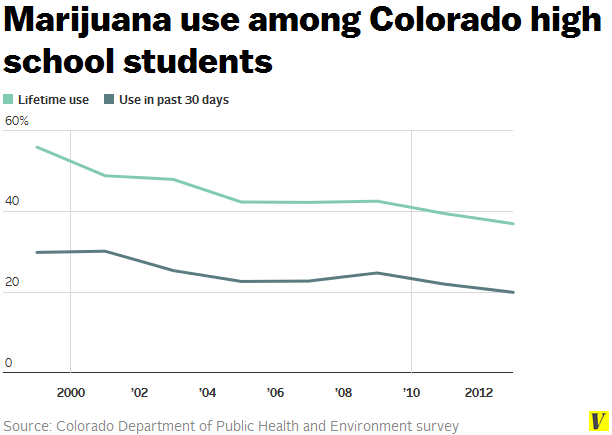
The legalization of marijuana in Colorado has coincided with fewer teens using the drug:
About 20 percent of teens surveyed by the Colorado Department of Public Health and Environment (CDPHE) said they had used marijuana in the past 30 days in 2013, down from 22 percent in 2011. The survey also found a decline in reported lifetime use, from 39 percent in 2011 to 37 percent in 2013. CDPHE said the declines were not statistically significant. But previous data suggests the drops are part of a longer-term trend that began even before Colorado voters approved the legalization of medical marijuana in 2000.
It is still possible, of course, that legal recreational sales, which began in Colorado only this year, will increase teenagers’ access to marijuana (not through direct sales but through diversion from adult buyers), which might lead to an increase in consumption. Colorado officials express a somewhat different concern. According to a press release from the health department, “Health experts worry that the normalization of marijuana use in Colorado could lead more young people to try it.” In other words, they worry that allowing adults to legally purchase marijuana for recreational use will encourage teenagers to take a more positive view of cannabis, which will make them more likely to use it. Call it the “permitted fruit” effect. Prohibitionists such as former drug czar Gil Kerlikowske raised the same complaint against medical marijuana laws, but their fears seem to have been misplaced.
I’ve long had my doubts on the question. What I doubt, to be clear, isn’t that some women are bisexual. Just that all women are, which is essentially what one is saying if one declares female sexuality fluid. I doubt this in part for personal-thus-anecdotal reasons (I’m female, and my orientation hasn’t budged since it first encountered photos of a then-young Keanu Reeves close to 20 years ago), but also because there are other explanations, not related to wiring, that could account for the appearance of fluidity one witnesses.
What it comes down to is, it remains much more controversial for men than women to have same-sex relationships or encounters. But at the same time, it’s much more taboo for women than men to be without a partner of the opposite sex.
This sounds contradictory, I realize, but let me explain: There’s a stigma, for women, on being boyfriend-less, husband-less. But the stigma isn’t based on fears that the woman might be a lesbian, but rather, that she might be unable to get a man. Being found desirable by men continues to be important to women’s power in the world in a way that’s independent of how attractive that woman may or not find these – or indeed any – men. There are also financial advantages to pairing off with someone of the gender that tends to earn more.
How does any of this relate to women’s alleged sexual fluidity? Men are under greater pressure than women to seem not-gay, so there’s less same-sex fooling around among the merely curious, or it’s less openly discussed, making male sexuality seem less fluid than might be the case. But men are under less pressure than women to pair off (and what pressure there is starts so much later in life), so there may be fewer gay men than lesbians in opposite-sex relationships.
I came up with this grand (and thus far mostly unsubstantiated) theory while listening to a recent Savage Lovecast. (Update: listen to the relevant clip below, sent to us by the tech-savvy at-risk youth:
A 25-year-old woman called the show (starts at 8:13) to say that she’s a serial monogamist who’s only ever dated men. But! She can’t stop thinking about women. She’s openly bisexual, has known this since she was 14, which her current boyfriend knows, but he doesn’t want an open relationship. And so on, but what jumped out at me was the part where she mentioned that “90% of the time” when she’s having sex with her boyfriend, she’s fantasizing about women. 90%!
Imagine, if you will, ladies, if you learned that your boyfriend or husband fantasized about men 90% of the time he was with you. You’d probably come to the conclusion that your guy was gay. Not because male bisexuality doesn’t exist, but because of how close 90% is to 100%.
Presumably Dan Savage would make this same assumption if the genders were reversed. He doesn’t. This is ostensibly because the caller identifies as bisexual, but may also have just a bit to do with the factthat she’s a woman, and women, so fluid! Savage, in his response, likens her persistent desire to be with women to kinks and fetishes people try to repress over the years (he mentions foot fetishes), and it’s like, gah, this woman is a lesbian! That’s not a kink, it’s a sexual orientation! This isn’t about monogamy being constraining (as much as Savage tried to fit it into that box), but about being with someone of the wrong gender posing certain fairly obvious obstacles to happiness. What this woman needs to do isn’t – as Savage advises – renegotiate her heterosexual relationship to allow for some women on the side. She needs to lose the boyfriend and get herself a girlfriend.
Why, then, is a lesbian dating dude after dude after dude? What comes through in her call isn’t the slightest glimmer of desire for her boyfriend (“I love him a lot” and “I really care about him” – sweet, but sort of tepid for “25” and “boyfriend”) or indeed any of the other men on the planet. She’s afraid of not being in a relationship with a man: “The thought of losing that someone I have thought about spending the rest of my life with is devastating.” She’s afraid of giving up the possibility of Husband. Which is… a totally legitimate fear in our society, but hardly evidence that she’s straight or bi.
If Savage’s alarm bells don’t go off at this call, perhaps it’s because he has been socialized to believe that female heterosexuality is this softer, more reactive version of its male counterpart. That it’s basically about wanting stability, a husband, a man who’ll find you attractive. No one expects women – even heterosexual women – to lust after men. (Many of us do. But we’re socialized to be discreet about it.) So it doesn’t immediately read as “lesbian” when a woman expresses intense interest in other women, but sounds sort of lukewarm about men.
Update: Phoebe responds to some criticism of her piece here.