2014: A Great Year For Jobs

Danielle Kurtzleben illustrates the ones we added last year:
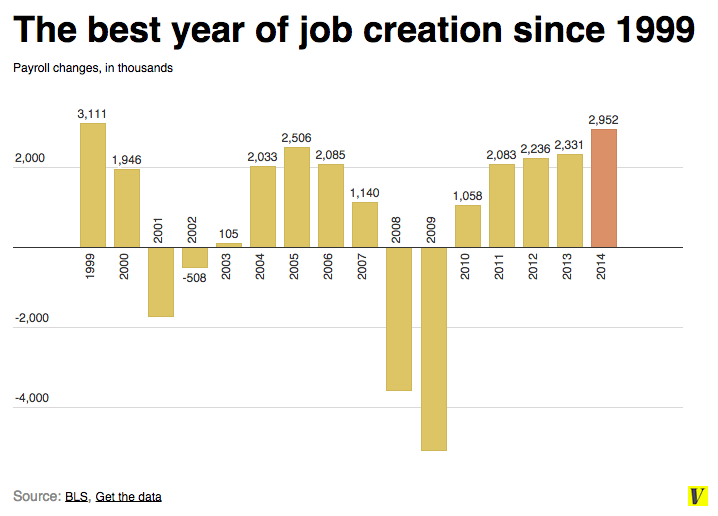
Job Creation

Chait expects this to transform politics:

The recovery is not complete — wages remain stubbornly suppressed — but this fact itself suggests an upside: The absence of higher pay is also the absence of any kind of inflationary pressure that might cause the Federal Reserve to apply the brakes to the recovery. This in turn suggests job growth is not finished. The 2016 elections could well take place against a backdrop of full employment. The entire predicate of the Republican argument since 2009 — that Obama’s massive expansion of spending, taxes, and regulation has snuffed out job creators’ incentive or ability to work their capitalistic magic — will be moot.

In 1996, the recovery was still embryonic enough that Bob Dole could lamely assert that Americans were suffering from “the Clinton crunch.” Four years later, George W. Bush had to acknowledge widespread prosperity, while casting himself as the ideological heir to Clinton’s moderate policies and running on “honor and dignity.” That is the sort of reversal currently under way.

Ben Casselman is more cautious:

It’s possible that the economy is poised for a breakout in 2015 and we just don’t know it. Average wages are a blunt measure, lumping together everyone from CEOs to fast-food workers, so it can be hard to pick up trends bubbling beneath the surface. There are at least a few individual sectors in which earnings are rising faster.

But after five years of dashed expectations, it’s probably wise to stay in a “show me” mind-set. The economy finally showed us job growth in 2014. For wages, though, we’ll have to wait to see what 2015 reveals.

Pethokoukis throws some cold water:

Some analysts think the next 12 months will show a big step-up in GDP and earnings growth, thanks in no small part to the 50% drop in oil prices. Citi just raised its projection for GDP growth by ½ percentage point to a robust 3.6% for 2015. We’ll see. As BTIG strategist Dan Green puts it, “The simple fact is we cannot consider an employment report a success, no matter how healthy the headline may be, if wage data does not begin to accelerate.”

Bloomberg View’s editors speculate that, “to some extent, the decline in global oil prices may be holding U.S. wages down”:

The average wage in mining and logging, a category that includes oil extraction, has fallen at an annualized rate of almost 5 percent during the past three months.

But McArdle sees the low oil prices as a major economic stimulus:

In 2009, economist James Hamilton suggested that most of the GDP loss in the Great Recession could be explained by looking at the very high price of oil that preceded it. A more recent paper from the Fed assigns a lesser role, but still a significant one.  The current confluence of strengthening jobs numbers and falling oil prices may suggest that they are right–not that jobs and GDP will fluctuate month to month along with the price of oil, but that positive and negative price shocks may also produce correspondingly positive and negative effects on our economy.

Neil Irwin digs further into the report:

One mild curiosity in the report is that the size of the labor force actually fell, with 273,000 people no longer either holding a job or looking for one. That may be a statistical aberration, but even over a longer period of time the steep drop in the labor force since 2008 has not reversed itself. It’s partly demographic, with more baby boomers nearing retirement age. But the wage numbers also suggest another reason: When employers are so reluctant to raise pay, it shouldn’t be shocking that more Americans choose to sit at home and remain out of the labor force.

Drum looks at the big picture:

Overall, this jobs report is decent news, but hardly great. Until we start to see steady employment growth and steady wage growth, the labor market still has a lot of slack no matter what the headline unemployment rate is. Given this, in addition to possible headwinds in the rest of the world, the Fed needs to continue to keep interest rates low for quite a while longer. It’s not yet time to tighten.
Who Won’t Republish Charlie’s Cartoons? Ctd

A reader makes a good point:

In general, I completely agree with the notion that the offending cartoons are newsworthy and should be published (I recently changed my Facebook photo to the “kissing a Muslim man” Charlie Hebdo cartoon precisely to make that point). But I do want to call attention to one major difference about out about the various media outlets that Christopher Massie refers to. “Legacy” organizations have journalists working on the ground throughout the world while newer digital outlets generally don’t. I wouldn’t be surprised if the primary factor in the decision not to publish those cartoons was protecting the safety of  reporters and safeguarding their ability to continue reporting from around the globe.

If BuzzFeed and Slate had journalists and photographers on their payroll working in Riyadh, Jakarta, or Damascus, I’m not convinced those organization would be so quick to reprint the offending images. It’s a heck of a lot easier to post a cartoon of a crying Mohammed when you’re in Manhattan than if you’re working for a news bureau in Cairo.

Update from a Dutch reader:

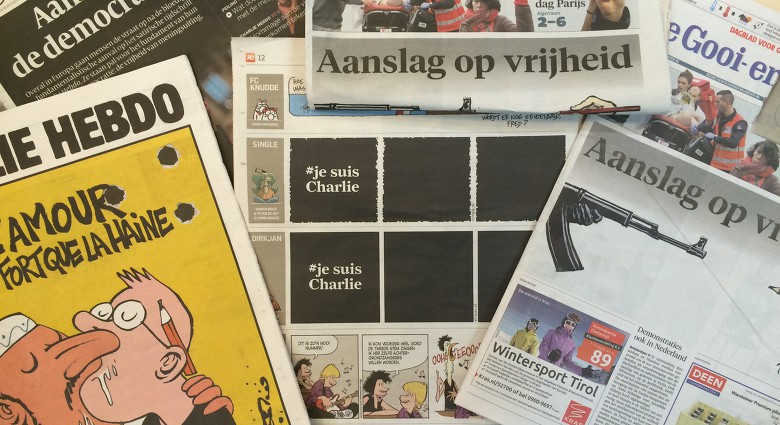
I have to call bullshit on that. Here are some Dutch front-pages from the day after:

dutch

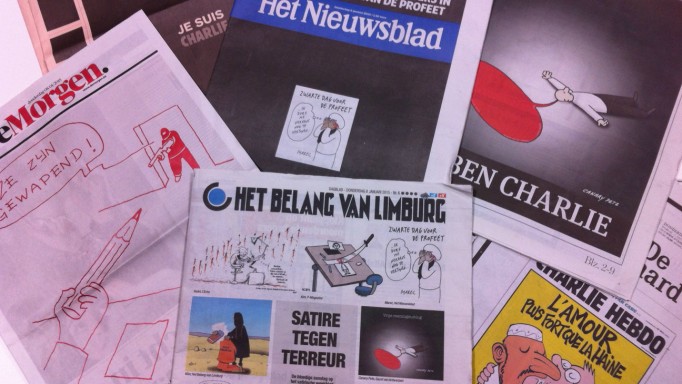
And Flemish front-pages:

flemish

So plenty of Dutch and Flemish newspapers had Charlie cartoons on their front-pages, and all had them inside. And from Germany:

german

And here’s a slideshow of other front-pages from around the world. You think those papers have no international correspondents?

Not publishing insulting religious cartoons is a typical American problem. I read a comment somewhere in the Dutch or Flemish media that suggested that since America is so much more religious than Europe, mockery of religion in general is a no-go area in the US. And that’s true. There is no serious mockery of religion in the US. Bill Maher may be the exception to that rule, and see how much crap he gets for it. The sharpest criticism of religion comes from Stephen Colbert, a devout Catholic himself.

Remember the mess when South Park wanted to show Muhammed in an episode? No-go, said Comedy Central.

Though Matt and Trey were able to get away with this crap-fest in lieu of Muhammed:

Another reader points to a notable exception in the US:

I hate to burst the first reader’s bubble about legacy new orgs, but Bloomberg News has reporters all over the world and in the places the reader mentioned, and it published every one of the “offensive” cartoons. Here’s the main one I’m thinking of, and other images have run with various stories Bloomberg writers have covered on different aspects of what’s going on.

And as we noted earlier, the WaPo did in fact publish a Charlie cover featuring Muhammed, in the opinion section. Money quote from Fred Hiatt:

I think seeing the cover will help readers understand what this is all about.

Precisely.

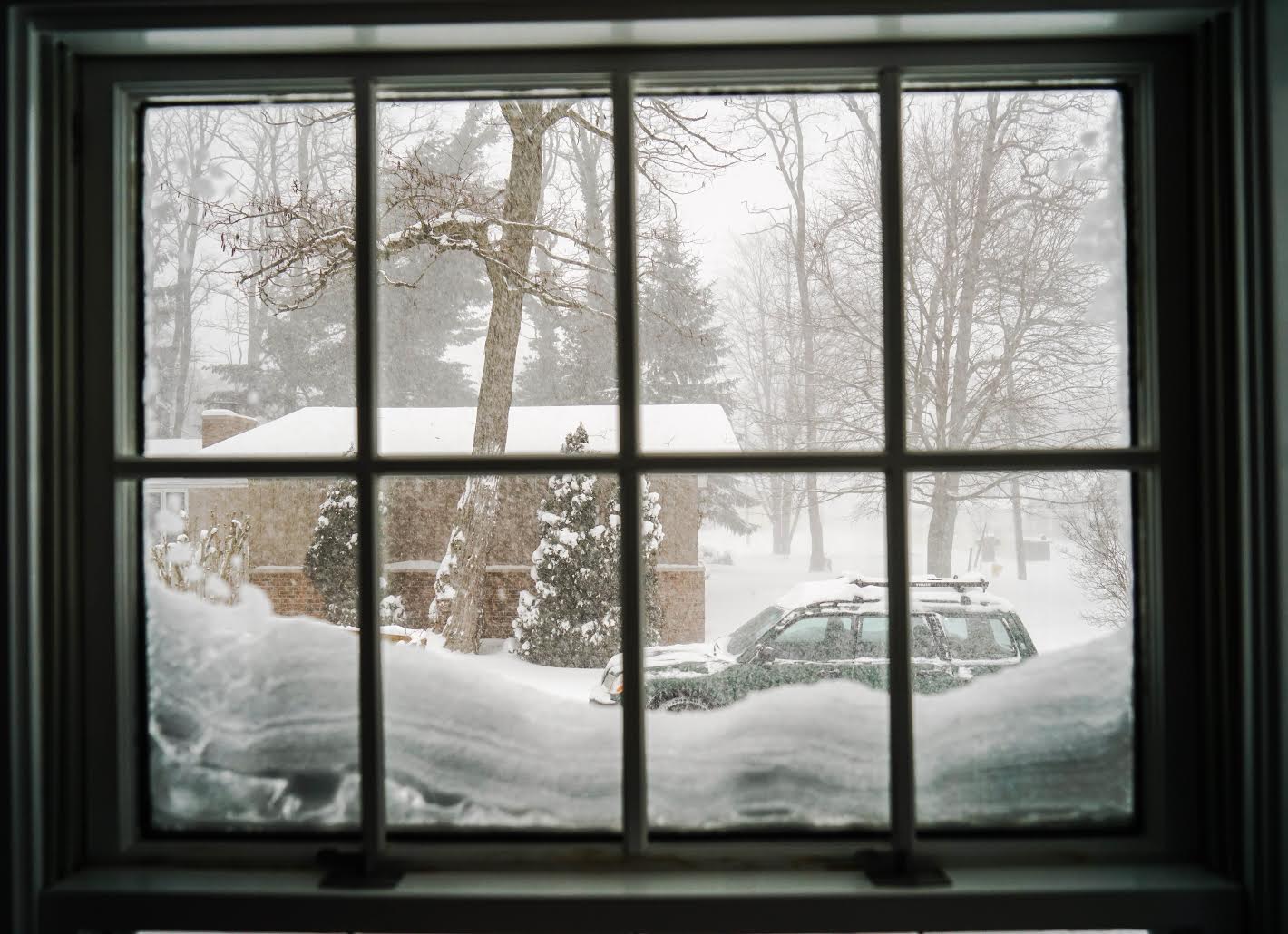
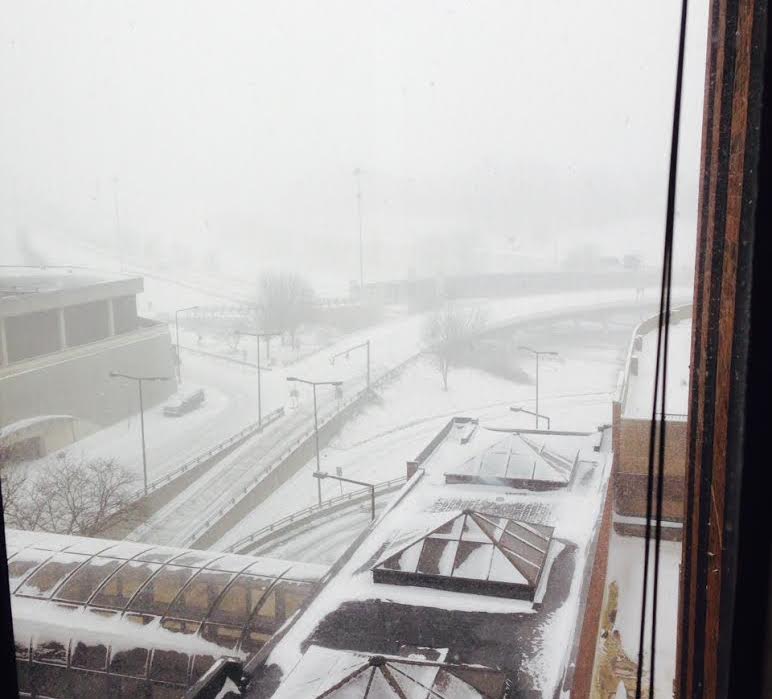
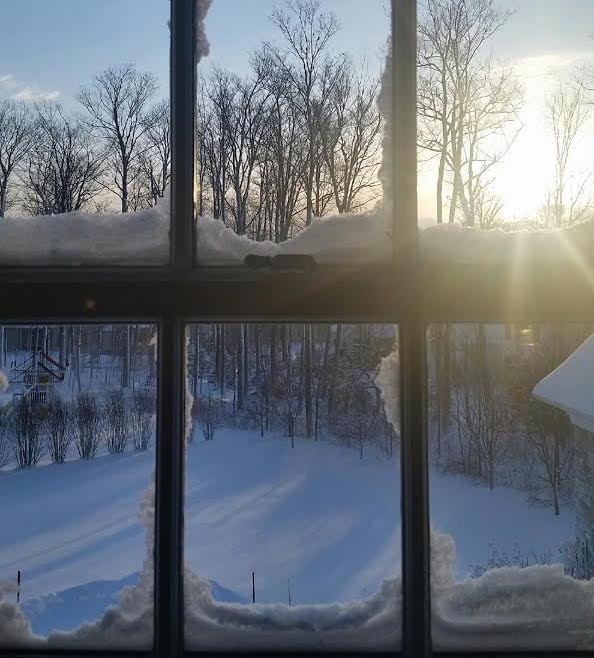
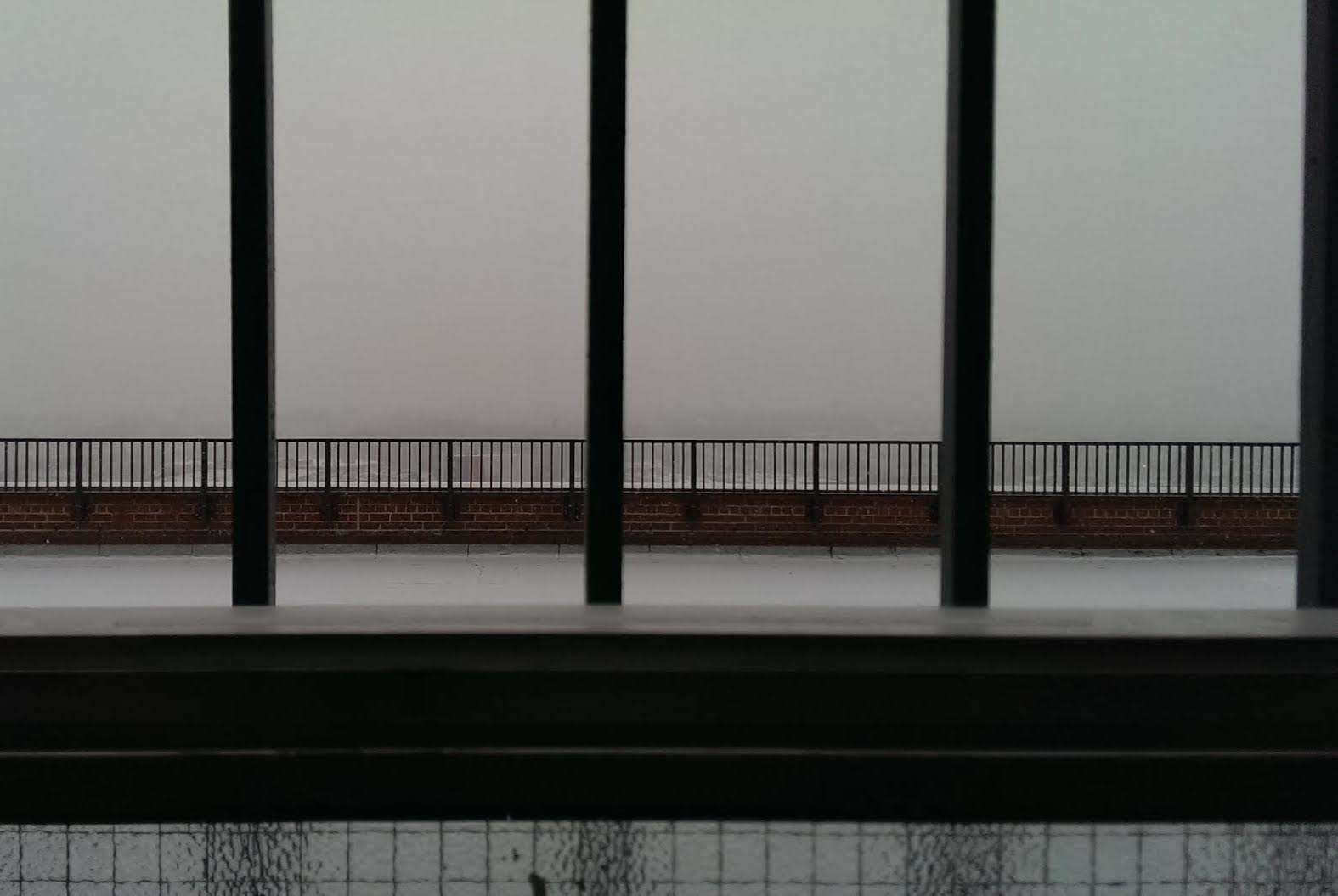
The View From Your Winter Freeze

Winnipeg, Manitoba at 2-50pm

Winnipeg, Manitoba, 2.50 pm.

Many more after the jump:

It's a blizzard in Norton Shores, Michigan.  About 4-45pm

“It’s a blizzard in Norton Shores, Michigan. About 4.45 pm”

Akron-OH-1242pm

Akron, Ohio, 12.42 pm

West Hartford, Ct, 4PM

West Hartford, Connecticut, 4 pm

Providence, RI-957am

Providence, Rhode Island, 9.57 am

buffalo-8am

Clarence, New York, 8 am

Essex Junction, Vermont 12.06 pm

Essex Junction, Vermont, 12.06 pm

Queens-901 AM

Queens, New York, 9.01 am

It's fucking cold today in New Haven, CT. It's pretty, like Siberia is pretty.

“It’s fucking cold today in New Haven, CT. It’s pretty, like Siberia is pretty.”

Update from a reader:

stop-whining

“It’s pretty, like Siberia is pretty.”

*snort*

Memo to the East Coast: Stop whining.

Another retorts:

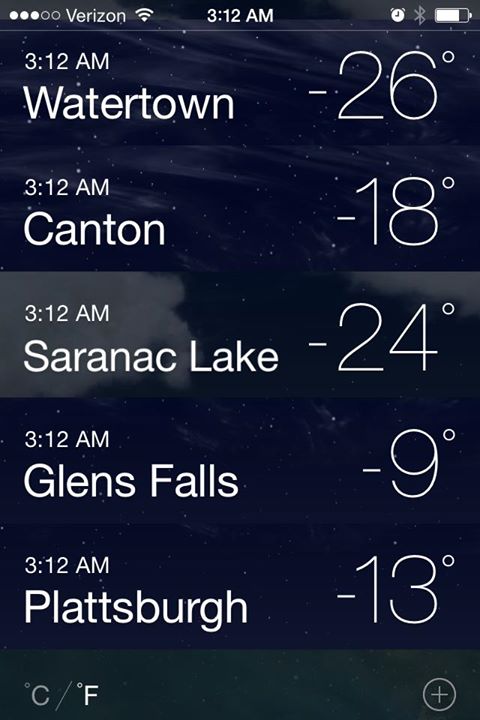
Proud New Yorker here – that would be the state, but not the city – and thus certifiable East Coaster. Am I supposed to be impressed that it’s 4°F in Wisconsin? Dude, yesterday it was -18°F in my hometown, and that was warm for the area:

NCPR-temps

Get a grip, Midwest.

PS — I hope Andrew feels better soon!

What Mike Huckabee Is Selling

Julie Bykowicz read his new book, which will be released later this month:

God, Guns, Grits and Gravy doesn’t get into many policy specifics; some of what Huckabee proposes he dubs “Redneck Remedies.” Like his head-shaking at Miley, his political views are hardly surprising: Obama is bad. Same-sex marriage is a sin. Guns save lives. Government is intended to be as local as possible. The IRS is a criminal enterprise. Climate change is probably hot air.  The “Get Off My Lawn” chapter wraps up with Huckabee boldly asserting that “part of the solution is better citizens obeying the laws we already have so we don’t have to pass new laws to further explain and expand the old ones.” Good luck with that.

David Catanese posts highlights from the book. He notes that Huckabee “devotes an entire chapter to same-sex nuptials, laying out his Biblical-based rationale for his position as well as raising several hypothetical scenarios about the future of the institution of marriage”:

He laments a court system that is forcing businesses to cater to gay weddings, even if violates their own religious beliefs. Given the current trend in judicial and public opinion, he floats the possibility of a future that expands marriage to more than two people.

“Shouldn’t a bisexual be able to have both a male and female spouse? Wouldn’t restricting that person access to both genders be denying the bisexual his or her marriage ‘equality?'”

Huckabee still fears the slide toward marriage equality is devaluing the entire tradition, but he also concedes that the true impact of gay marriage is unknown.

“When advocates of same-sex marriage say, ‘What’s the harm?’ the honest reply is that at this point, we simply don’t have enough reliable accumulated data to be able to say.”

That’s a considerable concession for such an unflinching figure at the helm of the culture war.

Brian Tashman instead concludes that “Huckabee has one message for his fiercely conservative base and a more nuanced message for a wider audience”:

Huckabee, of course, has repeatedly claimed in front of right-wing audiences that he knows exactly what will happen to society if same-sex marriages become legalized: divine punishment.

“There is no doubt in my mind that this country would not exist had it not been for the providential hand of God,” Huckabee said during his speech at the National Organization for Marriage’s June march against marriage equality in Washington D.C. [reordered] “And I’m also convinced that if we reject his hand of blessing, we will feel his hand of judgment.”

Olivia Nuzzi calls the book “an achievement in the genre of poorly written pandering”:

It is “not a recipe book for Southern cuisine, nor a collection of religious devotionals, nor a manual on how to properly load a semiautomatic shotgun.” Instead, “It’s a book about what’s commonly referred to as ‘flyover country.”

Clad in a blue, striped button-down, a silver watch adorning his left wrist, Huckabee beams on the cover. He stands, one assumes on a porch, which overlooks a prairie. “After you finish the book,” he writes, “you might just say, ‘Dang, those good ol’ boys ain’t so dumb after all.

In other Huckabee hucksterism, Andrew Kaczynski catches the candidate’s email list hawking a “secret biblical cancer cure”. Waldman face-palms:

Right now there’s a devout couple in their 80s who just found out that their 55-year-old daughter has cervical cancer. They’re terrified. They’d do anything to help her. And then they get an email from that nice Mike Huckabee, pointing them toward a miracle cure for cancer hidden right there in the Bible. It must be legit, because Mike Huckabee wouldn’t rope them into a scam. So they head right over to the web site, watch the video about the “Matthew 4 protocol” and the “frankincense extract,” then they send away for the free bonus gift of “The Bible’s Healing Code Revealed” which comes with a one-year subscription to Dr. Mark Stengler’s Health Revelations—half price if you’re a senior citizen!—and they whip out that credit card and start ordering all the supplements they can. They tell their daughter, with pain and fear in their voices, that this is what can cure her if only she’ll believe and they keep buying.

These are the people—gullible, afraid, at the most desperate point of their lives—that Mike Huckabee sees as marks just waiting to be scammed.

Les Limites De La Liberté

B60MfNeIgAAnudL-540x272

Judah Grunstein discusses how France’s conception of “free speech” differs from the more robust American version:

Both France and America make the sanctity of free speech a core principle. But at various times over the past 14 years that I have lived here in France, I have been called on by my American friends to “translate” just what the French mean by “free speech.” In particular, they have been perplexed by the willingness to place limits on speech and, relatedly, religious expression here. This first became visible in the context of the law against wearing veils in public schools and government buildings. More recently, it arose when the government banned the one-man show of the ostensible comic Dieudonné, due to offensive jokes about the Holocaust and gas chambers.

Put simply, in France, racist and anti-Semitic speech, as well as historical revisionism regarding the Holocaust, is illegal, as is all speech that can be considered an incitement to hate. That is something that very few Americans understand—or approve of.

Jonathan Laurence notes a crucial caveat to France’s hate-speech protections: they’re not extended to Muslims:

The last lawsuit to be filed against Charlie Hebdo in 2014 was declared ineligible only because Islam doesn’t qualify for the special legal regime that criminalizes blasphemy against Christianity and Judaism in the Alsace region. And the British Muslims in 1989 wanted authorities to invoke British blaspehemy laws, not the shar’ia, to sanction Salman Rushdie’s novel – but there too Islam did not qualify for protection.

Greenwald calls out hypocrisy among those defending Charlie Hebdo on the basis of free speech, and passes along some cartoons – of which the one above is the least offensive – that he suspects we would not be so quick to defend:

[I]t’s the opposite of surprising to see large numbers of westerners celebrating anti-Muslim jews_image081-540x702cartoons – not on free speech grounds but due to approval of the content. Defending free speech is always easy when you like the content of the ideas being targeted, or aren’t part of (or actively dislike) the group being maligned.

Indeed, it is self-evident that if a writer who specialized in overtly anti-black or anti-Semitic screeds had been murdered for their ideas, there would be no widespread calls to republish their trash in “solidarity” with their free speech rights. In fact, Douthat, Chait and Yglesias all took pains to expressly note that they were only calling for publication of such offensive ideas in the limited case where violence is threatened or perpetrated in response (by which they meant in practice, so far as I can tell: anti-Islam speech).

The Dish, of course, is an equal opportunity republisher of trash, as long as it’s relevant and newsworthy. In a sharp post, Sullum argues that France’s hate speech laws indirectly enabled Wednesday’s violence:

I am not saying yesterday’s massacre can be blamed on France’s hate speech laws. Although at least two of the perpetrators were born and raised in France, there is no evidence that they cared about the content of these statutes or that they needed any additional justification beyond their own understanding of Islam. But it is hypocritical and reckless for a government that claims to respect freedom of the press to criminalize images and words based on their emotional impact. Although such laws are defended in the name of diversity and tolerance, it is the opposite of enlightened to invite legal complaints aimed at suppressing offensive messages.

Instead of facilitating censorship by the sensitive, a government truly committed to open debate and freedom of speech would make it clear, in no uncertain terms, that offending Muslims (or any other religious group) is not a crime. Sacrilege may upset people, but it does not violate their rights. By abandoning that distinction, avowed defenders of Enlightenment values capitulate to the forces of darkness.

On the other hand, as Luke O’Neil notes, there’s plenty of free speech hypocrisy to be found right here in the USA:

[T]he self-professed most patriotic citizens in this country harp on our military’s presence in countries like Afghanistan and Iraq, insisting that, if not for these brave soldiers, the very foundation of our culture—our speech freedoms—would collapse overnight. Yet those who question the unwavering justness of any action by the American military are often invited to shut their mouths, or given directions to the nearest port of exit. It wasn’t that long ago that entertainers like the Dixie Chicks were being roundly denounced and taken off the air for having the temerity to question our country’s wars.

Nick Gillespie is sad to say that he “will not be surprised if the Charlie Hebdo massacre has the effect of increasing support for hate-speech laws in the United States “:

Many Americans who don’t particularly care about freedom of speech may look on the carnage and conclude it makes sense to avoid such scenes by stifling expression. Social Justice Warrior types will take another long look at Jeremy Waldron’s 2012 book, The Harm in Hate Speech, and gussy up their interest in controlling thought and social interactions with philosophical language and social-scientific “rigor.” Conservatives, sniffing out a possible way to screw liberals and libertarians, may rediscover The Weekly Standard’s case for censorship and decide, hell, it makes a lot of sense. Aren’t Christians the folks who are picked on in America and treated unfairly by the media and intellectuals? It’s always “Piss Christ” and never “Piss Mohammed,” right?

Which makes it more important not simply to show solidarity with the dead and wounded in France but to rehearse the arguments for unfettered trade in ideas and speech.

Update from a reader, who remarks on the cartoon seen at the top of the post, created by the anti-Semitic Carlos LaTuff:

This is a completely false equivalency, and really gets to the heart of the cultural gap at play. To secularists like the cartoonists at Charlie Hebdo, Mohammed is a man like any other, he is no prophet, he is aggrandized by a religion, and is therefore a legitimate target of satire, just like the the Pope, or Jesus, or even the Dalai Lama if one is so inclined. The Holocaust was systematic genocide based on religion/ethnicity. I’m not saying that jokes against the Holocaust should be off limits, there should be no limits.

A better choice would be a “Cartoons of Jesus, or Moses, or John the Baptist” in the place of the “Cartoons of Holocaust.” (If you did, you would be as likely to find the Westerner laughing at both. Unless it is Bill Donahue, who is incapable of laughter.) You simply cannot equate the murder of millions to making fun of a religious figure. One is a group of real human beings. The other is an idealized version of a person who claimed God spoke to him in a cave.

The reason for drawing Mohammed is less about a specific set of religious beliefs, it is about, (forgive me), forbidden fruit. Don’t tell me not to take a taste of that apple, or draw that picture. There is something wonderfully defiant in the human spirit when told we cannot have, or do something. I’m grateful to the cartoonists who were killed for having that spirit, and expressing it.

Slaughtered For Satire, Ctd

Several more readers sound off on the tragedy at Charlie Hebdo:

Your reader offers up a rather boilerplate “liberal” or “Ben Affleckian” response to a terrorist attack: the reasons the perpetrators gave for the attack are not the “real” reasons for it, but enhanced-15542-1420644588-9rather lack of education, poor treatment, alienation, etc.  While I do believe that these factors can play a role in radicalization, they do not explain the attack on Charlie Hebdo.  In fact, while claiming to be searching for “the whole story” or at least “the central one,” your reader fails to recognize the predominate and most obvious cause of the horrendous attack: religious dogma.

In fact, the reader seems to go out of his way to avoid mentioning religion at all.  He characterizes the cartoons (or other’s hypothetical opinions of the cartoons) as “racist slurs” (Islam is not a race) and the attack itself as “political violence.”  Now, Islamism, like all theocracy, is indeed partly political.  But it is also religious.  If this were political violence, why wasn’t the target political?  If the cause was poor education, strict immigration policies, and under representation in government, why not target a school or a government building?

No, this act of terror was religious violence.

The gunmen shouted “God is great” as they murdered journalists and artists.  They did so because their religious dogma states that anyone who insults or depicts the prophet Muhammad deserves death.  Islamists do not seem to mind free speech when that speech is used to disparage Christians, Jews, gays, or other infidels.  They only mind when someone breaks the rules of their religious dogma.  Any attempt to frame the whole story, or the central story, of the Charlie Hebdo attacks which does not mention religious dogma is inane, hypocritical, and self-defeating.

Another reader:

I have seen some of Charlie Hebdo‘s cartoons over the years and found some of them amusing, some of them repulsive. More than a few of them I’ve found out-and-out racist, and worse. I’ve thought they were racist against precisely people who, in French society, are the down-and-out, the outcast. It’s the kind of satire which I think can be ugly because it targets not the powerful, but the powerless. On balance, I don’t particularly care for Charlie Hebdo.

But I was reading about the people killed, and in particular the cartoonists, and I found myself weeping for a style, a tradition, a discourse: for human people murdered before they were done exploring what it means to live, to love, to laugh. I haven’t liked their cartoons, not always. But they have a style their own. A rhythm their own. A life their own. They are art in a tradition, a tradition whose contributors will now never contribute again to its growth, its development. People grow up. I grew up in the South and occasionally said or did things which were racist, and worse. I sometimes targeted the powerless, not the powerful. And I am thankful I have yet to be murdered for it, thankful that I had a chance to try again, to be again, to live again, to speak again.

To murder for free expression, even repugnant free expression, is irreligious blasphemy. It denies the person who you think is atrocious, the person who you think is abhorrent, the person who you think is blasphemous, and it denies them the opportunity for redemption. If you believe that God will stand at the end of time in judgment on all humanity, you owe your fellow human beings the chance to redeem themselves in the arc of time, in the arc of their life, to live to a ripe old age, to have a million moments, a million chances, to redeem where they have fallen short. You owe it to them. If your religion demands you kill, then you worship a weak God indeed, a God who has no business standing in judgment over anyone.

Along those lines, another reader highlights “a hadith (saying of the Prophet (p.b.u.h)) narrated by Abu Hurayrah”:

I heard the Apostle of Allah (p.b.u.h) say – “There were two men among the Banu Isra’il (the Jews) who were striving for the same goal.  One of them would commit sin and the other would strive to do his best in the world.  The man who exerted himself in worship continued to see the other in sin.  He would say to the other “refrain from it”.  One day he found him sinning and again said to him “refrain from it”.  The other responded – “Leave me alone with my Lord.  Have you been sent as a watchman over me?”.  The one who exerted himself in worship replied – “I swear by Allah, Allah will not forgive you, nor will He admit you to paradise”.

Then their souls were taken back (they died) and they met together with the Lord of the Worlds. Allah said to the man who had striven hard in worship – “Had you knowledge about Me or power over that which I had in My hand?” Allah said to the man who sinned – “go and enter paradise by My mercy.” He said about the other “Take him to hell”.

Abu Hurayrah said – “By Him in Whose hand my soul is, he (the man who exerted himself in worship) spoke a word (when he judged his partner to be hell bound) by which this world and the next world of his were destroyed.”

The Kouachi brothers judged the staff of Charlie Hebdo without knowing anything about what was truly in their hearts.  Perhaps if they understood their faith a little better, if they knew the above hadith, they would not have been moved to barbarism and murder of a magazine staff that never actually physically harmed a muslim, or prevented muslims from practicing their faith.  If Charlie Hebdo‘s publications offended them, perhaps they should have heeded their Quran:

“The true servants of the Merciful One are those who walk on the earth gently, and when the foolish ones address them, they simply say “peace be to you”” (Surah Al-Furqan; verse #63)

“Repel evil with that which is better and then the one who is hostile to you will become as a devoted friend” (Surah Fussilat; verse #34)

I am not saying the staff of Charlie Hebdo was foolish or evil, just pointing out that if the Kouachi brothers felt they were, their faith provided them with a radically different way to deal with them than the one they chose … a choice which led to the murder of twelve innocent people including a muslim (Ahmed Merabet – the cop they so casually shot in the head).

As Michel Houellebecq said in the Paris Review interview you linked to yesterday: “the most obvious conclusion is that jihadists are bad muslims”.

Malkin Award Nominee

https://twitter.com/EWErickson/status/553593617856868353

Update from a reader:

Erickson’s recommendation is doubly offensive (and doubly dumb) considering that he’s actually repurposing a trope of old-timey anti-semitism. As Zaid Jilani points out here, using pork products to taunt those who don’t eat them has been a staple of Jew-baiting in Europe for centuries:

In the book Anti-Semitic Stereotypes: A Paradigm of Otherness in English Popular Culture, 1660-1830, the author notes that English schoolboys would taunt Jews with a chant, “Get a bit of pork/Stick it on a fork/And give it to a Jew boy, a Jew.” In German culture, there was a popular concept of the “Judensau,” depicting Jews suckling from a pig; the bigoted imagery was so common it was even placed on churches to keep Jews away. Pope Leo VII called Jews “pigs,” and during the Inquisition, the  Spanish Jews were actually called “marrano” referring to a one-year old pig.

I wonder if Erickson realizes just what tradition he’s drawing on here. I suspect not.

Who Won’t Republish Charlie‘s Cartoons? Ctd

Dan Savage takes aim at another cowardly outlet:

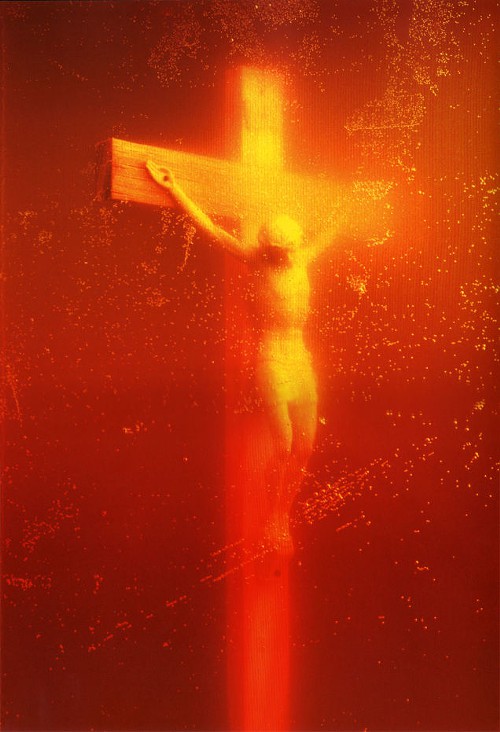
I was thinking about how afraid everyone is when I heard the Associated Press had yanked all images of Andres Serrano’s 1987 work Piss Christ from their website and archives. Before we knew how many people had died in the attack yesterday—before we learned that one of the victims (the one shown on the cover of the New York Times) was a Muslim cop—right-wing news outlets, bloggers, and Twitterers were condemning the AP’s supposed hypocrisy and anti-Christian bigotry. Slate:

The Associated Press is among the numerous news outlets that have been self-censoring images of the Charlie Hebdo cartoons that may have provoked 1420766951-pisschristasWednesday’s deadly Paris attack. In a statement, the news organization said that such censorship is standard policy: “None of the images distributed by AP showed cartoons of the Prophet Muhammad. It’s been our policy for years that we refrain from moving deliberately provocative images.” The conservative Washington Examiner publication then pointed out that the AP nonetheless continued to carry an image of Andres Serrano’s 1987 “Piss Christ” photograph—which is certainly provocative, having been the subject of massive controversy in the United States, and which was actually vandalized by Catholic protesters when it was on display in 2011 in, as it happens, France.

All images of Piss Christ have since been scrubbed from AP’s website—they’re all gone, including legitimately newsworthy photos of a vandalized Piss Christ. In an attempt to explain the memoryholing of Piss Christ, the AP says they’ve “revised and reviewed our policies since 1989.” The implication: Piss Christ should’ve been removed from the AP’s website years ago and its presence until yesterday afternoon was an oversight. (Perhaps the AP will send the Washington Examiner a thank-you note for bringing this matter to their attention.) The AP’s explanation is complete and total bullshit. They didn’t pull down those images of Piss Christ because they were “deliberately provocative.” The AP pulled them down because they’re afraid.

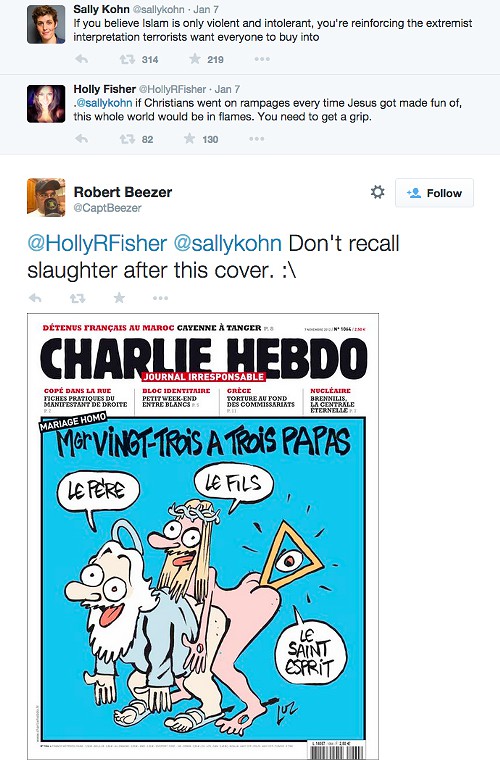
Here’s what the AP should’ve said to Christian conservatives screaming about Piss Christ and double standards: “Yeah, we blurred out those Charlie Hebdo cartoons because we’re afraid of them. We didn’t do the same to Piss Christ because we’re not afraid of you.” [That’s] something that Christians, conservative and otherwise, should be proud of. … Here are two (Holly and Robert) boasting yesterday:

1420763045-dontrecallcharlieimage

Christian conservatives want to have it both ways: They want credit for not reacting violently when their sacred symbols, holy texts, imaginary friends, etc. are mocked while also wanting the same deference—the same kid-glove, blurred-image treatment—that violent Muslim extremists have “won” for their sacred symbols, holy texts, imaginary friends, etc. But you can’t have it both ways. You can’t claim to be better than “they” are because you can take a joke while at the same time demanding that people stop joking about you. You can’t hold up their attempts to eradicate art (and artists) that offend them as proof that they’re hopelessly backwards while at the same time demanding the disappearance of art (and artists) that offend you.

Update from a reader:

I just read your item on the Washington Post censoring the Charlie Hedbo images as offensive. It is odd to me that they would strike them from the web, because they definitely printed the images in the print version of the paper. I wish I could show you an image, but I only know this because my husband noted it as he was throwing the dead tree version of the Post into our fireplace. Because it is cold. But here is an article on it (also still on the Post site): “Washington Post opinions section publishes controversial Charlie Hebdo cartoon“.

Ambinder’s take on the free speech question:

1. The attack ought to be connected to Islam, or religion, but not to Muslims. We cannot be afraid to criticize and even ridicule beliefs we find to be harmful and absurd. But neither is it humane nor in the interest of Europe, to indict the people who at worst have committed a thought crime and who at best can be persuaded to disregard that belief, just like practicing Christians and Jews (and even Bill Donohue, who doesn’t incite violence) have in the U.S.

2. Free speech has consequences. Saying it doesn’t is magical — it presupposes that there is some universal law which holds that good things will always happen when people are given license to speak their minds. Not always. But censoring political, symbolic, and religious speech, or trying not to offend anyone often have worse consequences. Censoring enfeebles our minds. Avoiding controversy removes the edge from humor. Protecting people from cartoons concedes sacred ground to much more harmful beliefs and practices.

Let the ink flow.

The Endgame In France

Early reports had suggested that all the hostages had escaped unscathed, which appears not to be the case.

The Plan To Make Community College Free

Obama wants the government to cover the first two years:

Suzy Khimm relays the basics:

To qualify for the program, “students must attend community college at least half-time, maintain a 2.5 GPA, and make steady progress toward completing their program,” the White House said. The administration estimates that the program would help about 9 million students, saving the average full-time student about $3,800 per year.

Leonhardt thinks it’s “worth acknowledging the potential impact of the plan — which is huge”:

Battles over health care, immigration, gun control and other issues may attract more attention. But both history and economics suggest that nothing may have a greater effect on the future of living standards than education policy. Even if a federal program doesn’t pass, the growth of state and local programs — like Chicago’s and Tennessee’s — have a large economic effect.

Reihan isn’t so sure:

I agree that education policy is very important, but unfortunately Leonhardt’s analysis tells us very little about the merits of this particular proposal.

The College Board collects data on trends in college pricing, and Texas A&M economist Jonathan Meer kindly pointed me to their recent work on net prices — that is, net tuition and fees after grant aid — for students attending public institutions, including community colleges. It turns out that in 2011–12, “net tuition and fees at public two–year colleges ranged from $0 for students in the lower half of the income distribution to $2,051 for the highest-income group.” That is, net tuition and fees were $0 for students from households earning $60,000 or less while it was $2,051 for students from households earning over $106,000.

While I don’t doubt that many households in the $106,000-plus range will welcome not having to pay for their children’s community college education, I’m hard-pressed to see why this initiative will have a “huge” impact, given that we’re presumably most concerned about improving community college access for students from disadvantaged backgrounds.

Tim Worstall focuses on “the problem that perhaps some education is in fact just signalling”:

To give an example: back 40 years, just before my university going days, in my native UK some 10% of the population actually went to one. The US attendance rate was very much higher (it expanded well before the UK’s rate did). And in the US at that time it was usual that you must have a BA (or BSc) to get anywhere at all in a professional job of any kind. While an MA (or MSc) was considered to be the minimum to really mark you out as being in the top set academically. At that same time in the UK the simple BA still marked you out as being in that top set (and entry into most professions, including lawyer, accountant and so on, was still possible without a degree at all in anything). As UK university admittance has expanded we’re now much closer to that US model. A mere BA, when 30-40% of the age cohort has one, doesn’t mark you out as anything special. So, that top set go on to do a masters now. And there’s not much evidence that anyone knows any more than they did, or that productivity has increased as a result of the extra years of education. We seem just to be embroiled in a signalling race to no very good purpose.

Margaret Hartmann takes note that the “program would have to be approved by the Republican-controlled Congress, which has rejected three Obama proposals aimed at expanding community-college programs”:

And the GOP has already noted that it’s unclear how this program would be funded. The White House said the federal government would cover 75 percent of the cost, and participating states would make up the rest. A source told Bloomberg News that the program would cost $5 billion, and experts suggested it could be more like tens of billions of dollars. “With no details or information on the cost, this seems more like a talking point than a plan,” said Cory Fritz, House Speaker John Boehner’s press secretary.

Ed Morrissey sees the proposal as purely political:

This doesn’t have a prayer of getting passed in this Congress, and he knows it. It’s merely a construct to Show Obama Cares About You, while at the same time gives the media another Republicans Are Just Flint-Hearted Meanies narrative to push.

Sargent admits that Obama’s plan will “will run into a wall of GOP opposition.” But he thinks it raises another question:

How far can Obama go unilaterally to address the deep problems afflicting working and middle class Americans, such as stalled mobility and declining wages? Obama appears to be getting serious about testing the limits of his office on this front. But there is one area where unilateral action could perhaps have more of an impact on wages than any other: The coming battle over overtime pay.