More Hostages In France

And it appears that the situation in Dammartin-En-Goele may be intensifying:

Nico Hines explains the newest crisis in Paris, which conflicting reports indicate may have led to two more deaths:

Twenty miles south [of where the Kouachi brothers have been cornered], in the east of the city, new-french-suspects-edit at least one gunman is believed to have taken six hostages at a Jewish store. Police suspect that the third gunman is the same man who shot and killed a policewoman on Thursday morning before escaping in a bullet-proof vest.
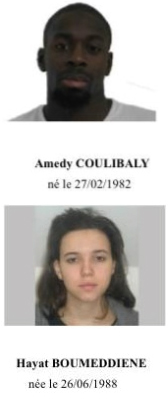
Parisian police have released a photograph of the suspect, Amedy Coulibaly, 32, who was a member of the same local terror network as the Kouachi brothers. They believe a 26-year-old woman was involved in the attack on the policewoman, it is not known if Hayat Boumeddiene is also helping her former partner stage the attack on the supermarket.

Hines also sums up the news, out last night, that the older Kouachi brother was possibly trained by the Yemeni branch of al Qaeda:

A senior U.S. intelligence official told The New York Times that Saïd Kouachi, the older brother, spent several months in Yemen in 2011, where he received small-arms and marksmanship training from al Qaeda in the Arabian Peninsula, one of the most feared al Qaeda affiliates.

Joshua Keating comments:

If AQAP was involved, even indirectly, in Wednesday’s attack, it would be the group’s biggest success outside the Middle East in quite a while. And coming at a time when international attention has shifted to al-Qaida’s hostile erstwhile allies ISIS—with that group’s leader, Abu Bakr al-Baghdadi,directly challenging Zawahiri’s leadership of the international jihadist movement—it’s a sign that al-Qaida is still far from contained.

You can watch a livestream of crisis coverage here:

The Greatest Threats To Mankind

Lost Years

Charles Kenny urges us to focus on fighting disease:

The WHO data suggest that on the whole, all forms of violence are a minor cause of death—accounting for just 1.2 percent of all deaths worldwide in 2000 and 1.1 percent of all deaths in 2012. Kidney diseases, liver cancer, suicide, and unintentional falls each killed more people than violence against others in 2012. Heart disease and stroke each killed more than 10 times as many.

… The past 12 years suggests how rapidly we can make progress if we focus on the biggest causes of tragically premature deaths worldwide—first among which are infectious diseases. Measles alone killed 499,000 children under the age of five in 2000. That dropped by four-fifths, to just 101,000 children, in 2012. This success story is underappreciated. A Web search for news stories suggests 80 times the coverage of terrorism and terror than of measles. And doubtless that’s one factor why the U.S. has spent about $1.6 trillion on the global war on terror from 2001 to 2014 compared with less than one-thousandth that amount on rolling out vaccines worldwide through the Global Alliance for Vaccines & Immunizations.

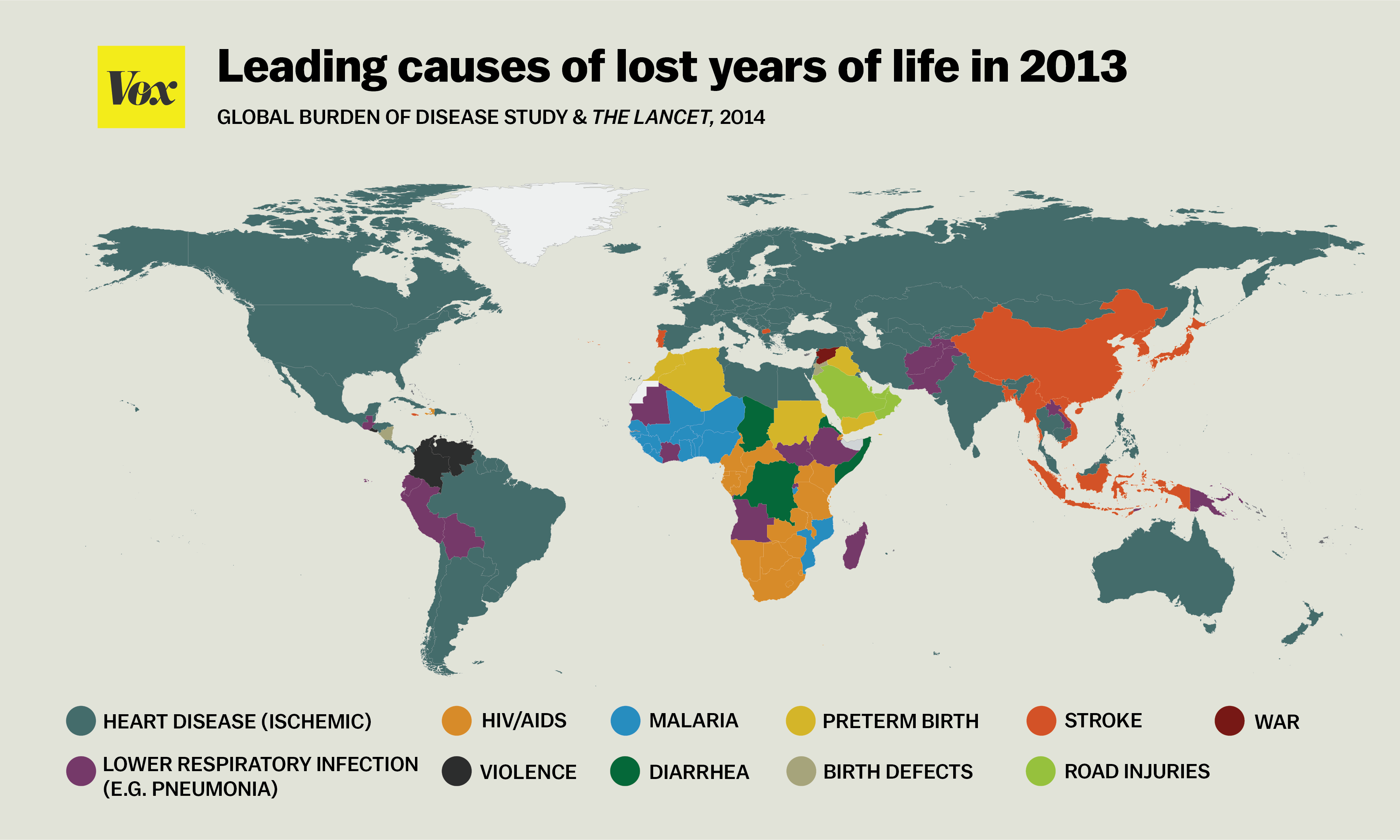
With the above chart, Dylan Matthews illustrates “the leading cause of lost years of life by country”:

It’s worth stressing that “cause of lost years of life” and “cause of death” aren’t identical. For example, deaths from preterm births may cause more lost years of life in a country than deaths from heart disease even if heart disease is the leading cause of death. Deaths from preterm births amount to many decades of lost life, whereas heart disease tends to develop much later on.

The Poor Aren’t Big On Voting

This class bias is a persistent feature of American voting: A study of 40 years of state-level data finds no instance in which there was not a class bias in the electorate favoring the rich—in other words, no instance in which poorer people in general turned out in higher rates than the rich. That being said, class bias has increased since 1988, just as wide gaps have opened up between the opinions of non-voters and those of voters.

Beware Of Nazi Cows

They’re mean bastards:

This particular breed dates back to the 1920s, when German zoologists and brothers Heinz and Lutz Heck, recruited by the Nazis, began a program to resurrect extinct wild species by cross-breeding various domestic descendants — an effort typically referred to as “back breeding.” Among their success stories was the half-ton Heck cattle, a reasonable facsimile of the hearty and Herculean auroch cattle that dated back some 2 million years prior and has roamed en masse all over Germany centuries prior.

The back-breeding program reflected the dual Nazi obsession with eugenics and nostalgia; the wild ancestry of the auroch reflected a time of “biological unity” before civilization softened and “uglified” man and beast alike. And in fact, the program’s research patron, one Hermann Goring, sought to preserve biological unity not only by resurrecting extinct species, but by restoring them to their original habitats; thus his plan was to return the aurochs to the primeval Białowieża forest.

Is anyone really surprised that the cows turned out to be murderously dangerous?

To wit, English farmer Derek Gow, the only owner of Heck cattle in his country, was forced to slaughter half of his herd this week because they were getting far too aggressive:

“I’m not sure how appealing Third Reich sausages would be,” he joked. “But they are very tasty.”

Update from a reader:

Please PLEASE tell me you saw Aasif Mandvi’s bit about “Nazi Cows”. You cannot mention this story without mentioning this bit. It’s classic TDS.

Closing In On The Kouachis

https://twitter.com/nffc82/status/553476183124606977

Capitulation Of The Day

[Re-posted and updated from earlier today]

A reader spots an “interesting bit of irony”:

The Washington Post article that criticizes Donohue’s ridiculous comments about Charlie Hebdo and the idea that offensive speech ought to be censored contains this cowardly disclaimer:

Editor’s note: An earlier version of this article included images offensive to various religious groups that did not meet the Post’s standards, and should not have been published. They have been removed.

If any reader knows exactly what images they removed, let us know and we’ll post them here. Update:

I saw the WaPo story before the images were pulled down they were exclusively images aimed at insulting Catholics and Jews. I left a comment asking why they weren’t also running the images aimed at insulting Muslims – i.e., the images that were particularly newsworthy. Awhile later all of the images were taken down. Definitely not my intent in making the comment. I just thought it was hypocritical to run one set of cartoons and not the other.  Here are a couple of the images I remember seeing before they were pulled:

hebdo-covers

Another reader:

The CBC has also refused to air the cartoons. Here’s the internal memorandum courtesy web journalist Jesse Brown:

Blogger Down, Aisle 3

[Re-posted from earlier today]

Just a note to apologize for my absence from the blog since a little after Christmas. I got the flu pretty bad (yes, like most HIVers, I got the shot) and haven’t been mobile now for ten days. I’m waiting on blood-work results to make sure nothing else is going on, and feel a little better today. So with any luck, I should be back blogging very soon. My deepest thanks, as always, to the Dish team for making my absence so worryingly hard to discern. And my deepest condolences to the people of Paris and France. Nous sommes Charlie aussi.

The Urgency Of Blasphemy

https://twitter.com/shashj/statuses/553202822662356992

In the wake of the terror attack on Charlie Hebdo, Douthat stands up for blasphemy:

[T]he kind of blasphemy that Charlie Hebdo engaged in had deadly consequences, as everyone knew it could … and that kind of blasphemy is precisely the kind that needs to be defended, because it’s the kind that clearly serves a free society’s greater good. If a large enough group of someones is willing to kill you for saying something, then it’s something that almost certainly needs to be said, because otherwise the violent have veto power over liberal civilization, and when that scenario obtains it isn’t really a liberal civilization any more.

Again, liberalism doesn’t depend on everyone offending everyone else all the time, and it’s okay to prefer a society where offense for its own sake is limited rather than pervasive. But when offenses are policed by murder, that’s when we need more of them, not less, because the murderers cannot be allowed for a single moment to think that their strategy can succeed.

Saletan refuses to pretend that the hyper-sensitivity to religious mockery that motivated this attack isn’t specific to Islam:

Islamic moderates who protest these caricatures are undercut by Islamic radicals. Charlie Hebdo insults all religions. Its current issue mockingly questions the existence of Jesus. But Christians haven’t responded with bullets.

Three years ago, after Charlie Hebdo’s office was bombed, its editorial director, Stéphane Charbonnier, pointed out that the magazine was “provocative on many subjects. It just so happens that every time we deal with radical Islam … we get indignant or violent reactions.”

Now Charbonnier is dead. The problem isn’t just the violence. It’s the celebration from other quarters of the Muslim world. On social media, there are comments celebrating Wednesday’s “blessed” attack and telling the killers, “You pleased our hearts.” There are congratulations to the terrorists for shouting “God is great” and striking “a paper known for its abuse of Islam.”

But Sarah Harvard stresses that Islamic doctrine doesn’t actually condone killing those who create offensive images of the prophet:

So what does Islam say about depictions that are not in a positive light? Islam’s most poignant instance of aniconism came when the Prophet Mohammed returned to the city of Mecca in 630 AD. After years fleeing from persecution, Mohammed and his followers had marched back to Mecca to rid idol worshiping from the holy city. According to the critically acclaimed book Muhammad: His Life Based on the Earliest Sources, upon entering the most sacred point in Islam’s most sacred mosque, Mohammed destroyed all the pagan idols and paintings that were sacrilegious to Islam. (He specifically guarded images of the Virgin Mary and Jesus.) Mohammed didn’t seek out the creators of the images or sentence those responsible for the idols and sacrilegious depictions to death.

Historically, Razib Khan argues, the Islamic radicals’ views of blasphemy are far closer to the norm than our modern, somewhat radical attitudes toward free speech in the US:

[T]he behavior of Islamic radicals is definitely not beyond comprehension. Rather, it is totally explicable, and in many societies and times would be entirely normal and healthy behavior. Attacking the religion of the folk is understood to be synonymous with attacking the folk. That is why Thomas Jefferson had to elucidate his views on religion in the first place, they did not come naturally to people in the 18th century. They had to be inculcated over generations. Even if Islamic radicals in the West prey upon the marginalized, they reflect ancient and primal methods of social outrage and sanction. What you see here is the reality of living in a multicultural world where there is no a harmony of values and norms, and free movement of individuals who don’t necessarily subscribe to the social viewpoints of the lands in which they settle.

To Michael Brendan Dougherty, the incident illustrates how modern secularism is not only a Western idea, but a Christian one:

We used to say of comedians, “He can make that joke because he’s Jewish.” In this respect, the Western world’s comfort with attacking Christianity is an inadvertent admission that Christianity is “our” religion. And so it elicits from us none of the respect, deference, or fear we give to strangers. Viewed this way, secularism looks less like universal principle than a moral and theological critique derived from Christian sources and pitched back at Christian authorities.

The great irony of Islam’s continued clashes with the Western way of life — whether its widespread riots over a YouTube video or the murderous actions of a crazed minority— is that it has revealed, to the surprise of everyone but Pope Emeritus Benedict, that modern secularism is a kind of epiphenomenon of Christendom.

Post-Post-Modern Lit

Jonathon Sturgeon hails the rise of “autofiction,” where autobiography and fiction blur and “the self is considered a living thing composed of fictions”:

knausgaardboyhoodislandWhat’s happening is that new novels — like … 10:04, The Wallcreeper, and My Struggle — are redistributing the relation between the self and fiction. Fiction is no longer seen as “false” or “lies” or “make-believe.” Instead it is more like Kenneth Burke’s definition of literature as “equipment for living.” Fiction includes the narratives we tell ourselves, and the stories we’re told, on the path between birth and death.

Nor is the infamous postmodern “pastiche” anywhere to be found in [last] year’s crop of autofictional novels. These authors have rejected the old patchwork of genres and styles and myths primarily because the life of the author is now the novel’s organizing principle. And life, drained of religiosity, often leads to questions of the body and its environment. It’s not surprising, then, that Zink’s The Wallcreeper concerns, in part, environmental terrorism, or that Lerner’s 10:04 frequently considers the impact of ecological disaster. And Lerner himself suggests that Knausgaard’s My Struggle “isn’t a story so much as an immersive environment.”

No, autofiction isn’t new. It could even be argued that it’s as old as literature itself, especially if you consider something like Hesiod’s Works and Days an autofiction. But it’s clear that what previously defined (most) autofictional novels was the tension between the real and the unreal, the “made up” and the “truthful.” (And this perhaps why critics can’t seem to let this debate go.) The new class of autofictions, on the other hand, having passed through modernism’s Joycean and Proustian portraits of artists, as well as the defiant relativism of postmodernism and post-structuralist theory, eschews the entire truth vs. fiction debate in favor of the question of how to live or how to create.

Sighting Elvis

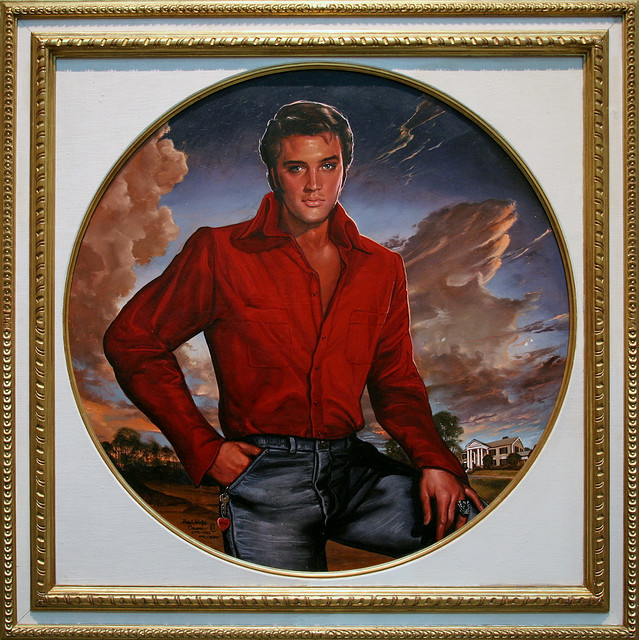
Elvis

Today would have been the music legend’s 80th birthday, assuming you believe he’s dead. Adrienne LaFrance ponders our varied perceptions of the man and his demise:

The tricky thing about Elvis [is] that people can’t agree on the Elvis they think they know. There’s the Elvis who died in 1977, and the Elvis who’s still alive and eating cheeseburgers in western Michigan. There’s Elvis the hip-swiveling hunk who could break your heart, and Elvis the doughy 40-something who couldn’t get through a performance without stumbling over his words. This duality was strong enough that it prompted debate about which Elvis ought to be depicted on a postage stamp. From The New York Times in 1992:

“Postal authorities are not sure which Presley likeness to use: the young, svelte, hip-gyrating Elvis of the rock-and-roll ’50s, or the rotund, road-worn Elvis who died in 1977 near the end of the Age of Aquarius, reportedly after a struggle with drugs.”

If conspiracy theories are a way to impose order on events that can’t be controlled, Elvis sightings are perhaps a way of rejecting mortality, and preserving the American dream he came to represent. After all, it wasn’t just Elvis’ death that challenged his place in American culture, but his actual life. Insisting Elvis never died is also, then, a way of rejecting what he had become.

Update from a reader:

If you’re talking about Elvis, why not include the finest Elvis-related song if all time, Mojo Nixon’s “Elvis is Everywhere”:

On a higher brow note, I recommend the Philip K Dick award-winning novel Elvissey by Jack Womack. This sci-fi novel has corporate commandos sent to an alternate version of Earth to kidnap a young Elvis in order to use him as their nouveau Messiah in a world where Christianity has been discredited.

Another:

Your post made me think about Bubba Ho-Tep, one of the strangest and most delightful films I have ever seen. It centers around an elderly Elvis living in a rundown retirement home in East Texas, having switched places with an Elvis impersonator in the early 1970s in order to get away from all the fame and the pains that came with it. He befriends a man, played brilliantly by Ossie Davis, who believes himself to be JFK (a harebrained and delightful explanation is given) and together they fight a mummy who is sucking the souls of their fellow residents through there assholes.

As I said, it is a very strange story. But it is also a story about death, fame, old age, family, heroism, peace of mind and above all else, Elvis himself. It received a very small theatrical release but after very positive reviews from several top critics (and tremendous praise for the performance of Bruce Campbell who played Elvis) it gained a cult following. As Roger Ebert said:

The King explains all of this in a thoughtful, introspective voice-over narration that also deals with other matters on his mind, such as the alarming pustule on that part of his anatomy where it is least welcome. He talks about Priscilla and Lisa Marie, about his movies (not a single good one), about his decision to disappear, and about how he broke his hip falling off a stage. This narration is not broad comedy, but wicked, observant and truthful. “Bubba Ho-Tep” has a lot of affection for Elvis, takes him seriously, and — this is crucial — isn’t a camp horror movie, but treats this loony situation as if it’s really happening

(Photo by Flickr user Cliff)