“An earlier version of this article misidentified the country whose army chased Tommy Caldwell’s kidnappers. It was Kyrgyzstan, not Kyrzbekistan, which does not exist,” – The New York Times. The ambassador to Dirkadirkastan couldn’t be reached for comment.
Face Of The Day

A woman tries to stay warm as she waits on an L platform in Chicago during the early morning rush while temperatures hovered around zero degrees Fahrenheit on January 7, 2015. Most of the city’s schools were cancelled today as wind chill temperatures were expected to exceed -30. By Scott Olson/Getty Images. Update from a proud Chicagoan, who contests Getty’s caption:
It actually gets into some serious linguistic issues. “A woman tries to stay warm as she waits on an L platform in Chicago . . . “ The L – sans punctuation, lone capital letter – is not how Chicagoans refer to their train system.
The Chicago Transportation Authority insists that it’s ‘L’ (single quotations marks, or inverted commas for you Brits). The scare quotes probably were originally meant to indicate “slang” usage, and probably originated when the vast majority of the system was elevated (now 2/3 of it is at or below grade, including lines down the medians of expressways). But this official usage is contested. Many great Chicago authors, including Nelson Algren, write El – short, obviously, for Elevated, sans punctuation. Like the T in Boston. I have worked on a number of books and other publishing projects where this conflicted usage has mattered, so I thought I’d share this Chicago minutia with the Dish’s discerning audience.
So it’s the El I take: to L with all other versions.
The Shrinking Economic Payoff Of Keystone
Michael Levi considers how plummeting oil prices might affect the pipeline:
Lower oil prices reduce both the costs and the benefits of approving the Keystone XL pipeline by reducing the odds that it will ever be fully used. There’s an outside chance that, if prices are sustained at an extremely low level, the Keystone XL pipeline won’t get built. That scenario isn’t likely – among other things, if Canadian production doesn’t grow, the odds of sustained low prices decline substantially – but it’s not zero. Lower prices also raise the odds that the pipeline will be built but not fully utilized. In that case, you still get the up-front construction stimulus, but you get less benefit from greater oil production, and less climate damage from the same. You also have a waste of economic resources.
The more likely scenario, though, is that the Keystone XL pipeline gets built and used. In that case, lower oil prices reduce its economic benefits without any clear impact on its climate costs.
Jordan Weissmann contends that “Keystone is neither irrelevant, nor especially critical to the future of Canadian oil”:
Keystone would probably be a small boon to the American fossil-fuel industry, even at this late date. Remember, the pipeline would send crude to refiners on the Gulf Coast. And what do refiners do? They buy oil, then transform it into gasoline, diesel, and other products to sell. The less expensive the oil, the easier it is for them to turn a profit, and the heavy crude found in the tar sands—which gulf refiners are specially equipped to process—is especially cheap, even compared to similar low grades from Mexico and Venezuela. This week, for instance, Western Canadian Select has traded at around just $33 a barrel. The refinery owners of Houston would surely love to get their hands on more it, but in a world of generally low oil prices, doing so isn’t exactly a matter of life and death for them.
Rebecca Leber wishes the Dems’ amendments to the Keystone bill didn’t focus on jobs:
Keystone emerged as a national issue when it became a symbol of climate change. Democrats ought to be marshalling their resources to remind people that Keystone is more about polution than it is about jobs. The pro-environment amendments have a slim chance at passing anyway. If Democratic amendments are hopeless from the start, they might as well go for bolder proposals, like a carbon tax, that will help at least to remind us of bigger things at stake than a few dozen jobs.
But Morrissey imagines that those amendments might get Obama to sign the bill:
If Democrats offer amendments that Republicans can support, the White House can claim that the bill has changed enough to their satisfaction — in essence, declare victory and depart the field before anyone asks too many questions.
Update from a reader, who corrected the first sentence of this post:
“Michael Levi considers how pummeling oil prices might affect the pipeline:”
“Plummeting”? The Dish’s own eggcorn?
Busted. But apparently we’re not alone this week, as another reader attests:
It has been fixed now, but when I first read Chait’s column on the conservative glee over Harvard faculty outrage at having to pay copays, I’m sure it read:
As the Times reports, the changes are a response to Harvard’s own health-care experts, many of whom advocated for Obamacare. The story has thus entered the conservative mind as a case of liberal elites suffering under the yolk of a liberal program.
Who Won’t Republish Charlie’s Cartoons?
Mark Steyn wishes the MSM would grow a pair:
Amen. Christopher Massie finds a clear divide between digital and legacy publications:
With few exceptions, it has been digital outlets like The Huffington Post, The Daily Beast, Business Insider, BuzzFeed, Vox, and Slate that have exercised their constitutional right by republishing the cartoons that are thought to be the basis for the attacks. In contrast, many “legacy” organizations, from CNN, to The Washington Post, to The New York Times, largely withheld the images.
A Dish reader also called out the CBC, as well as an egregious example from the WaPo. Massie talks to Daily Beast editor Noah Shachtman, who calls not publishing the images “giving in to the monsters that just massacred a bunch of people.” Massie is on the same page:
While editors are regularly forced to make difficult calls about publishing sensitive material, and while yesterday’s murders show that worries about angering jihadists are not without basis, in this case, the obvious news value of the cartoons ought to have outweighed any trepidation. The absence of a confirmed storyline as to whether a specific cartoon ignited the attack means that a wide array of context, including the images, is potentially relevant. Furthermore, if readers want to understand the tragic affront to free speech, there is no replacement for seeing the cartoons, in their unabashed irreverence.
The Fossil Fuels We Can’t Burn
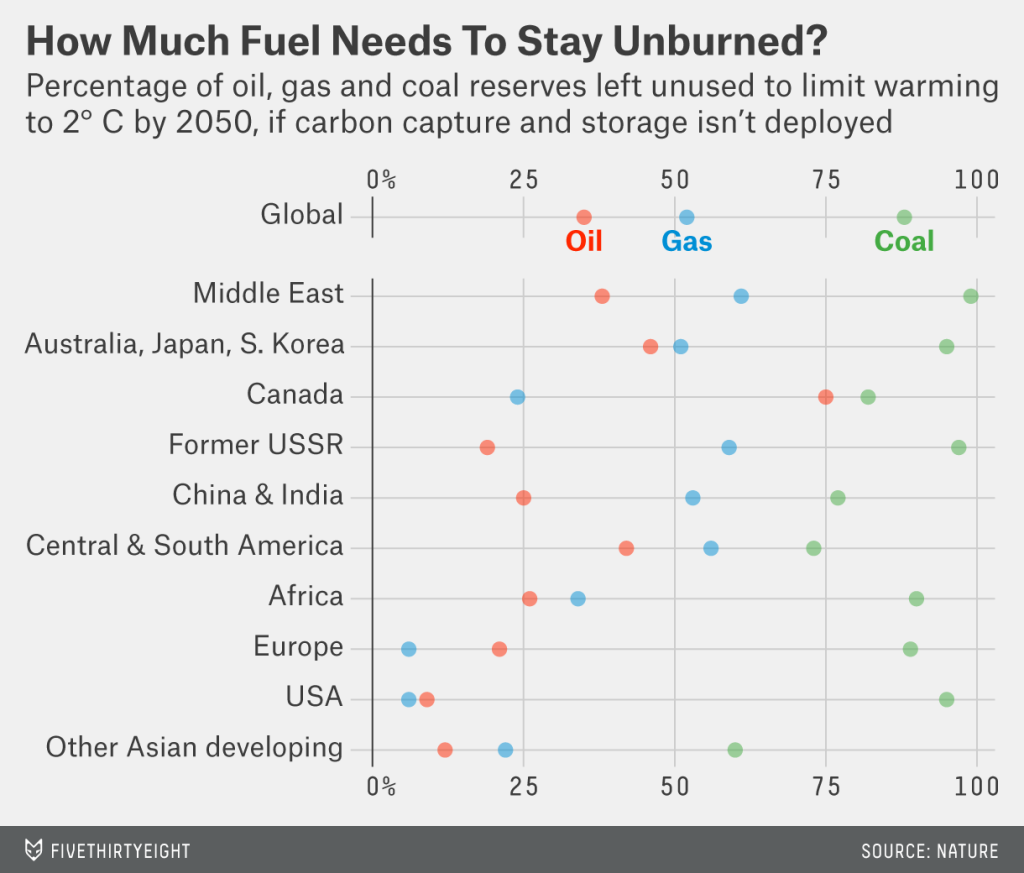
Christie Aschwanden reads through a new study which “shows, in the finest detail yet, which fossil fuel reserves can be exploited and which should remain untouched if we’re to have at least a 50 percent chance of meeting the 2-degree limit”:
The calculations show that some large reserves simply shouldn’t be tapped. For instance, essentially all Arctic oil reserves and 99 percent of Canadian oil sands are rated as unburnable under the model, a calculation that will surely give ammunition to those opposing the Keystone pipeline. More than half the world’s unburnable oil lies in the Middle East, but the model shows that the region could exploit more than 60 percent of its reserves without blowing the global carbon budget. The U.S. and Europe have the greatest flexibility to extract its reserves and remain within budget, in part because their proximity to energy users makes it more economical.
Scott K. Johnson also examines the report:
The fact that we can’t even use all of our current reserves calls into question the value of discovering or developing new sources of fossil fuels.
No new production of oil and gas takes place in the Arctic, for example, in the simulations that meet the total emissions target. In an associated article about the study, Potsdam Institute for Climate Impacts Research scientists Michael Jakob and Jérôme Hilairenote, “Fossil-fuel companies must therefore ask themselves whether they should continue to invest in exploration for, and processing of, oil, gas, and coal, or risk losing billions of dollars of stranded assets.”
“To conclude,” the study’s authors write, “these results demonstrate that a stark transformation in our understanding of fossil fuel availability is necessary. Although there have previously been fears over the scarcity of fossil fuels, in a climate-constrained world this is no longer a relevant concern: large portions of the reserve base and an even greater proportion of the [total] resource base should not be produced if the temperature rise is to remain below 2°C.”
Andrew Freedman focuses on the coal industry:
[Study author Christophe] McGlade told Mashable the countries that will be hurt the most by the carbon budget constraints are those that are heavily dependent on coal the countries that will be hurt the most by the carbon budget constraints are those that are heavily dependent on coal, which is among the most carbon-intensive fossil fuels. “It’s companies and countries that hold large coal reserves that are going to suffer under a 2 degree scenario, and also the Arctic oil,” McGlade said.
For example, McGlade said that meeting the temperature target in the most cost-effective way means foregoing the exploitation of 80% of the world’s coal reserves. Over the past few years, coal has become more expensive in many countries, including the U.S., compared to natural gas, thanks to fracking technologies that have produced a glut of gas.
Of course, the model has to make assumptions about future oil and gas prices that are basically impossible to be certain about. Unexpected changes to the price of oil, for example, could upset the cost equation for drilling in the US and re-shuffle the entire regional breakdown. But even as an estimate, the study really illuminates the vital need for policies all over the world that dramatically cut our dependence on coal.
Mental Health Break
Who needs a mouse when you have a weasel:
Busted With An Eggcorn, Ctd
Another day, another batch:
When my daughter was four, I asked her to go get me a beer (as it happens, a Budweiser) from the refrigerator. She was happy to make her dad happy and when she returned she said, “Here’s your buzzwater, Dad.”
Another tosses in a mondegreen:
For years, my favorite beer advertisement on the radio was a heavy metal tune with lyrics that went “AMSTEL LIIIIIIGHT, Enter night! Off to never never land!” I was too young to drink beer, and evidently too sheltered to have heard of Metallica.
From a reader with a Mozambique-born wife:
Her favorite tea is Early Grey.
Many more eggcorns below:
In my first real journalism job, my first big assignment was a feature on the head of an investment fund. He’s a very smart guy surrounded by a very smart team. I interviewed a partner in the firm for some background and, in my draft, quoted the partner using the phrase “a sort of Damocles.”
Fortunately, my editor asked me if that’s what he actually said. It was, I insisted. I went back and listened to the recording of our conversation multiple times, and that’s what I heard him say. Then I thought, “I don’t actually know what a ‘Damocles’ is.” So I did a little research and learned about Cicero and the Sword of Damocles and figured out quickly that I had a long way to go if I wanted to be any good at my job.
Another:
One of our ER psychiatrists referred in a note yesterday to the “Bloods and Crypts.”
Another:
I grew up in a small town, the kind where the newspaper would report on anything and everything that was happening if it was even mildly interesting. Sometime around my senior year of high school, the newspaper editor/reporter retired and was replaced by someone much younger. One of the first stories that the new editor ran was a story about the new tow truck that one of the two service stations in town had purchased. The new tow truck had a 15,000 pound winch on the back of it. Unfortunately, the newspaper article instead stated that the truck had a 15,000 pound wench in the back.
It’s unclear whether this ultimately helped or hurt the tow truck owner’s business.
Heh. Another:
When I was student-teaching, I taught To Kill a Mockingbird to a 10th grade class, and somehow we got onto the subject of ghosts (that was 20 years ago, but most likely we were referencing Atticus Finch’s remark that “there were other ways of making people into ghosts”). A female student then made a comment and used the idiom “the ghost is clear.” Everyone looked at her, puzzled. “You mean, the coast is clear,” I said. “No,” she responded, “that’s not the saying – ghosts are clear, aren’t they?”
Dina would appreciate this one:
When my son was four, we took a month-long camping trip following the Lewis and Clark Trail from our home in North Dakota to the Pacific Ocean. At one point we told my son that at the end of the trip we were going to Seattle. He got this really puzzled look on his face, and asked, “Who’s Attle, and why are we going to see her?”
Another of sorts:
I was holding back on sending this because it’s more related to an accent than an actual “eggcorn”, but somebody in the thread brought up the Boston accent and I couldn’t resist. In graduate school I worked in the produce department of the Cambridge, Massachusetts Bread & Circus Market (eventually purchased by Whole Foods). I was relatively new and sometimes overwhelmed at the bizarre array of produce that was for sale.
One day a call comes in and I take the phone. Caller: “Do you carry staff root?”
Me (after checking the display): “No, sir. We have celery root, burdock root, taro root and ginger root. We don’t have any staff root.”
Caller: “No, no, no. Fruit shaped like a sta!”
He was, of course, a Bostonian looking for ‘star fruit’.
One more:
I’m always sorry I didn’t save this clipping from our local newspaper … but the cut line under a picture of local school children dancing in a circle holding ribbons tied to a pole said: “Children Demonstrating the Maple Dance.” Makes me laugh to think of the circumstances of the likely over-the-phone interview between a young journalist and a grade school teacher, “Yeah, can you send me photo of the kid’s dancing? What’s it called again?”
Lovely thread. It probably should be recategorized into Mental Health Breaks.
Nous Sommes Charlie, But Do We Really Want To Be?
Yglesias, for one, is dismayed that yesterday’s attack made martyrs of cartoonists whose work he found distasteful in the extreme:
Viewed in a vacuum, the Charlie Hebdo cartoons (or the Danish ones that preceded it) are hardly worthy of a stirring defense. They offer few ideas of value, contribute little to any important debates, and the world would likely have been a better place had everyone just been more polite in the first place.
But in the context of a world where publishers of cartoons mocking Mohammed have been threatened, harassed, and even killed, things look different. Images that were once not much more than shock for its own sake now stand for something — for the legal right to blaspheme and to give offense. Unforgivable acts of slaughter imbue merely rude acts of publication with a glittering nobility.
One of Dreher’s readers makes a similar point:
I am a francophone European, and I sometimes read Charlie Hebdo. I am shocked by these murders and I hope the assassins will be caught and will pay dearly for their crimes. This being said, je ne “suis” pas Charlie et je ne l’ai jamais été: I am not Charlie and I never was.
I’ve always thought that Charlie’s brand of “humour” was despicable and part of the problem, not a solution. I’m not going to change my mind about this because of the murders. The people who died have become martyrs of the freedom of expression, but they were hardly the best defenders of the freedom of expression. First because the freedom to express your opinions does not imply that these opinions are correct – and Charlie was a far left, violently anti-religious rag. It is not because you are free to be vulgar, unfair and insulting that all these things are good. Moreover Charlie was not very good when the freedom of expression of its adversaries was at stake: look at the “Dieudonné” affair for instance.
Dieudonné M’bala M’bala is a controversial French comedian and political activist who’s been convicted many times of antisemitism. Diana Johnstone is on the same page as Dreher’s reader when it comes to Charlie Hebdo‘s spotty record on free speech:
In 2002, Philippe Val, who was editor in chief at the time, denounced Noam Chomsky for anti-Americanism and excessive criticism of Israel and of mainstream media. In 2008, another of Charlie Hebdo’s famous cartoonists, Siné, wrote a short note citing a news item that President Sarkozy’s son Jean was going to convert to Judaism to marry the heiress of a prosperous appliance chain. Siné added the comment, “He’ll go far, this lad.” For that, Siné was fired by Philippe Val on grounds of “anti-Semitism”. Siné promptly founded a rival paper which stole a number of Charlie Hebdo readers, revolted by CH’s double standards. In short, Charlie Hebdo was an extreme example of what is wrong with the “politically correct” line of the current French left.
Indeed, many Muslims on social media are wondering why free speech seems a bit freer than usual when Islam is the target. One such Muslim is a Jordanian friend of Dish editor Jonah Shepp, who didn’t want to reveal her name:
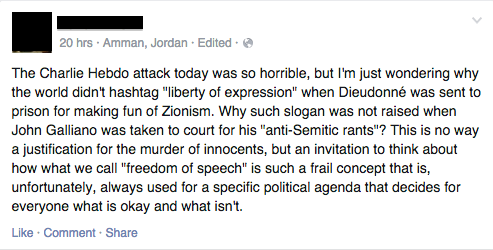
Meanwhile, responding to calls for other publications to reprint Charlie’s most controversial work in solidarity, Arthur Goldhammer cautions against sacralizing artists and journalists who saw profaning the sacred as their life’s work:
Reproducing the imagery created by the murdered artists tends to sacralize them as embodiments of some abstract ideal of free speech. But many of the publications that today honor the dead as martyrs would yesterday have rejected their work as tasteless and obscene, as indeed it often was. The whole point of Charlie’s satire was to be tasteless and obscene, to respect no proprieties, to make its point by being untameable and incorrigible and therefore unpublishable anywhere else. The speech it exemplified was not free to express itself anywhere but in its pages. Its spirit was insurrectionist and anti-idealist, and its creators would be dumbfounded to find themselves memorialized as exemplars of a freedom that they always insisted was perpetually in danger and in need of a defense that only offensiveness could provide.
Update from the in-tray:
Long-time reader (and francophone) here. I just saw you forward a tweet regarding Charlie
Hebdo‘s alleged racism in its cartoon “Rassemblement bleu raciste” [Update: the Twitter user deleted that tweet, but the image in question is embedded to the right]. I am not 100% certain of the background behind that cartoon. Unfortunately, the Charlie Hebdo website isn’t showing much in the way of past content at this time. That said, a quick google search reveals that this caricature – albeit maladroit – might have been put forth as a criticism of the French extreme right’s racist references to Minister Taubira. I invite you to look at the following links – here and here – which give a bit more detail on the text that allegedly accompanied the caricature. I may be wrong here, but I’m pretty sure that caricature was not the whole story and is mischaracterizing Charlie Hebdo’s position.

The first link is to a web forum and the second is to an article in French, so if any other readers, especially French-speaking ones, have something more conclusive, please let us know. Update from another:
As a French citizen, I was infuriated by your understanding of this drawing by Charlie Hebdo. This drawing was made as a response to racism found in the French weekly newspaper Minute, which depicted Taubira as a monkey. This shocking (and I concede awkward) drawing is meant to denounce the racists from Minute and the Front National, the nationalist extreme right party (their logo at the bottom left of the drawing). The drawing is meant to exemplify how racist and shocking their words were. I found that title/question insulting the memory of Charlie Hebdo.
Another adds further context:
Charlie Hebdo’s picture of Minister Taubira was indeed posted in the context when many Front national supporters and representatives made racist comments about Christiane Taubira, who supported legalizing gay marriage. They constantly compared her to a monkey and on some occasions taught their children to throw bananas at her.
The title is in fact a pun on the new name Marine Le Pen wanted to give to the Front national so as to nominally distance her own political agenda from her father’s (who was well known for his antisemitic and racist comments). She called her own movement « Rassemblement Bleu Marine » (this name itself included a pun since it means both a « Blue Navy Rally » and a « blue rally around Marine Le Pen » ). Charlie Hebdo just added a pun on her pun, replacing “Bleu Marine” with “Bleu raciste”. It was meant to show that the new Front national around Marine Le Pen was in fact just as racist as the former one and the caricature of Taubira as a monkey was meant to represent the so-called new Front National’s vision of a black female Minister of Justice.
Regarding “freedom of speech”, Dreher’s reader’s comments about a double standard are quite off the topic. From a legal point of view, in the US sense, freedom of speech is restricted in France. The cases that reader mentions does show an obvious double standard when it comes to antisemitism on the one hand and islamophobia on the other, but rather the fact that there is room for prosecution in France if you make public comments that suggest that you support racial inequality or that you deny the existence of events such as the Holocaust. There is no room for prosecution for any kind of religious blasphemy. Charlie Hebdo fought against the idea that anything was too sacred not to be ridiculed or laughed about. Such was their idea of freedom. They were irreverent by principle, but never racist nor in any way comparable to ideologues such as Dieudonné.
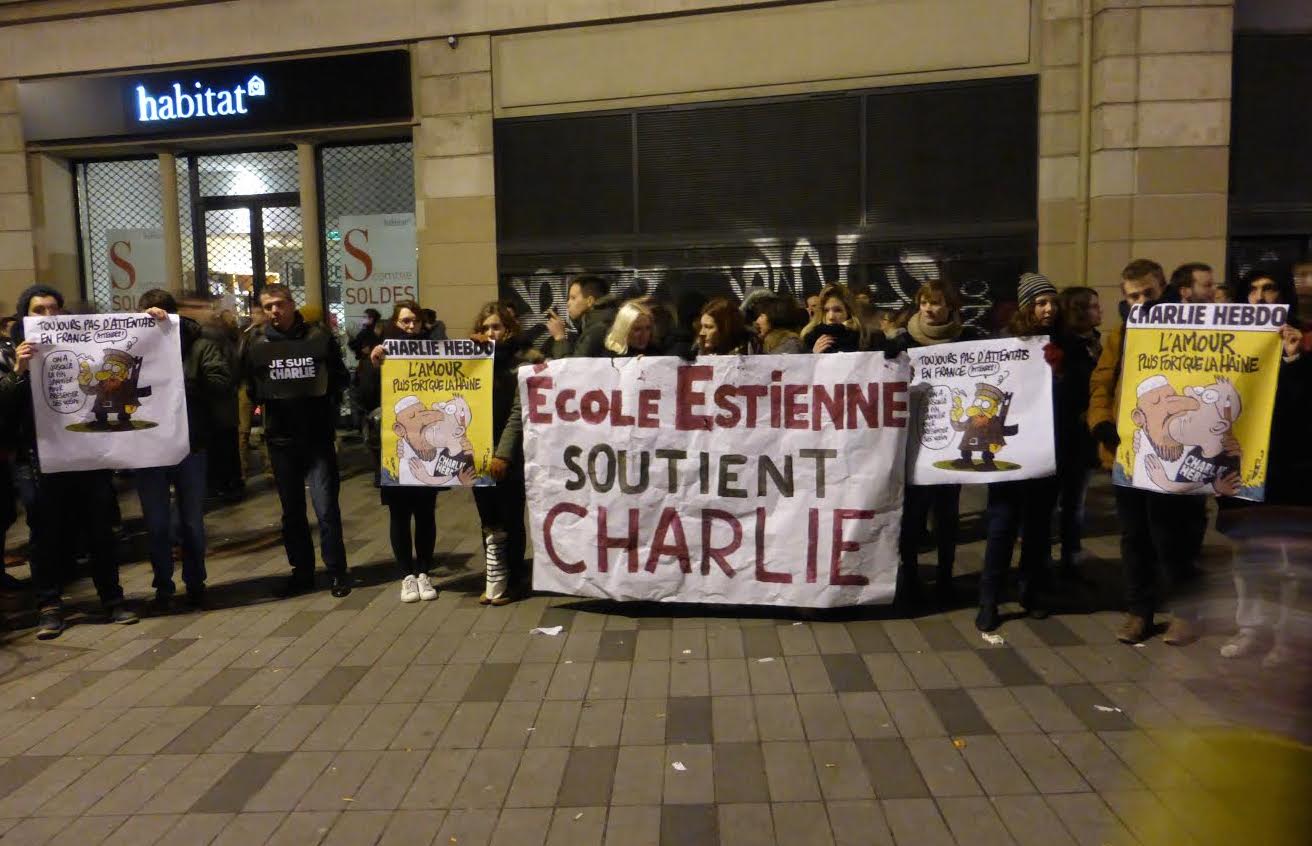
In any case, thank you for your coverage of the Charlie Hebdo attack and for pointing out the MSM’s lack of courage in reproducing the caricatures. Below is a picture I took at yesterday’s march in Place de la République around 8pm:
Kids, students, anonymous people are absolutely not afraid of showing these caricatures in public in France. It’s important that they are not and to some degree they are less than they ever were.
El Greco And God
Eve Tushnet recently visited an exhibition of El Greco’s paintings at the National Gallery of Art. She especially notices the 16th century painter’s striking religious vision, in which “tenderness, penitence, and estrangement comprise the human condition”:
The earliest work here is Christ Cleansing the Temple (ca. 1570). The wall caption notes that this was a popular subject for Roman Catholic painters during the Counter-Reformation. To Catholic artists, the church bore responsibility for the reaction its ministers’ sins and distortions had provoked, and the artists didn’t shy away from comparing their own church to the money-grubbing, Pharisaical religion confronted by Jesus. El Greco’s version of this scene is derivative and somewhat confused, but hints of his sensibility emerge: that characteristic blue-and-claret color scheme in Christ’s robes, the unearthly glow of the flesh.
Saint Francis Receiving the Stigmata [seen above] is surprisingly restrained. It’s another relatively early piece, from 1585-90, and although it’s a dramatic image, in which the saint is enraptured by his vision of the cross, there’s a quiet solitude to this painting. It doesn’t feel the need to shout. The tones are soft blacks and grays. The stigmata themselves are small: A dark red dot is visible on the big vein on the back of Francis’s left hand, as if an IV needle had been inserted there by a well-trained nurse. El Greco’s painting, in which flesh reveals that the crucifixion underlies all everyday experience, is not tormented. The saint’s expression speaks more of acceptance than agony or ecstasy. The cross itself is sketchy, blurred, in a frame of deep, black, rolling clouds. El Greco’s saints often have this gentleness to them.

Click here for a larger version of that painting, and go here for a detailed look at Christ Cleansing the Temple.
Taking A Stand On The Can, Ctd
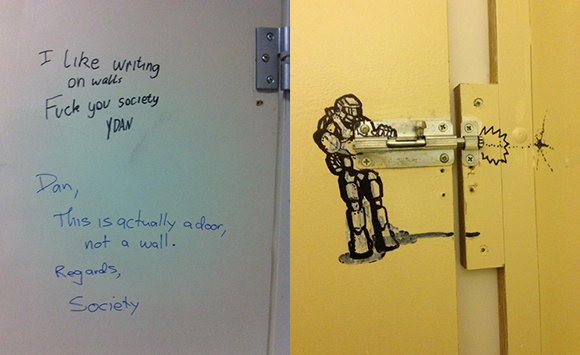
Your toilet humor continues:
I gotta say my all-time favorite piece of bathroom graffiti is “All in all you’re just another prick in the stall.”
Another reader:
Personal fave: DYSLEXICS UNTIE!
Another:
From my college dorm circa 1970: “Free the Jackson five!”
Many more after the jump:
This poem is from my high school lavatory:
Here you sit in silent vapor;
The person before you used all the paper.
The bell has rung, you must not linger.
I feel for you; You must use your finger.
Another:
Here’s a personal favorite, in the bathroom at The Chapter House in College Town right outside Cornell: “Don’t drop acid. Just take it pass/fail.”
Another:
This was actually a small sign that we saw in some random pub somewhere in England, quite a while ago: “If you feel like the bottom is falling out of your world, drink Real Ale and you’ll feel like the world is falling out of your bottom.”
Another:
From the men’s’ bathroom at the University of Texas Business school, in 1981: “Save the whales … collect the whole set!”
Another:
On a condom dispenser in Cambridge, MA about ten years ago: “Insert baby for refund.”
Another:
Posted in a latrine at the VFW in in Wisconsin over the urinal: “Bucks with short horns stand close. The next Brave might be barefoot.”
One more for now:
Someone wrote something filthy along the lines of “I’m going to fuck your mother so hard your Dad walks funny”, which itself wasn’t so funny, except someone else came along later and in different pen and wrote underneath “- Tom Hanks”.
I wonder how long they stood there thinking of the best name to put, because I thought about it a while, and I think Tom Hanks really is the funniest name you could put there.
(Photos from the tumblr Notes from the Stall)

