The Speaker's words get stronger:
'Don't Ask, Don't Tell', I feel quite certain, will be a memory come Christmas.
Both houses of Congress are set to vote on ending DADT this week.
The Speaker's words get stronger:
'Don't Ask, Don't Tell', I feel quite certain, will be a memory come Christmas.
Both houses of Congress are set to vote on ending DADT this week.
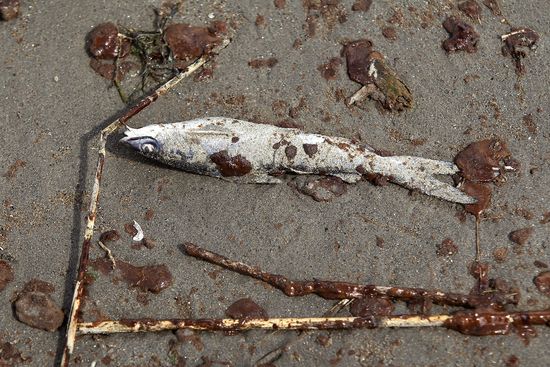
Bradford Plumer raises an eyebrow:
If BP's leak estimates were correct, then it'd be facing something like a $140 million fine so far. But if the high-end estimates are right, well, the oil giant could be facing penalties in the billions. Yesterday, Interior Secretary Ken Salazar said the government would make its own independent assessment of the numbers, though it's unclear why this wasn't done earlier.
Kate Sheppard voices the same concern:
If one believed BP's original estimate, there would only be 1.4 million gallons of oil in the gulf so far. If you believe the adjusted figure from NOAA and BP, 6.9 million gallons of oil have already hemorrhaged into the Gulf. But if outside experts are right, the figure is likely closer to 131.6 million gallons – or nearly 13 Exxon Valdez spills.
(Photo: A dead oil-covered fish lies on the beach on May 22, 2010 on Grand Isle, Louisiana. More than a month after BP's Deepwater Horizon well exploded, oil continues gushing from the well and is coating beaches and marshland along the Louisiana coast. By John Moore/Getty Images.)
Only 48.5 percent of those aged 18-24 voted in 2008 compared to 72.4 percent of those aged 65-74. And the senior population is growing steadily. Bruce Bartlett spies political turmoil ahead:
[W]hat we see is that over the next ten years the percentage of the population that benefits from Social Security and Medicare is going to rise significantly and that this group of the population votes in higher percentages than those that pay for these programs. And those that will, over their lifetimes, bear the heaviest burden of paying for entitlement programs–the young–vote at the lowest rate of any age group.
I bring this up because so many right-wingers seem to think it will be a simple matter to slash or even abolish major entitlement programs into order to restore fiscal stability…[T]he sort of radical cuts or quasi-privatization that right-wingers favor is politically impossible now and will become even more politically impossible when a higher percentage of voters are on Medicare.If this is the case, then there are really only two options: slash non-entitlement spending on things like national defense or raise taxes. The option of doing nothing and just pushing the costs off onto our children, grandchildren and great grandchildren by running deficits and raising the debt/GDP ratio–which is what we are doing now–will at some point no longer be an option.
Ben Smith stumbles upon the truth here:
Mr. Heath said he was careful about nudging his daughter toward the things that interest him.
“I don’t want to push the wrong button with Sarah,” he said. “Besides, she doesn’t make the decisions. Let me retract that. I’m sure she thinks them over and she has a lot of say as to yes and no.”
Who really makes the calls? Maybe the same dude who makes the threats:
Mr. Palin started to pull away, then he stopped and leaned toward the window. He emphasized that he did not want to be misrepresented by a reporter.
“What goes around comes around,” he said, still smiling.
Soon he would head down the 900-foot gravel drive to the property on Lucile Lake. He would pass the “No Trespassing” signs nailed into the birches and evergreens and then he would pass a new automatic metal gate, unoperational for now.
“It’ll be powered up soon,” he said.
(Photo: Todd Palin listens as his wife Former Alaska Governor Sarah Palin speaks at a Tea Party rally on Boston Common on April 14, 2010 in Boston, Massachusetts. By Darren McCollester/Getty Images)
I'm glad Peter has gotten around to a response to the fundamental argument his critics have made, and shown the bleeding obvious – that it is not an argument at all:
The main complaint is that I didn’t spend enough time discussing the nastiness of Hamas, Hezbollah, Iran, and extremist Muslims in general.
Well: duh. This was an essay about Israel and America's Jewish leadership, not about Hamas. It was about whom the American Jewish Establishment could influence, but have chosen not to. It was about a Rubicon in Israel's increasingly fundamentalist politics. It is not a valid criticism of an essay to say that it should have dealt with another subject instead. And on almost all the substantive points Peter makes about the Israeli right, his critics broadly agree. I would not feel so bleak about Israel, if I had not read so many of Jeffrey Goldberg's Cassandra-style warnings these past few years. No one is really defending the settlement expansion. No one is defending the Greater Israel the Israeli right is so wedded to.
So the real issue at hand is whether the situation is serious enough to prevent the AJE from using its clout to slo-mo any change and smear any critic (as they now are) or whether they should shift to saving Israel from itself, before the next generation of American Jews moves on from the subject en masse. I have to say that after reading Peter's critics concede almost all his points on Israel, Beinart's case stands up even more strongly. Have Chait and Wieseltier and Frum refuted his analysis of Israeli politics and society? Or have they simply thrown some Hamas sand in his eyes?
However pernicious Hamas and Hezbollah are, they do not prevent Israel from freezing settlement construction as a kick-start for wider talks.
And Israel's refusal to negotiate from that position has simply won Hamas, the PA and Hezbollah more sympathy than they deserve, while keeping all the blame fixed on Jerusalem. Moreover, the shape of Israeli domestic politics is something that leading American Jews could indeed influence, whereas their clout with the Israel's enemies is close to zero. So where are they? Playing the old Blame-The-Arabs-And-Expose-The-Anti-Semites game again.
What we have learned this past year and a half is sobering: it is that the minimum concession necessary from Israel to have any hope of movement on the Israel-Palestine question is now beyond the maximum power or will of any viable Israeli government at this moment in time. So peace may have become impossible because of internal shifts within Israel. That matters regardless of the positions of Israel's enemies.
All the West was asking for was a freeze in settlement construction – not withdrawal, not removal, not destruction, not even an end to construction. Just a freeze. For a while. Asked by a new president with a big majority at a moment when Israel desperately needs international support.
We know what the response from Israel was: "Don't even think about it." We know what the response from AIPAC was: "You're anti-Semites for asking." And we know how the American Jewish Establishment responded: "Move along here; there's nothing to see."
But there is something to see, something disturbing and apparently unstoppable. Peter is not wrong to point it out.
World Cup is just around the corner:
Chris Good bows to Nike's ad gurus:
Nike's new ad…is one of the highest-end pieces of commercial art you'll see, considering the production from a bona fide filmmaker and the aggregate global appeal of all the multi-national stars on screen. Its airing will be an oddly tailored event of art, commerce and sport.
Short answer: two Dems split the vote. Pareene predicted GOP triumphalism weeks ago.
"The only other two people to cancel have been Louis Farrakhan and Prince Bandar of Saudi Arabia," – Betsy Fischer, executive producer of Meet the Press, on Rand Paul's no-show.
The Tory right stirs (well, Simon Heffer, anyway).
Henry Jenkins has a two part interview (one, two) with Marwan Kraidy, author of Reality Television and Arab Politics. Jenkins asks:
As you note, many of these reality show formats come from the west but get localized in the Arab context. Can you describe this localization process? To what degree is their western origins central to their political impact?
Kraiday answers:
The localization process underpins the book's main argument that the Arab reality television controversies are best understood as a social laboratory where various versions of modernity are tested. The formats' western origins were never directly important. In the early years of Arab reality television, 2003 and 2004, critics leveled the charge that the reality television wave was another episode in a western cultural conquest trying to impose an alien reality on Arabs and Muslims.
Localization occurred in several ways.
One was a gradual take over by conservative forces. Consider the case of Algeria, where state television initially aired the Lebanese Star Academy. After opposition from Islamists, the Algerian president himself is said to have ordered it off the air, replacing it with a locally-made, ostensibly more conservative version. One season later, and the same slot was filled by a Qoranic recitation show, reality style–nominees, fan mobilization, viewer voting.
Two poetry reality shows epitomize another, and to me far more interesting, process of localization. Poetry enjoys a status in Arab culture that it is to my knowledge not accorded anywhere else in the world. Since pre-Islamic times, poetry is at once art form, political platform and entertainment. Numerous Arab television channels today have talk-shows dedicated to poetry, and poets show up on all kinds of talk-shows for women, youth, etc. A well-known poet in the Arab world is treated like a rock star. So here comes Abu Dhabi Television, supported by state financing, with the brilliant idea of launching poetry competitions, reality television style. The two shows, one dedicated to Arab poetry at large, the other focused on Gulf poetry, were major hits. Followers of your blog may have read recently the story of Hissa Helal, the Saudi woman who reached the finale of one of these shows, with a poem (in the semi-final) that attacked the reactionary clerics in her country, a gutsy move that was made partly possible by the venue–a public, popular poetry competition.
(Hat tip: Jesse Walker)

 The Dish