Saira Khan introduces the recently developed procedure of clitoral reconstruction, which promises to reverse at least some of the damage done to women who have been subjected to clitoridectomy:
The surgery itself is fairly simple.
As the science community has recently learned, the clitoris is much larger than the small accessible part. An unerect clitoris can be up to 9 centimeters long, meaning that most of the clitoris is actually within the body and inaccessible without surgery. So theoretically, underneath the scar tissue on a woman who has experienced female genital mutilation is more clitoris.
To restore part of the clitoris, the doctor opens up the scar tissue, brings some of the clitoris back up into position, and sews it in place. The recovery process for the surgery is long, painful, and arduous; it can take up to a few months for skin to grow on top of the newly restored clitoris leaving the woman very sensitive for some time. [Dr. Pierre] Foldès says he cannot guarantee orgasms from the restoration but it does have the potential to bring back some sensation.
Still, the surgery has not gained much traction in the U.S. The American Congress of Obstetricians and Gynecologists believes there is not enough research to support the surgery yet.
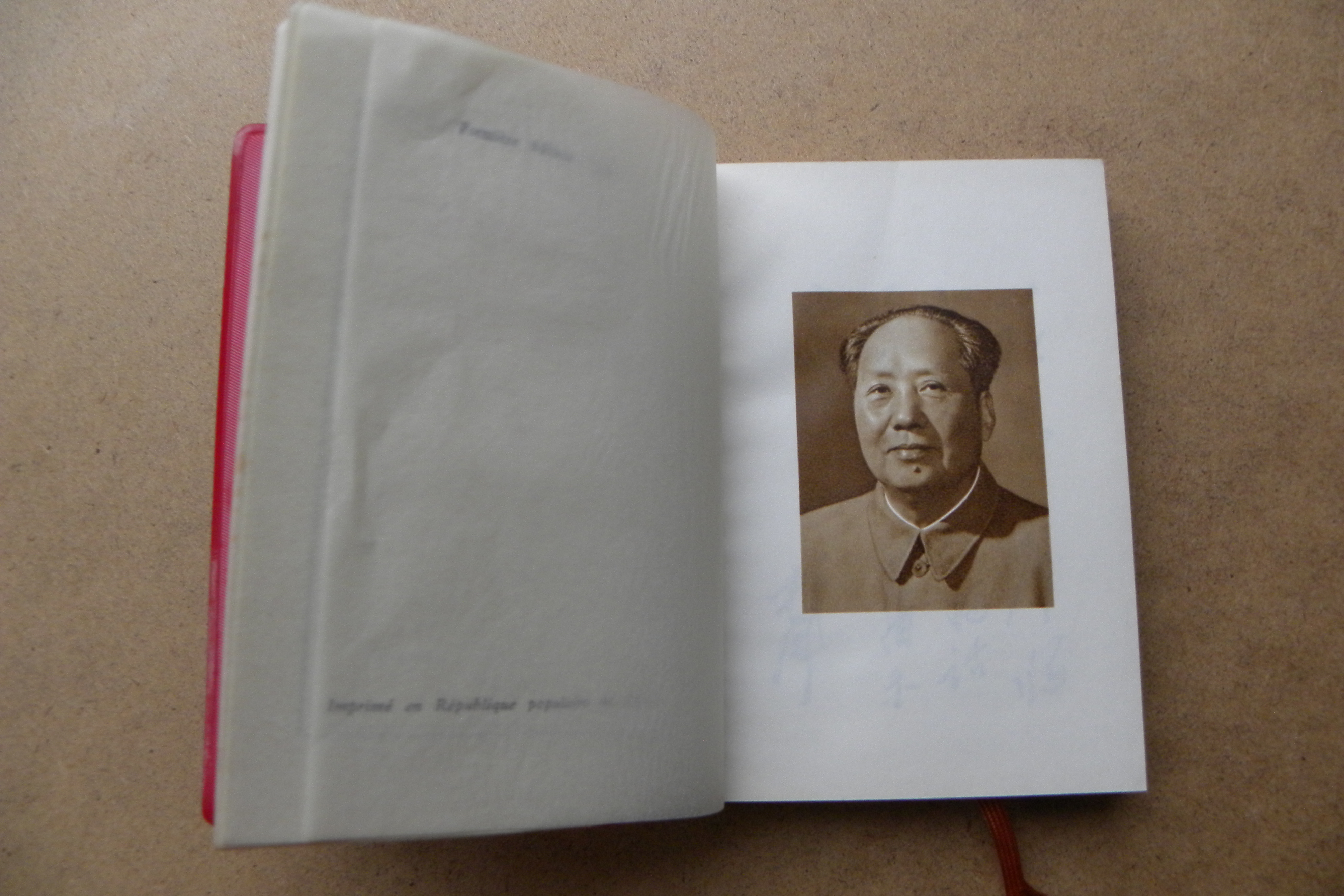
Reviewing Mao’s Little Red Book: A Global History, a collection of academic essays about the text that some claim is second only to the Bible in terms of print circulation, John Gray revisits where the collection of the Chinese leader’s sayings came from:
Originally the book was conceived for internal use by the army. In 1961, the minister of defence Lin Biao – appointed by Mao after the previous holder of the post had been sacked for voicing criticism of the disastrous Great Leap Forward – instructed the army journal the PLA Daily to publish a daily quotation from Mao. Bringing together hundreds of excerpts from his published writings and speeches and presenting them under thematic rubrics, the first official edition was printed in 1964 by the general political department of the People’s Liberation Army in the water-resistant red vinyl design that would become iconic. With its words intended to be recited in groups, the correct interpretation of Mao’s thoughts being determined by political commissars, the book became what Leese describes as “the only criterion of truth” during the Cultural Revolution. … Long terms of imprisonment were handed out to anyone convicted of damaging or destroying a copy of what had become a sacred text.
Gray goes on to express disappointment that the contributors “seem anxious to avoid anything that might smack of a negative attitude towards the ideas and events they describe” – and basically ignore the human costs of Maoism:
Reading the essays brought together here, you would hardly realise that Mao was responsible for one of the biggest human catastrophes in recorded history. Launched by him in 1958, the Great Leap Forward cost upwards of 45 million human lives. “When there is not enough to eat, people starve to death,” Mao observed laconically. “It is better to let half of the people die so that the other half can eat their fill.” He did not specify how those condemned to perish would be made to accept their fate. Ensuing events provided the answer: mass executions and torture, beatings and sexual violence against women were an integral part of a politically induced famine that reduced sections of the population to eating roots, mud and insects, and others to cannibalism. When Mao ordered an end to the horrific experiment in 1961, it was in order to launch another.
In a recent interview, however, the volume’s editor offered a more positive assessment of Mao’s writing:
I think one thread that does come through is because it is an authoritative text, in some ways we describe it almost like a religious text, even in its circulation. The only books that are comparable to it are things like the Bible and the Koran. As a religious text, you can imagine that maybe it holds a kind of power over the believers. But on other hand, you can see in places where the book was adopted, including in China, there is almost a religious reformation. It is almost like an education in the liberal arts, and education in rhetoric. Because the text can be used to argue for so many things, in a way it breaks down that kind of authority and allows people to begin to articulate their own desires, their own beliefs in a way to begin to speak freely. We can view this text as a tool of totalitarian dictatorship. But it has this ironic quality of emancipating people’s minds and teaching them how to think and speak freely.
(Photo of a 1966 French edition of Mao’s Little Red Book, via Wikimedia Commons)
From May 17th through September 7th, The New York Botanical Garden in the Bronx presents Great American Gardens and The Women Who Designed Them, an exhibit highlighting the achievements of some of the most prominent women in early 20th century landscape design.
A poetry walk on the grounds features poems by Edna St. Vincent Millay, who was the star poet of their generation. She was the first woman to win the Pulitzer Prize for poetry in 1923, and in the middle of the Great Depression, her collection Fatal Interview, published in 1931, sold 35,000 copies within a few weeks of its release.
Nancy Milford, author of Savage Beauty, a superb biography of Millay, describes the poet as the herald of the New Woman, “She smoked in public when it was against the law for women to do so, she lived in Greenwich Village during the halcyon days of that starry bohemia, she slept with men and women and wrote about it in lyrics and sonnets that blazed with wit and a sexual daring that captivated the nation…. Her performing self made people feel they had seen the muse alive . . . .”
This weekend we’ll feature some of the poems on the grounds of The New York Botanical Garden from now until September 7th beginning with a mock self-portrait, Millay as seen by a neighbor. Her poems compliment a riveting historical exhibit in the library rotunda and a spectacular floral exhibit in the conservatory, a recreation of Beatrix Farrand’s 1926 masterpiece in Seal Harbor, Maine, the Abby Aldrich Rockefeller Garden.
“Portrait by a Neighbour” by Edna St. Vincent Millay:
Before she has her floor swept
Or her dishes done,
Any day you’ll find her
A-sunning in the sun!
It’s long after midnight
Her key’s in the lock,
And you never see her chimney smoke
Till past ten o’clock!
She digs in her garden
With a shovel and a spoon,
She weeds her lazy lettuce
By the light of the moon,
She walks up the walk
Like a woman in a dream,
She forgets she borrowed butter
And pays you back cream!
Her lawn looks like a meadow,
And if she mows the place
She leaves the clover standing
And the Queen Anne’s lace!
(From Collected Poems by Edna St. Vincent Millay. Reprinted with the permission of The Permissions Company, Inc., on behalf of Holly Peppe, Executor, The Millay Society. All rights reserved. Photo is Carl Van Vechten’s 1933 portrait of Millay, via Wikimedia Commons)
In August, President Obama announced a new college ratings system that will factor in cost and student debt. The White House also made a push last year to give families better access to information through the College Scorecard, an online tool that lists data on employment, default rates and graduation rates for each college.
But some researchers and education advocates say the new rules don’t go far enough. While the information being compiled on career training programs is exactly the kind of information they say should be available for families comparing colleges, advocates say that information should be made available for all college degrees, not just vocational programs.
In a statement that likely set zero college administrators at ease, a White House advisor clarified that this policy would only hurt the bad universities:
“He is not interested in driving anybody out of business, unless they are poorly serving the American people,” said Cecilia Muñoz, the director of the White House Domestic Policy Council. “In which case, I think he’s probably pretty comfortable with that.”
White House officials claim to be increasingly concerned about rising student debt levels, as is the general public. Certainly, college administrators—especially those who work at taxpayer-subsidized universities that spend millions of dollars on fancy stadiums and luxury hotels—should expect a reckoning. But it’s hard to believe the federal government could cobble together a central database with valid insights about which colleges deserve to be driven out of business. Constructing such a system is probably a little harder than rating a blender.
But Rebecca Schuman is ready to give the ratings a chance:
[H]ere’s why I still hope Obama’s plan will work. The very fact that the ratings’ most vocal detractors are college presidents—who often rake in millions while their students crumble under debt—should tell us Obama is onto something. North Virginia Community College president Robert G. Templin Jr. claims we shouldn’t “take a sledgehammer” to the American higher education system across the board. I say that a system that currently survives on nearly three-quarters contingent faculty laborhas more than earned a sledgehammer—or at least a thorough audit from the body that’s providing a healthy percentage of its revenue. And that’s why I’m truly baffled at colleges being so affronted at this apparent government intrusion. If you funded an industry through $150 billion in loans, wouldn’t you demand some accountability?
[C]ollege rankings would give you, your children and your friends and relatives more information when applying, including whether or not your institution gets graduates jobs or is competitively priced. However, the real meat of the system would be congressional approval to tie loans to the ratings. If it works, it will help students pull through college and land jobs more easily. It could also help alert applicants to schools with advertising campaigns that are misleading or outright lies. If it’s a mess, it could harm already-struggling schools, many of which serve minority students.
Gary Younge fears that with the death of Angelou, “America has not just lost a talented Renaissance woman and gifted raconteur. It has lost a connection to its recent past that had helped it make sense of its present”:
At a time when so many Americans seek to travel ‘color blind’ and free from the baggage of the nation’s racial history, here she stood, tall, straight and true: a black woman from the South intimately connected to the transformative people and politics who helped shape much of America’s racial landscape. A woman determined to give voice to both frustration and a militancy without being so consumed by either that she could not connect with those who did not instinctively relate to it. A woman who, in her own words, was determined to go through life with “passion, compassion, humor and some style,” and would use all those attributes and more to remind America of where this frustration and militancy was coming from.
Perhaps more than anything else, Dr. Angelou was a teacher – ”a teacher who writes,” as she would say. She taught little black girls to do all of the things that no one expects little black girls to do. She taught little black boys to love themselves, and look beyond their own front porch to the hope of a broader horizon. And she taught every single one of us to make good use of pain, and weave that pain in as yet another plot line in our own, triumphant, stories.
Forrest Wickman notes Angelou’s profound influence on hip-hop:
Angelou also had an effect on Shakur in person. In an interview with George Stroumboulopoulos, Angelou remembered meeting Shakur, though she didn’t know who he was (“I don’t know six-pack,” she remembers joking at the time, in reference to 2Pac’s name), and conveying to him how important he was to the black community. According to Angelou, her message to him made him weep.
A reader passed along a video of Angelou telling that story to Dave Chapelle – watch it here. Meanwhile, John McWhorter steps back from a weighty review of her work with mixed feelings:
Angelou’s writings are the product of a worse and blissfully bygone America. White readers who feel enlightened enough about race issues to have wearied of being lectured about them may be put off by these books today. And a black person likely would not, and really should not, write a memoir in this style today. I must admit a guilty relief that the last volume ends in the late 1960s. …
During a fracas with white school administrators in The Heart of a Woman, Angelou asks: “How could the two women understand a black mother who had nothing to give her son except a contrived arrogance?” “Contrived arrogance” is exactly what Angelou seeks to give her readers. An outsider today might read this as the same kind of lordly superciliousness that my roommate sensed in Odetta. But contrived arrogance was once a useful and even natural form of defense against bigotry.
If you read the former or watch the latter after first being exposed to their many imitators, it is easy for both to seem like cliches. But while Casablanca entered the flow of the culture, I Know Why The Caged Bird Sings changed the course of that river, letting new tributaries feed into it, providing new jetties from which readers who did not see themselves in much literature could set sail in its waters.
More than with any other form of art, the relationships we have with novels are apt to approach the kind we have with people. For a long time, novels were typically named after people (Tom Jones, Emma, Jane Eyre), but that is not the crux of it. What makes our experience of novels so personal is not that they have protagonists, but that they have narrators. Paintings and photographs don’t, and neither, with rare (and usually unfortunate) exception, do movies or plays. Novels bring another subjectivity before us; they give us the illusion of being addressed by a human being.
They are also exceptionally good at representing subjectivity, at making us feel what it’s like to inhabit a character’s mind. Film and television, for all their glories as narrative and visual media, have still not gotten very far in that respect, nor is it easy to see how they might. The camera proposes, by its nature, an objectivist aesthetic; its techniques are very crude for representing that which can’t be seen, the inner life. (“I hate cameras,” Schmidt quotes Steinbeck as having remarked. “They are so much more sure than I am about everything.”) You often hear that this or that new show is like a Dickens novel. There’s a reason that you never hear one likened to a novel by Virginia Woolf or Henry James.
Flying instructor David Schnaible (R) teaches wind tunnel flying to nine-year-old Liam Harrison at the iFly indoor skydiving facility in Rosemont, Illinois on May 29, 2014. Guests at the facility are introduced to the sensation of free-fall skydiving as they are lifted into the air by fans that generate an upward draft from 80 to 175 miles per hour inside a 14-foot-wide circular chamber. The company operates about 30 similar facilities around the globe that are used for military and competitive skydiver training as well as recreation. By Scott Olson/Getty Images.
… in ways we don’t even realize. Debora McKenzie reviews Martin J. Blaser’s Missing Microbes, which explores the manifold effects these drugs have had on our bodies:
Missing Microbes is partly about [the rise of antibiotic-resistant bacteria]. But it is mainly a story you may not know, about the damage antibiotics do when they actually work. There have already been reports that antibiotics may cause obesity by disrupting gut bacteria that play a role in nutrition. Farmers use antibiotics to fatten livestock; we’re not so different, it seems. This book explains that such microbial disruption is widespread, often irreversible, and surprisingly damaging.
Antibiotics may also have made us taller. And by disrupting immune reactions, they may be involved in modern plagues such as diabetes, allergies, some cancers, maybe even autism. … We evolved with loads of microbes, especially in our gut; our bacteria outnumber our own cells 10 to 1. These complex communities are the delicately balanced results of long evolutionary struggles. We disrupt them at our peril.
Yet every time we take a typical antibiotic, we carelessly wipe out masses of innocent bacterial bystanders. Experiments in mice and epidemiology in humans implicate these losses in autoimmune disorders such as asthma, type 1 diabetes and Crohn’s disease. Meanwhile, babies delivered by Caesarian section are not colonised by the right bacteria, from their mother’s birth canal. And gut microbes affect nerves and immunity in ways that have led researchers to investigate potential links to autism.
But, after watching Blaser’s interview with Jon Stewart, Derek Lowe finds Blaser’s advocacy of narrow-spectrum antibiotics – which target specific families of bacteria – misguided:
The market for a narrow-spectrum agent would necessarily be smaller, by design, but the cost of finding it would … be greater, so the final drug would have to cost a great deal per dose – more than health insurance would want to pay, given the availability of broad-spectrum agents at far lower prices. It could not be prescribed without positively identifying the infectious agent – which adds to the cost of treatment, too. Without faster and more accurate ways to do this (which Blaser rightly notes as something we don’t have), the barriers to developing such a drug are even higher.
And the development of resistance would surely take such a drug out of usefulness even faster, since the resistance plasmids would only have to spread between very closely related bacteria, who are swapping genes at great speed. I understand why Blaser (and others) would like to have more targeted agents, so as not to plow up the beneficial microbiome every time a patient is treated, but we’d need a lot of them, and we’d need new ones all the time. This in a world where we can’t even seem to discover the standard type of antibiotic.
 highlighting the achievements of some of the most prominent women in early 20th century landscape design.