Dissents Of The Day

gitmo-feeding-chair630

A reader writes:

I assume you’ll receive dozens of emails pointing out a major error in your post “Did The Obama Administration Torture?“, but I have to chime in too. I was especially surprised at your comment: “The problem here is that there is no indication that this inhumane treatment was designed to procure a confession or admission of some kind – and that’s key to defining it as torture.” Your definition doesn’t fit the dictionary or UN definition of torture.  The UN Convention Against Torture defines torture as:

any act by which severe pain or suffering, whether physical or mental, is intentionally inflicted on a person for such purposes as obtaining from him, or a third person, information or a confession, punishing him for an act he or a third person has committed or is suspected of having committed, or intimidating or coercing him or a third person, or for any reason based on discrimination of any kind, when such pain or suffering is inflicted by or at the instigation of or with the consent or acquiescence of a public official or other person acting in an official capacity. It does not include pain or suffering arising only from, inherent in, or incidental to, lawful sanctions.

This is one of the stricter definitions of torture, yet if the claims about Guantanamo in that article are true, the US is certainly still torturing prisoners under President Obama. Your personal definition of torture doesn’t comport with international law and would even go so far as to preclude a lot of what happened in Saddam Hussein’s torture chambers from being called torture, since often it was to intimidate others or punish perceived enemies, not to get specific pieces of information.

First up, I find force-feeding barbaric and horrifying. What we’re talking here is legal definitions of torture. The reason I brought up the purpose of  it – to get information – was because it gets at the core question of intentionality. The reason force-feeding is problematic as torture is because the stated intention is to keep the prisoner alive, not to inflict pain and suffering. It may entail pain or suffering, but the intent is what counts. Many hospital patients are fed with NG tubes, even children. No one would describe that as torture, if medically necessary. Another reader:

The US definition of torture is even more expansive than the UN’s:

(1) “torture” means an act committed by a person acting under the color of law specifically intended to inflict severe physical or mental pain or suffering (other than pain or suffering incidental to lawful sanctions) upon another person within his custody or physical control;

(2) “severe mental pain or suffering” means the prolonged mental harm caused by or resulting from—
(A) the intentional infliction or threatened infliction of severe physical pain or suffering;
(B) the administration or application, or threatened administration or application, of mind-altering substances or other procedures calculated to disrupt profoundly the senses or the personality;
(C) the threat of imminent death; or
(D) the threat that another person will imminently be subjected to death, severe physical pain or suffering, or the administration or application of mind-altering substances or other procedures calculated to disrupt profoundly the senses or personality;

There’s no requirement at all that it be for a purpose.

Friedersdorf also pushes back:

If Dick Cheney walked into a prison cell at Guantanamo Bay and crushed the testicles of an inmate, not to elicit information but because John Yoo said it might be okay and he wanted to test the limits of executive power, Sullivan would not hesitate to call that act torture.

Why does he hesitate here? I have a theory.

President Obama is a very likable individual. He is handsome, eloquent, and charismatic. He seems to be a good husband and father. He exudes reasonableness in many of his speeches, and at his best, their substance is impressive. He has advanced important causes dear to me and to Sullivan, like gay equality. There is no reason to doubt that Obama believes his domestic agenda is salutary. There are also credible allegations that the U.S. government has tortured on his watch. I can see how this would be especially discomfiting to someone like Sullivan, who has written so eloquently in support of Obama and against torture. Sullivan’s idea of a torturing president and his idea of Obama are at odds.

Conor’s theory is silly. Feeding a prisoner to prevent his death from starvation is not the same thing as crushing an inmate’s testicles. And if you cannot see that distinction, you’re being blinded by otherwise admirable righteousness.

Previous Dish on force-feeding here.

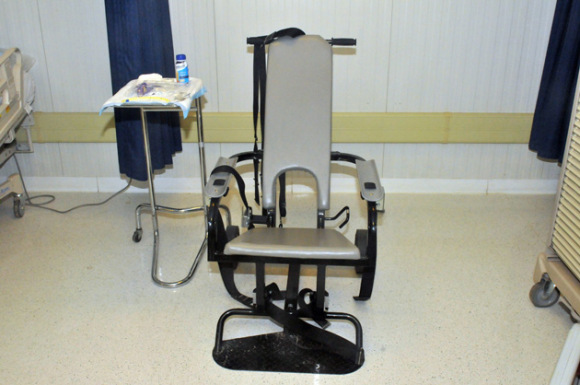
(Photo of a force-feeding chair used at Gitmo taken by Sgt. Brian Godette, Army 138th Public Affairs Detachment)

Hathos Alert

And some inspiration for Cartman’s next Faith + 1 album:

Update from a reader:

It was shocking to see that mashup of Gwen Shamblin, CEO of the Weigh Down Workshop. Around 2000, she founded her own church, the Remnant Fellowship, made up of hardcore adherents of her weight-loss program. It operates like a classic religious cult, using information, emotion, and behavior control to keep members in the group. Many families have been broken up over these beliefs. I know because my wife and myself were very nearly drawn into this group and then spent years helping and counseling ex-members who had been damaged by these crazy, legalistic beliefs. And of course, the legalistic focus on food intake turns into a legalistic focus on all other behaviors by which a believer can be judged, including child discipline. You can see a few ex-member testimonies here.

The Mandate Fight Is Back

Jon Cohn covers the new attempt to kill Obamacare’s mandate:

The Republicans’ latest gambit is to propose a five-year delay, which would save the government money, and then use those funds to offset the cost of a “doc fix”—a measure to spare physicians looming cuts in Medicare reimbursements.

It’s a new and clever way to package an effort to undermine the mandate—and, through it, the law. But, of course, it has consequences. According to the Congressional Budget Office, which released an analysis of the proposal on Wednesday, pushing back the mandate by five years would mean about 13 million fewer people would have health insurance, while premiums for those buying coverage would be 10 to 20 percent higher than they would be if the mandate remained in place. The estimates were for 2018 but, CBO said, the results would be similar for each of the previous years.

Jason Millman relays what both sides are saying:

People can avoid any penalties if they “experienced another hardship in obtaining health insurance.” This language is pretty broad. And those who claim hardship don’t have to provide documentation. So doesn’t this mean anyone can just claim hardship and avoid the penalty for not having insurance? The GOP is arguing as much.

But the administration says these exemptions are limited, and just applying for one doesn’t guarantee you’re going to get it. Each request is processed manually, and people could be asked to provide more information or be denied outright.

Suderman argues that the mandate is fairly toothless:

In some sense, it’s like used car pricing, or cable company discounts. Officially, the price is what’s on the sticker. But if you make even a token effort to bargain, or half-heartedly threaten to cancel service, you can get the price lowered. Mostly, it’s a mechanism that allows the administration to have it both ways: Of course the mandate is absolutely essential to the law, and of course practically anyone who wants out of it can get an exemption on a hardship basis. But that approach also reveals the tough spot administration officials are in with regards to the mandate: They don’t want to remove the requirement, but they don’t really want to enforce it either.

Does Vaping Lead To Smoking? Ctd

Clive Bates takes issue with the study we highlighted last week:

The reasoning for claiming e-cigarettes do not help people quit smoking amounts to a crude non sequitur: “e-cigarettes were associated with more, not less, cigarette smoking among adults“.  More, not less… but compared to what? The study found that more smokers were using e-cigarettes than non-smokers. However, this banal observation does not confirm that e-cigarettes do not help quitting any more than finding that [Nicotine Replacement Therapy (NRT)] is used more by smokers would suggest NRT is not used for quitting. The real test of the impact of e-cigarettes is hard to gauge because it requires knowledge of what would have happened in the absence of e-cigarettes.  If you could show there is “more, not less” smoking than there otherwise would have been had e-cigarettes not become available, then that would definitely be a concern.  But of course the study does not and cannot do this, given the limitations of its methods and the available data. That doesn’t stop you claiming the following, which as far as I can see, is based on nothing at all:

“E-cigarettes are likely to be gateway devices for nicotine addiction among youth, opening up a whole new market for tobacco”

Kleiman piles on:

The editors of JAMA Pediatrics should be embarrassed by this; the methods in the piece don’t pass the giggle test. The good news is that the tobacco control research and policy community is not united on this issue, with plenty of dissent from the anti-e-cig party line. The bad news is that politicians in places such as Los Angeles have allowed themselves to be buffaloed by junk science into making junk policy.

The Left’s Favorite Bogeymen

Cillizza considers why Harry Reid has been vilifying the Koch brothers from the Senate floor:

The more he talks about the Kochs, the more — he hopes — rank and file Democrats get fired up to turn out to stick it to the Kochs. And the more — he hopes — major Democratic donors open up their checkbooks to counter the Kochs spending.

Sargent’s take:

As I noted the other day, this is all about creating a framework within which voters can be made to understand the actual policy agenda Republicans are campaigning on. … [The Koch attacks] aren’t really about the Kochs. They are a proxy for the one percent, a means through which to tap into a general sense that the economy remains rigged in favor of the very wealthy.

Waldman doubts this strategy will pay dividends:

The problem is that most Americans have no idea who Charles and David Koch are. Yet they’re already being featured in ads like this one in which we see their picture without any explanation. I’d be interested to see a poll on their name ID, but until somebody does one, I’d guess that maybe 10 percent of voters are familiar with them. Now maybe between now and November, Democrats can successfully educate enough of the voters on the Kochs to have a real impact. But it won’t be easy.

Like Cillizza, Alex Roarty thinks the target audience is donors more than voters:

Although most citizens may not know who the Kochs are, liberal activists certainly do—including the wealthy ones, from whom the Democrats are desperately trying to coax the kind of large donations that will let them push back more forcefully in TV ads. And the Kochs do complicate the GOP’s own political efforts, too, as when their company closed down a small plant in Alaska. It wasn’t a game-changer for the Alaska race, but it did allow Democrats to blast the GOP field’s ties to the brothers.

But those efforts are about mitigating the damage done by the [Americans For Prosperity’s] ads, and not necessarily a way to start scoring points of their own.

How Morrissey sees the attacks:

When asked to rank their top priority, unemployment and jobs topped yesterday’s Gallup poll list, while environmental issues and global warming didn’t even make the list. Income inequality, by the way, polled 2% at the bottom. They’re flailing, and the reek of desperation is only getting more obvious.

Update from a reader:

Ed Morrissey conveniently missed the forest for the trees. Individuals like the Koch brothers, Sheldon Adelson, Shaun McCutcheon, Jeffrey Katzenberg, and Tom Steyer are all corrupting the political process by dropping huge piles of money on political advocacy and pushing the president and Congress to listen to their opinions and sign into law policies that they support rather than listening to and signing into law policies that the voters who elected them support. This Gallup poll showed that Americans in July 2012 believed reducing corruption in the federal government was the second-most important task for the future President Obama or Romney to tackle. Conveniently, it’s also the second-most important task in the poll that Morrissey cited as well!

The Skinny On The Senate

Senate Map

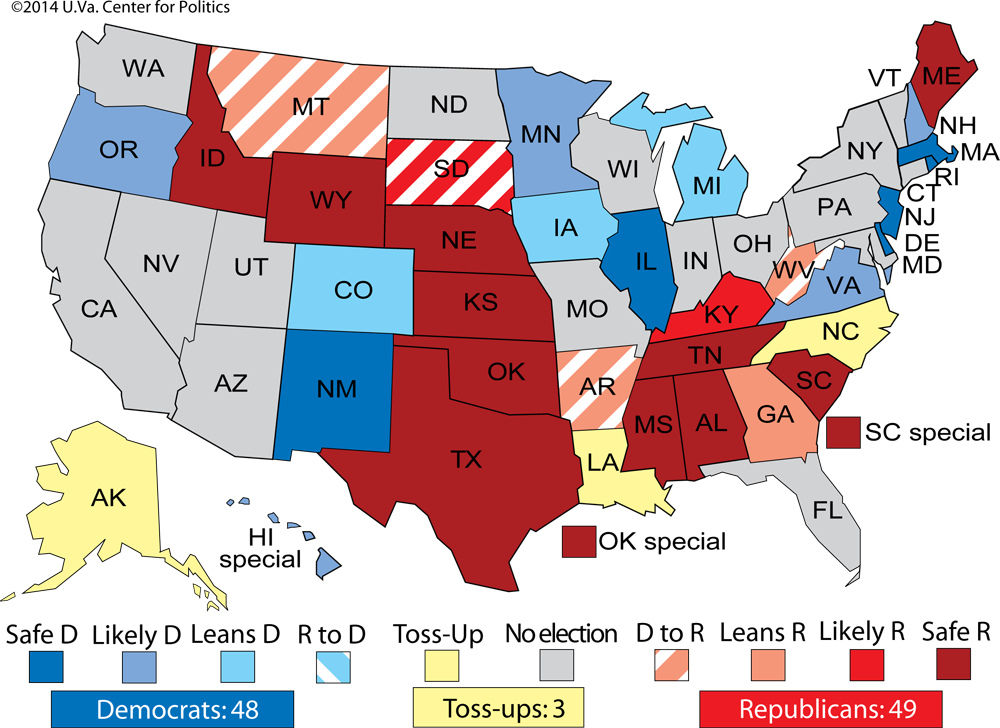
Kyle Kondik updates the Crystal Ball’s Senate map:

Democrats have to hope that Republicans continue their multiple-cycle trend of blowing winnable races by nominating bad candidates: The likeliest places for that to happen are Georgia, Iowa and North Carolina. Any improvement in President Obama’s approval rating would also help, and it remains interesting that despite the president’s weak numbers, Democrats are typically tied or slightly ahead on most generic ballot surveys measuring voter preferences in the House, which can also reflect the national sentiment in Senate races.

That might end up being thin gruel for many Democrats, particularly Senate candidates and incumbents in Red states, but it could also lead to an election that is less about a big wave and more about certain Republican-leaning states aligning their senators with their presidential preference.

Trende’s model finds that “Republicans win the Senate about 80 percent of the time”:

Why is this different from outcomes predicted by other modelers, such as Alan Abramowitz and John Sides/Eric McGhee? Part of it is that the predicted outcomes really aren’t that different. Abramowitz’s most likely outcome is a GOP pickup of six, while this model’s most likely outcome is a pickup of eight. This has great substantive importance, but in statistical terms, the findings are well within the confidence intervals of the various models.

These other models also take a much broader swath, putting results from back to the 1950s into their data set. One of the assumptions behind this model is that something has substantially changed in the past few cycles as we’ve become increasingly polarized. Red states don’t vote for blue senators except in exceptional circumstances, and vice versa. There’s some support for this in the Sides/McGhee models; if they base their predictions off of findings from 1980 to the present, instead of from 1952 to the present, they find that Tom Cotton’s chances of winning in Arkansas skyrocket.

At the end of the day, it’s important to remember that these models are largely heuristic devices, especially this far out.

Meanwhile, Scott Bland reports that Democratic fundraisers are using Nate Silver’s predictions to scare up campaign contributions:

The last time [Silver] wrote about the Senate landscape, all the way back in July 2013, [he] said Republicans “might now be close to even-money to win control of the chamber” in 2014. He also cited North Carolina as “the closest thing to the tipping-point state in the Senate battle,” and called Democratic Sen. Mary Landrieu’s seat in Louisiana “a true toss-up.”

That’s scary stuff if you’re a Democratic supporter, especially coming from an analyst whose accuracy made him a household name in the past few years. And the repeated name-dropping has probably opened some wallets for Senate Democrats.

“There’s a lot of testing, particularly for subject lines, to see what has the best open rates,” said Taryn Rosenkranz, a Democratic digital-fundraising consultant unaffiliated with the DSCC. “Using that name over and over suggests it’s successful, and people are opening and giving.”


Running Against The Family Dynasty

Kilgore compares how Rand Paul is trying to differentiate himself from Ron Paul to how George W. Bush veered away from George H.W. Bush:

It’s hard to imagine Rand Paul pulling off this sort of parricidal coup, particularly since these days there is no figure like Robert Novak around to signal a consensus “movement” blessing on a suspected heretic. It might require an actual public admonishment from Ron Paul to make Rand Paul kosher, so to speak.

The whole subject is also a reminder of the exceptionally tough challenge facing Wall Street’s current favorite, Jeb Bush, if he decides to take their money and run. How does he simultaneously distinguish himself from his father and from his brother, without casting some doubt on his credentials as a “family values” man? “Bush 3.0” doesn’t sound like a very compelling signature, and “Vote for the smart one” or “Vote for the REALLY conservative Bush” wouldn’t look too good on bumper stickers. I honestly don’t know how he pulls it off, unless he changes names.

High Consumer Spending

rand_drugs1

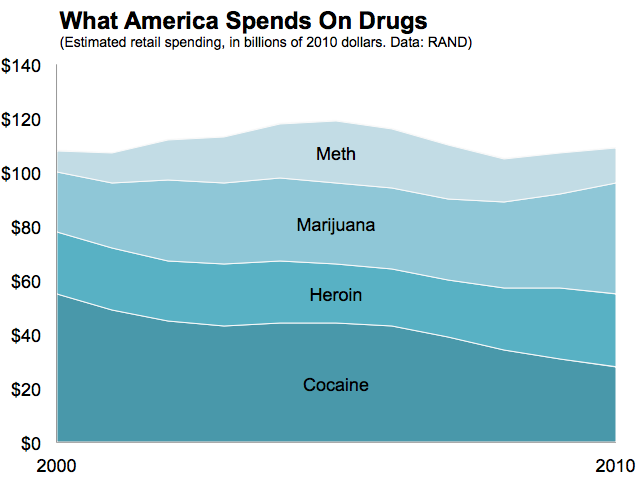
John Tozzi outlines the findings of a RAND Corporation study estimating that Americans spent $109 billion on illegal drugs in 2010:

To put that number in perspective: It’s more than we spend at furniture stores ($90 billion) or electronics and appliance retailers ($101 billion) annually, according to U.S. Census data. It’s more than one-fifth of what we spend eating out each year, and it dwarfs the $21 billion we drop at bars.

Most of that $109 billion is spent by what the RAND report calls “the minority of heavy users,” who get high during at least 21 days of a month. And while the total dollars spent (adjusted for inflation) remained roughly stable from 2000 to 2010, the mix has changed. Cocaine use has gone down; marijuana use has gone up. Meth peaked in the middle of the Aughts, though the report’s authors caution that the meth numbers are less reliable than other estimates.

Zoë Schlanger discusses the study’s limitations:

[G]athering data on undocumented dollar amounts spent on illegal drugs is extremely difficult. RAND’s numbers acknowledge a significant amount of uncertainty. For example, RAND’s best estimate of marijuana spending in 2010 is $41 billion, but it pegs the possible range of spending at $30 billion to $60 billion. For cocaine (crack and powder) RAND’s best estimate is $28 billion, with a range of $18 billion to $44 billion.

“Since there are many other sources of uncertainty, readers should not consider these as lower or upper bounds or as 95-percent confidence intervals,” the report reads. “The range should be considered plausible, but not extreme.”

Noting that the study counted far more regular heroin users than the National Survey on Drug Use and Health, Mike Riggs compares the data sources:

[R]esearchers suggest that one reason for this disparity may be that the NSDUH survey underestimates heroin use by an eye-boggling amount. “Estimates from the 2010 NSDUH suggest there were only about 60,000 daily and near daily heroin users in the United States,” drug policy researchers Beau Kilmer and Jonathan Caulkins, both of the RAND Corporation, wrote in a recent editorial. “The real number is closer to 1 million.” …

Kilmer and Caulkins came up with their much higher figures for heroin and hard-drug use by combining county-level treatment and mortality data with NSDUH data and a lesser known government survey called the Arrestee Drug Abuse Monitoring Program. Instead of calling people at home and asking them about their drug use, the ADAM survey questions arrestees when they’re being booked and tests their urine. “ADAM goes where serious substance abuse is concentrated — among those entangled with the criminal justice system, specifically arrestees in booking facilities,” Kilmer and Caulkins write.