Map Of The Day

Vaccine Rates

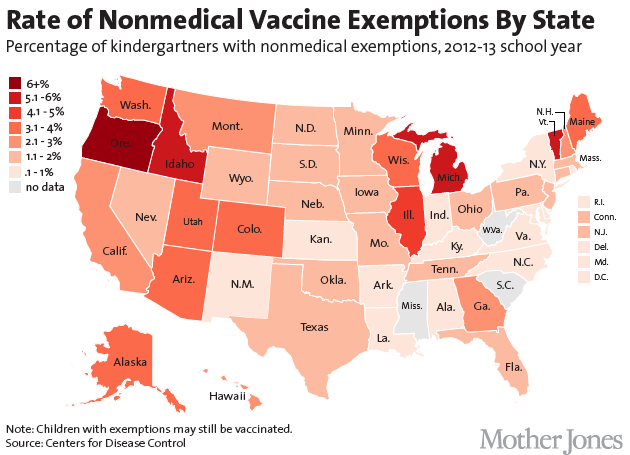
Tasneem Raja and Chris Mooney compare state-by-state data on vaccine exemptions:

There’s evidence that tightening exemption laws makes a difference. After reaching an exemption rate of 7.6 percent in 2009, Washington state passed a law requiring parents to get a doctor’s signature if they wanted to opt out of their children’s vaccinations. In just two years, the exemption rate plummeted by more than 40 percent. Pertussis vaccination ratesclimbed to 92.4 percent in the past school year, representing “the highest pertussis vaccine completion rate for kindergartners since the state began to collect this data in the 2006-2007 school year,” according to the Washington’s Department of Health.

Razib Khan examines the data for patterns:

[R]ather than a standard Left-Right axis, I think we’re seeing a “crunchy counter-culture” sentiment.

Slap-Happy In Topeka

A Kansas lawmaker is concerned that parents and teachers aren’t hitting children hard enough:

Democratic Rep. Gail Finney has introduced a bill that would allow parents, teachers and caregivers to spank children hard enough to leave redness or bruising. Under current state law, spanking that does not leave marks is already permitted. … Finney’s bill would allow “up to 10 forceful applications in succession of a bare, open-hand palm against the clothed buttocks of a child and any such reasonable physical force on the child as may be necessary to hold, restrain or control the child in the course of maintaining authority over the child, acknowledging that redness or bruising may occur on the tender skin of a child as a result.”

The chairman of the House Corrections and Juvenile Justice committee says they won’t even consider the bill. Other states, however, have laws on the books that are even more spanking-friendly:

Yes, it’s all the usual suspects. As of 2013: kids are still getting paddled (yes, paddled) in Georgia, though that’s declining in MississippiFlorida banned paddling elementary school students and then un-banned it. A city in Tennessee almost banned corporal punishment, then decided to do more research. In 2012, there was an uproar in Texas when two male assistant principles paddled two girls so hard they had bruises. Parents thought it was inappropriate for men to paddle girls without a same sex administrator in the room. As long as the paddler can prove they’re beating the paddlee for “discipline,” it’s all legal.

The Best Of The Dish Today

Arizona’s legislature passed the bill today allowing anyone in the state to discriminate against anyone else if their religious convictions demand it. My favorite quote from the debate was from the Republican sponsor of the bill, when challenged to answer whether it would sanction firing gay employees:

A business owner can already decide not to hire somebody who is gay or lesbian. This doesn’t change that.

Oh that’s all right then. Nothing to worry about. I’ll be fascinated to see if Governor Brewer decides to sign the law (she vetoed a similar measure last year). I’ll also be interested in what Senator John McCain has to say about this. Does he believe it’s now fair game to cite religion as a reason to refuse to offer any public accommodation or private employment? Can Catholics now openly discriminate against Protestants? Can Protestants now discriminate against Latinos now because they are largely Catholic? Are Jews now fair game as well?

I noted today how anti-Christian such laws are – an almost text-book modern case of what Jesus decried among the Pharisees of his day. We covered the unrest in Venezuela – a topic somewhat overlooked in much of the media; and wondered what on earth we can do about Russia’s attempt to keep Ukraine under Putin’s fascist thumb. Plus: Coke rips off the New Yorker. And how the Jews created Superman (or something like that).

The most popular post of the day remained “What The Hell Just Happened In Kansas?” (1.7 million pageviews so far), followed by “The Death-Throes Of the Anti-Gay Movement.

The doggie-video above? It cheered me up. Arizona got me down.

See you in the morning.

Email Of The Day

[Re-posted from earlier today]

A reader writes:

Just a quick note. I have read your blog for many years now.  I was an initial subscriber and also re-subscribed (for $40) for the new year.

howler beagleI’m getting spoiled by the no ads. In fact, since I’m so used to no ads, it is getting annoying to read other online content with ads. I regularly (at least used to) visit the Huffington Post. It is getting ridiculous how slow their site is becoming with all the extra crap. It’s getting to the point I don’t visit as much. I have a very fast machine with very fast Internet. It doesn’t help. It will sometimes take 30 seconds before all the content loads and I can actually scroll down and read the story.

In short, thanks for keeping your site clean. It is SO worth the subscription.

We feel the same way. Because so many other sites do not have any actual subscription revenue, and because revenue from ads keeps declining, the prevalence of sponsored content and ads and sponsored links will, I’m pretty sure, continue to proliferate. We started with the luxury of a very loyal readership, which enabled us to head off in the opposite direction to the herd when we went independent. That was a high-risk decision at the time; it’s been a high-reward move a year later.

As for an update, the revenue renewal rate is pretty steady at 105 percent over 2013. February’s revenue is now higher than last year – and we have a week to go. And our traffic in February – just under 2 million unique visitors so far – is currently the highest since we went independent. The potential for creating a space for vibrant, accessible, online journalism that is not overwhelmed by advertizing or pseudo-advertizing is real. Subscribe here – and help us maintain one of the highest signal-to-noise ratios on the web.

Update from a reader:

I’m rather red-faced that it’s taken this long, but I finally renewed my subscription. In honor of the age I’ll reach in three months, I renewed at $60. Why did it take so long? Who knows. Laziness, an attitude of I’ll-do-it-later, maybe a naïve assumption I didn’t click on READ ON all that much. Well, let me tell you something – these past few weeks have reminded me I click READ ON all the time. I was going through withdrawal not being able to read the full text of just about everything in The Dish. Being part-Ukrainian, and trying to devour your news about the protests in Maidan, I had to act. Withdrawal symptoms are lessening now.

America Slowly Sours On Afghanistan

gallup_afghanistan_2-14

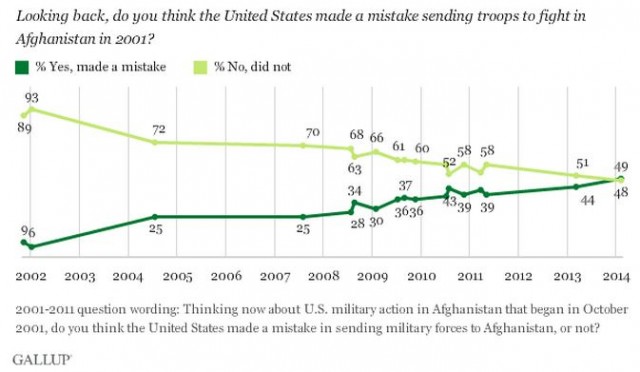
Paul Waldman is pleased that a plurality of Americans now see the war in Afghanistan as a mistake:

We’ve now amassed over 2,300 American dead there, in addition to the hundreds of billions of dollars we’ve spent. We didn’t get Osama bin Laden when we invaded. Our “partner” Hamid Karzai increasingly looks like he has lost his mind and is determined to make sure that when American troops leave later this year, the country will promptly get taken over by the Taliban again. So it isn’t too surprising that so many Americans are asking what the whole thing was for.

But it has taken us an unusually long time to come to that conclusion:

Just take a look at Gallup’s polling data from the four major U.S. wars since 1950. In comparison, the Afghanistan conflict actually took quite a long time for a plurality of Americans to consider it a mistake.

It took two years or less for public opinion to turn on the wars in Korea, Vietnam, and Iraq. The 12-plus it took for Afghanistan is practically a lifetime. And when you track the course of the Afghanistan War’s popularity compared to the Iraq War’s, it appears much more stable (and higher overall). Support for the Iraq war has fluctuated since mid-2004, and a majority of Americans have considered it a mistake since 2007.

Seeing The World As A Prodigy

A short documentary profiles Victoria and Zoe Yin, sisters who are both art prodigies:

Scott Barry Kaufman describes research that “investigated the cognitive profiles of 18 prodigies,” a sample set consisting of eight music prodigies, five math prodigies, and five art prodigies:

In terms of total IQ score, math and music prodigies had a significantly higher total IQ score than the art prodigies:

Math Prodigies: Average IQ= 140; Range= 134-147
Music Prodigies: Average IQ=129; Range=108-142
Art Prodigies: Average IQ= 108; Range=100-116

The math and music prodigies scored higher than the art prodigies on tests of general cultural knowledge, vocabulary, quantitative reasoning, and visual spatial ability. Surprisingly, the art prodigies displayed below average visual spatial skills (average visual spatial IQ = 88; Range=82-94). This finding suggests that the kind of mental visualization skills tested on IQ tests does not adequately capture artistic talent.

As a possible explanation, [psychologist Joanne] Ruthsatz and colleagues discuss research suggesting the key role of attention in the development of artistic talent. Artistically talented children tend to actively focus on the forms, shapes, and detailed surface features of their environments. As a result, the visual information around them is better and more selectively encoded, and they are able to remember those details while drawing. This skill may be at odds with the visual spatial skills tested on IQ tests, which highlight categories, concepts, and holistic perception at the expense of detailed-oriented perception. Consistent with this account, one of the art prodigies explained to the researchers that she uses her extraordinary memory to conjure images in her mind while painting. She remembers such details as how shadows fall on an object and is able to paint the entire scene from memory building up from those details.

Raped Where Rape Doesn’t Exist

In a lengthy, detailed investigation, Kiera Feldman interviews victims of sexual assault at Patrick Henry College, the bastion of evangelical elites, and describes how the college’s fundamentalism makes it hard for them to get justice:

Last September, the school chose Dr. Stephen Baskerville, a professor of government, to deliver a speech that the entire student body was required to attend. He argued that feminism and liberalism have transformed the government into “a matriarchal leviathan.” The result, he said, according to a copy of the speech, was a society plagued by politically motivated “witch hunts” against men—while “the seductress who lures men into a ‘honeytrap’ ” was really to blame. “Recreational sex in the evening turns into accusations of ‘rape’ in the morning, even when it was entirely consensual,” Baskerville explained. “This is especially rampant on college campuses.” (In a statement, PHC said Baskerville’s speech was “an exercise in academic freedom” and not “endorsed by the administration.”)

“When you have a culture of license where you can’t tell the difference between what’s full rape or fake rape and what’s real rape,” PHC journalism professor Les Sillars added during the post-speech Q&A, “it makes dealing with real rape really, really hard.”

Researchers estimate that one in five American women is sexually assaulted in college, and Patrick Henry College’s unique campus culture has not insulated the school from sexual violence. In fact, it puts female students, like Claire Spear, in a particular bind: How do you report sexual assault at a place where authorities seem skeptical that such a thing even exists?

Hanna Rosin, who wrote the book on PHC, comments:

Patrick Henry statement says the expected things: that they don’t “elevate one gender above the other” and that they don’t view women who experience sexual abuse as “deserving of their fate.” But the problem is baked into their philosophy. An “innocent” woman in their context is one who never ever breaks the rules, which would mean never getting in a car or sitting on a bed with a boy. That’s where Patrick Henry shares borders with Andrea Dworkin: all sex is at some level a violation of women. But that line, whether it comes from an evangelical or a feminist, is unlikely to foster a situation where college kids or their administration can make reasonable decisions about what constitutes sexual assault.

Dreher passes along an e-mail from a recent PHC alumna, disputing Feldman’s characterization of the school’s culture:

The TNR piece said women interested in government or leadership are viewed as “unmarriageable.” Nothing could be further from the truth—my smartest, most politically savvy, strong-willed female friends are either dating, engaged, or married (with a couple exceptions, and those women have turned down multiple requests). The meek, frightened, abused woman in the TNR  piece just doesn’t exist: at least not at the fault of the school. There may be larger, familial issues there, but it’s not an issue of institutional patriarchalism.

And Leah Libresco puts Feldman’s report in the context of sexual assault on college campuses in general:

Patrick Henry’s Christian ethos informs the tone in which these students were brushed off (you’d be unlikely to hear concerns about purity at a public or secular private school), but the alleged underlying betrayal is more attributable to being a university than a Christian one in particular.

Treating Patrick Henry’s crisis as unique because of its singular status as a private, Christian school (one of only four private colleges in the country that decline federal funds and, thus, aren’t regulated under Title IX) masks a broader problem with administrations’ treatment of students in crisis, one that isn’t limited to sexual assault.

Is Moderation Killing British Democracy?

TMC1

Rob Ford (no, not the crack-smoking one) thinks the UK could use a dose of American-style polarization:

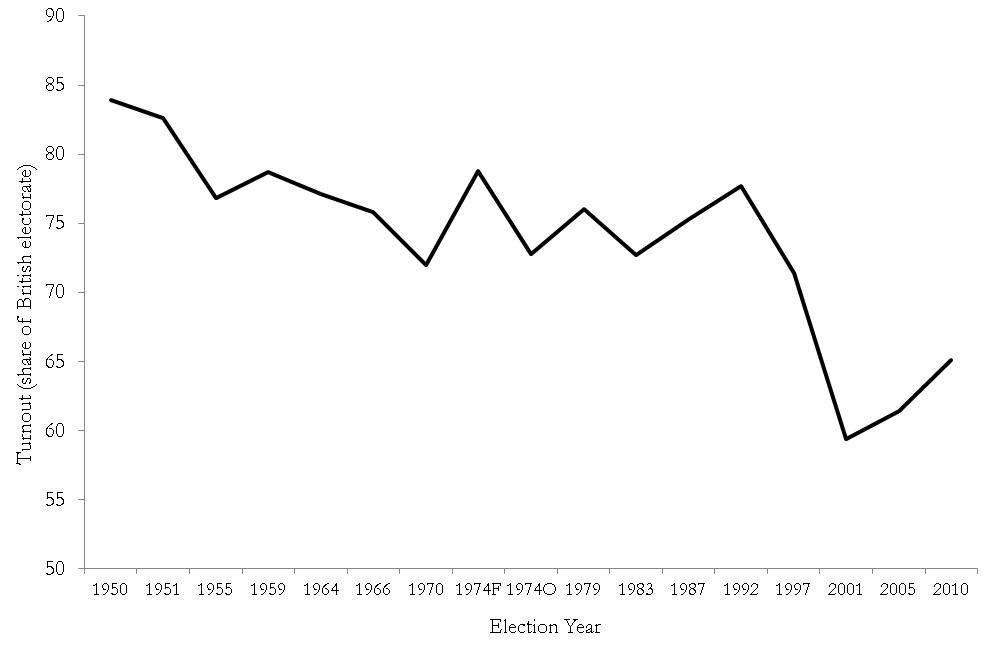
The British have been governed for 20 years by pragmatic parties, focused on the center and happy to steal each other’s ideas. Has this made for a contented electorate? Not at all. Turnout in British elections has slumped since this convergence began, as the figure below shows, leading to debate about a crisis in British democracy. Between 1992 and 2001, nearly one in five British voters stopped showing up on polling day, and most have not returned. Trust in politicians and satisfaction with politics have also fallenParty identification and party memberships have collapsed to their lowest levels in modern history. Growing numbers of voters now either ignore politics entirely, or express their hostility to the mainstream parties by backing the radical new entrant, the United Kingdom Independence Party (UKIP). After 20 years of rising polarization, America’s voters hate their politicians. Yet, after 20 years of steady moderation, Britain’s voters seem to hate their politicians too. What is going on?

Polarization leaves moderate voters without a voice in politics; centrism leaves voters at the extremes without a voice, and similarly unhappy about it, as recent research illustrates. What’s more, centrism may be more of a problem for parties, because political activists tend to hold more extreme views. Moderation may bring parties closer to the average citizen, but it also hollows them out, starving them of the activists and funders they rely on to communicate with voters.

But there’s a lot of noise in this model. Two other factors, among many, to take into account: the exposure of corruption in the political classes in the last decade – from the MPs’ expenses scandal to the collusion of government, media and police in phone-hacking; and the general affluence and civil peace that was the norm from the early 1990s to 2001. When things are hunky-dorey, politics becomes blessedly less essential. Then look at the very peak of participation in the 1950s. This was an era of bipartisan consensus unlike any other before or since: it even had its own name – “Butskellism” – a combination of the moderate Tory grandee, Rab Butler, and the Labour leader, Hugh Gaitskill, whose views were pretty close to indistinguishable.

Trinkets Of Genocide

Goldblog visited the Dachau gift shop:

I admire the country’s willingness to memorialize its atrocious past and to make sites like Dachau accessible to tourists, especially when compared with Austria’s unwillingness to do the same. But I’m not sure I’ll ever warm up to the idea of concentration camp gift shops, particularly those that sell Woody Allen biographies. (The last time I visited Yad Vashem, the Israeli Holocaust memorial, the gift shop was selling key chains, so this isn’t just about Germany.) In the absence of dispositive answers but knowing a bit about how modern-day German culture objectifies Jews in odd and somewhat disconcerting ways, my best guess is that these biographies are meant to suggest to visitors, especially German ones, that Jews are, in fact, really quite excellent — for one thing, they’re funny! — and therefore the Nazis were idiots for trying to annihilate them.