
Las Croabas, Puerto Rico, 3.35 pm
Las Croabas, Puerto Rico, 3.35 pm
Timothy George argues that Lincoln was “the most spiritually minded president in American history”:
So why did he never join a church himself? Two reasons. First, he was offended by the religious rivalry and braggadocio of the frontier preachers of his day. None of them made a compelling case to his lawyerly mind that only one denomination was right and all the others wrong. Further, Lincoln was reticent, “the most shut-mouthed man I know,” as his law partner William Herndon said. He did not want to cross the thin line between sincerity and self-righteousness. There was nothing smug about Lincoln’s faith.
Lincoln’s great achievement was to see the terrible times through which he lived in the context of God’s providential purposes. He referred to America as the almost-chosen nation and came to see himself as a “chosen instrument in the hands of the Almighty.” His firm belief that God is concerned for history and reveals his will in it drew on the wisdom of the Hebrew prophets, the teachings of the New Testament refracted through the tradition of St. Augustine, and the Calvinistic Baptists among whom he grew up. Though he read Voltaire as a young man, he had no interest in a deist God who dumbly peers down on human struggles. The God of Lincoln meets us in judgment and mercy and in the crucible of suffering that shapes the destiny of us all.
[Re-posted from yesterday]
Here’s the latest data, as of this morning, for Dish revenue since our independence over a year ago:

You’ll remember that we managed to beat January 2013’s total last month. And we’re at the very brink of equaling all of February 2103’s by the end of today. The total last February was $105,500. As of this writing, we’re at $104,800 on February 15. Can we beat last February in almost half the time? Help us get there. Subscribe here.
By the way, the total number of auto-renewing subscribers is now 26,070. There’s no other online-only journalism site with that kind of subscriber base. We really are building the future of the web – without pageview whoring, sponsored content, auto-playing videos, pop-ups, slide-shows and corporate propaganda. If you value all that white space, and a time each weekend for less frenzied cultural and intellectual coverage each weekend, then help us make this model truly lead the way for others.
Subscribe here. Under $2 a month or more if you love us. Update from a new subscriber:
Sorry it took so long. I just checked my email archives and the first email I sent you was on 9/7/06 (to your AOL account?!). I’ve been reading steadily since then, so really I should have been one of the first people to sign up. Keep up all the great work. Your blog is the only site I read on a regular basis now.
Another subscriber:
I just got a friend a year of the Dish for her birthday tomorrow. I had to search the “gift the dish” page though. That shit should be a “keeper” on the right side of the page, no?
It’s actually right there in the sidebar, in cartoon form between our Keeper Archive and our Recent Threads (unless you aren’t signed in). The gifting link is here for quick access. One more update:
Sorry it took me so long to renew, but life has gotten in the way recently with a death in the family andit’s been hard to make time for the little things. I chipped in forty bucks this go ’round, an arbitrary number that I could probably
explain by saying that I’ve paid that much before for dead-tree magazine subscriptions, ones that don’t give me a full magazine’s worth of reading EVERY GODDAMN DAY.
Regardless of what’s going on in life, and in fact often specifically because of what is going on in life, I always, always make time for The Dish. There are few things that I consistently derive as much pleasure and interest from as this blog. Y’all have a good thing going here and you managed to cycle through your first year as a free agent without screwing it up. If anything y’all keep getting better.
On Saturdays I eagerly await my Window View contest and on Tuesdays I look forward to the reveal. On any given day my wife and I cull a topic for discussion. The running threads are wonderful and well-curated. Through the years you’ve posted some of my emails (and thankfully ignored some of the shitty ones), and I feel this is a truly unique community with the best moderated dialogue on these here Internets. And there’s an ever-creeping dose of sports now! Last week you even posted my wife’s VFYW pic. In a word, neato.
Thanks again for all you and your team do. I’m happy to stay onboard and love knowing that on any given day I get to help steer this fucker.
Now do make some t-shirts.
Stay tuned.
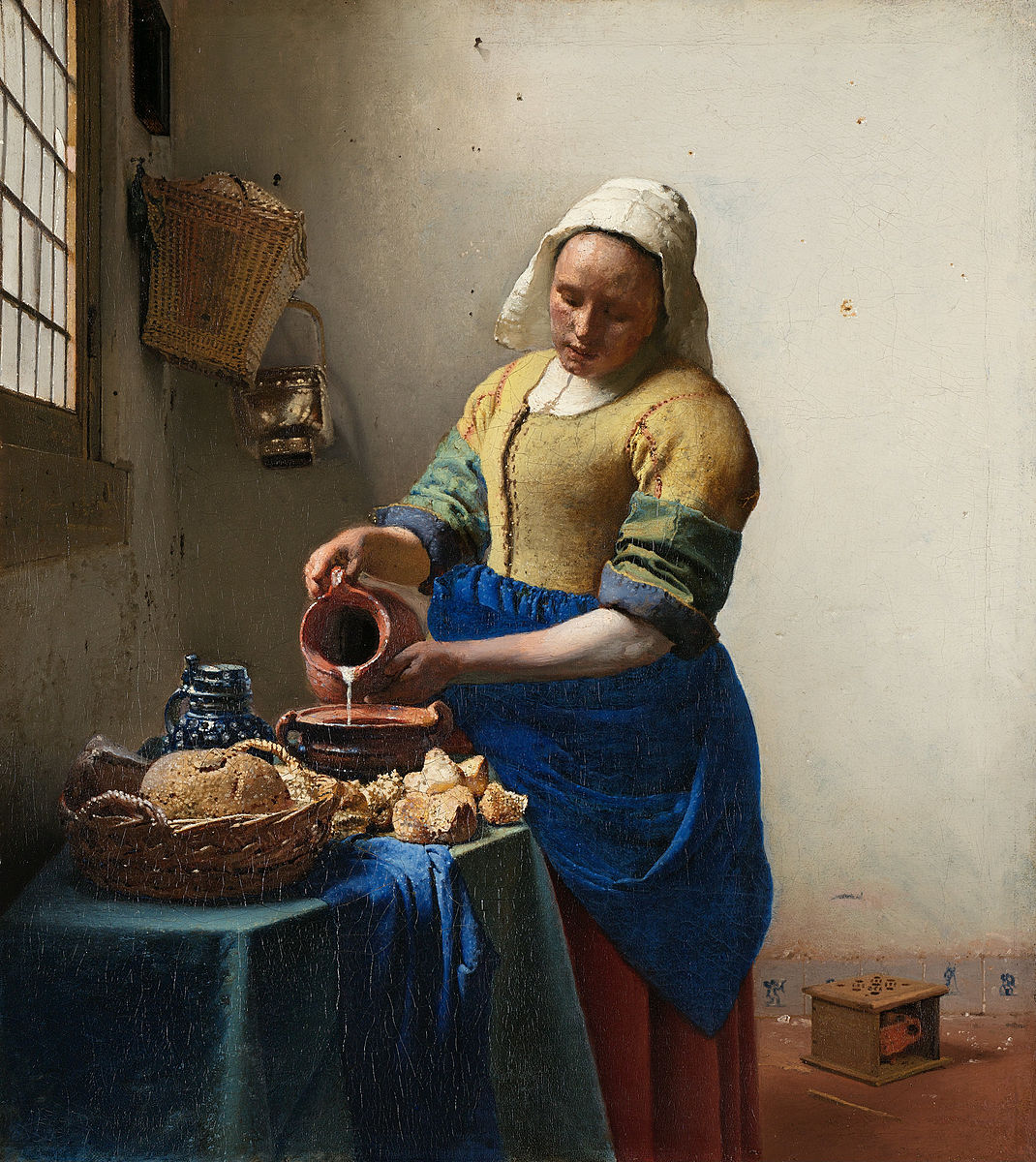
Morgan Meis marvels at the ability of Johannes Vermeer to portray people in “various states of attention, of self-awareness and of the immediate moments just before or just after becoming self-aware,” instances he terms “threshold moments.” He goes on to explore the painter’s interest in the sacred:
Even in the Vermeer pictures that do not expressly take up religious themes or
imagery, the quality of the sacramental is unmistakable once you know how to look for it. It is there in the gentle, attentive, worshipful manner in which the maid pours out the milk from the jug. It is there in the incredible presence of the woman who puts on a pearl necklace. As the writer Siri Hustvedt once noted of this painting, “Vermeer brought the miraculous into a room just like the rooms he knew, and he endowed the features of an ordinary woman with spiritual greatness. “Woman with a Pearl Necklace” is a painting that makes no distinction between the physical and the spiritual world.” It is that lack of distinction between the physical and spiritual world that creates the sense of mystery. You know you are looking at something more than what you seem to be looking at. Threshold moments are, in Vermeers, hidden and obvious simultaneously. It is not Vermeer’s intention to pull away the veil, to reveal the hidden structure of these daily sacraments. It is his purpose to show them to us as hidden and as right there, eternally holy in their sacramental character.
Update from a reader:
Here is another, less serious look at Flemish portraits; the artist has done magical things with items at hand while on an airplane.
Previous Dish on Vermeer and his methods here, here, and here.
(Image of The Milkmaid by Vermeer, c. 1660, via Wikimedia Commons)
Brad Leithauser considers the power of sparse verbiage in literature. He takes Hemingway’s The Old Man and the Sea as an example:
His hero, the aged fisherman Santiago, was once a figure of legendary prowess and strength up and down the coast of Cuba. … Santiago is also, explicitly, a Christ figure, and the sea he journeys on is saline as well as, potentially, salvational; he sails the waterways of the human soul. Of course, Hemingway understood that linking Santiago and Jesus would irk readers. Some critics lambasted him for heavy-handedness, or even for blasphemy. Still, Hemingway, showing his typical belligerence toward critics, wrote the following sentence to describe the moment when Santiago makes a sound—“Ay”—as marauding sharks arrive to feast on the fish that Santiago has so painfully, miraculously secured: “There is no translation for this word and perhaps it is just a noise such as a man might make, involuntarily, feeling the nail go through his hands and into the wood.” You can almost hear the author declaring “And screw you …” to his critics as he set the words down.
And you can hear something else, far nobler. For this is the moment of the book’s greatest daring. It’s what might be called the incarnational instant, the one in which Santiago enters the body of Christ, or Christ the body of Santiago, and the divine flesh gasps, as it did on the Cross, at the agony and the betrayal of earthly existence. I first read the sentence in my teens, and still recall self-defensively closing my hands as the words struck home.
Josh Jones spotlights a few video adaptations of Plato’s famous allegory:
The ever-flickering lights, the ever-present screen, the stupefied spectators immune to a larger reality and in need of sudden enlightenment—Plato’s allegory of the cave from Book VII of The Republic is a marketing department’s dream: it sums up an entire brand in a stock-simple parable that almost anyone can follow, one that lends itself to compellingly brief visual interpretations…. [T]he award-winning three-dimensional renderings of the prisoners and their nonstop nickelodeon in the Claymation Cave Allegory [above] offers dramatic close-ups of the chained prisoner’s faces and the hypnotic movement of firelight over the cave’s rock walls.
The works of David Foster Wallace inspired Joseph Winkler to return to the Talmud after falling away from Orthodoxy:
Through it all, from the religious passion to the expansive freedom of a secular life, I remained devoted to the works of Wallace. His voice—restless, wild, voracious, endlessly curious, reflective, and most important, unabashedly genuine—always made me feel less lonely, comforted in my self-doubts, and invigorated in my thoughts. He challenged readers to challenge themselves, assuming that the deepest questions belong to the province of everyone and that above all, past the religious, sexual, societal divides, we all desire deep intimacy despite the cynicism of our culture. He was also the smartest and funniest writer I ever read, and he expanded my intellectual tastes and desires. As I left the religious world, Wallace provided a sense of grounding in a world largely new to me, and his playful curiosity served as a guide through the secular culture I chose to embrace. When he hanged himself on Sept. 12, 2008, I instinctively went into shiva mode.
Wallace, in hindsight, besides his Talmudic nature, was always a rabbi to me, in a post-postmodern world where old values only meant anything if you so chose. In a new world in which I couldn’t believe in old dogma, his work still tackled morality, the nature of belief, obligations, responsibility, and the human spirit.
In an essay claiming Wallace was some manner of conservative, James Santel plumbs related themes:
What strikes me as absent from Wallace’s essays isn’t sincerity or even necessarily optimism; what’s missing is faith.
Wallace was narrowly correct in saying that we’re all marooned in our own skulls, and that we ultimately have to make up our own minds about things. But most of us draw a line where Wallace couldn’t in his interview, just before “true empathy’s impossible.” If by “true empathy” Wallace means total inhabitance of another’s inner workings, then yes, true empathy is impossible. But most of us don’t go there. In order to get along in life, we put our faith in the good will of people we love, or in higher beings, or in the rule of law, or in inspiring public figures like John McCain and Barack Obama. Some of us even put our faith in literature.
This is the real tragedy of Wallace’s conservatism. It entailed a curious blindness to the extent to which his writing, imbued as it was with the rare ability to dissect contemporary problems with humanity and humor, reached people, inspiring in his readers a rare devotion born of the sense that Wallace was speaking directly to them. (If you need evidence of this, look at the memorial to Wallace on the McSweeney’s website.) And yet Wallace, widely regarded as the premier literary talent of his generation, ultimately had little faith in his chosen medium. Heavily influenced by Wittgenstein, he saw language as at best the faded messages we seal into bottles and toss into uncertain waters from our little desert island, hoping they reach someone else’s. Wallace (“It goes without saying that this is just one person’s opinion”) could never totally buy into this project. “It might just be that easy,” he told his interviewer in 1993. But for Wallace, blessed and cursed with that endlessly perceptive mind, it was never that easy.
Nicolaus Wegner spent the summer of 2013 photographing the storms over the northern Great Plains:
In a long review of Sam Harris’ Free Will, Daniel Dennett squirms at the practical, political consequences of full-throated determinism:
Harris, like the other scientists who have recently mounted a campaign to convince the world that free will is an illusion, has a laudable motive: to launder the ancient stain of Sin and Guilt out of our culture, and abolish the cruel and all too usual punishments that we zestfully mete out to the Guilty. As they point out, our zealous search for “justice” is often little more than our instinctual yearning for retaliation dressed up to look respectable. The result, especially in the United States, is a barbaric system of imprisonment—to say nothing of capital punishment—that should make all citizens ashamed. By all means, let’s join hands and reform the legal system, reduce its excesses and restore a measure of dignity—and freedom!—to those whom the state must punish. But the idea that all punishment is, in the end, unjustifiable and should be abolished because nobody is ever really responsible, because nobody has “real” free will is not only not supported by science or philosophical argument; it is blind to the chilling lessons of the not so distant past. Do we want to medicalize all violators of the laws, giving them indefinitely large amounts of involuntary “therapy” in “asylums” (the poor dears, they aren’t responsible, but for the good of the society we have to institutionalize them)? I hope not.
Harris shrugs off the complaint:
These concerns, while not irrational, have nothing to do with the philosophical or scientific merits of the case. They also arise out of a failure to understand the practical consequences of my view. I am no more inclined to release dangerous criminals back onto our streets than you are.
In my book, I argue that an honest look at the causal underpinnings of human behavior, as well as at one’s own moment-to-moment experience, reveals free will to be an illusion. (I would say the same about the conventional sense of “self,” but that requires more discussion, and it is the topic of my next book.) I also claim that this fact has consequences—good ones, for the most part—and that is another reason it is worth exploring. But I have not argued for my position primarily out of concern for the consequences of accepting it. And I believe you have.

“At the Beach” by Elizabeth Alexander:
Looking at the photograph is somehow not
unbearable: My friends, two dead, one low
on T-cells, his white T-shirt an X-ray
screen for the virus, which I imagine
as a single, swimming paisley, a sardine
with serrated fins and a neon spine.I’m on a train, thinking about my friends
and watching two women talk in sign language.
I feel the energy and heft their talk
generates, the weight of their words in the air
the same heft as your presence in this picture,
boys, the volume of late summer air at the beach.Did you tea-dance that day? Write poems
in the sunlight? Vamp with strangers? There is
sun under your skin like the gold Sula
found beneath Ajax’s black. I calibrate
the weight of your beautiful bones, the weight
of your elbow, Melvin,on Darrell’s brown shoulder.
(From Crave Radiance: New and Selected Poems © 2010 by Elizabeth Alexander. Reprinted with kind permission of Graywolf Press. Photo of Fire Island in the autumn by Harvey Barrison)
 The Dish
