Arming The Kurds

by Jonah Shepp

The US has begun providing weapons directly to Kurdish forces in northern Iraq, in a break with our longstanding policy of only selling arms to the government in Baghdad:

The officials wouldn’t say which U.S. agency is providing the arms or what weapons are being sent, but one official said it isn’t the Pentagon. The CIA has historically done similar quiet arming operations. The officials spoke on condition of anonymity because they were not authorized to discuss the operation publicly. The move to directly aid the Kurds underscores the level of U.S. concern about the Islamic State militants’ gains in the north, and reflects the persistent administration view that the Iraqis must take the necessary steps to solve their own security problems. A senior State Department official would only say that the Kurds are “getting arms from various sources. They are being rearmed.”

This move is typical of Obama’s decisions in Iraq so far: sensible, realist, but a bit late. Imagine if we had decided to arm the Kurds months ago, when ISIS was merely threatening to completely destabilize Iraq, as opposed to today when it has already done so. On the other hand, of course, these decisions are not made in a vacuum, and it may have been politically impossible to do so at the time, even if Obama had wanted to. Now, with Iraq’s government in a state of total chaos, dealing with Kurdistan as an effectively independent entity makes even more sense, and it doesn’t really matter anymore if we upset Maliki. And if this really is Kurdistan’s moment, why stand in the way of the inevitable? So three cheers to the peshmerga, and let’s hope this works. Cale Salih also thinks it’s about time we threw our full weight behind the Kurds:

Obama needs the Kurds, and he knows it. They are largely secular and pro-Western, but also maintain dynamic ties to both Iran and Turkey. They offer a potential base from which the US can stage counterterrorism operations against Isis. Iraqi Kurdish parties have links to Kurdish groups in Syria, and Kurdistan Worker’s Party-affiliated Syrian Kurds have been one of the only militias able to effectively fight Isis there. Kurdistan is a much-needed safe haven for refugees from Syria, and internally displaced people from other parts of Iraq. It offers a stable, economically prosperous buffer zone right at the intersection of several regional conflicts. A weak, unstable Kurdistan would allow Isis and other militants to more easily move between Iraq and Syria.

Spencer Ackerman saw this coming days ago, when he called the claim that the US intervention was intended to protect American personnel in Erbil “a convenient elision”, allowing us “to avoid, or at least defer, explicit preferential treatment for the Kurds”:

Conspicuously, the US has yet to attack the Isis positions threatening Iraqi Yazidis at Mount Sinjar, whose dire conditions ostensibly prompted Obama’s first step toward making the Iraq crisis an American one. On the ground by Irbil, these distinctions are less meaningful. The F/A-18s might not have explicitly provided close air support for the Peshmerga – that would require coordination between the Peshmerga and the US Navy pilots – but the strikes nevertheless provide the Peshmerga with a measure of air cover, an advantage over the better-armored Isis fighters. It rhymes with close air support, at least: the Kurds get a chance to fortify the defense of Irbil.

Judis, meanwhile, suspects that our interest in Kurdistan has a lot to do with its oil:

If the Islamic State were to take over Erbil, they would endanger Iraq’s oil production and, by extension, global access to oil. Prices would surge at a time when Europe, which buys oil from Iraq, has still not escaped the global recession. Oil prices have already risen in response to the Islamic State’s threat to Erbil, and on Thursday, American oil companies Chevron and Exxon Mobile began evacuating their personnel from Kurdistan. … The United States should worry about the global oil supply. It is important for global economic and political stability. And having a significant chunk of it fall into the hands of a group like the Islamic State should certainly be a concern. But if Obama is worried about the world’s oil supply, then he should say so forthrightly and not leave himself in a position where he will be unable to justify or explain further intervention after the airdrops to the Yazidis are completed.

Well, an intervention can be both humanitarian and strategic, and I don’t think anyone really doubts that this is both. Judis is right to warn Obama against underselling the strategic angle of what he’s doing in Iraq (others have made the same point), and it would be lovely if an American president would acknowledge the degree to which petro-politics really influences our foreign policy, but my fear is that if the anti-war left ends up spinning this intervention as another sacrifice of blood and treasure to Big Oil, that would obscure much more than it would illuminate. Judis compares the situation to Libya:

If the Obama administration wanted to prevent the world’s peoples from brutal dictators and repressive regimes or from takeovers by terrorist groups, there are other countries besides Libya and Iraq where it could intervene. What distinguishes these two countries is that they are major oil producers.

It’s not the only thing that distinguishes them, though.

What The Hell Is Maliki Doing?

by Dish Staff

Baghdad’s political crisis appears to have gone off a cliff, with the embattled prime minister in the driver’s seat. Mary Casey sums up the news since yesterday:

Maliki has accused the country’s new president, Fouad Massoum, of staging a “coup against the constitution and the political process” for refusing to designate him prime minister. On Monday, Massoum asked Deputy Speaker Haider al-Abadi to form a government. U.S. Secretary of State John Kerry said the United States supports Massoum and warned Maliki not to interfere with the constitutional process and the formation of a new government. However, an Iraqi court ruled that Maliki’s State of Law coalition is the largest bloc in parliament and should be given the first opportunity to form a new government. Meanwhile, the United States has begun to directly provide arms to the Kurdish pesh merga forces who are battling Islamic State fighters in northern Iraq. The U.S. administration had previously sold weapons only to the Iraqi government in Baghdad. U.S. airstrikes over the weekend have helped the pesh merga to retake the towns of Gwer and Mahmour.

Maliki has not only threatened to sue Massoum for neglecting his constitutional duties, but has also deployed security forces loyal to him throughout Baghdad, ostensibly to forestall a coup against him but more likely, some fear, to be ready to carry one out on his behalf (NYT):

As he spoke in the middle of the night, extra security forces, including special forces units loyal to Mr. Maliki, as well as tanks, locked down the Green Zone and took up positions around the city, heightening the sense of drama. There were no immediate signs Monday afternoon that Mr. Maliki had taken further steps to use military force to guarantee his survival. And Mr. Maliki was scheduled to make a public statement on television, along with other members of his Dawa Party who remain loyal to him. Mr. Maliki’s television appearance, in which he appeared to be trying to intimidate Mr. Massoum by mentioning the army in the context of protecting the constitution, alarmed American officials, and left Baghdad wondering if a coup was underway.

To Zack Beauchamp, this kind of strongman behavior perfectly illustrates the point Obama made in his Saturday press conference that the only permanent solution to the crisis is an Iraqi political solution. After all, Maliki’s heavy-handed dealings with Iraq’s Sunni minority played a major part in enabling the rise of ISIS:

“The Sunnis have lots of different grievances,” Kirk Sowell, a political risk analyst and expert on Iraqi politics, says. Some of these are the current government’s fault. Prime minister Maliki has treated the Sunnis badly, including forcibly breaking up a peaceful protest movement in 2013. His seemingly authoritarian turn on Sunday shows just how far Maliki remains from moving towards a more inclusive style of governance. …

While these grievances of course don’t transform Iraqi Sunnis into ISIS-style theocrats, it does make Sunni communities more open to at least seeing if ISIS will be better for them than Baghdad. And so long as ISIS has at least passive support from the Sunni population, it will be almost impossible for the Iraqi government to dislodge them from the mostly Sunni territory they hold.

This behavior has even invited comparisons to Bashar al-Assad:

“The Assad approach” is how Maliki’s detractors, both rival politicians in Baghdad and civilians caught up in the government’s fight against Sunni militants, describe the Iraqi leader’s military strategy, comparing the men’s use of military force to address internal social and political problems. In Syria, Assad’s use of military force in response to popular protests, some argue, was partially to blame for how the originally peaceful protests morphed into an armed uprising that eventually created a security vacuum in which al Qaeda-inspired militants flourished. Some Iraqis say the same is true of Maliki’s decision to clear the Ramadi protest [in January]. Some Syrians say so, too. “Sometimes I laugh when I see this Iraqi dictator following Assad’s footsteps,” said Omar Abu Leila, a spokesman for the Free Syrian Army’s Eastern Front.

Ed Morrissey throws up his hands:

Kerry’s bluster aside, the US has no real influence in Baghdad any longer, which the White House made clear with its earlier unmet demands for political reform as a prerequisite for intervention. Maliki made it official last night. The only option left to the US is to arm the Kurds to get an effective fight against ISIS, and apparently leave Baghdad to Iran. If Masum can wrest power away from Maliki and get a Shi’a PM who can work with Kurds and Sunnis, that would be terrific — but he might have to fight through Maliki’s elite forces and Moqtada al-Sadr’s irregulars to have a chance now, and the US endorsement will hardly be a boon to that cause.

And Josh Marshall takes this moment to revisit the question of whether the unitary Iraqi state is worth trying to preserve:

Many of you will rightly say, this is hardly our decision. And I agree with that. But our policy inevitably looks toward and tries to shape what we see as the preferred outcome. The US and Europe tried to keep Yugoslavia together until it obviously couldn’t be kept and then we gave up trying. At the moment we’ve kept our closest friends, the Iraqi Kurds, on a tight leash and actually have a tanker of their oil held off the coast of Texas, all to help along the move toward unity in Baghdad, which Maliki seems set on preventing.

We’re told that Maliki missed the opportunity he was given with the Sunni Awakening in 2007-08 and went back to a Shia sectarian approach to governance, in essence triggering another uprising on the order of the one from the last decade, just now in a different guise and turbocharged by the immolation of Syria. This is no defense of Maliki. But what if he’s just the symptom – the symptom of a state that can’t be held together without the tyrannical grip we liberated it from more than a decade ago?

The Empire Is Striking Back

The Obama administration is now facing a real test of its resolve in Iraq. The depressing but utterly predictable resurgence of Sunni Jihadism in a country broken in 2003 and never put back together again by the “surge” has been so successful and the Iraqi government so weak that even Kurdistan is now at risk. The policy now is to do enough – but no more – to keep the Kurds in the game, keep the Yazidis on planet earth and push the Iraqis in Baghdad to get real. I felt queasy when the president announced this intervention and feel queasier two Hillary Clinton Awarded The 2013 Lantos Human Rights Prizedays later. Even though attempted genocide creates a uniquely grave crisis, as soon as the US is committed militarily to an open-ended endeavor in that country, and is in any way dependent on the Iraqis to take the lead, then we are at the mercy of that country’s profound dysfunction once again. It is quicksand. One foot in and you start sinking.

Or you can think of Iraq as perhaps the least reformable of all welfare dependents. Chronically divided, disintegrating yet again at a particularly explosive moment in Middle Eastern madness, it will always seem on the brink of some disaster or other. The temptation to go in again – especially since we gave it tens of thousands of corpses and years of trauma to add to its chaotic polity – is great. And Obama’s signature achievement so far has been his steadiness in resisting that vortex, in defusing Jihadism rather than giving it yet more reason to be inflamed, in being that rare president capable of internalizing what most Americans want – rather than what Sunday talk show blowhards demand.

He still has a chance to do that – but it will be much, much tougher now. Give the hegemonists some blood in the water, and they will soon swarm, demanding more war, and more meddling. You can see that dynamic in the idiotic ravings of John McCain who wants a full-scale war against ISIL – or in the classic scare tactics of Butters, with the inane idea that we have to fight them over there or they will come here. It is madness as strategy – madness that already created catastrophe. But no one responsible for that catastrophe in Washington was ever held mccainmariotamagetty.jpgaccountable – they’re doing their damndest right now to make sure war criminals are white-washed as well  – and so their ability to snap back right to 2003 is intact.

And the greatest throwback to 2003 in this respect is Hillary Clinton. So far as one can tell from her interview with Jeffrey Goldberg, there is no daylight between her and John McCain or even Benjamin Netanyahu – but a hell of a lot of space between her and Barack Obama. The interview confirms my view that she remains neoconservatism’s best bet to come back with bells on. It appears, for example, that her boomer-era pabulum about foreign policy on the Jon Stewart show – “We need to love America again! –  was not an aberration. She actually means it. And once we believe in ourselves again – don’t look at that torture report! – it will be back to the barricades for another American century of American global hegemony. And why not start in Syria and Iraq? I mean: she’s already hepped up about the threat of Jihadism –  and what could possibly go wrong this time? If only we believe in America!

You know, when you’re down on yourself, and when you are hunkering down and pulling back, you’re not going to make any better decisions than when you were aggressively, belligerently putting yourself forward. One issue is that we don’t even tell our own story very well these days.

Just forget that this country destroyed its military deterrence and its moral authority by the war that Clinton favored and has never fully expressed remorse for. Forget the trillions wasted and the tens of thousands of lives lost and the brutal torture we authorized and the hapless occupation that helped galvanize Jhadism, let’s just feel good about ourselves! And do it all again!

And so try and find a real difference between John McCain and Hillary Clinton on these topics. It’s certainly the same “fight them over there so we don’t fight them over here” fear-mongering:

One of the reasons why I worry about what’s happening in the Middle East right now is because of the breakout capacity of jihadist groups that can affect Europe, can affect the United States. Jihadist groups are governing territory. They will never stay there, though. They are driven to expand. Their raison d’etre is to be against the West, against the Crusaders, against the fill-in-the-blank—and we all fit into one of these categories. How do we try to contain that? I’m thinking a lot about containment, deterrence, and defeat.

Well, actually, their raison d’etre is not to be against the West. Right now and for the foreseeable future, it is about defeating the apostates of Shia Islam and wimpy Sunni Islam. It’s about forcing other Muslims to submit to their medieval authority – with weapons left behind from the last American interventionist project. The West for these Jihadis is a long, long way away. But not for Clinton or for McCain who see Benjamin Netanyahu Chairs Weekly Israeli Cabinet Meetingevery struggle anywhere as involving the US because … America! And that’s when you realize how fresh Obama was and how vital he has been – and how in foreign policy, a Clinton presidency is such a contrast to his.

Among those most eager for a return of the past is, of course, Benjamin Netanyahu. And you see in the interview with Goldberg how closely Clinton’s views mirror his. She hits every single neocon talking point: the Israelis have no responsibility for the killing of hundreds of children because “there’s no doubt in my mind that Hamas initiated this conflict … So the ultimate responsibility has to rest on Hamas and the decisions it made.” That’s almost a paraphrase of the Israeli prime minister or Joan Rivers (take your pick of the nuance artists). And Clinton even backs Netanyahu’s recent dismissal of a two-state solution! Yep: she’s not just running to succeed Barack Obama, there are times in the interview when it seems she’s running against him:

“If I were the prime minister of Israel, you’re damn right I would expect to have control over [West Bank] security, because even if I’m dealing with [Palestinian Authority President Mahmoud] Abbas, who is 79 years old, and other members of Fatah, who are enjoying a better lifestyle and making money on all kinds of things, that does not protect Israel from the influx of Hamas or cross-border attacks from anywhere else. With Syria and Iraq, it is all one big threat. So Netanyahu could not do this in good conscience.”

Again, you see how fresh Obama was. And what more could the entire neocons wish for? Oh wait: yes! They can also get their most cherished of dreams – a new war on Iran! Listen to Clinton parrot every AIPAC trope:

“I’ve always been in the camp that held that they did not have a right to enrichment,” Clinton said. “Contrary to their claim, there is no such thing as a right to enrich. This is absolutely unfounded. There is no such right. I am well aware that I am not at the negotiating table anymore, but I think it’s important to send a signal to everybody who is there that there cannot be a deal unless there is a clear set of restrictions on Iran. The preference would be no enrichment. The potential fallback position would be such little enrichment that they could not break out.” When I asked her if the demands of Israel, and of America’s Arab allies, that Iran not be allowed any uranium-enrichment capability whatsoever were militant or unrealistic, she said, “I think it’s important that they stake out that position.”

Clinton’s position is Netanyahu’s. And that’s important to understand. If you want a United States with no daylight between it and any Israeli government, whatever that government may do, vote for Clinton. If you want someone who believes the Libya intervention was the right thing to do, vote for Clinton. If you think America’s problem is not torture or drones or destabilizing occupations or debt but that we don’t tell the world how great we are enough, then vote for Clinton. If you really long for 2003 again, vote for Clinton.

She may be the only option – if the GOP nominates a full-bore pro-torture neocon. But isn’t it amazing that after the catastrophes of the Bush-Cheney era, both parties could effectively be running neocons for the presidency in 2016! Welcome to Washington – where the past is always present, amnesia is a lubricant, and the leading Democrat is running as a neocon. That change you could believe in? Not if Washington has the final say.

The Strategic Dimension Of Obama’s Iraq Campaign

First, the good news. Some progress has been made in aiding the Yazidi refugees trapped on Sinjar Mountain:

Iraqi Kurdish security forces have opened a road to Sinjar Mountain in northwestern Iraq, rescuing more than 5,000 Yazidis trapped there after running away from fighters from the Islamic State (IS) group, a Kurdish army spokesman has told Al Jazeera. “I can confirm that we succeeded in reaching the mountains and opening a road for the refugees,” said Halgord Hikmet, a spokesman for the peshmergas the Kurdish security forces.

But with the president acknowledging that the new air campaign in Iraq will last for months (at least), there is obviously a strategic element to this intervention beyond the immediate humanitarian objective. Meghan O’Sullivan worries that by framing the campaign as primarily humanitarian, Obama risks obscuring those “equally strong” strategic goals:

Whatever the reasoning, relying solely on humanitarian arguments to justify American action could create problems for the Obama administration down the road. While the trapped Yezidis must be rescued, this is not the only objective that limited U.S. military force can and should achieve. In fact, if initial reports are accurate, the first airstrikes were not against ISIS at Sinjar mountain, which is near Syria, but against targets near Erbil, far to the east, nearer the Iranian border. Such strikes are welcome — Kurdish forces have fought alongside the U.S. in more than one war — but the rationale is more strategic than humanitarian. While Americans are unlikely to protest this distinction today, the White House may open itself up to criticism of overstepping its self-defined mandate if it continues to use limited airpower for strategic gains after the immediate humanitarian crisis is resolved.

Phillip Lohaus criticizes Obama for having no coherent strategy, arguing that he can’t take on the project of defeating ISIS while forswearing the deployment of ground forces:

Right now, the administration is only making things harder for itself. The President’s statement that he will send no additional American troops to Iraq, though politically soothing at home, also reassures ISIS that US involvement will remain limited. At home, the President has yet to explain precisely why the prospect of genocide was not reason enough to stay in Iraq in 2007, but that now, apparently, it is reason enough to strike.  Amidst this strategic confusion, it’s no wonder that the President’s foreign policy approval ratings are at an all-time low.

Let’s be clear: no one is advocating for sending hundreds of thousands of troops back to Iraq. But, as evidenced by the presence of American advisers and now air strikes, the decision of whether we should involve ourselves or not has already been made. What’s less clear is whether the President has defined his objectives and whether he is willing to dedicate what is required to achieve them.

So mission creep is a real danger here, and the president’s pledge of no ground forces is in doubt, especially if he wants to cripple ISIS permanently. Such an objective could require thousands of American soldiers:

Military experts say tactical commanders will want more ground forces. Forward air controllers could provide more precise targeting information. U.S. advisers could support the Kurdish forces fighting the militants. And U.S. commanders may need to expand their intelligence effort on the ground. In turn, U.S. forces might need a forward operating base with a security perimeter, more force protection and a logistical supply line. Medevac capabilities may require a helicopter detachment and a small aviation maintenance shed.

“You’re talking about a 10,000- to 15,000-soldier effort to include maintenance, and medevac and security,” said retired Army Col. Peter Mansoor, who served as executive officer to David Petraeus during the 2007 surge in Iraq and now is a professor of military history at Ohio State University. “But that is the price you’re going to pay if you want to roll back [Islamic State]. You can’t just snap your fingers and make it go away,” Mansoor said.

Benjamin Friedman calls the goals of the intervention “a muddle”:

The conventional wisdom in Washington is that we should aide moderate opponents of Bashir al-Assad’s government. But aiding any rebels there hurts the main Syrian force going after ISIS. We cannot foster insurgency in Syria and suppress one Iraq without contradiction.  The president says that the bombing in Iraq falls under the “broader strategy that empowers Iraqis to confront this crisis” by creating a “new government that represents the legitimate interests of all Iraqis.” He promises increased U.S. support once a new government forms. The implicit message is that if the next Iraqi government has someone other than Nouri al-Maliki heading it and takes steps to deal with Sunni grievances, more support will flow. But bombing ISIS might increase Maliki or some other Shi’ite leader’s security, reducing their incentive to give ground to Sunnis.

But Saletan doubts that this is the beginning of a new war, arguing that military intervention “doesn’t have to fit into a strategy for military victory”:

It can make sense on more modest terms, as part of a larger political process that is moving in the right direction and is driven by other players. When miscreants such as ISIS endanger that process, a timely use of force can contain the damage and preserve the momentum. We don’t have to wage a larger war in Iraq.

One of his reasons for thinking so:

ISIS will destroy itself. We don’t have to stamp out ISIS, because its growth is inherently limited. It picks too many fights and alienates too many people. It has already taken on the Iraqi army, the Kurds, the Turks, Iraqi Baathists, and many Iraqi Sunnis. Now it’s going head to head against Syria’s armed forces. As if that weren’t enough, ISIS went into Lebanon this week. ISIS also antagonizes civilians in its territory. People in Mosul are rebelling against its oppression. It won’t last.

Reihan supports the intervention but has qualms about the long-term implications:

I am a pessimist. Though I sincerely hope that the limited airstrikes authorized by the president will be enough to force ISIS into retreat, I don’t expect this gruesome war to end tomorrow. We need to start thinking about the Yazidis and the Christians and the other persecuted Iraqis who will need to find shelter somewhere other than Iraq. The United States welcomed as many as 130,000 refugees from South Vietnam after the fall of Saigon in 1975. We might have to welcome just as many from Iraq in the years to come.

And Robin Wright warns of “a broader danger”:

The direct American presence may galvanize more jihadis to the Islamic State. There was no Al Qaeda presence in Iraq until after the United States deployed troops in 2003, an act that fuelled Al Qaeda’s local appeal, on territorial, political, and religious grounds. In Iraq and Syria, ISIS is now estimated to have between ten thousand and twenty thousand fighters, including a couple of thousand with Western passports and a hundred or so from the United States.

As the United States confronts ISIS, the dangers that Americans will be targeted at home grow. Last month, the F.B.I.’s director, James B. Comey, said that the domestic threat emanating from ISIS “keeps me up at night,” that ISIS was a potential “launching ground” for attacks of the kind that occurred on September 11, 2001. The Attorney General, Eric H. Holder, Jr., told ABC News that ISIS, particularly its American jihadis, “gives us really extreme, extreme concern. . . . In some ways, it’s more frightening than anything I think I’ve seen as Attorney General.”

The Secret To ISIS’s Success

Josh Marshall passes along an email from a “TPM Reader who’s former US military intelligence/counter-terrorism ops and has worked as a military contractor in Iraq”:

Why is ISIL so successful? Simply put they attack using simple combined arms but they hold two force multipliers – suicide bombers and a psychological force multiplier called TSV – Terror Shock Value. TSV is the projected belief (or reality) that the terror force that you are opposing will do anything to defeat you and once defeated will do the same to your family, friends and countrymen. TSV for ISIL is the belief that they will blow themselves up, they will capture and decapitate you and desecrate your body because they are invincible with what the Pakistanis call Jusbah E Jihad “Blood Lust for Jihad”.

I have worked the Iraq mission since 1987 and lived in and out of Iraq since 2003. TSV was Saddam’s most effective tool and there is some innate characteristic of the Iraqis that immobilizes them when faced with a vicious, assuredly deadly foe who will do exactly as they have done to others – and they will unsuccessfully try to bargain their way out of death by capitulating. The Kurds are not immune to ISIL’s TSV -90% of which is propaganda seen on Facebook, Twitter and al-Arabiya. The Kurds have not fought a combat action of any size since 2003 and like the Iraqi Army it will take the Americans to give them the spine to get them to the first hurdle – they need a massive win to break the spell of ISIL’s TSV.

But Jonathan Freedland contends that the Islamic State’s stunning success is mostly thanks to the weakness of the Syrian and Iraqi states:

The state structures of both Iraq and Syria have all but collapsed. The result is a power vacuum of a kind that would have been recognised in the lawless Europe of seven or eight centuries ago – and which IS has exploited with the ruthless discipline of those long ago baronial warlords who turned themselves into European princes.

“Islamic State are jihadis with MBAs,” says [Iraq scholar Toby] Dodge, speaking of a movement so modern it has its own gift shop. He notes its combination of fierce religious ideology, financial acumen and tactical nous. “It’s Darwinian,” he adds, describing IS leader Abu Bakr al-Baghdadi and his inner circle as those strong enough to have survived the US hammering of al-Qaida in Iraq between 2007 and 2009. But what has been crucial, Dodge says, is “not ancient hatreds but this collapse of state power”.

But Robert Beckhusen thinks ISIS has major vulnerabilities:

Here’s the problem for ISIS. Since ISIS fighters operate semi-conventionally, they are easy pickings for these warplanes. It’s easier to hit vehicles and fixed artillery sites from the air than it is to strike individual insurgent fighters.

It’s possible ISIS has limited anti-aircraft weapons, including shoulder-fired Stingers it took from the Iraqis. Indeed, the loss or capture of a U.S. pilot is a terrifying prospect for the White House. But the bulk of ISIS’s anti-aircraft weapons are DShK and ZU-23–2 heavy machine guns that the terror group has used with brutal effectiveness against Iraq’s dwindling helicopter gunship force—but which don’t stand much of a chance against fast, high-flying fighter planes.

Others disagree that the group is vulnerable to airstrikes:

The problem, some analysts point out, is that airstrikes tend to be most helpful against troops when they are massing. As it stands now, IS is “too big and too dispersed,” argues Christopher Harmer, senior Navy analyst at the Institute for the Study of War. “They aren’t vulnerable to air strikes the way the Republican Guard was with their armored tanks and artillery tubes,” Mr. Harmer says. “Yes, ISIS has some of that – and we can hit it and should – but, fundamentally it’s a light infantry terrorist organization. You can’t beat those guys by dropping a couple of bombs here and there.”

Another way to damage ISIS is to lower its cash flow. Britain is taking steps to do just that:

Britain hopes a diplomatic initiative it introduced in the U.N. Security Council on Friday will contain Islamic extremists in Iraq and Syria by curtailing their fundraising. The plan is to quash their illicit oil and gold exports, prevent ransom kidnappings, and hobble recruitment to stymie the establishment of an Islamic caliphate straddling the two Middle Eastern countries.

How Long Will We Be In Iraq?

It could be awhile:

President Barack Obama said Saturday he doesn’t have an end date in mind for the end of American strikes targeting Islamic militants in Iraq or airdrops supporting stranded Iraqis fleeing those militants. “I don’t think we’re going to solve this problem in weeks,” said Obama told reporters before departing Washington for a family vacation. “This is going to take some time.”

If that’s true, Jack Goldsmith urges Obama to get approval from Congress:

If the President plans to engage in military operations in Iraq for “months” (and almost certainly longer) in an effort to address the militant threat posed over the long term there, then the case for doing so in reliance solely on his inherent Article II self-defense power just grew weaker, legally and especially politically, and the case for seeking authorization from Congress for the military strikes just grew stronger.  As I noted yesterday, the case for seeking congressional authorization in this context was made forcefully and persuasively less than a year ago by President Obama himself, when he explained why he was seeking congressional authorization prior to military strikes in Syria.  (The Syrian strikes were supposedly going to be “limited in duration and scope,” unlike the longer term strikes now planned for Iraq.)

Larison sighs:

As we know from previous interventions, the initial estimates of how long they will last and what they will cost are frequently wrong. If the administration expects that this “project” will last several months, it will most likely continue for a lot longer than that, and it will end up being a larger commitment that originally advertised.

Beauchamp unpacks Obama’s speech:

“Ultimately, there’s not going to be an American military solution to this problem,” President Obama said in his press conference on the Iraq crisis on Saturday. “There’s going to have to be an Iraqi solution.” This is the key line to understand if you want to grasp the administration’s approach to Iraq — and why the goals of the US military campaign are more narrow than you might think. …

If the United States can beat ISIS back in Kurdistan, why not elsewhere? That line about an Iraqi solution is the administration’s answer. In fact, the Obama administration has been consistent on this question since June, when ISIS first took control of big chunks of Iraq. They see ISIS as, at its heart, a political problem — one that can’t be solved solely with force. But the march on Kurdistan and the siege on Sinjar are narrow military problems, and thus merit military solutions. This distinction between military and political problems is at the heart of the Obama administration’s thinking on Iraq.

Obama further explained his thinking in an interview with Tom Friedman:

“I do think the Kurds used that time that was given by our troop sacrifices in Iraq,” Obama added. “They used that time well, and the Kurdish region is functional the way we would like to see. It is tolerant of other sects and other religions in a way that we would like to see elsewhere. So we do think it’s important to make sure that that space is protected, but, more broadly, what I’ve indicated is that I don’t want to be in the business of being the Iraqi air force. I don’t want to get in the business for that matter of being the Kurdish air force, in the absence of a commitment of the people on the ground to get their act together and do what’s necessary politically to start protecting themselves and to push back against ISIL.”

Back To Iraq: Blog Reax II

Waldman couches the intervention in Iraq in terms of Obama’s foreign policy doctrine, and particularly in contrast to that of his predecessor:

When he ran for president, Obama promised a new approach to military involvement overseas, one defined by limited actions with clear objectives and exit strategies. It was to be a clean break with the Bush doctrine that had given us the debacle of the Iraq War: no grand military ambitions, no open-ended conflicts, no naïve dreams of remaking countries half a world away. Of necessity, that means American military action is reactive. Instead of looking around for someone to invade, this administration has tried to help tamp down conflicts when they occur, and use force only when there seems no other option — and when it looks like it might actually accomplish something, and not create more problems than it solves.

But even though it’s designed to avoid huge disasters, this approach carries its own risks, particularly when we confront situations like the one in Iraq where there are few good options. We can take some action to keep IS out of the Kurdish north, but that might leave them just as strong, with their maniacal fundamentalism still threatening the entire region. IS is a truly ghastly bunch, with ambitions that seem unlimited. Obama said he was acting “to prevent a potential act of genocide.” What if it happens anyway, and we could have done more?

Ezra Klein focuses on how Obama expressed that doctrine in last night’s announcement:

Calling something a “genocide” has a very particular power under international law, because the US is signatory to the Convention on the Prevention and Punishment of Genocide.

The treaty says that “The Contracting Parties confirm that genocide, whether committed in time of peace or in time of war, is a crime under international law which they undertake to prevent and to punish.” The US is one of those Contracting Parties. Obama is justifying these strikes under international law as, in part, an effort to prevent a genocide.

But he’s stopping there. He’s willing to use air strikes to protect Americans and Kurds in Erbil, the capital of Iraqi Kurdistan, and to stop a genocide against the Yazidi men and women trapped in Sinjar. But he’s not willing to go further, at least not barring substantial political change in Baghdad. … Obama doesn’t oppose all wars. But to him, a smart war is a very, very limited war.

For Joe Klein, this marks the start of a new chapter in our seemingly endless war on Islamist terrorism:

Yes, we’re sick of war, sick of the region and particularly sick of Iraq–but, as seemed clear in the days after 9/11, and less clear since, this is a struggle that is going to be with us for a very long time. It doesn’t need to be the thunderous, all-consuming struggle that the Bush-Cheney government made it out to be. It will require a strategic rethink of who our friends and enemies actually are in the region. (As others have suggested, we may find that Iran is part of the solution rather than part of the problem–this is one case where America’s and Israel’s national security interests may diverge). And it will require a far smarter response than our first attempts to deal with Al Qaeda. It will have to be measured, proportionate–an insinuation rather than an invasion, acting in concert with true allies who also understand the threat and are capable of sophisticated covert operations.

Larison weighs in with characteristic skepticism:

As reasons for military action go, these are better than most, but I keep coming to the conclusion that these airstrikes are still a mistake. Many of the usual objections to military action don’t apply here, but a few still do. The airstrikes are being presented as a “limited” response, but it is hard to believe that military action of this kind will continue to be “limited” for very long. It is also taken for granted that military action won’t make things worse, but it is entirely possible that it will.

These airstrikes are at best a stop-gap measure to slow the advance of ISIS’ forces, and to the extent that they are effective they will likely become an ongoing commitment that the U.S. won’t be able to end for the foreseeable future. Administration officials claim that there is no plan for a “sustained” campaign, but now that airstrikes have begun it will be only a matter of time before there are demands for escalation and deeper involvement, and sooner or later I expect that Obama would yield to those demands. Having made the initial commitment and having accepted that the U.S. has a significant military role in Iraq’s internal conflicts, the U.S. will be expected to continue its commitment for as long as ISIS exists, and that will leave the U.S. policing the Iraqi civil war for months and years to come.

Noah Millman also has doubts:

I am terrified by what ISIS represents. I think a case can be made that our top priority for Iraq and Syria should be defeating the group. Logically, though, that likely means accepting an Assad victory in the Syrian civil war and greater Iranian influence in Iraq. And accepting those two outcomes puts us on the opposite side from the major Sunni powers, particularly Saudi Arabia. What else will we have to sacrifice to mollify them? Back when ISIS first came on the scene in Iraq, I argued that we have a moral responsibility to do what we can to ameliorate the situation in Iraq, but also that direct military intervention would likely prove counter-productive. As the situation in northern Iraq gets worse and worse, I stand by both views.

Lexington highlights “a contradiction between the extreme narrowness of the missions handed to American commanders, and the breadth of the crisis that senior American officials are starting to describe in Iraq”:

It is not clear whether Mr Obama and his inner circle consider spiralling instability in Iraq in and of itself a threat to American national security. Iraqi politicians have been wrangling over the creation of a new government for weeks. In a not so subtle nudge, Mr Obama said that more American assistance would be on offer once a new government was in place. …

Critics might also reasonably ask why averting a massacre in Sinjar should prick American consciences now, when so many other towns have fallen to the fanatics of IS without stirring a response from Washington (and when massacres in Syria have triggered a pitiful response from the West). Much of the answer involves recent advances by IS fighters towards Erbil. The Kurds are not just long-standing American allies, their capital has also become an important safe haven for refugees. American officials called Erbil “increasingly threatened” by IS on August 8th.

Though airstrikes alone won’t defeat ISIS, Paul Iddon argues that they can make a difference:

American air-power alone won’t defeat an irregular militia like Islamic State. But it can be effectively used in order to stop movements between the Islamic States’ captured territories as well as seriously hamper their efforts of consolidating their hold and control over those areas. Also coupled with extensive humanitarian aid it will serve to keep the tens-of-thousands of civilians that group displaced alive and in turn help stave off a humanitarian catastrophe. So all in all US air-power if used properly will be a worthy endeavor to help Iraq and especially the Kurds who find themselves and everything they have built over the last few years, under the auspices of American forces, at risk of destruction.

That being said the United States shouldn’t necessarily feel compelled to follow an air campaign up with an extensive deployment of boots on the ground. A decisive air campaign that will give those Iraqi state forces preparing to fight Islamic State time to get their act together and the government to take necessary reform and reconciliation steps to function as an effective governmental institution for the multi-denominational and multi-ethnic and cultural, and imperfectly secular, state which Iraq on the whole broadly constitutes.

On the other hand, Brett Logiurato relays concerns that they might backfire:

Phyllis Bennis, a scholar at the Institute for Policy Studies, progressive think tank, told Business Insider that the decision to launch airstrikes now could undermine the U.S. push for a new, more inclusive government. “The ‘humanitarian’ mission has already crept. T​he return of direct US military engagement will be seen in Iraq in the context of proving US support for the corrupt and discredited prime minister, Nuri al-Maliki, widely blamed for expanding and consolidating the sectarian political system put in place with the US occupation,” Bennis said.

“It will also undermine any possibility that al-Maliki might step down, paving the way for a broader, less sectarian government in Baghdad (the deadline was supposed to be today), since a Maliki administration with the full backing of the US military is hardly likely to give in to public political pressure to step down.”

The Yazidi Rescue: Your Thoughts

DSC02227

A reader writes:

I’ll keep it short. Do I think ISIS would really have killed, directly or indirectly, tens of thousands of Yezidis? As former military intelligence deployed to that exact area and with fairly intimate experience with how takfiris think of Yezidis, yes I do. I really thought that if someone didn’t begin to intervene in a big way, there would be tens of thousands of dead Yezidis by this time next week. Now there won’t be. I kind of don’t give a shit about anything else.

Another writes:

I spent 10 months in 2009-2010 specifically in Sinjar with the US Army. Having never heard of the Yazidi previously I was very interested in learning their background and beliefs and found them all to be easy to get along with and supportive of our presence. And as soon as ISIS started making moves in Northern Iraq, I was very worried that I would wake up one morning to news of Sinjar (an ancient Roman/Parthian/Persian border town that seems to have been traded back and forth multiple times over the centuries) and its Yazidi minority being persecuted or worse.

While I have generally appreciated the coverage of the recent events in Northern Iraq I feel like most people I listen to or read are CAEIPDS0making some large logical and geographical leaps. Sinjar, although previously occupied by the Kurdish Peshmerga, is far from the Kurdish Autonomous Region (some 200 km). Sinjar Mountain itself is a strange anomaly. The area of Western Nineveh is generally flat with small 1 to 2 meter hills that litter some patches. Then seemingly out of no where is a stand alone mountain with the town of Sinjar at its southern base. Comments like “But it will bring jubilation to the terrified thousands on Mount Sinjar, for whom salvation is now coming” are utterly ridiculous. Sinjar Mountain is not connected to the mountains that make up Kurdistan.

Sinjar, the mountain and the religious minorities are an island in the new Sunni ISIS sea. The only way to bring them real relief would be for the Kurds to gain back ground and establish supply lines to Sinjar. I would imagine that would be highly unlikely if Erbil is being threatened. I feel like more reports I have read are mixing the Kurdish and Sinjar parts of the ISIS offensive together. This is lazy and wrong and setting our expectations up for failure. I sadly do not see a good end for the Yazidi near Sinjar. Their only real hope is to get to the Kurdistan region proper. Any US attempts to do anything but drop food and water to the Yazidis on the mountain would take a lot of troops (not just special forces, so real boots on the ground) and I can’t think of a good end state even if we put the troops necessary to hold the mountain.

Another:

Thanks for your thoughtful post.  I just wanted to outline why I am supporting this intervention, while I opposed the inane intervention in Libya (you linked the two).

In Libya there was no genocide occurring.  There was no targeting of minorities. The battle was simple: a naked power struggle.  Second, in Libya we had no ally at stake.  By intervening we actually undermined an ally, as Qaddafi had assisted us post 9/11, removed his nuclear program, and had generally aligned with the West.  We destroyed that and left anarchy.

In northern Iraq the difference is acute. The minorities there will be obliterated, which is the major byproduct of our Iraq intervention in 2003; we have insured the destruction of communities that existed for thousands of years.  Second, the Kurds are an actual ally.  Our interests are aligned.  This isn’t some fanciful ally that McCain imagines exists in Syria or in Western Ukraine.  If we let the Kurds fall, then that would make us look like fools.

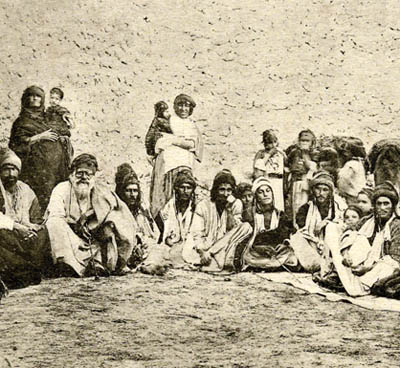
(Photos: the entrance to Sinjar, by a reader; Yazidis on the mountain of Sinjar, Iraq/Syrian border, 1920s. Via Wiki.)

Why Did The Kurds Retreat?

David Stout scrutinizes the retreat of the peshmerga from their positions near Sinjar and the Mosul Dam, which led to the ISIS gains that tipped the scales in favor of US intervention:

Analysts say the retreat of Peshmerga troops in the face of the ISIS onslaught reveals more about the political failings of the Kurdish leadership than it does about the capabilities of what had long been considered one of the most formidable fighting forces in the region. “This advance in Sinjar and in other areas has shown the structural weakness of the KRG, the Kurdistan Regional Government,” Kawa Hassan, a visiting scholar at Carnegie Middle East Center, told TIME.

A report presented by the parliamentary commission on the Peshmerga last week explicitly stated that, while Kurdish forces had high morale, they were still under-equipped and not being paid in a timely fashion, Hassan said. The rout of Kurdish fighters in Sinjar is also particular damming for the administration of the Kurdish Regional Government’s President Masoud Barzan. Sinjar is considered a stronghold of the president’s Kurdistan Democratic Party, and his inability to protect the region will not likely fade from memory soon.

Michael Goldfarb relays a theory that the Kurds withdrew in order to precipitate a crisis and force Obama’s hand:

The idea is to create images in the west of a desperate population and an outgunned and outmanned force in need of American military aid. Indeed, news reports from the region in the last 24 hours have had pictures of Kurdish men volunteering to join existing Peshmerga forces and being handed dilapidated Kalashnikovs. That theory/rumour is as good as any.

It is hard to understand why this is happening now. IS didn’t seem to have the manpower or the inclination to push eastwards toward Erbil when it made its first breathtaking sweep into Iraq.  There was no strategic reason to do so.

Frankly, the Peshmerga are too strong and numerous a force particularly the closer any invading group gets to Erbil. The IS “army” is still reported to have not more than 15,000 men. And even with all manner of looted Syrian and Iraqi army equipment it couldn’t possibly take a city like Erbil, population 1.5m, whose people wanted to stand and fight.

But as Brett Logiurato and Michael Kelley point out, ISIS is now much better armed than the peshmerga:

ISIS is using modern U.S. weapons its fighters have seized from Iraqi forces, while the Kurds fight with Soviet arms. “They are literally outgunned by an ISIS that is fighting with hundreds of millions of dollars of U.S. military equipment seized from the Iraqi Army who abandoned it,” Ali Khedery, a former American official who has served as an adviser to five U.S. ambassadors and several American generals in Iraq, told The New York Times.

McClatchy reports that the Kurdish peshmerga, meanwhile, possess “a handful of 12.7mm Soviet-era heavy machine guns and rocket-propelled grenades,” along with a few Soviet-era T-55 tanks, to take on battle-hardened militants riding in U.S. Humvees.

Hathos Red Alert

Kristol

The usual suspects are having a collective orgasm at Obama’s decision to intervene in Iraq. In their view, it proves them right about the Obama retrenchment/surrender/capitulation to terrorism, and has them licking their chops at the prospect of “finishing the job”. Mercifully, the American people are likely to resist their insanity. Here is Bill Kristol pushing for greater involvement:

“If you’re going to get in, get in big and get in decisively now,” Kristol said. “If you go in incrementally, in this way, you don’t have the effect you want to have on ISIS; you don’t have the effect you want to have on bolstering your allies; you don’t have the effect you want to have in the region.”

Repeat after me: a whole new war. Give these fanatics an inch and they’ll be in Baghdad before you know it. Jennifer Rubin encapsulates the emerging neocon narrative we will surely see trotted out on TV and talk radio over the coming days:

Virtually every action or refusal to act has now come back to haunt Obama. Trying to reconcile past mistakes with grudging action is impossible, and yet he refuses to admit error or commit wholeheartedly to a different set of policies. As Bolton puts it, “The problem is not just Iraq, but the entire Middle East where state structures are collapsing and terrorism increasing to fill the vacuum. Thus we have moved from the American Century to the Obama Chaos.”

We should be pleased, I suppose, that he acted in some fashion. Now he needs a new policy team, a coherent policy for the region and a recognition that retrenchment failed and is indeed the cause of many of the horrors we now see. That would require adequately funding the military, taking action to prevent Iran’s hegemonic ambitions and ensuring that non-jihadi rebels in Syria succeed — to name only a few significant policy reversals that would be required. Let’s hope that this is the first indication of an about-face on Obama’s entire foreign policy approach.

The idea that what has been happening all over the Arab Muslim world since the Arab Spring is “Obama’s Chaos” just reveals that the neocons still have no idea that the world is more than America’s plaything. Wolfowitz just declared that the Iraq war had been “won” by 2009 – another sign that they have been chastened not a whit by the destruction and disorder and violence they unleashed more than a decade ago. Conor catches John Podhoretz gloating in a similar vein and rips his argument to shreds:

Alternative history cannot be definitively disproved. There’s no way to know what would be happening now if Obama had left more troops in Iraq.

But if you’ve been wrong about Iraq as frequently as Podhoretz, or the magazine he runs, it is perverse to profess certainty that the war was “all but won” by 2009, that Iraq would now be stable if only the president had listened to you, when of course you have no earthly way of knowing whether that is actually true. Podhoretz’s definition of a war that was all but won required the indefinite presence of U.S. troops. His prior positions on Iraq include a belief that firing Don Rumsfeld in 2006 would definitely lose the Iraq War, as well as the notion that perhaps the U.S. could’ve only won in Iraq by slaughtering Sunni men between 15 and 35.

Danielle Pletka insists that there is plenty we can do without re-occupying Iraq, and amps up the fear to make the case – just as the neocons did with the Iraq war:

What could Barack Obama have done, his few apologists and their libertarian cohort ask. This is not our problem, they insist. We know these isolationists and know-nothings — they’re the ones who said it didn’t matter that Afghanistan was taken over by Osama bin Laden and Mullah Omar. But, they retort, none of this would be a problem if Saddam Hussein and Hosni Mubarak and Bashar al Assad were still firmly seated on their thrones. But of course, those thrones were teetering thanks to the oppressed people of the Middle East, who have noticed that the only parties now talking liberation are the Islamist Shiites and Sunnis from Hezbollah, Hamas and al Qaeda et al.

More than a year ago, Jack Keane and I wrote about what the US could do — none of the straw men’s “boots on the ground” — to stop Assad’s slaughter here. Earlier this year, we wrote about what could — no boots — swiftly cut off IS in Iraq here. These ideas are still relevant today. Remember, Obama’s movement is a lagging indicator of the seriousness of the problem we — yes, we — face in the Middle East. More must be done or the security of the American people will be the next victim.

(Image of “True Chyrons For Bush-Era Iraq War ‘Experts'” from the Huffington Post.)